« Livraisons d’histoire de l’architecture » 26 (2013)
From the Centre André Chastel:
“Les Ministres et les arts,” numéro thématique des Livraisons d’histoire de l’architecture 26 (2013), €23.
 Basile Baudez, “Le comte d’Angiviller, directeur de travaux : le cas de Rambouillet”
Alexandre Burtard, “Sur la piste des orientations artistiques de Nicolas Frochot, premier préfet de la seine sous le Consulat et l’Empire”
Rose-Marie Chapalain, “L’abbé Terray, seigneur de la Motte-Tilly”
Marie-Claude Chaudonneret, “Les ministres de l’intérieur et les arts sous le Directoire”
Hélène Drutinus, “Jean Naigeon, conservateur du Luxembourg sous le Consulat : les rapports d’un conservateur avec le Sénat et le ministre de l’intérieur”
Dominique Massounie, “Philibert Orry et l’embellissement du territoire autour de l’Instruction de 1748 : genèse d’un paysage routier et urbain”
Gabriele Quaranta, “Deux générations à côté du pouvoir : quelques remarques sur les arts chez les de Fourcy”
Aleth Tisseau des Escotais, “Finances et arts pendant la Révolution et le Premier Empire : l’exemple du Garde-Meuble”
Summaries for a selection of the articles are available as a PDF file here»
Oxford Art Journal, December 2013
From the latest issue of the Oxford Art Journal:
 • Tim Ingold, “Lines in Time / Review of Daniel Rosenberg and Anthony Grafton, Cartographies of Time: A History of the Timeline (2010),” Oxford Art Journal 36 (December 2013): 463–64.
• Mechthild Fend, “Allegory and Fantasy: Portraiture Beyond Resemblance / Review of Sarah Betzer, Ingres and the Studio: Women, Painting, and History (2012) and Melissa Percival, Fragonard and the Fantasy Figure: Painting and Imagination (2012),” Oxford Art Journal 36 (December 2013): 465–67
• Richard Taws, “Ruins and Reputations / Review of Nina Dubin, Futures and Ruins: Eighteenth-Century Paris and the Art of Hubert Robert (2010) and Elizabeth Mansfield, The Perfect Foil: François-André Vincent and the Revolution in French Painting (2012),” Oxford Art Journal 36 (December 2013): 467–70.
The Burlington Magazine, December 2013
The (long) eighteenth century in The Burlington:
The Burlington Magazine 155 (December 2013)
E D I T O R I A L
• Richard Shone, “Home is Where the Art Is,” p. 807.
 Houses once occupied by distinguished residents are a special strand of the heritage industry that increasingly dominates a nation in thrall to all aspects of the past. We are constantly being exhorted to save and preserve this or that—a factory, a view, a manor house, a pier, a site of outstanding natural beauty, the historic habitat of wildlife, or, indeed, of the famous dead. Some of the shrines we visit are more larded with authenticity than others. Inevitably, the further back in time the illustrious lives were lived, the fewer objects there are likely to be which were familiar to the inhabitants. Was this her chair; was this really his easel? The aspic of preservation continually wobbles between the authentic and the fake. We do not always know—are not always told—whether something is ‘of the same period’ or ‘similar to’ or a ‘replica of’ what may or may not have been originally there, under the eye, the hand, the bottom or the feet of the presiding genius. Much depends on the piety of heirs and descendants, the
changing ownership of the house and the fluctuating stakes of fame. . . .
The latest appeal for an artist’s house has much to recommend it and should attract supporters beyond British shores. It concerns the restoration and preservation of J.M.W. Turner’s rural retreat at Twickenham, west London. This is an exceptional project and not simply a matter of tidying up and putting a blue plaque on the front. Turner designed this house himself, and plans for it abound in sketchbooks of c.1810–12, after he had purchased two plots of land near the Thames. The intention is to remove later additions (not serious) and reveal its compact interior, obviously influenced by his friend John Soane’s house in Lincoln’s Inn Fields. For Turner, Sandycombe Lodge was for rest and recreation such as fishing (when he could ‘angle out the day’) and hosting friends on excursions for picnics, rather than for long residence and staying guests. Turner sold the house in 1826 and the adjoining meadow in 1848 (to the Windsor, Staines and South Western Railway). Under the auspices of the Turner’s House Trust, the appeal for £2 million is well underway, with support already assured from the Heritage Lottery Fund, among many other organisations and private donors, although further funding is still needed.2 It is expected that the public will be able to visit in 2016.
2. For an entertaining and informative account of the house, see C. Parry-Wingfield, with Foreword by A. Wilton: J.M.W. Turner. The Artist and his House at Twickenham, London 2012. Donations can be sent to the Trust at 11 Montpelier Row, Twickenham, tw1 2nq, or at www.turnerintwickenham.org.uk.
The full editorial is available here»
A R T I C L E S
• Gauvin Alexander Bailey and Fernando Guzmán, “The Rococo Altarpiece of St Ignatius: Chile’s Grandest Colonial Retable Rediscovered,” pp. 815–20.
An examination of the Rococo altarpiece of St Ignatius in Santiago, Chile, and of the European influences on this great retablo.
• David Pullins, “Dating and Attributing the Earliest Portrait of Benjamin Franklin,” pp. 821–22.
A re-evaluation of a painting now found to be the earliest known portrait of Benjamin Franklin, added to an earlier figure of a man by Robert Feke (c.1746–48).
R E V I E W S
• Elizabeth Goldring, Review of Laura Houliston, ed., The Suffolk Collection: A Catalogue of Paintings (English Heritage, 2012), p. 835.
• Michael Rosenthal, Review of Leo Costello, J.M.W. Turner and the Subject of History (Ashgate, 2012), p. 836.
• Basile Baudez, Review of the exhibition Soufflot: Un architecte dans la lumière, pp. 850–51.
• Xavier F. Salomon, Review of the exhibition Il Gran Principe Ferdinando de’ Medici (1663–1713) collezionista e mecenate, pp. 851–53.
• Angela Delaforce, Review of the exhibition Da Patriarcal à Capela Real de São João Baptista, pp. 855–56.
• Jamie Mulherron, Review of the exhibition Interwoven Globe: The Worldwide Textile Trade, 1500–1800, pp. 856–58.
Forthcoming Issues of ‘Eighteenth-Century Studies’
From Joseph Roach’s introduction to the ASECS News Circular (Fall 2013). . .
. . . In addition to encouraging individual submissions of articles for consideration, Steve Pincus [editor of Eighteenth-Century Studies] has introduced a process for the regular creation of special issues on topics of current interest and future promise. The Lewis Walpole Library and the Beinecke Rare Book and Manuscript Library have agreed to alternate in sponsoring Workshops in a particular interdisciplinary subfield. Scholars prominent in that field are invited to Farmington or the Yale campus to spend a day sharing their expertise and identifying potential contributors to a special issue. Workshops in three topics have been held so far: “The Eighteenth Century: East and West”; “The Maritime Eighteenth Century”; and “Performance in the Eighteenth Century.”
On February 23, 2013, the Walpole Library hosted a panel consisting of Felicity Nussbaum (English, UCLA), Robert K. Batchelor (History, Georgia Southern University), David Porter (English and Comparative Literature, University of Michigan), and Peter Perdue (History, Yale University). They identified key issues and trends, profiled new work in the field by both well established and emerging scholars, and made recommendations. After a process of further vetting, solicitation, and review, the East-West special issue (forthcoming) will be introduced by Chi-ming Yang (English, University of Pennsylvania) and contain the following articles: Danna Agmon (History, Virginia Tech), “The Currency of Kinship: Trading Families and Trading on Family in Colonial French India”; Srinivas Aravamudan (English, Duke), “East-West Fiction as World Literature: The Hayy Problem Reconfigured”; Kristina Kleutghen (Art History, Washington University in St. Louis), “Ocean Goods and Occidenterie: The Art of Eighteenth-Century Chinese Fascination with the West”; Suzanne Marchand (History, Louisiana State University) Herder’s “Oldest Document of Mankind” and the Problem of Near Eastern Chronology”; Nabil Matar (English, University of Minnesota), “Christians in Arabic Writings of the Eighteenth-Century Levant”; and Matthew Mosca (History, William and Mary), “The Qing State and Its Awareness of Eurasian Interconnections, 1789–1805.”
On May 23, 2013, the Beinecke Library hosted a panel on “The Maritime Eighteenth Century” consisting of Joseph C. Miller (History, University of Virginia), Neil Rennie (English, University College London), Felicia Gottmann (French, University of Warwick), Ellie Hughes (Art History, Yale Center for British Art), and Gagan Sood (History, Yale University). Plans for the special issue on “The Maritime Eighteenth Century” are pending.
On October 17, 2013, the Lewis Walpole Library hosted a panel on “Performance in the Eighteenth Century” consisting of Misty Anderson (English and Theatre, University of Tennessee Knoxville), Jeffrey Leichman (French, Louisiana State University); Kathleen Wilson (History and Cultural Studies, Stony Brook University), John Cooper (Clare-Mellon Fellow in the History of Art, Yale University) and Will Fleming (East Asian Languages and Literature and Theater Studies, Yale University). Virginia Johnson (Sociology, University of Michigan) was unable to attend, but she is communicating her views in writing. Plans for the “Performance” special issue are in the early stages.
With the cooperation with Carolyn C. Guile, ECS Review Editor, special issues will include reviews of pertinent new work on the featured topics. Members are encouraged to propose ideas for future special issues, including nominations for Workshop panelists and potential contributors. The Editor and Managing Editor held a session for interested scholars at the recent NEASECS Conference in New Haven, and a dynamic critical conversation ensued. More will be welcome, live or electronic. . .
The Wellcome Library Open Access Fund
With the move toward open access gaining more momentum, even as questions regarding who funds the access remain, this is a particularly interesting example from the Wellcome Library:
◊ ◊ ◊ ◊ ◊
The Wellcome Library is a free resource and is open to anyone who wants to use our collections. We know that lots of our users publish the outcome of their Library research. We want to encourage and support this research, and to ensure that it can be read and enjoyed by as many people as possible.
The Wellcome Trust has a long-standing commitment to Open Access, and provides funding to grant-holders to help them make their research accessible. We’re extending this principle to users of the Wellcome Library in a new scheme aimed at independent scholars, as well as students and university-based researchers who don’t have funding to cover the costs of open-access publishing.
The new Wellcome Library Open Access Fund is (and will always be) entirely voluntary – it’s up to library users whether they want to take advantage of it. We will pay the costs associated with open-access publishing for peer-reviewed journal articles, scholarly monographs or book chapters aimed at academic audiences. To qualify, you’ll need to have made substantial use of our collections; to have had your research accepted for publication; and to be ineligible for open-access funding from any other source.
In the Fall 2013 Issue of ‘Konsthistorisk Tidskrift’
Konsthistorisk Tidskrift / Journal of Art History 82 (Fall 2013)
A special issue of Konsthistorisk Tidskrift / Journal of Art History, guest edited by Peter McNeil (Faculty of Design, Architecture and Building University of Technology Sydney, Australia and Centre for Fashion Studies, Stockholm University) and Patrik Steorn (Centre for Fashion Studies, Stockholm University), addresses the theme of “Fashion and Print Culture: Translation and Transformation.”
From the editorial:
Print itself is both a materiality as well as a vehicle of representation. How did the meaning of various forms of fashion-related prints change as they were circulated in new contexts? What was the relationship of ‘fashion words’ and images? What were the mechanisms through which print – as newsprint, almanac, trade-card, respectful or satirical image – supported or undermined the spread of fashions, from ‘head-piece’ to ‘borders’? A pluralistic perspective is needed to better understand the transmission of ideas about fashion in print as well as in practice – and their interrelationship for the new readers and viewers of the period from the renaissance to the eighteenth century. This theme issue of Konsthistorisk tidskrift publishes some of the findings related to the Humanities in the European Research Area (HERA)/European Science Foundation funded project ‘Fashioning the Early Modern: Innovation and Creativity in Europe, 1500–1800’ (FEM) and the portfolio ‘Print Culture and Fashion Products’ managed therein by Peter McNeil and Patrik Steorn. HERA FEM was a three-year major funded project conducted from 2010 to 2013.
C O N T E N T S
· Peter McNeil and Patrik Steorn, The Medium of Print and the Rise of Fashion in the West, pp. 135–56.
· Chia-hua Yeh, From Classical to Chic: Reconsidering the Prints from Varie acconciature di teste usate da nobilissime dame in diverse città d’Italia by Giovanni Guerra, c. 1589, pp. 157–68.
· Lena Dahrén, Printed Pattern Books for Early Modern Bobbin-made Borders and Edgings, pp. 169–90.
· Cecilia Candréus, The Use of Printed Designs in Seventeenth-Century Embroidery: Layers of Transfer and Interpretation, pp. 191–204.
· Mark de Vitis, Sartorial Transgression as Socio-political Collaboration: Madame and the Hunt, pp. 205–18.
· Patrik Steorn, Migrating Motifs and Productive Instabilities: Images of Fashion in Eighteenth-Century Swedish Print Culture, pp. 219–34.
· Carolina Brown, Portraits en savoyarde and the Shepherdess of the Alps: Portraits, Prints, Literature, and Fashion in Eighteenth-Century Sweden, pp. 235–51.
· Arlene Leis, Displaying Art and Fashion: Ladies’ Pocket-Book Imagery in the Paper Collections of Sarah Sophia Banks, pp. 252–71.
· Audrey Millet, Dessiner La Mode En Régime De Fabrique: L’imitation Au Cœur Du Processus Créatif, pp. 272–86.
The Burlington Magazine, October 2013
The eighteenth century in The Burlington:
The Burlington Magazine 155 (October 2013)
 A R T I C L E S
• Simon Lee, “A Newly Discovered Portrait of Napoleon by Jacques-Louis David,” pp. 687–92.
Discusses the various versions of David’s portrait of the emperor, including a previously unknown example.
R E V I E W S
• François Marandet, Review of Karen Chastagnol, Nicolas Colombel, 1644–1717 (Editions Nicolas Chaudun, 2012), p. 711.
Painting in France at the end of Louis XIV’s reign has for many years been regarded as the precursor of the Rococo era. Charles de La Fosse’s aimables figures anticipate Antoine Watteau’s world of the fêtes galantes, who himself was the precursor of the peintre des grâces François Boucher. One of the merits of the exhibition devoted to Nicolas Colombel recently at the Musées des Beaux-Arts, Rouen (closed 24th February), was to demonstrate that the story of history painting c. 1700 was much more complex. Karen Chastagnol, curator of the exhibition, rightly insists on the direct link between early eighteenth-century French artists and the art of Poussin: as well as François Verdier, René-Antoine Houasse and Daniel Sarrabat, to which could be added the names of Sébastien II Leclerc of Henri de Favanne. . .
• Willibald Sauerländer, Review of Guilhem Scherf and Séverine Darroussat, Jean-Jacques Rousseau et son image sculptée, 1778–1798 (Paris: Varia, 2012), pp. 711–12.
The iconography of the grands hommes des Lumières has become a fashionable topic. In 1994 Guilhem Scherf wrote an important essay on the iconographie sculptée of Voltaire; now he has added a substantial text on Jean-Jacques Rousseau et la Révolution: Les avatars d’une representation sculptée. . .
• Robin Middleton, Review of John Martin Robinson, James Wyatt, 1746–1813: Architect to George II (London: The Paul Mellon Centre for Studies in British Art, 2012), pp. 712–13.
The range and diversity of James Wyatt’s designing, the sheer number of buildings with which he was involved (the Catalogue of Works lists 283 sites) makes any attempt to chart his career a task of the utmost difficulty. Anthony Dale’s pioneering but nonetheless solid account of Wyatt’s career is, however, quite overtaken by John Martin Robinson’s new book. Dates and attributions are sharpened. The nature of the ordnance work is fully revealed — all quite decent. But the most significant revelations are contained in the chapter on Wyatt’s activity as an industrial and furniture designer. . .
• Ann Massing, Review of Noémie Etienne, La Restauration des peintures à Paris, 1750–1815: Pratiques et discours sur la matérialité des œuvres d’art (Rennes: Presses Universitaires de Rennes, 2012), p. 713.
The period before and after the French Revolution in Paris was one of enormous change and, due to the French centralised administration, the French National Archives and the AMN (Archives des musées nationaux) are a fertile source of information for one of the most interesting periods of the history of painting restoration — when the King’s painters became professional art restorers. Noémie Etienne’s book contributes much to our knowledge of this fascinating period. Her archival research encompasses not only the rich resources in Paris, but also those in Rome, Venice, Madrid, Antwerp and Brussels. Her approach is mainly based on eighteenth- and nineteenth-century written sources, and the wealth of information she has culled is presented not as a chronological series of events but by theme. . .
• Shearer West, Review of Marcia Pointon, Portrayal and the Search for Identity (London: Reaktion, 2013), p. 714.
Marcia Pointon has a distinguished record of scholarly publication about portraiture, since Hanging the Head (1993) revolutionised and enlivened a historiography that had somewhat fallen in the doldrums. There are few historians of British art who have not been inspired by her nimble imagination, unexpected visual analysis and deep intellectual engagement with her textual and visual sources past and present. Her latest collection of essays on portraiture will not disappoint her admirers, although the more dazzling parts of her analysis are intertwined with sections that have the flavour of a work in progress . . .
• Rüdiger Joppien, Review of Olivier Lefeuvre, Philippe-Jacques de Loutherbourg (Paris: Athena, 2012), pp. 714–15.
. . . The catalogue raisonné is of exceptional value, and lies at the very heart of the book, . . . [which] gives a splendid account of Loutherbourg’s career as a painter, as well as a thoroughly documented, reliable idea of his artistic output. That this monograph could be published so fully and handsomely is due to the assistance of the Athena publishing house. Its appearance coincided with the retrospective exhibition devoted to the artist at the Musée de Beaux-Arts in Strausbourg (17th November 2012 to 18th February 2013), which the author organized. Both the book and the exhibition are indicative of the esteem in which France still holds the artist, even though he worked less than ten years in Paris and almost forty years in London.
Review | A Selection of Digital Humanities Projects
The current issue of Renaissance Quarterly includes Michael Ullyot’s assessment of five digital resources, several of which are relevant to eighteenth-century studies:
Michael Ullyot, “Review Essay: Digital Humanities Projects,” Renaissance Quarterly 66 (Fall 2013): 937–47.
 “Are databases the defining genre of the twenty-first century? This question was at the core of a debate in 2007 over the nature of the Walt Whitman Archive in PMLA (Publications of the Modern Language Association of America). With digital resources now firmly established as an essential scholarly research tool, the question remains: what status do we afford databases relative to other forms of publication, like editions or monographs? The question is pertinent not just to tenure and promotion decisions, as the MLA Committee on Information Technology recently advocated, but more fundamentally to the circulation and provocation of ideas.1 If databases help us to interact with texts and cultural objects differently, enabling us to interpret them in ways we
could not otherwise do, how do they differ from monographs or journal articles? . . .” (937)
1. “Guidelines for Evaluating Work in Digital Humanities and Digital Media.” http://www.mla.org/guidelines_evaluation_digital; accessed 17 January 2013.
◊ ◊ ◊ ◊ ◊
· Mapping the Republic of Letters, which draws on the University of Oxford’s Electronic Enlightenment data, a collection containing over 50,000 letters.
· The Map of Early Modern London, a digital atlas of sixteenth- and seventeenth-century London (Ullyot references, in passing, Locating London’s Past, which is based on John Rocque’s 1746 map).
· 1641 Depositions Project, which collects 8,000 manuscript accounts of the 1641 Irish rebellion of Catholic gentry against Protestant settlers from England and Scotland.
· The Medici Archive Project, which aims to catalog the Medici Archival Collection (Mediceo del Principato), a collection of over four million letters written between 1537 and 1743. To date, approximately 10 percent of the archive is included within the database, though Ullyot explains a number of new, “promising” features aimed at making the platform more efficient and more interactive.
· Early English Books Online, a collection of texts published between 1473 and 1700. “What makes EEBO truly innovative and interesting is the Text Creation Partnership (TCP), under which the University of Michigan and Oxford University began in 1999 to convert these PDFs [created from microfilm copies of the books] into fully searchable texts. The TCP has focused on transcribing all 70,000 of the unique monographs in EEBO’s collection. These transcriptions are cross-linked to the page images they are taken from, so they are fully integrated into EEBO. At present, only members of the TCP consortium of libraries are able to access this resource, but it will ultimately pass into the public domain [starting in 2015 and finishing up in 2020]” (945).
September 2013 Issue of ‘The Art Bulletin’
The eighteenth century from the September issue:
Matthew M. Reeve, “Gothic Architecture, Sexuality, and License at Horace Walpole’s Strawberry Hill,” The Art Bulletin 95 (September 2013): 411–39.
From 1747 Horace Walpole and a close circle of male friends and associates designed, decorated, and furnished Strawberry Hill, the remarkable neo-Gothic villa in Twickenham, a fashionable suburb of London. An examination of the role of Walpole’s sexuality in the design and reception of the house and its furnishings, following the lead of recent studies in literature, historiography, and the history of sexuality, reveals the interrelations between the revival of the Gothic as one of the “modern styles” of eighteenth-century architecture and fundamental changes in human sexuality characterized by the rise of a “third sex.”
In addition, the “Notes from the Field” feature addresses the theme of time, with the following responses drawing on the eighteenth century:
Malcolm Bull, “Time,” The Art Bulletin 95 (September 2013): 360–62.
Ludmilla Jordanova, “Time,” The The Art Bulletin 95 (September 2013): 364–67.
Gerrit Walczak, “Time,” The Art Bulletin 95 (September 2013): 377–79.
David E. Wellbery, “Time, The Art Bulletin 95 (September 2013): 379–80.
We All Scream for Ice Cream
In case you’re somewhere hot, thinking about ice cream . . . (a full list of contents for the current issue of Past & Present is available here).
Melissa Calaresu, “Making and Eating Ice Cream in Naples: Rethinking Consumption and Sociability in the Eighteenth Century,” Past & Present 220 (August 2013): 35-78.
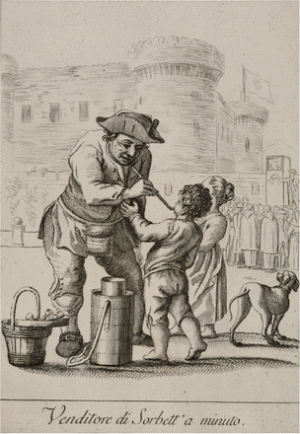
Pietro Fabris, Venditore di sorbett’a minuto, from his Raccolta di varii vestimenti ed arti del Regno di Napoli (Naples, 1773). © British Library Board D-7743.h.13.
Two barefoot children reach out to lick the spoon of the ice-cream seller. He carries a pouch around his waist that hints at the profits that are to be made from his trade. Two wooden containers rest on the ground beside him, one of which has a canister inside it and a strap outside to carry it, while the other holds a tray of cups to serve the ice cream (Plate 1).1 Behind this scene is the Angevin castle in Naples and a crowd gathered around a puppet stall. Pietro Fabris made this engraving as part of a collection depicting the costumes and customs of Neapolitans which was published in 1773 and dedicated to the British emissary to Naples, William Hamilton. Three years later, Fabris would provide elaborate hand-coloured illustrations for Hamilton’s scientific study of the eruptions of Vesuvius published in French and English and dedicated to the members of the Royal Society.2 Both books projected an image of Naples that appealed to the Grand Tourists who were flocking to see the excavations of the ancient cities of Herculaneum and Pompeii and the volcanic spectacle nearby (Vesuvius was particularly active in the last decades of the eighteenth century), and to experience life on the streets of the city. The collection of engravings including the sorbet seller appealed directly to a growing interest in Neapolitan popular culture and presented an image of the city as a theatre of extremes, in which the pleasures of life collided with the extreme poverty of the lazzaroni, and where its poorest inhabitants splurged on what — from a northern European perspective — might be seen as one of the great luxuries of the eighteenth century. We could leave our interpretation of the Fabris engraving there, safely within a history of the vast visual production of the Grand Tour in Italy, but the image conveys more than a tourist discourse about the exotic.3 In fact, the engraving illustrates the eating of a food product that was far from a luxury, and its sale to ordinary people on the streets of Naples, a point that has been completely overlooked by historians of the early modern period. . .
N O T E S
1 There is a variety of vocabulary in English, French and Italian describing ice or frozen desserts and drinks with a water or milk base. In Italian, sorbetto is used in the eighteenth century generally to describe what we know today as both sorbet and ice cream. Here I use the term ‘ice cream’ generically. All translations from Italian are my own unless otherwise stated.
2 Pietro Fabris, Raccolta di varii vestimenti ed arti del Regno di Napoli (Naples, 1773); William Hamilton, Campi Phlegræi: Observations on the Volcanos of the Two Sicilies as They Have Been Communicated to the Royal Society of London, 3 vols. (Naples, 1776–9), i–ii. On Fabris and Hamilton, see the essays in Ian Jenkins and Kim Sloan (eds.), Vases and Volcanoes: Sir William Hamilton and his Collection (London, 1996).
3 The use and the study of the term lazzaroni have a long history. It generally had a pejorative sense in travel accounts describing some of the poorer inhabitants of Naples, meaning ‘scoundrels’ or ‘layabouts’, although the lazzaroni became of increasing ethnographic interest at the end of the eighteenth century: see Melissa Calaresu, ‘From the Street to Stereotype: Urban Space, Travel and the Picturesque in Late Eighteenth-Century Naples’, Italian Studies, lxii (2007).










 Enfilade
leave a comment