The Magazine of the Decorative Arts Trust, Summer 2024
The Decorative Arts Trust has shared select articles from the summer issue of their member magazine as online articles for all to enjoy. The following articles are related to the 18th century:
The Magazine of the Decorative Arts Trust, Summer 2024
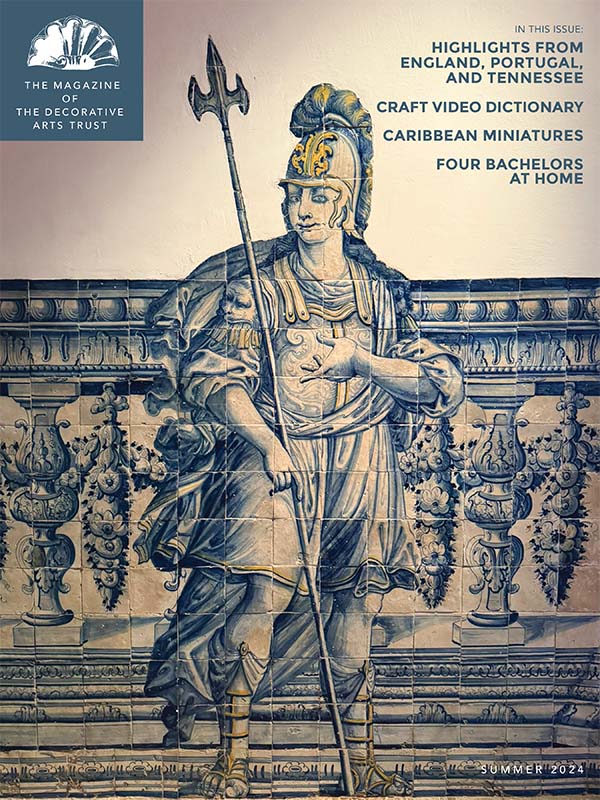 • “A Primer on Portugal” by Matthew A. Thurlow Link»
• “Saltram’s Saloon: Adam, Chippendale, and Reynolds in England’s West Country” by Catherine Carlisle Link»
• “Understanding Craft: A New Digital Tool Debuts” by Emily Zaiden Link»
• “Art and Imagination in Spanish America, 1500–1800: Highlights from LACMA’s Collection” by the Saint Louis Art Museum Link»
• “Painted Walls: New Virtual Museum Offers an Immersive Experience” by by Margaret Gaertner and Kathleen Criscitiello Link»
• “Seafaring Portraits in Bermuda and the Atlantic Basin” by Damiët Schneeweisz Link»
• “Summer Reading Recommendation: Ceramic Art” by Jessie Dean Link»
The printed Magazine of the Decorative Arts Trust is mailed to Trust members twice per year. Memberships start at $50, with $25 memberships for students.
Pictured: The magazine cover features a detail of wall tile from the stair hall of the Palácio Azurara in Lisbon, home of the Fundação Ricardo do Espírito Santo Silva’s decorative arts museum. Bartholomeu Antunes, Tile with the Figure of a Praetorian Guard, 1730–40, Lisbon. Earthenware tile with blue and yellow decoration.
The Burlington Magazine, June 2024
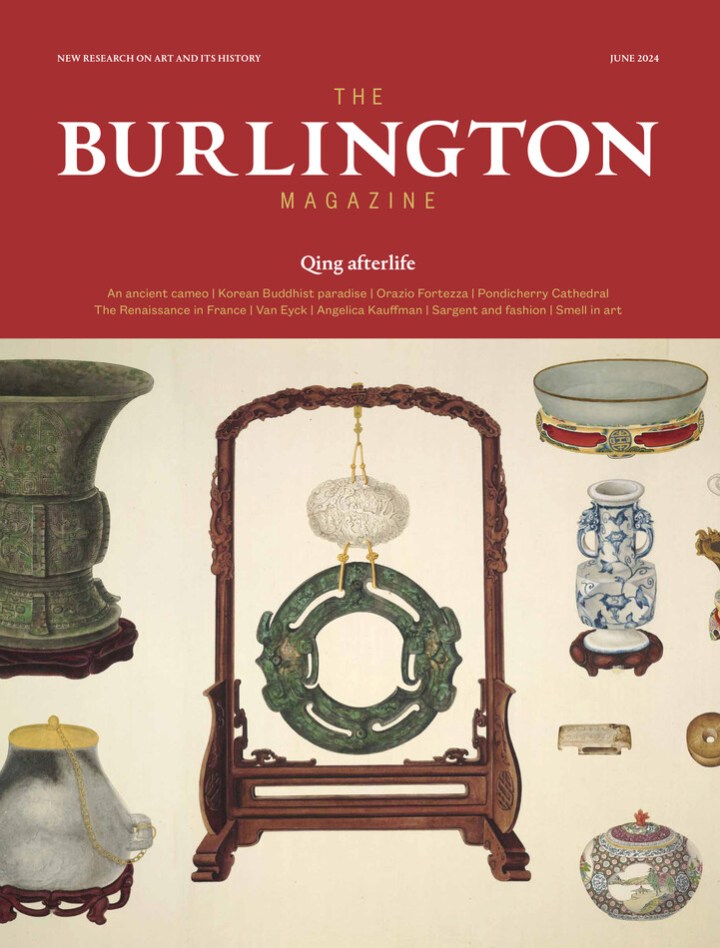
Summer is for falling behind . . . and for catching up . . . The long 18th century in the June issue of The Burlington:
The Burlington Magazine 166 (June 2024)
e d i t o r i a l
 • “La Serenissima,” p, 543.
Henry James famously wrote in his Italian Hours (1909) that there is nothing more to be said about Venice. As so much ink has been spilt over its charms you can see his point. However, James then proceeded to rhapsodise at length about its beauty; and it is imperative that we, similarly, keep talking and writing and championing it, not least because all that it represents seems to be more precious and precarious than ever.
a r t i c l e s
• Ittai Gradel, “Nothing To Do with Menander: A Rediscovered Roman Cameo from the Caylus Collection,” pp. 546–53.
A Roman cameo published in 1752, but since lost, has been rediscovered. It shows actors rehearsing The Pimp by Posidippus, who portrait is included on the cameo. All other identifiable scenes of comedies in Roman art depict plays by Menander, the most popular Greek comic poet on the Roman stage.
• Gauvin Alexander Bailey, “The Cathedral of Notre-Dame-de-la-Conception, Pondicherry,” pp. 580–95.
When the cathedral at Pondicherry, the most ambitious in French India, was begun in 1771, its anonymous designer was obliged to make allowance for separation of the castes, despite a papal edict that they must attend public worship together. The cathedral was completed with the construction of its west facade in 1788–91; its design was based on seventeenth-century Parisian models and is here attributed to the engineer-architect François-Anne-Maire Rapine de Saxy.
• Ricarda Brosch, “The Art of Qing Imperial Afterlife: The Pictures of Ancient Playthings (Guwantu 古玩圖) Revisited,” pp. 596–611.
Two magnificent eighteenth-century handscrolls depict myriad precious objects made of jade, bronze, porcelain, glass, and bamboo. A novel interpretation of their function suggests that the illustrations were originally for wall decorations and remounted as scrolls for the Yongzheng Emperor’s tomb. The paintings’ remediation and repurposing offer a compelling example of the art of Qing imperial afterlife.
r e v i e w s
• Johnny Yarker, Review of the exhibition Angelica Kauffman (London: Royal Academy of Arts, 2024), pp. 620–23.
• William Barcham, Review of Martin Gayford, Venice: City of Pictures (Thames & Hudson, 2023), p. 653.
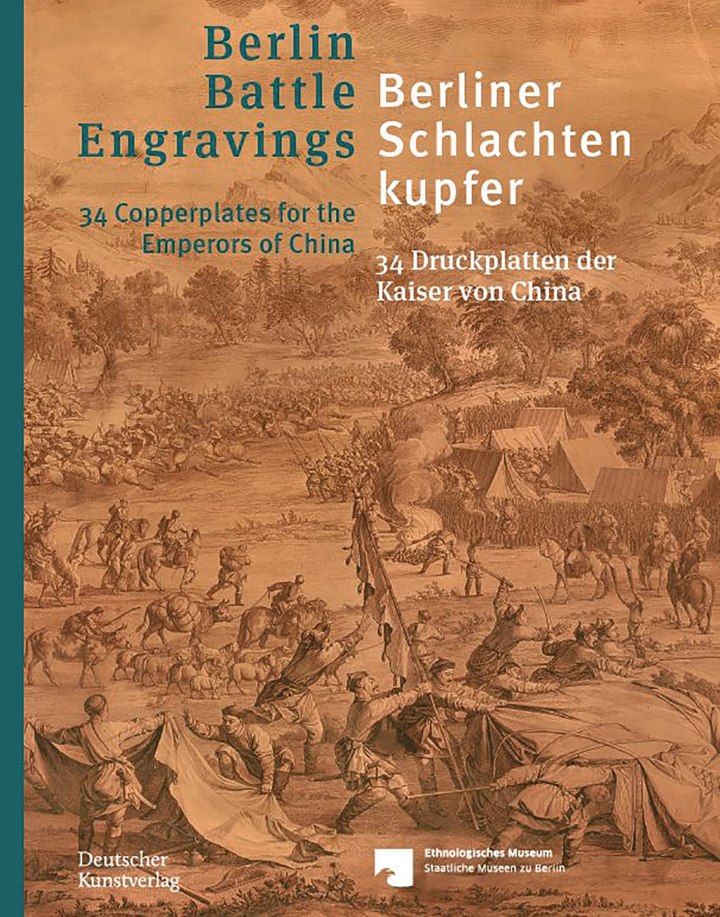
• Lianming Wang, Review of Henriette Lavaulx-Vrécourt and Niklas Leverenz, Berliner Schlachtenkupfer: 34 Druckplatten der Kaiser von China / Berlin Battle Engravings: 34 Copperplates for the Emperors of China (Deutscher Kunstverlag, 2021), pp. 654–55.
• Amina Wright, Review of Frédéric Ogée, Thomas Lawrence: Le génie du portrait anglais (Cohen & Cohen, 2022), pp. 655–56.
• Barry Bergdoll, Review of Didem Ekici, Patricia Blessing, Basile Baudez, eds., Textile in Architecture: From the Middle Ages to Modernism (Routledge, 2023), pp. 662–63.
Oxford Art Journal, March 2024
In the latest issue of the Oxford Art Journal:
Oxford Art Journal 47.1 (March 2024), published June 2024.
a r t i c l e s
 • Matthew C. Hunter and Avigail Moss, “Art and the Actuarial Imagination: Propositions,” pp. 1–12.
Noting insurance’s importance will hardly come as a surprise to curators, artists, conservators, and others concerned with current practices of exhibiting art. “Art insurance,” as one commentator observes, “is huge business and not least now that artworks move around the world in far greater volume and frequency than ever before.”6 Similarly, insurance and its extensive profiteering—from the trade in enslaved peoples to its biopolitical work in capitalist modernity—have been powerfully thematised by Cameron Rowland, Rana Hamadeh, and numerous other contemporary artists (Fig. 1).7 Yet, academic art history has been conspicuously slow to reckon with insurance’s force, functions, and fictions. This special issue is meant less as a reprimand for that blind spot than as a prompt to disciplined conversation. Drawing primarily upon the archive of European and North American art practices from the eighteenth century to the present, we mean to agitate for greater attention to how, when, where, and why insurance has come to penetrate art’s making, moving, showing, selling, storing, and being.
• Nina Dubin, “‘Infidelity, Imposture, and Bad Faith’: Reproducing an Insurance Bubble,” pp. 13–37.
When Grayson Perry commemorated the 2008 financial crisis with an etching titled Animal Spirit, he participated in a longstanding tradition of deploying printed images to satirize and demystify a boom-and-bust economy. More specifically, his print recalls a wave of caricatures that circulated in 1720 amidst a pan-European crash: one precipitated by a bubble in hypothetical commodities, foremost among them shares in joint-stock insurance companies. Produced by a group of Amsterdam-based artists including Bernard Picart, such engravings catered to a public that, already in 1720, viewed the business of insurance as occupying the vanguard of an inscrutable financial culture. Not only do these works exemplify early modern artistic efforts to translate into visual form the abstractions of an increasingly financialized economy. They also critically engage with the insurance operations of print, at a time when engraved reproductions presented themselves as policies that safeguarded works of art from the risks of accident and loss.
• Matthew C. Hunter, “The Sun Is God: Turner, Angerstein, and Insurance,” pp. 39–65.
J. M. W. Turner’s Slavers Throwing Overboard the Dead and Dying—Typhon Coming On (also known as The Slave Ship) is probably the iconic visualization of insurance logic in Western art. Exhibited in 1840, the painting has come to be taken as a meditation on the jettison of one hundred thirty three captives from the slave ship Zong off Jamaica in late 1781, murders notoriously claimed as insurable losses from the ship’s underwriters. Less noted is the pervasive presence of insurance within Turner’s practice and milieu. This article follows the tandem of Turner and John Julius Angerstein (1735–1823), a leading underwriter at Lloyd’s of London and an early patron. It places them within a world of artists’ organizations being remade as political instruments by embracing life insurers’ actuarial tables. It traces the pair into the National Gallery (originally housed in Angerstein’s home) as Turner willed his art to the institution, contingent on the purchase of fire insurance. Revisiting The Slave Ship through this skein of underwriting activity, the article posits the Turner/Angerstein coupling as an instructive moment in insurance’s penetration through the thick of artistic practice.
• Richard Taws, “Charles Meryon’s Graphic Risks,” pp. 67–94.
This article considers the place of risk and fictitious value in the work of French printmaker Charles Meryon. Meryon is best-known for the Eaux-fortes sur Paris, the vertiginous etchings of the city he made between 1850 and 1854. Yet despite his close association with the metropolis, Meryon’s visual world was not limited to the French capital. Previously a sailor, he had travelled widely, notably to the South Pacific, to protect speculative whaling interests in New Zealand. At the peak of his career, in 1855, Meryon designed share certificates for an unrealised Franco-Californian property development company, whose owners commissioned from Meryon a panorama of San Francisco. Meryon’s certificate prints have not been discussed at length in the literature on the artist. In the years following the 1848 Revolution, thousands of French workers emigrated to California, and Meryon’s famous etchings of Paris were made against the backdrop of contemporary enthusiasm for the California Gold Rush; these phenomena should, I suggest, be understood together. Focusing on Meryon’s connections to construction and extraction schemes, lotteries, mass emigration, and insurance, this paper reorients analysis of Meryon’s work away from Paris towards more transnational, transatlantic networks of people and things. Reviewing Meryon’s practice in the light of these works, I argue that they illuminate an actuarial imagination at work.
• Ross Barrett, “Sculpting the ‘Idea of Insurance’: John Quincy Adams Ward’s Protection Group and the Rise of the American Life Sector,” pp. 95–115.
This essay examines John Quincy Adams Ward’s Protection Group (1871), a now-lost sculpture that ornamented the original New York headquarters of the Equitable Life Assurance Society, as a complex cultural response to the array of public relations problems that its patron and the broader life insurance sector faced in the decades after the Civil War. Adopted as a company logo at the very moment that the Equitable took steps to expand its insurance portfolio and extend the geographic range of its operations, the Protection Group outlined an imaginative allegory of indemnification that explained the benefits of the company’s policies, popularized actuarial conceptions of status, risk, and uncertainty, and set the terms for a wave of cultural promotions and rebranding efforts that would be undertaken by American life companies in the decades that followed. Tracing the work that the Protection Group did to smooth the way for the Equitable’s development into a multinational insurer and inure turn-of-the century consumers to the financial products and risk sensibilities of the life sector, this essay sheds new light on the pivotal contributions that academic sculptors made to the development of the modern US life insurance industry.
• Avigail Moss, “Ars Longa,Vita Brevis: The Fine Art & General Insurance Company, Ltd,” pp. 117–40.
In late-nineteenth-century Britain, artworks circulated widely between exhibitions, institutions, and marketplaces, increasing the risks of destruction and loss. Administrators, artists, and collectors offset these risks by turning to a key incidental service in capitalism: insurance. But how did artworks and artifacts test insurance underwriters’ capacities? And how did the insurance world impact the art world? This article introduces the Fine Art & General Insurance Company, Ltd, a firm established in London in 1890. As a unique collaboration between art workers and powerful City merchants and underwriters, the company operated for nearly a century, insuring works that travelled to international and domestic expositions, and underwriting collections like the National Gallery’s Chantrey Bequest. With branches and agents stationed in global metropoles, and with ties to the broader British imperium, the company was a key, if inconspicuous, power broker and proxy on the global cultural stage. As an economic and aesthetic gatekeeper, the company also adjudicated on the artworks it perceived to be acceptable risks, and I argue that by analysing its early activities we gain insight into the ways that art insurance—an inherently collective and even speculative activity—was already affecting art’s ecosystems before the twentieth century.
• Sophie Cras, “Art and Insurance after the Era of Statistics,” pp. 141–57.
This article focuses on two artworks made in 2010 by two French artists of different generations: Christian Boltanski’s The Life of C.B. and Julien Prévieux’s Les connus connus, les inconnus connus et les inconnus inconnus. Both resulted from the collaboration between the artist and an actuary-mathematician, at a time when the theoretical, technical and professional assumptions about statistics-based insurance were deeply shaken by the emergence of so-called ‘big data’ and ‘global catastrophic risks’. This vacillation is perceptible in the artists’ choices to represent—and make use of—quantitative, actuarial knowledge. Boltanksi’s video work stages the transformations of life insurance under the data deluge produced by connected technologies of ‘quantified self’. Prévieux’s sound installation displays the techniques of prospective actuarial imagination, when experts mix fact and fiction so as to quantify global catastrophic risks that exceed our capacities to foresight. Therefore, instead of showcasing the implacable efficiency of data-driven technologies, both artists humorously emphasize their inadequacy in the chain of knowledge, prediction, and action.
b o o k r e v i e w s
• Arie Hartog, “Viewing Broken Things: Review of Stacy Boldrick, Iconoclasm and the Museum (Routledge, 2020),” pp. 159–62.
• Ty Vanover — The Spectacle of Crime: Review of Frederic Schwartz, The Culture of the Case: Madness, Crime, and Justice in Modern German Art (The MIT Press, 2023),” pp. 162–66.
• Jennifer Sichel — A Feminist Queering: Review of Julia Bryan-Wilson, Louise Nevelson’s Sculpture: Drag, Color, Join, Face (Yale University Press, 2023),” pp. 166–68.
Abstracts
Notes on Contributors
Essay | Caroline Gonda on Anne Seymour Damer
Caroline Gonda recently published this essay on The British Museum’s Blog, with lots of images and links for relevant items, including the drawing reproduced here.
Caroline Gonda, “Anne Seymour Damer: Public Life, Private Love,” The British Museum Blog (27 June 2024). Gossip about Anne Seymour Damer’s sexuality nearly wrecked her relationships and reputation, but in this queer love story, love beats scandal.

John Downman, Study for a Portrait of Anne Damer, charcoal, touched with red chalk, 1788 (London: The British Museum, 1967,1014.181.141).
‘Social media’ ruined lives in the 18th century, just as it does today. Anne Seymour Damer (1748/9–1828) was a sculptor (a highly unusual career for a woman artist at the time) and an aristocrat, which made her a part of celebrity culture and particularly exposed to gossip. Damer was also the subject of scandal because of her intimate relationships with other women. One of her contemporaries, the writer and literary hostess Hester Piozzi, described her as ‘a lady much suspected for liking her own sex in a criminal way’. Damer was repeatedly labelled as a Sapphist. The term was an allusion to the ancient Greek poet Sappho; famous for her love poems, many of them addressed to other women, Sappho was beginning to be seen in this period as the original lesbian (a term drawn from her birthplace of Lesbos). The gossip put Damer’s reputation at risk, but also sabotaged her chances of finding—and keeping—love. . .
The full essay is available here»
Caroline Gonda is College Associate Professor and Glen Cavaliero Fellow in English at St Catharine’s College, Cambridge.
The Burlington Magazine, May 2024
From the May issue of The Burlington, which is dedicated to French art — and please note that Yuriko Jackall’s important article is currently available for free, even without a subscription.
Burlington Magazine 166 (May 2024)

Jean-Honoré Fragonard, The Swing, 1767, oil on canvas, 81 × 64 cm (London: Wallace Collection).
a r t i c l e s
• Ludovic Jouvet, “A Medal of the Sun King by Claude I Ballin,” pp. 440–45.
• Yuriko Jackall, “The Swing by Jean-Honoré Fragonard: New Hypotheses,” pp. 446–69.
• Thadeus Dowad, “Dāvūd Gürcü, Ottoman Refugee, and Girodet’s First Mamluk Model,” pp. 479–87.
• Humphrey Wine, “The Paintings Collection of Denis Mariette,” pp. 488–92.
r e v i e w s
• Richard Stemp, Review of Ingenious Women: Women Artists and their Companions (Hamburg: Bucerius Kunst Forum / Basel: Kunstmuseum, 2023–24), pp. 501–04.
• Christoph Martin Vogtherr, Review of Louis XV: Passion d’un roi (Château de Versailles, 2022), pp. 508–10.
• Eric Zafran, Review of The Hub of the World: Art in Eighteenth-Century Rome (Nicholas Hall, 2023), pp. 515–18.
• Saffron East, Review of Black Atlantic: Power, People, Resistance (Cambridge: Fitzwilliam, 2023), 523–25.
• Gauvin Alexander Bailey, Review of Marsely Kehoe, Trade, Globalization, and Dutch Art and Architecture:
Interrogating Dutchness and the Golden Age (Amsterdam UP, 2023), pp. 534–35.
• Helen Clifford, Review of Vanessa Brett, Knick-Knackery: The Deards’ Family and Their Luxury Shops, 1685–1785 (2023) pp. 535–37.
o b i t u a r y
• Michael Hall, Obituary for Jacob Rothschild (1936–2024), pp. 538–40.
One of the leading public figures in the arts in the United Kingdom, Lord Rothschild was a major collector of historic art and a patron of contemporary artists and architects. His principal focus was Waddesdon Manor, his family’s Victorian country house and estate in Buckinghamshire.
◊ ◊ ◊ ◊ ◊
Jean-Honoré Fragonard was one of the supreme exponents of the French Rococo style and his painting The Swing in the Wallace Collection, London, is perhaps his most famous work. Yet despite this elevated status, mystery surrounds its origins. New documentary and technical research presented here by Yuriko Jackall may, however, have finally established for whom it was painted and why the painting was hidden away for the first few years of its existence.
The May issue also includes the publication by Ludovic Jouvet of a previously unknown and spectacular medal of the Sun King, Louis XIV, as well as Humphrey Wine’s study of the intriguing collection of the publisher Denis Mariette (the uncle of the more famous Pierre-Jean Mariette). Other articles feature the work of French Romantic painters: Andrew Watson establishes the early history of Delacroix’s The Death of Sardanapalus in the Musée du Louvre, Paris, and Thadeus Dowad identifies Girodet’s first Mamluk model.
Exhibition reviews include Sarah Whitfield discussing Bonnard’s Worlds (Kimbell Art Museum, Fort Worth, and the Phillips Collection, Washington) and Lisa Stein assessing Saul Leiter (MK Gallery, Milton Keynes). Catalogue reviews feature Christoph Martin Vogtherr on Louis XV, Lunarita Sterpetti on Eleonora of Toledo, and Eric M. Zafran surveying art in eighteenth-century Rome. Meanwhile, an impressive and wide range of new books are examined: these feature Megan McNamee on diagrams in medieval manuscripts, Christine Gardner-Dseagu on photographing Pompeii and Richard Thomson on Henry Lerolle.
◊ ◊ ◊ ◊ ◊
Note (added 31 July 2024) — The posting was updated to include additional content.
Print Quarterly, June 2024
The long eighteenth century in the latest issue of Print Quarterly:
Print Quarterly 41.2 (June 2024)
a r t i c l e s
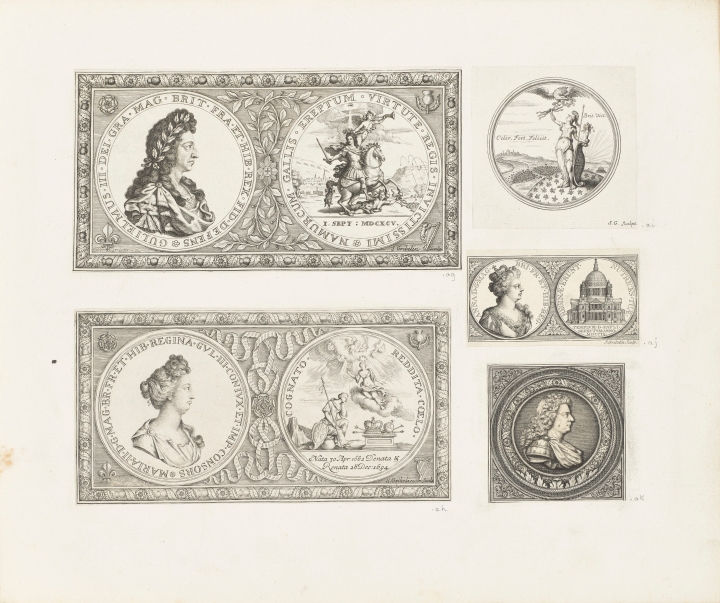
Simon Gribelin, A Medal of William III Commemorating the Fall of Namur, 1695 and other engravings, in the Works of Gribelin album, sheet 311 × 372 mm (Windsor Castle, Royal Collection. Image Royal Collection Trust / © His Majesty King Charles III 2023).
• Rhian Wong, “Simon Gribelin’s Presentation Albums,” pp. 157–71.
The article examines two previously unpublished presentation albums in the Royal Collection, compiled by the engraver Simon Gribelin (1661–1733). The Works of Gribelin album was compiled in 1715 for George II (when Prince of Wales), while an album of prints of the ceiling of the Banqueting House, London was presented around 1720 to George I. A consideration of the contents of the Works of Gribelin album reveals that Gribelin followed a deliberate programme for the arrangement of its contents. The article looks at the purpose of the albums and places their creation in the context of four other albums known to have been assembled by Gribelin.
n o t e s a n d r e v i e w s
• Galina Mardilovich, Review of Julia Khodko, Peterburg Mikhaila Makhaeva. Grafika I zhivopis’ vtoroi poloviny XVIII veka (The State Russian Museum, 2022), pp. 183–85. This is the catalogue for an exhibition addressing the drawings (and resulting prints) of St Petersburg made by Mikhail Makhaev (1717–1770).
• Shijia Yu, Review of The Art of the Deal (Daniel Crouch Rare Books, 2023), pp. 185–87. This is catalogue of the playing card collection assembled by the Dutch collector Frank van den Bergh.
• Thea Goldring, Review of Esther Bell, Sarah Grandin, Corinne Le Bitouzé, and Anne Leonard, Promenades on Paper: Eighteenth-Century French Drawings from the Bibliothèque National de France (Yale University Press, 2022), pp. 188–90.
• Joanna Sheers Seidenstein, Review of Amy Golahny, Rembrandt’s Hundred Guilder Print (Lund Humphries, 2021), pp. 221–26. Includes the reception history of the print, and the section on William Baillie’s restrikes in the 1770s is relevant.
Journal18, Spring 2024 — Color
The latest issue of J18:
Journal18, Issue #17 (Spring 2024) — Color
Issue edited by Ewa Lajer-Burcharth and Thea Goldring
 Color has been at the center of artistic debates at least since the seventeenth century, and it has remained a key issue in the historiography of art. Recent research has largely pursued two directions. First, color has been studied as a material substance and a technology. Scholars have documented the relation between technological, industrial, and commercial developments and the quality, range, and availability of pigments and colorants available to artists, manufacturers, and consumers. A second approach has focused on the key role of color in the construction of social, racial, colonial, and gender hierarchies. Recent scholarship has revealed the intimate connection between aesthetic debates on chroma and the development of the modern discourse of race. The eighteenth century’s feminization of color, linked to make-up and artifice, has also been reexamined. Clearly, it is no longer viable to think of color or its materials, technologies, and processes in purely aesthetic, ideologically innocent terms. This issue of Journal18 considers what is at stake now in reconsidering color in its historical dimensions by bringing these two lines of research together.
The four articles and two notes in this issue explore how the current interest in materiality and the matter of art might be harnessed to alter—enrich, complicate, or challenge—our understanding of the historical functions and socio-cultural meanings of color in the long eighteenth century. . . .
a r t i c l e s
Andrea Feeser — When Blue and White Obscure Black and Red: Conditions of Wedgwood’s 1787 Antislavery Medallion
Caroline Culp — Embalming in Color: John Singleton Copley’s Vital Portraits at the Edge of Empire
Tong Su — Color in Taxidermy at the Eighteenth-Century Qing Court
Melissa Hyde — Men in Pink: The Petit-Maître, Refined Masculinity, and Whiteness
s h o r t e r p i e c e s
Tori Champion — Catherine Perrot: Color, Gender, and Medium in the Seventeenth-Century Académie
Philippe Colomban — The Quest for the Western Colors in China under the Qing Emperors
Écrans, 2024: William Hogarth et le cinéma
From Classiques Garnier, where individual articles are also available for purchase:
Marie Gueden and Pierre Von-Ow, ed., Écrans, Nr. 20: William Hogarth et le cinéma (Paris: Garnier, 2024), 295 pages, French and English, ISBN: 978-2406169727, €25.
 This special issue of Écrans explores the largely overlooked and unexpected connections between William Hogarth and cinema. Frequently mentioned in passing, these links are thoroughly examined here by art historians, film and literary scholars, and a filmmaker. The collection addresses various crucial themes (such as narrative serialization, visual dynamics, and socio-cultural aspects), aiming to showcase the historical significance, artistic richness, and contemporary relevance of the relationship between Hogarth and cinema.
Marie Gueden holds a PhD in film studies from Université Paris 1 Panthéon-Sorbonne. Associate researcher at the Institut ACTE (Université Paris 1 – Panthéon-Sorbonne) and Passages XX-XXI (Université Lumière Lyon 2), lecturer at ENS Lyon and Université Sorbonne Nouvelle-Paris 3, she has published several articles, including studies on Sergei M. Eisenstein and William Hogarth.
Pierre Von-Ow recently received his PhD in History of Art from Yale University. His research focuses primarily on the intersections of arts and sciences in the early modern period. Among his recent projects, he curated in 2022 the virtual exhibition William Hogarth’s Topographies for The Lewis Walpole Library.
s o m m a i r e
• Marie Gueden et Pierre Von-Ow — Introduction: William Hogarth et le cinéma
I Sérialisation narrative et genres / Narrative Serialization and Genres
• Kate Grandjouan — Virtual witnessing in A Harlot’s Progress (1732). Hogarth’s visio-crime media
• Marie Gueden — Progress hogarthien et continuité narrative et morale aux États-Unis. Du pré-cinéma au cinéma des années 1930
• Brian Meacham and Yvonne Noble — An early film adaptation of Henry Fielding’s Tom Jones at Yale University
II Image et mouvement / Image and Movement
• Marie Gueden — « Hogarthisme » outre-Atlantique. Du tournant du XXe siècle aux années 1920–1930
• Marion Sergent — Sur la serpentine. Hogarth et l’abstraction musicaliste de Janin, Béothy et Valensi
• Jordi Xifra — Luis Buñuel, cinéaste hogarthien
• Théo Esparon — Beauté, glamour, baroque dans La Femme et le pantin (1935) de Josef von Sternberg
III Revoir Hogarth / Re-Viewing Hogarth
• Jean-Loup Bourget — Hogarth au cinéma, indice d’anglicité ?
• Pierre Von-Ow — Hogarth through a camera. Bedlam from print to film
• Enrico Camporesi — De Southwark Fair à Tom, Tom, the Piper’s Son. Cinéma des origines et origines du cinéma
• Mike Leigh on Hogarth, Interview by Pierre Von-Ow
Annexes / Appendices
1 Angles and Pyramids (1936)
2 Pierre Kast — De la parodie de « Paméla » à « Tom Jones ». L’Angleterre georgienne, scénario de Henry Fielding, réalisation de Hoggarth (1948)
Filmographie
Résumés / Abstracts
Call for Articles | Anachronisms in Art History
From the Call for Papers / Appel à contributions:
Anachronisms in Art History / Anachronismes en histoire de l’art
Special issue of Perspective: Actualité en histoire de l’art
Edited by Thomas Golsenne, Hélène Leroy, and Hélène Valance
Proposals due by 17 June 2024, with finished articles due by 1 December 2024
Perspective will explore, in its 2025.2 issue—co-edited by Thomas Golsenne (INHA), Hélène Leroy (Musée d’Art Moderne de Paris), and Hélène Valance (université Bourgogne-Franche-Comté/InVisu)—the question of anachronisms in art history.
Since at least the 1960s, a number of critical approaches have emerged with regard to sweeping Western approaches that classified artworks and artists in successive stylistic periods, and even based the discipline on these temporal and formal categories. They made it possible to call into question the 19th-century ‘historism’ that confused the scholars’ temporal categories with the historical phenomena themselves, just as they have redefined periods as designations of time, objects of history. In practice, however, it is clear that the period remains more than ever the temporal unit within which we conceive art history and study it. Even if the subject of anachronism in art history emerged much earlier, for reasons that merit further consideration, it genuinely became worthy of interest for the epistemology of the historical sciences at the turn of the 21st century. What about art history?
To this end, three main topics emerge for proposed articles:
1 Disciplinary Anachronisms
2 Methodological Anachronisms
3 Historical Anachronisms
Additional information (including a bibliography) is available from the full Call for Papers»
Taking care to ground reflections in a historiographic, methodological, or epistemological perspective, please send your proposals (an abstract of 2,000 to 3,000 characters/350 to 500 words, a working title, a short bibliography on the subject, and a biography limited to a few lines) to the editorial email address (revue-perspective@inha.fr) no later than 17 June 2024.
Perspective handles translations; projects will be considered by the committee regardless of language. Authors whose proposals are accepted will be informed of the decision by the editorial committee in July 2024, while articles will be due on 1 December 2024. Submitted texts (between 25,000 and 45,000 characters/ 4,500 or 7,500 words, depending on the intended project) will be formally accepted following an anonymous peer review process.
Published by the Institut national d’histoire de l’art (INHA) since 2006, Perspective is a biannual journal which aims to bring out the diversity of current research in art history, highly situated and explicitly aware of its own historicity.
Call for Articles | Fall 2025 Issue of J18: Clean
From the Call for Papers:
Journal18, Issue #20 (Fall 2025) — Clean
Issue edited by Maarten Delbeke, Noémie Etienne, and Nikos Magouliotis
Proposals due by 1 October 2024; finished articles will be due by 1 April 2025
This issue of Journal18 asks: what we might see if we regard the eighteenth century as possessed by a cleaning frenzy? Cleaning, as a process of removing excess matter to get to the essential or the original, engaged an eighteenth-century obsession with origins and etiology. This type of removal took place in a time of formulations and nebulous debates about race, class, and ethnicity and intersected with attempts to ‘purify’ the urban and rural environment as well as society itself. Cleanliness suggested a particular aesthetic that resonated with the tenets of neoclassicism but also with racialized notions of whiteness, as the opposite of ‘impure’, non-white races, cultures, and objects. In the increasingly disenchanted worldview of elites, cleaning artworks was also a way to annihilate any living presence connected to these objects, from bugs and microorganisms to ancestral spirits to immanent beliefs.
In eighteenth-century Europe, political, cultural, and religious authorities sought to clean artworks and monuments from anything that ‘soiled’ them, whether that was actual dirt, natural traces of use and time, or (hu)man-made ephemera, immaterial rituals, and ideological beliefs. These actions were symptoms of a power struggle between religious institutions and the state and between different cultures and countries, but also between local populations and an increasingly centralized administration. Even when presented as neutral measures of maintenance, such acts of cleaning often led to conflict. This was the case, for example, in late eighteenth-century Naples, when the German painter Jacob Philip Hackert was accused by local artists of disrespecting a number of Italian paintings he had cleaned. What for one cultural milieu diminished artistic value could be, for another, an integral part of the artwork.
This issue of Journal18 invites essays on acts of and discourses around cleaning in the long eighteenth century, particularly cases that address issues of authority and ownership. Who was entitled to touch, handle, modify, or clean an artwork, relic, building, or monument? What/who was allowed to reside within such buildings and objects, and what/who had to be erased or exterminated? What was the significance of defining the ‘pure’ or ‘original’ state of such artworks? What line of separation did actors draw between cleaning and destruction? Was cleaning gendered, and, if so, how? Who was expected to do the cleaning, and who was allowed to produce dirt? What are the connections between racialized ideologies that led to the devastations of ethnic cleansing and eighteenth-century aesthetics of cleaning and cleanliness? Is there a way to contrast the ‘messiness’ of the early modern multi-modal ‘entangled’ historiography with the streamlined ‘cleanliness’ of eighteenth-century historical writing?
Proposals for issue #20 Clean are now being accepted. The deadline for proposals is 1 October 2024. To submit a proposal, please send an abstract (250 words) and brief biography to editor@journal18.org and nikolaos.magouliotis@gta.arch.ethz.ch. Articles should not exceed 6000 words (including footnotes) and will be due by 1 April 2025. For further details on submission and Journal18 house style, see Information for Authors.
Issue Editors
• Maarten Delbeke, ETH, Zurich
• Noémie Etienne, University of Vienna
• Nikos Magouliotis, ETH, Zurich










leave a comment