Talk | Pride of Passage: Strawberry Hill
Celebrating Pride Month, in conjunction with the exhibition The Grand Tour: The Two Horaces and the Court of Florence; from EventBrite:
Pride of Passage: Strawberry Hill, Sexuality, and the Grand Tour
The London Library, St James’s Square, 29 June 2022, 7pm
Last year World Monuments Fund (WMF) announced a commitment to Underrepresented Heritage as one of three global priorities. This year is significant for the Pride movement and LGBTQ+ community, as it marks the 50 years since the first Pride took place in the United Kingdom. Join WMF Britain for its annual Paul Mellon Lecture, in partnership with Strawberry Hill House and Queer Britain.
This special event will take a fresh look at Horace Walpole, the creator of the ‘little Gothic castle’ at Strawberry Hill, his sexuality, and the liberating impact of the Grand Tour, exploring research into the correspondence between his network of friends and acquaintances, which has informed the interpretation of the house and collection. The discussion will also address the importance of telling historical LGBTQ+ narratives across the cultural sector, ensuring these stories are preserved, understood, and celebrated.
The event, hosted by John Darlington, Executive Director at WMF Britain, will spotlight WMF’s focus on underrepresented heritage and its involvement at Strawberry Hill. Dan Vo, Head of Learning and Engagement at Queer Britain, will join Joseph Galliano, Director and Co-Founder of Queer Britain, in conversation, taking the audience on their own Grand Tour, from Walpole to the UK’s first LGBTQ+ museum. The event will include a Q&A with both speakers.
“Queer people have impacted every part of culture, yet all too often their lives have been written in the margins of history books.” –Queer Britain
John Darlington is Executive Director of World Monuments Fund in Britain. He is an archaeologist, author, and Fellow of the Society of Antiquaries with over 30 years’ experience of heritage conservation in the UK and internationally. Prior to joining WMF, John was Regional Director for the National Trust in Northwest England and County Archaeologist for Lancashire.
Joseph Galliano is Director and Co-Founder of Queer Britain. He is a fundraiser, journalist, former editor of Gay Times magazine, and third sector ambassador manager who has just opened the UK’s first national LGBTQ+ museum, Queer Britain, at 2 Granary Square, Kings Cross, N1C 4BH.
Dan Vo is Head of Learning and Engagement at Queer Britain and Project Manager of the Queer Heritage and Collections Network. He founded the award-winning volunteer-led V&A LGBTQ+ Tours and has developed LGBTQ+ programmes for the National Gallery, National Galleries of Scotland, National Museum Wales, and the Fitzwilliam Museum in Cambridge, among others.
At Bonhams | Preview of Summer Auctions at After Hours Event

Detail of a tray from a Sèvres tea service (déjeuner ‘corbeille losange’) painted by Armand l’aîné, dated 1758 (Five Hundred Years of European Ceramics, Lot 164, estimate £100,000–£150,000).
◊ ◊ ◊ ◊ ◊
From Bonhams and Eventbrite:
After Hours at Bonhams: The Classics
Bonhams, London, New Bond Street, 4 July 2022, 6pm
This summer, explore The Classics, a series of auctions dedicated to the Classic Arts at Bonhams. This season of sales will offer rare and exceptional items across traditional collecting categories, including ceramics, fine glass, works of art, furniture, silver, sculpture, clocks, Old Master paintings, antiquities, books and manuscripts, and more.
Join us After Hours at Bonhams for an evening of art, drinks, food, music, workshops, and conversation set against the backdrop of our forthcoming auctions.
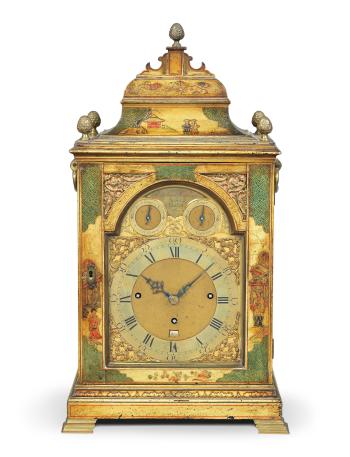
A fine and rare mid-18th-century quarter chiming table clock, chinoiserie decorated on a light yellow ochre ground; Eardley Norton, London, numbered 297 (Fine Clocks, 14 July 2022, Lot 73, estimate: £7,000–10,000).
Programme Highlights
• Join broadcaster and creative director at Glassette Laura Jackson in conversation with The Wallace Collection, celebrating the must-see exhibition Inspiring Walt Disney: The Animation of French Decorative Arts, with co-curators Helen Jacobsen and Wolf Burchard
• Live performances by multi-instrumental duo Momento Sounds
• Portraits by artist Michalis Christodoulou
• London Calligraphy pop-up booth
Also Featuring
• Ice-Cream Parlour by Ladurée
• Pay Drinks and Cocktail Bar
On View, The Summer Classics
• Old Master Paintings, 6 July 2022
• Antiquities, 7 July 2022
• 500 Years of European Ceramics, 7 July 2022
• Decorative Arts through the Ages, 13 July 22
• The Grand Tour Sale, 14 July 22
• Fine Clocks, 14 July 22
Online Talk | Disaster on the Spanish Main
From the Fraunces Tavern Museum:
Craig S. Chapman, The American Experience in the West Indies, 1740–42
Online, Fraunces Tavern Museum, New York, Thursday, 16 June 2022, 6.30pm (ET)
 Thirty-five years before the battles of Lexington and Concord, the British colonies in North America raised a regiment to serve in the British Army for an expedition to seize control of the Spanish West Indies. The expedition marked the first time American soldiers deployed overseas. In this lecture, Craig Chapman will discuss the Americans’ role in the conflict, their terrible suffering, and the awful results of the expedition. This lecture will be held via Zoom. Registration ends at 5.30pm on the day of the lecture.
The talk is based on the author’s recent book, published by Potomac, an imprint of the University of Nebraska Press:
Craig Chapman, Disaster on the Spanish Main: The Tragic British-American Expedition to the West Indies during the War of Jenkins’ Ear (Lincoln, Nebraska: Potomac Books, 2021), 426 pages, ISBN: 978-1640124318, $30.
Disaster on the Spanish Main unveils and illuminates an overlooked yet remarkable episode of European and American military history and a land-sea venture to seize control of the Spanish West Indies that ended in ghastly failure. Thirty-four years before the Battles of Lexington and Concord, a significant force of American soldiers deployed overseas for the first time in history. Colonial volunteers, 4,000 strong, joined 9,000 British soldiers and 15,000 British sailors in a bold amphibious campaign against the key port of Cartagena de Indias. From its first chapter, Disaster on the Spanish Main reveals a virtually unknown adventure, engrosses with the escalating conflict, and leaves the reader with an appreciation for the struggles and sacrifices of the 13,000 soldiers, sailors, and marines who died trying to conquer part of Spain’s New World empire. The book breaks new ground on the West Indies expedition in style, scope, and perspective and uncovers the largely untold American side of the story.
Craig S. Chapman spent thirty years managing dual careers in telecom network sales and the U.S. Army and National Guard. He is the author of Battle Hardened: An Infantry Officer’s Harrowing Journey from D-Day to VE Day and More Terrible Than Victory: North Carolina’s Bloody Bethel Regiment, 1861–65. Chapman lives and writes in Raleigh, North Carolina.
Panels and Performances | Porcelain, Chinoiserie, and Dance
The Ballet des Porcelaines arrives in the UK this month with performances at Waddesdon Manor (16–17 June) and Brighton’s Royal Pavilion (19–21 June). In conjunction with the project, The Oxford Research Centre in the Humanities (TORCH) presents a day of panel discussions:
Porcelain, Chinoiserie, and Dance: The Teapot Prince
Worcester College, Oxford, Friday, 17 June 2022
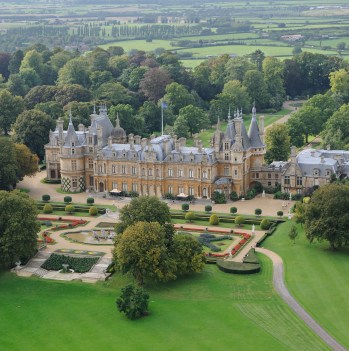
Waddesdon Manor
Three panels of creative artists and academics discuss the porcelain ballet, The Teapot Prince, as part of its world tour. Panel members include choreographer, Phil Chan, founder of Final Bow for Yellow Face; Meredith Martin, art historian and co-creator with Phil Chan, of The Teapot Prince; artist, Hannah Lim; poet and academic, Sarah Howe; ceramicist, Matt Smith; writer and ceramicist, Edmund de Waal; and art historian, Katie Scott. All are welcome! Registration is available here»
The Teapot Prince is based on an Orientalist fairy tale about a sorcerer who lives on a ‘Blue Island’ and transforms anyone who dares to trespass into porcelain cups, vases, and other wares. When the sorcerer turns the eponymous prince into a teapot, his lover, the princess comes to his rescue…The original Ballet des Porcelaines can be seen as an allegory for the aggressive European desire to know and steal the secrets of Chinese porcelain manufacture. In the new version, the narrative is flipped. The main protagonists are now Chinese, the Sorcerer a mad European porcelain collector, modelled on Augustus II the Strong (1670–1733), King of Poland, elector of Saxony and founder of Meissen, the first European manufactory to succeed in making true porcelain.
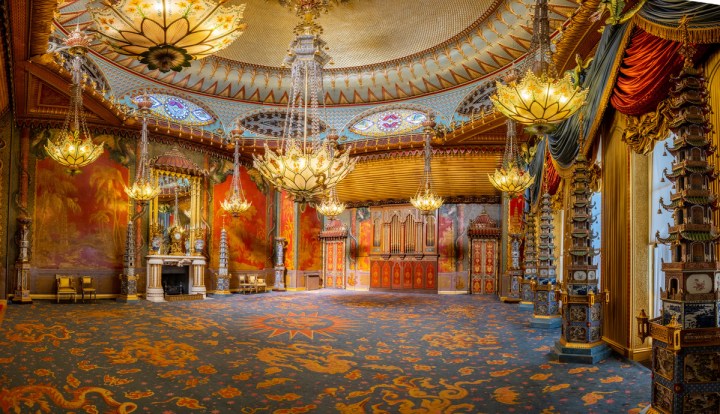
Music Room at the Royal Pavilion, Brighton,
Photo by Jim Holden
Exhibition | Making East London Porcelain

Now on view:
Making East London Porcelain
Stratford Library, London, 1–30 June 2022
It is now over 250 years since the earliest dated pieces of Bow porcelain were produced in London. The success of the Bow Porcelain Factory reminds us that Newham was a global centre for experimentation and creativity during the middle of the eighteenth century. As part of our Making London Porcelain Project funded by the Arts and Humanities Research Council (AHRC), scientists and curators at the Victoria and Albert Museum and the Ashmolean Museum have been researching 15 objects owned by Newham Borough of London. Using scientific analysis, we have been trying to better understand the materials and processes used to create such incredible works of art.
Making East London Porcelain is part of a collaborative science-led heritage project between the V&A Museum and Newham Borough of London, which has been made possible by the Arts and Humanities Research Council’s (AHRC) Capability for Collections Fund. Focusing on the celebrated Bow Porcelain Factory, this project brings communities together to explore Newham Borough as a place of creativity, experimentation, and entrepreneurship in the mid-eighteenth century. Co-curated with sixth-form students from Chobham Academy (Newham) and Cardinal Vaughan Memorial School (Chelsea), the exhibition explores how heritage science and re-making practices can help us better understand the places we live today and inspire us to innovate and experiment tomorrow.
◊ ◊ ◊ ◊ ◊
Exploring Bow Porcelain
Stratford Library, London, Wednesday, 15 June 2022, 6.00pm
Join us for an object-handling workshop with local artists as we celebrate the launch of the exhibition Making East London Porcelain.
Take part in a conversation with local ceramic artist Julia Ellen Lancaster, one of the Explorer Leach 100 Artists, whose work offers a modern twist on sculptural figures and historic clay recipes, such as those made by the Bow Porcelain Factory. You will have the opportunity to handle and examine historic pieces of eighteenth-century Bow porcelain from Newham’s special collections guided by V&A Ceramics Curator, Dr Caroline McCaffrey-Howarth, and learn about how historic making processes inspire and influence ceramic artists in Newham today.
Online | Hogarth’s Topographies: Decolonizing Sámi Representations
This Thursday, from The Lewis Walpole, Yale Library:
Joar Nango and Mathias Danbolt | Decolonizing Sámi Representations and the Legacy of Colonial Topographies
William Hogarth’s Topographies: A Series of Conversations
Online, The Lewis Walpole Library, 2 June 2022, noon EST
 Topography is central to William Hogarth’s canonical progress series in which London settings play a decisive narrative role. Lesser-known works by the artist, however, also engage with topographical representation. Pierre Von-Ow’s online exhibition William Hogarth’s Topographies considers the artist’s illustrations of national and colonized geographies beyond the metropole. Among international topographical views are Hogarth’s illustrations of Sápmi in the Scandinavian north, referred to at the time as “Lapland.” Artist Joar Nango and art historian Mathias Danbolt will discuss the legacy of historical representations of the Sámi, and their reworking of colonial archives in the service of Indigenous Sámi self-determination. This is an online event, and registration is required.
Joar Nango (born 1979 in Alta, Norway) is a Sámi architect and indigenous artist, living in Norway. Nango’s work investigates the nomadic conception of space, territories, and ideas of the concept of home. He focuses on different ways of dealing with materiality, movement, and space. He has exhibited internationally both separately as an individual artist including at Documenta14 (2017), Chicago Architecture Biennial (2019), Institute for Modern art (Brisbane, 2019), National Museum of Canada (2019), Bergen Kunsthall (2021), and National Museum of Norway (2022). He is also involved in collective projects. In 2010 he established the architecture collective FFB which makes an architecture celebrating the failure of capitalism. Since 2020, he has been involved as a host and director of the ongoing TV production PCA-TV (Post-Capitalist Architecture TV) in which the 6th episode features a commissioned work for Toronto Biennial of Art in May 2022.
Mathias Danbolt is a Norwegian art historian who has a special focus on queer, feminist, and decolonial perspectives on art and visual culture. Danbolt is currently leading three collective research projects: “The Art of Nordic Colonialism: Writing Transcultural Art Histories” (2019–23), “Okta: Art and Social Communities in Sápmi” (2019–22), and “Moving Monuments: The Afterlife of Sculpture from the Danish Colonial Era” (2022–25). In 2017 Danbolt curated the visual culture exhibition Blind Spots: Images of the Danish West Indies Colony (2017–18), with Mette Kia Krabbe Meyer and Sarah Giersing at the Royal Danish Library. Danbolt is professor of art history at University of Copenhagen.
This program is organized by The Lewis Walpole Library in conjunction with the online exhibition William Hogarth’s Topographies, curated by Pierre Von-Ow, PhD candidate in Yale’s Department of The History of Art.
Online Lecture | Boettger’s Invention of Red Jasper Porcelain
From The French Porcelain Society:
Angela Wallwitz | Ars Naturalis-Ars Artificialis: Boettger’s Invention of Red Jasper Porcelain in the Wake of the Early Enlightenment
FPS Living Room Lecture, Online, Sunday, 29 May 2022, 18.00 (BST)
Angela Wallwitz draws on her expertise in cataloguing ceramics as an art dealer, combined with her research skills as an independent scholar specialised in Meissen ware. In this lecture, she will delve into the subject of Plaue stoneware. We hope you can join us!
FPS members will receive an email invitation with instructions on how to join the online lecture. Please contact us for more details on FPSenquiries@gmail.com.
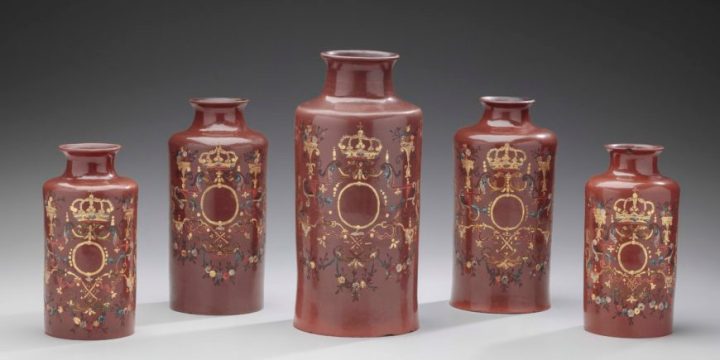
To achieve the artificial manufacture of gold, silver, and precious stone was the aim of man to re-create God’s creations since Renaissance times. The invention of Boettger stoneware, red jasper porcelain, and white porcelain played a significant historic role in this context. Ernst Zimmermann was the first to understand this after having spent years of research in the archives in Dresden and Meissen before they suffered losses and destruction during both world wars. However, his publication of 1908, Erfindung und Frühzeit des Meissner Porzellans, with 271 pages of small print and 721 invaluable footnotes, remains a hidden treasure for all non-German speakers. Researching a unique red jasper porcelain garniture of five apothecary vases, Angela Wallwitz discovered Ernst Zimmermann’s fascinating interpretations of the facts and the difference between stoneware made in Dresden from those manufactured in Meissen and the identity of a glassmaker, Boettger engraver and co-founder of the Prussian rival manufactory in Plaue. The garniture, published as an early diplomatic gift, was most probably Boettger’s gift to Augustus the Strong for his famous Royal apothecary in the Residenz of Dresden. This lecture, intends to serve as the guideline to illustrate the role of ceramics as ars naturalis and ars artificialis.
Online Workshops | Egypt in Early-Modern Antiquarian Imagery
From the Antiquitatum Thesaurus research project:
Ägypten in der frühneuzeitlichen antiquarischen Bildwelt
Egypt in Early-Modern Antiquarian Imagery
Online Workshops, 5 May, 2 June, and 7 July 2022
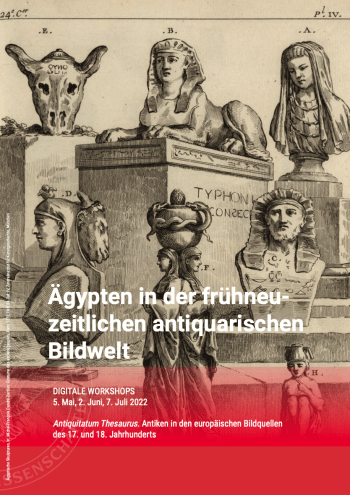 Antiquitatum Thesaurus: Antiquities in European Visual Sources from the Seventeenth and Eighteenth Centuries
On the occasion of this year’s anniversaries of important milestones in the recent reception of Egypt, the academy project Antiquitatum Thesaurus devotes three digital workshops in the summer semester of 2022 to the perception of the land on the Nile in the early modern period. The focus will be on various personal motivations of some of the protagonists, the antiquarian or scientific methods they used, and a broad spectrum of media in which the engagement with Egyptian or Egyptianizing artifacts and images was reflected from the 15th to the 18th century. In addition, current research projects present their perspectives on the reception of Egypt.
Thursday, 5 May 2022, 4pm
• Michail Chatzidakis (Berlin), „Ad summam sui verticem pyramidalem in figuram vidimus ascendentes […] anti quissimum Phoenicibus caracteribus epigramma conspeximus“. Bemerkungen zu den ägyptischen Reisen Ciriacos d’Ancona
• Catharine Wallace (West Chester), Pirro Ligorio and the Late Renaissance Memory of Egypt in Rome
• Stefan Baumann (Trier), Project Presentation: Early Egyptian Travel Accounts from Late Antiquity to Napoleon
Please register at: https://bit.ly/3LQWgMB
◊ ◊ ◊ ◊ ◊
Thursday, 2 June 2022, 4pm
• Maren Elisabeth Schwab (Kiel), Herodots Ägypten im Interessenshorizont italienischer Antiquare
• Alfred Grimm (München), Osiris cum capite Accipitris. Zu einem Objekt aus der Bellori-Sammlung und dem Barberinischen „Osiris“
• Florian Ebeling (München), Project Presentation: Handwörterbuch zur Geschichte der Ägyptenrezeption
Please register at: https://bit.ly/3O4dS9O
◊ ◊ ◊ ◊ ◊
Thursday, 7 July 2022, 4pm
• Guillaume Sellier (Montréal), Oldest Egyptian Artefacts in Canada: The Quebec Palace Intendant’s Amulets
• Valentin Boyer (Paris), „Sphinxomanie“ durch die Ikonographie ägyptisierender Exlibris
• Nils Hempel, Timo Strauch (BBAW), Project Presentation: Antiquitatum Thesaurus. Antiken in den europäischen Bildquellen des 17. und 18. Jahrhunderts
Please register at: https://bit.ly/3rd7T8z
Online Lecture | Tessa Murdoch on Huguenot Art and Culture
This afternoon from the YCBA:
Tessa Murdoch, Huguenot Refugee Art and Culture through the YCBA Collections
Online, Yale Center for British Art, New Haven, 21 April 2022, noon

William Hogarth, Mr. Garrick in the Character of Richard III, 1746, engraving (New Haven: Yale Center for British Art).
The Yale Center for British Art is pleased to present an online lecture on Thursday, 21 April 2022, at 12pm by Tessa Murdoch about Huguenot artistic production in early modern London. Focusing on the museum’s collections, Murdoch examines an array of paintings, prints, drawings, maps, and sculpture with notable examples including François Gasselin’s 1692 drawing View of the Royal Hospital, Chelsea, and William Hogarth and Charles Grignion’s 1746 engraving Mr. Garrick in the Character of Richard III. This talk is based on research completed for her recent book Europe Divided: Huguenot Refugee Art and Culture (V&A publishing, 2021), which traces the international networks and artistic products created by French Protestant artists and craftsman in the wake of the Huguenot diaspora in the late seventeenth century.
Registration is available here»
Tessa Murdoch PhD FSA worked at the Museum of London (1981–1990) and at the Victoria and Albert Museum (1990–2021) where she was the Rosalinde and Arthur Gilbert Research Curator from 2019. She is an adviser for the National Trust and the National Heritage Memorial Fund, a board member of the Idlewild Trust, and chair of trustees of the Huguenot Museum, Rochester. Murdoch’s most recent book, Europe Divided: Huguenot Refugee Art and Culture, was published by the V&A in 2021. She is currently consulting on the forthcoming publication Great Irish Households: Inventories from the Long Eighteenth Century (2022), and is co-editing, with Heike Zech, A Cultural History of Craft in the Age of Enlightenment (expected 2024).
Online Talk | Paweł Gołyźniak on Philipp von Stosch

From The Wallace Collection:
Paweł Gołyźniak, Philipp von Stosch and His Circle: Collecting and Studying of Ancient Engraved Gems, from Antiquarianism to Proto-Archaeology
Online, The Wallace Collection, London, 25 April 2022, 17.30 (BST)
Paweł Gołyźniak’s research traces and examines Philipp von Stosch’s (1691–1757) collecting, antiquarian, and scholarly activities in terms of engraved gems on the basis of the unknown pictorial (drawings) and archival sources. The discovery of nearly 2300 unknown gem drawings in the Princes Czartoryski Museum in Krakow gives an opportunity to present him as one of the most instrumental figures of 18th-century antiquarianism. The seminar will discuss Stosch’s outstanding collection of intaglios and glass gems, and most importantly his scholarly projects: starting from his celebrated book Gemmae antiquae caelatae published in 1724 in Amsterdam, through to his attempts to write a supplement to that study, documentation of his own collection of gems and other European gem cabinets, and, finally, the virtually unknown project Histoire universaille, meant to reflect history, mythologies, and customs of the ancient Egyptians, Etruscans, Greeks, and Romans, combined with a reconstruction of the history of glyptic art.
For all his enterprises, Stosch commissioned large quantities of drawings that were produced in a truly archaeological vein with attention paid to such issues as material, form, right proportions, state of preservation, provenance, etc. of the reproduced gems. Often the gems received extensive commentaries explaining their iconography and providing analogies in sculpture, reliefs, wall paintings, and coins. Relevant passages in ancient literary sources were also referenced. The study of Stosch’s scholarly activities advances our understanding of emergence of archaeology as a scientific discipline. The discovered pictorial documentation provokes us to hypothesise that Stosch, his collecting, and scholarly enterprises greatly inspired and influenced Johann Joachim Winckelmann (1717–1768) in writing his first synthesis of ancient art (Geschichte der Kunst des Alterthums) published in 1764.
This talk will be hosted online through Zoom and The Wallace Collection’s YouTube channel.
Pawel Golyzniak is a Research Fellow in the Institute of Archaeology at Jagiellonian University in Krakow.










 Enfilade
leave a comment