Rosenberg Lecture | Jessica Fripp, The French Academy in Rome
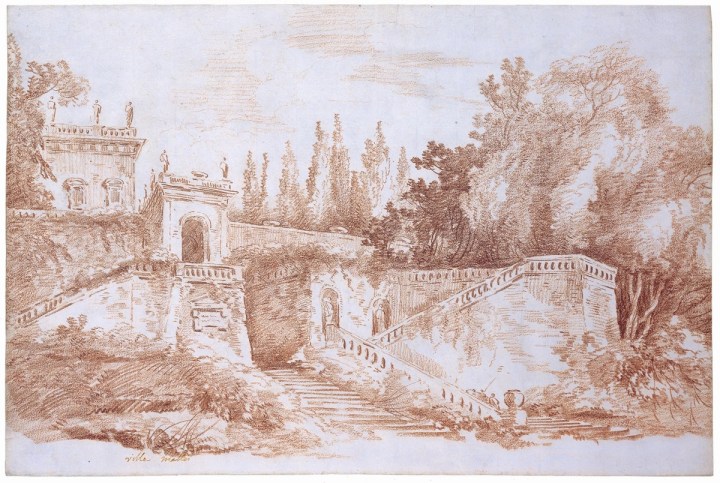
Hubert Robert, View of the Gardens at the Villa Mattei, 1761, red chalk on paper
(Dallas Museum of Art, fractional gift of Charlene and Tom Marsh, 2006.17)
◊ ◊ ◊ ◊ ◊
From the DMA:
Jessica Fripp, The French Academy in Rome: Adventures in Bromance
Annual Rosenberg Lecture
Online and In-Person, Dallas Museum of Art, 11 November 2021, 7.00pm
Presented by the Michael L. Rosenberg Foundation
Winning the Royal Academy’s prix de Rome was a major accomplishment for aspiring painters and sculptors in 18th-century France. The prize came with a three-year funded stay in Rome, and provided an opportunity for artists to finish their education by viewing firsthand antique, Renaissance, and Baroque works of art in the Eternal City. But, much like students who study abroad today, their time in Rome involved just as much play as work.
In this lecture, Jessica L. Fripp, Associate Professor of Art History and Undergraduate and Graduate Coordinator at Texas Christian University, will talk about works of art that provide a view into the less studious side of artists’ time in Rome: caricatures. What can these ‘silly’ drawings tell us about life in Rome as a young artist and the role of friendship and play in academic artistic training?
This talk will be livestreamed on the DMA’s YouTube channel, with limited in-person seating available. Dr. Fripp’s recent book Portraiture and Friendship in Enlightenment France will be available for purchase at the DMA Store, and a book signing will follow the event on-site.
To register (for either in-person or virtual attendance), click here»
Online Seminar | The Perth Literary and Antiquarian Society, 1784–1914
From The Wallace Collection:
Mark Hall, The Perth Literary and Antiquarian Society, 1784–1914: Collecting Scotland, Collecting the World
Wallace Collection Seminars on the History of Collections and Collecting
Online, Monday, 25 October 2021, 5.30pm
Perth Museum & Art Gallery, Scotland, is currently managed on behalf of Perth & Kinross Council by the cultural trust, Culture Perth & Kinross. The Museum’s history as a local authority service dates back just over a century, to the first decade of the twentieth century. It is part of a history of collecting spanning four centuries, beginning in the late eighteenth century. Its formative iteration, both in terms of a collection and a physical museum, was the Perth Literary and Antiquarian Society, founded in 1784.
The Museum is looking back at this history as part of its project to create a new museum in Perth. In the context of that project, this contribution will summarise the collecting significance and history of the Perth Literary and Antiquarian Society from its Enlightenment origins and including its colonial legacy. In the presentation a range of collecting case studies will be discussed to further emphasis the local and international network of collectors and donors the Society relied on and to demonstrate the rich range of the collections. The case studies will include the Cambus Bronze Age sword, collecting John Knox, and the collectors Colin Robertson (1783–1842), David Ramsay (1794–1860), and the Riach Brothers—active respectively in America, Oceania, and the Middle-East.
Dr Mark Hall is Collections Officer for Culture Perth & Kinross, Perth Museum & Art Gallery, Scotland.
Please note that this seminar will take place on Zoom and YouTube, and will not be held at the Wallace Collection. Admission is free, and registration is required. More information and details of future seminars can now be found here.
Online Series | Graphic Landscape
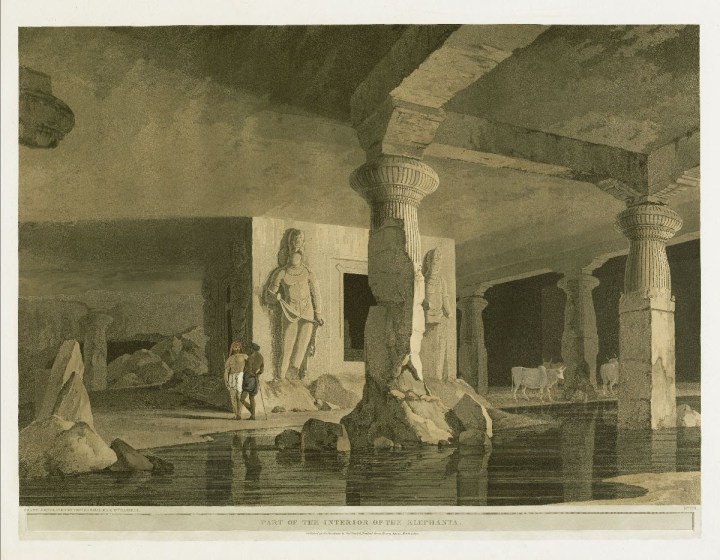
‘Part of the Interior of the Elephanta’, from Thomas and William Daniell, Antiquities of India, Oriental Scenery, aquatint, 1795.
◊ ◊ ◊ ◊ ◊
From the Paul Mellon Centre:
Graphic Landscape: The Landscape Print Series in Britain, 1775–1850
Online, Paul Mellon Centre and the British Library, 2, 4, 9, 11 November 2021
Organized by Mark Hallett and Felicity Myrone
Graphic Landscape: The Landscape Print Series in Britain, 1775–1850 is a four-day programme of online webinars taking place between 2 and 11 November 2021, presented jointly by the Paul Mellon Centre for Studies in British Art and the British Library.
Landscape and topographical print series proliferated in the late eighteenth century and in the first decades of the nineteenth century. Indeed, the format seems to have enjoyed an artistic and commercial boom in this period. Some examples of these series, such as Turner’s Liber Studiorum (1807–19) and Constable’s English Landscape Scenery (1830–33), are extremely well known. Many others, however, have still to receive sustained and critical attention. This programme of four online seminars is designed to look afresh at the late Georgian and early Victorian landscape print series and to stimulate new research on this important strand of graphic art. Participants will bring a wide range of perspectives to bear on the topic and address works in a variety of graphic media.
Graphic Landscape: The Landscape Print Series in Britain, 1775–1850 is co-convened by Mark Hallett at the Paul Mellon Centre and Felicity Myrone at the British Library.
Additional information—including paper abstracts, speaker biographies, specific times, and registration links—can be found here.
T U E S D A Y , 2 N O V E M B E R 2 0 2 1
Day 1 | 12.00–14.00
12.00 Print, Politics, and Industrialisation
• Introduction by Mark Hallett (Director, Paul Mellon Centre) and Felicity Myrone (Lead Curator, Western Prints and Drawings, British Library)
• Amy Concannon (Senior Curator, Historic British Art, Tate), ‘A Captur’d City Blazed’: Printmaking and the Bristol Riots of 1831
• Lizzie Jacklin (Keeper of Art, Tyne & Wear Archives & Museums), Mining Landscapes: Thomas Hair’s Views of the Collieries
• Morna O’Neill (Associate Professor of Art History, Art Department, Wake Forest University), John Constable, David Lucas, and Steel in English Landscape
T H U R S D A Y , 4 N O V E M B E R 2 0 2 1
Day 2 | 12.00–14.00
12.00 Print and Property
• Introduction by Richard Johns (Senior Lecturer in History of Art at the University of York)
• John Bonehill (Lecturer, History of Art, University of Glasgow), Picturing Property: The Estate Landscape and the Late Eighteenth-Century Print Market
• Kate Retford (Professor of Art History, Birkbeck, University of London), Views of the Lakes at the Vyne
• James Finch (Assistant Curator, 19th-Century British Art, Tate Britain), Amelia Long’s Views from Bromley Hill
T U E S D A Y , 9 N O V E M B E R 2 0 2 1
Day 3 | 12.00–14.00
12.00 Revisiting the Canon
• Introduction by Cora Gilroy-Ware (Associate Professor, History of Art, University of Oxford)
• Greg Smith (Independent Art Historian), Engaging with the Voyage Pittoresque de la France: Thomas Girtin’s Picturesque Views in Paris and Their Appeal to the ‘Most Eminent in the Profession’
• Timothy Wilcox (Independent Scholar), John Sell Cotman’s Architectural Antiquities of Normandy: A Catastrophic Miscalculation?
• Gillian Forrester (Independent Art Historian, Curator and Writer), A Glossary for the Anthropocene? Turner’s Liber Studiorum in the Era of Climate Change
T H U R S D A Y , 1 1 N O V E M B E R 2 0 2 1
Day 4 | 14.00–16.00
14.00 A Wider View: From Collaboration to Empire
• Introduction by Mark Hallett (Director, Paul Mellon Centre) and Felicity Myrone (Lead Curator, Western Prints and Drawings, British Library)
• Sarah Moulden (Curator of 19th-Century Collections, National Portrait Gallery), Creative Collaboration: Cotman’s Norfolk Etchings
• Eleanore Neumann (PhD Candidate, University of Virginia), Translating Topography: Women and the Publication of Landscape Illustrations of the Bible (1836)
• Alisa Bunbury (Grimwade Collection Curator, Ian Potter Museum of Art, University of Melbourne), Taken From Nature: Printed Views of Colonial Australia
• Douglas Fordham (Professor of Art History, University of Virginia), Travel Prints or Illustrated Books?
Online Talk | Linda Binsted, Jefferson’s Brick Palladian Architecture
This afternoon, from Monticello:
Linda Binsted, Brick Palladian Architecture: Jefferson’s Transformation of Stone to Clay
Online, 21 September 2021, 4.00pm (Eastern Time)
Join the Robert H. Smith International Center for Jefferson Studies at Monticello for a virtual Fellow’s Forum with architect and architectural historian, Linda Binsted. Click here to join us on Zoom on Tuesday, 21 September at 4.00pm.
Thomas Jefferson’s international travels took him to the cities and countryside of England and France but not to Italy, the birthplace of Palladian design. His travels never took him to Rome and its classical buildings, nor did he see any works by Palladio firsthand. Yet, through architectural treatises, the prevalent pattern books of the 18th century, visits to architecturally significant structures in America, England, and France, and the intellectual thoughts of the day, he came to produce some of the most influential Palladian designs in the still young United States.
Palladio’s villas are visions of smooth planar beauty, crisp whiteness in the Italian piedmont sun. Jefferson’s Palladian work in the Virginia piedmont—Monticello, Poplar Forest and the University of Virginia—are clothed in molded red brick and striped with sand mortar. Other builders and architects of the era studied the same sources as Jefferson and used the same materials to produce worthy Palladian-inspired plans and volumes; however, their detailing of the façade merely replicated the prevalent Georgian and Federalist manner. This presentation examines the pathway Jefferson travelled and the methods he employed to purify the brick edifice to better attain the planar volumes depicted in Palladio’s folios.
Linda Binsted is a practicing architect working in Washington, DC. Her architectural designs have garnered design awards and appeared in local and national publications. She has conducted seminars focused on the intersection of the design, technology, and history of building materials including brick and concrete as well as mid-century urban renewal at American Institute of Architects (AIA) conferences including AIA Washington Chapter’s Design DC and Virginia AIA ArchEx. She is also a graduate of the University of Virginia’s Master’s program in architectural history. As an architectural historian, she has presented her preliminary findings on Jefferson’s brickwork design at the Southeast Chapter of the Society of Architectural Historians (SESAH) regional conference in 2017 and the New Discoveries of Thomas Jefferson’s Architecture and Design symposium sponsored by the University of Virginia in 2018.
Online Roundtable | Russia in Europe / Europe in Russia

Russia in Europe / Europe in Russia: Cross-Cultural Connections in a Recentered Art World
Rosalind Polly Blakesley, Catherine Phillips, Emily Roy, Margaret Samu, and Zalina Tetermazova
Online, 23 September 2021, noon (Eastern Time)
HECAA is pleased to announce the next installment in our Zoom event series. Please join us on Thursday, 23 September 2021 for Russia in Europe / Europe in Russia: Cross-Cultural Connections in a Recentered Art World. The roundtable will take place at the following times: 9.00 Los Angeles, 12.00 New York, 17.00 London, and 19.00 Moscow.
Registration is available here»
Online Seminar | Collecting and Displaying Rembrandt’s Pictures
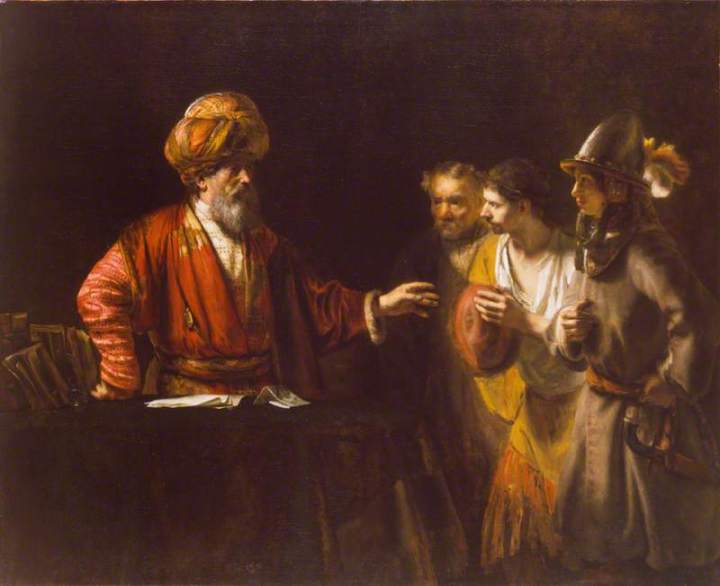
Follower of Rembrandt (1606–1669), The Centurion Cornelius (The Unmerciful Servant), ca. 1660, oil on canvas
(London: The Wallace Collection)
◊ ◊ ◊ ◊ ◊
From the seminar flyer:
Andrea Morgan, Collecting and Displaying Rembrandt’s Pictures in 18th- and 19th-Century England: Charles Jennens of Gopsall Hall and the ‘Rembrandt Room’ at Stowe
Wallace Collection Seminars on the History of Collections and Collecting
Online, Monday, 27 September 2021, 5.30pm
The history of collecting paintings attributed to Rembrandt in eighteenth- century England is especially rich. The English developed such a passion for the Dutch artist by the second half of the century that it led the Reverend Matthew Pilkington to worry in 1770 that “the genuine works of this master are rarely to be met with, and whenever they are to be purchased they afford incredible prices.” This talk will focus on two private collections of paintings attributed to Rembrandt that were formed beginning in the eighteenth century.
Charles Jennens is best remembered as the librettist to the composer George Frederic Handel, but he also owned a massive art collection. Among Jennens’s collection by the 1760s and hanging at his now lost estate, Gopsall Hall, formerly in Leicestershire, were six paintings attributed to Rembrandt and one contemporary copy. The copy was a painting by Pieter Tillemans after Rembrandt’s celebrated picture of Belshazzar’s Feast that was in the eighteenth century owned by the Earl of Derby at Knowsley Hall. While Jennens’s ‘Rembrandt’ pictures have since lost their attribution to the master, I propose some reasons why Jennens in particular might have had a special interest in Rembrandt’s painted oeuvre.
One of the largest but heretofore neglected English collections of paintings attributed to Rembrandt was formerly held at Stowe House, Buckinghamshire, having been amassed by various members of the aristocratic Temple-Grenville family. The first picture was recorded at Stowe as early as 1724, but by 1838 there were a total of ten paintings attributed to the Dutch artist at the estate, along with three said to be by artists in Rembrandt’s circle. I trace the history of this collection and conclude with a discussion of the aptly called ‘Rembrandt Room’ at Stowe.
Please note that this seminar will take place on Zoom and YouTube, and will not be held at the Wallace Collection. Admission is free, and registration is required. More information and details of future seminars can now be found here.
Online Tour | European Porcelain at Villa Cagnola
Online this Sunday from the French Porcelain Society:
Alessandro Biancalana, European Porcelain at Villa Cagnola
FPS Living Room Lecture, 5 September 2021, 18.00 (BST)
 The French Porcelain Society is delighted to continue its online lectures with a very special private tour of Villa Cagnola, north of Milan. Alessandro Biancalana will discuss some highlights from the vast collection of European porcelain in the villa, including Doccia, Meissen, and Capodimonte. He will be joined during the Q&A session by director Don Eros Monti and curator Andrea Bardelli. We hope you can join us. For free links, please email FPSmailing@gmail.com.
“I would define Villa Cagnola not as a house museum in the strictest sense of the term, but rather as a Wunderkammer. Among its numerous treasures, including naturalia, porcelain plays a leading role: it is a composite collection, which has the eighteenth century as leitmotif, bringing together pieces from different manufactories all of them of high quality. Walking along Villa Cagnola’s rooms and looking at the showcases full of objects fascinates the visitor who travels between decorative systems and shapes that are different from each other: the most important European centres of production are represented with Meissen, Doccia, and the most relevant Venetian factories. I hope our journey is stimulating and a source of curiosity.” –Alessandro Biancalana
Online Lecture | Gem Impressions in the Portuguese Royal Collections
From the registration page:
Ana Mónica da Silva Rolo and Noé Conejo Delgado, A Dactyliothec from Pietro Bracci in the Portuguese Royal Family’s Collections
Wallace Collection Seminars on the History of Collections and Collecting
Online, Monday, 26 July 2021, 17.30
 During the eighteenth and nineteenth centuries, in Europe, the versatile education of erudite elites was indispensable to and synonymous with social distinction. In this cultural frame, travels through Europe, in the style of the Grand Tour, became especially appreciated among European aristocratic youth. At the same time, interest in Classical antiquity and collecting antiques was enhanced, giving rise to a flourishing activity of replica production and trade, especially in Italy.
The dactyliothec by the Italian artist Pietro Bracci (1700–1773) in the collections of the Museum-Library of the House of Bragança (Vila Viçosa, Portugal) illustrates eighteenth- and nineteenth-century taste, shared by the last generations of the Portuguese Royal House. The set presented is composed of 2,350 plaster moulds of gems and cameos, organized in three thematic series. The first and largest series is dedicated to emblematic pieces of ancient art and the Italian Renaissance. The second series is composed of a selection of reproductions of the best carvings originally made by eighteenth-century craftsmen, like Giovanni or Luigi Pichler and Natal Marchant. The third and last series brings together a total of 180 cameos dedicated to Emperors of Europe. Dated between the end of the eighteenth century and the first quarter of the nineteenth century, this dactyliothec reflects the importance that such casts assumed as souvenirs of Classical art and history for collectors and travellers, as well as their use as an educational resource in the academic training of young aristocrats.
You can register to view this talk via Zoom here, or plan to watch via The Wallace Collection’s YouTube channel.
Ana Mónica da Silva Rolo and Noé Conejo Delgado are both based at the Archaeology Centre UNIARQ of Lisbon University.
Online Lecture | David Adshead on Pompeii and Neoclassicism
From the Attingham Summer Lecture Series:
David Adshead, Pompeii and All That: Reimagining Ancient Worlds
Online, Wednesday, 14 July 2021, 6.00pm (BST)

Wilhelm Zahn, Die schönsten Ornamente und merkwürdigsten Gemälde aus Pompeji, Herculanum und Stabiae (Berlin, 1828).
David Adshead, Co-Director of the Attingham Summer School and Director of the London House Course, will look at the cultural impact of the discovery of Herculaneum and Pompeii. News of the excavation of these ancient Neopolitan cities sent an electric shock of excitement across Europe and beyond and served as a stimulus to the nascent Neoclassical movement. Grand Tourists, artists, and architects flocked to see the statuary, wall paintings, and other artefacts that emerged unscathed from their volcanic overburden. Illustrated publications followed. These cities also caught the attention of philhellenes at a time before travel to Greece and, modern day, Turkey was common, for they had been Greek colonies before they were Roman. The discovery at Pompeii of a temple dedicated to the goddess Isis, decades before Napoleon’s invasion of Egypt, also triggered a fascination in all things Egyptian. Aspects of collecting, design, and decoration were all directly or indirectly influenced as a result.
Registration is available here»
Online Talk | Pushing Boundaries of Photo-Based Work

Kyungmi Shin, Lunch on the Grass, 2020. The work layers an image of a picnic from 1960s Korea (an image which includes Shin’s father, a Protestant pastor) on top of an image of François Boucher’s Chinese Garden from around 1742. The oil painting by Boucher is in the Musée des Beaux-Arts et d’Archéologie de Besançon. For more information on Shin, see Susan Stamberg’s piece for NPR, “An Artist Explores What ‘Crosses the Ocean’ in Porcelain and Painted Collage,” (12 November 2020), produced in response to the exhibition Kyungmi Shin: Father Crosses the Ocean on view at the Orange County Museum of Art in Santa Ana, California from 24 September 2020 until 21 February 2021.
◊ ◊ ◊ ◊ ◊
From The Getty:
Mercedes Dorame, Kori Newkirk, and Kyungmi Shin
Beyond the Frame: Pushing Boundaries of Photo-Based Work
Online, The Getty, Tuesday, 20 July 2021, 5pm (Pacific Time)
In this conversation, multidisciplinary artists Mercedes Dorame, Kori Newkirk, and Kyungmi Shin discuss how their approaches to art making and activism push the boundaries of photography, transforming it beyond its perceived objectivity and conventional format. Their work is featured in the exhibition Photo Flux: Unshuttering LA, which disrupts the privileging of white narratives in photography by celebrating the diverse, dynamic practices of contemporary Los Angeles artists. The event is free, though advance sign-up is required.










leave a comment