FPS Online Lecture | Angiviller, Rambouillet, and ‘Etruscan’ Taste
From The French Porcelain Society:
Gabriel Wick and John Whitehead | Angiviller, Rambouillet, and ‘Etruscan’ Taste
Sir Geoffrey de Bellaigue Memorial Lecture
FPS, Online, Sunday, 11 July 2021, 18.00 (BST)
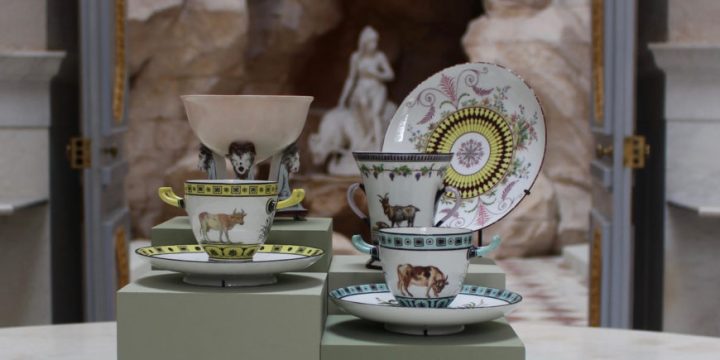
The French Porcelain Society is delighted to host the Sir Geoffrey de Bellaigue Memorial Lecture with Gabriel Wick, curator of the exhibition Vivre à l’Antique, who will explore the fascinating history of Rambouillet, a château associated with the avant-garde ‘Etruscan’ taste championed by the comte d’Angiviller. John Whitehead will discuss the Sèvres-porcelain service created for its dairy. We hope you can join us!
FPS members will receive an email invitation with instructions on how to join the online lecture. If you want to join, please contact us for more details on FPSenquiries@gmail.com. This will be the last Living Room Lecture until Sunday, 5 September 2021.
Rambouillet, 30-miles southwest of Paris, is the most recent and the least-known of France’s royal palaces. Acquired by Louis XVI as a domaine privé only six-years before the Revolution, it served successive sovereigns and presidents as a hunting lodge and rustic retreat until 2009, when it was entrusted to the care of the Centre des Monuments Nationaux and opened to the public. In the second half of the 1780s, the king’s de facto minister of the arts, the comte d’Angiviller, developed a number of remarkable projects for the domain—a proposal for the reconstruction of the château à l’antique, a model farm, extensive plantations of American trees, and the menagerie and dairy. The last of these, conceived as a theatrical evocation of the arts and rituals of the Etruscans, benefitted from contributions by Hubert Robert, Jean-Jacques Lagrenée, Georges Jacob, and the Sèvres manufacture (which Angiviller directed since 1783).
Online Roundtable | New Approaches to Piranesi
From the program flyer:
New Approaches to Piranesi: A Virtual Roundtable
Online, Friday, 16 July 2021
Organized by Jeanne Britton and Zoe Langer
 Join us for a roundtable of lightning talks on interdisciplinary approaches to the works of Giovanni Battista Piranesi (1720–1778). Recent scholarship by Heather Hyde Minor, Carolyn Yerkes, and Susan Dixon, as well as the current bestselling novel Piranesi by Susanna Clarke, have started to open the field of Piranesi Studies to new avenues of research and potentially wider audiences. This roundtable consists of two panels of short presentations of 5–7 minutes followed by ample time for discussion. Papers engage with a wide range of disciplinary fields and methods including globalism, reception, collecting, virtual reality, exhibition curation, book history, archaeology, history of design, and architecture. We hope the themes and format of the roundtable will encourage lively conversation and prompt new critical perspectives that will continue to broaden the interpretation of Piranesi’s works.
Organized by Jeanne Britton and Zoe Langer, Digital Piranesi, Irvin Department of Rare Books and Special Collections, University of South Carolina
Sponsored by Historians of Eighteenth Century Art and Architecture (HECAA)
Panel 1: 10.00–11.30am (EST)
• Hélène Bremer (Art Historian and Independent Curator), For the Love of the Master, 25 Artists Fascinated by Piranesi
• Erik Herrmann (Ohio State University), Another Campo Marzio
• Mireille Linck (Museum Boijmans Van Beuningen), Watermark Research: The Beginning of a Research Tool
• Ari Lipkis (Tyler School of Art & Architecture), Imprisoned in the Fold: Piranesi and the Video Artist
• Jason Porter (University of South Carolina), The Virtual Piranesi: New Methods of Immersive Literacy
• Carla Scagliosi (Galleria Nazionale dell’Umbria), Exploring ‘the Dark Brain of Piranesi’
Panel 2: 1.00–2.30pm (EST)
• George Dodds (University of Tennessee), Giambattista Piranesi, Modernity, and the Continuous Avant-Garde
• Sara Hayat (School of the Art Institute of Chicago), What We Can Learn from 18th-Century Global Histories of Architecture
• Helen Marodin (University of South Carolina), The Magnificence of Rome in the Carceri: Flashes of Light into Piranesi’s Shadowy Prisons
• Thomas Mical (India), Scanning for Duration and Intensity in Piranesi’s Carceri
• Aleksander Musial (Princeton University), Beyond the Capriccio: Piranesi’s Candelabra, Classical Transgression, and their Reception in Warsaw and St. Petersburg
• Kate Retford (Birkbeck, University of London), Piranesi and the Print Room
• Betsey Robinson (Vanderbilt University), Tunnel Visions: Rendering Conventions and Process at the Alban Lake
Online Talks | Rubens Series

Peter Paul Rubens, The Rainbow Landscape (detail), ca. 1636
(London: The Wallace Collection)
◊ ◊ ◊ ◊ ◊
The last three talks in the series address the eighteenth- and nineteenth-century reception of Rubens. From The Wallace Collection:
Rubens Talk Series
Online, The Wallace Collection, 9 June — 21 July 2021
To accompany The Wallace Collection’s new exhibition Rubens: Reuniting the Great Landscapes, this series of seven talks will explore different aspects of Rubens’s extraordinary life and achievements, the fascinating social, cultural and economic circumstances of his age, and his enduring artistic legacy.
Series talks will be presented through Zoom Webinar. Each talk duration is 1 hour, including time for Q&A with the speaker. Tickets can be purchased for individual talks or the entire series. Ticket holders will receive their Zoom link, Webinar ID, and Passcode 24 hours in advance of each talk. Series talks, excluding 21 July, will be recorded. Following each talk, ticket holders will be emailed a link to view the recording, which will be available for one week only.
◊ ◊ ◊ ◊ ◊
John Chu | ‘Equal to the Great Masters’: Landscapes by Gainsborough and Rubens
Wednesday, 7 July 2021, 19.00 BST
Thomas Gainsborough (1727–1788) had a lifelong love of Netherlandish landscape art. As his career developed so too did the range and depth of his appreciation for the ‘Great Masters’ of the Low Countries—prominent in this pantheon was Peter Paul Rubens (1577–1640). In this talk, John Chu will consider the transformative influence of Rubens’s landscapes on Gainsborough’s art, examining what he learned from his predecessor and why these paintings became such an important model. Looking more broadly, he will also explore the reputation of Rubens’s landscapes in 18th-century Britain and establish the social and artistic conditions that shaped, and made possible, Gainsborough’s fruitful encounter with the works of the Flemish master.
Dr John Chu is Senior Curator of Pictures and Sculpture at the National Trust. He has taught and published widely on 18th-century British and French painting and specialises in the art of Thomas Gainsborough and Joshua Reynolds.
◊ ◊ ◊ ◊ ◊
Christoph Vogtherr | Flemish Painting in 18th-Century French Collections
Wednesday, 14 July 2021, 19.00 BST
Flemish painting rose to a prominent role in Parisian collections only in the late 17th century. Even Rubens started to be regarded as one of the major European painters considerably later than in territories of the German Empire or in Italy. This change in perception and taste went hand in hand with new modes of picture displays. In the first decades of the 18th century, the comparison of schools and painters became the guiding principle of art presentation. Flemish painting was introduced into Parisian collections in this context of emulation and competition between the schools. In the process, Flemish and French painting gained a prominence comparable to Italian art. In this talk, Christoph Vogtherr will trace the rise of Flemish and Dutch painting in Parisian collections, its important position in picture displays and art theory, as well as its role in the formation of French 18th-century painting.
Dr Christoph Martin Vogtherr is General Director of the Stiftung Preußische Schlösser und Gärten Berlin-Brandenburg. His main research interests are the history of the Prussian Royal palaces, French 18th-century painting, and the history of art collecting in the 18th and 19th centuries. He was previously Director of the Hamburger Kunsthalle (2016–19), and before that, Curator of paintings and then Director of the Wallace Collection from 2011 to 2016. He has published widely on 18th-century French painting.
◊ ◊ ◊ ◊ ◊
Tim Barringer | British Painters and Rubens’s Poetic Pastorals
Wednesday, 21 July 2021, 19.00 BST
Tim Barringer will explore the character of Rubens’s landscapes, which blend the legacies of classical poetry with the rough and tumble of rural life in the 17th century. Erudite references mix with rustic pastimes. While Rubens’s grand historical and religious paintings, like his portraits, commanded admiration across Europe, British artists and collectors found a special affinity with his pastoral works. Painters such as Constable, Turner, and Bonington were indelibly affected by the experience of seeing Rubens’s paintings and drawings, allowing them to see the natural world anew.
Dr Tim Barringer is Paul Mellon Professor and Chair of the Department of the History of Art at Yale University. He contributed to Rubens and his Legacy, the RA’s exhibition catalogue, and has co-curated exhibitions including American Sublime: Opulence and Anxiety; Pre-Raphaelites: Victorian Avant-Garde; Picturesque and Sublime: Thomas Cole’s Trans-Atlantic Inheritance; Unto This Last: Two Hundred Years of John Ruskin; and Victorian Radicals: From the Pre-Raphaelites to the Arts & Crafts Movement.
Online Talks | NDENCA, Series 4, May–July 2021
From NDENCA (click for lots more information on speakers and presentation abstracts).
New Directions in Eighteenth- and Nineteenth-Century Art (NDENCA)
Series 4: May–July 2021
Organised by Freya Gowrley and Madeleine Pelling
New Directions in Eighteenth- and Nineteenth-Century Art (NDENCA) is a digital seminar series aimed at championing new scholarly voices working across visual and material cultures in this period. It aims to take a global perspective, and in particular welcomes contributions by scholars from minority groups. Series 4 seminars take place on Mondays, via Zoom and are open to all. To book tickets, please email us at, ndencaseminar@gmail.com.
Papers are available on our YouTube channel for up to one month after their live session.
P R O G R A M M E
24 May 2021
1) Caroline McCaffrey-Howarth (Visiting Research Fellow, University of Leeds, Curator, 17th- and 18th-Century Ceramics and Glass, V&A Museum), Sèvres-mania’ and the Standardisation of Ceramics Connoisseurship
7 June 2021
2) Amara Thornton (Honorary Research Associate, UCL Institute of Archaeology), Caribbean Collections Histories: Archaeology and Empire
14 June 2021
3) Nat Reeve (PhD Candidate, Royal Holloway, University of London), Queer Tombs and Reframing Doom: Elizabeth Siddal and Georgiana Burne-Jones’s Unfinished Collaborative Project
21 June 2021
4) Emily Doucet (University of Toronto), Illuminating Infrastructures: Nadar’s Underwater Photography and the Expansion of Marseille’s Modern Port
28 June 2021
5) Miguel Angel Gaete (PhD Candidate, University of York), Territorial Fantasies, Sexual Nuances, and Savage Energy: Orientalism and Tropicality in Eugène Delacroix and Johann Moritz Rugendas
5 July 2021
6) Kate Heller (Research Associate, Art Institute of Chicago), Wrought(-Iron) Boundaries: A Victorian Ecology of Thomas Jeckyll’s Norwich Gates
12 July 2021
7) Camilla Pietrabissa (Postdoctoral fellow, IUAV University of Venice), Drawing in 18th-Century Venice: The Origins of the Veduta and the Modern Culture of Spectacle
19 July 2021
8) Samuel Raybone (Lecturer in Art History, Aberystwyth University), Global Impressionism and the Idea of Wales
26 July 2021
9) Cabelle Ahn (PhD Candidate, Harvard University), Drawing Site-Specificity: The 1797 Exhibition of Drawings in the Louvre
Online Conversation | Juneteenth

This CW Conversation is part of the Foundation’s Us: Past, Present, Future series (there are lots of terrific resources listed below; for course websites, I’m particularly excited about the timeline, which ranges from 1565 to 2020. –CH).
Juneteenth: A Conversation with Deirdre Jones Cardwell, Richard Josey, and Michael Twitty
Online, Colonial Willamsburg Foundation, 19 June 2021, 4pm (EDT)
General Order Number Three, which officially informed enslaved Texans of their legal freedom, stated that emancipation involved “an absolute equality of personal rights and rights of property.” Have we achieved the promises of Juneteenth, and how should it be observed? Join Deirdre Jones Cardwell, Programming Lead and Actor Interpreter with Colonial Williamsburg, Richard Josey, Founder and Principal Consultant for Collective Journeys LLC, and Michael Twitty, Culinary Historian, in a discussion about the story, significance, and meanings of Juneteenth.
Click here to join the livestream event on Saturday, 19 June 2021, at 4.00pm (EDT). You don’t have to have a Facebook Account to watch, but you will need to sign in to join the discussion.
◊ ◊ ◊ ◊ ◊
Whether you’re looking to read up on this topic before joining the conversation, or want some further reading afterward, here’s recommended reading from Colonial Williamsburg.
Colonial Williamsburg Juneteenth Resources
Colonial Williamsburg has created several related web resources, including an informational What is Juneteenth? page, a calendar of Juneteenth special events at Colonial Williamsburg, and a Juneteenth Historical Timeline that provides history and context for the commemoration.
The Colonial Williamsburg Resource Library provides access to numerous resources that explore relevant themes such as citizenship, civics, and government using video, lessons, and interactive web activities. The Resource Library features several relevant resources such as the When Freedom Came electronic field trip and Whose Emancipation?
Colonial Williamsburg’s YouTube Channel features 2020 productions “Juneteenth at Custis Square” and “Before Juneteenth.”
Juneteenth Resources from Other Cultural Institutions
• The Smithsonian National Museum of African American History & Culture offers “The Historical Legacy of Juneteenth.”
• The Library of Congress blog offers “The Birth of Juneteenth: Voices of the Enslaved” and “Emancipation Day in South Carolina . . .,” an 1863 illustration from Frank Leslie’s Illustrated Newspaper.
• The Library of Virginia’s The Uncommonwealth blog focuses on “Why Juneteenth?”
• PBS features “What is Juneteenth?” with Henry Louis Gates, Jr.
• The National Archives presents an online exhibit The Emancipation Proclamation, providing context on that document issued January 1, 1863.
Books
• Annette Gordon-Reed. On Juneteenth. New York: Liveright Publishing, 2021.
• Angela Johnson. All Different Now: Juneteenth, the First Day of Freedom. New York: Simon & Schuster Books for Young Readers, 2014.
Online Talk | Sarah Coffin on Fêtes and Feasts
From The Royal Oak Foundation:
Sarah Coffin | Fêtes and Feasts: Diplomatic Dining and the Noble Table, 1660–1830
Online, The Royal Oak Foundation, Wednesday, 16 June 2021, 6.00pm (EDT)

Martin van Meytens, Banquet at the Wedding of Joseph II to Isabella of Parma, 10 October 1760, detail, 1763, oil on canvas (Vienna: Schönbrunn Palace).
What do Italian architects, English, French, and German diplomats and noblemen, and French chefs all have in common? Between the 17th century and 1830, they served up fantastical ‘table architecture’ to honor their noble and royal guests. These tables showcased lavish temples, beautiful arrangements of food, specially created sugar and porcelain sculptures, silver and gilded display pieces, and even table fireworks.
Marriages, diplomatic visits, and treaty signings turned these meals into theatrical extravaganzas, in which the chef played the role of master of ceremonies, organizing all the details including musical entertainment to accompany the cuisine. When James II of England acceded to the throne in 1685, he sent Lord Castlemayne to Rome as Ambassador to the Vatican where he arranged an elaborate banquet in honor of the Pope.
While Italy and France led the way in culinary fashion, English visitors and diplomats were often the beneficiaries and sometimes the hosts. Chef Antonin Câreme’s splendid dinner for the Treaty of Versailles attended by Alexander I of Russia, Tallyrand and others led to the chef briefly being lured to England by George IV for a State Dinner for Tsar Alexander in 1816, who tempted the chef to then travel to Russia.
Sarah Coffin, will recount some of these amazing meals and illustrate the elaborate table settings and accoutrements devised to impress guests from the top echelons of European society and royalty. She will provide first-hand accounts by observers, as well as show prints and paintings that show the masterpieces that were created for the pleasures of the table.
Sarah D. Coffin is an independent decorative arts and design historian, curator, consultant, and lecturer who has extensively researched and explored the interaction of culinary design and history. Previously she was Senior Curator and Head of the Product Design and Decorative Arts Department at Cooper Hewitt for over 14 years, retiring in 2018. Her tenure at Cooper Hewitt included her curation of the exhibition Feeding Desire: Design and Tools of the Table, 1500–2005. Other exhibitions for Cooper-Hewitt included the blockbuster exhibition Set in Style: The Jewelry of Van Cleef & Arpels (2011); Rococo: The Continuing Curve, 1730–2008; and The Jazz Age: American Style in the 1920s, which she co-curated and co-authored the exhibition catalog. Most recently she co-authored the exhibition catalogue for a show on Art Nouveau architect and designer Hector Guimard, opening in 2022 at Cooper Hewitt, Smithsonian Design Museum in New York, and then The Driehaus Museum, Chicago.
Watch live on Wednesday, June 16 at 6.00pm (EDT), or rent the recording for 4 days. $15 Royal Oak members; $20 non-members.
Online Conversation | Future of Publishing, Art and Architectural History
The Future of Art and Architectural History in Publishing: A Conversation
Online, University of Buckingham, 27 May 2021, 5pm (UK)
 The last of this academic year’s Research Days organised by the Department of History and History of Art at the University of Buckingham is structured as a conversation with some of the most prominent editors in history of art and architecture. To register, please send an email to Seminars-HRI@buckingham.ac.uk. Questions may be addressed to Adriano Aymonino, who will be moderating the event, adriano.aymonino@buckingham.ac.uk.
• Mark Eastment, Editorial Director, Art and Architecture Editor, Yale University Press, London
• Michelle Komie, Publisher, Art & Architecture, Princeton University Press
• Alodie Larson, Art and Art History Editor, Oxford University Press
• Thomas Weaver, Senior Acquisitions Editor, Art and Architecture, MIT Press
Online Talk | Building a Print Collection in Malta
This month’s installment of The Wallace Collection Seminars on the History of Collections and Collecting:
Krystle Attard Trevisan, The ‘Primo Costo’ Inventory of Count Saverio Marchese (1757–1833)
Wallace Collection Seminars on the History of Collections and Collecting
Online, The Wallace Collection, London, 24 May 2021, 17.30
Print collecting was considered a noble and erudite activity from the sixteenth and well into the nineteenth century. Collectors in major cities purchased prints from dealers and publishers and traded with other collectors. Malta’s role in the print market has so far been overlooked. There were no dealers in prints on the island. However, the Maltese nobleman and collector Count Saverio Marchese built a collection of 4,500 high quality prints. We know how he did this through his ‘Primo Costo’ manuscript in which he recorded all his purchases. The manuscript reveals who formed part of Marchese’s widespread network of print sellers in European cities such as Paris, Munich, Rome, and Milan. It confirms that there were local suppliers, though not specialised print dealers. It reveals the various collecting methods that Marchese adopted to obtain prints from Malta. The ‘Primo Costo’ is a rare type of document which gives invaluable insight into European print trading, making it essential for studying collecting practices. Marchese recorded the names of continental and local dealers, auctioneers, and other suppliers. The manuscript also refers to other Maltese collectors. Using the information found in the ‘Primo Costo,’ this paper will identify key figures not only within the Maltese print market but also within the European one.
Krystle Attard Trevisan is a PhD Candidate at the Institute of English Studies, School of Advanced Study, University of London.
Register here to view this talk via Zoom.
To view the talk via The Wallace Collection’s YouTube channel, please click here.
Some of the previous seminars are now available on YouTube.
Online Discussion | Advancing Equity in & through Academic Footnotes
Information on The Italian Art Society, which is dedicated to the study of Italian art and architecture from prehistory to the present day, is available here:
Citing Truth to Power: Advancing Equity in & through Academic Footnotes
The Emerging Scholars Committee of The Italian Art Society
Online, 2 June 2021, 12pm (CST)
 Footnotes are the fundamental building blocks of academic arguments. They not only validate new ideas, they also situate us scholars within larger academic conversations and serve as a roadmap for how those conversations have developed over time. But this relationship is reciprocal. When appealing to the authority of these previous scholars, our footnotes also amplify their voices and argue implicitly for what conversations are worth being had, and by whom. As a result, footnotes often serve to reinforce the dominance of a narrow range of (usually European and American, white, fully-able, male) academics, limiting both the kinds of conversations that can be had within a field as well as who can have them. For this reason, we invite you to our virtual open forum. By bringing scholars of Italian Art History and related art historical and humanities fields into conversation with each other, we hope to interrogate what is at stake in both our footnotes and the citational process.
Allison Levy is Digital Scholarship Editor for Brown University Library’s Digital Publications Initiative. She has authored or edited five books on early modern Italian visual culture and is co-chair of the College Art Association’s Committee on Research and Scholarship.
Julia DeLancey is Professor of Art History at the University of Mary Washington. She specializes in the visual culture of early modern Venice and, most recently, works on questions related to disability, art, and visual culture.
Robert Clines is Assistant Professor of History and International Studies at Western Carolina University. His first book A Jewish Jesuit in the Eastern Mediterranean appeared in 2019. He’s currently writing a book tentatively entitled Ancient Others: Essays on Race, Empire, and the Mediterranean in Italian Renaissance Humanism.
Online Talk | Alec Cobbe, Birds, Bugs and Butterflies
Tomorrow, from The Decorative Arts Trust:
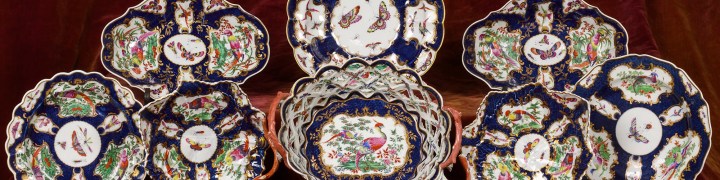
Recounting the Life of the ‘Peacock’ Worcester Service (1763)
Alec Cobbe, joined with Leslie Fitzpatrick
Online, Monday, 10 May 2021, 1.00pm (ET)
Join us as we learn about some incredible ceramics from Ireland with artist, designer, and collector Alec Cobbe. Alec will share an illustrated talk about the creation, dispersal, and recovery of the ‘Peacock’ Worcester service of 1763, the largest mid-18th-century service recorded from any British porcelain manufacturer. Thomas and Lady Betty Cobbe of Newbridge House, County Dublin, acquired the service after becoming acquainted with Dr. Wall’s porcelain factory in Worcester as they traveled from Dublin to Bath.
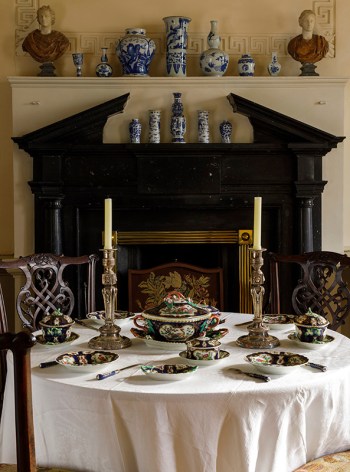 This lecture features scholarship that is part of a recent publication and exhibition Birds, Bugs and Butterflies: Lady Betty Cobbe’s ‘Peacock’ Worcester Porcelain composed by Alec and shown at Dublin Castle (October 2019 to February 2020).
After his presentation, Alec will be joined in conversation with Leslie Fitzpatrick, who previously served as the Samuel and M. Patricia Grober Associate Curator of European Decorative Arts at the Art Institute of Chicago.
This program is dedicated in memory of Christopher Monkhouse, a recipient of the Decorative Trust’s Award of Merit, whose extraordinary 2015 exhibition and publication Ireland: Crossroads of Art and Design, 1690–1840 continue to serve as a testament to the incredible material culture of Ireland.
Participants will receive an email with the event link after registering. If you have any questions about this or other programs, please email carrie@decorativeartstrust.org.
Registration is available here (pay what you can)
◊ ◊ ◊ ◊ ◊
From Boydell and Brewer:
Alec Cobbe, Birds, Bugs and Butterflies: Lady Betty Cobbe’s ‘Peacock’ China: A Biography of an Irish Service of Worcester Porcelain (London: Boydel Press, 2019), 143 pages, ISBN: 9781783274727, £45 / $80.
A major contribution to our knowledge of the Worcester porcelain factory in its early years, based on a single large and elaborate dinner service commissioned by an Irish family.
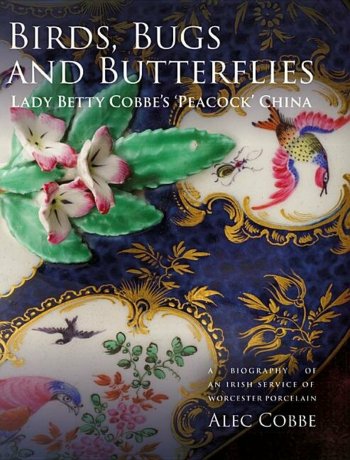 2020 Winner of the American Ceramic Circle Book Award
The early years of the famous Worcester porcelain factory established by Dr Wall have always been a little mysterious, owing to the destruction of the records of the business for this period. Alec Cobbe’s discovery of family papers listing the purchases over a period of years of a particularly beautiful and ornate table set have enabled him to give a vivid glimpse of how the factory interacted with its customers. He is able to describe the commissioning of perhaps the largest service of first period Worcester porcelain on record by Thomas and Lady Betty Cobbe for Newbridge House Co. Dublin. It was bought in stages from 1763 as the family travelled from Dublin to Bath each year, stopping at Worcester en route, as other Irish gentry did. The Cobbe service, uniquely in the context of British porcelain, was accompanied by a full set of Irish silver and steel cutlery fitted with Worcester porcelain handles matching the service. The various pieces of porcelain and their historical context are described as well as their painted decoration, and the sources for it. The later history of the service is outlined and its gradual dispersal in the nineteenth century, culminating in a final sale of the remaining pieces lot by lot in a Christie’s sale in 1920. This book celebrates Cobbe’s reassembly of more than 160 pieces of the original service over a period of more than thirty years and their return to Newbridge following their exhibition in the State Apartments at Dublin Castle. Overall, the book gives an important insight into Irish social life and patronage in the mid-eighteenth century.
Alec Cobbe was born in Ireland and still resides in Newbridge House, Co. Dublin, where his ancestors have lived since it was built in the middle of the eighteenth century. He practises as an artist and designer. As a passionate collector, he added to his family’s historic collections and assembled the world’s largest group of composer-owned keyboard instruments.
C O N T E N T S
Foreword
Preface and Acknowledgements
Beginnings
‘Snuff for Dr Walls’: The Cobbes in Worcester and London
Plans for Collecting and Entertaining
The Peacock Service and Its Cutlery
The Decoration of the Original Peacock Service
The Service through Later Centuries, Sale, and Reassembly
Appendices
I. Transcripts from Worcester and Cobbe archives, accounts, and inventories
II. Hypothetical tally of the original Peacock Service
III. Transcript of Christie’s 1920 sale catalogue
IV. Known destinations of Cobbe pieces
V. A note on the nomenclature of Worcester porcelain pieces
VI. Inventory of Worcester blue-scale porcelain from the original service and re-assembled pieces in Lady Betty’s pattern of birds, insects, and butterflies










leave a comment