Online Talk | Naming Rights: The Case of Mai/Omai from Polynesia
From YCBA:
Naming Rights: The Case of Mai/Omai from Polynesia
with Jessie Park, Catherine Roach, and Edward Town
Online and in-person, Yale Center for British Art, New Haven, Thursday, 13 November 2025, 12pm ET
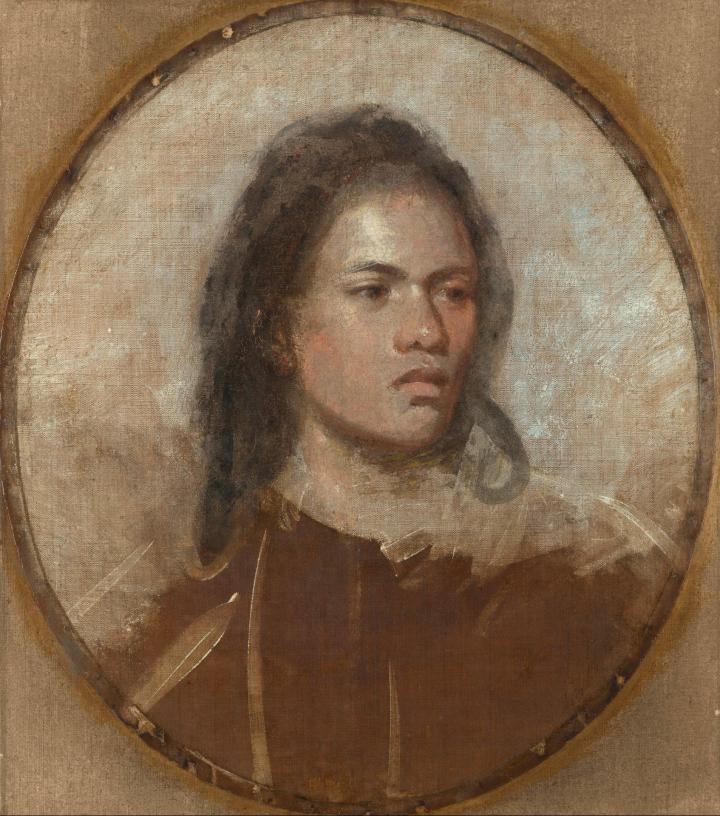
Sir Joshua Reynolds, Study for the Portrait of Mai (‘Omai’), ca. 1774, oil on canvas, 64 × 56 cm (New Haven: Yale University Art Gallery).
This event marks the return to public view of Sir Joshua Reynolds’s Study for the Portrait of Mai (‘Omai’), on loan from the Yale University Art Gallery. The first person from Polynesia to reach Britain, the sitter in Reynolds’s painting sought a military alliance and instead became a celebrity among Europeans, due in part to a public persona he crafted and enacted. The man now known as Mai bore many names over his lifetime. He came to fame in Britain as ‘Omai’ or ‘Omiah’, a British misunderstanding of a Tahitian honorific that he reportedly bestowed on himself. What should we call him, and his representations, today? Can this case study offer deeper insights into the ethics of naming pictures? And how might we thoughtfully narrate the stories of historical figures of color whose lives are known nearly exclusively through European visual and textual sources?
Join the livestream here»
Jessie Park is Nina and Lee Griggs Assistant Curator of European Art, YUAG. Catherine Roach is Graduate Program Director and Associate Professor of Art History in the School of the Arts, Virginia Commonwealth University. Edward Town is Assistant Curator of Paintings and Sculpture, YCBA.
New Book | The People of Print: Eighteenth-Century England
From Cambridge UP, with an online book launch, together with a speed-pitching workshop, scheduled for Monday (see below) . . .
Adam James Smith, Rachel Stenner, and Kaley Kramer, eds., The People of Print: Eighteenth-Century England (Cambridge: Cambridge University Press, 2025), 124 pages, ISBN: 978-1009629454, $18.
 This collection profiles understudied figures in the book and print trades of the eighteenth century. With an explicit focus on intervening in the critical history of the trades, this volume profiles seven women and three men, emphasising the broad range of material, cultural, and ideological work these people undertook. It offers a biographical introduction to each figure, placing them in their social, professional, and institutional settings. The collection considers varied print trade roles including that of the printer, publisher, business-owner, and bookseller, as well as several specific trade networks and numerous textual forms. The biographies draw on extensive new archival research, with details of key sources for further study on each figure. Chronologically organised, this Element offers a primer both on individual figures and on the tribulations and innovations of the print trade in the century of national and print expansion.
c o n t e n t s
Preface
1 Introduction — Adam James Smith, Rachel Stenner, and Kaley Kramer
2 Elizabeth Nutt: Print Trade Matriarch (1666–1746) — Helen Williams
3 John Nicholson and the Auctioning of Copyright (d.1717) — Jacob Baxter
4 Catherine Sanger: Publisher in Bartholomew Close (1687–1716) — Kate Ozment
5 John White Junior: Printer in the North (1689–1769) — Sarah Griffin
6 Selling the Enlightenment: Mary Cooper and Print Culture (1707–1761) — Lisa Maruca
7 The ‘Indefatigable’ Ann Ward: Printer in York (1715/6–1789) — Kaley Kramer
8 Anne Fisher (1719–1778): Not Simply a Printer’s Wife — Barbara Crosbie
9 Sold at the Vestry: John Rippon (1751–1836) and the Hymnbook Trade — Dominic Bridge
10 Diversity in the Book Trades: Ann Ireland (1751–1843) of Leicester — John Hinks
11 ‘Laugh when you must, be candid when you can’: The Concealed Resistance of the Radical Printer Winifred Gales (1761–1839) — Adam James Smith
◊ ◊ ◊ ◊ ◊
From Eventbrite:
The People of Print: Eighteenth-Century England
Book Launch and Early Career Researcher Speed-pitching Workshop
Online, Monday, 3 November, 6.30pm GMT
All welcome! Please register by 2 November.
Join the Centre for Print Culture at the University of Sussex to celebrate the publication of this volume, the follow-on to The People of Print: Seventeenth-Century England, with an evening of lively talks and discussion. The People of Print: Eighteenth-Century England profiles understudied figures in the book and print trades, featuring new research and critical perspectives on this fascinating and rich cultural field. We will be joined by Dr Barbara Crosbie (Durham University), Dr Jacob Baxter (St Andrews), and Dr Lisa Maruca (Wayne State, Professor Emerita), who will discuss their research for the latest collection.
Following the launch, there will be a Speed-pitching workshop (7.30–8.15pm GMT) for early career researchers studying topics in the histories of the book, print, and publishing trades. Come with an idea you can explain in 3 minutes, and we will pair you with one of our publishing panel of journal, series, and book editors for feedback:
• Dr Helen Williams, The Printing Historical Society
• Dr Kaley Kramer and Dr Adam James Smith, editors The People of Print
• Professor Samantha Rayner, Commissioning Editor of Cambridge Elements, Publishing and Book Culture
• Dr Rachel Stenner, editor of Publishing History journal and The People of Print series
Society of Antiquaries of London Launches Fundraising Series
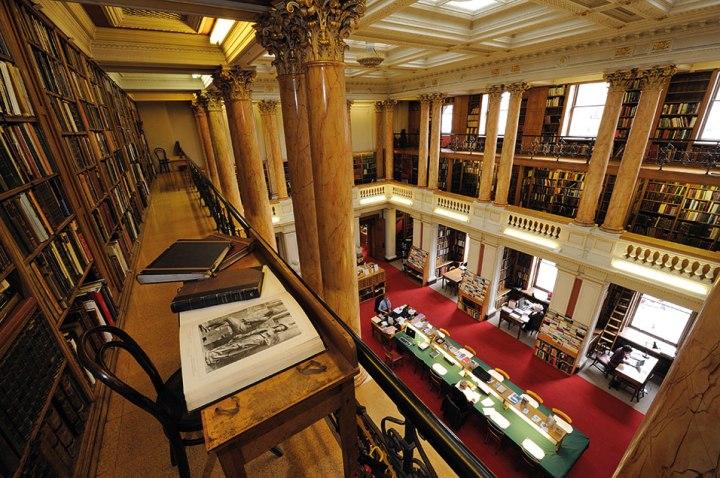
Library of the Society of Antiquaries of London, Burlington House.
◊ ◊ ◊ ◊ ◊
From the press release, via Art Daily:
The Society of Antiquaries has launched a series of fundraising events Past Matters: Shaping Our Future at Burlington House in support of the Society’s bold vision to transform its historic home into a world-leading centre for the study of heritage. The talks series will take place from 28 October to 19 November 2025 with tickets now available to buy online. These autumn events will enable the Society to commission architectural plans to shape the Society’s future at Burlington House and increase access to the vast collections, expand the Society’s research and education programmes, and create dynamic new spaces for exhibitions, seminars, and events. This will ensure that Burlington House remains a place of inspiration, scholarship, and discovery for generations to come.

George Vertue, Lady Jane Grey, 1748, engraving.
Alongside the talks, Abbott & Holder (30 Museum Street, opposite the British Museum) will sell some early engravings by George Vertue for the Society of Antiquaries from 21 October until December 2025. Seven prints of the 18th-century engravings made from plates by the Society’s first official engraver, George Vertue (1684–1756), all duplicates with copies still part of the Society’s Collection, will be for sale with 65% of the sale price going to the Society. The enterprising Vertue combined his work for the Society with illustrious private commissions and the production of independent engravings, which he sold from his shop in Drury Lane. His ‘tablatures’ of historical royal portraits were ‘collected, drawn, and engraved from ancient original pictures’.
Natasha McEnroe FSA, General Secretary and CEO of the Society of Antiquaries of London, says: “Thanks to our kind sponsors so far we have raised £1.3 million (27%) of the £4.8m cost of the Society’s 999-Year Lease. We invite supporters to sponsor our home in square feet:£500 cover a square foot of Burlington House, while ‘Foundation 1707 Sponsors’ will sponsor four square feet of Burlington House with £2,000 (costs can be spread with monthly Direct Debits). Our supporters will all get a special ‘Bond of Support’ designed by British artist Adam Dant.”
All events cost £30 per person, with tickets available on the Society’s website. Geoffrey Munn’s Halloween talk can also be followed online at a cost of £6. The Society is collaborating with the St. James’s Hotel & Club for the Past Matters season and supporters are able to enjoy a special three-course lunch offer of £30 including a glass of bubbly and event attendees can exclusively enjoy a 20% discount on the exquisite art-inspired afternoon tea by showing their ticket confirmation. The hotel is just across the road in St James’s; pre-booking is essential and the offers are available until 30 November; they can be booked here.
Sale of Early Engravings of the Society of Antiquaries at Abbot & Holder
October — December
From 21 October we are offering seven prints of engravings made from plates by the Society’s first official engraver, George Vertue (1684–1756) for sale with the gallery Abbott & Holder.
Royal Patrons and Collectors in the 20th Century, from King Edward VII to Queen Elizabeth II
Tuesday, 28 October, 6pm
Join Tim Knox FSA, Director of the Royal Collection, for a lively exploration of royal taste and patronage from Edward VII to Queen Elizabeth II.
Myth and Magic: A 16th-Century Charmstone and Its Links to the Society of Antiquaries
Friday, 31 October, 6pm
On Halloween night, join Geoffrey Munn OBE FSA, as he unveils the extraordinary tale of a mysterious 16th-century rock crystal charmstone.
Drawn to Discovery at the Antiquaries
Thursday, 6 November, 5pm
An evening reception with Abbott & Holder at the Antiquaries for a curated selection of highlights from the Society’s remarkable collection of over 55,000 prints and drawings from the 17th to 20th centuries.
Hats off to Tradition: Tales from The Cocked Hat Club
Wednesday, 19 November, 6pm
Roll up! Roll up! Join us for a unique evening that lifts the lid on one of the most curious—and least known—aspects of the ‘Old Lady’, as the Society of Antiquaries is affectionately known.
Talk | Christine Stevenson on Vanbrugh and His Clients

Sir John Vanbrugh, Blenheim Palace, Oxfordshire, 1705–22. Seat of the Dukes of Marlborough.
◊ ◊ ◊ ◊ ◊
From The Georgian Group, in anticipation of Vanbrugh300 in 2026:
Christine Stevenson | John Vanbrugh and the Art of Client Management
The Georgian Group, 6 Fitzroy Square, London, 21 October 2025, 6.30pm
The early eighteenth-country houses designed by John Vanbrugh (1664–1726), including Blenheim in Oxfordshire and the now-lost Claremont in Surrey and Eastbury in Dorset are, or were, remarkable for their bold forms and unorthodox ornament. Yet in one respect Sir John’s work was supremely delicate: the ways in which he persuaded clients that boldness and unorthodoxy were the most economical routes to displays appropriate to their status. His arguments are gossipy, funny, and often suspect. They present the architect less as a designer than as a hedge against financial and reputational risk. At the same time, they offer us a fascinating insight into the sometimes-fraught social and familial relationships in play when it came to spending money on a house. Georgian Group members, £15 / non-members, £18; tickets include a glass of wine.
Booking is available here»
Online Talks | Finding Moses Williams
Upcoming from The Library Company of Philadelphia:
Finding Moses Williams
Online, Wednesday, 19 November 2025, 1.00–3.30
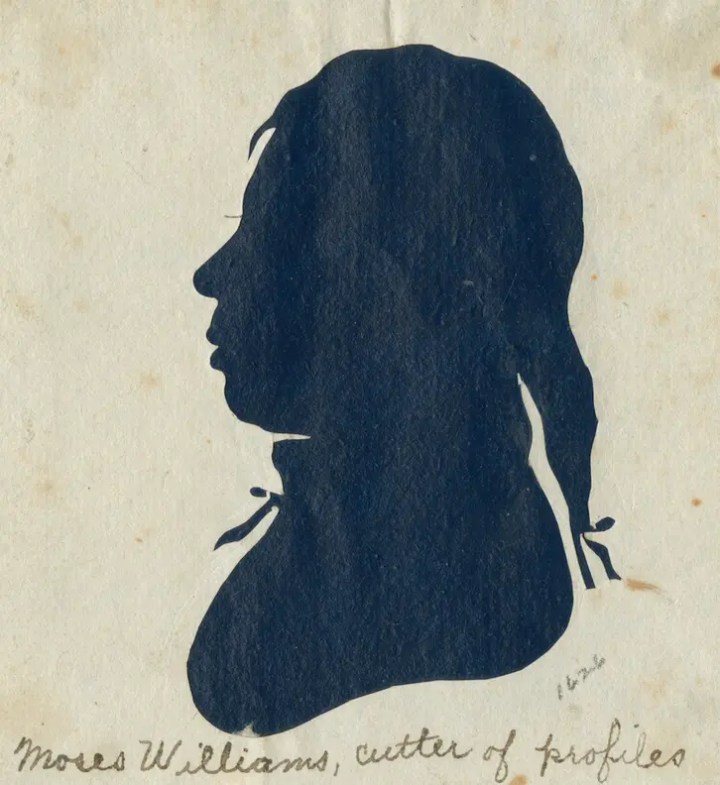
Silhouette of Moses Williams, perhaps by Raphaelle Peale or by Williams himself, after 1802, 9 × 8 cm (Library Company of Philadelphia).
This program of illustrated talks by five speakers will focus on the identification of the exceptional hollow-cut paper profiles created by Moses Williams (1776–1830) at Peale’s Philadelphia Museum and on presenting new historically accurate information about Williams’s life and family. Moses’s parents were manumitted by Peale in 1786 and Moses, who was born enslaved, was then indentured to Peale by his parents until age twenty-eight
Raised within the Peale family, Moses was literate and trained in skills for creating and installing the Museum’s displays of art and natural science. After the installation of a physiognotrace device for creating hollow-cut paper profiles in 1802, Moses was freed and given the concession to operate this new attraction. The popularity of this inexpensive form of portraiture and the highly accurate and elegant profiles Moses cut, made him financially independent.
Recent research into Moses’s life provides us with a clearer understanding of his artistry and other activities, as well as his death date and the identity of his descendants. And, the story of Williams’s birth family illuminates how the practice of indenture used by Free Black families, like the Williams family, was a strategy for seeking financial stability.
A small selection of Moses Williams’s profiles will be on display at the Library Company during November and December and in the Peale Gallery at the Philadelphia Museum of Art. The program is sponsored by the Library Company of Philadelphia’s Program in African American History and the Center for American Art at the Philadelphia Museum of Art.
Registration for this free virtual event is available here»
p r e s e n t a t i o n s
1.00 Welcome — Sarah Weatherwax (Senior Curator of Graphic Arts, The Library Company of Philadelphia)
1.05 Introduction to LCP’s Program in African American History — Wynn Eakins (Reference Librarian and African American History Subject Specialist, The Library Company of Philadelphia)
1.10 Finding Moses in the Peale-Sellers Family Album — Carol Soltis (Project Associate Curator, Philadelphia Museum of Art)
1.35 Presenting Moses at The Peale, Baltimore’s Community Museum — Nancy Proctor (Re-founding Director of The Peale)
2.00 ‘Not Yet Completely Free,’ Moses and His Family in the Context of the Gradual Manumission Act — Ellen Fernandez Sacco (Genealogist and Independent Scholar)
2.25 Locating Moses William in Philadelphia: New Information about Moses Williams’s Life and Death Based on a Re-examination of Philadelphia’s Primary Sources — Dean Krimmel (Creative Museum Services, Research Consultant to The Peale)
2.50 Moses Williams, A Technical View — Lauren Muney (Silhouette Artist and Researcher)
3.15 Final Q&A
Online Talks | European Prints in Museums in the American South
From ArtHist.net:
Paper Backstories: European Prints in Southern Museums
Online, hosted by Vanderbilt University, 16 October 2025
Staged in conjunction with the Vanderbilt University Museum of Art’s Fall 2025 exhibition Paper Backs: Hidden Stories of European Prints from the VUMA Collection, this virtual symposium will bring together curators who oversee collections of European prints at museums spread across the South. Each curator will give a lightning-style, 10-minute presentation about their museum’s pre-1915 European print holdings, with the goal of making these collections better-known amongst local, regional, and global audiences of both amateurs and professionals. The symposium also seeks to initiate a collective discussion about how and why European prints often served as catalysts for the formation of institutional art collections in a region with limited public art infrastructure before the turn of the twentieth century. How did old master and early modernist European prints in particular support various progressive and post-World War I- era agendas? What challenges and opportunities face the study and promotion of such objects in the South today? Attendance is free and open to all.
Please register to receive the Zoom link.
s c h e d u l e
12pm (Central Standard Time) Courtney Wilder, The Vanderbilt University Museum of Art, Nashville
12.15 Sarah Cartwright, The John and Mable Ringling Museum of Art, Florida State University, Sarasota
12.25 Dana E. Cowen, The Ackland Art Museum, University of North Carolina-Chapel Hill, Chapel Hill
12.35 Maggie Crosland, The Birmingham Museum of Art
12.45 Nelda Damiano, The Georgia Museum, University of Georgia, Athens
1.00 Alyssa M. Hughes, The Virginia Museum of Fine Arts, Richmond
1.10 Q&A
1.30 Event concludes
Cambridge Material Culture Workshop Fall 2025
This fall’s Material Culture Pre-1850 Workshop schedule:
Cambridge Material Culture Workshop
Michaelmas 2025
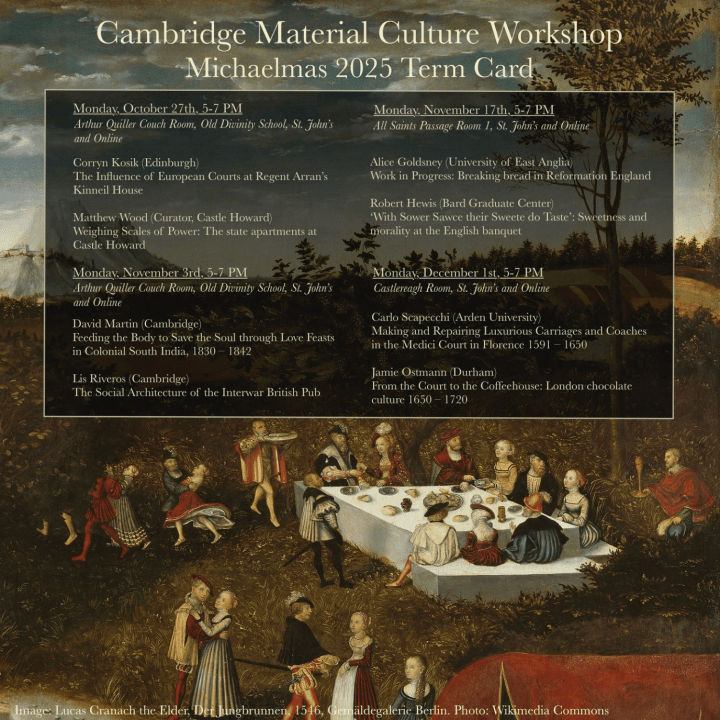 We’re excited to announce the term card for Michaelmas 2025. Each of the four sessions will meet online and in-person at St. John’s, Cambridge, starting at 5pm. For more information, please contact Tomas Brown (tbnb2@cam.ac.uk) or Sophia Feist (stcf2@cam.ac.uk).
27 October
• Corryn Kosik (Edinburgh), The Influence of European Courts at Regent Arran’s Kinneil House
• Matthew Wood (Curator, Castle Howard), Weighing Scales of Power: The State Apartments at Castle Howard
3 November
• David Martin (Cambridge), Feeding the Body to Save the Soul: Love Feasts in Colonial South India, 1830–1842
• Lis Riveros (Cambridge), The Social Architecture of the Interwar English Pub
17 November
• Alice Goldsney (University of East Anglia), Work in Progress: Breaking Bread in Reformation England
• Robert Hewis (Bard Graduate Center), ‘With Sower Sawce their Sweete do Taste’: Sweetness and Morality at the English Banquet
1 December
• Carlo Scapecchi (Arden University), Making and Repairing Luxurious Carriages and Coaches in the Medici Court in Florence, 1591–1650
• Jamie Ostmann (Durham), From the Court to the Coffeehouse: London Chocolate Culture, 1650–1720
Conversations | Regarding History: American Art in Perspective
From The Met:
Regarding History: American Art in Perspective
The Metropolitan Museum of Art, New York, 1 November 2025
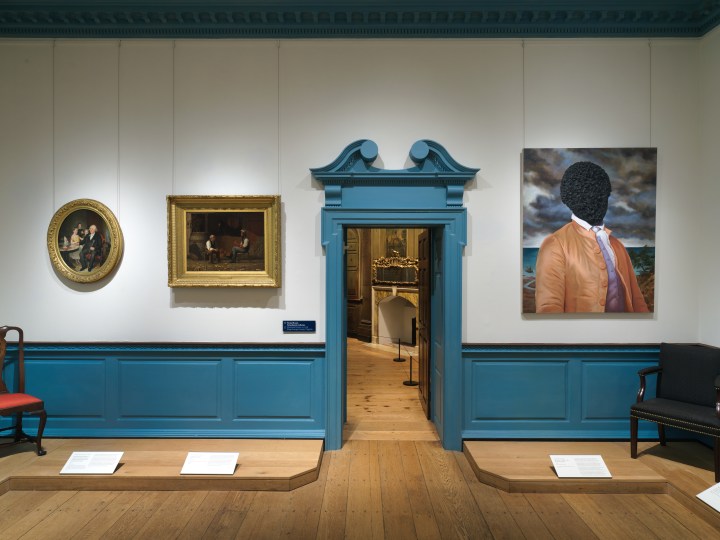 Join curators, academics, and artists to mark the end of the American Wing’s 100th anniversary with dynamic conversations and presentations that explore multilayered interpretations of American art and history. Discover how diverse institutions and individuals are bringing history to life for audiences through a variety of engaging approaches that activate digital technologies, showcase innovations in visual and material object-based displays, and center the power of place and the potential for contemporary artistic interventions. Presentations will be recorded and posted soon after the event on The Met’s YouTube channel.
Registration for in-person attendance is available here»
s c h e d u l e
11.00 Introduction — Sylvia Yount (Lawrence A. Fleischman Curator in Charge of the American Wing, The Met)
11.15 Keynote Conversation
• Edward Ayers (Tucker-Boatwright Professor of the Humanities and President Emeritus, University of Richmond)
• Christy Coleman (Executive Director, Jamestown-Yorktown Foundation)
12.15 Break
1.30 Curatorial Roundtable
Moderated by Sylvia Yount
• Layla Bermeo (Museum of Fine Arts, Boston)
• Kathleen Foster (Philadelphia Museum of Art)
• Sarah Kelly Oehler (Art Institute of Chicago)
2.30 Artist Presentation — Titus Kaphar
3.00 Closing Remarks
New Book | Protestant Relics in Early America
From Oxford UP (use code AAFLYG6 for a 30% discount) . . .
Jamie Brummitt, Protestant Relics in Early America (New York: Oxford University Press, 2025), 560 pages, ISBN: 978-0197669709, $149.
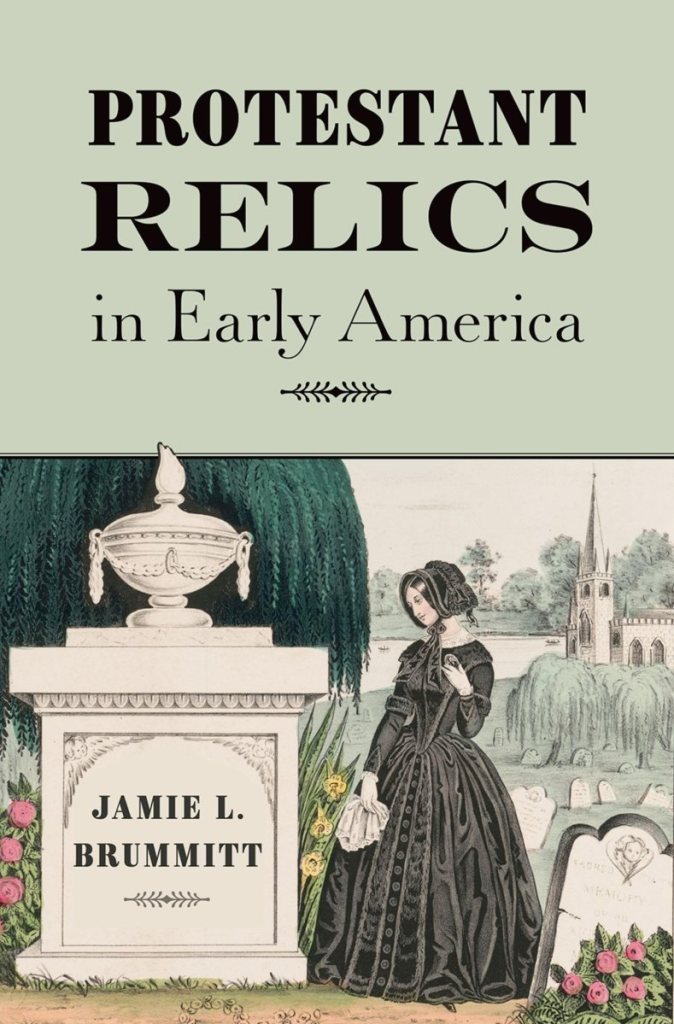 In Protestant Relics in Early America, Jamie L. Brummitt upends long-held assumptions about religion and material culture in the early United States. Brummitt chronicles how American Protestants cultivated a lively relic culture centered around collecting supernatural memory objects associated with dead Christian leaders, family members, and friends. These objects materialized the real physical presences of God, Jesus, the Holy Spirit, and souls of the dead on earth.
As Brummitt demonstrates, people of nearly all Protestant denominations and walks of life—including members of Congress, college presidents, ministers, mothers, free Black activists, schoolchildren, and enslaved people—sought embodied and supernatural sense experiences with relics. They collected relics from deathbeds, stole relics from tombs, made relics in schools, visited relics at pilgrimage sites like George Washington’s Mount Vernon, purchased relics in the marketplace, and carried relics into the American Revolution and the Civil War. Locks of hair, blood, bones, portraits, daguerreotypes, post-mortem photographs, memoirs, deathbed letters, Bibles, clothes, embroidered and painted mourning pieces, and a plethora of other objects that had been touched, used, or owned by the dead became Protestant relics. These relic practices were so pervasive that they shaped systems of earthly and heavenly power, from young women’s education to national elections to Protestant-Catholic relations to the structure of freedom and families in the afterlife.
In recovering the forgotten history and presence of Protestant relics in early America, Brummitt demonstrates how material practices of religion defined early American politics and how the Enlightenment enhanced rather than diminished embodied presence. Moreover, Brummitt reveals how the secular historical method has obscured the supernatural significance of relics for the Protestants who made, collected, exchanged, treasured, and passed them down. This book will be an essential resource for scholars and students of early American history, religion, politics, art, and popular culture.
Jamie L. Brummitt is an Associate Professor of American religions and material culture at the University of North Carolina Wilmington. Brummitt earned her PhD from Duke University. In 2017, Brummitt was the recipient of the Anthony N. B. and Beatrice W. B. Garvan Research Fellowship in American Material Culture at The Library Company of Philadelphia. She is also a past fellow of the George Washington Presidential Library at Mount Vernon; Winterthur Museum, Garden and Library; the Filson Historical Society; and the New England Regional Fellowship Consortium.
c o n t e n t s
Introduction: The History and Presence of Protestant Relics
1 From ‘Memorials and Signs’ to ‘Art That Can Immortalize’: The Evangelical Enlightenment’s Influence on Real Presence in Protestant Relic Culture
2 The ‘Precious Relict[s]’ of George Whitefield: Collecting the Supernatural Memory Objects of a Dead Minister and the Spread of Masculine Mourning in Late Eighteenth-Century Evangelicalism
3 The ‘Invaluable Relique[s]’ of George Washington: Sensing the Heavenly Presence of America’s Savior and the Politics of Protestant Relics in the Early Republic
4 ‘The Reign of Embroidered Mourning Pieces: The Rise and Decline of Handmade Relics in Young Protestant Women’s Education and the ‘Feminization’ of Mourning
5 ‘A Sacred Relic Kept’: The Evangelical ‘Good Death’ Experience and Protestant Relics in the Marketplace
6 ‘Protestant Evidence on the Subject of Relics: Catholic Encounters with Protestant Relic Practices and the Christian Roots of American Civil Religion
7 ‘I Was Not a Slave with These Pictured Memorials’: Supernatural Deathbed Experiences as Justifications for Slavery and the Work of Protestant Relics in Black Liberation
8 The Deaths and Afterlives of Protestant Relics: Or, Why Enlightened People Forgot the History and Presence of Protestant Relics
Notes
Bibliography
◊ ◊ ◊ ◊ ◊
Online Talk | Protestant Relics in Early America with Jamie Brummitt
The Library Company of Philadelphia, Thursday, 20 November 2025, 7pm (ET)
Virtual Event | Free
Registration is available here»
Exhibition | Thomas Patch and the British Grand Tour
Opening this week at the Lewis Walpole Library:
Caricatures, Campagna, and Connoisseurs:
Thomas Patch and the British Grand Tour in Eighteenth-Century Italy
Lewis Walpole Library, Farmington, CT, 10 September — 15 December 2025
Curated by Hugh Belsey
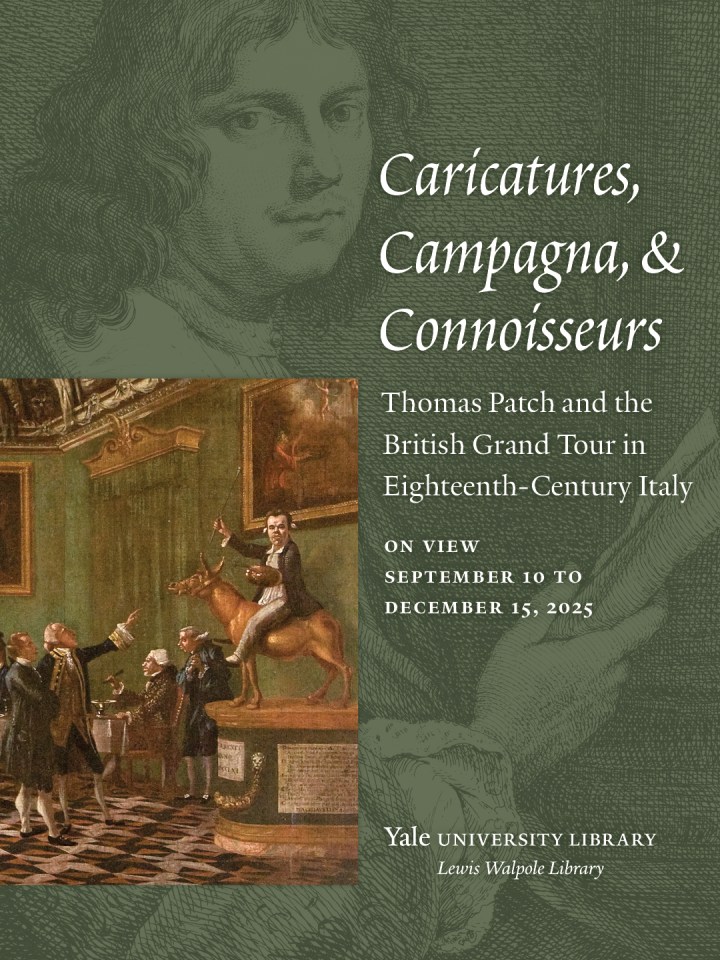 Known primarily as a caricature artist, Thomas Patch (1725–1782) in fact engaged in a much wider array of activities. He was a landscape painter, experimental printmaker, and a dealer of antiquities and old master paintings. He was also among the first scholars of early Renaissance art. This exhibition will explore the many aspects of Patch’s art, life, and associations with the British community of diplomats, tourists, artists, and collectors in Italy.
Hugh Belsey, a graduate of the Universities of Manchester and Birmingham, has lectured to groups in Europe, America, Australia, and Britain. For twenty-three years he was the curator of Gainsborough’s House in Sudbury (UK) where he formed one of the largest collections of the artist’s paintings and drawings. In 2004 he was awarded an MBE in recognition of his museum work. His long-awaited catalogue of portraits by Thomas Gainsborough was published by Yale University Press in February 2019, and was awarded the William W.B. Berger Prize for British Art History in 2020.
The exhibition brochure is available at the Library’s website»
Exhibition Lecture | Caricatures, Campagna, and Connoisseurs
Presented by Hugh Belsey, guest curator and independent scholar
Thursday, October 16, 7pm
Space is limited and advance registration is required.










leave a comment