The Wallace’s History of Collecting Seminars, 2018
From the 2018 schedule:
History of Collecting Seminars
The Wallace Collection, London, 2018
The seminars, typically held on the last Monday of each month, act as a forum for the presentation and discussion of new research into the history of collecting. Seminars are free and open to curators, academics, historians, archivists, and all those with an interest in the subject. Papers are generally 45–60 minutes long and take place at the Wallace Collection between 5.30 and 7pm (except for December’s presentation as noted below). For inquiries, please contact: collection@wallacecollection.org.
29 January
Tessa Murdoch (Deputy Keeper of Sculpture, Metalwork, Ceramics and Glass, Victoria & Albert Museum) and Matthew Winterbottom (Curator of Sculpture and Decorative Arts, Ashmolean Museum, Oxford) , ‘This Jew of Taste’: Sir Ernest Cassel’s Collection of Silver
26 February
Alden Gordon (Paul E. Raether Distinguished Professor of Fine Arts, Trinity College, Hartford), ‘Heureux ceux qui ont un Coeur de bronze . . . “: The French Financial Crisis in the Late Reign of Louis XV and Its Impact on Royal Manufactures and Royal Patronage
26 March
Barbara Pezzini (PhD candidate, University of Manchester, and Editor-in-chief, Routledge-Taylor & Francis Journal), The Politics of Public Collecting: William Gladstone and the National Gallery
30 April
C. Tico Seifert (Senior Curator, Northern European Art, Scottish National Gallery), Collecting Rembrandt’s Art in Britain Please note that this event will take place in the Regatta Room in Durrants Hotel on George Street, located directly behind the Wallace Collection; the 60 available seats will be allocated on a first come first serve basis.
21 May
Kajal Meghani (Exhibition Assistant Curator, Royal Collection Trust), The Prince of Wales’s Indian Collection: The Circulation of Giften from the 1875–76 Tour of India
25 June
Caroline McCaffrey-Howarth (PhD Candidate and History of Art Tutor, University of Leeds), Sèvres Mania? The History of Collection Sèvres Porcelain in Britain in the Later Nineteenth Century
30 July
Elizabeth Pergam (Lecturer, Sotheby’s Institute of Art, New York), Paris over London: Victorian Curator J. C. Robinson’s Collection at Auction
24 September
Saskia van Altena (Cataloguer of prints, Rijksprentenkabinet, Rijksmuseum, Amsterdam), The Sale of Sir Peter Lely’s Paintings and Prints: A Breaking Point in the History of Collection in Britain?
29 October
Alexandre Tissot Demidoff (Independent scholar), The Last Great Demidoff Sale of Paintings
26 November
Catrin Jones (Curator of Decorative Arts, Holburne Museum, Bath), Piercing Together a Collection: Sir William Holburne’s Display Mounts
10 December (please note the 5:00pm start time)
Robert Wenley (Deputy Director, Head of Collections, Barber Institute of Fine Arts, University of Birmingham), ‘Rare and Most Magnificent’: The Picture Collection of Stephen Alers Hankey (1809–1878)
◊ ◊ ◊ ◊ ◊
Note (added 26 April 2018) — The venue change for the April 30 seminar was added.
Research Lunch | Helen Whiting on Duff House and the House of Duff
From the Paul Mellon Centre:
Helen Whiting, ‘Your Beautiful and Hopeful Family’: Dynasty, Duff House, and the House of Duff
Paul Mellon Centre for Studies in British Art, London, 24 November 2017

William Mosman, William Duff, Lord Braco (1697–1763) and His Son George, detail, signed and dated: ‘Gul Mosman Pingebat, 1741’.
This paper will consider the link between a set of family portraits and the house within which they were intended to hang. I will discuss the idea of the ‘family group portrait’ not simply existing in one frame but depicted across several canvases nevertheless conceived as a coherent whole. The focus will be a group of five portraits executed by William Mosman (c1700–1771) in 1741 for William Duff of Braco. The portraits were commissioned to hang in Duff House, the grand family seat designed for Braco by the architect William Adam and built between 1735 when its foundation stone was laid and 1741 when work came to halt due to a dispute between architect and patron. The connection between the portraits, those of other family members and worthies, and the place in which they were designed to hang, I will be argue, constituted a conscious, indeed ostentatious, act of dynastic establishment which was orchestrated by Braco and further developed by his son, James. The tools used in establishing ‘the house of Duff’ as a noble entity was, for both men, a partnership of paint and stone. The paper will offer a close reading of the featured portrait group along with consideration of archival material which highlights the changes in display patterns over time, family relations and dynastic concerns.
Friday, 24 November 2017, 12:30–2:00pm.
Nel Whiting is undertaking an AHRC funded inter-disciplinary PhD at the University of Dundee. She is using Scottish family group portraits from the second half of the eighteenth century along with archival sources to investigate gendered constructions of national and familial identity. She was awarded the Leah Leneman Essay Prize 2010 by Women’s History Scotland for new writing in Scottish gender history and is author of “Gender and National Identity in David Allan’s ‘Small, Domestic and Conversation’ Paintings,” in the Journal of Scottish Historical Studies 34 (May 2014), and “Depictions of Childhood in David Allan’s Family Group Portraiture,” in Childhood and Youth in Pre-Industrial Scotland, ed. Elizabeth Ewan and Janay Nugent (Boydell and Brewer, 2015).
As our events are free, not everyone who asks for tickets comes to our events. To make sure we have a full house we allocate more tickets than there are seats. We do our best to get the numbers right, but unfortunately we occasionally have to disappoint people. Admission is on a first come, first served basis, so please arrive in good time for the start of the event.
Research Seminar | Greg Smith on Thomas Girtin
From the Paul Mellon Centre:
Gregory Smith | Thomas Girtin: An Online Catalogue, Archive, and Introduction to the Artist
Paul Mellon Centre, London, 8 November 2017

Thomas Girtin, Lindisfarne Castle, Holy Island, Northumberland, 1796–97, watercolor, 38 × 52 cm (The Metropolitan Museum of Art).
I will begin by outlining the scope at the outset of a major project to produce an online catalogue covering the drawings, watercolours, and prints by, and after, the short lived but highly productive artist, Thomas Girtin (1775–1802). There are three categories of his works which pose a particular challenge to any cataloguer: the many hundreds of watercolours that he made in collaboration with fellow practitioners; the numerous copies or creative variations that Girtin produced after the works of contemporary artists, both professional and amateur, and after earlier landscape and topographical prints; and, finally, watercolours where the ostensible topographical subject has been lost or effaced as a result of Girtin’s ambitions to transcend the status of his chosen medium. Each of the three categories of problem works pose different challenges, which I will explore through a series of case studies before concluding that, despite the new research opportunities opened up by online searches and the mass digitisation of works on paper, a Girtin catalogue must, by necessity, admit a healthy degree of uncertainty and a fluidity at its margins. 8 November 2017, 6:00–8:00pm.
Greg Smith is an independent art historian who has published extensively on the history of British watercolours and watercolourists, as well as landscape artists working in Italy. He has also worked as a curator at the Whitworth Art Gallery, Manchester, the Design Museum, London, and the Barber Institute of Fine Art, Birmingham. He has organised exhibitions on the work of Thomas Girtin (Tate Britain), Thomas Jones (National Gallery of Wales), and Thomas Fearnley (Barber Institute of Fine Art). As Senior Research Fellow at the Paul Mellon Centre for Studies in British Art, Greg is developing a major online project: Thomas Girtin (1775–1802): An Online Catalogue, Archive and Introduction to the Artist.
Lecture | Iris Moon on the Late Shipwrecks of Jean Pillement
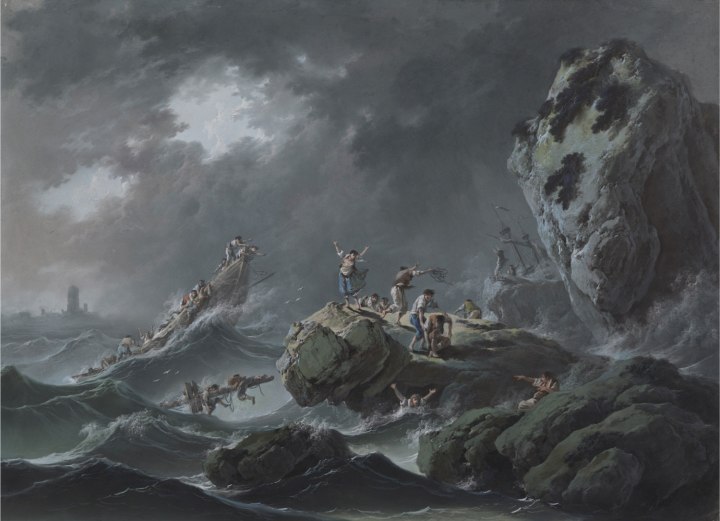
Jean Pillement, A Shipwreck, 1782, pastel on paper (Philadelphia Museum of Art).
◊ ◊ ◊ ◊ ◊
Iris Moon | Rococo Adrift: The Late Shipwrecks of Jean Pillement
University College London, 18 October 2017
Dr. Iris Moon (European Sculpture and Decorative Arts, Metropolitan Museum of Art, New York)
The lecture is part of UCL’s visual culture research seminar Past Imperfect, which aims to explore recent concerns with time: the unfinished past, the future present, the over investment in the contemporary. This year’s theme is Destruction and Demolition.
Seminar Room 6, 21 Gordon Square, London, 6:00–8:00pm
Lecture Series | L’art de l’Ancien Régime
From H-ArtHist:
Lecture Series: L’art de l’Ancien Régime
Deutsches Forum für Kunstgeschichte / Centre allemand d’histoire de l‘art, Hôtel Lully, Paris, 11 October — 4 December 2017
Le Centre allemand d’histoire de l’art organise des conférences publiques dans le cadre de son sujet annuel 2017/18 L’art de l’Ancien Régime – centres, acteurs, objets (Die Kunst des Ancien Régime – Zentren, Akteure, Objekte). Nous avons le plaisir d’accueillir au premier semestre:
11 October 2017, 18.00
Sophie Raux (Université Lumière Lyon 2), Explorer virtuellement un haut lieu du commerce d’art, à Paris, sous la Régence: Gersaint, Watteau et le Pont Notre-Dame
24 October 2017, 18.00
Hannah Williams (Queen Mary University of London), Inside a Parish Church: Art and Religion in 18th-Century Paris
7 November 2017, 18.00
Ulrike Gehring (Universität Trier), Land in Sicht. Verfahren der Landkartierung bei küstennaher Fahrt um 1600
4 December 2017, 18.00
Olivier Bonfait (Université de Bourgogne), Un enjeu national pour la peinture française aux XVIIe et XVIIIe siècles : le grand format
Lecture | Tracy Ehrlich on Carlo Marchionni and the Art of Conversation
From the flyer:
Tracy Ehrlich, Carlo Marchionni and the Art of Conversation:
Architectural Drawing and Social Space in Eighteenth-Century Rome
Cooper Hewitt, Smithsonian Design Museum, New York, 3 November 2017

Carlo Marchionni, Design for a Doorway in the Villa Albani, Rome, 1755–56; pen and brown ink, brush with brown and grey wash, graphite on cream laid paper, 417 × 289 mm (Cooper Hewitt, Smithsonian Museum; photo by Matt Flynn).
In the 1750s the Roman architect Carlo Marchionni (1702–1786) produced a set of highly finished drawings for the villa of the noted collector Cardinal Alessandro Albani. Marchionni’s renderings feature sophisticated figures in fashionable dress conversing and gesticulating at the thresholds of the grand gallery. The figures yield little if any technical information; yet in these drawings the bodies are as architectonic and expressive as the building itself, perhaps even more so. Marchionni’s work diverged from contemporary conventions for architectural drawings, offering his patron not simply a design for a pleasure casino but a distinctive cultural argument that may be traced to models of civility. An eloquence of the body, a sociable kind of living, in short, the art of civil conversation, marks the drawings of Carlo Marchionni.
Tracy Ehrlich, Faculty member, MA in the History of Design & Curatorial Studies Parsons School of Design, The New School, and Smithsonian Institution, Senior Fellow, 2016–17
3 November 2017 at 1:00pm, Lower Level Lecture Hall, Cooper Hewitt, Smithsonian Design Museum
Lunch Lecture | Ulrich Leben on German Cabinetmakers in Paris
Upcoming at the BGC (the lecture is scheduled to be livestreamed; see the website for details). . .
Ulrich Leben, Cabinetmakers of German Origin in Eighteenth-Century Paris
A Chapter in European History of Migration and Transfer of Knowledge and Craft in the Age of Enlightenment
Bard Graduate Center, New York, 9 October 2017
Ulrich Leben will be giving a Brown Bag Lunch presentation on Monday, October 9, at 12:15pm. His talk is entitled “Cabinetmakers of German Origin in Eighteenth-Century Paris: A Chapter in European History of Migration and Transfer of Knowledge and Craft in the Age of Enlightenment.”
The fact that a large number of cabinetmakers working in Paris during the eighteenth century were of German origin is well known. It is therefore surprising that there has never been research on the lives and work of these more than one hundred craftsmen. This talk will present various aspects of a project currently being undertaken by Dr. Ulrich Leben and Miriam Schefzyk on these craftsmen and provide insight into archive-based research in France and abroad exploring questions regarding social, economic, and cultural circumstances. A major goal of this project is the publication of a dictionary of these craftsmen that will be a tool for further work in the field.
E. Ulrich Leben is an independent art historian based in Paris and Associate Curator for the Rothschild Collection at Waddesdon Manor in Buckinghamshire. He teaches classes on French and German decorative arts and interior architecture for the European programs of Parsons, The New School. From 2010 to 2015 he was Visiting Professor and Special Exhibitions Curator at Bard Graduate Center, where in 2013 he co-curated the exhibition Salvaging the Past: Georges Hoentschel and French Decorative Arts from The Metropolitan Museum of Art. After an apprenticeship as a cabinetmaker in Germany he studied the History of Art at the École du Louvre in Paris and received his PhD at the Rheinische Friedrich Wilhelm Universität in Bonn. He is the author of numerous articles and exhibition catalogues on the history of French and German interiors and furniture design.
Lecture | Basile Baudez on Color in Architectural Drawings
Upcoming at the BGC (the lecture is scheduled to be livestreamed; see the website for details). . .
Basile Baudez, Inessential Colors: A History of Color in Architectural Drawings, 16th–19th Centuries
Bard Graduate Center, New York, 3 October 2017
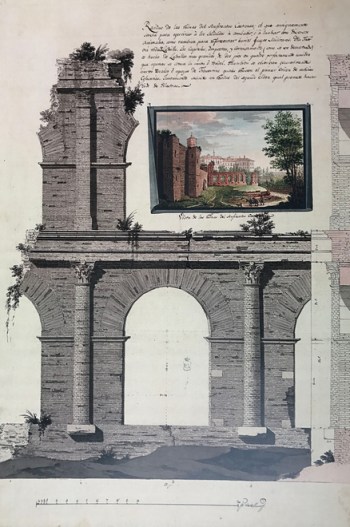
Isidro Velázquez (1765–1840), Roma, Anfiteatro castrense. Alzado, sección y vista de sus ruinas, 1792–96, 48.5 × 32.5cm (Madrid, Biblioteca Nacional Dib/13/5/51).
Basile Baudez will deliver a Françoise and Georges Selz Lecture on Eighteenth- and Nineteenth-Century French Decorative Arts and Culture on Tuesday, October 3, at 6pm. His talk is entitled “Inessential Colors: A History of Color in Architectural Drawings, 16th–19th Centuries.”
Architectural historians have focused on the history of drawing primarily as a project design tool. By applying the methods of art history, this talk traces color as a key player in the long history of rivalry and exchange between European traditions in architectural drawing and practice. While Italian Renaissance drawings were largely monochrome and developed their conventions under pressure from engravers, seventeenth-century European drawings are characterized by a contrast between a colorful German and Dutch world—developed around architect-painters’ designs that influenced French and Spanish draughtsmanship—and a still largely monochrome tradition in Italy and England. At the end of Louis XIV’s reign, French architects adopted color conventions taken from engineers, largely for informational purposes. In the middle of the eighteenth century, however, a color revolution took place, one in which a new generation of architects who were working alongside painters developed a wide chromatic range that was no longer limited to informing the worker but to persuading academic juries and gaining commissions. This eighteenth-century French employment of color laid the foundation for Beaux-Arts architectural drawings in the first half of the nineteenth century, at a moment when English architectural drawings also adopted color in response to the English watercolor movement.
Since 2007, Basile Baudez has been Maître de Conférences in heritage studies and architectural history at Université Paris-Sorbonne, Paris IV. For the 2015–16 year he was a Visiting Scholar in the History of Art Department at the University of Pennsylvania. His research has been supported by fellowships from CASVA at the National Gallery of Art and the Getty Research Institute. He received his PhD from the Ecole Pratique des Hautes Études in 2006 and published his dissertation at the Presses Universitaires de Rennes under the title Architecture et tradition académique au siècle des Lumières. His main areas of research are the history of architectural schools and the Beaux-Arts system as well as the history of architectural representation in the Western world. He co-edited a monograph on Les Hôtels de la Guerre et des Affaires étrangères à Versailles (Paris: Chaudun, 2010) and a volume Chalgrin, architectes et architecture entre l’Ancien Régime et l’Empire (Bordeaux: Blake and Cie, 2016). He has published extensively, including in La Revue de l’Art, Metropolitan Museum Journal, Journal of Art Historiography, Bulletin Monumental, The Burlington Magazine, and Livraisons d’Histoire de l’Architecture. He curated the exhibition À la Source de l’Antique (2011) at the Ecole des Beaux-Arts, devoted to Italian, Russian, and French neo-classical architectural drawings, and he co-curated, with Nicholas Olsberg, the exhibition Civic Utopia, France 1765–1837 (2016–17) at the Courtauld Institute of Art. His current book project addresses the history of color in architectural representation from the Renaissance to the nineteenth century.
Lecture Tour | Wolf Burchard on Charles Le Brun
 Wolf Burchard, The Sovereign Artist: Charles Le Brun and the Image of Louis XIV
• Charleston Library Society, Charleston
Tuesday, 26 September 2017, 6:00
• Institute of Classical Architecture and Art / Boston Design Center
Friday, 29 September 2017, 2:00
• Institute of Classical Architecture and Art / New York School of Interior Design
Thursday, 5 October 2017, 6:00
• National Gallery of Art, Washington D.C.
Friday, 6 October 2017, 3:30
• The Bard Graduate Center, New York
Tuesday, 10 October 2017, 12:15
King Louis XIV’s favorite artist, Charles Le Brun (1619–1690) has often been described as a “dictator of the arts in France”—a view Burchard reassesses in his new book, The Sovereign Artist (Holberton 2017). Le Brun was a gifted and versatile artist, an excellent painter and designer of tapestries, sculpture, architecture, and furniture. As Louis XIV’s principal painter and director of the Gobelins manufactory, he sought to translate the Sun King’s claim for absolute power into a visual form. This lecture will explore Le Brun’s different fields of activities and his relationship to the great monarch.
Wolf Burchard, an art and architectural historian and a specialist on seventeenth- and eighteenth-century royal patronage, is the Furniture Research Curator at Britain’s National Trust. From 2009 to 2014 he was Curatorial Assistant at the Royal Collection Trust, where he assisted Desmond Shawe-Taylor, Surveyor of The Queen’s Pictures, in curating The First Georgians: Art & Monarchy, 1714–1760, an exhibition held at The Queen’s Gallery, Buckingham Palace, to commemorate the tercentenary of George I’s accession to the British Throne. He studied history of art and architecture at the universities of Tübingen and Vienna as well as the University of London, where he earned the MA and PhD at the Courtauld Institute of Art. He regularly publishes and lectures on art and architectural patronage at the British, French, and German courts. He is a Trustee of the Georgian Group and a member of the Committee of the Society for Court Studies and of the Events Committee and Editorial Panel of the Furniture History Society.
Seminar | The Interiors of Jean de Jullienne’s Paintings Collection
From the seminar flyer:
Seminars in the History of Collecting
Laura Langelüddecke | Lieux de Collection: The Interiors of Jean de Jullienne’s Paintings Collection
The Wallace Collection, London, 26 June 2017
This seminar focuses on entrepreneur, amateur, and collector Jean de Jullienne (1686–1766), whose comprehensive activities are paradigmatic of the heyday of private collecting during the Régence period. Chiefly known for his substantial collection of Dutch, Flemish, and French paintings, Jullienne also spent lavishly on furniture and sculpture, as well as porcelain, lacquer objects, and other exotic curiosities. Director of the Manufacture royale des Gobelins, the leading producer of tapisseries and other luxurious furnishings, his private hôtel adjacent to the manufactory was at the heart of a dynamic artistic milieu that defined the style of contemporary fashionable interiors.
While recent research on Jullienne and fellow collectors of his time has focused on the identification of individual paintings and the social and professional networks involved in the formation of these cabinets, little attention has been given to the interiors which housed these works. Understanding the collection as an intrinsic part of the domestic realm, this seminar will investigate the creation and modification of domestic spaces to accommodate works of art in early eighteenth-century Paris. Taking into account archival evidence as well as contemporary writings on architecture and interior design, the paper will explore the principles according to which an interior intended for the display of paintings was conceived and how the juxtaposition of different colours, textures, and material qualities was used to impact the sensory effect of the presentation.
The Wallace Collection Lecture Theatre, Monday, 26 June, 5:30pm (free).
Laura Langeluddecke is a PhD candidate at the University of Bonn and Assistant Curator at The Wallace Collection.










leave a comment