Lecture | Mr. Boswell Goes to Corsica

◊ ◊ ◊ ◊ ◊
From The Lewis Walpole Library:
David A. Bell | Mr. Boswell Goes to Corsica: Charismatic
Authority in the Age of Democratic Revolutions
22nd Lewis Walpole Library Lecture
Yale Center for British Art, New Haven, 6 October 2016
David Bell’s lecture examines how new ways of imagining political leadership emerged during the Enlightenment, across the Atlantic world, using as a case study the way the Corsican independence leader Pasquale Paoli become an unexpected hero in Britain and its American colonies. He then speculates on how these ways of imagining political leadership helped shape the character of the great Atlantic revolutions of the century’s end. The lecture (held in the Yale Center for British Art Lecture Hall and starting at 5:30pm on Thursday, October 6) is free and open to the public.
David A. Bell, Sidney and Ruth Lapidus Professor in the Department of History at Princeton University, is a historian of early modern France with a particular interest in the political culture of the Old Regime and the French Revolution. He earned a Ph.D. from Princeton University in 1991. Prior to joining Princeton’s faculty in 2010, he taught at Yale University (1990–96) and at Johns Hopkins University, where he held the Andrew W. Mellon chair in the Humanities and served as dean of faculty in the School of Arts and Sciences. He is the author of five books including, most recently, Shadows of Revolution: Reflections on France, Past and Present (Oxford University Press, 2016). He is currently working on a comparative and transnational history provisionally entitled “Men on Horseback: Charismatic Authority in the Age of Democratic Revolutions.” He is also a frequent contributor to general-interest publications on a variety of subjects ranging from modern warfare to the impact of digital technology on learning and scholarship.
Call for Proposals | History of Collecting Seminars
From The Wallace Collection:
History of Collecting Seminars
The Wallace Collection, London, 2017
Proposals due by 12 September 2016
The seminar series was established as part of the Wallace Collection’s commitment to the research and study of the history of collections and collecting, especially in the eighteenth and nineteenth centuries in Paris and London. In 2017, as in previous years, we plan to organise a series of 10 seminars. We are keen to encourage contributions covering all aspects of the history of collecting, including:
• Formation and dispersal of collections
• Dealers, auctioneers and the art market
• Collectors
• Museums
• Inventory work
• Research resources
The seminars, which are normally held on the 4th Monday of every month during the calendar year, excluding August and December, act as a forum for the presentation and discussion of new research into the history of collecting. Seminars are open to curators, academics, historians, archivists and all those with an interest in the subject. Papers are generally 45–60 minutes long and all the seminars take place at the Wallace Collection between 5.30 and 7pm. If interested, please send a short text (500–750 words), including a brief CV, indicating any months when you would not be available to speak, by 12 September 2016. For more information and to submit a proposal, please contact: collection@wallacecollection.org.
Please note that we are able to contribute up to the following sums towards speakers’ travelling expenses on submission of receipts:
• Speakers within the UK – £ 80
• Speakers from Continental Europe – £ 140
• Speakers from outside Europe – £ 200
Remaining lectures in this year’s schedule include:
26 September: Silvia Davoli, Paul Mellon Centre Research Curator, Strawberry Hill House, The Horace Walpole Collection: Researching the Strawberry Hill Sale of 1842: A Real Baedeker’s Guide of Taste
31 October: Hannah Kinney, DPhil candidate, History of Art, University of Oxford: Con fiducia: Commissioning Copies of Antiquities in Eighteenth-Century Florence
28 November: Jessica Feather, Allen Fellow at the Paul Mellon Centre: Collecting the Modern Aesthetic: Britain at the fin de siècle
All lectures start at 17:30 in the Lecture Theatre. Booking not required.
Exhibition | Character Mongers
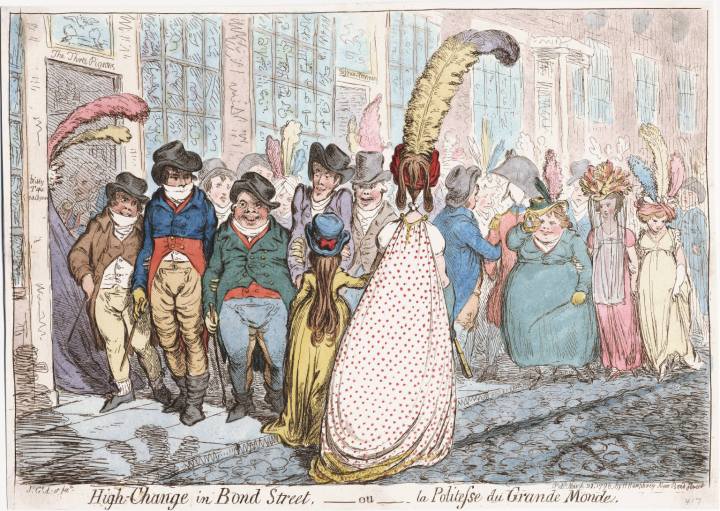
James Gillray, High Change in Bond Street, ou, La Politesse du Grande Monde, published March 27th 1796 by H. Humphrey, etching with hand coloring (The Lewis Walpole Library, 796.03.27.01+).
◊ ◊ ◊ ◊ ◊
From The Lewis Walpole Library:
Character Mongers, or, Trading in People on Paper in the Long 18th Century
The Lewis Walpole Library, Farmington, CT, 10 October 2016 — 27 January 2017
Curated by Rachel Brownstein and Leigh-Michil George
In the course of the long eighteenth century—the Age of Caricature, and of The Rise of the Novel—the British reading public perfected the pastime of savoring characters. In a flourishing print culture, buying and selling likenesses of people and types became a business—and arguably an art. Real and imaginary characters—actual and fictional people—were put on paper by writers and graphic artists, and performed onstage and off. The exigencies of narrative, performance, and indeed of community conspired to inform views of other people—friend and foe, fat and thin—as tellingly, characters. “For what do we live,” Jane Austen’s Mr. Bennet would ask rhetorically in 1813, “but to make sport for our neighbours and laugh at them in our turn?”
This exhibit will feature images by William Hogarth, James Gillray, Thomas Rowlandson, Thomas Patch, Edward Francis Burney, Francis Grose, and G.M. Woodward, excerpts from novels by Jane Austen, Frances Burney, Henry Fielding, and Laurence Sterne, and examples of graphic collections published by Matthew and Mary Darly and Thomas Tegg that marketed caricature as entertainment.
◊ ◊ ◊ ◊ ◊
Public Talk | Eating People
Rachel Brownstein (Professor Emerita, Brooklyn College and The Graduate Center, CUNY)
The Lewis Walpole Library, Farmington, CT, Wednesday, 16 November 2016, 7:00pm
Offered in collaboration with the Farmington Libraries. Advance registration required.
◊ ◊ ◊ ◊ ◊
Graduate Student Seminar | Character and Caricature
Rachel Brownstein (Professor Emerita, Brooklyn College and The Graduate Center, CUNY)
The Lewis Walpole Library, Farmington, CT, Friday, 18 November 2016
Caricature relies on a double take: you recognize both the person represented and the artist’s critical, comic view, register both the familiar and the strange. Basic to what E.H. Gombrich called “the cartoonist’s arsenal” is the contrast between extremes, differences in scale (fat and thin, short and tall) that define a character in relation to another (the thing it is not). Pairings proliferate, sometimes by accident, always by design.
History has a hand in the process. The fathers of Charles James Fox and William Pitt were also political rivals, and Fox in fact was plump and Pitt skinny. But as Simon Schama imagines it, the artist James Gillray, commissioned in 1789 to produce a formal portrait of Pitt, could not but see him with a caricaturist’s eye, as “angular where Fox was sensual, repressed where Fox was spontaneously witty, … the upper lip stiff as a board, where both of Fox’s were fat, shiny cushions.” Schama speculates, “How could he resist? He didn’t. The ‘formal portrait’ looked like a caricature, or at the very least a ‘character.’” Is the one a version of the other?
Coming with different questions from different disciplines, we will consider caricatures by Gillray and others, bringing fresh perspectives to the questions they raise about the relation of caricature to character and to being ‘a character,’ as well as to the trick of contrast, to historical context, and to point of view.
The program is open by application. Preference will be given to graduate students. For further details contact Cynthia Roman, cynthia.roman@yale.edu. Yale Shuttle to and from New Haven. Accommodation at the Library’s Timothy Root House may be available at no charge upon inquiry.
◊ ◊ ◊ ◊ ◊
Talk with Edward Koren
Edward Koren (Cartoonist, The New Yorker Magazine)
Sterling Memorial Library Lecture Hall, New Haven, 13 December 2016, 5:30pm
“In my cartoon drawings, I like getting things right… What captures my attention is all the human theater around me. I can never quite believe my luck in stumbling upon riveting minidramas taking place within earshot (and eyeshot), a comedy of manners that seem inexhaustible. And to be always undercover makes my practice of deep noticing more delicious. I can take in all the details as long as I appear inattentive—false moustache and dark glasses in place. All kinds of wonderful moments of comedy happen right under my nose…”
On Cartooning, by Edward Koren
Edward Koren’s iconic images record the comedy of manners in society and politics that have captured his attention for decades. In this talk, he will reflect on his career as a New Yorker artist, and on the many and diverse influences that have contributed to the development of his thinking and drawing.
◊ ◊ ◊ ◊ ◊
The Art of Observational Satire: A Conversation
Rachel Brownstein and Edward Koren, moderated by Cynthia Roman
Beinecke Rare Book and Manuscript Library, New Haven, Friday, 14 December 2016, 2:00pm
Edward Koren, a long-time cartoonist, and Rachel Brownstein, a literary scholar, will reflect on the enduring tradition of social satire. Space is limited. Please register in advance.
Note (added 17 October 2016) — The original posting incorrectly listed the 13 December talk as scheduled for mid-afternoon. My apologies for any confusion –CH.
Conference | Human Kind: British and Australian Portraits
From The University of Melbourne:
Human Kind: Transforming Identity in British and Australian Portraits, 1700–1914
The University of Melbourne & National Gallery of Victoria, Melbourne, 8–11 September 2016
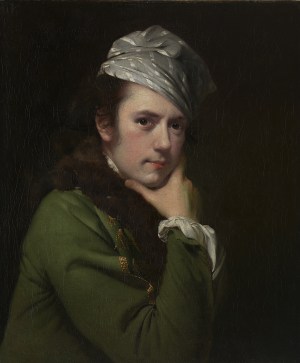
Joseph Wright of Derby, Self-portrait, 1765–68, oil on canvas (Melbourne: National Gallery of Victoria)
Inspired by the outstanding collection of the National Gallery of Victoria, this interdisciplinary conference will be the largest gathering of international and Australian scholars to focus on portraits. It will provide a unique opportunity to explore both British and Australian portraits through a dynamic interchange between academics and curators. Over sixty speaker will explore various aspects of British and Australian portraiture between 1700 and 1914, both as separate fields and as overlapping or comparative studies. Full details of the program can be found here. Keynotes and a selection of papers on eighteenth-century themes are listed below.
Keynotes
• David H. Solkin FBA Walter H Annenberg Professor of the History of Art, The Courtauld Institute of Art: ‘English or European? Portraiture and the Politics of National Identity in Early Georgian Britain’
• Kate Retford Senior Lecturer, Department of History of Art, Birkbeck, University of London: ‘Conversing in and with the Landscape: Edward Haytley’s Portraits of The Brockman Family at Beachborough’
• David Hansen Associate Professor, Centre for Art History & Art Theory, Australian National University: ‘Skin and Bone: Surface and Substance in Anglo-Colonial Portraiture’
• Martin Myrone, Lead Curator, Pre-1800 British Art, Tate Britain, London ‘Portrait and Autograph: Art and Identity in the Age of Reform, c.1820–40’
• Anne Gray Emeritus Curator, National Gallery of Australia, Canberra ‘The Two Titans of Australian Portraiture: Roberts and Lambert’
Sessions and papers on eighteenth-century themes
F R I D A Y , 9 S E P T E M B E R 2 0 1 6
The British Portrait and Europe
• Mark Shepheard, University of Melbourne: ‘The Servile Drudgery of Copying Faces’: Batoni’s Italian Portraits through British Eyes’
• Callum Reid, University of Melbourne: ‘Driven by Glory’: British Self-Portraits in the Galleria degli Uffizi’
• Matthew Ducza, University of Melbourne: ‘Dutch and Flemish Art in Eighteenth-Century Britain: Its Influence on Sir Joshua Reynolds’
• Sophie Matthiesson, National Gallery of Victoria: ‘Joseph Highmore’s Portrait of David Le Marchand’
Portraits, Prints, and the Business of Art
• Kathleen Kiernan, University of Melbourne: ‘Going…Going… Gone!: Portraits of Auctioneers and Printsellers in London, 1741–1800’
• Louise Box, University of Melbourne: ‘Into the Light: An ‘Unknown’ Mezzotint after Romney at the National Gallery of Victoria’
• Sue Russell, Independent scholar: ‘The Dealer as Artist: Robert Bragge’s Portrait of His Father, the Reverend Robert Bragge’
The Theatre of the Self
• Jennifer Jones-O’Neill, Federation University: ‘Male Sensibility in Late Eighteenth-Century Portraits’
• Matthew Watts, University of Melbourne: ‘Reynolds’s Lady Frances Finch: The Female Form as a Site for Social Meaning’
• Matthew Martin, National Gallery of Victoria: ‘Fragile Identities: Eighteenth-Century British Portraits in Porcelain’
Portraits and Empire
• Deirdre Coleman, University of MelbourneL ‘Susanna Gale: A Rose by Any Other Name’
• Kate Fullagar, Macquarie University: ‘Joshua Reynolds’s Portraits of Empire’
• Kim Clayton-Greene, University of Melbourne: ‘The Portrait of Queen Victoria in Colonial Victorian Print Culture’
S A T U R D A Y , 1 0 S E P T E M B E R 2 0 1 6
Empathy
• Angela Hesson, University of Melbourne: ‘Eighteenth-Century Portrait Miniatures as Love Tokens’
• Gillian Russell, University of Melbourne: ‘Emma Hamilton’s Performance Art: ‘Screening’ the Attitudes’
• Jennifer Milam, University of Sydney: ‘Sympathetic Understanding and Viewing Portraiture during the Enlightenment’
Artists and Sitters
• Mark Ledbury, University of Sydney: ‘James Northcote’s Godwin: Friendship, Politics and Likeness in Radical London’
• Georgina Cole, National Art School, Sydney: ‘Blind Justice: Identity and Allegory in Nathaniel Hone’s Portraits of Sir John Fielding’
• Vivien Gaston, University of Melbourne and National Gallery of Victoria: ‘Artist, Actress, Lover: Zoffany’s Portrait of Elizabeth Farren, c.1780’
Display | Jacques-Louis David’s ‘Napoleon’
Now on view at AIC:
Jacques-Louis David’s Napoleon
Art Institute of Chicago, 28 May — 9 October 2016

Jacques-Louis David, The Emperor Napoleon in His Study at the Tuileries, 1812 (Washington, D.C.: National Gallery of Art)
The dominant French painter of the late 18th and early 19th century, Jacques-Louis David responded with brilliant artistry to the extraordinary events unfolding during the French Revolution and its aftermath. With his painting The Emperor Napoleon in His Study at the Tuileries, David created the quintessential image of the legendary leader as a figure of deliberation and action. At the time, Napoleon’s empire was at its height—he had not yet led his army on the disastrous invasion of Russia—and David himself had referred to Napoleon as “the man of the century.” For his painting of this exalted figure, David drew on the tradition of the state portrait, a full-length standing representation that had served as the public image of a ruler since the Renaissance, but he brought new life to the conventional type by placing Napoleon in the foreground and framing him with details that tell a story. David described that story in this way: “Having passed the night composing his Napoleonic code, [the emperor] only realizes that it is dawn from the guttering candles that are about to go out. The clock has just struck four in the morning. With that, he rises from his desk to strap on his sword and review his troops.”
The loan of this great painting from the National Gallery of Art, Washington, D.C., provides occasion to highlight related paintings, works on paper, and sculpture in the Art Institute’s own collection. Featured objects include a rarely exhibited sketchbook of studies for another renowned Napoleonic painting by David, The Distribution of the Eagle Standards, which records the ceremonial oath-taking of the generals and officers of the imperial army following Napoleon’s coronation in 1804. This original sketchbook is displayed near an interactive digital reconstruction that allows visitors to turn the book’s pages.
In addition to the NGA loan, the display includes Marie Denise Villers’s 1801 portrait of Charlotte du Val d’Ognes, on loan from The Met (though I’ve been unable to find any mention of it online). The digitized sketchbook is remarkable, but I’m not sure why it’s not also available through the AIC website. –CH
◊ ◊ ◊ ◊ ◊
Lecture | Napoleon, and the Legacy of the Storming of the Bastille
Fullerton Hall, Art Institute of Chicago, 14 July 2016, 2:00pm
In honor of Bastille Day, this lecture interweaves a discussion of Jacques-Louis David’s Napoleon with the history of the Bastille as event, monument, and symbol. Registration required—register today!
Lecture | Aaron Wile, Watteau: Making as Meaning
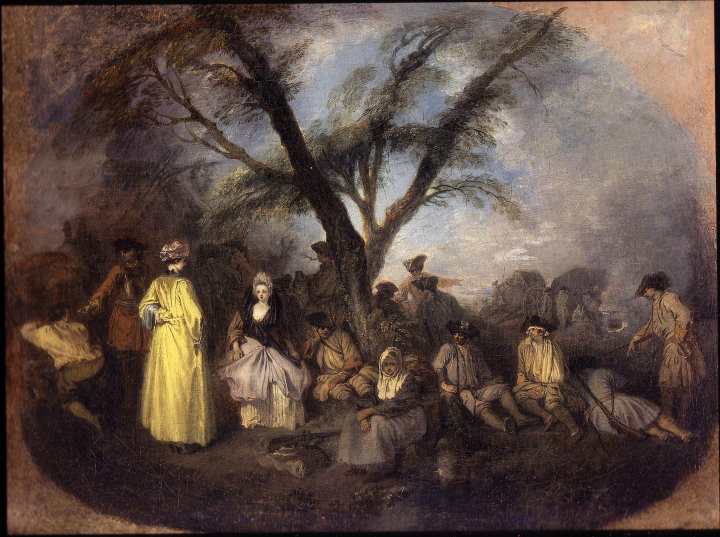
Jean-Antoine Watteau, The Halt (Alte), ca. 1710–11, oil on canvas, 13 × 17 inches
(Madrid: Museo Thyssen-Bornemisza)
◊ ◊ ◊ ◊ ◊
Next week at The Frick:
Aaron Wile, Watteau: Making as Meaning
The Frick Collection, New York, 13 July 2016
Jean-Antoine Watteau’s military works proffer a modern vision of war in which the soldier’s inner life is brought to the fore. This talk, presented by the curator of the special exhibition Watteau’s Soldiers: Scenes of Military Life in Eighteenth-Century France (on view until October 2), examines how the problem of representing interiority informed the artist’s working methods. Wednesday, July 13, 6pm.
Aaron Wile is the Anne L. Poulet Curatorial Fellow at The Frick Collection.
Course | The Country House: Art, Politics, and Taste
From the Paul Mellon Centre for Studies in British Art:
Public Lecture Course | The Country House: Art, Politics, and Taste
Paul Mellon Centre for Studies in British Art, London, 13 October — 1 December 2016
The Paul Mellon Centre is pleased to announce the 2016 Public Lecture Course: The Country House: Art, Politics, and Taste. The course has been developed in conjunction with the research project Country House: Collections and Display, and both will explore various facets of the collections and display of art in the country house in Britain and Ireland from the sixteenth century to the present day.
The Country House course will be taught by Martin Postle, Deputy Director of Grants and Publications; Jessica Feather, Allen Fellow at the Paul Mellon Centre; and other distinguished scholars from the field. This year’s course will run for eight lectures and will continue to be held weekly on Thursday evenings starting with an informal reception at 18.30. Lectures will then begin at 19.00 followed by a discussion session until 20.30.
The course requires some preparation on the part of the participant. Each lecture will have at most two readings (provided electronically ahead of the start of the course), which participants are strongly encouraged to read in order to have some background knowledge on the topics being discussed in class each week.
As an educational charity the Paul Mellon Centre strives to promote and support academic research into the history of British Art. The Public Lecture Course, which will be free to attend, offers an exciting opportunity to broaden our audiences and to communicate the newest and most original research on British art in an engaging and accessible way.
The Country House will take place on Thursday evenings between 13th October and 1st December 2016 in the Lecture Room at the Paul Mellon Centre. The course syllabus will be made available in July. Registration will open to the public on 1st August 2016. The reading list will be circulated to participants in September.
Lecture Programme for Art Antiques London, 2016
Art Antiques London
Albert Memorial West Lawn, Kesington Gardens, 24–30 June 2016
Albert Memorial and Kensington Gardens once again provide the stunning backdrop to one of London’s most exciting and glamorous art and antique fairs. Held in a beautiful bespoke pavilion opposite the Royal Albert Hall and close to the site of the Great Exhibition of 1851, Art Antiques London brings together leading international dealers and discerning visitors from all over the world, who can buy with confidence at this strictly vetted sumptuous summer showcase for the arts. The fair is complemented with a full lecture programme.
◊ ◊ ◊ ◊ ◊
Saturday, 25 June 2016, 11.30–12.30
Elisabetta Dal Carlo (Curator, The Fondazione Querini Stampalia, Venice), “Geminiano Cozzi, His Manufactory, and Its Porcelain”
During the eighteenth century, the Serenissima Repubblica was the only State which boasted no less than four porcelain factories, and it is remarkable that none of them had been founded by public decree, but by private initiative. The manufactory founded by Geminiano Cozzi in 1763 achieved a great success in Venice and was active until 1812. The factory was located in San Giobbe, Canaregio and followed a strict trade policy in order to exclude foreign imports in the Venetian market. The lecture will present the story of the manufactory, its huge production of high quality porcelain decorated with rich and brilliant colours, and will focus on the finest pieces featuring all the Venetian charm.
Almost 250 years later, Venice has dedicated a fascinating exhibition to this extraordinary entrepreneur which explores the long activity of the factory and recognizes its rightful place among other European manufactures. The exhibition is the first retrospective on the Cozzi manufactory and offers the public more than 600 items on view, an important collection from national and international museums, enriched by rare pieces from private collections that have never been displayed before. It takes place in Venice, Ca’Rezzonico, Museo del Settecento veneziano from March 18th to July 12th 2016.
Elisabetta Dal Carlo is an art historian, a scholar of decorative arts between baroque and neoclassical styles and a specialist in eighteenth-century ceramics. Curator, Fondazione Querini Stampalia, Venice. She graduated in History of Art at Ca’Foscari University in Venice, and she obtained her Ph.D. in History of Art at Siena University. She lectured in Italy and abroad (London and Paris) on the art of porcelain and she edited some catalogues of decorative arts collections and various publications on Venetian and Veneto art history.
◊ ◊ ◊ ◊ ◊
Saturday, 25 June 2016, 3.00–4.00
Suzanne Findlen Hood (Curator of Ceramics and Glass, Colonial Williamsburg Foundation), “Ceramic Treasures from the Colonial Williamsburg Collection”
Colonial Williamsburg’s collections illuminate our understanding of colonial Virginia and the larger Anglo-American world. In addition to objects of everyday life, Williamsburg has also collected the finest British and American arts. Explore the treasures of Colonial Williamsburg’s ceramics collection from porcelain produced by Chelsea, Bow, and Worcester to exceptional English delft. From a first edition Portland vase, to seventeenth-century German stoneware, Williamsburg’s collection is full of masterpieces that illustrate that teapots and plates are more than just dishes. This lecture will reacquaint you with some old friends and introduce you to some of Colonial Williamsburg’s lesser known strengths. With two museums and more than eighty eighteenth-century buildings, ‘collecting colonial’ in the twenty-first century offers a world of variety.
Suzanne Findlen Hood is the curator of ceramics and glass at Colonial Williamsburg. She has had the privilege of working at Colonial Williamsburg since 2002. Ms. Hood holds a B.A. in history from Wheaton College in Massachusetts and an M.A. from the Winterthur Program in Early American Culture and the University of Delaware. Prior to coming to Colonial Williamsburg, Ms. Hood was employed at The Chipstone Foundation in Milwaukee, Wisconsin. Her research has focused on ceramics owned and used in seventeenth- and eighteenth-century America with a particular emphasis on archaeological ceramics, Chinese export porcelain, salt-glazed stoneware, and British pottery. Ms. Hood is co-author with Janine Skerry of Salt-glazed Stoneware in Early America, winner of the American Ceramic Circle Book Award for 2009. Her most recent exhibition, China of the Most Fashionable Sort: Chinese Export Porcelain in Colonial America, is currently on view at the DeWitt Wallace Decorative Arts Museum, one of the Art Museums of Colonial Williamsburg.
◊ ◊ ◊ ◊ ◊
Monday, 27 June 2016, 11.30–12.30
Rosalind Sword (BA Cantab, Author and Lecturer), “Coloured Worcester Porcelain of The First Period: The H.R. Marshall Collection at The Ashmolean Museum”
To celebrate the publication of the new Worcester catalogue of the H.R. Marshall Collection at the Ashmolean Museum in August, Rosalind Sword will talk about the highlights of the Marshall collection. Drawing on Marshall’s own papers, the speaker will give further insights into how this amazing, academic, and encyclopaedic collection was formed. Highlights to be discussed will include a rare garniture of five vases decorated by James Giles with naturalistic birds, the ‘Grubbe’ tea jar also by Giles (its partner is in the Museum of Royal Worcester), O’Neale Vases and dishes, a Duvivier signed and decorated teapot, a teapot from the Theatrical Service, and an amazing pair of candlesticks in under-glaze blue. Particular attention will be paid to rare items from the first ten years of the factory such as a Wigornia type cream boat, a large jug decorated with the Stag Hunt pattern, a cylindrical vase with European Figures possibly decorated by O’Neale, tall vases, and many covetable small bottles and dishes of different shapes and decoration. Examples of other items of great interest to Marshall will also be discussed such as comparative or prototype pieces from other factories and armorial porcelain not featured in depth in his own book. This unparalleled 20th-century collection, now re-displayed for the 21st century viewer in the Ashmolean, is an amazing insight into this extraordinary Worcester collection.
◊ ◊ ◊ ◊ ◊
Monday, 27 June 2016, 5.15–6.30
“Face to Face: Dame Rosalind Savill in Conversation with Richard, 10th Duke of Buccleuch and 12th Duke of Queensberry”
In this conversation Dame Rosalind and the 10th Duke of Buccleuch will discuss the extraordinary task of preserving and presenting four most wonderful houses and their sumptuous art treasures in the United Kingdom: Boughton House (The English Versailles), Drumlanrig Castle, Bowhill and Dalkeith Palace in Scotland. His legacy will not simply be one of stewardship and scholarship but also creating innovative exciting landscape projects.
Dame Rosalind Savill DBE, FBA, FSA, Curator Emeritus, The Wallace Collection, London, became a Museum Assistant in the Ceramics Department of the Victoria and Albert Museum in 1973, moving to the Wallace Collection in 1974. There she worked for thirty-seven years, becoming an Assistant Director in 1979 and Director in 1992, and retired in 2011. Her major publication is The Wallace Collection: Catalogue of Sèvres Porcelain, 3 vols, 1988, which won her the National Art-Collection Fund prize for Scholarship in 1990; she has written numerous articles and papers, chiefly on Sèvres porcelain. In 1990 she became a Fellow of the Society of Antiquaries, in 2000 she was awarded a CBE for Services to the Study of Ceramics, in 2006 she became a Fellow of the British Academy, and in 2009 she was awarded a DBE for Services to the Arts. She has Visiting Professorships from the University of Buckingham and the University of the Arts London, won the European Woman of Achievement Award (Arts and Media) 2005 and was a Member of the Conseil d’Administration at Sèvres Cité de la Céramique. Currently her Trusteeships include: the Royal Collection Trust, the Buccleuch Living Heritage Trust and The Wallace Collection Foundation. Dame Rosalind is also President of the French Porcelain Society and of the Academic Committee at Waddesdon Manor.
◊ ◊ ◊ ◊ ◊
Tuesday, 28 June 2016, 11.00–5.00
“The English Ceramics Circle: Study Day | A Taste for the Antique, The Neo-classical Style, and Ceramics in England, ca. 1770–1800″
• Matthew Martin (Curator, NG Victoria), Introduction
• Oliver Fairclough (Hon. Research Fellow, N M Wales), ‘A Very Masterly Stile’: The British Taste for Sèvres Porcelain, 1760–1790
• James Lomax (F.S.A., Emeritus Curator of Collections at Temple Newsam House), The Neo-classical Style and Ceramics at Temple Newsam
• Diana Edwards (porcelain researcher and author), Dry-bodied Pottery
• Leslie Grigsby (Senior Curator of Ceramics and Glass, Winterthur), Some Neo-classical Sources
• Roger Massey (porcelain researcher and author), Derby Bisque Figures
• Patricia Ferguson (ceramics advisor to the National Trust), Vases and Garnitures
• Nicholas Panes (porcelain researcher and author), Bristol Porcelain
Tickets (including a three-course dinner) £110 ECC members. £135 non-ECC members; lectures only £70 ECC members, £85 non-ECC members. For further information please visit the English Ceramics Circle website. Booking information is available here.
◊ ◊ ◊ ◊ ◊
Wednesday, 29 June 2016, 11.30–12.30
Sally Kevill-Davies (Independent writer and researcher), “Chelsea ‘Hans Sloane’ Botanical Porcelain: Visions of Arcadia and America in the English Landscape Garden”
Marking the 300th anniversary of the birth of Lancelot (‘Capability’) Brown (1716–1783), this lecture examines the influx of unknown American trees and shrubs into England during the first decades of the eighteenth century. This was initiated largely by Peter Collinson (1694–1768), a London cloth merchant with a passion for botany, in response to the Enlightenment interest in the natural world, and the desire by English aristocrats to find trees and shrubs with which to adorn their estates in the new fashion for landscape gardening. Through his American contacts Collinson was put in touch with John Bartram (1699–1777), a Pennsylvania farmer, whom he paid to go on hazardous expeditions into virgin territory in search of new plants. These were shipped across the Atlantic, and were eagerly cultivated by London nurserymen, Philip Miller at the Chelsea Physic Garden, and Collinson himself, for distribution to the aristocracy for their fashionable landscape gardens. Many of the plants were painted by Georg Dionysius Ehret (1708–1770) and later engraved, and these images were copied onto porcelain at Nicholas Sprimont’s Chelsea porcelain factory during the 1750s. Thus, the sensational new plants of the American wilderness and of the landscape garden were, for a few years, pictured at the tables of elite Society.”
Sally Kevill-Davies started her ceramic career as a specialist at Sotheby’s, where she worked for nine years. She also worked on re-cataloguing the English porcelain at the Fitzwilliam Museum in Cambridge and organised an exhibition of Chelsea porcelain for the Chelsea Festival, 1999. She wrote the catalogue, Sir Hans Sloane’s Plants on Chelsea Porcelain for an exhibition in June 2015.
◊ ◊ ◊ ◊ ◊
Wednesday, 29 June 2016, 3.00–4.00
Katharina Hantschmann (Curator for Ceramics at the Bavarian National Museum, Munich and The Ernst Schneider Collection of Meissen Porcelain, Lustheim Castle), “Chinese and Meissen Porcelain of the Bavarian Elector Karl Albrecht: An Exercise in Propaganda”
When in 1740 the German Emperor Karl VI died without a male heir, it was the only time in modern history that a member of the Habsburg family was not elected emperor but one of the other German electors, the Bavarian ruler Karl Albrecht (1697–1745). He substantiated his claim to the title of emperor by detailing familial relationships dating back to the sixteenth century. His dynastic ambitions are reflected in the prestigious and magnificent developments he made to the Munich court decades before, such as commissioning the building of the Reiche Zimmer (‘rich apartment’) in 1730. Also his acquisitions and presentations of exceptional Chinese and Meissen porcelain services bear witness to the elector’s aspirations. A unique service magnificently etched with Augsburg gold decoration on Chinese and Meissen porcelain was probably displayed on a buffet on festive occasions. The Bavarian electors were also early owners of Meissen porcelain, such as four early tea services with Chinese scenes, two presently displayed in the Munich Residenz on tiered silver stands. Was all this an exercise in propaganda? The speaker will explore these aspirations.
Katharina Hantschmann MA, PhD: Curator of Ceramics at the Bavarian National Museum, Munich and The Ernst Schneider Collection of Meissen Porcelain, Lustheim Castle from 1984.
Tom Stammers on Jean-Charles Davillier
Thomas Stammers | Baron Jean-Charles Davillier: A Paragon
and Historian of Taste in Nineteenth-Century France
The Wallace Collection, London, 25 June 2016
 The French Porcelain Society is delighted to announce this year’s Sir Geoffrey de Bellaigue Memorial Lecture to be presented by Dr. Thomas Stammers, Durham University, entitled “Baron Jean-Charles Davillier: A Paragon and Historian of Taste in Nineteenth-Century France.”
Baron Jean-Charles Davillier (1823–83) was a pioneering figure in the Second Empire, not simply through his forays into neglected fields—such as Spanish decorative arts—but also through the self-consciousness and erudition he brought to the study of collecting. His landmark publications on the celebrated cabinets and sales of the old regime demonstrate how nineteenth-century amateurs situated themselves in a lineage stretching back, across the revolution, to the ancien régime. This paper situates Davillier within the context of French mid-century collecting, characterized by its expanding geographical reach and heightened emphasis on selection and discernment. It will consider his methods and sources as an historian, and relate his scholarship to both other nascent attempts to write the history of collecting, and to wider cultural politics, not least the violent events of the Franco-Prussian War and the Commune. It will conclude by considering Davillier the patriot, and the controversy that engulfed the donation of his collections to the Louvre and to Sèvres in 1883. Davillier’s career and research are central for understanding how French porcelain was revered as both an aesthetic and technical marvel, and also as an historical document.
Tom Stammers is a cultural historian of France from the Revolution down to the end of the nineteenth century.
The free lecture will be held at The Wallace Collection, Hertford House, Manchester Square, London, W1U 3BN, on Saturday 25 June 2016 at 7:00–8:00pm. To reserve a place, please email fpsmailing@gmail.com.
Lecture | James Legard on Blenheim Palace
This afternoon at the Paul Mellon Centre:
James Legard, Ambitious Architecture: Rethinking the Meanings of Blenheim Palace
The Paul Mellon Centre for Studies in British Art, London, 20 May 2016
 This paper seeks to recover the meanings that Blenheim Palace was originally intended to embody. It will show how Blenheim’s purposes were repeatedly reconceived in lockstep with the ever-growing social, political and dynastic ambitions of its patron, the 1st Duke of Marlborough, Queen Anne’s most favoured courtier and foremost military commander. Initially conceived as a private gift from the Queen, the building was transformed first into a ‘public monument’ to a great battle; then into a palace that was, quite literally, fit for a prince; before finally becoming a dangerous liability as Marlborough’s dizzying ascent turned to disgrace. By tracing how the duke’s architects, Sir John Vanbrugh and Nicholas Hawksmoor, reconfigured Blenheim’s formal structure and symbolic programme in response to their patron’s evolving status and aspirations, this analysis aims to bring new clarity to our understanding of Britain’s most spectacular Baroque country house.
All are welcome! However, places are limited, so if you would like to attend please book a place in advance. Friday, 20 May 2016, 12:30–2:00 pm, Seminar Room, Paul Mellon Centre.
James Legard completed a PhD in the history of architecture at the University of York in 2014, where the subject of his thesis was Vanbrugh, Blenheim Palace and the Meanings of Baroque Architecture. He is currently working for the National Gallery on a collaborative project with the Getty Research Institute to digitise early British art sales catalogues. When this project ends later this year, he will take up a recently awarded Postdoctoral Fellowship at the Paul Mellon Centre in order to prepare his thesis for publication.










 Enfilade
leave a comment