Lecture | Mark Hallett on Gainsborough’s Landscapes
At The Morgan:
Mark Hallett, The Nomadic Eye: Traveling through Thomas Gainsborough’s Landscapes
The Morgan Library and Museum, New York, 9 December 2015
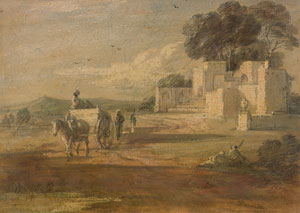
Thomas Gainsborough, Landscape with Horse and Cart, and Ruin, watercolor, oil and black chalk on laid paper; varnished (The Morgan Library and Museum)
Thomas Gainsborough’s landscape drawings and paintings take us into a distinction world. It is one in which we are typically granted the perspective a of a traveller wandering along a winding path, track or road. It is one in which we encounter a succession of familiar but also enigmatic subjects: the edges of woods, muddy banks, shadowed ponds, whitewashed ruins, figures resting on the road’s edges, shepherds with their flocks, men and women returning form the market. It is one in which trees often seem to dance and interact, and in which skies are constantly shifting. And finally, it is one in which we continually sense the echoes of earlier art—of dutch seventeenth-century landscape paintings, for example, or the territories painted by artists such as Rubens, Ruisdael, or Gaspard Dughet. In this illustrated lecture Professor Mark Hallett, Director of Studies at The Paul Mellon Centre for Studies in British Art, takes us on a tour of Gainsborough’s pastoral views and suggests how we might best understand and appreciate the pictorial world that the artist created in and through his landscapes. This program is organized by the Morgan Drawing Institute.
Wednesday, December 9, 6:30pm; admission is free.
Lecture | Margaret Oppenheimer, ‘Madame Jumel Collects’
Next month at the Mid-Manhattan Library:
Margaret Oppenheimer, ‘Madame Jumel Collects’
Mid-Manhattan Library, New York, 12 November 2015
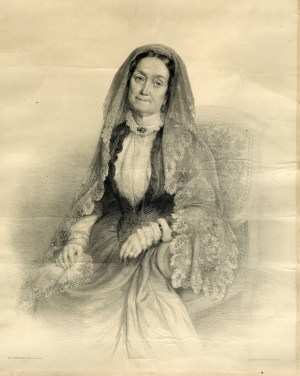
Eliza Jumel, seen in a lithograph she commissioned in 1852 (Collection of the Morris-Jumel Mansion)
The amazing Eliza Jumel—raised in a brothel, indentured as a servant, and confined to a workhouse while her mother was in jail—rose to become one of the richest women in New York. Along the way, she turned herself into an art connoisseur, acquiring more than 240 paintings while living in Paris between 1815 and 1817. In this richly illustrated lecture, art historian Margaret Oppenheimer will bring Jumel’s pioneering collection back to life, discussing the paintings, their owner, and the early nineteenth-century art scene in New York and Paris. Oppenheimer is the author of the new biography The Remarkable Rise of Eliza Jumel: A Story of Marriage and Money in the Early Republic, forthcoming from Chicago Review Press on November 1.
Thursday, November 12, 6:30–8pm; admission is free.
◊ ◊ ◊ ◊ ◊
Margaret A. Oppenheimer, The Remarkable Rise of Eliza Jumel: A Story of Marriage and Money in the Early Republic (Chicago: Chicago Review Press, 2015),
352 pages, ISBN: 978-1613733806, $30.
 Eliza Jumel (1775–1865) was born in poverty in Providence, Rhode Island, and died one of the richest women in New York. During her rise from the workhouse to Paris’s place Vendôme, she acquired a fortune from her first husband, a French merchant, and nearly lost it to her second, the notorious Aaron Burr. Divorcing him promptly amid lurid charges of adultery, she lived on triumphantly to the age of ninety, astutely managing her property and public persona. After her death, a titanic battle over her estate went all the way to the United States Supreme Court . . . twice. During the decades-long fight over Eliza’s dollars, claimants adapted her life history to serve their own ends. Family members described a woman who earned the gratitude of Napoleon I and shone at the courts of Louis XVIII and Charles X. Their opponents painted a less flattering picture: they said Eliza bore George Washington an illegitimate son, defrauded her first husband, and even plotted his death.
Margaret A. Oppenheimer holds a Ph.D. in art history from New York University. She is the author of The French Portrait: Revolution to Restoration (2005), the collaborating writer of the first edition of Art: A Brief History (2000), and a contributor to A Personal Gathering; Paintings and Sculpture from the Collection of William I. Koch (1996). Her articles on eighteenth- and nineteenth-century French art have appeared in Apollo, the Gazette des Beaux-Arts, the Metropolitan Museum Journal, and other publications. In her off-hours from working as a writer and copy editor, she volunteers as a docent at the Morris-Jumel Mansion in New York City, Eliza Jumel’s former home.
Bard Graduate Center’s 2015–16 Seminar Series
Here are some of the highlights that might be of particularly relevant for eighteenth-century studies, though be sure to have a look at the full schedule. -CH
◊ ◊ ◊ ◊ ◊
2015–16 Seminar Series
Bard Graduate Center, New York
RSVP is required. For general information or to reserve your place, please visit us online, email academicevents@bgc.bard.edu, or call 212.501.3019.
 BGCTV. All events listed below will be live-streamed on BGC’s online live-streaming channel. The live-streaming of our research events reflects Bard Graduate Center’s commitment to making our innovative programming more widely available and so shaping the global discourse about the cultural history of the material world.
October 6, 6–7:30pm
Susan Hunter
MA Candidate, Bard Graduate Center; Associate Director, Winston Art Group
“Case Study: Sir Thomas Hanmer’s Silver Gilt Sideboard Dish in the Collection of the Federal Reserve Bank of New York”
October 13, 6–7:30pm
Anne Higonnet
Professor of Art History, Barnard College, Columbia University
“A Digital Enlightenment: Experiments in the Teaching of Eighteenth-Century Decorative Arts”
November 10, 12–1:30pm
Tian Chun
Associate Professor, Art and Design History, Guangzhou Academy of Fine Arts; Visiting Fellow, Bard Graduate Center
“Parasols and Pagodas: Lacquer Furniture and East West Exchange in the Seventeenth and Eighteenth Centuries”
January 26, 6–7:30pm
Robert Wellington
Lecturer, Center for Art History and Art Theory, Australian National University
“Sun King to Moon King: Emulating the Grand Siècle in the Eighteenth and Nineteenth Centuries”
March 2, 12–1:30pm
Margaret Holben Ellis
Eugene Thaw Professor of Paper Conservation, New York University; Director, Thaw Conservation Center, Morgan Library and Museum
“Paper is Part of the Picture”
March 22, 6–7:30pm
Dedo von Kerssenbrock-Krosigk
Head, Glasmuseum Hentrich
“The Meaning of Glass: What Do People Think When They Think About Glass?”
March 29, 6–7:30pm
Anne T. Gerritsen
Associate Professor of History, University of Warwick
“‘The best Rubarbe is that which is brought from China fresh and newe’: Rhubarb and the Imagination of China in European Visual Print Culture, 1500–1850”
April 5, 5:30–7pm
Giorgio Riello
Professor of Global History and Culture, Director of the Institute of Advanced Study, University of Warwick
“Global Things: Trade and Material Culture in the First age of Globalization, c. 1500–1800”
Lecture | Kathleen Wilson, Performing ‘The Wonder’ in Sumatra
Next month at The Newberry:
Kathleen Wilson, Performing The Wonder in Sumatra:
East India Company Peripheries and the History of Modernity
The Newberry Library, Chicago, 17 October 2015
Registration due by October 16
How did theatrical performance work to stage larger English encounters with alterity in far-flung colonial sites? Professor Wilson will examine that question from the point of view of colonial residents of Sumatra and Saint Helena, who used English theatrical and social performances to reflect upon their own presence and status as agents of British modernity.
One such entrepreneur, East India Company Secretary William Marsden, wrote an epilogue to a staging of The Wonder at Fort Marlborough that reflected upon the temporal and cultural politics of British imperial rule in ways that anticipated his History of Sumatra, a work that stages English and Malay culture as part of a narrative of ‘world history’ that Britain had inaugurated.
Kathleen Wilson is Past President of the American Society for Eighteenth Century Studies. Her scholarship addresses issues of identity and difference in eighteenth-century Britain and empire. In addition to numerous peer-reviewed articles, her books include The Sense of the People: Politics, Culture and Imperialism in England, 1715–1785; The Island Race: Englishness Empire and Gender in the Eighteenth Century; A New Imperial History: Culture, Identity and Modernity in Britain and the Empire 1660–1840; and Strolling Players of Empire: Theatre, Culture and Modernity in the English Provinces. She is a series editor of Critical Perspectives on Empire for Cambridge University Press and has been awarded fellowships from the John Simon Memorial Guggenheim Foundation, the National Endowment for the Humanities, the American Council of Learned Societies, and the Huntington Library, among others.
Saturday, October 17, 2015, 1:00pm, Towner Fellows Lounge, with a reception to follow the seminar.
Center for Renaissance Studies Programs and Eighteenth-Century Seminar
Organized by Timothy Campbell, University of Chicago; Lisa A. Freeman, University of Illinois at Chicago; Richard Squibbs, DePaul University; and Helen Thompson, Northwestern University.
This program is free and open to the public, but space is limited and registration in advance is required. Register online here. Registrations will be processed through 10:00am Friday, October 16.
Lecture | Fit for a King: Louis XIV and the Art of Fashion
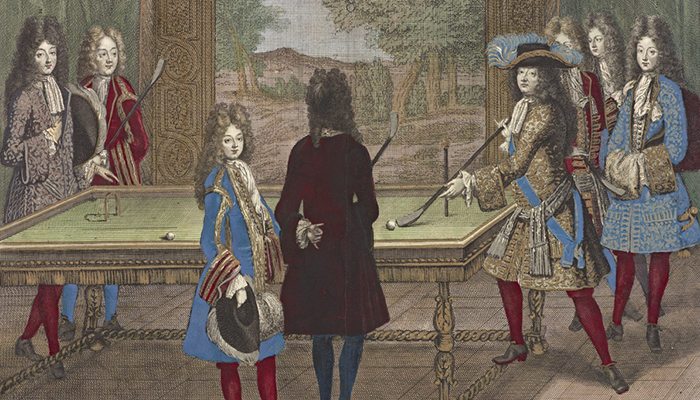
Antoine Trouvain, Third Apartment (detail), 1694. Hand-colored engraving and etching. From Appartements ou amusements de la famille royale à Versailles, a suite of 6 plates (The Getty Research Institute, 2011.PR.20)
◊ ◊ ◊ ◊ ◊
From The Getty:
Kimberly Chrisman-Campbell | Fit for a King: Louis XIV and the Art of Fashion
The Getty Center, Los Angeles, 23 August 2015
Louis XIV recognized fashion’s propaganda value as well as its economic importance, and he was deeply invested in establishing the technical and aesthetic superiority of France’s clothing and textile industries. Through prints, fashion plates, and his own oft-reproduced image, he set the standard of elegant dress and deportment throughout Europe. Art historian Kimberly Chrisman-Campbell examines the Sun King’s lasting contributions to French fashion as well as his own exquisite (and extravagant) taste. Sunday, August 23, 2:00pm.
This lecture complements the exhibition A Kingdom of Images: French Prints in the Age of Louis XIV, 1660–1715, organized in special collaboration with the Bibliothèque nationale de France and on view in the Getty Research Institute from June 16, 2015, to September 6, 2015.
Kimberly Chrisman-Campbell is an independent art historian specializing in fashion and textiles. She has worked as a curator, consultant, and educator for museums and universities around the world. Following the lecture, she will sign copies of her book, Fashion Victims: Dress at the Court of Louis XVI and Marie-Antoinette (Yale University Press, 2015), which will be available for purchase.
Lecture | Christoph Vogtherr on Karoline Luise of Baden
Later this summer at The Wallace Collection:
Christoph Vogtherr | Karoline Luise of Baden: Collector and ‘Amatrice’
The Wallace Collection, London, 7 August 2015
Karoline Luise, Markgräfin (Marchioness) of Baden was one of the greatest women collectors of the eighteenth century and an accomplished amateur artist. Her collection of paintings and drawings—including works by Chardin, Boucher and Liotard—forms the nucleus of the Kunsthalle in Karlsruhe in Southern Germany. Christoph Vogtherr will discuss the collecting and interests of this fascinating figure. The Wallace Collection is embarking on a collaboration with the Kunsthalle towards an exhibition of French drawings from the Karlsruhe collection.
Friday, 7th August, 2015 at 1:00pm; admission is free.
Chrisman-Campbell to Deliver The Huntington’s Robert Wark Lecture
From The Huntington:
Robert Wark Lecture | Fashion Victims: Dress at the Court of Louis XVI and Marie Antoinette
The Huntington Art Gallery, San Marino, CA, 7 May 2015
 Fashion historian Kimberly Chrisman-Campbell discusses one of the most exciting, controversial, and extravagant periods in the history of fashion: the reign of Louis XVI and Marie-Antoinette in 18th-century France. She explores the exceptionally imaginative and uninhibited styles of the period leading up to the French Revolution, as well as fashion’s surprising influence on the course of the Revolution itself. A book signing and coffee reception will follow the lecture. Thursday, 7 May, at 7:00pm, Rothenberg Hall.
The Cafe will be open for light suppers prior to this event. From 5:30pm until the start of the program, attendees can enjoy selected items including artisan pizzas, sushi, cheeses and charcuterie, and beer or wine in the new dining venue overlooking the gardens.
Helen Jacobsen on The Wallace Collection’s Sphinx Clock, 1781

◊ ◊ ◊ ◊ ◊
This afternoon at The Wallace Collection:
The Wallace Collection Treasure of the Month, April 2015 | Sphinx Clock, France, 1781
Gallery Talk by Helen Jacobsen, The Wallace Collection, London, 27 April 2015
In the late summer of 1777, Queen Marie-Antoinette wagered her brother-in-law 100,000 livres that he could not build a ‘pleasure house’ in less than 100 days; she lost the bet and the charming Pavillon de Bagatelle in the Bois de Boulogne was the result, although the interiors took several years to complete. Designed by the comte’s architect, François-Joseph Bélanger (1744–1818), it was intended for parties and enjoyment, with a billiard room, a dining room and a salon on the ground floor. Everything was in the latest neo-classical taste, executed by the group of talented decorators, sculptors and cabinet-makers around Bélanger and d’Artois.
The walls of the circular salon were decorated with panels of painted and gilded stucco decoration in the Antique style made fashionable by English and French architects such as Robert Adam and Charles-Louis Clérisseau, while the silk curtains and velvet chairs were of ‘English green’. Bélanger designed a clock for the room that reflected this decoration and when it was finally delivered in 1781 it was considered to be of such superb workmanship that it sat under a glass shade on the chimneypiece. The king’s clock-maker, Jean-Baptiste Lepaute (1727–1801), charged d’Artois the enormous sum of 7,500 livres for the clock, and also made one for his older brother, the comte de Provence. This clock is most likely the one made for Bagatelle. . . .
More information about the clock is available here»
A gallery talk on the clock by Helen Jacobsen, Senior Curator and Curator of 18th-Century Decorative Arts will take place Monday, 27 April 2015, at 1:00pm.
Basile Baudez on Architectural Drawings
Coming up at MIT’s HTC Forum, the main lecture series of the History, Theory, and Criticism of Architecture and Art Program:
Basile Baudez | Drawing for the Prize: Architectural
Competition Drawings from Europe to America
School of Architecture and Planning, Massachusetts Institute of Technology, Cambridge, 5 May 2015
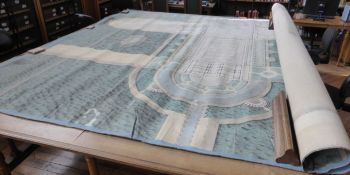 This talk will adopt the premise that architectural training as it was conceived in France in the eighteenth and nineteenth centuries was aimed more directly at producing drawings than buildings. The relatively limited existing scholarship on architectural drawings in a pedagogical context has been dominated, however, almost exclusively by concern for the subjects assigned—which is to say the final, built result. This approach has failed to address the question of the drawings as objects rather than illustrations and more particularly their status as the product of a complex institutional apparatus that taught and rewarded a codified system of architectural representation. This talk considers not only the questions of why and how a French Beaux-Arts model became dominant in dialogue with shifts in institutional structures but also the story of its discontents when alternate means of representation that the Beaux-Arts system had suppressed were revived and explored by those outside the academic establishment.
Architects trained with Legeay and deeply influenced by Piranesi, legitimated a separation between the representation and the actual project itself and taught students to draw ‘des tableaux d’architecture’. Students of the Académie de France à Rome in particular began to make use of expressive techniques that were until then considered exclusively the domain of the pictorial or plastic arts. Variations in ornamentation or distribution were conveyed through affective juxtapositions of color and daring application of pigment that held little to no relationship with the realities of the projected building. The proximity between architects and painters in the second half of the eighteenth century became institutionalized after the Revolution at the École des Beaux-Arts, where architects were trained in the same building as painters, sculptors, and engravers and where draftsmen across media shared life and perspective drawing classes.
During the first years of the nineteenth century, and particularly during the Napoleonic Empire, a reaction against such dramatic pictorial effects encouraged students to restrain their chromatic palette, to refine their lines and to lay stress on the precision with which they represented ornaments and sculpture. Monochromes were prized, resulting in a new value placed on mastering shading and wash, which was to become one of the defining characteristics of the Beaux-Arts style. Over the course of the century wash would provide an arena for experimenting with conventional uses of color and the production of abstract forms that tread carefully between providing a satisfying degree of detail without distracting the viewer or compromising a harmonious whole. In the ateliers of Vaudoyer, Percier and Lebas, students were taught how to animate the surroundings (notably natural elements, such as water, lawns, isolated trees, etc.) in order to produce the most affective architectural renderings of the century. While their most dominant features had little to do with the structures depicted they would emerge as the key models of academic architectural training at the end of the nineteenth century throughout Europe and the United States.
Basile Baudez received his PhD from the Ecole pratique des hautes études in Paris in 2006 and published his dissertation at the Presses universitaires de Rennes under the title Architecture et tradition académique au siècle des Lumières. He is currently associate professor in art and architectural history at the Paris-Sorbonne University. His current book project addresses the rise and dominance of the Beaux-Arts style in architectural drawing in Europe and America from the eighteenth through twentieth centuries.
Lecture | Philippe Blanchard on the Tombs of the Dukes of Épernon
From Inrap:
Philippe Blanchard | Étude historique et archéologique du caveau
des ducs d’Épernon, XVIIe–XVIIIe siècle, Eure-et-Loir
Musée du Louvre, Paris, 21 May 2015

Crânes sciés, famille des ducs d’Épernon (1661–1690), église Saint-Pierre d’Épernon © Philippe Blanchard, Inrap.
Cette conférence est donnée dans le cadre du cycle de conférences Actualité de la recherche archéologique.
Sous l’égide des départements du musée du Louvre, des spécialistes sont invités à présenter leurs plus récentes découvertes et les orientations de la recherche archéologique. En partenariat média avec Archéologia le magazine de l’actualité archéologique.
Auditorium du Louvre
Cour Carrée et Pyramide du Louvre
75058 Paris
Jeudi 21 mai 2015, à 12 h 30. Durée : 1 h
Entrée libre










 Enfilade
leave a comment