Lecture | Tobias Locker on ‘Rococo for the Spanish Court’
Tomorrow at the BGC:
Tobias Locker, Rococo for the Spanish Court:
The Interiors of Mattia Gasparini in the European Context
Bard Graduate Center, New York, 4 May 2016

Mattia Gasparini (design), José Canops (execution): (one of two) Chest of drawers (with secret compartments), HWD 94.5 x 95.3 x 45.3 cm, 1760/65, different exotic marquetry woods (partly sculpted) and engraved brass marquetry on mahogany, gilt bronze mounts and marble top (Palacio Real Madrid).
The presentation focuses on the person and the production of Mattia Gasparini, who worked for Charles III of Spain in Madrid. Its research follows three axis. A first focus is set on Gasparini and the creation of his Spanish Rococo interiors, that is the reconstruction of workshops and working practice on the basis of written sources and selected furniture—as objects as well as documents show manifold connection to the French capital (French workforce, technical and stylistic aspects). A second is set on distinguishing the French influence of the furniture by way of comparison with Parisian examples. Finally, the presentation contextualizes the interiors through comparison of the above mentioned aspects (style, technique, knowledge and provenance of workforce, quality) with the interiors at Potsdam/Prussia and Schönbrunn/Austria.
Tobias Locker is Adjunct Lecturer of Art History, Pompeu Fabra University and Visiting Fellow, Bard Graduate Center.
Coffee and tea will be served; attendees are welcome to bring their own lunch. RSVP is required. Please click on the registration link or contact academicevents@bgc.bard.edu. The event will also be live-streamed.
Wednesday, May 4, 2016, 12:00–1:30pm
Bard Graduate Center (38 West 86th Street)
Study Day | William Blake’s Printing Techniques
William Blake Study Day
Gainsborough’s House, Sudbury, Suffolk, 6 May 2016
 This study day will comprise a morning lecture by Michael Phillips, who will discuss Blake’s ground-breaking print techniques, followed by lunch (for those attending the full day) and an afternoon demonstration of the full-scale reproduction of Blake’s wooden printing press that is currently located in the exhibition gallery at Gainsborough’s House. Attendees will have the rare opportunity to use the press to make a print from a choice of copper plates.
Michael Phillips, who will lead the day, was guest curator of three major exhibitions on Blake: at Tate Britain in 2000; Petit Palais in 2009; and most recently his acclaimed exhibition and catalogue, William Blake Apprentice & Master, at the Ashmolean Museum, Oxford, in 2014–15. Michael’s training as a printmaker and his research into Blake’s methods and materials over more than 25 years has enabled him to explore and replicate Blake’s graphic techniques used in producing the illuminated books and separate prints.
Tickets: £8 morning illustrated lecture, or £40 full day, including illustrated lecture, lunch and afternoon printmaking demonstration. To book your place please contact us at mail@gainsborough.org.
Study Session | French Royal Furniture by Jean-Henri Riesener
◊ ◊ ◊ ◊ ◊
Study day opportunities at Waddeson Manor in connection with the Riesener exhibition:
Study Session: Spotlight on French Royal Furniture by Jean-Henri Riesener
Waddesdon Manor, Buckinghamshire, 25 May, 28 July, and and 23 September 2016
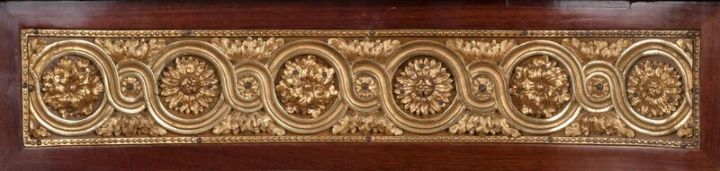
Waddesdon Manor houses three extraordinary chests of drawers by court cabinet-maker Jean-Henri Riesener, two of which belonged to members of the French royal family. They are among twelve pieces of furniture now at Waddesdon that were originally at the Palace of Versailles. Riesener was perhaps the most celebrated cabinet-maker of the 18th century, the official cabinet-maker to King Louis XVI, and the favourite of Queen Marie Antoinette. Each of these chests of drawers is richly decorated with colourful marquetry (designs made with wood veneers) depicting flowers and trophies and geometric patterns, and mounted with finely chased and gilded bronzes. Learn about their design, technical construction, and fascinating history. £25 (includes grounds admission), £15 National Trust/Art Fund members, £10 students. Wednesday 25 May, Thursday 28 July, and Friday 23 September 2016. Coffee on arrival at 10.15; session 10.45–12.15.
Study Session | Persuading the King
Study day opportunity at Waddeson Manor in connection with the exhibition:
Study Session Persuading the King: Gabriel de Saint-Aubin’s Placets
de l’officier Desbans and Other Books by the Saint-Aubin Brothers
Waddesdon Manor, Buckinghamshire, 24 June 2016
A rare opportunity to study Waddesdon’s newly acquired royal petition by Gabriel de Saint-Aubin, alongside other manuscript volumes, drawings, and prints by the artist and his brothers Charles-Germain and Augustin. Senior Curator Dr Juliet Carey and Curator Rachel Jacobs will offer a glimpse into the politics of promotion and favour near the end of the Old Regime. Works will include Gabriel de Saint-Aubin’s Memoire sur la reformation de la police de France (1749) and a special copy of Du Perron’s Discours sur la peinture et sur l’architecture (1757), made for the book’s dedicatee Madame de Pompadour. Charles-Germain de Aubin’s famous Livre de caricatures will provide a subversive counterpoint to the arts of flattery and persuasion that lay at the heart of court culture. £25 (includes grounds admission), £15 National Trust/Art Fund members, £10 students. Friday, 24 June 2016. Coffee on arrival at 10.15; study session 10.45–12.15. Book early to avoid disappointment.
Study Session | Books and Bindings at Waddesdon Manor
From Waddesdon:
Study Session: Books and Bindings
Waddesdon Manor, Buckinghamshire, 12 May and 15 September 2016
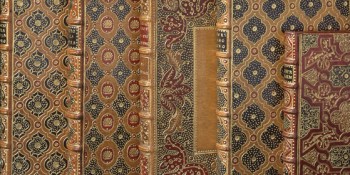 Come and explore the treasures of the Waddesdon collection of 17th- and 18th-century books and bindings. These include unique manuscripts and luxuriously illustrated printed volumes. Many of the books in the collection have illustrious provenances including great bibliophiles and members of the French Royal Family. The session will provide an opportunity to view some of the treasures of the Waddesdon Collection and to learn about book history through some of its finest examples. £25 (includes grounds admission), £15 National Trust/Art Fund members, £10 students. Thursday 12 May and 15 September 2016. Coffee on arrival at 10.15; study session 10.45–12.15.
Lecture | Basile Baudez on Color in Architectural Drawing

François-Joseph Bélanger, An Elevation for the Projected Mill at Méréville, ca. 1786 (New York: The Metropolitan Museum of Art, Gift of Mrs. Charles Wrightsman, 2003)
◊ ◊ ◊ ◊ ◊
Basile Baudez (Paris-Sorbonne University), Histoire de la couleur dans le dessin d’architecture, XVIe–XIXe siècles / History of Color in Architectural Drawing, 16th–19th Centuries
Centre André Chastel, Paris, 11 May 2016
Architectural historians have focused on the history of drawing as one of project design tools. By applying the methods of art history, this paper traces color as a key player in the long history of rivalry and exchange between European traditions in architectural drawing and practice. While Italian Renaissance drawings were largely monochrome and developed their conventions under pressure from engravers, the seventeenth-century European situation is characterized by a contrast between a colorful German and Dutch world around architect-painters’ designs and a still largely monochrome tradition in Italy and England. At the end of Louis XIV’s reign, French architects adopted a series of color conventions taken from the engineers, largely for informational purposes. In the middle of the eighteenth century, however, a color revolution took place, one in which a new generation of architects who were working alongside painters developed a wide chromatic range that was no longer limited to informing the worker but to persuading academic juries and gain commissions. This eighteenth-century French employment of color laid the foundation for Beaux-Arts architectural drawings in the first half of the nineteenth century, at a moment when English architectural drawings, too, adopted color in response to the English watercolor movement. Wednesday, 11 May 2016, 6:30–8:00pm, Galerie Colbert, 2 rue Vivienne, 75002 Paris, salle Ingres (2nd floor).
Lecture | Satish Padiyar on Fragonard, Temporality, and Suprises
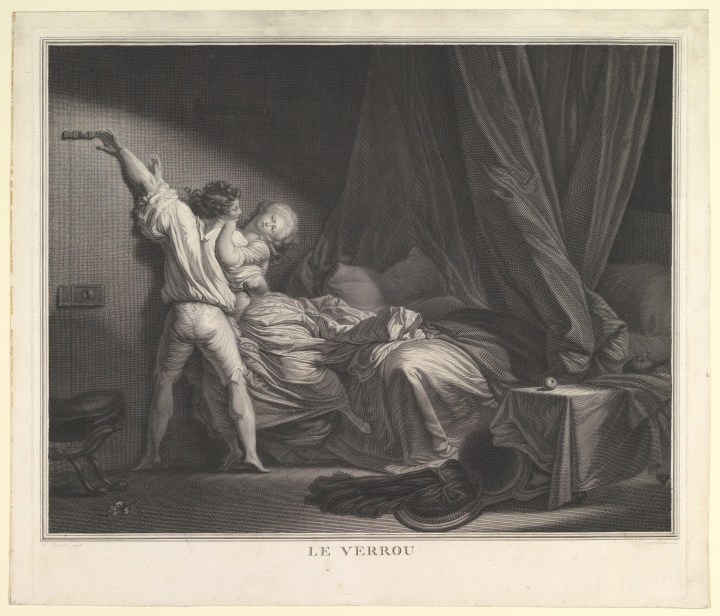
Maurice Blot, after Jean Honoré Fragonard, Le Verrou (The Bolt, or The Lock), etching, second state, sheet: 41.8 × 49 cm, image: 36.8 × 45 cm (New York: The Metropolitan Museum of Art, The Elisha Whittelsey Collection, The Elisha Whittelsey Fund, 1974.652). Fragonard’s painting is in The Louvre.
◊ ◊ ◊ ◊ ◊
Satish Padiyar, Surprises: Fragonard and Temporality
The Institute of Fine Arts, New York University, 21 April 2016
Arguably, Jean-Honoré Fragonard (1732–1806) was a painter at odds with late-eighteenth-century bourgeois notions of progressive time and the Enlightenment concept of historical and material progress. In this talk, Satish Padiyar asks how Fragonard marks time and what is the time and the timing of his quasi-expressionist marks.
In an oeuvre eminently about love, it is the particular moment of ‘surprise’ that Fragonard obsessively returns to: a moment of temporal suspense in which the human subject is taken by storm and which resurrects a quasi-infantile sense of un-control and openness to the unexpected. Through the “spontaneous gesture” (Winnicott), Fragonard seeks to throw the subject outside the received norms of time and social courtesies. The surprise attack characterizes both his technical audacity and his psychology of love, corporeal attraction and violence. Thursday, 21 April 2016, 6:00pm, Institute of Fine Arts, Lecture Hall, New York University, 1 East 78th Street.
Satish Padiyar is a Visiting Scholar at the Institute of Fine Arts and Senior Lecturer in Nineteenth-Century European Art at The Courtauld Institute of Art.
RSVP here»
The lecture is scheduled to be live-streamed.
David Pullins on Painting, Decoration, and Porcelain at The Frick
Upcoming talks at The Frick:
David Pullins, Shared Practices: Painting and Decoration in Eighteenth-Century France
The Frick Collection, New York, 20 April 2016
Motifs after François Boucher and other leading painters populate the surface of Sèvres porcelain, including pieces in The Frick Collection. David Pullins considers what it was about academic painters’ training and working methods that encouraged the adaptation of their motifs from canvas to porcelain, textiles, and other media. Wednesday, 20 April, 6pm, in the Music Room. Free, though seating is on a first-come, first-served basis; a live webcast will also be available.
David Pullins, The French Dialogue with Chinese Porcelain
The Frick Collection, New York, 21 April 2016
Focusing on examples from The Frick’s permanent collection, learn how France became familiar with Chinese culture through its porcelain, which traveled around the globe during the seventeenth and eighteenth centuries. We will also ask how a foreign material was repackaged into a symbol of French cultural identity, one that was considered a necessary part of Gilded Age collections. Thursday, 21 April, 5:30pm. Advance registration is required; courses are free with a $25 student membership or a full membership for recent graduates.
Lecture | 17th- and 18th-Century Dutch Design in the Global Marketplace
Thursday at The Nelson-Atkins:
Catherine Futter, Reflecting on 17th- and 18th-Century Dutch Design in the Global Marketplace
The Nelson-Atkins Museum of Art, Kansas City, 31 March 2016
In this series, connected with the exhibition Reflecting Class in the Age of Rembrandt and Vermeer, four Nelson-Atkins curators reflect on themes presented in the exhibition, including the importance and legacy of 17th-century Dutch painting and depictions of the social classes in art. Works from across art-historical periods and the museum’s collections will be discussed.
With the revocation of the Edict of Nantes in 1685 and the reach of the Dutch East India Company, Dutch designs spread to distant lands as far away as the American colonies and China. Join Catherine Futter, Director, Curatorial Affairs, for this talk that explores Dutch influence in ceramics, furniture, silver and other decorative arts.
Thursday, March 31
6-7 pm | Atkins Auditorium
Tickets required
Exhibition | James Gillray’s Hogarthian Progresses
From The Lewis Walpole Library:
James Gillray’s Hogarthian Progresses
The Lewis Walpole Library, Farmington, CT, 6 April — 16 September 2016
Curated by Cynthia Roman
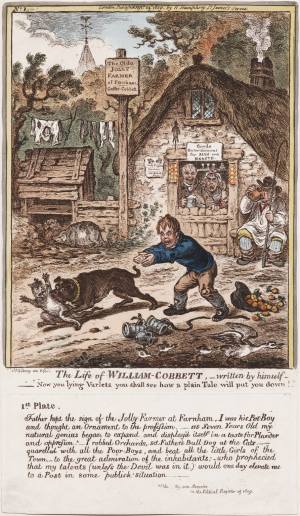
James Gillray, The life of William-Cobbett, written by himself. : Now you lying varlets you shall see how a plain tale will put you down! / Js. Gillray inv. & fec. Published in London, 29 September 1809 (Lewis Walpole Library).
Sequential narration in satiric prints is most famously associated with the ‘modern moral subjects’ of William Hogarth (1697–1764): Harlot’s Progress (1732), A Rake’s Progress (1735), Marriage A-la-Mode (1745), and Industry and Idleness (1747) among others. Less well-known is the broad spectrum of legacy ‘progresses’ produced by subsequent generations drawing both on Hogarth’s narrative strategies and his iconic motifs. James Gillray (1756–1815), celebrated for his innovative single-plate satires, was also among the most accomplished printmakers to adopt Hogarthian sequential narration even as he transformed it according to his unique vision. This exhibition presents a number of Gillray’s Hogarthian progresses alongside some selected prints by Hogarth himself.
P R O G R A M S
Study Day
James Gillray’s Experimental Printmaking
Organized by Esther Chadwick, History of Art, Yale University and Cynthia Roman, The Lewis Walpole Library, Yale University, 10 June 2016
Graduate Student Seminar
Collecting the Graphic Work of William Hogarth
Sheila O’Connell, Former Curator of Prints, British Museum, 14 June 2016
Graduate Student Seminar
Connoisseurship: Graphic Satire from William Hogarth to James Gillray
Andrew Edmunds, Collector and Dealer, 15 June 2016
Master Class for Graduate Students
A Contest of Two Genres: Graphic Satire and British History Painting in the Long Eighteenth Century
Mark Salber Phillips, Professor of History at Carleton University, Ottawa, and Cynthia Roman, Curator of Prints, Drawings, and Paintings at the Lewis Walpole Library, 22–26 August 2016
Master Class for Graduate Students
The Comic Image 1800–1850: Narrative and Caricature
Brian Maidment, Professor of the History of Print, Liverpool John Moores University
Cynthia Roman, Curator of Prints, Drawings, and Paintings at the Lewis Walpole Library, 14—16 September 2016










leave a comment