Lectures | Benjamin West at Spencer House
I noted this small exhibition a week ago but failed to include the programming details. The first lecture takes place on Monday. –CH
Benjamin West at Spencer House
Spencer House, London, 31 January 2016 — 29 January 2017
In celebration of the 25th anniversary of the restoration of the State Rooms at Spencer House, James ‘Athenian’ Stuart’s early neo-classical interiors will showcase work of Benjamin West, a central figure in the development of neo-classical painting. Central to the exhibition is West’s Milkmaids in St. James’s Park, Westminster Abbey Beyond (ca. 1801, oil on panel, Paul Mellon Fund), which is on special loan to the Rothschild Foundation from the Yale Center for British Art. . . .
To complement the exhibition, a series of three lectures about Benjamin West will take place at Spencer House, followed by drinks:
• Loyd Grossman, How to Paint History: Benjamin West and the Death of General Wolfe, 14 March at 6.30pm
• Desmond Shawe-Taylor (The Surveyor of The Queen’s Pictures), Benjamin West and George III, 18 July at 6.30pm
• Lars Kokkonen (Assistant Curator of Paintings and Sculpture, Yale Center for British Art), Evaporations: Milkmaids in St. James’s Park No More, 14 November at 6.30pm
Booking information is available here»
Lecture | Giorgio Riello, Towards a Global Cultural History?
Giorgio Riello, Towards a Global Cultural History? Gifts,
Commodities and Diplomacy in the First Global Age
Deutsches Haus, Columbia University Department of History, New York, 23 March 2016
Columbia University Department of History is pleased to present the Dr. S. T. Lee Annual Lecture in History: Towards a Global Cultural History? Gifts, Commodities and Diplomacy in the First Global Age, presented by Professor Giorgio Riello (University of Warwick, Department of History), Wednesday, March 23rd, Deutsches Haus (420 West 116th Street, between Amsterdam Avenue and Morningside Drive), 6:00–7:30pm. Reception to follow.
Giorgio Riello was trained as an economic historian, with a focus on material culture and the history of technology. After his work on the transformation of Italian and European industry in the eighteenth century, he began publishing on global history, becoming founding director of the Centre for Global History and Culture at Warwick University, one of the world’s leading programs focusing on the global history of material culture. His multiply award-winning publications have ranged from the global history of cotton to south Asian textile production, to the global industry of shoe production.
Lecture | Philip Morgan on Slavery at Mount Vernon
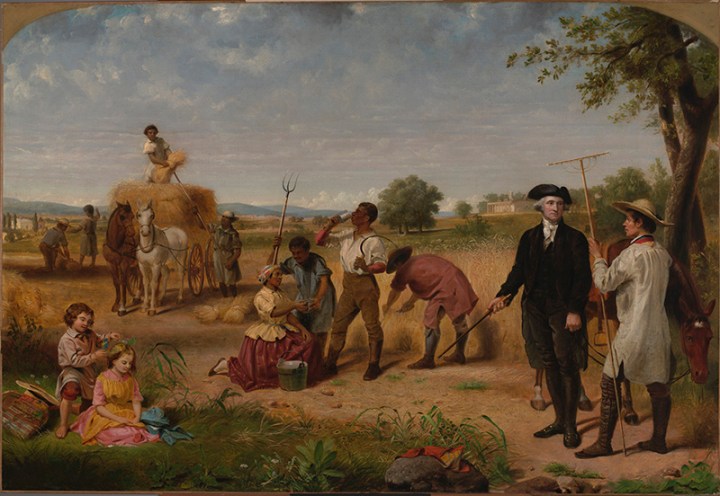
Junius Brutus Stearns, George Washington as a Farmer at Mount Vernon, 1851 (Richmond: Virginia Museum of Fine Arts; photo by Katherine Wetzel). Information on the painting from Colonial Williamsburg.
◊ ◊ ◊ ◊ ◊
From the Homewood Museum at Johns Hopkins:
Philip Morgan, Entangled Lives: Slavery at George Washington’s Mount Vernon
Johns Hopkins University, Baltimore, 18 February 2016
The fifth-largest slave owner in Virginia by the late 1780s, George Washington constantly struggled with the tangled web of slavery despite his personal desires to eliminate it from his life. In this lecture illuminating the lived experience of slavery, historian Philip Morgan will share the ways in which master and slaves, whites and blacks, interacted at Washington’s Mount Vernon plantation with special focus on the workplace, families and resistance.
A reception with the speaker will precede the lecture at 5pm. The lecture, at 6pm, is presented in celebration of African-American History Month by Homewood Museum, the former country house and slave-holding farm of the Carroll family in the early decades of the nineteenth century. Admission is free; however, reservations are requested. Walk-in registration is based on seating availability. The reception and lecture will be held in the Mason Hall Auditorium: 3101 Wyman Park Drive, Baltimore, MD 21211.
Philip Morgan is the Harry C. Black Professor of History at Johns Hopkins University and one of the leading specialists on the history of the Atlantic world.
Additional information on Morgan’s work on slavery at Mount Vernon is available from George Washington University.
◊ ◊ ◊ ◊ ◊
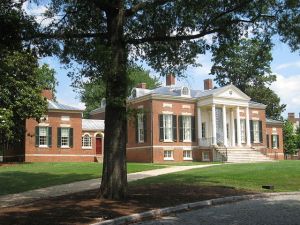
Homewood Museum, Johns Hopkins University, Baltimore. Photo: Wikimedia Commons, July 2008.
Located on the Johns Hopkins University campus, Homewood Museum offers visitors the chance to explore diverse interests in tremendous depth and provides an intimate look at life in early-19th-century Baltimore. The museum’s collections consist of fine and decorative arts objects representative of the furnishings during the Carroll family’s occupancy (1802–1833). Some works have direct affiliation with the Carroll family. The majority of the collection is American, with a strong concentration in high-quality Baltimore furniture of the period. English ceramics, silver, and furniture, as well as items of Chinese and French manufacture, are reflective of the imports available in early-19th century Baltimore.
Exhibition | Picturing Prestige: New York Portraits, 1700–1860

From left to right: John Trumball, Portrait of Alexander Hamilton, ca. 1804–08 (Museum of the City of New York, 72.31.3); Nicholas Biddle Kittell, Portrait of Mr. and Mrs. Charles Henry Augustus Carter, ca. 1845 (Museum of the City of New York, 62.234.12); and George Peter Alexander Healy, Portrait of Caroline Slidell Perry Belmont (Mrs. August Belmont, Sr.), ca. 1855 (Museum of the City of New York, 51.317).
◊ ◊ ◊ ◊ ◊
Press release for the exhibition now on view at MCNY:
Picturing Prestige: New York Portraits, 1700–1860
Museum of the City of New York, 5 February — 18 November 2016
Curated by Bruce Weber
The Museum of the City of New York presents Picturing Prestige: New York Portraits, 1700–1860, an ensemble of iconic New Yorkers presented by intricate and elegant portraits, which were commissioned as status symbols and painted by the very best artists a young nation had to offer. The exhibition opened to the public on Friday, February 5, 2016.
Visitors can see familiar figures, such as the renowned John Trumbull portrait of Alexander Hamilton that inspired the image on our ten-dollar bill, and can also come face-to-face with New Yorkers like Richard Varick, of Varick Street in Greenwich Village, and the Brooks family, of Brooks Brothers fame, whose names are part of the city’s fabric but whose stories remain untold to a broad audience. This unique exhibition draws from the City Museum’s permanent collection to reveal the evolution of a dynamic city through its leading merchants, politicians and patrons, as well as the development of portraiture itself, one of New York’s oldest visual art forms.
“New York City’s distinctive character and unique personality have always come from its citizens,” said Whitney Donhauser, Ronay Menschel Director of the Museum of the City of New York. “This exhibition explores over 150 years of city life through the lives of many of history’s most celebrated New Yorkers, offering visitors an intensely engaging and deeply personal interaction with the past.”
Picturing Prestige relies on the people who shaped New York City in its formative years to tell the story of how the city grew from its colonial foundations through the Revolutionary War and blossomed into a mercantile powerhouse in the mid-19th century. The namesakes of Varick and McDougal Streets in Greenwich Village are brought to life by centuries-old paintings of Richard Varick and Alexander McDougall. Brooks Brothers is a household name in present-day America, and Picturing Prestige will display the early Brooks family in the light they wished to be shown in their own time.
The exhibition is also a study in the art of portraiture and New York City’s place as an artistic hub, showcasing over 40 oil paintings to go along with a dozen miniatures—small portraits kept as keepsakes, which were the original version of family wallet photos. The show is organized in three sections that demonstrate not only the growth and transformation of the city itself, but also the changing nature of portraiture as an art form, the city’s emergence as an artistic center, and the ways in which the city’s elite viewed itself over time:
• Colonial Foundations, 1700–1775
• Young Nationhood, 1777–1815
• The City Rises, 1815–1860
The scope of the exhibition, curated by Bruce Weber, City Museum Curator of Paintings and Sculpture, is made possible by the wealth of the City Museum’s permanent collection, offering portraits of iconic New Yorkers as painted by the leading artists of their respective generations. The artists themselves reveal nearly as much history as their subjects do, from the Duyckinck family demonstrating that the best painters in America in the 17th century were not from America, to John Singleton Copley personifying the rise of fine art in this country over one hundred years later.
“The portraits in this exhibition are works of art in and of themselves, but they are also windows into the lives and times of legendary New Yorkers,” added Weber. “In thinking about who commissioned these paintings and the artists who brought their subjects to life, we can tell the story of a city emerging from the throes of revolution to lead a young nation towards its rightful place at the vanguard of the artistic world. Today, New York City’s role as a cultural center is undisputed. Picturing Prestige helps explain how we got there.”
The conservation of many of the works and their related frames featured in Picturing Prestige: New York Portraits, 1700–1860 was made possible by a grant from the National Endowment for the Arts, as was digital photography and cataloguing of many of the paintings.

◊ ◊ ◊ ◊ ◊
From MCNY:
Hamilton and Friends: Portraiture in Early New York
Museum of the City of New York, Thursday, 11 February 2016, 6:30 pm
Alexander Hamilton was a man of many faces: politician, economist, revolutionary—and rumored philanderer. After he was killed in a duel with Aaron Burr in 1804, Hamilton’s widow, Elizabeth Schuyler Hamilton, worked tirelessly to defend her husband’s reputation. Today we are familiar with likenesses of Alexander Hamilton—including one that is on the ten dollar bill. This panel will explore how portraiture served in the decades after the American Revolution as a critical tool in shaping and canonizing the public image of leaders and notables. Join us for a conversation about how the Hamiltons and other members of the colonial New York elite commissioned portraits to use both as status symbols and a means to craft their public image. This program delves into the themes of our exhibition Picturing Prestige: New York Portraits, 1700–1860.
• William H. Gerdts, Professor Emeritus of Art History, CUNY Graduate Center
• David Jaffee, Professor and Head of New Media Research, Bard Graduate Center
• Elizabeth Mankin Kornhauser, Alice Pratt Brown Curator of American Paintings and Sculpture, The Metropolitan Museum of Art
• Brett Palfreyman, Assistant Professor, History Department, Wagner College
• Bruce Weber (moderator), Museum’s Curator of Picturing Prestige: New York Portraits, 1700–1860
Study Day | Exploring Lee Priory: A Child of Strawberry Hill

◊ ◊ ◊ ◊ ◊
From Eventbrite:
Exploring Lee Priory: A Child of Strawberry Hill
Taddington Manor, Taddington, Near Cutsdean, Gloucestershire, 1 March 2016
Organized by Peter Lindfield
This study day, based at Architectural Heritage, Taddington Manor, Gloucestershire, explores the architecture of James Wyatt (1746–1813), the most famous architect of late Georgian Britain. The day will feature talks by experts on the architecture, interiors and furniture by James Wyatt, including the development of his architecturally-aware Gothic style at Lee Priory, Kent, before his most famous house, Fonthill Abbey, Wiltshire.
The relationship between Lee Priory and the most famous Gothic Revival house in Georgian Britain, Horace Walpole’s Strawberry Hill, will also be addressed. The conservator who worked on Strawberry Hill and a second, previously unknown, room saved from Lee Priory before its demolition in 1953, will speak about Wyatt’s work.
The highlight of the day will be the close examination of the second surviving room from Lee Priory, the Library Ante-Chamber. This room is currently for sale and the study day offers perhaps the last chance to be able to get up close and examine, under the guidance of experts, one of the most exciting Wyatt-related discoveries of the recent past.
Registration (£25) includes lunch and refreshments at Taddington Manor. Please do not hesitate to get in contact with the organiser, Dr Peter N. Lindfield, at: peter.lindfield@stirling.ac.uk. At time of booking, please advise of dietary or access requirements. Tuesday, 1 March 2016 from 10:30 to 16:30.
Research Lunch | Geological Landscape in Britain

Drawings of minerals arranged in families according with the system of Professor Jameson, 1830–36
(Special Collections at Edinburgh University)
◊ ◊ ◊ ◊ ◊
From the Paul Mellon Centre:
Allison Ksiazkiewicz | Primitive Forms and Prospects: Geological
Landscape in Late Eighteenth- and Early Nineteenth-Century Britain
Paul Mellon Centre, London, 5 February 2016
During the late eighteenth and early nineteenth centuries, British mineralogists and geologists appropriated different forms of inquiry such as art and architecture to help them wrestle with the natural and artificial aspects that informed their scientific sensibilities. The relationship between humanity and Nature, as debated in philosophical and artistic circles, paralleled discussions in earth studies and the developing new science of geology. While aesthetic categories such as the picturesque enabled artists to negotiate and articulate attitudes towards Nature that emphasized harmony and balance, these same techniques in scientific depiction cultivated and supported a sense of empirical vision of geological landscapes.
The mineral collections of Sir Charles Greville (1749–1809), Sir John St Aubyn (1758–1839) and Sir Abraham Hume (1749–1838), and A Geological Map of England and Wales by George Bellas Greenough (1778–1855) will be used to explore issues of art and aesthetics in the making of mineralogical and geological knowledge. Greville, St Aubyn and Hume were each influential figures in artistic and scientific communities and commissioned the mineralogist and French émigré Comte de Bournon (1751–1825) to catalogue their respective mineral cabinets. As a student of crystallography, Bournon classified specimens according to basic crystallized shapes that functioned as universal primitive forms. Geologists motivated by mineralogical interpretations of the earth understood geo-landscape through the interpretation of these basic elements. The production of a coloured geological map of England and Wales was one of the first projects undertaken by the Geological Society of London. Greenough, founder and first President of the Society, supported chemical and mineralogical interpretations of earth structure, and used colour to represent the relative positions of strata while maintaining a ‘naturalistic’ palette in the depiction of formations on his map.
All are welcome! However, places are limited, so if you would like to attend please contact our Events Manager, Ella Fleming on events@paul-mellon-centre.ac.uk. This is a free event, and lunch is provided.
Friday, 5 Februay 2016, 12:30–2:00pm
Lecture Room, Paul Mellon Centre, 16 Bedford Square, London WC1B 3JA
Lecture | Mark Hallett on Gainsborough’s Landscapes
At The Morgan:
Mark Hallett, The Nomadic Eye: Traveling through Thomas Gainsborough’s Landscapes
The Morgan Library and Museum, New York, 9 December 2015
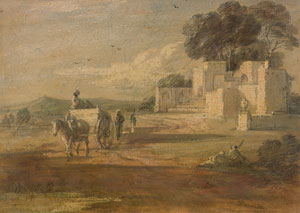
Thomas Gainsborough, Landscape with Horse and Cart, and Ruin, watercolor, oil and black chalk on laid paper; varnished (The Morgan Library and Museum)
Thomas Gainsborough’s landscape drawings and paintings take us into a distinction world. It is one in which we are typically granted the perspective a of a traveller wandering along a winding path, track or road. It is one in which we encounter a succession of familiar but also enigmatic subjects: the edges of woods, muddy banks, shadowed ponds, whitewashed ruins, figures resting on the road’s edges, shepherds with their flocks, men and women returning form the market. It is one in which trees often seem to dance and interact, and in which skies are constantly shifting. And finally, it is one in which we continually sense the echoes of earlier art—of dutch seventeenth-century landscape paintings, for example, or the territories painted by artists such as Rubens, Ruisdael, or Gaspard Dughet. In this illustrated lecture Professor Mark Hallett, Director of Studies at The Paul Mellon Centre for Studies in British Art, takes us on a tour of Gainsborough’s pastoral views and suggests how we might best understand and appreciate the pictorial world that the artist created in and through his landscapes. This program is organized by the Morgan Drawing Institute.
Wednesday, December 9, 6:30pm; admission is free.
Lecture | Margaret Oppenheimer, ‘Madame Jumel Collects’
Next month at the Mid-Manhattan Library:
Margaret Oppenheimer, ‘Madame Jumel Collects’
Mid-Manhattan Library, New York, 12 November 2015
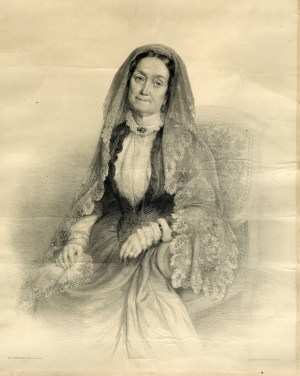
Eliza Jumel, seen in a lithograph she commissioned in 1852 (Collection of the Morris-Jumel Mansion)
The amazing Eliza Jumel—raised in a brothel, indentured as a servant, and confined to a workhouse while her mother was in jail—rose to become one of the richest women in New York. Along the way, she turned herself into an art connoisseur, acquiring more than 240 paintings while living in Paris between 1815 and 1817. In this richly illustrated lecture, art historian Margaret Oppenheimer will bring Jumel’s pioneering collection back to life, discussing the paintings, their owner, and the early nineteenth-century art scene in New York and Paris. Oppenheimer is the author of the new biography The Remarkable Rise of Eliza Jumel: A Story of Marriage and Money in the Early Republic, forthcoming from Chicago Review Press on November 1.
Thursday, November 12, 6:30–8pm; admission is free.
◊ ◊ ◊ ◊ ◊
Margaret A. Oppenheimer, The Remarkable Rise of Eliza Jumel: A Story of Marriage and Money in the Early Republic (Chicago: Chicago Review Press, 2015),
352 pages, ISBN: 978-1613733806, $30.
 Eliza Jumel (1775–1865) was born in poverty in Providence, Rhode Island, and died one of the richest women in New York. During her rise from the workhouse to Paris’s place Vendôme, she acquired a fortune from her first husband, a French merchant, and nearly lost it to her second, the notorious Aaron Burr. Divorcing him promptly amid lurid charges of adultery, she lived on triumphantly to the age of ninety, astutely managing her property and public persona. After her death, a titanic battle over her estate went all the way to the United States Supreme Court . . . twice. During the decades-long fight over Eliza’s dollars, claimants adapted her life history to serve their own ends. Family members described a woman who earned the gratitude of Napoleon I and shone at the courts of Louis XVIII and Charles X. Their opponents painted a less flattering picture: they said Eliza bore George Washington an illegitimate son, defrauded her first husband, and even plotted his death.
Margaret A. Oppenheimer holds a Ph.D. in art history from New York University. She is the author of The French Portrait: Revolution to Restoration (2005), the collaborating writer of the first edition of Art: A Brief History (2000), and a contributor to A Personal Gathering; Paintings and Sculpture from the Collection of William I. Koch (1996). Her articles on eighteenth- and nineteenth-century French art have appeared in Apollo, the Gazette des Beaux-Arts, the Metropolitan Museum Journal, and other publications. In her off-hours from working as a writer and copy editor, she volunteers as a docent at the Morris-Jumel Mansion in New York City, Eliza Jumel’s former home.
Bard Graduate Center’s 2015–16 Seminar Series
Here are some of the highlights that might be of particularly relevant for eighteenth-century studies, though be sure to have a look at the full schedule. -CH
◊ ◊ ◊ ◊ ◊
2015–16 Seminar Series
Bard Graduate Center, New York
RSVP is required. For general information or to reserve your place, please visit us online, email academicevents@bgc.bard.edu, or call 212.501.3019.
 BGCTV. All events listed below will be live-streamed on BGC’s online live-streaming channel. The live-streaming of our research events reflects Bard Graduate Center’s commitment to making our innovative programming more widely available and so shaping the global discourse about the cultural history of the material world.
October 6, 6–7:30pm
Susan Hunter
MA Candidate, Bard Graduate Center; Associate Director, Winston Art Group
“Case Study: Sir Thomas Hanmer’s Silver Gilt Sideboard Dish in the Collection of the Federal Reserve Bank of New York”
October 13, 6–7:30pm
Anne Higonnet
Professor of Art History, Barnard College, Columbia University
“A Digital Enlightenment: Experiments in the Teaching of Eighteenth-Century Decorative Arts”
November 10, 12–1:30pm
Tian Chun
Associate Professor, Art and Design History, Guangzhou Academy of Fine Arts; Visiting Fellow, Bard Graduate Center
“Parasols and Pagodas: Lacquer Furniture and East West Exchange in the Seventeenth and Eighteenth Centuries”
January 26, 6–7:30pm
Robert Wellington
Lecturer, Center for Art History and Art Theory, Australian National University
“Sun King to Moon King: Emulating the Grand Siècle in the Eighteenth and Nineteenth Centuries”
March 2, 12–1:30pm
Margaret Holben Ellis
Eugene Thaw Professor of Paper Conservation, New York University; Director, Thaw Conservation Center, Morgan Library and Museum
“Paper is Part of the Picture”
March 22, 6–7:30pm
Dedo von Kerssenbrock-Krosigk
Head, Glasmuseum Hentrich
“The Meaning of Glass: What Do People Think When They Think About Glass?”
March 29, 6–7:30pm
Anne T. Gerritsen
Associate Professor of History, University of Warwick
“‘The best Rubarbe is that which is brought from China fresh and newe’: Rhubarb and the Imagination of China in European Visual Print Culture, 1500–1850”
April 5, 5:30–7pm
Giorgio Riello
Professor of Global History and Culture, Director of the Institute of Advanced Study, University of Warwick
“Global Things: Trade and Material Culture in the First age of Globalization, c. 1500–1800”
Lecture | Kathleen Wilson, Performing ‘The Wonder’ in Sumatra
Next month at The Newberry:
Kathleen Wilson, Performing The Wonder in Sumatra:
East India Company Peripheries and the History of Modernity
The Newberry Library, Chicago, 17 October 2015
Registration due by October 16
How did theatrical performance work to stage larger English encounters with alterity in far-flung colonial sites? Professor Wilson will examine that question from the point of view of colonial residents of Sumatra and Saint Helena, who used English theatrical and social performances to reflect upon their own presence and status as agents of British modernity.
One such entrepreneur, East India Company Secretary William Marsden, wrote an epilogue to a staging of The Wonder at Fort Marlborough that reflected upon the temporal and cultural politics of British imperial rule in ways that anticipated his History of Sumatra, a work that stages English and Malay culture as part of a narrative of ‘world history’ that Britain had inaugurated.
Kathleen Wilson is Past President of the American Society for Eighteenth Century Studies. Her scholarship addresses issues of identity and difference in eighteenth-century Britain and empire. In addition to numerous peer-reviewed articles, her books include The Sense of the People: Politics, Culture and Imperialism in England, 1715–1785; The Island Race: Englishness Empire and Gender in the Eighteenth Century; A New Imperial History: Culture, Identity and Modernity in Britain and the Empire 1660–1840; and Strolling Players of Empire: Theatre, Culture and Modernity in the English Provinces. She is a series editor of Critical Perspectives on Empire for Cambridge University Press and has been awarded fellowships from the John Simon Memorial Guggenheim Foundation, the National Endowment for the Humanities, the American Council of Learned Societies, and the Huntington Library, among others.
Saturday, October 17, 2015, 1:00pm, Towner Fellows Lounge, with a reception to follow the seminar.
Center for Renaissance Studies Programs and Eighteenth-Century Seminar
Organized by Timothy Campbell, University of Chicago; Lisa A. Freeman, University of Illinois at Chicago; Richard Squibbs, DePaul University; and Helen Thompson, Northwestern University.
This program is free and open to the public, but space is limited and registration in advance is required. Register online here. Registrations will be processed through 10:00am Friday, October 16.










leave a comment