Lecture | Fit for a King: Louis XIV and the Art of Fashion
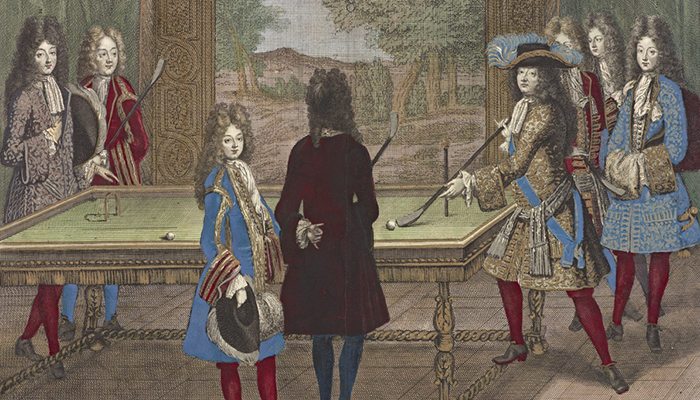
Antoine Trouvain, Third Apartment (detail), 1694. Hand-colored engraving and etching. From Appartements ou amusements de la famille royale à Versailles, a suite of 6 plates (The Getty Research Institute, 2011.PR.20)
◊ ◊ ◊ ◊ ◊
From The Getty:
Kimberly Chrisman-Campbell | Fit for a King: Louis XIV and the Art of Fashion
The Getty Center, Los Angeles, 23 August 2015
Louis XIV recognized fashion’s propaganda value as well as its economic importance, and he was deeply invested in establishing the technical and aesthetic superiority of France’s clothing and textile industries. Through prints, fashion plates, and his own oft-reproduced image, he set the standard of elegant dress and deportment throughout Europe. Art historian Kimberly Chrisman-Campbell examines the Sun King’s lasting contributions to French fashion as well as his own exquisite (and extravagant) taste. Sunday, August 23, 2:00pm.
This lecture complements the exhibition A Kingdom of Images: French Prints in the Age of Louis XIV, 1660–1715, organized in special collaboration with the Bibliothèque nationale de France and on view in the Getty Research Institute from June 16, 2015, to September 6, 2015.
Kimberly Chrisman-Campbell is an independent art historian specializing in fashion and textiles. She has worked as a curator, consultant, and educator for museums and universities around the world. Following the lecture, she will sign copies of her book, Fashion Victims: Dress at the Court of Louis XVI and Marie-Antoinette (Yale University Press, 2015), which will be available for purchase.
Lecture | Christoph Vogtherr on Karoline Luise of Baden
Later this summer at The Wallace Collection:
Christoph Vogtherr | Karoline Luise of Baden: Collector and ‘Amatrice’
The Wallace Collection, London, 7 August 2015
Karoline Luise, Markgräfin (Marchioness) of Baden was one of the greatest women collectors of the eighteenth century and an accomplished amateur artist. Her collection of paintings and drawings—including works by Chardin, Boucher and Liotard—forms the nucleus of the Kunsthalle in Karlsruhe in Southern Germany. Christoph Vogtherr will discuss the collecting and interests of this fascinating figure. The Wallace Collection is embarking on a collaboration with the Kunsthalle towards an exhibition of French drawings from the Karlsruhe collection.
Friday, 7th August, 2015 at 1:00pm; admission is free.
Chrisman-Campbell to Deliver The Huntington’s Robert Wark Lecture
From The Huntington:
Robert Wark Lecture | Fashion Victims: Dress at the Court of Louis XVI and Marie Antoinette
The Huntington Art Gallery, San Marino, CA, 7 May 2015
 Fashion historian Kimberly Chrisman-Campbell discusses one of the most exciting, controversial, and extravagant periods in the history of fashion: the reign of Louis XVI and Marie-Antoinette in 18th-century France. She explores the exceptionally imaginative and uninhibited styles of the period leading up to the French Revolution, as well as fashion’s surprising influence on the course of the Revolution itself. A book signing and coffee reception will follow the lecture. Thursday, 7 May, at 7:00pm, Rothenberg Hall.
The Cafe will be open for light suppers prior to this event. From 5:30pm until the start of the program, attendees can enjoy selected items including artisan pizzas, sushi, cheeses and charcuterie, and beer or wine in the new dining venue overlooking the gardens.
Helen Jacobsen on The Wallace Collection’s Sphinx Clock, 1781

◊ ◊ ◊ ◊ ◊
This afternoon at The Wallace Collection:
The Wallace Collection Treasure of the Month, April 2015 | Sphinx Clock, France, 1781
Gallery Talk by Helen Jacobsen, The Wallace Collection, London, 27 April 2015
In the late summer of 1777, Queen Marie-Antoinette wagered her brother-in-law 100,000 livres that he could not build a ‘pleasure house’ in less than 100 days; she lost the bet and the charming Pavillon de Bagatelle in the Bois de Boulogne was the result, although the interiors took several years to complete. Designed by the comte’s architect, François-Joseph Bélanger (1744–1818), it was intended for parties and enjoyment, with a billiard room, a dining room and a salon on the ground floor. Everything was in the latest neo-classical taste, executed by the group of talented decorators, sculptors and cabinet-makers around Bélanger and d’Artois.
The walls of the circular salon were decorated with panels of painted and gilded stucco decoration in the Antique style made fashionable by English and French architects such as Robert Adam and Charles-Louis Clérisseau, while the silk curtains and velvet chairs were of ‘English green’. Bélanger designed a clock for the room that reflected this decoration and when it was finally delivered in 1781 it was considered to be of such superb workmanship that it sat under a glass shade on the chimneypiece. The king’s clock-maker, Jean-Baptiste Lepaute (1727–1801), charged d’Artois the enormous sum of 7,500 livres for the clock, and also made one for his older brother, the comte de Provence. This clock is most likely the one made for Bagatelle. . . .
More information about the clock is available here»
A gallery talk on the clock by Helen Jacobsen, Senior Curator and Curator of 18th-Century Decorative Arts will take place Monday, 27 April 2015, at 1:00pm.
Basile Baudez on Architectural Drawings
Coming up at MIT’s HTC Forum, the main lecture series of the History, Theory, and Criticism of Architecture and Art Program:
Basile Baudez | Drawing for the Prize: Architectural
Competition Drawings from Europe to America
School of Architecture and Planning, Massachusetts Institute of Technology, Cambridge, 5 May 2015
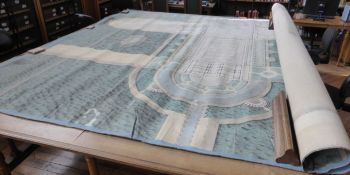 This talk will adopt the premise that architectural training as it was conceived in France in the eighteenth and nineteenth centuries was aimed more directly at producing drawings than buildings. The relatively limited existing scholarship on architectural drawings in a pedagogical context has been dominated, however, almost exclusively by concern for the subjects assigned—which is to say the final, built result. This approach has failed to address the question of the drawings as objects rather than illustrations and more particularly their status as the product of a complex institutional apparatus that taught and rewarded a codified system of architectural representation. This talk considers not only the questions of why and how a French Beaux-Arts model became dominant in dialogue with shifts in institutional structures but also the story of its discontents when alternate means of representation that the Beaux-Arts system had suppressed were revived and explored by those outside the academic establishment.
Architects trained with Legeay and deeply influenced by Piranesi, legitimated a separation between the representation and the actual project itself and taught students to draw ‘des tableaux d’architecture’. Students of the Académie de France à Rome in particular began to make use of expressive techniques that were until then considered exclusively the domain of the pictorial or plastic arts. Variations in ornamentation or distribution were conveyed through affective juxtapositions of color and daring application of pigment that held little to no relationship with the realities of the projected building. The proximity between architects and painters in the second half of the eighteenth century became institutionalized after the Revolution at the École des Beaux-Arts, where architects were trained in the same building as painters, sculptors, and engravers and where draftsmen across media shared life and perspective drawing classes.
During the first years of the nineteenth century, and particularly during the Napoleonic Empire, a reaction against such dramatic pictorial effects encouraged students to restrain their chromatic palette, to refine their lines and to lay stress on the precision with which they represented ornaments and sculpture. Monochromes were prized, resulting in a new value placed on mastering shading and wash, which was to become one of the defining characteristics of the Beaux-Arts style. Over the course of the century wash would provide an arena for experimenting with conventional uses of color and the production of abstract forms that tread carefully between providing a satisfying degree of detail without distracting the viewer or compromising a harmonious whole. In the ateliers of Vaudoyer, Percier and Lebas, students were taught how to animate the surroundings (notably natural elements, such as water, lawns, isolated trees, etc.) in order to produce the most affective architectural renderings of the century. While their most dominant features had little to do with the structures depicted they would emerge as the key models of academic architectural training at the end of the nineteenth century throughout Europe and the United States.
Basile Baudez received his PhD from the Ecole pratique des hautes études in Paris in 2006 and published his dissertation at the Presses universitaires de Rennes under the title Architecture et tradition académique au siècle des Lumières. He is currently associate professor in art and architectural history at the Paris-Sorbonne University. His current book project addresses the rise and dominance of the Beaux-Arts style in architectural drawing in Europe and America from the eighteenth through twentieth centuries.
Lecture | Philippe Blanchard on the Tombs of the Dukes of Épernon
From Inrap:
Philippe Blanchard | Étude historique et archéologique du caveau
des ducs d’Épernon, XVIIe–XVIIIe siècle, Eure-et-Loir
Musée du Louvre, Paris, 21 May 2015

Crânes sciés, famille des ducs d’Épernon (1661–1690), église Saint-Pierre d’Épernon © Philippe Blanchard, Inrap.
Cette conférence est donnée dans le cadre du cycle de conférences Actualité de la recherche archéologique.
Sous l’égide des départements du musée du Louvre, des spécialistes sont invités à présenter leurs plus récentes découvertes et les orientations de la recherche archéologique. En partenariat média avec Archéologia le magazine de l’actualité archéologique.
Auditorium du Louvre
Cour Carrée et Pyramide du Louvre
75058 Paris
Jeudi 21 mai 2015, à 12 h 30. Durée : 1 h
Entrée libre
Lecture | Pannill Camp on Masonic Ritual as Philosophy
From The Newberry:
Pannill Camp, Masonic Ritual as Philosophy in Early Eighteenth-Century France
The Newberry Library, Chicago, 25 April 2015
The story of Freemasonry’s introduction into France in the early decades of the eighteenth century is also in part the story of Enlightenment philosophy’s reliance on performance activity. Radical philosophy and freethinking did not subsist only in the circulation of printed texts. Natural philosophy was demonstrated in proliferating spaces of experimental proof, and esoteric thinkers devised ceremonies meant to serve as the basis of a new moral and intellectual reality. Figures credited with promoting French interest in Freemasonry, including J. T. Desaguliers, were also intimately involved in disseminating new knowledge about the natural world.
As part of a project that examines multiple categories of performance behavior that Freemasonry instituted and inspired in France, Professor Camp will propose that Masonic ritual activity represents a broader category of philosophical performance, encompassing works like John Toland’s 1720 Pantheisticon, which Margaret C. Jacob has provocatively called a Masonic ritual text. Examining this text alongside artifacts of proper Masonic rituals, Professor Camp will also argue that treating eighteenth-century French Freemasonry as an embodied philosophical pursuit may allow us to reconcile two disjointed themes that have so far characterized historians’ approaches to the topic. In other words, the ideals that motivated early Masonic activity, when viewed through the lens of performance, may also be seen as integral to the synthetic emotional bonds and sensitive masculine solidarity cultivated in lodge activity.
Eighteenth-Century Seminar, Saturday, April 25, 2015, 2pm.
Please register by 10am Friday, April 24.
Pannill Camp is Assistant Professor of Drama at Washington University, St Louis. His research examines points of intersection between theater history and the history of philosophy, especially in eighteenth-century France. He is the author of The First Frame: Theatre Space in Enlightenment France, (Cambridge University Press, 2015).
Mellon Lectures | Thomas Crow on Restoration as Event and Idea
Press release (20 February 2015) from NGA in Washington (after the fact, audio and video recordings are available here) . . .
Thomas Crow, Restoration as Event and Idea: Art in Europe, 1814–1820
64th Annual A. W. Mellon Lectures in the Fine Arts
National Gallery of Art, Washington, D.C., 15 March — 26 April 2015
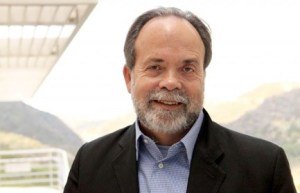 Thomas Crow, Rosalie Solow Professor of Modern Art at the Institute of Fine Arts, New York University, will give the 64th annual A. W. Mellon Lectures in the Fine Arts in a series entitled Restoration as Event and Idea: Art in Europe, 1814–1820. Crow will consider the period 1814–1820, following the fall of Napoleon. During this time, artists throughout Europe were left uncertain and adrift, with old certainties and boundaries dissolved. How did they then set new courses for themselves? Crow’s lectures will answer that question by offering both a wide view of art centers across the continent—Rome, Paris, London, Madrid, Brussels—and a close-up focus on individual actors—Francisco Goya (1746–1828), Jacques-Louis David (1748–1825), Antonio Canova (1757–1822), Sir Thomas Lawrence (1769–1830), Jean-Auguste-Dominique Ingres (1780–1867), and Théodore Géricault (1791–1824). Whether directly or indirectly, these artists were linked in a new international network with changed artistic priorities and new creative possibilities emerging from the wreckage of the old.
March 15: Moscow Burns/The Pope Comes Home, 1812–1814: David, Gros, and Ingres Test Empire’s Facade
March 22: At the Service of Kings, Madrid and Paris, 1814: Aging Goya and Upstart Géricault Face Their Restorations
March 29: Cut Loose, 1815–1817: Napoleon Returns, David Crosses Borders, and Géricault Wanders Outcast Rome
April 12: The Religion of Ancient Art from London to Paris to Rome, 1815–1819: Canova and Lawrence Replenish Papal Splendor
April 19: The Laboratory of Brussels, 1816–1819: The Apprentice Navez and the Master David Redraw the Language of Art
April 26: Redemption in Rome and Paris, 1818–1820: Ingres Revives the Chivalric while Géricault Recovers the Dispossessed
All lectures will take place on Sunday afternoons at 2:00pm and are free and open to the public. Because of the East Building renovation, the lectures will be presented in the West Building Lecture Hall, which has limited capacity. Entry passes (one per person) will be required for admission and will be distributed starting at 1:00pm on a first-come, first-served basis on the day of each lecture in the East Building Concourse. The lectures will be streamed live. At the Gallery, the live stream will be shown in the West Building Project Room and the East Building Reception Room. The live stream will also be available at the NGA website. On the Wednesday following each lecture, a video screening will be shown in the West Building Lecture Hall at noon. Audio recordings will be available each Tuesday, and video recordings with closed captioning will be available each Friday following the lecture here.
Thomas Crow is the Rosalie Solow Professor of Modern Art at the Institute of Fine Arts, New York University. He holds an MA and a PhD in art history from the University of California, Los Angeles, and a BA from Pomona College. His interests center on the entwined aesthetic and social dynamics in the production of art and the role of art in modern society.
Crow’s most recent book, The Long March of Pop: Art, Design, and Music, 1930–1995, was published by Yale University Press in January 2015. He is also the author of Emulation: Making Artists for Revolutionary France (1995, 2006); The Rise of the Sixties: American and European Art in the Era of Dissent (1996, 2005); The Intelligence of Art (1999); Modern Art in the Common Culture (1996); Painters and Public Life in Eighteenth-Century Paris (1985); and articles including “The Practice of Art History in America,” Daedalus 135 (Spring 2006) and “Marx to Sharks: The Art-Historical ’80s,” Artforum 41 (2003). He is a contributing editor of Artforum.
Crow has received numerous honors throughout his career, including the Eric Mitchell Prize for the best first book in the history of art (1986), the Charles Rufus Morey Prize of the College Art Association (1987), and a National Endowment for the Humanities Fellowship (1988–1989). He is a member of the American Academy of Arts and Sciences. He is currently the recipient of a John Simon Guggenheim Memorial Foundation fellowship (2014–2015) and spent the fall of 2014 as a Michael Holly Fellow at the Sterling and Francine Clark Art Institute.
Before his appointment at the Institute of Fine Arts, Crow was director of the Getty Research Institute, professor of art history at the University of Southern California, the Robert Lehman Professor of the History of Art at Yale University, and professor and chair in the history of art at the University of Sussex.
Royal Oak Foundation Lectures, Spring 2015
A selection of the season’s offerings from The Royal Oak Foundation as related to the eighteenth century:
Royal Oak’s speakers are engaging, knowledgeable experts with a passion for a variety of topics related to The Royal Oak Foundation’s mission.
Charles Hind | Palladianism: Four Centuries of Style
First Baptist Church, Charleston 12 May 2015
Chicago Architectural Foundation, 8 May 2015
The MAA Carriage House, Washington, D.C., 5 May 2015
Abigail Adams Smith Auditorium, New York, 7 May 2015
The Union League of Philadelphia, 4 May 2015
The year 2015 marks the 300th anniversary of the publication of the first English translations of Andrea Palladio’s I Quattro Libri dell’Architettura [The Four Books of Architecture] and Colen Campbell’s Vitruvius Britannicus. Since the early 17th century, Palladio’s work, as adapted by Inigo Jones for English taste and needs, has influenced architects and clients. British Palladianism, as developed by Jones, Campbell, Lord Burlington and William Kent also proved hugely influential in northern Europe and in the British Colonies including India and North America.
Charles Hind, Chief Curator and H.J. Heinz Curator of Drawings at the Royal Institute of British Architecture, will examine the development of Palladianism in Britain using drawings, photographs and models from the RIBA’s collections, as well as contemporary architects’ practices. He will demonstrate how the contributions of this 16th-century Venetian man influenced centuries of style, and how Palladianism became one of the most important styles ever designed by a single architect, and is still used in public and private buildings.
Charles Hind’s areas of specialty are Andrea Palladio and British architecture from 17th to early 20th centuries. He co-curated a major European exhibition on Palladio in 2008–2009, and served as joint curator and co-author of the catalogue for the 2010 exhibition Palladio and His Legacy: A Transatlantic Journey. Mr. Hind has written numerous journal and magazine articles and lectured on architecture and British country houses. He also leads art and architecture tours in Virginia, St. Petersburg, and Venice. Mr. Hind has curated a number of exhibitions held in the RIBA Heinz Gallery and in the V&A+RIBA Architecture Gallery at the Victoria & Albert Museum.
◊ ◊ ◊ ◊ ◊
David Milne | ‘Still Life Drama’: A Walk Through Dennis Severs’ House
The Explorers Club, New York, 18 June 2015
At the Dennis Severs’ House at 18 Folgate Street in London, visitors are invited not to a museum to learn how people lived in the past, but rather to participate in what the founder called “a still life drama.” Guests walk through each room of the house in a multisensory experience feeling as if the 18th- and 19th-century inhabitants have only just withdrawn a moment before. These encounters were designed by American collector and founder Dennis Severs, who bought a semi-derelict early 18th-century house in the 1970s and then set about bringing it back to life. With no desire to restore the house, Severs instead wanted to honor what he imagined were the echoes of the house’s history. So armed with a chamber stick and pot, he created the fictional story of a Huguenot silk merchant’s family who might have lived in the house for generations from 1724 to 1914.
The triumph and tragedy of this fictional family is told through each room over several stories. Severs filled the house with original objects he bought in London’s street markets and sale rooms, atmospherically lit by candlelight. Painstakingly assembled over 20 years, many of the rooms are mocked up in the manner of stage scenery using inexpensive materials—all is artifice but still conveys a haunting sense of London’s past: silk waistcoats are flung across rumpled bed clothes, a card game has just ended, fires crackle, and steam rises from a filled punch bowl. Curator David Milne will discuss Dennis Severs’ incredible vision and illustrate how his remarkable home uniquely captures a moment in time.
David Milne has served as curator of Dennis Severs’ House since 1990. He has previously worked for Paul Dyson & Associates on projects for the Royal Historic Palaces, the Royal Opera House, the V&A Museum, Versace and Armani. He has been invited to give lectures for The National Trust and English Heritage, and was awarded the Verney fellowship by the Nantucket Historical Association in 2006–2008.
◊ ◊ ◊ ◊ ◊
Sean Sawyer | Tales of Loss & Redemption: The Country House in the National Trust
Castle Hill on the Crane Estate, Boston, 14 April 2015
The Explorers Club, New York, 28 April 2015
The Union League of Philadelphia, 27 April 2015
From the 1880s through the 1930s, Britain experienced a revolution in land ownership only paralleled in its history by the Norman Conquest and the Dissolution of the Monasteries. Britain’s landed elites found themselves under attack by the forces of modernity on all fronts, and their bastions, the country house, fell to the auction block and the wrecker’s ball in increasing numbers throughout the first half of the 20th century. Into this breach in the fabric of British landed society stepped a reluctant new force of social order, the National Trust.
The Royal Oak Foundation’s Executive Director, Dr. Sean E. Sawyer will discuss the National Trust’s role in rescuing some of Britain’s greatest country houses and their internationally significant collections of decorative and fine arts.
From a reluctant recipient of a handful of houses in the 1920s, the Trust evolved, through its Country Houses Scheme, to lead the way in preserving houses and collections through the bleakest years of the post-World War II era. The last decades of the 20th century saw a revival of fortunes for the country house and the Trust’s adaptation as its role as a leading operator of visitor attractions. This is a story full of deaths, both mortal and material, and of daring rescues and bureaucratic blindness. This illustrated lecture will explore some of the Trust’s most important properties, including Blickling and Hardwick Hall, and of the families and great characters who haunt them still.
Sean Sawyer became the Executive Director of The Royal Oak Foundation in October 2010. He received a B.A. summa cum laude from Princeton University in 1988 and his Ph.D. from Columbia University in 1999, specializing in 18th- and 19th-century British architectural history. In 1996, he was awarded the Society of Architectural Historians of Great Britain’s Hawksmoor Essay Medal, and in 2002 he attended the Attingham Summer School as a Royal Oak Fellow. Dr. Sawyer has taught at Columbia, Fordham and Harvard universities as well as The Parsons / New School Master’s Program in the History of Decorative Arts & Design at the Cooper-Hewitt. He has contributed essays and articles to numerous publications on Sir John Soane and late Georgian architecture and urbanism as well as Dutch-American history and architecture. From 2001 to 2007, he served as Executive Director of the Wyckoff House & Association, a Brooklyn-based organization focused on the operation of the Wyckoff Farmhouse Museum. Prior to joining Royal Oak, Sean was the Director of Administration and Development for the History Department at Columbia University for three years. He is a founding and current member of the Board of Directors for the Dyckman Farmhouse Museum Alliance, which supports the Dyckman Farmhouse Museum in Inwood, northern Manhattan.
◊ ◊ ◊ ◊ ◊
Michael Snodin | A Little Gothic Castle: Horace Walpole and Strawberry Hill
Scandinavia House, New York, 23 March 2015
The Union League of Philadelphia, 24 March 2015
Boston Athenaeum, 26 March 2015
Timken Museum, San Diego, 30 March 2015
UCLA Faculty Center, Los Angeles, 1 April 2015
Arader Galleries, San Francisco, 2 April 2015
Strawberry Hill, the fantasy gothic revival castle in Twickenham, was created during the mid-18th century for the politician, historian, and author Horace Walpole. But Strawberry Hill was more than an assemblage of bricks, plaster and papier mâché: it was the place to house Walpole’s eclectic collection. Portraits by renowned artists, furniture, and porcelain were displayed alongside eccentricities such as a limewood ‘lace’ cravat carved by Grinling Gibbons, embroidered gloves belonging to James II, and Dr. Dee’s mirror.
Mr. Snodin will describe Walpole’s collection—nearly all dispersed in an 1842 auction—and discuss the treasure hunt which is now underway to return as much as possible to the house. He also will illustrate the house’s incredible interiors and reveal how medieval architecture was the inspiration for the style of this summer villa: the stone fan vaulting of Henry VII’s chapel in Westminster Abbey influenced an ethereal confection of gilded plaster and papier mâché for Walpole’s Gallery. “My house is of paper like my writings,” wrote Walpole, “and both will blow away ten years after I am dead.” However, the house has miraculously survived and is now restored to its original appearance from 1790.
Michael Snodin is a design and architectural historian and Chairman and Hon. Curator of the Strawberry Hill Trust and the Strawberry Hill Collection Trust. In his career at the Victoria and Albert Museum he was Head of the Designs Collection, a Senior Curator and a Senior Research Fellow. He curated galleries as well as several major exhibitions including Horace Walpole and Strawberry Hill which opened in 2009 at The Yale Center for British Art. In addition to exhibition catalogues, his publications include many specialist articles. He is curator of Strawberry Hill Restored, which will open in 2017.
Lecture | Mark Rakatansky on Piranesi and Soane
From The Morgan:
Mark Rakatansky | ‘His Conduct is Mischievous’: Piranesi and Soane
The Morgan Library and Museum, New York, 19 March 2015
Sir John Soane, although an admirer of the graphic works of Piranesi, remarked that his “conduct is mischievous” in his only built work Santa Maria del Priorato. Similar sentiments have been expressed about Soane, particularly in regard to his own House-Museum. Mark Rakatansky (Graduate School of Architecture, Planning and Preservation, Columbia University) will explore the complex relationship of these two architects and the unsettling ‘mischievous’ engagements of their architecture, drawings, and writings. This lecture is cosponsored by Sir John Soane’s Museum Foundation.
The exhibition Piranesi and the Temples of Paestum: Drawings from Sir John Soane’s Museum will be open at 5:30pm for program attendees.
Thursday, March 19, 2015, 6:30pm
Tickets: $15; $10 for Morgan and Sir John Soane’s Museum Members; and free for students with valid ID.










leave a comment