Lecture | Jenny Uglow on Living in Britain through Napoleon’s Wars
This evening at 8:00, in connection with the Waterloo 200 events:
Jenny Uglow, In These Times: Living in Britain through Napoleon’s Wars
Army & Navy Club, 36–39 Pall Mall, London, 29 January 2015
 Join prize-winning author Jenny Uglow as she explores the many ways in which the Napoleonic Wars touched the lives of ordinary people. Discover the moving story of everyday people, struggling through hard times and opening new horizons that would change their country for a century ahead.
Bookings for the Celebrity Speakers can be made online at nam.ac.uk or via the ticket hotline on 020 7881 6600. Standard tickets are available for £10. SOFNAM, Students, Military and Senior tickets are available for £7.50. Proof of ID is required when collecting tickets. Concessions can only be booked via the ticket hotline.
The Army & Navy Club offer a two-course dinner in their Coffee Room fine dining restaurant before each talk. Combined ‘Dinner & Talk’ bookings can only be made by calling 020 7881 6600. Standard tickets are available for £32.50 and concessions for £30.
Seminar Series | Visual Cultures of Enlightenment: New Approaches
From ENS:
Cultures visuelles des Lumières: Nouvelles approches en histoire de l’art
École Normale Supérieure, Paris, January — May 2015
Séminaire coordonné par Charlotte Guichard (CNRS/ENS) et Anne Lafont (INHA)
L’histoire de l’art est une discipline aux frontières. Par-delà les traditionnelles hiérarchies entre high art et low art, ce séminaire, à vocation pluridisciplinaire, entend rendre compte aussi bien des chefs-d’œuvre consacrés que desimages scientifiques ou techniques, des graffitis et des cultures visuelles politiques dans un long dix-huitième siècle. La modernité critique des Lumières est en effet indissociable d’une production nouvelle d’images et d’artefacts qui va radicalement changer la manière de voir le monde. Celle-ci se déploie à la faveur d’une articulation inédite entre conception savante de l’image, commercialisation et politisation de l’art au moment de la formation d’un espace critique. Comment la naissance conjointe de l’histoire de l’art, de l’histoire naturelle, de l’anthropologie et de l’esthétique peut-elle nous aider à ressaisir le projet des Lumières ?
Ce séminaire propose un premier état historiographique de ce champ en pleine reconfiguration. Chaque séance sera conçue comme une réflexion autour d’un thème général, avec une intervention plus spécifique menée à partir de travaux en cours. Nous interrogerons notamment les frontières entre art et science à travers l’image ; la question du genre ; les formes de la visualité ; les liens entre art et culture politique.
Séminaire est ouvert aux étudiants à partir du niveau master
Vendredi de 10h à 12h
Salle de séminaire de l’IHMC (esc. D, 3e étage)
École normale Supérieure 45, rue d’Ulm, 75005 Paris
charlotte.guichard@ens.fr et anne.lafont@inha.fr
◊ ◊ ◊ ◊ ◊
P R O G R A M M E
30 janvier 2015 : Séance introductive
6 février 2015 : Violences et Lumières atlantiques
Anne Lafont, « Visualités de la violence à l’époque des abolitions »
Alors que la fin du dix-huitième siècle voit les guerres de révolution éclater de part et d’autre de l’Atlantique (révolutions américaine, française et haïtienne), les saisies visuelles et artistiques de ces événements donnent à voir et à penser différentes expressions de la violence plus ou moins propres au mouvement progressiste desLumières. La production des imagiers de Paris, de Philadelphie et de Saint-Domingue forge un champ visuel de la violence hétérogène qu’il faut scruter à l’aune de ce que signifient ces conflits émancipatoires les uns par rapport aux autres, des révoltes indépendantistes aux luttes contre l’esclavage.
20 février : Figures de l’artiste
Charlotte Guichard, Les signatures de Chardin : des écritures ordinaires ?
Dans la peinture française du 18e siècle, la signature s’impose comme un détail nouveau : lieu de l’expertise pour les amateurs et les marchands, élément d’autoreprésentation pour les peintres, réflexion sur l’objet tableau. La séance portera sur les signatures du peintre Jean Baptiste Chardin : discrètes mais omniprésentes, éminemment réflexives, elles expriment de manière exemplaire les nouvelles conceptions de l’art, de l’auteur et du tableau au siècle des Lumières.
6 mars : Histoire de l’art et Genre
Anne Lafont, « Création/Procréation : autoportrait des femmes artistes »
Les questions relatives à l’activité artistique des femmes sont multiples au cours de l’histoire et ébranlent souvent les catégories d’analyse établies, tels le génie artistique ou la transmission des savoir-faire, mais aussi la détermination des corpus dignes de l’histoire de l’art. Au cours du XVIIIe siècle, l’institutionnalisation de la pratique artistique, de l’exposition, de la critique et d’une manière générale des différents métiers de l’art précipite et multiplie les possibilités offertes aux femmes : non seulement d’exercer leur art, mais de le rendre public et, exceptionnellement, d’accéder à une reconnaissance de leur production par des moyens comparables à ceux déployés par les hommes. Une telle aventure progressiste et perfectible offre certainement un point d’entrée remarquable dans les études de l’art des Lumières.
20 mars : Les Lumières Américaines
Wendy Bellion, « L’art américain et l’illusion optique au XVIIIe siècle »
Cette séance explorera les questions relatives à l’illusion optique aux Etats-Unis à la fin du XVIIIe siècle et au début du XIXe siècle. En mettant l’accent sur les espaces d’exposition à Philadelphie – la plus grande ville américaine de l’époque – nous étudierons les dispositifs de trompe l’œil mis en œuvre par la famille de Charles Willson Peale et d’autres artistes contemporains, considérant que leurs peintures mirent au défi l’agilité des modes de perception desspectateurs, tout comme elles imposèrent une attention accrue portée à la part politique du regard.
3 avril : Cultures visuelles en Révolution
Guillaume Mazeau : « Du spectacle à l’observation : le rôle des cultures visuelles dans la définition de la citoyenneté pendant la Révolution française »
Si le rôle des cultures écrites et orales dans la transition politique de la fin du XVIIIe siècle est assez bien connu, celui des cultures visuelles l’est beaucoup moins. Or parmi les nombreuses compétences et valeurs qui contribuent à dessiner les contours mouvants et débattus de la nouvelle citoyenneté, le sens de l’observation occupe une place de choix. Défini à rebours du spectateur comme celui qui exerce un regard critique, actif et attentif sur la nature dont il tente de saisir la réalité, l’observateur devient un protagoniste majeur des utopies politiques et sociales comme despratiques les plus quotidiennes. Il s’agira ici de poser des questions sur cette « visiocratie » (Peter Goodrich) naissante, en s’interrogeant sur son rôle dans les processus d’émancipation et de domination dans un contexte de révolution.
17 avril : Manière(s) de voir : le regard des Lumières
Charlotte Guichard : « Science et esthétique du coup d’œil »
L’histoire du regard est un terrain de rencontre privilégié pour historiens de l’art et historiens des sciences qui se sont intéressés, chacun dans leur perspective, à une histoire du détail (Daniel Arasse), de l’attention et de l’observation dans les sciences et la culture (Lorraine Daston, Jonathan Crary). Qu’en est-il du « coup d’œil », formule omniprésente au 18e siècle, qui désigne à la fois un dispositif visuel dans l’image et un régime du regard ? Elle nous servira de point d’entrée pour réfléchir à la manière dont artistes, savants et amateurs ont représenté et synthétisé, dans les images d’art et de science, leur expérience et leurs savoirs sur le monde.
15 mai 2015 : Histoire de l’art, histoire des techniques, histoire des sciences
Mechthild Fend, « Epaisseurs de la peau : organicité, sémantique et matérialité de l’image »
À partir de deux images médicales illustrant la structure microscopique de la peau, cette intervention interrogera la relation entre l’image et l’objet de l’image, entre l’observation artistique et l’observation anatomique, entre le savoir médical et le savoir artisanal des imprimeurs. Autrement dit, on envisagera ce que veut dire produire une image sur le vif quand cela fait référence à la représentation de structures microscopiques auparavant invisibles à l’œil nu et dont la connaissance demeure imparfaite. Enfin, il conviendra d’analyser comment un médium – qu’il s’agisse d’un dessin ou d’une gravure, éventuellement en couleur – participe non seulement de la visualisation mais aussi de l’interprétation, et même de la constitution d’un phénomène anatomique.
Lecture | Basile Baudez on Saint Petersburg’s Panorama

◊ ◊ ◊ ◊ ◊
From Penn’s Humanities+Urbanism+Design Initiative:
Basile Baudez | ‘The Décor of an Opera Built Yesterday’, Saint Petersburg’s Panorama
Penn School of Design, University of Pennsylvania, Philadelphia, 20 November 2014
Founded in 1703 on the Neva River Delta to provide Russia with a port to serve its Baltic ambitions, Saint Petersburg was aggressive in its bid to be read as a modern, European capital. The first prints representing the city adopted a panoramic format that focused on the Neva, its sublime width, and the magnificent new façades erected along its shores. Visitors understood the river landscape, however, as an insurmountable obstacle to proper urban development. For them, the Neva conveyed the hostility of nature, while the buildings—forever to be seen from too great a distance—appeared unreal, ready to vanish into the flat horizon.
Basile Baudez is Assistant Professor at the University Paris-Sorbonne (Paris IV).
Thursday, 20th November 2014, 6:15pm
Meyerson Hall, Lower Level, B3
210 S. 34th Street
Philadelphia, PA
Exhibition | Tables from the Great Gallery of The Wallace Collection
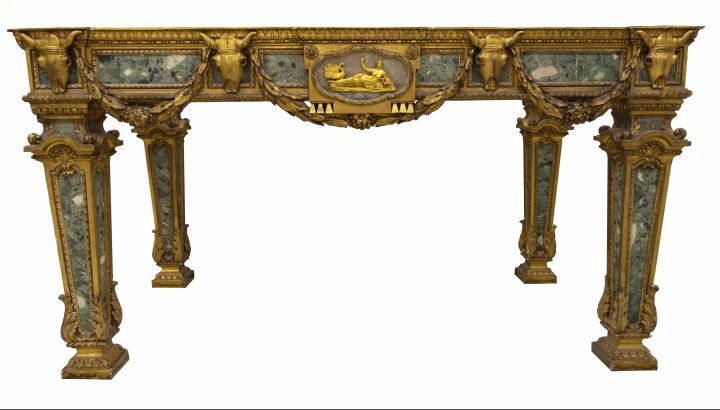
Pier table, Italy, ca. 1770 (London: The Wallace Collection)
A high resolution image is available here»
◊ ◊ ◊ ◊ ◊
Now on at The Wallace:
Collaboration, Conservation and Research: Furniture from the Great Gallery
The Wallace Collection, London, 19 September 2014 — 27 September 2015
Two pairs of monumental tables have been on display in the Great Gallery for more than a century. The recent Great Gallery refurbishment project provided the perfect opportunity for all four tables to undergo full cleaning and conservation treatment. To address the treatment needs of the tables, the Wallace Collection teamed up with Buckingham New University, City and Guilds of London Art School and West Dean College and several students undertook the work as an integral part of their degree course. Now, some two years later, the tables have returned from treatment and look stunning in their former locations, much as they would have looked in Sir Richard Wallace’s day.
During the course of their treatment conservators and curators were able to analyse the tables forensically, discovering, for example, that the two in the centre of the gallery (F510-511) are not in fact a pair, instead one is a later copy of the other. To learn more about our new findings, as well as the techniques which the students used in their conservation work on these and the pair of pier tables (F514-515), come and visit the display from 19 September in the Conservation Gallery at the Wallace Collection.
T A L K S
All talks start at 1pm in the Conservation Gallery.
Monday, 22 September: John Slight, a former student from Bucks New University, will discuss the treatment of a grand nineteenth-century Italian table.
Monday, 20 October: Hans Thompson, a former student from City and Guilds of London Art School, will discuss the treatment of the Italian eighteenth-century Pier table.
Thursday, 20 November: Kate Aughey, a former student from West Dean College, will discuss the treatment of the Italian eighteenth-century Pier table.
Monday, 8 December: Dr. Marina Sokhan, Head of Conservation at City and Guilds of London Art School, will discuss the treatment of the Italian eighteenth-century Pier table as well as the conservation course at City and Guilds of London Art School.
Paul Mellon Centre Research Lunches, Autumn 2014
This fall’s research lunches at The Mellon Centre include two sessions on eighteenth-century topics:
The Paul Mellon Centre, Research Lunches, Fall 2014
The Paul Mellon Centre for Studies in British Art, London, Fridays, 12:30–14:00
3 October: Rosie Razzall (Curator of Prints and Drawings: The Royal Collection)
Copying Gainsborough: Paul Sandby and the Refashioning of His Artistic Identity
28 November: Eleonora Pistis (Scott Opler Research Fellow in Architectural, Worcester College, Oxford)
Nicholas Hawksmoor, Oxford, and Eighteenth-Century Europe
All seminars are free, but places are limited; so you must book a place in advance by emailing Ella Fleming at
events@paul-mellon-centre.ac.uk. The full programme of autumn lunches is available here.
Charles Eldredge Prize for 2014 (Lecture) and 2015 (Nominations)
Wendy Bellion, ‘Here Trust Your Eyes’: Visual Illusion and the Early American Theater
2014 Charles C. Eldredge Prize Lecture
Smithsonian American Art Museum, Washington, D.C., 18 September 2014
The Smithsonian American Art Museum invites you to join Wendy Bellion (associate professor of American art and material culture at the University of Delaware and winner of the museum’s 2014 Charles C. Eldredge Prize for Citizen Spectator: Art, Illusion, and Visual Perception in Early National America) for a discussion entitled ‘Here Trust Your Eyes’: Visual Illusion and the Early American Theater on September 18th, 2014, at 4:00pm at the museum. Bellion’s talk will explore how Philadelphia’s Chestnut Street Theater was also a space of visual display and illusion akin to and in conversation with exhibition sites like Charles Willson Peale’s museum.
◊ ◊ ◊ ◊ ◊
2015 Charles C. Eldredge Prize for a Single-Author Book
Smithsonian American Art Museum, Washington, D.C.
Nominations due by 1 December 2014
The Smithsonian American Art Museum invites nominations for the 2015 Charles C. Eldredge Prize, an annual award for outstanding scholarship in American art history. Single-author books devoted to any aspect of the visual arts of the United States and published in the three previous calendar years are eligible. To nominate a book, send a one-page letter explaining the work’s significance to the field of American art history and discussing the quality of the author’s scholarship and methodology. Self-nominations and nominations by publishers are not permitted. The deadline for nominations is December 1, 2014. Please send them to: The Charles C. Eldredge Prize, Research and Scholars Center, Smithsonian American Art Museum, P.O. Box 37012, MRC 970, Washington, D.C. 20013-7012. Nominations will also be accepted by email: eldredge@si.edu or fax: (202) 633-8373. For more information about the prize, please visit americanart.si.edu/research/awards/eldredge.
◊ ◊ ◊ ◊ ◊
Note (added 26 October 2014) — A slightly different version of the announcement for the 2015 Eldredge Prize originally appeared in this posting; the new wording reflects the most recent description from the Smithsonian American Art Museum.
Lecture | Nancy Hills on Historical Dress
This recap (along with a link to the video of the lecture, included below) comes from the newsletter of the Society of Antiquaries of London, Salon Issue 321 (2 June 2014). The video usefully provides a sense of the kind of scholarship the Janet Arnold Award aims to support. -CH
◊ ◊ ◊ ◊ ◊
Nancy Hills | Historical Dress: a Project Inspired by Janet Arnold
Society of Antiquaries of London, 27 May 2014
Advance publicity for the meeting simply said that Nancy Hills, a Janet Arnold Award recipient, would talk about ‘Historical Dress: a project inspired by Janet Arnold’. It transpired that Nancy Hills is Professor of Costume Design at Utah State University and a leading designer of authentic period costume for theatres and opera houses all over the United States. Her Janet Arnold-inspired project involved studying historic clothing in the collections of Hereford Museum and the National Trust (at Berrington Hall, near Leominster, Herefordshire, and Snowshill Manor, in Gloucestershire). Nancy made drawings and measurements that she then used to make new patterns enabling the historic garments to be re-created using modern materials but as close as possible to the original fabrics.
The garments in these three collections span the period from the late 1780s—when cotton was the coming fabric, taking over in popularity from silk, and when full skirts with extravagant gathers were fashionable—to the stripped back Utility dresses of the 1940s, made to conform to the government’s Controlled Commodity 1941 (CC41) austerity regulations, which went so far as to dictate the maximum number of buttons that could be used on each garment.
Despite, or perhaps because of, the simplicity of this garment, the speaker admitted that the Utility dress. . . was marginally her favourite in the collection, and most members of the audience agreed—indeed, historians of this period now say that initial hostility towards cheap, price-controlled Utility clothing was whipped up by retailers fearful for their profits: the public, by contrast, came to like the hard-wearing, good-quality and surprisingly stylish CC41 products.
◊ ◊ ◊ ◊ ◊
Lecture | Michael Twitty on The Cooking Gene
After hearing Michael Twitty at this year’s ASECS conference in Williamsburg, I’ve become a big fan. He speaks this evening at the Yale Center for British Art in conjunction with New Haven’s International Festival of Arts & Ideas (14–28 June 2014). -CH
From YCBA:
Michael Twitty | The Cooking Gene: Tracing My African Story Through Food
Yale Center for British Art, New Haven, 18 June 2014
 For African American culinary historian Michael W. Twitty, there was a hole in the history of American cooking as large as those in the stories of most African American families. Twitty traced his own family history along with that of Southern and American food using genetic research, historic interpretation, nature study, heirloom gardening, and interviews with contemporary food experts. His journey led him back to his family’s origins in West and Central Africa. Join him and grab a front-row seat in the debate over race and food in American life. This lecture is offered as part of the International Festival of Arts & Ideas.
◊ ◊ ◊ ◊ ◊
Toward the end of the month, and also in conjunction with the Festival of Arts & Ideas, YCBA will host the premiere of the film Visual Literacy: Rethinking the Role of Art in Education:
Visual Literacy: Rethinking the Role of Art in Education
Yale Center for British Art, New Haven, 28 June 2014
Please join us for the premiere screening of this thirty-five minute documentary. Produced by the Yale Center for British Art, the film focuses on the role art can play in teaching literacy and a unique partnership between the museum and local schools. The screening will be followed by a discussion with the film’s director Lisa Molomot and producer Cyra Levenson.
Visit artidea.org for more Festival information.
Evening Lecture | Beyond the Ropes: National Trust Collections
From Spectator Events:
Beyond the Ropes: A Closer Look at National Trust Collections
Chelsea Old Town Hall, London, 7 July 2014
The National Trust looks after some 200 individual collections, with more than a million objects in its care. Together, they include nearly 14,000 paintings—the single largest collection in the UK. What can these outstanding collections tell us about the families who built them, and what historical and artistic narratives might they yet reveal? How have they been passed to the Trust, and how do they continue to grow? And are they beginning to benefit from the expansion of government incentives for philanthropy?
Join our panel of experts for an evening of discussion and debate about the National Trust collections, their formation and future. A drinks reception will follow the talk.
Thomas Marks (Editor, Apollo Magazine) and David Adshead (Head Curator, the National Trust), with more speakers to be announced.
Doors open at 6:30 and the discussion begins at 7:00. Tickets are £20 and can be booked here.
Fair | Art Antiques London, 2014
From the fair’s website:
 Art Antiques London
London, 11–18 June 2014
The Albert Memorial and Kensington Gardens once again provide the stunning backdrop to one of London’s most exciting and glamorous art and antique fairs. Held in a beautiful bespoke pavilion opposite the Royal Albert Hall and close to the site of the Great Exhibition of 1851, Art Antiques London brings together leading international dealers and discerning visitors from all over the world, who can buy with confidence at this strictly vetted sumptuous summer showcase for the arts.
◊ ◊ ◊ ◊ ◊
From the fair’s lecture series (with information about each speaker available here) . . .
Jewellery in the Age of Queen Victoria: A Mirror to the World
Thursday, 12 June, 11:30
Judy Rudoe (Curator of Jewellery and Decorative Arts, The British Museum)
This lecture emerges from the speaker’s recent book co-authored with Charlotte Gere (see biography). The ‘age of Victoria’ is taken in its widest sense to encompass jewellery from across Europe and America, at a time when expanding foreign trade, the new illustrated press and a growing tourist industry brought jewellery from many parts of the world to a wide audience. Queen Victoria played a huge role: what she wore and did had tremendous impact, so what might seem a narrow subject acts as a key to our understanding of the entire Victorian age. Using examples from the British Museum and collections worldwide, Judy Rudoe considers Victorian jewellery against its global background and uncovers what jewellery meant to those who wore it, both literally and metaphorically. She will show how it was used in private and in public to reveal that politics, nationalism and even humour of the period are all embodied in jewellery.
◊ ◊ ◊ ◊ ◊
J.M.W. Turner: The Artist and His House at Twickenham
Thursday, 12 June, 2:30
Catherine Parry-Wingfield (Chairman of Turner’s House Trust)
Turner is rightly one of the most famous names in the history of British art, and remains an inspiration to painters today. Tucked away in Twickenham is a small unknown work by this great artist, not a painting, but a work in three dimensions. Sandycombe Lodge was designed by Turner himself as a country retreat from the pressures of the London art world; his ‘old Dad’ kept house here, Turner sketched, fished the river and occasionally entertained. This talk will explore a little-known side of Turner’s life and work, against the backdrop of the ‘Matchless Vale of Thames’, the beautiful Thames scenery which inspired much of his work. Sandycombe Lodge is now owned by Turner’s House Trust, which is developing plans for major conservation and future use of this beautiful and important building.
◊ ◊ ◊ ◊ ◊
A Matter of Fashion: The Collecting of English Ceramics
Friday, 13 June, 11:30
Anton Gabszewicz (Independent ceramics researcher)
Since the death of Lady Charlotte Schreiber in 1895, English ceramics have been collected with increasing enthusiasm. The founding of the English Porcelain Circle in 1927, under the Presidency of Mrs Radford, brought leading enthusiasts together and since then, through the yearly publication of the ECC Transactions their knowledge has been disseminated to a wider public. Yet the collections the speaker will discuss are markedly varied in their content and in the way they have been assembled. The names form a roll call of the influential collectors of the last 70 years. This lecture identifies those influences and how they informed the taste of succeeding generations.
◊ ◊ ◊ ◊ ◊
Of Soup and Love: The Campbell Collection of Soup Tureens at Winterthur Museum
Friday, 13 June, 2:30
Pat Halfpenny (Independent researcher)
The Campbell Collection of soup tureens is the finest collection of its type in the world. Although this lecture will focus on the magnificent ceramic pieces, they will be set in a context that includes highly prized silver and gilt examples that will help us understand the evolution of high style in the eighteenth and early nineteenth centuries. As grand gilded baroque examples, fanciful rococo porcelain, and elegant neoclassical forms will be discussed, the speaker will share some of the changes in social life and dining practices that created the environment in which tureens were first introduced, rose to great prominence, declined, and found new purpose in the twentieth and twenty-first centuries.
◊ ◊ ◊ ◊ ◊

Early Chelsea Model of a Finch, ca. 1745–49, exhibited by the Brian Haughton Gallery.
Nature, Porcelain and Enlightenment: Early English Porcelain and its Place in the Eighteenth-Century Home
Friday, 13 June, 4:30
Paul Crane (Lecturer, researcher, and dealer)
England in the mid-eighteenth century was a country riveted by an insatiable appetite for knowledge, exploration, and discovery. This forged a new scientific approach which was to spearhead the Age of Enlightenment. Through new eminent publications Science and Nature became the pinnacle of taste and fashion within the Aristocracy, who decorated their homes with this organic natural force. The birth of English porcelain in London in the 1740s provided an opportunity for enlightenment to fuse with the arts. Examples of the production at the porcelain manufactories of Bow, Chelsea, Worcester, and Vauxhall together with the Liverpool factories of Samuel Gilbody, William Reid, and Richard Chaffers will illustrate these natural recreations that were to fill the eighteenth-century home with a totally re-invented Cabinet of Natural Curiosity.
◊ ◊ ◊ ◊ ◊
The Silver Society Study Day: New Silver Projects
Saturday, 14 June, 11:00–6:00
Dirk-Jan Biemond, Michèle Bimbenet Privat, Hazel Forsyth, Christopher Hartop, James Rothwell, Peter Taylor, and Charles Truman
Tickets: £50 society members / £65 non-members. Please note that The Silver Society Study Day is booked separately from the Art Antiques London lecture programme. To book, visit The Silver Society’s website or email events@thesilversociety.org.
◊ ◊ ◊ ◊ ◊
Around the World in 80 Figures: Highlights of the Pauls-Eisenbeiss-Stiftung, Basel
Sunday, 15 June, 11:30
Samuel Wittwer (Director, Prussian Palaces and Gardens Foundation, Berlin-Brandenburg)
Established in 1975 in Basel, the Pauls-Eisenbeiss Foundation is one of the world’s leading collections of eighteenth-century German porcelain figures. The collection concentrates on four leading manufactories (Meissen, Frankenthal, Ludwigsburg, and Höchst) bringing together 750 objects, mainly figures. This treasure trove of German porcelain has been open to the public since 1977. It is not just a collection of important examples of each manufactory; it is a collection cleverly put together in the 1950s and 1960s and is the perfect study base enabling collectors to compare variations of decoration and modelling, discovering unique pieces and also enabling students to gain insight to a wide range of topics such as fashion and social aspects of the eighteenth century. This lecture introduces us to this important collection in a multifaceted way by giving us a general overview as well as concentrating on new aspects of research and details.
◊ ◊ ◊ ◊ ◊
Freedom of Expression: The Fantastic Range of du Paquier Porcelain
Sunday, 15 June, 3:30
Claudia Lehner-Jobst (Art historian and curator, Vienna)
This lecture will pay homage to two personalities: Claudius Innocentius du Paquier, the founder of the first porcelain manufactory in Vienna and his artistic resourcefulness and to one of the first collectors of his work, Marchese Emanuele d’Azeglio whose objects now form the heart of the ceramics collection at the Palazzo Madama in Turin. The speaker will discuss the history of that collection and some outstanding objects in depth.
◊ ◊ ◊ ◊ ◊
A Behind the Scenes Look at Ming: 50 Years that Changed China
Monday, 16 June, 11:30
Jessica Harrison-Hall (Curator of Chinese Ceramics, British Museum and Sir Percival David Collections and Vietnamese Art)
This year the British Museum will open a major exhibition on Ming courts and their international engagement. Ming: 50 Years that Changed China shows how fifty years of the Ming dynasty transformed China in ways which still affect the country we know today. Ming China was thoroughly connected with the rest of the world in these years and absorbed many influences. The staggering wealth of the courts included some of the most beautiful porcelain, gold, jewellery, furniture, paintings, sculptures, and textiles ever made. Many of these objects were undiscovered until recently and have never been shown within the context of China’s multiple courts and of Ming China’s interaction with foreign countries ranging from Mogadishu to Kyoto. This lecture takes a behind the scenes look at the four years of collaborative research and international co-operation which culminate in the exhibition.
◊ ◊ ◊ ◊ ◊
Face to Face: Dame Rosalind Savill in Conversation with the Duke of Devonshirec
Monday, 16 June, 4:00
Where do you find the essential combination of sensibility and pizzazz needed to cherish the traditional and celebrate the innovative in a great country house? The answer is simple: at Chatsworth with the Duke and Duchess of Devonshire. Throughout its history the individual contribution of each generation has enabled it to evolve and flourish, often against huge odds, but the pressures and challenges today are more formidable than ever. Stoker and Amanda Devonshire have spent the last ten years reinventing Chatsworth in a myriad of inspirational ways, giving it a new twenty-first century lease of life, and using their magic touch to turn a possible millstone into a marvel. This discussion will attempt to discover the secrets of their success in bringing a thrilling new edge to Chatsworth. It will touch on the history of the house and its great collections, and will explore their daunting responsibilities and prospects when he inherited in 2004, how their grand plans took shape, the highs and lows of achievement, and the continuing excitement of future projects and dreams. Conversation sponsored by 1stdibs.
◊ ◊ ◊ ◊ ◊
The French Porcelain Society Study Day: Sèvres and China
Tuesday, 17 June, 11:00–5:30
Dame Rosalind Savill, John Whitehead, Juliet Carey, Kee Il Choi, Vincent Bastien, and David Peters
Tickets: £45 Society members / £65 non-members. Please note that The French Porcelain Study Day is booked separately from the Art Antiques London lecture programme. To book, visit The French Porcelain Society’s website or email rmcpherson@orientalceramics.com.
◊ ◊ ◊ ◊ ◊
Porcelain Figures in the Royal Court Pantries in Dresden, Warsaw and Hubertusburg: A Crash-Course in the Hof-Conditorei Inventories
Wednesday, 18 June, 2:30
Maureen Cassidy Geiger (Independent ceramic researcher)
Meissen figures have typically been studied via the work reports in the manufactory archives, which were suspended from 1748 to 1764, or the Japanese Palace inventories. By comparison, the highly detailed inventories of the court pantries of the Saxon-Polish realm have been overlooked as an essential resource for understanding the types and numbers of figures produced for table decoration, especially during the gap in the work reports. This Hof-Conditorei crash course will focus on three inventories taken between 1750 and 1755 at three royal palaces: Dresden, Warsaw, and Hubertusburg.
◊ ◊ ◊ ◊ ◊
Dining Culture in Enlightenment Europe
Wednesday, 18 June, 4:30
Ivan Day (British food historian)
From the town houses of Edinburgh to the palaces of St Petersburg, from the chocolate houses of Madrid to the grand salons of Stockholm, the cuisine and dining protocol of the French ancien regime spread rapidly during the course of the eighteenth century to all of the great European centres, frequently obliterating the native high status food traditions of those who adopted it. In this illustrated lecture, British food historian Ivan Day will examine the dramatic cultural impact that the spread of French court dining protocol had on the non-French speaking aristocratic world. He will not discuss not only the remarkable food itself, with a particular emphasis on the dessert course, but also its mode of service and the glittering material culture it spawned.










leave a comment