Lecture | Jean-Baptiste Boiston (1734–1814): Sculpteur ornemaniste
Upcoming at the Institut culturel italien de Paris:
Brice Leibundgut et Maxime Georges Métraux | Jean-Baptiste Boiston (1734–1814): Sculpteur ornemaniste de l’hôtel de Gallifet
Institut culturel italien de Paris / Istituto Italiano di Cultura di Parigi, 24 October 2024, 6.30pm
Né en 1734 à Morteau, dans le Doubs, Jean-Baptiste Boiston est un sculpteur ornemaniste de premier plan durant la seconde moitié du XVIIIe siècle. Il est principalement actif à Paris de 1760 à 1792, avant d’émigrer au moment de la Révolution. En 1814, au lendemain de la Restauration, il revient s’établir dans la capitale française où il s’éteint cette même année. Cette conférence se propose d’étudier son œuvre et d’inventorier sa production connue à ce jour. Les créations de Jean-Baptiste Boiston sont principalement à destination de nombreux hôtels particuliers parisiens, mais aussi au service du prince de Condé (Palais Bourbon, château de Chantilly). Ses différents chantiers auprès de l’architecte Étienne François Legrand feront l’objet d’une analyse détaillée, au premier rang desquels le chantier de l’hôtel de Galliffet, actuel Institut culturel italien de Paris. Cette conférence sera l’occasion de plonger dans l’univers de cet entrepreneur en ornements sous le règne de Louis XVI, de découvrir son métier et ses spécificités, mais aussi d’évoquer sa relation avec l’Italie.
Brice Leibundgut, historien de l’art, trésorier et administrateur de la Société de l’Histoire de l’Art français, spécialiste de l’art en Franche-Comté, expert UFE de trois peintres de cette région : Gustave Courtois, Dagnan-Bouveret, Robert Fernier.
Maxime Georges Métraux, historien de l’art, membre de l’équipe de la galerie Hubert Duchemin et chargé d’enseignement à l’université Paris 1 Panthéon-Sorbonne, administrateur de la Société de l’Histoire de l’Art français.
Online Talk | Rachel Jacobs on Ornament Prints at the Cooper Hewitt
From the Cooper Hewitt:
Rachel Jacobs | A Dictionary of Ornament: Highlights from Cooper Hewitt’s Print Collection
Online (via Zoom), 24 October 2024, 1.00pm ET
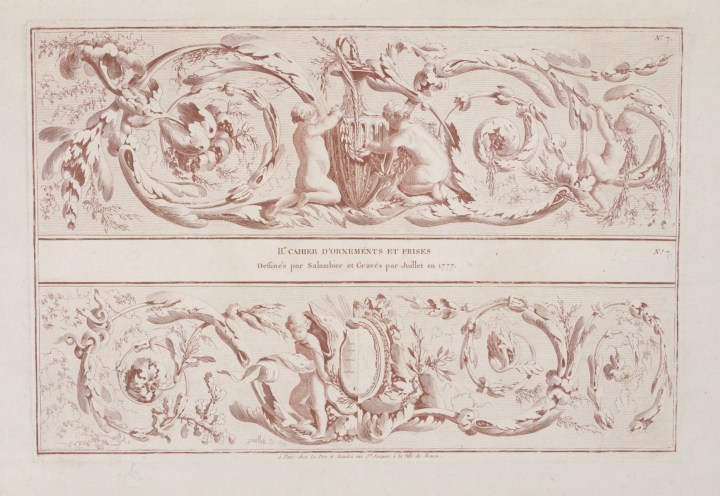
Title page and Frieze Designs, plate 7 from IIe Cahier d’Ornements et Frises (2nd Book of Ornaments and Friezes), 1777; Jacques Juillet after Henri Sallembier, published by Le Père et Avaulez (Paris); etching and engraving in red ink on laid paper (Cooper Hewitt).
Join Cooper Hewitt for an illustrated talk exploring the Decloux collection of ornament and architecture prints. The museum is home to the premier collection of ornament prints in the United States, consisting of over 13,000 European prints from the 16th to the 19th centuries. The lecture will include highlights from the collection by some of the most celebrated artists and designers of the period, as well a discovery of more hidden treasures by many forgotten or lesser-known artists and printmakers.
Ornament prints were produced with the purpose of illustrating designs, patterns, or motifs of decorative ornament for use by craftsman and applicable to all aspects of applied arts from ceramic vases to furniture, from wall paneling to wrought-iron gates. This illustrated talk will introduce the Decloux collection of ornament and architecture prints by exploring the language of ornament. How do these printmakers and publishers describe and title their works? What are the most common terms and motifs found in this broad genre and why? And how do these two-dimensional intaglio prints translate to real three-dimensional objects and interiors?
The talk is free with registration. It will also be recorded and posted on Cooper Hewitt’s YouTube channel within two weeks.
Rachel Jacobs is an independent curator specializing in French 17th-and 18th-century books and prints, based in Toronto, Canada. Since 2021, she is the Remote Senior Research Cataloguer for the Decloux collection of ornament and architecture prints in the Department of Drawings, Prints, and Graphic Design at Cooper Hewitt, Smithsonian Design Museum. She was previously Curator of Books and Manuscripts at Waddesdon Manor (Rothschild Collections) National Trust in England, where she continues to work remotely part-time. She has curated several exhibitions at Waddesdon Manor including most recently Alice’s Wonderlands: Life, Collections, and Legacy of Alice de Rothschild (1847–1922) (2022–23, co-curated).
Caitlin Condell is the associate curator and head of the Department of Drawings, Prints, and Graphic Design at Cooper Hewitt, Smithsonian Design Museum, New York, where she oversees a collection of nearly 147,000 works on paper dating from the 14th century to the present. She has organized and contributed to numerous exhibitions and publications. Prior to joining the Smithsonian, Condell held positions at the Massachusetts Museum of Contemporary Art and The Museum of Modern Art.
Research Lunch | London’s Periodical Architecture, 1700–1750
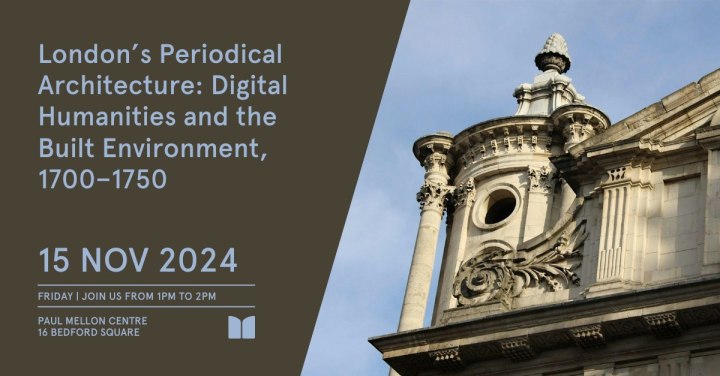
Thomas Archer, St John Smith Square, London, completed in 1728
(Photo: © Matthew Lloyd Roberts)
◊ ◊ ◊ ◊ ◊
Next month at the Mellon Centre:
Matthew Lloyd Roberts | London’s Periodical Architecture: Digital Humanities and the Built Environment, 1700–1750
Paul Mellon Centre, London, 15 November 2024, 1pm
In recent years, large-scale digitisation of early modern periodicals has revolutionised the searchability of collections of ephemeral print culture. Enabled by optical character recognition technology, this shift has transformed the way scholars use databases of primary material, introducing new quantitative approaches to these vast collections. However, this shift also poses epistemological questions within new digital humanities frameworks. The paper will explore this shift by presenting material newly discovered by these methods relating to church building in London in the first half of the eighteenth century. Firstly, looking at the way that the work of the New Churches Commission was represented and debated by the politically factional newspaper culture in the first years of Hanoverian rule, and then recognising the effect this discourse may have had in shaping the way that people experienced the city. By incorporating periodical culture as an important context of the work of the Commission, for the first time this study proposes a substantive media and reception history of these iconic buildings of the English Baroque.
Furthermore, this paper will consider the explosion of architectural publishing in the periodical press of the mid-1730s, in the context of James Ralph’s Critical Review, examining the way that architectural practitioners such as John James were increasingly forced to foray into periodical culture to defend their expertise and reputations. These events will be read towards the political and social meanings of church building and church restoration, and the growing anxiety about the need to disambiguate the meanings of the built environment to the urban public in an age of print culture.
Matthew Lloyd Roberts is a history of art PhD candidate at Downing College, Cambridge and member of the Ax:son Johnson Centre for the Study of Classical Architecture. His PhD research is concerned with the cultural reception of the changing built environment of England in the seventeenth and eighteenth centuries. He studied ancient and modern history at Keble College, Oxford and has an MA in architectural history from the Bartlett, UCL. Complementing his academic work, he is also interested in disseminating academic research to broader audiences and produces and hosts two podcasts concerned with architectural history and culture, the independent About Buildings and Cities and the official podcast of the Society of Architectural Historians of Great Britain. His architectural criticism has also appeared in Tribune (magazine), The New Statesman, and The Critic, and he leads architectural walking tours for a variety of organisations including Open City.
Lecture | Jussi Nuorteva on August Philip Armfelt in England, 1790–91
From the Society of Antiquaries:
Jussi Nuorteva | A Swedish-Finnish Antiquarian and Military Officer in England
Online (via YouTube), Society of Antiquaries of London, 14 October 2024, 1.30pm

August Philip Armfelt, ca. 1830 (Wiurila Manor, Halikko, Finland).
Discover the life of Baron August Philip Armfelt (1768–1839), Aide-de-Camp of the Swedish King Gustaf, and hear about his adventures during a trip to England in 1790–1791.
Free poster display on the ground floor of the Society’s Burlington House premises, 10am–4pm each day:
Tuesday, 15 October
Wednesday, 16 October
Thursday, 17 October
Friday, 18 October
During this period, the connection between Sweden and France had been close, but those ties were broken in the French Revolution of 1789. Afterward, new connections arose between Britain and Sweden. Britain was concerned about the rising power of Russia in the Baltic Sea area, crucial for import of tar and iron—essential materials in shipbuilding. Sweden, where Finland had been part of since 12th century, was the most important producer of these goods. Thus, new relations were formed.
While in England, August Philip Armfelt met many interesting people, not only the royals. His autobiography, around which the exhibition is built, tells of his various meetings and conversations with many other areas of the society. Armfelt met people like Goodfellow, the Swedish artist Elias Martin (one of the early academicians of the Royal Academy of Arts), and abolitionists like John Wedgwood and Swedish Carl Bernhard Wadenström. Sadly, Armfelt’s travels lasted only until 1792, when Swedish King Gustaf III was murdered by his opponents and a block of noble men took the power.
Live-streamed and open to anyone to join online, the lecture forms part of a series of events organised by the Embassy of Sweden in London and the Embassy of Finland in London, with the support of Samfundet Ehrensvärd, Medical Counsellor Sakari Alhopuro, Stiftelsen Tre Smeder and the Kalevi Kuitusen Foundation.
The YouTube link is available here»
Jussi Nuorteva was National Archivist of Finland until his retirement in 2022. He is a member of the Finnish Academy of Science and Letters, as well as Chancellor of the Orders of the White Rose of Finland and the Lion of Finland.
Artists in Conversation | Flora Yukhnovich
This evening from YCBA:
Artists in Conversation | Flora Yukhnovich
In-person and online, Hastings Hall, Yale School of Architecture, New Haven, 1 October 2025, 6pm

Flora Yukhnovich, photo by Kasia Bobula.
Flora Yukhnovich will talk to Eleanor Nairne, the Keith L. and Katherine Sachs Curator of Modern and Contemporary Art, the Philadelphia Museum of Art. Watch the livestream here.
The Artists in Conversation series brings together curators and artists to discuss artistic practices and insights into their work.
Born in 1990 in Norwich, UK, Flora Yukhnovich developed her characteristic painting language while studying at City and Guilds of London Art School, where she completed her MA in fine art in 2017. She also studied portraiture at the Heatherley School of Fine Art in London. Yukhnovich’s art boldly explores materiality and process as vehicles for meaning, with cascading and swirling forms that evoke rhythm and energy, flowing between representation and abstraction. Her immersive paintings splice historic styles, from French rococo and Italian baroque to abstract expressionism, with references drawn from contemporary films, music, literature, and consumer culture. Through her work, Yukhnovich addresses dynamics of power inherent in received readings of art-historical subjects and their associated hierarchies. She questions notions of femininity and gender that are hard-wired into the aesthetic language of color and form.
Yukhnovich received the Elizabeth Greenshields Foundation Award in 2013 and 2016. She has participated in group and solo exhibitions worldwide. Her work is included in many collections, including the Hirshhorn Museum, Washington, DC; the Montreal Museum of Fine Arts; the Roberts Institute of Art, London; and the National Gallery of Victoria, Melbourne. She lives and works in London.
Eleanor Nairne is the Keith L. and Katherine Sachs Curator of Modern and Contemporary Art and department head, modern and contemporary art, at the Philadelphia Museum of Art. Previously, she was the senior curator at Barbican Art Gallery, London, where her exhibitions included Basquiat: Boom for Real (2017), Lee Krasner: Living Colour (2019), Jean Dubuffet: Brutal Beauty (2021), Soheila Sokhanvari: Rebel Rebel (2022), Alice Neel: Hot Off The Griddle (2023), and Julianknxx: Chorus in Rememory of Flight (2023–24). She also curated Erotic Abstraction: Eva Hesse / Hannah Wilke (2021) at Acquavella Galleries in New York.
Panel Discussion | Jeremy Bentham’s Books at UCL
From Eventbrite:
Jeremy Bentham’s Books in UCL’s Special Collections
UCL Object Based Learning Laboratory, London, 9 October 2024
An event exploring Jeremy Bentham’s book collection and ways in which it continues to shape UCL’s library holdings today.
It has long been known that the 18th-century philosopher Jeremy Bentham bequeathed a number of his books to University College London (known at the time as the London University). But the contents of the bequest and the faith of the books had remained obscure. A recent discovery of an item-by-item list of the books in the UCL library archives by Colin Penman (UCL Head of Records) and a Bentham expert, Professor Tim Causer, sparked a project to uncover some of Bentham’s books in UCL’s rare book collections, overseen by Erika Delbecque (UCL’s Head of Rare Books). Join UCL Special Collections to hear Colin, Tim, and Erika talk about the project, the discoveries made so far, the process of identifying Bentham’s books, and their significance today. The original list of the Bentham’s bequest, along with some of the books from his library (many heavily annotated by Bentham himself), will be on display. The event is free and open to all, but booking is essential.
The UCL guide to the Bentham Book Collection offers a helpful introduction to our holdings as well as information about researching and accessing this collection. You can also read more about our ongoing research into Bentham’s bequest here.
Wednesday, 9 October 2024
3.00–4.00pm | Panel discussion and collections display
4.00–4.30pm | Collections display and refreshments
Lecture | Adrienne Childs on Pearls and Blackamoors
Presented by the Lewis Walpole Library and the Wadsworth Atheneum:
Adrienne Childs | Pearl Drops and Blackamoors: The Black Body and Pearlescent Adornment in European Art
Wadsworth Atheneum, Hartford, Connecticut, 10 October 2024, 6pm

Nicolaes Berchem, A Moor Offering a Parrot to a Lady (detail), ca. 1660–70, oil on canvas (Hartford: Wadsworth Atheneum Museum of Art, 1961.29).
European artists of the seventeenth through nineteenth centuries often depicted Black figures wearing pearl ornaments. The contrast evoked notions of luxury, distant lands, and exoticism. Art historian and curator Adrienne L. Childs, PhD explores the complexities of subjugating and enslaving Black bodies in one context and using their images to showcase luxuries in another. Before the lecture, meet at 5pm in the galleries to view works from the museum’s European art collection. Free and open to the public with registration encouraged.
The lecture is offered in connection with the exhibition The Paradox of Pearls: Accessorizing Identities in the Eighteenth Century, curated by Laura Engel, Professor, Duquesne University, on view at the Lewis Walpole Library until 31 January 2025.
Adrienne L. Childs is an independent scholar, art historian, and curator. She is Senior Consulting Curator at The Phillips Collection in Washington, DC. Her current book project is an exploration of Black figures in European decorative arts entitled Ornamental Blackness: The Black Figure in European Decorative Arts, forthcoming from Yale University Press (2025). She is co-curator of Vivian Browne: My Kind of Protest for The Phillips Collection (on view until September 2025). She recently co-curated The Colour of Anxiety: Race, Sexuality and Disorder in Victorian Sculpture at The Henry Moore Institute in Leeds, England. She was the guest curator of Riffs and Relations: African American Artists and the European Modernist Tradition at The Phillips Collection in 2020. Childs was awarded the 2022 Driskell Prize from The High Museum of Art in recognition of her contribution to African American art and art history. She holds a BA from Georgetown University, an MBA from Howard University, and a PhD in the History of Art from the University of Maryland. Currently, Childs serves as the Distinguished Scholar at the Leonard A. Lauder Center at The Metropolitan Museum of Art.
Talk | Philippa Tudor on Huguenot Records at Lambeth Palace Library
From Eventbrite:
Philippa Tudor | Huguenot Records in Lambeth Palace Library: Cataloguing Complexity
Lambeth Palace Library, London, 2 October 2024, 5.30pm
Registration due by 30 September 2024
Philippa Tudor will be talking about her work as a volunteer at LPL cataloguing the Huguenot records.
The term ‘refugees’ was first used to describe the 50,000 Protestants who fled to England from France in the 16th–18th centuries. The miscellany of related records in Lambeth Palace Library sheds light on the experiences of Huguenots in England, as well as attempts to secure the release of those condemned to the French galleys. All are welcome, but anyone wishing to attend must book an individual ticket or email archives@churchofengland.org no later than Monday, 30 September.
Philippa Tudor, who completed her doctorate in the literature of the early Reformation in England, is a volunteer cataloguer and friend of Lambeth Palace Library, working on a finding aid to its Huguenot-related resources.
Lecture | Miriam Schefzyk on German Cabinetmaker in 18th-C. Paris
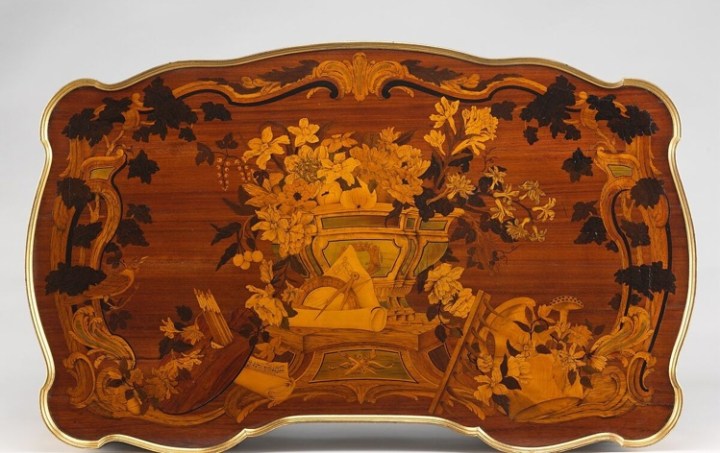
Jean-Francois Oeben and Roger Vandercruse, Tabletop of a mechanical table, ca. 1761–63, oak veneered with mahogany, kingwood, and tulipwood, with marquetry of mahogany, rosewood, holly, and various other woods; gilt-bronze mounts; imitation Japanese lacquer; replaced silk (New York: The Metropolitan Museum of Art, 1982.60.61).
◊ ◊ ◊ ◊ ◊
This fall at BGC:
Miriam Schefzyk | Parisian Dreams: German Migrants and Cabinetmaking in 18th-Century Paris
A Françoise and Georges Selz Lecture on Eighteenth- and Nineteenth-Century French Decorative Arts and Culture
Bard Graduate Center, New York, 2 October 2024, 6pm
Paris has long been a privileged destination for many, but there was a particularly significant migration that began in the seventeenth century and gathered strength during the eighteenth century: that of German cabinetmakers. Hardworking and aspiring to wealth, recognition, and a better life, these numerous artisans made Paris into the most important center in the furniture and luxury trade of the time. Many of them rose to important positions as masters or leaders in the guild, and some even obtained royal privileges and titles. Their furniture was regarded as the incarnation of French taste and is still viewed as evidence of the supremacy of French decorative arts today. In this lecture, Miriam Schefzyk will examine the living and working conditions of these artisans and how their background as migrants significantly shaped the framework in which these extraordinary pieces of furniture were created.
$15 General | $12 Seniors | Free for people associated with a college or university, people with museum ID, people with disabilities and caregivers, and BGC members.
Miriam E. Schefzyk is the associate curator of decorative arts at the J. Paul Getty Museum and previously worked at the Museum of Decorative Arts in Berlin. She studied art history at the universities of Marburg, Berlin, Münster, and Paris, earning a PhD in a joint French-German doctoral program. A specialist of French decorative arts of the seventeenth and eighteenth centuries, her research focuses on Parisian furniture, artistic transfer, social history, and materiality. Her book Migration und Integration im Paris des 18. Jahrhunderts: Martin Carlin und die deutschen Ebenisten (Bielefeld: Transcript Verlag, 2022) was awarded the Marianne Roland Michel Foundation Prize for its important contribution to French art and will soon be published in French.
Lecture | Mia Jackson on the Birds of Louis-Denis Armand

Louis-Denis Armand, Parrots, ca. 1750–70
(Paris: Galerie Dragesco-Cramoisan)
◊ ◊ ◊ ◊ ◊
This fall at BGC:
Mia Jackson | Flights of Fancy: The Birds of Louis-Denis Armand (1723–1796)
A Françoise and Georges Selz Lecture on Eighteenth- and Nineteenth-Century French Decorative Arts and Culture
Bard Graduate Center, New York, 11 December 2024, 6pm
Mia Jackson will talk about her recent exhibition, Flights of Fancy, the first ever survey of the life and work of the recently rediscovered Sèvres painter Louis-Denis Armand (1723–1796), now celebrated as one of the foremost painters of birds. Very few artisans from the eighteenth century have left us such a detailed biography; over thirty drawings by Armand survive, and research into the drawings and their inscriptions (by Jackson and collaborator Bernard Dragesco) has revealed a wealth of detail about the artist, his life, his work, and even his political opinions.
Mia Jackson has been curator of decorative arts at Waddesdon Manor since 2017. She studied French and Philosophy at the University of Oxford then completed an MA in eighteenth-century French decorative arts at the Courtauld Institute of Art. Her doctoral thesis entitled “André-Charles Boulle (1642–1732) and Paper: Prints and Drawings in the Workshop of an Ébéniste du Roi” was completed at Queen Mary, University of London in 2016. She previously worked in the Prints and Drawings Department at the British Museum, the Wallace Collection, and English Heritage. Eighteenth-century France is her area of expertise, in particular the links between works on paper and the decorative arts.










 Enfilade
leave a comment