Looking Ahead: HECAA Session at CAA 2013
HECAA Session at CAA 2013: ‘Art in the Age of Philosophy?’ — Chaired by Hector Reyes
College Art Association, Chicago, February 2013
The relationship between philosophy and art has been a rich field of research for scholars of eighteenth-century painting. Such inquiry has identified philosophical motivations for the pursuit of pleasure, especially aesthetic pleasure, and led to a new understanding of the intellectual foundations and commitments of supposedly frivolous painters, such as Fragonard, Greuze, Boucher and Chardin. This panel seeks to broaden the inquiry in eighteenth-century philosophy and art by considering a wide range of philosophical and artistic practices. Are there neglected philosophies that might relate to artistic theory or production? How might philosophical approaches help us to rethink the status of other media or artistic production more generally in the eighteenth century? Does an emphasis on philosophical questions occlude or lead us away from important formal questions? Papers that question or interrogate the philosophical approach to art historical research are as welcome as those that present new research or that propose new approaches and methodologies.
Reviewed: ‘Early Georgian Furniture’
Adam Bowett, Early Georgian Furniture 1715–1740 (Woodbridge, UK: Antique Collectors’ Club, 2009) 328 pages, ISBN: 9781851495849.
Reviewed for Enfilade by David Pullins
 In the preface to Adam Bowett’s first book English Furniture 1660–1714 From Charles II to Queen Anne (2002), he wrote “I have attempted to write this book from first principles and, in the main, from primary evidence — bills, inventories and, of course, the furniture itself” (10). In Bowett’s latest work, Early Georgian Furniture 1715–1740, he pursues this disciplined and productive approach, providing numerous correctives to the sloppy dating that has infiltrated not only the antiques trade but also academic publications on English furniture. In particular, his research reveals the dangers of back-dating in the field, which, he argues, has created stylistic vacuums, particularly for the period of the 1720s and 1730s. In order more precisely to date a given form or motif, Bowett focuses on “fashionable furniture” — which is to say items typically produced in London for less than ten percent of the population. While this might at first appear to limit the usefulness of his study beyond the most rarefied examples, his point is not so much to disregard less elevated or vernacular examples but to provide solid points of departure through vanguard furniture. A trickle-down effect, largely accepted by most scholars who examine commerce during the period, is therefore a basic premise of the study. For readers aiming to identify and date a given piece of furniture, this method — along with the structure of the book, which is divided into six chapters according to form (e.g., “Seat Furniture” or “Mirrors”) — results in a remarkably user friendly text that, through a rich range of intelligently selected illustrations, can help contextualize furniture of varied quality and geography.
While Bowett’s meticulously documented corrections to the accepted chronology of English furniture will probably prove the strongest case for the importance of his book, the contribution he offers expands beyond issues of dating. Bowett’s primary research has revealed a fascinating body of information on the training of craftsmen, power structure in the workshop and the intricacies of interaction between patrons and furniture makers. By looking at contemporary documents, including inventories, trade-cards and labels (many of them illustrated), Bowett is able better to define basic terms used to describe furniture forms and the division of labor in the trade between, for example, turners and chair-makers or cabinet-makers and carvers. In the best case scenarios, contemporary descriptions are matched with the surviving work allowing us better to describe undocumented pieces of furniture and better to imagine pieces which are known now only through written descriptions. Bowett also lays the groundwork for understanding two especially complex issues relevant to his subject, the timber trade and the influence of East Asian furniture on English stylistic developments. While expanding on either topic would have greatly enriched his book and its relevance apart from the objects immediately at hand, he wisely curtails his discussion within the context of a self-acknowledged survey (though East Asia appropriately reappears in his description of the development of the cabriole leg, the top rails and back splats of early Georgian chairs).
In addition to Bowdett’s primary concern with form, this survey is also notable for its detailed account of gilt furniture (an important counterpoint to the materials caught in the colloquial phrase “Age of Walnut” to describe the period) and japanned surfaces, which Bowett first treated with considerable care in his earlier book on the preceding period. Both kinds of decoration remind us of the resilience of baroque modes well into the eighteenth century which issues of condition have sometimes occluded.
Bowett’s reappraisal of early Georgian furniture stands out as arguably the most important since R.W. Symonds’s classic texts from the 1920s through 1950s and the Dictionary of English Furniture (last revised in 1954), all of which continue to be used regularly by scholars. At two to three color illustrations per page, each given a detailed caption, the book moves beyond what earlier authors could offer while retaining their high standards of archival research. Following from his earlier work on furniture from Charles II through Queen Anne, Bowett’s book also paves a carefully plotted path for his next anticipated project devoted to the rise and influence of the most famous English cabinet-maker, Thomas Chippendale.
David Pullins is a Ph.D. candidate in History of Art and Architecture at Harvard University. His research addresses the circulation of images across media in eighteenth-century France.
New Title: ‘The Efflorescence of Caricature, 1759-1838’
Todd Porterfield, ed., The Efflorescence of Caricature, 1759–1838 (Aldershot: Ashgate), 240 pages, ISBN: 9780754665915, $99.95.
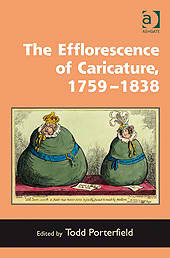 Searing disputes over caricature have recently sparked flames across the world—the culmination, not the beginning, of the story of one of modernity’s definitive artistic practices. Modern visual satire erupts during a period marked by reform and revolution, by cohering nationalisms and expanding empires, and by the emerging discipline of art history. This has long been recognized as its Golden Age. It is time to look anew.
In The Efflorescence of Caricature, 1759–1838, an international, interdisciplinary, and intergenerational team of scholars reconfigures the geography of modern visual satire, as the expansive narrative reaches from North America to Europe, to China and the Ottoman Empire. Caricature’s specific visual cultures are also laid bare, its iconographic means and material support, as well as the diverse milieu of its making—the military, the art academy, diplomacy, politics, art criticism, and popular entertainment. Some of its greatest practitioners—James Gillray and Honoré Daumier—are seen in a new light, alongside some of their far flung and opportunistic pastichers. Most trenchantly, assumptions about the consequences of caricature’s rise come under intense scrutiny, interrogated for its cherished and long-vaunted civilizational claims on individual character, artistic supremacy, political liberty, and global domination.
- Todd Porterfield, The efflorescence of caricature
- Dominic Hardy, Caricature on the edge of empire: George Townshend in Quebec
- Pierre Wachenheim, Early modern Dutch emblems and French visual satire: transfers of models across the 18th century
- Reva Wolf, John Bull, liberty and wit: how England became caricature
- Douglas Fordham, On bended knee: James Gillray’s global view of courtly encounter
- Helen Weston, The light of wisdom: magic lanternists as truth-tellers in post-Revolutionary France
- Richard Taws, The currency of caricature in Revolutionary France
- Mike Goode, The public and the limits of persuasion in the age of caricature
- Robert L. Patten, Signifying shape in pan-European caricature
- Christina Oberstebrink, James Gillray, caricaturist and modernist artist avant la lettre
- Ségolène Le Men, The Musée de la caricature
Todd Porterfield is Professor and Canada Research Chair in Art History at the Université de Montréal. He is the author of The Allure of Empire: Art in the Service of French Imperialism, 1798–1836 (1998), and co-author of Staging Empire: Napoleon, Ingres, and David (2006).
A Fine Time in Vancouver

Just a quick note of thanks to all of you who helped make this year’s ASECS conference in Vancouver such a terrific experience. The HECAA sessions were well attended and instructive at multiple levels. As is often the case, I left thinking how much I still don’t know about the eighteenth century but also how excited I am to take away a broader vision of the period and its cultural production. Any HECAA members who would like a copy of the minutes from this year’s business meeting are welcome to send me an email requesting a copy. Thanks again! -CAH
Latest Issue of ‘Journal for Eighteenth-Century Studies’
Journal for Eighteenth-Century Studies 33 (December 2010)
Special Issue: Animals in the Eighteenth Century, guest edited by Glynis Ridley
 Peter Singer, “Foreword”
Glynis Ridley, “Introduction: Representing Animals”
Speakers
Ann Cline Kelly, “Talking Animals in the Bible: Paratexts as Symptoms of Cultural Anxiety in Restoration and Early Eighteenth-Century England,” pp. 437-51.
Conrad Brunström and Katherine Turner, “‘I shall not ask Jean-Jacques Rousseau’: Anthropomorphism in the Cowperian Bestiary,” pp. 453–68.
Jane Spencer, “Creating Animal Experience in Late Eighteenth-Century Narrative,” pp. 469–86.
Subjects
Sam George, “Animated Beings: Enlightenment Entomology for Girls,” pp. 487–505.
Jeff Loveland, “Animals in British and French Encyclopaedias in the Long Eighteenth Century,” pp. 507–23.
Christopher Plumb, “‘Strange and Wonderful’: Encountering the Elephant in Britain, 1675-1830,” pp. 525–43.
Craig Ashley Hanson, “Representing the Rhinoceros: The Royal Society between Art and Science in the Eighteenth Century,” pp, 545–66.
Boundaries
Tobias Menely, “Sovereign Violence and the Figure of the Animal, from Leviathan to Windsor-Forest,” pp. 567–82.
Anne Milne, “Sentient Genetics: Breeding the Animal Breeder as Fundamental Other,” pp. 583–97.
Peter C. Messer, “Republican Animals: Politics, Science and the Birth of Ecology,” pp. 599–613.
Paula Young Lee, “The Curious Affair of Monsieur Martin the Bear,” pp. 615–29.
Emotions
Lisa Berglund, “Oysters for Hodge, or, Ordering Society, Writing Biography and Feeding the Cat,” pp. 631-45.
James P. Carson, “Scott and the Romantic Dog,” pp. 647–61.
Elizabeth Amy Liebman, “Animal Attitudes: Motion and Emotion in Eighteenth-Century Animal Representation,” pp. 663–83.
Latest Issue of ‘Ars Orientalis’: Globalizing Cultures
Volume 39 of Ars Orientalis, “Globalizing Cultures: Art and Mobility in the Eighteenth Century,” guest-edited by Nebahat Avcıoğlu and Finbarr Barry Flood, is now available. The volume addresses various aspects of the movement of cultural forms in Europe and Asia during the eighteenth century.
Contents
- Nebahat Avcıoğlu and Finbarr Barry Flood, “Globalizing Cultures: Art and Mobility in the Eighteenth Century”
- Sanjay Subrahmanyam, “A Roomful of Mirrors: The Artful Embrace of Mughals and Franks, 1550–1700”
- Kristel Smentek, “Looking East: Jean-Etienne Liotard, the Turkish Painter”
- Tülay Artan, “Eighteenth-Century Ottoman Princesses as Collectors: From Chinese to European Porcelain”
- Anton Schweizer and Avinoam Shalem, “Translating Visions: A Japanese Lacquer Plaque of the Haram of Mecca in the L. A. Mayer Memorial Museum, Jerusalem”
- Chanchal Dadlani, “The ‘Palais Indiens’ Collection of 1774: Representing Mughal Architecture in Late Eighteenth-Century India”
- Elisabeth A. Fraser, “‘Dressing Turks in the French Manner’: Mouradgea d’Ohsson’s Panorama of the Ottoman Empire”
- Mercedes Volait, “History or Theory? French Antiquarianism, Cairene Architecture, and Enlightenment Thinking”
Congratulations to This Year’s Mary Vidal Memorial Fund Recipients
Congratulations to the recipients of this year’s Mary Vidal Memorial Fund for travel. Georgina Cole will present a paper, “Eavesdropping: Rethinking Space and Subjectivity in the Eighteenth Century,” at the American Society for Eighteenth-Century Studies meeting next week in Vancouver, British Columbia. The second recipient, Susan Wager, a doctoral student at Columbia University in New York, presented a paper, “Madame de Pompadour’s Indiscreet Jewels: Boucher, Reproduction, and Luxury in Eighteenth-Century France,” at CAA’s 2011 Annual Conference in New York.
Letter from the President: Call for Participants
Dear HECAA Members,
It was so nice to see many of you in New York at CAA. Our sessions, “The Global Eighteenth-Century,” “New Scholars” and the ASECS session on “Cosmopolitanism” were well attended, as were the other sessions with eighteenth-century topics. We had 29 people attend the reception.
I want to give a special thanks to Denise Baxter, who will have completed her term as treasurer. She has done a marvelous job. It is time to elect a new treasurer. I would like to nominate Jennifer Germann for this position. If there are other nominations, please send them to me. Next week I will send an email calling for a vote of the membership. The official inauguration will take place at our HECAA luncheon in Vancouver.
I also need volunteers to serve on two committees and to chair sessions:
- three volunteers to serve on the Vidal Travel Award committee
- three volunteers to serve on the Wiebenson Prize committee
- one volunteer to chair the 2012 “New Scholars” session at CAA
- one volunteer for the 2012 “New Scholars” session at ASECS
We can vote to approve these slates at the HECAA luncheon. Finally I am soliciting submissions for our HECAA affiliate session at the 2012 ASECS and for the 2013 CAA. If you could submit abstracts to me, we can vote online after this year’s ASECS meeting.
Best wishes,
Julie-Anne Plax
jplax@email.arizona.edu
New Title: Michael Yonan on Empress Maria Theresa
From Penn State UP:
Michael Yonan, Empress Maria Theresa and the Politics of Habsburg Imperial Art (University Park, PA: Penn State University Press, 2011), 240 pages, ISBN 9780271037226, $89.95.
 Between 1740 and 1780, Empress Maria Theresa governed the Habsburg Empire, a multilingual conglomeration of states centered on Austria. Although recent historical scholarship has addressed Maria Theresa’s legacy, she remains entirely absent from art history despite her notable role in shaping eighteenth-century European diplomatic, artistic, and cultural developments. In Empress Maria Theresa and the Politics of Habsburg Imperial Art, Michael Yonan explores the role that material culture—paintings, architecture, porcelain, garden sculpture, and decorative objects—played in forming the monarchical identity of this historically prominent woman ruler.
Maria Theresa never obtained her power from men, but rather inherited it directly through birthright. In the art and architecture she commissioned, as well as the objects she incorporated into court life, she redefined visually the idea of a sovereign monarch to make strong claims for her divine right to rule and for hereditary continuity, but also allowed for flexibility among multiple and conflicting social roles. Through an examination of Maria Theresa’s patronage, Michael Yonan demonstrates how women, art, and power interrelated in an unusual historical situation in which power was legitimated in women’s terms.
Addition information is available here»
Call for Papers: Feminist Art History Conference in DC
Second Annual Feminist Art History Conference
American University, Washington D.C., 4-5 November 2011
Proposals due by 15 May 2011
Keynote: Mary Sheriff, Professor, Art History, University of North Carolina-Chapel Hill
Please submit one-page single-spaced proposals on any topic of feminist interest in art history and/or visual studies with a 2-page curriculum vita by May 15, 2011. Accepted proposals will be notified by June 15, 2011. Please email proposals and CVs to bellow@american.edu; nbroude@american.edu; butler@american.edu; mgarrar@american.edu; kunimoto@american.edu; hlanga@american.edu.
Sponsored by the Art History Program, Department of Art, College of Arts and Sciences at American University
Organizing committee: Kathe Albrecht, Juliet Bellow, Norma Broude, Kim Butler, Mary D. Garrard, Namiko Kunimoto, and Helen Langa










 Enfilade
leave a comment