Chistoph Vogtherr Named Director of the Hamburg Kunsthalle
From The Wallace (14 January 2016) . . .
Director, Dr Christoph Vogtherr, to leave the Wallace Collection
We at the Wallace are sad to hear about his departure, he has been an inspiration to his staff and we wish him well in his new role at Hamburger Kunsthalle.
 Dr Vogtherr joined the Wallace Collection as the Curator of Old Master Paintings and was appointed as Director in October 2011. During his tenure Dr Vogtherr has been responsible for the acclaimed refurbishment of the museum’s Great Gallery, seen visitor numbers increased by 20% and has established the museum as an international research centre for French seventeenth and eighteenth century art and European arms and armour.
Dr Vogtherr said: “It has been a great privilege to be part of the Wallace Collection team over the past nine years and its Director for the past five. I am proud to have been associated with such an outstanding collection and to have made a contribution to ensuring its enduring appeal for future generations. The refurbishment of the Great Gallery has been a once-in-a-lifetime project. The Hamburg Kunsthalle has played a crucial role in the history of the art museum and current museum practice, which explains the timing of this decision but I know I leave the Collection in good hands under the Chairmanship of António Horta-Osório, who I know will lead the Collection from strength to strength”.
António Horta Osório, the Chairman of the Wallace Collection, said: “We are very sorry to learn of Dr Vogtherr’s decision. We are immensely grateful to him for the very substantial contribution he has made to the Wallace Collection. He will leave the museum in a position of great strength artistically and intellectually.”
Dr Vogtherr will take up his post in Hamburg in October and the Wallace Collection will begin the search for a new Director in due course.
◊ ◊ ◊ ◊ ◊
From the Hamburg Kunsthalle (13 January 2016). . .
Dr. Christoph Martin Vogtherr wird Direktor der Hamburger Kunsthalle
Der Stiftungsrat der Hamburger Kunsthalle hat heute beschlossen, Dr. Christoph Martin Vogtherr die künstlerische und wissenschaftliche Leitung der Hamburger Kunsthalle zu übertragen. Vogtherr ist seit 2011 Direktor der Wallace Collection in London, einem der weltweit renommierten Museen für ältere, insbesondere französische Kunst. Er tritt zum 1. Oktober 2016 in der Hamburger Kunsthalle die Nachfolge von Prof. Dr. Hubertus Gaßner an, der in den Ruhestand geht.
Kultursenatorin Prof. Barabara Kisseler: „Mit Christoph Martin Vogtherr geben wir die Leitung der Hamburger Kunsthalle in die Hände eines ebenso erfahrenen wie innovativen Museumsdirektors. Vogtherr ist ein international anerkannter Kunsthistoriker. Als Direktor der Wallace Collection in London ist es ihm gelungen, mit neuen Sammlungspräsentationen und aktuellen Perspektiven ein neues Publikum für das Museum zu begeistern. Wir haben mit ihm eine Persönlichkeit gefunden, die dem Rang der Hamburger Kunsthalle gerecht wird und neue internationale Impulse setzen wird.“
Christoph Martin Vogtherr: „Die Hamburger Kunsthalle ist eines der herausragenden Kunstmuseen in Deutschland. Mit ihrer beeindruckenden und inspirierenden Tradition in der kunsthistorischen Arbeit und der Kunstvermittlung hat sie immer wieder die internationale Museumswelt geprägt und herausgefordert. Ich freue mich sehr über das große Vertrauen der Freien und Hansestadt Hamburg und möchte gemeinsam mit allen Mitarbeiterinnen und Mitarbeitern des Museums die künstlerische und gesellschaftliche Bedeutung der Kunsthalle weiter entwickeln.“
Christoph Martin Vogtherr ist seit 2011 Direktor der Wallace Collection in London. Seit 2007 war er dort zunächst als Kurator, später als Sammlungsleiter tätig. Von 2003 bis 2007 leitete er ein interdisziplinäres Forschungsprojekt der Getty Stiftung.
Seine derzeitige Wirkungsstätte, die Wallace Collection, ist eines von mehreren britischen Nationalmuseen und verfügt über eine hochkarätige Sammlung. Für Christoph Martin Vogtherr haben Museen eine wichtige Funktion als Teil der Zivilgesellschaft. Dabei ist es ihm ein besonderes Anliegen, ein junges und internationales Publikum durch innovative Vermittlungsangebote zu gewinnen.
Christoph Martin Vogtherr wurde 1965 in Uelzen geboren und studierte Kunstgeschichte, mittelalterliche Geschichte und klassische Archäologie in Berlin, Heidelberg und Cambridge. 1996 promovierte er an der Freien Universität Berlin mit einer Dissertation über die Gründung der Berliner Museen 1797-1835. Er verfügt über hervorragende internationale Beziehungen im anglo-amerikanischen Raum sowie in Frankreich. Seit 2014 ist er Mitglied im Wissenschaftsrat des Institut national d’histoire de l’art in Paris.
Winterthur’s Online Collections Reaches 60,000 Entries
As noted recently at Art Daily:
In an effort that began ten years ago, Winterthur Museum, Garden & Library has accomplished a significant milestone: 60,000 objects in the Winterthur collection have been catalogued or re-catalogued and made available to the public through Winterthur’s Online Collections.
In late summer of 2005, Winterthur welcomed new collections management software, and more than 70 staff and volunteer cataloguers began the process of cataloguing or re-cataloguing the entire collection of nearly 90,000 objects. With the help of many grants, approximately 16,000 ceramics, 14,500 metals, 11,000 textiles and needlework 3,500 prints and maps, 3,200 glass objects, 3,000 pieces of furniture, as well as architectural elements, paintings, tools, toys and games, works on paper, and more have been catalogued. In addition, nearly 152,000 digital images have been added to Winterthur’s collection database.
“We are incredibly grateful to all of our cataloguers over the years, as well as to those agencies, organizations, and individuals who have contributed to this project. Creating our Online Collections has given the public and scholars important access to the Winterthur collection and the wealth of information it has to offer, and in doing so, the Museum has been able to engage new audiences with its collection,” said Linda Eaton, John L. & Marjorie P. McGraw Director of Collections & Senior Curator of Textiles.
The original grant that started this process was given by the Jane du Pont Lunger Residual Trust Fund, which also funded the purchase of digital photographic equipment. Several other grants from federal agencies, foundations, and generous private supporters have helped Winterthur reach this achievement. Four grants from the Institute of Museum and Library Services made possible cataloguing discrete parts of Winterthur’s diverse collections of decorative and fine arts. The textile collection, an important resource for historians internationally, was partially catalogued through two grants for furnishing textiles and printed textiles. Winterthur’s collection of tools used by artisans in trades ranging from carpentry to silversmithing to needlework is the focus of the most recent grant that will be completed June 2016. An additional grant from the National Endowment for the Arts scanned and photographed half of the maps and prints in the collection, which are now available online. A grant from The Coby Foundation catalogued quilts and other bed covers, while a grant from the Museum Loan Network was used to catalogue and photograph 100 pre-1800 English ceramics that were then made available for loan on the MLN website. The generosity of Leslie B. Durst has made it possible to catalogue and photograph the needlework collection.
The Getty Acquires 31 Pieces of French Decorative Arts
Press release (12 January 2016) from The Getty:

Wall Clock, with clock movement probably by Nicolas Thomas, ca. 1785; gilt bronze, enameled metal, glass, 49.5 x 55.9 cm (Los Angeles: The J. Paul Getty Museum)
The J. Paul Getty Museum today announced the acquisition of an important collection of eighteenth-century French decorative arts assembled by Dr. Horace Wood (Woody) Brock, one of the world’s foremost economists. The acquisition is a combined gift and purchase. The thirty-one works of art include seven clocks; six gilt-bronze mounted porcelain, feldspar and porphyry objects; five works in gilt bronze including a pair of candelabra, two sets of firedogs, and two sets of decorative vases; a carved gilt-wood console table; a porcelain inkstand; and a leather portrait medallion of Louis XIV. The collection substantially enhances the Getty Museum’s extraordinary holdings of French decorative arts, renowned as one of the most important outside France.
“These exquisite objects constitute the most significant acquisition of French decorative arts made by the Museum in many years,” said Timothy Potts, director of the J. Paul Getty Museum. “Produced in the sophisticated artistic culture of eighteenth-century Paris, these extraordinary works epitomize the skill and artistry that made the French court and aristocratic life the epitome of elegant extravagance, and the envy of collectors throughout Europe. We are deeply grateful to Dr. Brock for his generosity in enriching our collection with this important gift and purchase.”

Mantel Clock, ca. 1789. Clock case attributed to Pierre-Philippe Thomire; clock movement by Charles-Guillaume Manière; patinated bronze, gilt bronze, enameled metal, glass, white marble, griotte marble, 55.2 × 64.5 × 19.1 cm (Los Angeles: The J. Paul Getty Museum, Los Angeles)
Dr. Brock has been collecting French and English decorative arts and Old Master drawings for the last thirty years. He began lending decorative arts objects to the Getty Museum in 1997 and made several long-term loans through 2008. Since being lent to the Getty, these objects have been on continuous display in the European decorative arts galleries in the South Pavilion Plaza Level at the Getty Center.
“The objects collected by Dr. Brock are sumptuous and refined pieces of the highest quality that have significantly enriched the French Decorative Arts galleries since the opening of the Getty Center in 1997,” said Anne-Lise Desmas, curator and department head of Sculpture and of Decorative Arts. “They have become key components in the Museum’s recreation of French eighteenth-century interiors and have played an essential role in our visitors’ experience and understanding of this critical period of European art.”
The newly-acquired works were created as luxury objects that would have decorated the lavishly furnished residences of the French aristocracy and bourgeoisie. Many, such as the clocks, candelabra, and the inkstand, were made for practical use, but their sophisticated design and rare materials were also meant to demonstrate the wealth, prestige, and refined taste of their owners. The objects represent the full range of decorative styles practiced during the eighteenth century, from the grandeur and opulence of late Baroque and Régence, through the intimate brilliance of the Rococo, to the severe restraint of the Neoclassical.
Highlights of the collection include a pair of gilt-bronze candelabra (2015.60.1) attributed to the prominent Baroque cabinetmaker André-Charles Boulle, called during his lifetime “the most skillful artisan in Paris.” Two early Rococo lidded jars (2015.70) include exotic motifs from the Far East; porcelain and hardstones were avidly collected and prominently displayed, mounted with gilt bronze to highlight the beauty and rarity of porphyry and feldspar.
A passionate collector of decorative arts, Dr. Brock knows the Getty Museum’s outstanding collection intimately. Consequently, he has given works that fit exceptionally well in the context of the Museum. For example, the extraordinary gilt-bronze wall clock in the form of a winged clock face (2015.67) adds an important model not currently represented in the collection and the imposing Neoclassical mantel clock with Vestal Virgins (2015.64) attributed to Pierre-Philippe Thomire joins a significant group of objects from early in that artist’s career already belonging to the Museum.
Most of the donations have been made in honor of Theodore Dell, an important scholar who catalogued the French furniture and gilt bronzes at The Frick Collection in New York. Dell was a consultant to Gillian Wilson, former Getty Museum curator of decorative arts, and helped Dr. Brock in the formation of his collection. Dell assembled an important library of sales catalogues, journals, magazines, books, and museum catalogues, all focused on French decorative arts, which he donated to the Bard Graduate Center Library in 2012. Other objects have been donated to the Getty in honor of Gillian Wilson as well as knowledgeable dealers in decorative arts such as Leon Dalva, Will Iselin, Pascal Izarn, Laurent and Olivier Kraemer, and Martin Zimet; and, in memory of Frank Berendt, Philippe Kraemer, and François Léage.
“The J. Paul Getty Museum contains a superb collection of the decorative arts of eighteenth-century France, a period in which the quality of design and craftsman ship arguably reached its historical zenith. My hope is that the objects I have collected will permanently enhance this already remarkable collection,” says Dr. Horace Wood Brock.
Dr. Horace Brock earned his B.A., M.B.A., and M.S. in Mathematics from Harvard University, and his M.A. and Ph.D. from Princeton University (Mathematical Economics and Political Philosophy). He is the former president and founder of Strategic Economic Decisions (SED), Inc., and specializes in applications of the modern economics of uncertainty to forecasting and risk assessment in the international economy and its asset markets. He has developed a new theory of rational beliefs that disputes the classical theory of efficient markets and is the author of American Gridlock: Why the Right and the Left Are Both Wrong — Commonsense 101 Solution to the Economic Crises (Wiley: 2012).
New Acquisition | MFA Acquires Extraordinary Desk and Bookcase
Press release via Art Daily (30 December 2015). . .
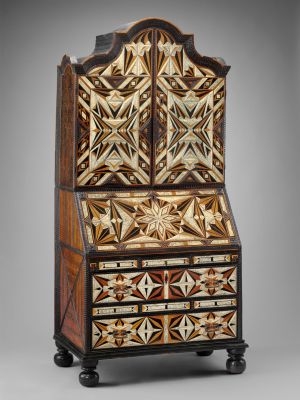
Desk and bookcase, mid-18th century, Mexico. Inlaid woods and incised and painted bone, maque, gold and polychrome paint, metal hardware (Museum of Fine Arts, Boston).
The Museum of Fine Arts, Boston, has acquired a rare and important desk and bookcase (mid-18th century, Mexico) from the Ann and Gordon Getty Collection. Originally made in Puebla de los Ángeles, this work is a remarkable piece of furniture that displays influences from Europe, Asia, Africa and the Americas. The striking geometric exterior looks toward Europe with its wood-and-bone Mudéjar designs—a Hispano-Moresque style popular during the era. Opening the doors reveals a dramatic interior of chinoiserie-style painting in gold on a red background. The inside recalls early colonial mapping traditions of Nahuatl-speaking artists, showing views of an extensive hacienda in Veracruz drawn in an indigenous style. The estate, once owned by a wealthy Spaniard, was the site of one of the earliest free African settlements in Mexico; the maps may depict descendants of these early African slaves or free blacks. This truly global mix of sources extends to the object’s material: the red background is likely maque (from the Japanese word for lacquer, maki-e), a resin created using local materials in the style of Asian painting.
The work is among the most rare pieces of furniture currently on view in the exhibition, Made in the Americas: The New World Discovers Asia, the first major, pan-American exhibition to examine the profound influence of Asia on the arts of the colonial Americas (on view through February 15).
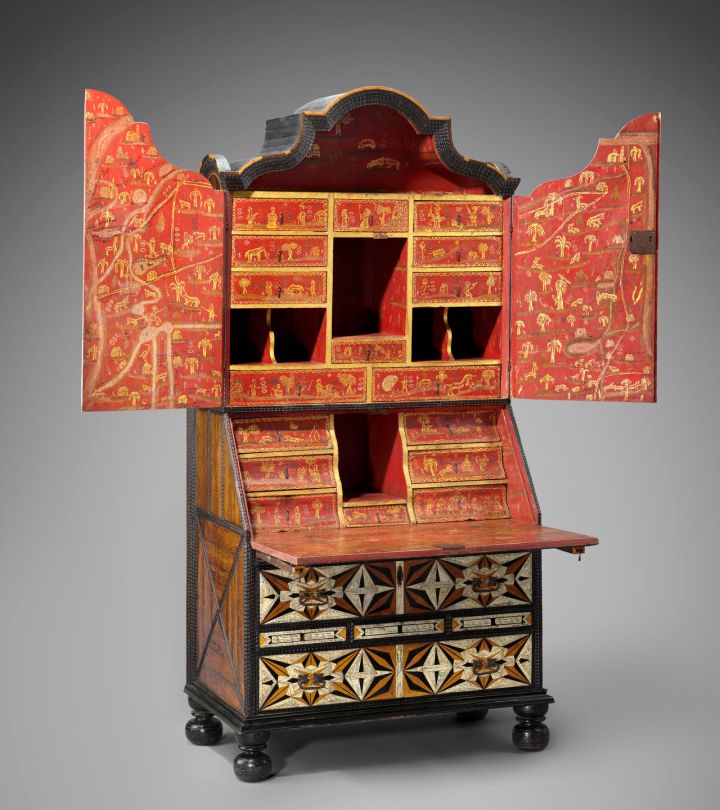
Desk and bookcase, mid-18th century, Mexico. Inlaid woods and incised and painted bone, maque, gold and polychrome paint, metal hardware (Museum of Fine Arts, Boston)
New Acquisition | Portrait of Yarrow Mamout (Muhammad Yaro)
With cultural and religious ignorance and intolerance finding new, ever uglier modes of expression here in the United States, on what seems a daily basis, this remarkable portrait (a 2011 acquisition by the Philadelphia Museum of Art) usefully speaks to how diverse and complex American history has always been. –CH
◊ ◊ ◊ ◊ ◊
From the Philadelphia Museum of Art:
Charles Willson Peale, Portrait of Yarrow Mamout (Muhammad Yaro), 1819, oil on canvas, 24 x 20 inches (Philadelphia Museum of Art, 2011-87-1).
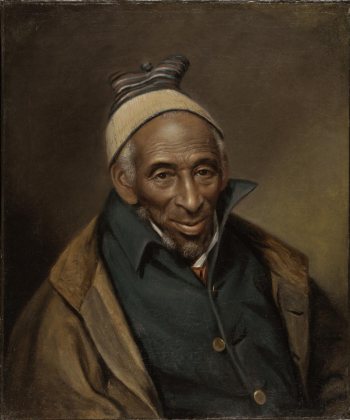 Yarrow Mamout, an African American Muslim who won his freedom from slavery, was reputedly 140 years old in 1819, when Charles Willson Peale painted this portrait for display in his Philadelphia Museum. Although Peale learned this was a miscalculation, the story of eighty-three-year-old Yarrow (c. 1736–1823), a native of the West African country of Guinea who was literate in Arabic, was still remarkable. As Peale noted, Yarrow was “comfortable in his Situation having Bank stock and [he] lives in his own house.”
A rare representation of ethnic and religious diversity in early America, and an outstanding example of Peale’s late naturalistic style, the picture is distinguished by the direct and sympathetic encounter between the artist and his subject and the skilled rendering of the details of physiognomy and age. Yarrow’s knit cap suggests a kufi, a hat traditionally worn by African Muslim men to assert their religion or African identity, but Peale artfully employs its yellow band to highlight his steady gaze with its glint of humor and wisdom.
Seventy-seven years old when he created this portrait, Peale was seeking a record of the personal traits that he believed supported a long life. In his writings and museum displays Peale celebrated making wise choices to maintain good health and a positive attitude, and he perceived Yarrow’s perseverance through his difficult life as a model of resourcefulness, industriousness, sobriety, and an unwillingness to become dispirited.
◊ ◊ ◊ ◊ ◊
More information about Mamout is available from this piece by Colbert King for The Washington Post (13 February 2015). For Mamout’s biography, see James Johnston, From Slave Ship to Harvard: Yarrow Mamout and the History of an African American Family (Fordham University Press, 2012). This past summer, the Historic Preservation Office dug shovel test pits in Georgetown in connection with the Yarrow Mamout Archaeology Project, led by Mia Carey (as reported by WAMU 88.5).
At Bonhams | Meissen Acquisitions

Meissen armorial two-handled beaker and saucer from the service for the Elector Clemens August of Cologne, 1735.
More information is available here»
◊ ◊ ◊ ◊ ◊
Press release (4 December 2015) from Bonhams:
Fine European Ceramics, Sale 22783
Bonhams, London, 2 December 2015
A rare Meissen armorial two-handed beaker and saucer, which once belonged to the Elector Clemens of Cologne, was bought this week at Bonhams Fine European Ceramics sale by the Brühl Palaces Augustusburg and Falkenlust. The UNESCO World Heritage Site, which belonged to the Elector Clemens August of Cologne (1700–1761), is the original home of the service to which this beaker and saucer belonged. Estimated at £50,000–60,000, the lot (#42) sold for £74,500. Bonhams Head of European Ceramics, Nette Megens said, “It’s very satisfying to know that this wonderful beaker is going back to its first home and will be re-united with other pieces from the same service in the Brühl Palaces’ collection.”
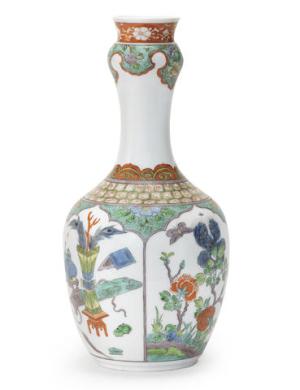
Meissen Famille verte vase, ca. 1735
Sold for £74,500.
The other top lot in the sale was a Meissen Famille verte vase from ca. 1735 (lot #40). One of very few examples of Meissen porcelain in the Chinese style, the vase sold for £74,500. Two other Meissen pieces were bought by major international museums confirming the manufactory’s importance in European cultural history.
The Palace Het Loo bought a Meissen soup plate for £6,875, more than double the lot’s pre-sale estimate of £3,000–5,000 (lot #51). The plate, made in the early 1770s, is from the service of Willem V of Orange, Stadholder of the United Provinces of the Netherlands. The service consists of 435 pieces which over the centuries have been dispersed across a range of museums and private collections. The plate will now join the Het Loo’s collection of around 170 pieces as, little by little, they bring the service together again. “It is one of the earliest Meissen topographical services and what we consider the most important related to the House of Orange,” said Suzanne Lambooy, Curator of Glass and Ceramics at Palace Het Loo. “We are excited to add this plate to our exhibition
as it is has an exceptional decoration depicting a view of
Vlissingen that we did not have before in our collection.”

Large Meissen figure of Paris, ca 1747
Sold for £4,750 (acquired by the V&A)
The Victoria & Albert Museum also purchased a large Meissen figure of Paris from a table centerpiece for £4,750 (lot #67). Reino Liefkes, Senior Curator of Ceramics and Glass at the V&A said: “The V&A is excited about acquiring this Meissen figure, which was originally modeled in 1747 for a grand table-centrepiece in white porcelain which has now been lost. The figure will be acquired with funds from the Capt. H.B. Murray Bequest and will go on display in the Museum’s Ceramics Galleries in due course. A spectacular Meissen centre-piece, also dating from 1747, has recently been restored by the V&A for the Museum’s new Europe 1600–1815 Galleries, which will open next week.”
Armorial Meissen was a further success of the sale. An armorial beaker from 1737 sold for £25,000 and an armorial teabowl and saucer from the service for Christian VI of Denmark sold for £12,500.
New Acquisitions | Pair of 18th-Century Silver Sculptures at Mia
Now on view at Mia:
The Archangels Saint Michael and Saint Raphael: A Pair of 18th-Century Silver Sculptures
Minneapolis Institute of Art, 14 November 2015 — 3 January 2016

Giuseppe Sanmartino, Saint Raphael with Tobias, his Dog, and the Fish, c. 1780, 27 inches high; The Archangel Saint Michael in Triumph, c. 1780, 33 inches high, silver, gilt bronze (Minneapolis Institute of Art, 2015.24.1,2)
A pair of two silver statues by Neapolitan artist Giuseppe Sanmartino (1720–93), donated to the museum by long-time trustees Al and Mary Agnes McQuinn, marks one of the most important additions to Mia’s silver collection. Executed with amazing detail, the statues testify to a devotion to the two Archangels, an act that goes back to the Early Christian period and continues to flourish in Southern Italy (as well as in the Greek and Russian Orthodox churches) to the present day. Throughout Christianity, Saint Michael and Saint Raphael are venerated for their healing powers. The exhibition celebrates the acquisition of these unique masterpieces, without peer in any American museum collection, and whose only comparables remain in Italian churches.
Painting Restoration on View at The National Gallery of Denmark
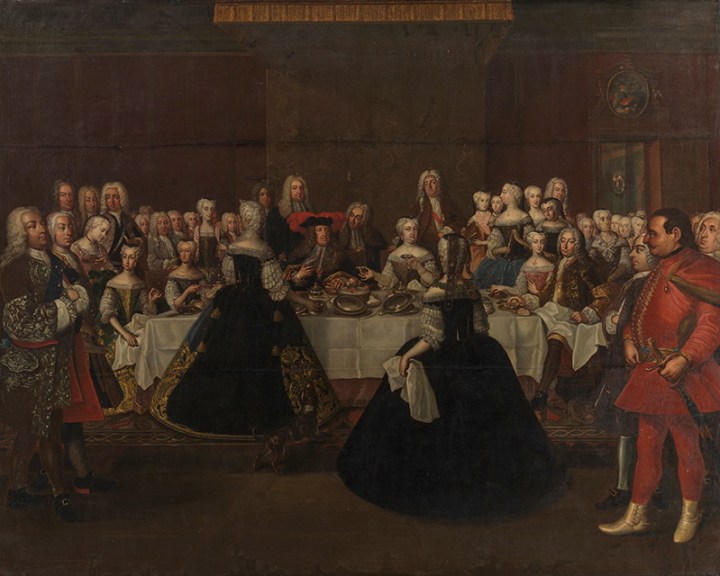
Johann Salomon Wahl, after an original by Martin van Meytens, A Banquet at the Court of the German Emperor Charles VI, 1741 (Danish Royal Collection)
◊ ◊ ◊ ◊ ◊
On view at the National Gallery of Denmark:
Open Studio: A Birthday Present for the Queen
Statens Museum for Kunst, Copenhagen, 29 October 2015 — 28 February 2016
For a four-month period, visitors to the SMK can watch the museum’s conservators at work, wielding scalpels and pigments to restore a painting that usually hangs on the wall of Her Majesty Queen Margrethe II’s private quarters. The restoration of J.S. Wahl’s painting A Banquet at the Court of the German Emperor Charles VI (1741) is the New Carlsberg Foundation’s gift to the Queen on the occasion of her 75th birthday.
 This large-scale painting has hung on the walls of Fredensborg Palace—now the private residence of H.M. Queen Margrethe II—since 1872. Painted by Johann Salomon Wahl in 1741, after an original by Martin van Meytens, the painting was acquired for the Royal Danish Kunstkammer in the year of its making and has been part of the royal collections ever since. With the passage of the years, the painting deteriorated to the point where it could no longer withstand being on display. A lack of adhesion between the paint layer and the canvas has caused paint to peel off in many areas, and even more paint threatens to fall off across the entire canvas. The painting is in need of thorough conservation and restoration.
Such restoration has now been made possible by a donation from the New Carlsberg Foundation, a birthday present to the Queen. The treatment requires more than 2,200 hours of painstaking work where the conservators will reattach unstable paint, laminate the canvas onto a new one and carry out extensive retouching of the damage sustained over the years. When the extensive conservation process is complete, the painting will once again be on display at Fredensborg Palace.
The SMK has many years of experience with opening up its conservators’ workshops to visitors. Doing so offers the general public a chance to gain insight into the work done behind the scenes at the museum. From 29 October 2015 to 28 February 2016 the SMK’s conservators will allow all visitors to peep into the museum’s engine room. During this period, visitors can follow the conservators’ work on this extensive restoration project—and will also have the opportunity to ask questions.
A Banquet at the Court of the German Emperor Charles VI was painted as a copy after an original by Martin van Meytens, created for the Viennese court in 1736. In the years that followed, several different versions were painted by a range of artists. The original work was probably painted in connection with either the wedding or the engagement between the emperor’s eldest daughter, Maria Theresa, and Francis Stefan of Lorraine. Their union was an important event in European history; upon her father’s death a few years later Maria Theresa became sovereign of the Austrian and Hungarian lands as the Habsburg family’s first female successor to the throne. When Francis Stefan was subsequently elected Holy Roman Emperor as Francis I, their marriage expanded and reaffirmed the Habsburg family’s power in Europe.
The ruling emperor and empress, Charles VI and Elisabeth Christine, are seated underneath a canopy at the centre of the table, whereas the bride and groom are seated at the end of the table to the right. To the left are the emperor’s sister, Maria Magdalena, and his second-eldest daughter, Maria Anna. They are surrounded by courtiers, members of the aristocracy and persons of prominent military rank.
Peggy Fogelman Named Director of the Gardner Museum
From the Gardner:
Peggy Fogelman Named Next Director of Isabella Stewart Gardner Museum
 The Isabella Stewart Gardner Museum announced today that Peggy Fogelman is the next Norma Jean Calderwood Director, succeeding Anne Hawley as the fifth director in the Museum’s history. Hawley will step down after 26 years at the end of the year, and Fogelman will assume the directorship in January 2016.
“I am overjoyed to be entrusted with leading the Gardner, a unique and treasured museum where visitors feel so closely connected to the collection,” Fogelman said. “Being located in this creative and intellectual hub makes the potential enormously exciting as we continue to reach the next generation of museum-goers. It is truly a privilege to apply all my experience to a place that is beloved by so many.”
Since 2013, Peggy has been Director of Collections at the Morgan Library & Museum in New York, overseeing eight curatorial departments, conservation, registration, and 16 to 20 exhibitions per year. Earlier this year, Peggy served for 12 months as Acting Director while the Morgan searched for a new Director. She previously worked at the Metropolitan Museum of Art as Chairman of Education, the Peabody Essex Museum as Director of Education and Interpretation, and the J. Paul Getty Museum as Associate Curator of European Sculpture and later Assistant Director and Head of Education and Interpretive Programs.
“Peggy is the perfect fit for the Gardner with her impressive background ranging from work in large prestigious institutions to small, intimate museums,” said Steve Kidder, the Gardner Museum’s Board President. “She brings us the best intersection of creativity, vision, and successful execution. We look forward to seeing what she dreams up for this very special Museum.”
Longtime Gardner Museum Trustee and former Board President, Barbara Hostetter chaired the committee that conducted an international search to find Hawley’s successor. “We are overjoyed that the Museum has found a new director with the vision and expertise to take it to new heights,” she said “Peggy comes to us with a seasoned perspective, honed by working at some of the nation’s finest museums, and with a freshness of spirit that makes being part of the Gardner leadership so rewarding.”
The Morgan began much like the Gardner Museum as a private collection that evolved into a vibrant cultural institution offering exhibitions, musical concerts, public lectures and special events. Fogelman has been instrumental in building a larger audience, developing the exhibition program, and forging meaningful collaborations with other institutions, foundations, and private collectors.
From 2009 to 2013, Fogelman was the Met’s Frederick P. and Sandra P. Rose Chairman of Education where she oversaw education, concert, and lecture programs. She took on the challenge of restructuring the education department to advance visitor engagement and to create more collaboration in the large institution. She spearheaded first time artist-based residencies and commissioned performances, fellowships in education and public practice, studio classes, gallery talks, artists’ study days, and digital art-making activities.
Before being recruited to the Met, Fogelman was Director of Education and Interpretation at the Peabody Essex Museum in Salem. She began her career at the J. Paul Getty Museum with a curatorial focus, and over the next 13 years, rose to Associate Curator in the Department of Sculpture and Works of Art. She was then appointed Senior Project Specialist to the Director, and transitioned to become Assistant Director and Head of Education and Interpretative Programs, achieving a major restructuring of the museum education program at the Getty. She holds a Bachelor of Arts from Johns Hopkins University and a Master of Arts from Brown University. Her work has been published widely for both general and specialized audiences.
As Anne Hawley prepares for her next chapter, she said she is delighted that the Museum will be in such capable hands. “I trust the magic and uniqueness of the Gardner Museum will continue to soar under Peggy’s leadership,” she said.
Acquisition Campaigns | Jacques Saly’s Cupid Testing One of His Arrows
From The Louvre:
Be a Patron of Love
Louvre Launches Campaign to Acquire
Jacques Saly’s Cupid Testing One of His Arrows
 In 1753, sculptor Jacques Saly signed and dated his masterpiece, the marble statue Cupid Testing One of His Arrows (L’Amour essayant une de ses flèches). The piece had been commissioned a year earlier by the Marquise de Pompadour, royal mistress of Louis XV, and was presented to the king in person on August 11, 1753, before being installed at the Salon de l’Académie at the Louvre to be shown to the public for one month.
Jacques Saly was made royal sculptor in 1750, when he became a member of the Royal Academy of Painting and Sculpture. Recommended by renowned sculptor Edme Bouchardon, Saly was called to Denmark in 1753 to work on the equestrian statue of Frederick V and help establish the Royal Danish Academy of Fine Arts in Copenhagen. He did not return to France until 1774, two years before his death.
Despite his short artistic career in France, Saly received a number of prestigious commissions. His masterpiece remains Cupid Testing One of His Arrows, which Madame de Pompadour presented in her three favorite residences: the Château de Crécy and the Château de Bellevue, on the outskirts of Paris, and the Hôtel d’Evreux, future site of the Palais de l’Elysée. Hidden from view in private collections for over two centuries, Saly’s sculpture of Cupid was revealed to the public in 2002 for the exhibition Madame de Pompadour and the Arts at the Château de Versailles. It was listed as a National Treasure by the French state in 2006.
A masterpiece of French art by its delicateness of composition and virtuosity of marblework, the statue is also outstanding for the pedestal that has remained with it since the beginning. It was executed by the great sculptor and ornamentalist Jacques Verberckt, who produced sumptuous wood paneling for the Château de Versailles and the Château de Fontainebleau, and who was also a friend of Saly’s. It is indeed quite remarkable that the two royal sculptors worked together on the same commission.
To execute this spectacular work of art, Saly gave of his best and applied all of his expertise. Its reappearance in France is an unhoped-for opportunity to shine light on the artist, a highly skilled sculptor who was sensitive to the art of his time.
The Société des Amis du Louvre has already provided half of the amount required for this major acquisition. In order for the exceptional work of art to enter the national collections, the Musée du Louvre is calling upon the generosity of the public to raise a minimum of €600,000 before February 14, 2016.










leave a comment