Renuka Reddy’s Search for Traditional Chintz Techniques
Writing for the the V&A’s blog for the museum’s fall exhibition The Fabric of India, Renuka Reddy, “a contemporary chintz-maker,” recounts “the story of her search for lost techniques, the challenges she’s faced as a designer-cum-maker, and how the V&A’s collection has inspired her work. Renuka’s studio, Red Tree, is based in Bengaluru.”
◊ ◊ ◊ ◊ ◊
“Guest Post: Renuka Reddy’s Adventures in Chintz,” V&A Blog (6 October 2015).
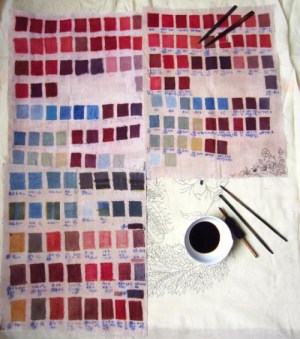
Color swatches. © RedTree Textile Studio
If only I could time travel…
It was nearly two years after its publication that I got my hands on the book Chintz: Indian Textiles for the West written by Rosemary Crill and published by the V&A. I vividly remember my response to the spectacular plates, the desire to make something so beautiful. Little did I know how this reaction would change my life in ways I could not imagine.
By chintz, I refer to hand-painted resist-and-mordant dyed cottons. I am particularly interested in the intricate resist work of chintz exported from India to the West between the seventeenth and the eighteenth century. This is where I draw my inspiration from.
My goal was to produce chintz, which at that time meant working with craftsmen. So I went in search of one in Machilipatnam and Srikalahasti, two historic towns in the state of Andhra Pradesh where kalamkari (literally ‘pen-work’)
is practiced today. . .
The full posting is available here»
Dutch Royal Barge Returns to Het Scheepvaartmuseum

◊ ◊ ◊ ◊ ◊
Press release (14 October 2015) from Amsterdam’s National Maritime Museum:
After an eight-year absence, the Royal Barge will once again be on display at Het Scheepvaartmuseum. At a spectacular opening event on Wednesday evening, framed by the pipers and drummers of the Marine Corps, the Royal Barge was presented to more than 300 guests. Just one week before this event, the 200-year old barge and its new boathouse were transported across land and water. In the home port of Amsterdam, the doors will be opened to visitors every morning.
The director-general of Het Scheepvaartmuseum, Pauline Krikke, is overjoyed at the return of the crown jewel of the museum’s collection. “It is a momentous occasion to celebrate the return of the barge after such a long absence,” she says. “The Royal Barge is restored and seaworthy. The museum is incredibly grateful to all the people who helped to make this possible.”
The Royal Barge, also referred to as the ‘Golden Coach of the water’ (‘de gouden koets te water’), was given a thorough overhaul. With a donation of one million euros from the BankGiro Lottery, the Cultuur Lottery, and specialist input from AkzoNobel, this unique barge was completely renovated and restored to once again be admired in all its magnificence. Now, this public favourite has finally returned to Het Scheepvaartmuseum. With the new set-up in the boathouse, the beautiful golden ornaments are closer than ever before and can be admired in detail by the visitors.
The Royal Barge is a rowing barge that was built at the Navy shipyard in Rotterdam in 1816 for King William I. Since then, the Royal Barge has been used by the head of state for official events such as state visits, jubilees, naval reviews, and the launching of new ships. The barge marked its final voyage in 1962 with the silver wedding anniversary of Queen Juliana and Prince Bernhard, and was then retired from service.
The National Maritime Museum (Het Scheepvaartmuseum) tells the story of how the sea has defined Dutch culture. Visitors follow their own paths through twelve exciting and interactive exhibitions to discover 500 years of maritime history. Highlights of world-class collections are displayed in unforgettable exhibitions. A few of the exhibitions (like The Tale of the Whale and Life Onboard) are specially designed for families. The museum draws approximately 330,000 visitors per year, putting it among the top ten Amsterdam museums and making it a major attraction for both domestic and foreign tourism. Het Scheepvaartmuseum is located in ‘s Lands Zeemagazijn, an historic Golden Age building dating from 1656.
AIC Director Douglas Druick Announces Retirement

Douglas Druick, photo by Robert Carl
◊ ◊ ◊ ◊ ◊
Press release from the Art Institute of Chicago, via ArtDaily (8 October 2015). . .
Douglas Druick, President and Eloise W. Martin Director announced today his plans to retire from the Art Institute of Chicago. An internationally recognized scholar and curator who joined the Art Institute in 1985, during his distinguished 30 years of service Druick chaired two of the museum’s eleven curatorial departments and led the institution as its president and director since 2011, overseeing many milestones in the museum’s illustrious history.
“Douglas is one of the most respected, thoughtful, and innovative museum leaders in the world. He has made extraordinary contributions to the development of the Art Institute—ushering the museum into the digital age, achieving an unparalleled ranking among the world’s top three museums on TripAdvisor for three years running, and managing the largest gift of art since the museum’s founding with the contemporary works from Stefan Edlis and Gael Neeson,” said Bob Levy, Chairman of the Board of Trustees of the Art Institute of Chicago. “Douglas’s initiatives to place a stronger emphasis than ever before on visitor access and engagement, and to champion global diversity as it is reflected in the museum’s audiences, collections, and programs, will only continue to advance the Art Institute’s global reach and reputation for excellence.”
“It has been my honor to serve as the Art Institute’s president and director,” said Druick. “I have been deeply proud to lead one of the finest museums in the world, and to work for three decades with an exceptional cadre of remarkably talented museum colleagues. It is my hope that together we have ensured a solid footing for the Art Institute to continue to grow stronger and more vibrant, financially stable and internationally renowned, with a future filled with more opportunities than challenges.”
Under Druick’s leadership, since 2011, the Art Institute has offered more than 100 internationally recognized and innovative exhibitions that have inspired and educated millions of visitors who count on the museum to encourage the individual experience of exceptional works of art. During Druick’s tenure, the museum achieved-and continues to record-the highest attendance numbers in its history. He managed the largest gift of art to the Art Institute since its founding, in the generous and extraordinary collection of Stefan Edlis and Gael Neeson, affirming the museum’s legacy as an international leader in contemporary art and realizing the promise of the Modern Wing.
Druick’s commitment to bring the museum fully into the digital age-overseeing a comprehensive plan to install wireless internet in the galleries and public spaces, launching a pioneering Online Scholarly Catalogue Initiative, and recalibrating the museum’s culture to prioritize visitor access and engagement-has ensured the Art Institute’s continued preeminence as one of the world’s most exceptional museums.
Druick noted, “The next chapter in the life and legacy of the Art Institute hinges on an all-important five to seven year endeavor to realize the museum’s long range plan that I believe requires uninterrupted leadership. I will retire with confidence, knowing that the foundation for the museum’s future is firmly in place and that we will energetically pursue our ambitious vision. For decades, the Art Institute’s life has been my own, but I need now to draw a distinction between my professional and personal life. I am doing so to realize long held plans with my partner and frequent collaborator Peter Zegers to actively pursue new directions and experiences together, here and abroad.”
Douglas Druick, 70, received a B.A. in English and Philosophy from McGill University in Montreal in 1966, and an M.A. in English from the University of Toronto in 1967. In 1972, he received his M.Phil. in the History of Art from Yale University, followed by his Ph.D., also from Yale, in 1979. From 1973 to 1984, Druick was the Curator of European and American Prints at the National Gallery of Canada in Ottawa.
He first came to the Art Institute in 1985 as the Chair and Prince Trust Curator of Prints and Drawings. Four years later, in 1989, he also became the Searle Curator of European Painting at the Art Institute. In 2006, while remaining the Chair of the Department of Prints and Drawings, he was named the Chair of the Department of Medieval to Modern European Painting and Sculpture, deftly stewarding the Art Institute’s renowned Impressionist, Post-Impressionist, and Modern collections.
As chair of two of the museum’s largest departments Druick oversaw the acquisition of thousands of notable prints and drawings of all schools and many important European paintings, both building on the collections’ strengths and expanding the geographical representation of nineteenth- and twentieth-century art.
During his tenure at the Art Institute, Druick conceived and organized or contributed to some of the most significant exhibitions in the museum’s history. These exhibitions include Odilon Redon: Prince of Dreams, 1840–1916 (1994); Gustave Caillebotte: Urban Impressionist (1994) with Gloria Groom; Van Gogh and Gauguin: The Studio of the South (2001) with Peter Zegers; Cézanne to Picasso: Ambroise Vollard, Patron of the Avant-Garde (2006) with Gloria Groom; and, in contemporary art, Jasper Johns: Gray (2007) with James Rondeau-named ‘Best Monographic Museum Show Nationally’ by the American section of the International Art Critics Association.
Druick has published and lectured extensively, with 15 exhibition catalogues to his credit, numerous essays and articles, and talks and lectures from Vienna to London and from Amsterdam to San Francisco.
He has been awarded many professional honors and has served on various advisory councils and boards, including as the Chairman of the Arts and Artifacts Indemnity Advisory Panel, National Endowment for the Arts (2002–2004); a Founding Board Member of the Association of Art Museum Curators (2002–2008); and the National Committee for the History of Art (2003–2009). The Government of France named him an ‘Officier des Arts et Lettres’ in 2012, and he was elected as a Fellow to the American Academy of Arts & Sciences in 2013.
Douglas Druick will remain fully engaged in his duties as President and Eloise W. Martin Director until his successor has been appointed and installed. The Board of Trustees of the Art Institute of Chicago deeply respects and has enormous gratitude for Druick’s service and his stewardship of the museum, and will begin the important work to formulate an approach to his succession.
VMFA Acquires Royal Portrait by Benjamin West

Benjamin West, Portrait of Prince William and his Elder Sister, Princess Sophia, 1779, oil on canvas, 61 x 85 inches
(Richmond: VMFA).
◊ ◊ ◊ ◊ ◊
From the VMFA press release (1 October 2015) . . .
At the Virginia Museum of Fine Arts, an important work by American painter Benjamin West was recently installed in the McGlothlin American Galleries. The portrait was acquired during the June 18 meeting of the VMFA Board of Trustees and is among the most valuable acquisitions in VMFA history.
Benjamin West, known as the ‘father of American painting’, was at one point the most prominent painter in the British Empire. He served as President of the Royal Academy, History Painter to the King, and Surveyor of the King’s Pictures until his death in 1820. While in London, he also mentored American artists Charles Wilson Peale, Gilbert Stuart, and John Trumball—each of whom is represented in VMFA’s American Galleries. This is one of six group portraits commissioned by King George III during the American Revolution. Intended as a gift for the king’s brother, HRH Prince William Henry, Duke of Gloucester and Edinburgh, it is the only one of the six outside the Royal Collection. Descended in the family of George III, whose daughter HRH Princess Mary wed the sitter, Prince William, the painting celebrates the king’s protection of his niece and nephew at a moment during their father’s ill-health. In acknowledgement of the king’s generosity, the children and father—symbolized by the robe and crown—signal their obedience to the king, symbolized by the lion. This patriarchal narrative of duty and protection served a dual purpose as wartime propaganda. As the king served to protect his subjects, so his subjects—the colonists—owed their obedience to the king.
The acquisition of Portrait of Prince William and his Elder Sister, Princess Sophia was made possible by the J. Harwood and Louise B. Cochrane Fund for American Art. Since 1988, this permanent endowment has provided support for the acquisition of historic American paintings, sculpture, works on paper, and decorative arts, ca. 1700–1945, including those native to Virginia. It has been funded with outright gifts, 220 parcels of real estate in Manchester, and their former home and farm in Hanover County. Proceeds from the sales of the real estate have been added to the Cochrane endowment principal. The endowment is now nearly 30 years old and has underwritten 79 important American acquisitions
Hartwig Fischer Appointed as Director of The British Museum
Press release (29 September 2015) from The British Museum:
 Sir Richard Lambert, Chair of the Trustees of the British Museum, this morning announced to staff that Hartwig Fischer had been appointed Director of the British Museum. Dr Fischer, who is currently the Director General of the Staatliche Kunstsammlungen Dresden, will take up the post in Spring 2016. The current Director, Neil MacGregor, will retire from the Museum at Christmas. The appointment has been confirmed by the Prime Minister, the Rt Hon David Cameron.
Chairman of the Trustees Sir Richard Lambert said, “On behalf of the Trustees I am very happy to announce the appointment of Hartwig Fischer—currently Director General of the Staatliche Kunstsammlungen Dresden—as Director of the British Museum. He is one of the outstanding museum directors in the world. He is not only a great scholar, but an experienced administrator and a gifted linguist with a global reputation for rethinking and representing great collections. In Essen he directed one of the leading museums of 20th-century art in Germany and in Dresden he directs a museum whose collections are amongst the greatest in the world. Neil MacGregor has been a brilliant Director of the British Museum and has transformed its presence across the world. The Trustees are confident Dr Fischer will be a worthy successor.”
Hartwig Fischer said: “When I was growing up in Hamburg, Britain was always present in my family life. It has remained so ever since. I never dreamt that I would be invited to be responsible for this great British institution and I am conscious that nobody could fail to grasp what the British Museum represents not only for the UK but for the whole world. For many years I have looked to the British Museum as a model of public engagement, critical scholarship, and international outreach. I am of course daunted by such a responsibility but I know that nobody directs such a museum alone and the colleagues of the British Museum are admired and envied around the world. I am greatly looking forward to working with them. I have visited the British Museum on many occasions as a member of the public and have always admired the way every member of the team plays their part in making the collection available to the public all over the world. It’s an honour to be asked to become the Director of the British Museum and to follow in the footsteps of Neil MacGregor, who has done more than anybody else to position the Museum as one of modern society’s key institutions, fostering knowledge, understanding, and global citizenship.”
Neil MacGregor said “Hartwig Fischer is the perfect choice to run the British Museum. The Museum, its staff, its Trustees and its unparalleled collection is truly international. It therefore makes absolute sense for the new Director to reflect this global outlook. Dr Fischer is a well-respected scholar with extensive experience. He will, I am sure, build on the British Museum’s recent successes to ensure the Museum remains one of the world’s greatest museums.”
Hartwig Fischer is currently the Director General of the Dresden State Art Collections (Staatliche Kunstsammlungen Dresden) where he is responsible for fourteen museums and four separate institutions in four cities. His focus since his appointment in 2012 has been on modernizing and developing the State Art Collections, which date back to the 16th century. The collections are some of Germany’s finest, spanning more than 5,000 years of art, archaeology, anthropology and cultural history. Prior to that appointment, Fischer was Director of the Folkwang Museum in Essen (2006–2012). Whilst in post he oversaw the fundraising and restoration of the historic museum and the construction of a new building, and presided over a period of increasing visitor figures and popularity. He began his museum career at the Kunstmuseum in Basel, where he was curator of 19th-century and Modern Art from 2001–2006. Fischer has studied the History of Art, History and Classical Archaeology in Bonn, Berlin, Rome and Paris and holds a Doctorate in Philosophy from the University of Bonn. He speaks German, English, French and Italian. He was born in Hamburg 14 December 1962 and is married to psychoanalyst Ilaria Piqueras Fischer.
V&A Names Antonia Boström as Keeper of SMCG Department
V&A press release (15 September 2015). . .
 The V&A is pleased to announce that Antonia Boström, currently Director of Curatorial Affairs at the Nelson-Atkins Museum in Kansas City, USA, will join the Museum in January 2016 as Keeper of the Sculpture, Metalwork, Ceramics and Glass Department.
Paul Williamson, Keeper of the Sculpture, Metalwork, Ceramics and Glass (SMCG) Department since 2001, retires from the V&A in early 2016. This will follow a distinguished 37-year career at the Museum during which he also took on the roles of Director of Collections (2004–7) and Acting Deputy Director (2013).
As one of the six most senior curatorial roles in the Museum, the Keeper manages the Sculpture, Metalwork, Ceramics and Glass Department, and is responsible for promoting research, knowledge and enjoyment of the collection of over 110,000 objects reflecting European history and design. The department is in charge of several of the most visited and important galleries in the V&A, including the Medieval & Renaissance Galleries, The Cast Courts, the Hintze Galleries of British Sculpture, the Jewellery Gallery, the Sacred Silver and Stained Glass Gallery, the Silver Galleries, and the Ceramics and Glass Galleries.
Martin Roth, Director of the V&A said: “Paul Williamson has made a magnificent contribution to the V&A during his impressive career here. His loyalty in serving the Museum is unparalleled and we thank him warmly for all that he has done. We look forward to welcoming another world-leading expert, Antonia Boström, who brings with her significant scholarship and a wealth of experience across world-class collections including the J. Paul Getty Museum in Los Angeles, the Nelson-Atkins Museum in Kansas and the Detroit Institute of Arts back to the V&A where she began her career.”
Paul Williamson said: “I’ve been hugely privileged to work at the V&A for so long, to be responsible for a large part of its internationally-important collections and to be surrounded by brilliant and committed colleagues, both inside and outside the Museum; and it will be a great pleasure to continue this connection as Keeper Emeritus and Honorary Senior Research Fellow. I’m delighted to welcome Antonia Boström as my successor, and wish her every success in the years ahead.”
Antonia Boström said: “Having spent the last 19 years in the United States, I am extremely excited to be returning to the V&A, the museum where I first trained as a curator and whose collections are so meaningful to me. The V&A is at an important moment in its history; it is thrilling to witness its astonishing achievements over the last several years and to look forward to future projects. I look forward to contributing to those important initiatives and to leading a department of curators widely recognized as among the foremost experts in their fields.”
Paul Williamson has been Keeper of the Sculpture, Metalwork, Ceramics & Glass Department at the V&A since 2001 and was Director of Collections, 2004–7, and Acting Deputy Director in 2013. He joined the Museum in 1979 and was Chief Curator of Sculpture 1989–2001. He has published widely, principally on medieval art including the Pelican History of Art volume Gothic Sculpture 1140–1300 (Yale University Press, 1995) and, most recently, the V&A catalogues Medieval Ivory Carvings: Early Christian to Romanesque (2010) and Medieval Ivory Carvings 1200–1550 (the latter with Glyn Davies). He has been involved in the organisation of numerous exhibitions, including English Romanesque Art 1066–1200 (Hayward Gallery, 1984), Age of Chivalry: Art in Plantagenet England 1200–1400 (Royal Academy of Arts, 1987–88), Images in Ivory: Precious Objects of the Gothic Age (Detroit and Baltimore, 1997), Gothic: Art for England 1400–1547 (V&A, 2003–4), and Object of Devotion: Medieval English Alabaster Sculpture from the Victoria and Albert Museum, which toured to ten U.S. venues, 2010–14. He has served on many committees both inside and outside the V&A, has been Expert Adviser on Sculpture to the Reviewing Committee on the Export of Works of Art since 1989, was Vice-President of the Society of Antiquaries of London 1999–2003, and is a Trustee and Director of The Burlington Magazine. He is a Fellow of the Royal Historical Society.
Antonia Boström has been Director of Curatorial Affairs at the Nelson-Atkins Museum of Art, Kansas City, Missouri, USA since 2013. She was Senior Curator & Department Head, Sculpture & Decorative Arts Department, J. Paul Getty Museum, Los Angeles from 2004 to 2013, Assistant Curator, Department of European Sculpture and Decorative Art and research scholar at the Detroit Institute of Arts from 1996 to 2004 and previously held curatorial posts at the Royal Academy, London, 1995–96, V&A, 1980–85, and National Portrait Gallery in 1980. She has been involved with many exhibitions including Messerschmidt and Modernity (J. Paul Getty Museum, 2012); Cast in Bronze: French Sculpture from Renaissance to Revolution (J. Paul Getty Museum, Musée du Louvre and Metropolitan Museum of Art, 2009) and Magnificenza! The Medici, Michelangelo, and Art of Late Renaissance Florence (Florence, Palazzo Strozzi, Chicago, AIC, and Detroit Institute of Arts, 2002–4) as well as gallery installations including the sculpture and decorative arts galleries (J. Paul Getty Museum, 2006–10). She has written, edited and contributed to publications including Messerschmidt and Modernity (Getty Publications: Los Angeles, 2012), The Fran and Ray Stark Collection of 20th-Century Sculpture at the J. Paul Getty Museum (Getty Publications: Los Angeles, 2008) and The Encyclopedia of Sculpture, 3 vols. (Fitzroy Dearborn/Routledge: New York, 2004). She is fluent in five languages.
New Appointments Announced at the Harvard Art Museums
Press release (via Art Daily, 20 September 2015). . .
The Harvard Art Museums has announced the appointment of two new curators to the Division of European and American Art and the Division of Asian and Mediterranean Art, as well as the internal promotion of two curators in the Division of European and American Art.
Ethan Lasser has been named Head of the Division of European and American Art and was promoted to Theodore E. Stebbins, Jr., Curator of American Art—the first person to hold this endowed position at the museums. Lasser had served as acting head of the division since December 2014.
A. Cassandra Albinson has been appointed the new Margaret S. Winthrop Curator of European Art, and Elizabeth M. Rudy, who has been at the museums since 2011, was named the new Carl A. Weyerhaeuser Associate Curator of Prints.
In the Division of Asian and Mediterranean Art, Rachel Saunders has been named the Abby Aldrich Rockefeller Associate Curator of Asian Art; she is the first to hold this endowed position at the museums.
Comprised of the Fogg Museum, the Busch-Reisinger Museum, and the Arthur M. Sackler Museum, the Harvard Art Museums reopened to the public last November after a six-year renovation and expansion project. These curatorial appointments, with deep expertise in key areas of the museums’ world-class collections, will help fulfill the promise of the new facility.
“Last year, we unveiled a new model for a 21st-century university art museum—one that broke down barriers between traditional curatorial areas of expertise to create new opportunities for research, teaching and learning with the collections,” said Deborah Martin Kao, the Landon and Lavinia Clay Chief Curator and Interim Co-Director of the Harvard Art Museums. “These new curatorial appointments go to four extraordinary scholars who share our belief in the intrinsic power of original works of art, and who are committed to unlocking the full potential of Harvard’s great collections for all audiences. As representatives of a new generation of curators, they will bring energy, fresh ideas, and an intellectual dynamism that will help us grow into our future.”
The appointments, which begin this fall, were initiated and completed before Thomas W. Lentz, the former Elizabeth and John Moors Cabot Director of the Harvard Art Museums, stepped down in July.
 Lasser joined the Harvard Art Museums in 2012 as the Margaret S. Winthrop Associate Curator of American Art and played a key role in the Division of European and American Art as the museums prepared for reopening. Lasser developed a compelling cross-media and transnational approach to the European and American galleries, posing exciting and imaginative new questions that have propelled the field forward and contributed to the further refinement of the broader Collection Galleries program for European and American art. He also led the development of the Silver Cabinet and the galleries devoted to the Atlantic World and the interplay between painting and photography in the 19th century.
In 2017, the museums will open Lasser’s special exhibition, From the Philosophy Chamber: Harvard’s Lost Collection, 1766–1831, developed in collaboration with Harvard faculty partner Jennifer Roberts. For the first time since the early 19th century, an astounding collection of portraits, prints, scientific instruments, and various ‘curios’ obtained abroad by Harvard graduates will be reunited for display and study. The reassembled Philosophy Chamber will examine the role that images and objects can play in building, organizing, and transmitting new knowledge.
 Albinson brings more than a decade of curatorial experience and a commitment to teaching with original works of art. She comes from the Yale Center for British Art, where she was curator of paintings and sculpture and acting head of the department. Albinson also served as a lecturer at Yale, teaching courses on portraiture and on British and French art from the Rococo period through 1850. She has curated multiple exhibitions including The Critique of Reason: Romantic Art, 1760–1860 and Thomas Lawrence: Regency Power and Brilliance. The catalogue for the latter was awarded the Historians of British Art Book Prize for a multi-authored volume in 2011. Albinson was drawn to the Harvard Art Museums’ rich collections—notably, portraiture, works by Géricault, and Pre-Raphaelite art—and the museums’ new collaborative curatorial model, with experts across specializations working together to advance teaching, learning, and research. She is currently working on a project on the importance of the color pink in the 18th century in Britain and France, and is writing a book on portraits of aristocratic women in Victorian Britain.
As the former Cunningham Assistant Curator of European Art at the Harvard Art Museums, Rudy has in-depth knowledge of both Harvard and the Harvard Art Museums. She received her Ph.D. in art history at Harvard, with a dissertation titled “Pierre-Paul Prud’hon and the Problem of Allegory.” Rudy played a vital role in the reinstallation of the European and American galleries, and served as lead curator for the romanticism, impressionist, and Wertheim Collection galleries. She is currently working with Professor Ewa Lajer-Burcharth on a forthcoming show of French drawings, which involves multiple graduate and undergraduate collaborators. In addition to her experience at Harvard, Rudy also served as a curatorial fellow in the Department of Drawings and Prints at the Metropolitan Museum of Art in New York, and has maintained an impressive record of lectures and publications.
Saunders has just completed her Harvard dissertation on a fourteenth-century Japanese handscroll illustrating the journey to India of the Chinese monk Xuanzang. She joins the Harvard Art Museums from the Center for Advanced Study in the Visual Arts at the National Gallery of Art in Washington, D.C., where she was the Ittleson Fellow. From 2004 to 2011, Saunders was a research associate in Japanese art at the Museum of Fine Arts, Boston. There, she curated the exhibition Pursuits of Power: Falconry and the Samurai and led efforts to catalogue numerous rare, woodblock-printed books. Saunders specializes in Japanese art and maintains great interest in the larger framework of the entire East Asian cultural region. She will help unlock the museums’ powerful Asian art collections, buttressed by the extensive promised gift of Japanese works of art from the collection of Robert and Betsy Feinberg, through exhibitions and programs that will benefit Harvard students, faculty, and the wider public.
Opening in December 2015: V&A’s ‘Europe 1600–1815’ Galleries
From the V&A press release:

Writing cabinet, 1750s, possibly by Michael Kimmel, or Kümmel (1715-1794) a cabinet-maker in Dresden (London: V&A, Purchased by H.M. Government from the estate of the 6th Earl of Rosebery and allocated to the Victoria and Albert Museum, W.63-1977)
The V&A’s Europe 1600–1815 galleries will open to the public in December 2015, following the transformation of seven galleries for the redisplay of the Museum’s unrivalled collection of 17th- and 18th-century European art and design. A major part of the V&A’s ongoing redevelopment programme known as FuturePlan, the £12.5m project will complete the restoration of the entire front wing of the Museum for the display of more than 1,100 objects.
In its prominent position next to the V&A’s grand entrance, Europe 1600–1815 will continue the story of art and design that begins in the award-winning Medieval & Renaissance Galleries (opened 2009). Four large galleries will introduce the story in chronological sequence, alternating with three smaller galleries that focus on specific activities: collecting in the Cabinet, enlightened thought in the Salon and entertainment and glamour in the Masquerade. In addition, three period rooms will invite visitors to imagine life in the personal spaces of the time including a 17th-century French bedroom, Madame de Sérilly’s cabinet and a mirrored room from 18th-century Italy.
The collection comprises some of the most magnificent works held by the V&A, including spectacular examples of textiles and fashion, painting and sculpture, ceramics and glass, furniture and metalwork, prints and books. Many objects were made in Europe by its finest artists and craftsmen for the period’s most discerning leaders of taste such as Louis XIV, Marie Antoinette, Catherine the Great and Napoleon.
Martin Roth, V&A Director, said: “These new galleries are a major development in our ambitious programme to renew the architecture of the V&A for the 21st century and, at the same time, re-examine and re-present our collection for our visitors. At a time when roles and relationships within Europe and the world are under scrutiny, it is interesting to explore the objects, makers and patrons of a period that was so influential upon the habits and lifestyle of Europe today.”
A large, highly ornate Rococo writing cabinet made for Augustus III and acquired in 1977 from the celebrated sale of Mentmore Towers, Buckinghamshire will be exhibited for the first time since its recent conservation. Another newly conserved highlight on display will be a grand 18th-century bed from the Parisian workshop of George Jacob. A supplier to royal courts across Europe, Jacob survived the French Revolution and later made furniture for Napoleon.
The displays will demonstrate how France succeeded Italy as the undisputed leader of fashionable art and design in Europe in the second half of the 17th century. They will also show how—for the first time ever—Europeans systematically explored, exploited and collected resources from Africa, Asia and the Americas.
The collection includes several outstanding bequests, notably from John Jones, a military tailor who left his exceptional collection of French decorative arts to the Museum in 1882 and who is the subject of a special display within the galleries. A number of significant new acquisitions will be exhibited for the first time at the Museum including a 17th- century Venetian table by Lucio de Lucci, acquired after a temporary export ban in 2012. The magnificent oil painting The Château de Juvisy, by Pierre-Denis Martin, a rare, accurate depiction of the architecture and bustling life of an estate near Paris in the 17th century, will be a centrepiece of the gallery exploring the rise of French cultural dominance during the period. The work was secured for the nation in 2014 thanks to a major public appeal and donations from the Friends of the V&A and the Art Fund.
Preparation for the reopening is underway with a full reinterpretation of the collection and important objects undergoing conservation: several large tapestries have been cleaned at De Wit Royal Manufacturers of Tapestries in Mechelen, Belgium, including the Gobelins tapestry after the Poussin painting The infant Moses tramples on Pharoah’s crown manufactured in Paris in the 1680s. Fashion garments, furniture and textiles have been conserved in the V&A’s world- renowned studios and a Meissen table fountain has been meticulously researched and rebuilt for the first time since its acquisition in 1870.
The V&A is working with architectural practice ZMMA on the redesign of the galleries. The project will see the complete removal of the interior cladding added in the 1970s and will reclaim back of house storage space. The combined effect will enlarge the galleries by almost a third to 1,550 square meters. Natural light will be returned to the spaces by uncovering windows previously obscured. Environmental controls will be upgraded to provide sustainable and stable conditions for the collection and new state-of-the-art cases that meet modern environmental and security requirements will be installed.
The Europe 1600-1815 galleries are being made possible thanks to a generous £4.75m lead grant from the Heritage Lottery Fund with further support from many other Trusts, Foundations and individuals.
Lesley Miller is lead curator and Joanna Norman is project curator of Europe 1600–1815. To mark the opening of the new galleries, the V&A will publish The Arts of Living: Europe 1600–1815, edited by Elizabeth Miller and Hilary Young.
Dawn Hoskin provides details (with photos) at the V&A’s Blog»
◊ ◊ ◊ ◊ ◊
From the V&A press release:
The V&A has commissioned the artist collective Los Carpinteros to create a contemporary installation for the Museum’s new Europe 1600–1815 galleries, opening to the public in December 2015. Established in 1992, Los Carpinteros have received international acclaim for their sculptural pieces. The duo work between Madrid and Havana, and this will be their first major project for a London museum.
Charged with devising a large-scale, imaginative and thought-provoking piece that would sit within the gallery examining the Enlightenment, Los Carpinteros proposed The Globe. It is a curved architectural sculpture made from a lattice of engineered beech that will form a ‘room within a room’ at the heart of the new Europe displays. Occupying a pivotal space—both architecturally and in terms of the narrative of the galleries—it will offer visitors an opportunity to pause and reflect, as well as encourage engagement with the complex concept of the Enlightenment. Seating up to 30 people, The Globe will also be used as a space for programmed salons, events and discussions.
The period represented the triumph of intellectual curiosity and enquiry, a culture of increasing literacy and debate, and a desire to acquire and classify knowledge. This is encapsulated in one of the most important publications of the 18th century, Diderot and Alembert’s Encyclopedia (1751–1772). A vast collaborative project involving many of the leading thinkers of the day, it aimed to gather all available knowledge, to examine it critically and rationally, and to bring it to a wide public. Bernard and Picart’s Religious Ceremonies and Customs of All the Peoples of the World (1723–1743) will be on display in the gallery. A number of sculptural busts from the period will be placed in dialogue around The Globe and be visible from inside the installation, recalling the intellectual environment and salon culture, and making connections between past and present.
Lesley Miller, lead curator for Europe 1600–1815, said: “Bringing alive the Enlightenment is a challenge for a curator—how might we represent intellectual thought and debate in a gallery? Los Carpinteros’ work, set among sculpture and books from the period, creates a fundamentally different experience for visitors—inviting them into a contemplative, calm place to reflect and think. The design of The Globe reflects not only the world but also, in its bookshelf, cell-like construction, the organisation of knowledge—central to Enlightenment thought. It also creates space for intellectual debate in a relatively informal setting—the V&A’s own 21st-century take on an 18th-century salon, if you like.”
Los Carpinteros said: “Our commission for the V&A is the culmination of a 20-year fascination with the idea of the ‘panopticon’. First devised in the 18th century by Jeremy Bentham, these structures promoted surveillance and control and were originally intended for prisons. The Globe reinterprets this format as an observation point midway through the Museum’s new galleries. It is a station for rest, contemplation and discussion that will relate closely to the objects that surround it. Our work to date has mainly been with museums and galleries dedicated to contemporary art, so it has been very exciting to work in the context of the V&A’s historical collection of objects, fine art and design; a world with which our practice has many familiarities and connections. Here our work as artists, craftsmen, designers and carpenters has a rare practical utility and function alongside its symbolism—with pleasingly ambiguous results.”
The V&A has an established reputation for working with contemporary artists and designers to respond to the permanent collections. Past collaborations have included site-specific commissions from Elmgreen & Dragset, Cornelia Parker, Edmund De Waal, Felice Varini, rAndom International, and Troika. . . .
Los Carpinteros (The Carpenters) are Marco Antonio Castillo Valdes (b. 1971) and Dagoberto Rodríguez Sanchez (b. 1969). A Havana-based collective, they have created some of the most important work to emerge from Latin America in the past decade. Formed in 1992 (with Alexandre Arrechea until his departure in June 2003), Los Carpinteros took their name in 1994, deciding to renounce the notion of individual authorship and refer back to an older guild tradition of artisans and skilled craftsmen. Merging architecture, design, and sculpture in unexpected and often playful ways, their work negotiates between the functional and the non-functional. Their carefully crafted drawings and installations use wit to set up contradiction between object and function as well as practicality and uselessness. Their work is in the permanent collections of many leading international museums and galleries.
The V&A invited proposals for “the creation of an imaginative, exciting and thought provoking work, or concept, that not only challenges and engages the audience but which also introduces them to a different kind of aesthetic experience”. The commission was conceived as a way of drawing visitors to the space and of encouraging visitors to engage with the challenging ideas of the Enlightenment.
The Globe has been made and installed by Tin Tab, a specialist creative engineering group and producers of highly innovative furniture and staircases. With the V&A and Los Carpinteros, they designed, engineered and manufactured hundreds of components out of Beech Multiply, worked on by hand and machine and completed like a giant 3D puzzle. Tin Tab has been established for over 17 years. Based in Newhaven, East Sussex, Tin Tab’s workshop has a team of 15 expert designers and makers from multi-disciplinary backgrounds.
Acquisitions | Set of Five Ivories by Le Marchand Bought for Scotland
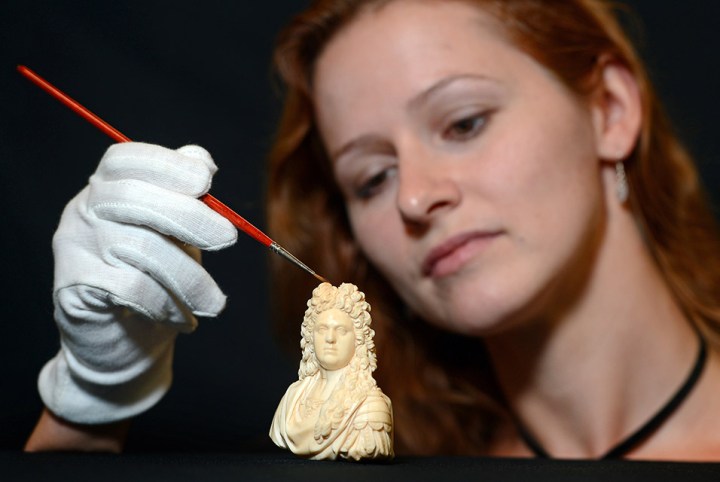
Lydia Messerschmidt, assistant conservator at National Museums Scotland, works on one of five ivories.
Photo: © Neil Hanna
◊ ◊ ◊ ◊ ◊
From the Art Fund:
David Le Marchand (1674–1726) was one of the most prominent ivory carvers and one of the most influential portraitists of his day in Britain. His works were highly prized for his extraordinary skill in rendering likeness and for the sheer expense of the ivory, his chosen specialist material. For Le Marchand, ivory held a nostalgic significance. He was born in 1674 in the northern French port of Dieppe, a town famed for its long tradition in ivory carving. However, following the edict of Nantes, which saw the ensuing persecution of French Protestants, Le Marchand fled his native France. Still in his early twenties, he settled in Edinburgh and was given a licence to practise the art of ivory cutting on the condition that he trained Scottish apprentices in the craft.
National Museums Scotland has acquired a rare group of five ivories by Le Marchand. The set was commissioned by the Mackenzie family and comprises of four medallions and a miniature bust. One of the medallions depicts Sir James Mackenzie of Royston and is dated 1696, the year Le Marchand arrived in Scotland suggesting that the ivories are likely to be the very first that he carved in Britain.
Stephen Deuchar, director of the Art Fund, said: “This interesting group of ivories, with its excellent provenance and rich object biographies, is an ideal fit for National Museums Scotland, particularly given the Museum’s interest in Scottish identity and its relationship with the rest of the world. Scotland now has a meaningful presence of works by Le Marchand, which will appeal to scholars, students, artists and families alike. I look forward to seeing them in the new galleries.”
The ivories will go on display in one of the ten new galleries opening next summer at the National Museum of Scotland.
Two Paintings Returned to the Deutsches Historisches Museum
Press release (14 August 2015) from the Gemäldegalerie:

Frans Lütgert, The Margrave of Bayreuth, Officer of the Dragoon Regiment, 1734
(Berlin: Deutsches Historiches Museum)
The Gemäldegalerie in Berlin is returning two paintings, originally from the Zeughaus (Armoury) holdings, to the Deutsches Historisches Museum. The eighteenth-century portraits had been placed in safekeeping at the Gemäldegalerie, as works of unknown provenance. The Deutsches Historiches Museum, which is now responsible for the Zeughaus collections, believed the paintings had been lost in the war.
The portrait entitled The Margrave of Bayreuth, Officer of the Dragoon Regiment was painted by the artist Frans Lütgert in 1734. It shows Friedrich III of Brandenburg-Bayreuth wearing a short powdered wig and a uniform of the period of Friedrich Wilhelm I. The second work, painted in 1770, is a portrait of Albrecht Christian von Oheimb, Lieutenant General of the Cavalry and Governor of Rinteln. He wears the Order of the Golden Lion of the House of Hesse and the Hessian Order of Military Merit ‘Pour la vertu militaire’. The identity of the artist is unknown.
Staff members of the Deutsches Historisches Museum came across entries for the two works while searching the Lost Art database of the Deutsches Zentrum Kulturgutverluste (German Lost Art Foundation). On the basis of its own catalogue of items of unknown provenance, the Stiftung Preussischer Kulturbesitz had placed the works in the keeping of the Gemäldegalerie. A comparison with the catalogue of works lost by the Berlin Zeughaus confirmed their identification and they have now been returned to the Deutsches Historisches Museum.
For both institutions, the return of the paintings is a success story for provenance research, which includes the identification of works which museums hold but do not own. The Stiftung Preussischer Kulturbesitz attempts to trace the origins of such items and restore them to their rightful owners. All works which are held by the Stiftung but which are not its legal property are being documented in a series of publications by the Staatliche Museen zu Berlin: the first catalogue, for the Gemäldegalerie, appeared in 1999, the volume for the Nationalgalerie was published in 2008, and a volume for the Antikensammlung is now in production.
The Deutsches Historisches Museum has made its digitalised collections available to the public on-line since 1992. So far, 600,000 data records can be accessed via the museum’s website and are thus available to support provenance research.










leave a comment