Marie-Stéphanie Delamaire Joins Winterthur as Associate Curator
As reported last week at Art Daily:
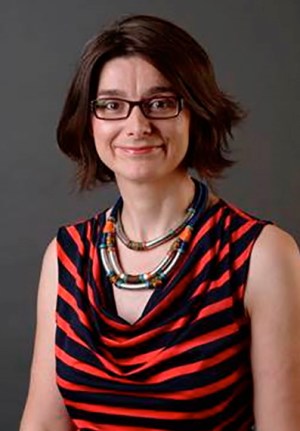 Winterthur Museum, Garden & Library announced that Marie-Stéphanie Delamaire, Ph.D., will join the Museum July 13, 2015, as Associate Curator of Fine Art. Dr. Delamaire will be responsible for curating the Museum’s collection of nearly 5,000 prints, paintings, and sculpture from the 17th, 18th, and 19th centuries. In addition to her curatorial responsibilities, Dr. Delamaire will teach in University of Delaware’s graduate level Winterthur Program in American Material Culture.
“Stephanie joins the Winterthur curatorial department as the Associate Curator of Fine Art to oversee an important and growing part of the collection,” said Dr. David Roselle, Director of Winterthur. “We are confident that Stephanie will soon make Winterthur’s substantial collection of prints, paintings, maps, photographs, and sculpture be an added attraction for the many persons who visit our well known decorative arts collection.”
Linda Eaton, the John L. and Marjorie P. McGraw Director of Collections and Senior Curator of Textiles, said, “With a background both in the arts and the sciences, Stephanie brings a wide range of experience to Winterthur. We look forward to seeing where her fresh eye and keen mind will take her as she works with our collection, which includes iconic works of art by important artists such as Benjamin West and John Singleton Copley, among others.”
Dr. Delamaire earned her Ph.D., in Art History from Columbia University, where she also worked as a lecturer in the Department of Art History and Archaeology. She also holds a master’s degree in Egyptian Archaeology from l’Ecole du Louvre. While her studies began in France, her interests turned to American art, and her primary field of expertise is the history of American art from the Colonial era to World War I. In particular, Delamaire has investigated how translation developed in 19th-century American art with the expansion of the publishing industry and the formation of an American school of painting. Her research has been supported by the Andrew W. Mellon Foundation, the National Endowment for the Humanities, the Caroline and Erwin Swann Foundation for Caricature and Cartoon, the American Historical Print Collectors Society, the Smithsonian American Art Museum, and the Terra Foundation for American Art.
In addition to her research, Dr. Delamaire served on the advisory committee for the preparation of the exhibition New Eyes on America: the Genius of Richard Caton Woodville at The Walters Museum of Art in Baltimore, Maryland, and as the curatorial research assistant for the New-York Historical Society exhibition Group Dynamics: Family Portraits & Scenes of Everyday Life at the New-York Historical Society.
Galleries Reopen at the Bayerisches Nationalmuseum

◊ ◊ ◊ ◊ ◊
From the Bavarian National Museum:
Barock und Rokoko
Bayerisches Nationalmuseum, Munich, open from 9 July 2015
Seit dem 9. Juli 2015 ist der zum Englischen Garten gelegene Westflügel des Bayerischen Nationalmuseums nach mehrjähriger Sanierung wieder für den Besucher zugänglich. Auf rund 1500 m² werden mehr als 600 einzigartige kunst- und kulturhistorische Glanzstücke des 17. und 18. Jahrhunderts in neuem Licht präsentiert. Skulpturen, Möbel, Gemälde, Uhren, Porzellan, Goldschmiedewerke, Prunkwaffen und Tapisserien künden von Vorlieben, Alltag und Entwicklungen jener Epoche.
 Im Hauptgeschoss des Museums wird damit der kunst- und kulturhistorische Rundgang fortgesetzt, der sich in erster Linie an bayerischen Kurfürsten Maximilian I., Ferdinand Maria, Max Emanuel und Karl Albrecht und ihren Kunstvorlieben orientiert. Erstmals präsentiert sind große Teile der Kunstsammlung des Kurfürsten Johann Wilhelm von der Pfalz, dessen Kunstschätze aus Düsseldorf und Mannheim um 1800 nach München kamen. Bei den nun neu ausgestellten Werken handelt es sich um einen Großteil der Objekte, die das Haus Wittelsbach dem Museum kurz nach dessen Gründung 1855 übergeben hat.
Ein eigener Saal widmet sich Facetten des barocken Gartens und dem von der Natur inspirierten Kunsthandwerk. Ein weiterer Raum, das sogenannte Landshuter Zimmer aus dem Stadtpalais der Freiherren von Stromer in Landshut, veranschaulicht die Wohnwelt des Adels im 18. Jahrhundert. Einen weiteren Schwerpunkt der Sammlung bilden schließlich die Skulpturen des Barock und Rokoko, allen voran die Werke von Johann Baptist Straub und Ignaz Günther.
In der Vermittlung beschreitet das Museum neue Wege. Medienstationen mit Touchscreens ermöglichen den Besuchern spannende Blicke hinter verschlossene Schranktüren oder auf tickende Uhrwerke.
Additional images are available here»

◊ ◊ ◊ ◊ ◊
The catalogue, published by Sieveking Verlag, is available from Artbooks.com:
Renate Eikelmannn, Barock und Rokoko: Meisterwerke des 17. und 18. Jahrhunderts (München: Sieveking Verlag, 2015), 248 pages, ISBN: 978-3944874364, 25€ / $45.
The collections of Baroque and Rococo art at the Bayerisches Nationalmuseum are among the most important in Europe. Many of the works created by the international artists and craftsmen represented at the museum are outstanding achievements. Sculptures, furniture, paintings, clocks, porcelain objects, goldsmith work, sumptuously decorated weapons, and tapestries bear witness to the tastes and trends of the era. The succession of rulers who had a profound impact on Bavaria between the Thirty Years’ War and the French Revolution provides the chronological focus for this catalogue of selected works: Bavarian electors Maximilian I, Ferdinand Maria, Max Emanuel, and Karl Albrecht, as well as Elector Palatine Johann Wilhelm, whose art collection arrived in Munich by way of family succession. The publication also includes a look at the domestic environments of the nobility and the eighteenth-century passion for gardens. Baroque and Rococo sculptures constitute a cornerstone of the museum’s collections, especially works by Munich sculptors Johann Baptist Straub and Ignaz Günther. Their masterpieces, produced for churches and monasteries as well as for aristocratic patrons, are now considered quintessential examples of southern German Rococo.
Funding the Larson Historic Fashion Collection for the FIDM Museum
$4 for 400 Years of Fashion: Helen Larson Social Media Fundraising Campaign
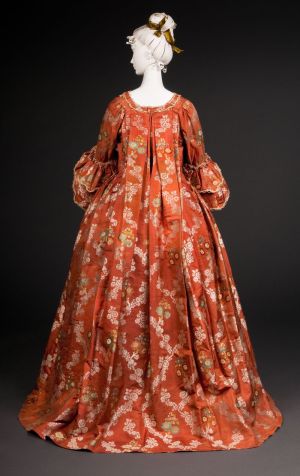
Robe volante, France, ca. 1745 (Helen Larson Historic Fashion Collection)
The Fashion Institute of Design and Merchandising Museum is fundraising to acquire a truly remarkable collection of rare historical fashion, ranging from a man’s red velvet jerkin dating to 1600 to stunning couture creations of the twentieth century. These pieces were collected by Helen Larson, a collector and successful entrepreneur who understood the importance of fashion history. The Helen Larson Historic Fashion Collection encompasses more than 1,400 pieces representing 400 years of history—but this critically important collection could be broken up and lost forever. The Museum has until the end of 2015 to raise the remaining $2 million needed to purchase the collection for our institution. Without these funds, the collection will be dispersed or absorbed into another private collection, inaccessible to students, researchers, and the general public.
On August 4, 2015, the FIDM Museum will launch the #4for400 project, a social media fundraising campaign to keep the Larson Collection at a public institution. The Museum’s Facebook, Twitter, and Instagram accounts will ask supporters to text MUSEUM to 243-725 and donate just $4 to save more than 400 years of fashion. Our hope is that a momentum will build, resulting in #4for400 posts being shared, liked, re-tweeted, and re-grammed, creating a flurry of donation activity. In conjunction with the launch, the Museum will host an Open House event from 3–7 pm, allowing the public to join in the excitement of the fundraising campaign with refreshments, raffles, music, and gallery tours.
The #4for400 campaign has the power to keep this one-of-a-kind cultural treasure at an academic institution in downtown Los Angeles, where it can be appreciated by museum visitors and used for research and inspiration by generations to come.
You can also donate by clicking here»
Peabody Essex Museum Announces $650Million Advancement Plan
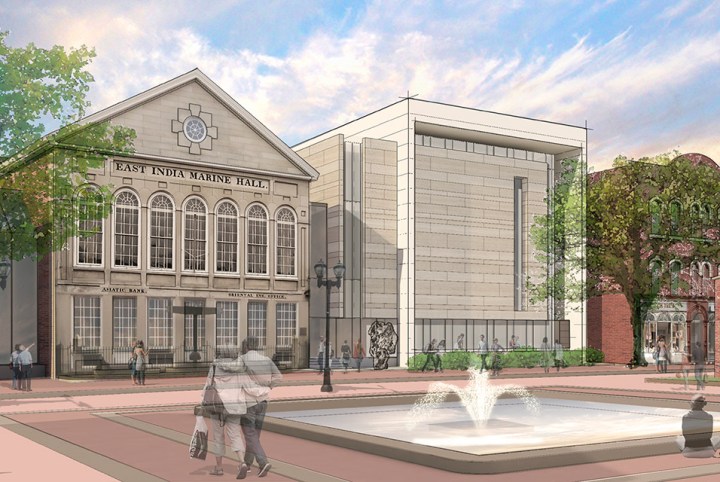
Rendering of the planned expansion of the Peabody Essex Museum in Salem, Massachusetts from Essex Street.
Photo: ©Ennead Architects
◊ ◊ ◊ ◊ ◊
Press release (9 July 2015) from PEM:
The Peabody Essex Museum (PEM) is pleased to announce an updated expansion and facilities plan, an array of infrastructure improvements and new programmatic initiatives as elements of PEM’s landmark $650 million Advancement Campaign, one of the largest art museum campaigns in the country.
“PEM’s Advancement Campaign defines a new model for museum finance, fundraising and operations. The updated plan emphasizes long-term financial stability through substantially increased endowment. By right-sizing facility and infrastructure investments, PEM gains a rare degree of freedom to advance our mission through sustained innovation and focus on new and enhanced programmatic initiatives,” said Dan Monroe, the Rose-Marie and Eijk van Otterloo Director and CEO of PEM.
Sam Byrne and Sean Healey, Co-Chairs of PEM’s Board of Trustees added, “We balanced priorities for this Campaign by allocating $350M to endowment, $200M to facility expansion, and $100M to various infrastructure improvements. To maintain these priorities we have restructured expansion plans to meet our highest priority facility needs, avoid overinvestment in bricks and mortar, and maintain our commitment to long-term financial sustainability and programs.” (more…)
Graham Beal Retires from the Detroit Institute of Arts
Press release (8 January 2015) from the DIA: 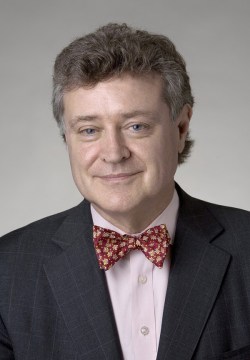 The Detroit Institute of Arts announced that Director Graham W. J. Beal will retire as of June 30, 2015, after serving as director, president and CEO for nearly 16 years. Since joining the DIA, Beal has presided over some of the most significant accomplishments in the museum’s history, including a tremendously successful reinvention of presenting art to the public; passage of a tri-county regional millage to support museum operations; and the DIA participation in the historic and unprecedented grand bargain initiative, which secured for future generations’ the DIA’s widely acclaimed art collection while also successfully facilitating resolution of the Detroit bankruptcy. Beal has overseen two major capital campaigns, has built on the museum’s outstanding reputation with regard to art acquisitions and exhibitions, has greatly increased attendance and expanded the DIA’s community outreach and awareness through programming and innovative art installations. Under Beal’s leadership, the DIA has co-organized outstanding exhibitions such as Van Gogh: Face to Face in 2000, Magnificenza! The Medici, Michelangelo and the Art of Late Renaissance Florence in 2003 and organized the highly anticipated Diego Rivera and Frida Kahlo in Detroit. . . The full press release is available here» Michael Hodges reports on the story for The Detroit News (29 June 2015), available here»
Progress Report on the New Berliner Stadtschloss

Belvedere © Berlin Palace–Humboldtforum Foundation /
Franco Stella
◊ ◊ ◊ ◊ ◊
As reported this past weekend by AFP (via ArtDaily). . .
The German capital celebrated a milestone Friday [12 June 2015] in the rebuilding of its Prussian-era royal palace that is set to house a world history museum billed as the country’s top cultural project. From 2019 the ‘Berliner Stadtschloss’ or Berlin City Palace replica will be the home of the Humboldt Forum global collection, to be curated by the British Museum’s outgoing chief Neil MacGregor, dubbed the “pop star of the museum world” by local media. On Friday, government ministers and culture officials met at what is now a raw concrete and steel structure for the so-called topping-out ceremony that marks the end of the major structural work which started two years ago. MacGregor, who was reportedly hand-picked for the job by German Chancellor Angela Merkel, hopes to “tell the story of humanity” with artefacts from Berlin’s many rich collections, ranging from European antiquity to East Asian arts.
The 590-million-euro ($660 million) domed venue is a reconstruction of a historical jewel of Baroque architecture located on the city’s Unter den Linden boulevard, near the Protestant Berlin Cathedral and Humboldt University. The original palace was badly damaged in World War II and its remains blown up by East Germany’s communist regime, which replaced it with its 1970s Palace of the Republic, a giant block with orange tinted windows that housed its assembly and a cultural and recreation centre. After the Berlin Wall fell in 1989 and Germany reunited the following year, bitter debate long raged about whether to keep the communist monument or raze it to rebuild Berlin’s original palace—with the latter option approved by the German parliament in 2007.
The replica, designed by Italian architect Franco Stella, will now be fitted on three sides with baroque sandstone facades recalling the old Hohenzollern palace built between the 15th and 18th centuries, and a fourth modern front facing the Spree River. The Humboldt Forum will house artefacts from Berlin’s Ethnological Museum, Asian Art Museum as well as Humboldt University, libraries and cultural centres. . . .
The full article is available here»
Commemorating the Aboriginal Warrior Pemulwuy

This engraving by Samuel John Neele of James Grant’s image of ‘Pimbloy’ is believed to be the only known depiction of Pemulwuy. It was published in Grant’s The Narrative of a Voyage of Discovery, Performed in His Majesty’s Vessel the Lady Nelson, of Sixty Tons Burthen, with Sliding Keels, in the Years 1800, 1801 and 1802, to New South Wales, 1803 (State Library of New South Wales Q80/18).
◊ ◊ ◊ ◊ ◊
Press release (20 March 2015) from the National Museum of Australia in Canberra:
Defining Moment in Australia’s History
National Museum Honours Aboriginal Warrior Pemulwuy
The life of Aboriginal warrior Pemulwuy is commemorated today at the National Museum of Australia as part of its Defining Moments project, which explores key dates that have defined the country’s history over more than 50,000 years.
As Australia’s first Aboriginal resistance leader and a member of the Bidjigal people, Pemulwuy fought the British at Sydney from 1792 by leading attacks on farms, burning crops and dispersing stock in an attempt to starve the settlers out. After surviving a number of battles he was finally killed by settlers in June 1802 at the age of about 52 years. His body was dishonoured with the removal of his head, which was sent to the naturalist Joseph Banks in England. It has yet to be found. The National Museum is working in collaboration with the Ministry for the Arts Museums and Repatriation unit, to undertake research into the possible whereabouts of Pemulwuy’s remains.
The National Museum today [20 March 2015] unveils a plaque in its Main Hall, commemorating Pemulwuy’s campaign of resistance.
The Minister for Education and Training, Christopher Pyne, representing the Australian Government at the ceremony, said Pemulwuy was a figure of Aboriginal defiance, and his legacy remains an important part of Indigenous culture in Australia. “For some years I have been working with Alex Hartman, a member of the National Museum of Australia Council to help find and repatriate the remains of Pemulwuy,” Pyne said. “Pemulwuy’s story is an important one and he deserves to be commemorated in this way.”
National Museum director Mathew Trinca said Pemulwuy was a hero to Aboriginal people. “Pemulwuy’s daring leadership impressed enemies and comrades alike and the story of his concerted campaign of resistance against British colonists should be more widely known,” said Trinca.
Bidjigal elder Uncle Vic Simms said, “What the Museum is doing is so important for getting the history right about Pemulwuy as a Bidjigal man, who resisted and rebelled against the settlers and stood up against them when they were giving blackfellas such a hard time.”
Defining Moments is a National Museum project supported by patrons, the Hon Michael Kirby AC CMG and Mr Michael Ball AM. Under the project, the National Museum is releasing online content for an initial list of 100 Defining Moments and is encouraging people to contribute their own ideas on historical dates of importance. The Museum’s list is a starting point for discussions and is not intended to be definitive.
Helen Jacobsen on The Wallace Collection’s Sphinx Clock, 1781

◊ ◊ ◊ ◊ ◊
This afternoon at The Wallace Collection:
The Wallace Collection Treasure of the Month, April 2015 | Sphinx Clock, France, 1781
Gallery Talk by Helen Jacobsen, The Wallace Collection, London, 27 April 2015
In the late summer of 1777, Queen Marie-Antoinette wagered her brother-in-law 100,000 livres that he could not build a ‘pleasure house’ in less than 100 days; she lost the bet and the charming Pavillon de Bagatelle in the Bois de Boulogne was the result, although the interiors took several years to complete. Designed by the comte’s architect, François-Joseph Bélanger (1744–1818), it was intended for parties and enjoyment, with a billiard room, a dining room and a salon on the ground floor. Everything was in the latest neo-classical taste, executed by the group of talented decorators, sculptors and cabinet-makers around Bélanger and d’Artois.
The walls of the circular salon were decorated with panels of painted and gilded stucco decoration in the Antique style made fashionable by English and French architects such as Robert Adam and Charles-Louis Clérisseau, while the silk curtains and velvet chairs were of ‘English green’. Bélanger designed a clock for the room that reflected this decoration and when it was finally delivered in 1781 it was considered to be of such superb workmanship that it sat under a glass shade on the chimneypiece. The king’s clock-maker, Jean-Baptiste Lepaute (1727–1801), charged d’Artois the enormous sum of 7,500 livres for the clock, and also made one for his older brother, the comte de Provence. This clock is most likely the one made for Bagatelle. . . .
More information about the clock is available here»
A gallery talk on the clock by Helen Jacobsen, Senior Curator and Curator of 18th-Century Decorative Arts will take place Monday, 27 April 2015, at 1:00pm.
Edouard Kopp Appointed Curator of Drawings, Harvard Art Museums
Press Release (21 April 2015) from the Harvard Art Museums:
 The Harvard Art Museums are pleased to announce the appointment of Edouard Kopp as the Maida and George Abrams Associate Curator of Drawings in the museums’ Division of European and American Art. Kopp comes to the museums from the J. Paul Getty Museum in Los Angeles, where he was associate curator of drawings and was responsible for French and later Germanic drawings. At the Getty, Kopp organized exhibitions devoted to French landscape, Germanic drawings, the artist Gustav Klimt, and 18th-century French drawings from Los Angeles collections. He has recently co-curated two international loan shows: The Work of Nature: The Landscapes of Théodore Rousseau, which will be displayed at the Getty and the Ny Carlsberg Glyptotek in Copenhagen, in 2016–17; and an exhibition focused on the sculptor and draftsman Edme Bouchardon, which will be on view at the Musée du Louvre and the Getty in 2016–17.
Kopp has published widely on the drawings of French sculptor Edme Bouchardon, and on the 18th- century French collector Pierre-Jean Mariette, in journals such as Master Drawings and The Burlington Magazine. He has contributed to exhibition catalogues on French prints from the age of Louis XIV, Edgar Degas and his method, and French landscapes, and he is co-author of the forthcoming catalogues for the Théodore Rousseau and Edme Bouchardon exhibitions described above. He is currently revising his doctoral dissertation for publication by Getty Publications in 2016.
In his role at the Harvard Art Museums, Kopp will oversee the museums’ collection of drawings dating from before the 20th century. This collection is considered to be the finest and most comprehensive of any university art museum in the United States, and ranks among the most important public collections in the country. He will be actively engaged in the development of exhibitions, public lectures, and other programming, and will play an integral role in the regular rotation of works on paper within many of the museums’ galleries. He is also responsible for the stewardship of the drawings collection, including identifying key works for acquisition.
“We are thrilled to welcome such an accomplished scholar and art historian to the Harvard Art Museums,” said Ethan Lasser, interim head of the Division of European and American Art, and the Margaret S. Winthrop Associate Curator of American Art. “Edouard brings a fresh perspective and rigorous eye to the storied collection of drawings, and his enthusiasm will engage audiences across the University and visitors from around the world.”
“I am thrilled to have the invaluable opportunity to work with one of the finest drawings collections in the United States—and especially to do so within the unique and stimulating context of a university art museum,” said Kopp. “This is a living collection at a major institution with a strong tradition of encouraging firsthand, up-close study of original works of art. I look forward to interacting with students, faculty, and the wider community of scholars, collectors, and art lovers.”
Before his time at the Getty, Kopp worked as a researcher for the Weiss Gallery in London, and also for Waddeson Manor, a National Trust estate in Buckinghamshire, England. He served as a teaching assistant while a graduate student at the Courtauld Institute of Art in London, where he received his Ph.D. with a dissertation entitled “Edme Bouchardon: Learned Draughtsman of the Eighteenth Century (1698–1762).” He has a master’s degree in modern art, also from the Courtauld, and wrote his thesis on the Austrian graphic artist Alfred Kubin (1877–1959). He also holds a master of science in management from the Grenoble Graduate School of Business.
The Harvard Art Museums’ collection of approximately 12,000 drawings (from before the year 1900) includes major masterpieces from American and principal European schools. Among the strengths are 17th- and early 19th-century French works, including the most extensive holding of drawings by Ingres, Géricault, and David outside of France. The collection also excels in Italian Renaissance works by Carpaccio, Perugino, and Michelangelo, among others. Works by German and Netherlandish masters such as Dürer, Holbein, Bruegel, and Rembrandt are well represented, as are 19th-century British works by Blake, Beardsley, and the Pre-Raphaelites. In the American school, the collection includes more than 20 Homer watercolors, drawings and pastels by Whistler, and an incomparable grouping of more than 500 drawings and sketches by Sargent.
Colin Bailey Named as New Director of the Morgan
Press release (16 April 2015) from the Morgan:
The Board of Trustees of the Morgan Library & Museum today announced the appointment of Colin B. Bailey, director of the Fine Arts Museums of San Francisco, as the Morgan’s new director. He succeeds William M. Griswold who left last year to head the Cleveland Museum of Art.

Colin B. Bailey, Photography by Randy Dodson, © FAMSF
“We are delighted that Colin Bailey has agreed to become the new director of the Morgan,” said Lawrence Ricciardi, president of the museum’s board. “He is a scholar of the highest order with an impressive record of leadership at a number of outstanding museums. Moreover, he has extensive knowledge of New York cultural institutions and of the philanthropic world, and also brings to the Morgan valuable international experience.”
Bailey is a highly regarded specialist on 18th-century French art and a recognized authority on the work of Pierre-Auguste Renoir. He earned his Doctor of Philosophy in Art History from the University of Oxford. Prior to joining the Fine Arts Museums of San Francisco, Bailey held a variety of positions over thirteen years at New York’s Frick Collection, including serving as deputy director and the Peter Jay Sharp Chief Curator.
“To direct the Fine Arts Museums of San Francisco has been an extraordinary privilege,” Bailey said, in accepting the position at the Morgan. “But the opportunity to return to New York and lead an institution with the reputation of the Morgan was irresistible. Its collections are not only among the most recognized internationally, but also among the most diverse, touching on so many forms of creative expression, from drawing and literature to music, photography, and the arts of the ancient and medieval worlds. There is no place quite like it in the United States, and I look forward to working with its staff, trustees, and supporters to maintain and deepen the Morgan’s preeminent role as a cultural institution—one with the highest standards and a commitment to making its holdings widely accessible.”
Bailey has previously been deputy director and chief curator at the National Gallery of Canada, in Ottawa, senior curator at the Kimbell Art Museum in Ft. Worth, Texas, and held curatorial posts at the Philadelphia Museum of Art and the J. Paul Getty Museum in Los Angeles earlier in his career.
He has been responsible for many celebrated exhibitions. These include Renoir, Impressionism, and Full-Length Painting (2012); Watteau to Degas: French Drawings from the Frits Lugt Collection (2009); and Gabriel de Saint-Aubin (1724–1780) (2007), all mounted at the Frick Collection in New York; Renoir Landscapes, 1865–1883 (2007), The Age of Watteau, Chardin and Fragonard: Masterpieces of 18th-century French Genre Painting (2003), and Renoir’s Portraits: Impressions of an Age (1997), at the National Gallery of Canada; and The Loves of the Gods: Mythological Painting from Watteau to David (1992), at the Philadelphia Museum of Art. His book, Patriotic Taste: Collecting Modern Art in Pre-Revolutionary Paris, was awarded the Mitchell Prize for the best art history book of 2002–2003, and in 2011 he authored the well-received Fragonard’s Progress of Love at The Frick Collection.
Bailey has taught graduate seminars in 18th-century French art at Bryn Mawr College, Columbia University, and the City University of New York Graduate Center, and has acted as a spokesperson in video, podcast, and broadcast media nationally and internationally. An Officier de L’Ordre des Arts et des Lettres since 2010, Bailey has been recognized by the Foundation for Italian Art and Culture with its 2013 FIAC Excellency Award. He is also a board member of the Burlington Magazine Foundation and the Scientific Committee of Arthéna.
The Morgan Library & Museum’s holdings, which number well over a half million objects, are principally in the western European and American traditions. Its collections of drawings and prints, books and bindings, and illuminated manuscripts are preeminent among U.S. institutions. Literary, historical, and music manuscripts holdings, as well as other specialized collections, are also considered among the world’s greatest. The museum’s critically acclaimed 2006 addition by award-winning architect Renzo Piano deftly connected three historic buildings dating to the 19th and early 20th centuries around a central, glass-enclosed court. The expansion also doubled the museum’s gallery space, allowing the institution to mount over a dozen special exhibitions a year. In 2010, the Morgan restored for the first time its landmark 1906 McKim building, which was the personal library of the museum’s founder, financier and philanthropist Pierpont Morgan.
Bailey becomes the Morgan’s sixth director. Belle da Costa Greene became the first director of the newly public institution in 1924, having presided over the private Morgan library since 1906. She was succeeded by Frederick B. Adams, Jr. in 1948, Charles Ryskamp in 1969, Charles E. Pierce, Jr. in 1987, and William M. Griswold in 2008.










leave a comment