Getty Acquisition | ‘The Italian Comedians’ by Watteau
Press release (15 March 2012) from the Getty:

Antoine Watteau, "The Italian Comedians," ca. 1720 (The J. Paul Getty Museum, 2012.5)
The J. Paul Getty Museum announced today the acquisition of The Italian Comedians (ca. 1720) by Jean-Antoine Watteau (French, 1684–1721). The large oil painting (50 7/8 x 36 3/4 inches) was painted at the height of Watteau’s fame, shortly before his early death at age 36.
“This major, little-known painting is extraordinary. It shows Watteau at the height of his creative genius,” said James Cuno, President and CEO of the J. Paul Getty Trust. “Not only will it enhance our paintings collection, but it complements the Museum’s collection of French decorative arts, which is amongst the finest in the world.”
The Italian Comedians joins 18th-century French paintings already in the Getty Museum’s collection by artists such as Nicolas Lancret (1690 –1743), Jean-Honoré Fragonard (1732–1806), Jean-Baptiste-Siméon Chardin (1699–1779), and Claude-Joseph Vernet (1714–1789), all of which have been acquired in the last decade.
The painting portrays five fairground comedians costumed as characters from the Comédie Italienne. Watteau, who would have seen the travelling performers at fairgrounds on the outskirts of Paris, often depicted members of this popular troupe in his fêtes galantes, small compositions showing conversations or music-making set in a park or landscape. Monumental paintings, in which the performers dominate a larger picture, are extremely rare in Watteau’s oeuvre. His compassionate depictions of the character Pierrot, a white-clad clown, are especially renowned, with one of the most notable being the life-size depiction of him that hangs in the Musée du Louvre in Paris.
In this painting, Pierrot and his troupe have just finished a performance and taken their bows. They have stepped off the makeshift stage and are about to start collecting money. All five of the actors look expectantly at the viewer. The central figure, Pierrot, holds his hat in one hand while his other reaches into a pocket of his baggy white jacket, cueing the audience, and the viewer, that it is time to show their appreciation.
“Watteau was perhaps the greatest French artist of the 18th century,” explains Scott Schaefer, senior curator of paintings at the Getty Museum. “This painting typifies the way that Watteau combined acuity and elegance with poetic powers of description, in equal parts sensitive and humorous.”
The Italian Comedians has been in private collections since the 18th century and has not been publicly exhibited since 1929. Over the last three centuries, its attribution has fluctuated. Until the late 19th century, the painting was attributed to Watteau. It was then assigned to Watteau’s pupil Jean-Baptiste Pater and subsequently to an anonymous painter in the circle of Watteau. Although the attribution has changed over time, the artwork has always been praised for its brilliant composition and emotional power and associated with Watteau’s psychologically profound depictions of the Italian Comedians. (more…)
V&A Crowdsourcing Project: Reading Europe, 1600-1800
From the V&A:
Reading Europe for the V&A
Crowdsourcing Project for the forthcoming 1600-1800 galleries
As part of the development of our new Europe galleries, the Victoria and Albert Museum is collecting quotes from published and unpublished material written in Europe between 1600 and 1815. We are looking for passages that show how people lived during this period, and how they might have used or perceived the objects that are now in our collections. These quotes will inform our work and may also appear in the gallery displays. Please see ‘Quotes & Images’ for some of the passages we have already collected. The new Europe galleries are part of FuturePlan, our major programme of renewal and restoration. The galleries are due to open in 2014.
◊ ◊ ◊ ◊ ◊
Coffee is widely drunk in Paris: there are a great many public establishments where it is served. In some of these establishments news is disseminated; in others, people play chess: there is one place where coffee is prepared in such a manner as to sharpen the wits of those who drink it; at any rate, of those who emerge from there, not a single one fails to be convinced that he is four times cleverer than he was upon entering.
-Charles de Secondat, Baron de Montesquieu, Persian Letters,
written 1717, published 1721 in Holland; translated in 2008.
Stockholm’s Nationalmuseum Acquires Satyr and Nymph by Clodion
Press release (30 November 2011) from the Nationalmuseum in Stockholm:

Claude Michel, known as Clodion, "Satyr and Nymph," terracotta, 1780s (Photo: Linn Ahlgren/Nationalmuseum)
At an ordinary public auction this past April, Nationalmuseum purchased a magnificent terracotta sculpture by French artist Claude Michel, known as Clodion. The piece, thought to date from the 1780s, depicts a satyr embracing a young nymph. Clodion’s superb attention to detail and perfect balancing of the two figures makes this one of his most significant works.
Claude Michel, known as Clodion, was two years the senior and a colleague of the Swedish sculptor Johan Tobias Sergel during his time in Rome. Clodion never completely abandoned the graceful rococo style. Not surprisingly, he was popular with collectors, but he was never elected to the Académie in his native France. The terracotta sculpture of a satyr embracing a nymph, purchased by Nationalmuseum at a public auction held by Stockholms Auktionsverk in April, typifies Clodion’s work in many respects. This piece, which probably dates from the 1780s, is a finished work rather than a prototype. Clodion produced these terracotta pieces for an eager market that could hardly wait for him to finish his works, since they were so popular. He produced several variations on the satyr and nymph theme, but the piece recently acquired by Nationalmuseum is one of the most thoroughly executed. The two figures, perfectly balanced in relation to each other, appear to be fashioned from a single piece of clay. Rather than powerful eroticism, the work exudes a gentle sensualism, which is most evident in the tentative kiss being exchanged between the couple. Clodion makes elegant play with the contrast between the plastic smoothness of the skin and the graphic nature of the nymph’s hair, carved into the clay while it was still wet.
On account of its sensual subject matter, in 1990 the grouping ended up in a private Swedish erotica collection. At different points in its life it had belonged to Henri Rochefort, a prominent French politician, and Jacques Doucet, a legendary art collector, whose collection (auctioned off piecemeal in 1912) included Picasso’s les Demoiselles d’Avignon. A counterpart to Clodion’s Satyr and Nymph can be seen in the Metropolitan Museum of Art in New York. The version now acquired by Nationalmuseum was long believed to be lost.
The acquisition was made possible by a generous donation from the Sophia Giescke Foundation. The Nationalmuseum has no funds of its own with which to acquire art and design, and so relies on gifts and financial support from private foundations and funds to expand its collection.
San Diego Museum of Art Acquires Portrait by Mengs
As noted at ArtDaily

Anton Raphael Mengs, "Don Luis de Borbón," 1750-51 (San Diego Museum of Art)
The San Diego Museum of Art announces its newest addition to the permanent collection. An eighteenth-century painting by Anton Raphael Mengs, a portrait of Don Luis de Borbón, is now displayed among the Museum’s world-renowned collection of Spanish art.
“Although Spanish art is one of the Museum’s strengths, the collection has not had a Spanish painting made between the 1650s—the date of our late Zurbarán and early Murillo—and 1795, the date of our great portrait by Goya. This portrait by Mengs, the leading artist in Spain in the 1760s and 70s, begins to fill that gap. More importantly, the Don Luis de Borbón will hang proudly alongside our works by Goya and Pompeo Batoni, giving us a spectacular display of European portraiture from the later eighteenth century” says John Marciari, Curator of European Art at The San Diego Museum of Art.
Mengs (1728-1779) was famous throughout Europe during his lifetime. In the 1740s and 50s he divided his time between Dresden and Rome, winning major commissions for both portraits and fresco paintings in both cities. In Rome, he was also closely associated with the archaeologist and writer Johann Joseph Winckelmann, and their research into Greek art made them key figures in the rise of Neo-Classicism. Despite his importance as a theoretician and as a history painter, however, Mengs was most accomplished in the field of portraiture; the Don Luis de Borbón displays his delicacy and refined touch in the genre.
From 1761 onward, Mengs spent much of his time in Spain and was eventually named Primer Pintor (First Painter) and executed portraits of the royal family. Don Luis (1727-1785), the younger brother of King Charles III, had been destined for a career in the church and was named Cardinal at age eight, although he later renounced that office and became the Count of Chinchón. Living in semi-exile outside of Madrid, he became an important patron of the arts and was responsible for commissioning, for example, Francisco de Goya’s first major works.
Marciari will lecture on this painting, telling the story behind the acquisition and giving more details of the fascinating lives of both Mengs and Don Luis, on Saturday, February 11th, at 10:30 a.m.
Lemoyne’s Annunciation on Loan to the National Gallery
From the National Gallery:

François Lemoyne, The Annuncation, 1727
François Lemoyne, The Annuncation, 1727
National Gallery, London
On Loan from Winchester College
According to Saint Luke’s Gospel, the archangel Gabriel announces to the Virgin that she will give birth to Jesus. This depiction of the subject is signed and dated 1727, the year the artist was awarded a prize for history painting by Louis XV. It may have been commissioned by the then headmaster of Winchester College where it was installed in 1729. Its painted arched top suggests an arched frame was originally intended.
New Acqusitions at LACMA: Baratta’s ‘Wealth’ and ‘Prudence’

Giovanni Baratta (1640-1747), Pair of Allegorical Figures – "Wealth" and "Prudence," ca. 1703-08, photo © 2011 Museum Associates/LACMA
Press release from LACMA:
The Los Angeles County Museum of Art has acquired two life-size allegorical figure statues by the late Florentine Baroque master, Giovanni Baratta (1640–1747). The rediscovery of these sculptures, Wealth and Prudence, has been recognized as a major contribution to the study of early eighteenth-century Florentine art. The works are generous gifts to the museum by long-time benefactor, The Ahmanson Foundation, which has contributed extensively to the development of LACMA’s collection of European Painting and Sculpture over the last forty years. The sculptures are on view on the third floor of the Ahmanson Building, in the recently reinstalled European galleries.
Originally part of one of the artist’s most illustrious commissions, the works are noted for their refined elegance. The sculptures were commissioned by Niccolò Maria Giugni (1672-1717) for the gallery in his Palazzo on the Via degli Alfani in Florence. Facing one another at either end of the gallery, they were part of an elaborate iconographic scheme intended to glorify the Medici family and celebrate the Giugni family’s allegiance to the Medici. The choice of Wealth and Prudence was particularly appropriate to illustrate the joint virtues of the families, as some members of the Giugni family had advised the Medici in various aspects of their governance. (more…)
Installing a Ceramic Room in Honolulu
As a follow-up to yesterday’s essay from Amanda Strasik, which relied heavily upon an interview she conducted with Amber Ludwig, today’s posting gives us a glimpse at one of the projects keeping Amber busy these days . . . From her posting at the Honolulu Academy of Arts Blog (1 November 2011) . . .
◊ ◊ ◊ ◊ ◊
 Many museums are reinstalling their ceramics collections in a manner that reflects the high point of innovation in Western ceramics—the 18th century. It was during the early 18th century that Europeans were finally able to produce the strong, thin, white-bodied ceramic known as porcelain, some 1,100 years after the Chinese began making it. Porcelain was so highly valued in the Western world that wealthy collectors displayed their collections not in large breakfronts or atop delicate tea tables, but in entire rooms filled floor-to-ceiling with “white gold,” as porcelain was commonly called.
Gallery five at the Honolulu Academy of Arts is the second gallery to be reinstalled as part of a year-long curatorial project that began with gallery four. The new design of gallery five includes a ceramics cabinet that reflects this curatorial trend of large-scale installations of porcelains and other ceramics. Currently, gallery five displays exquisite examples of 17th-century painting and sculpture. Soon, however, it will be reinstalled with European and American paintings and sculpture from the 18th and 19th centuries and will also include a floor-to-ceiling ceramics display, meant to evoke the great “ceramic rooms” of the 18th century.
I was hired in September as the Curatorial Assistant to Theresa Papanikolas, Curator of European and American Art, and, for my first project, Theresa asked me to research the Academy’s collection of European and American ceramics for the reinstallation. My academic background is 18th- and 19th-century European art, so this is a good fit and something I am enjoying immensely. For the past month, I’ve been scouring the Academy’s holdings of European ceramics to determine a checklist and to create a design for the gallery five ceramics cabinet. I find myself often visiting the Seattle Art Museum’s Guide to the Porcelain Room for inspiration. . . .
The full posting is available here»
On 11.11.11 at 11am . . .
On Friday, the much-anticipated Crystal Bridges Museum of American Art opens in Bentonville, Arkansas. We’re sure to hear a lot about it in the coming weeks. In the meantime, Julia Halperin’s short piece for ArtInfo (7 October 2011) highlights a few early responses (Rebecca Mead’s article for The New Yorker is especially good on the origins of the project) . . .
◊ ◊ ◊ ◊ ◊
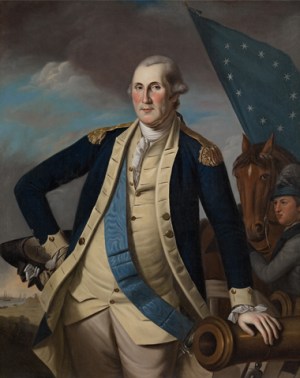
Charles Willson Peale, "George Washington," ca. 1780-82 (Crystal Bridges Museum of American Art)
Wal-Mart heiress Alice Walton’s mammoth Crystal Bridges Museum of American Art in Arkansas will soon be open for business, and The Washington Post’s Philip Kennicott snagged the coveted first look.
The $800 million museum has been subject to sharp skepticism in the art world (though not, it should be noted, in The New Yorker or The New York Times). Many art professionals believe the museum is “too rich, too conservative, and too reflexively American” to be a major player, according to Kennicott. So what’s his verdict? Apparently, money may not buy the art world’s happiness, but it can buy a pretty impressive museum.
“There’s no embarrassment about the immense fortune that made the museum possible, no old-fashioned cultural money-laundering in the manner of Carnegie or Mellon,” writes Kennicott of the museum, which will be free for everyone, forever thanks to a $20 million donation from Wal-Mart. “It is a mature, serious, relatively progressive museum launched at a
time when increasing numbers of people consider themselves
socially tolerant and fiscally conservative.”
◊ ◊ ◊ ◊ ◊
Writing for Architectural Record (17 October 2011), Fred Bernstein responds to Moshe Safdie’s building . . .
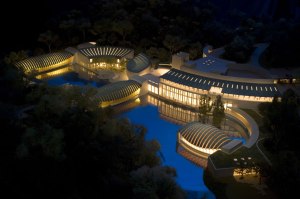
Model of Moshe Safdie's design for Crystal Bridges Museum of American Art (Photo: John Horner)
. . . Putting a museum containing many of the acknowledged masterpieces of American art above ponds fed by an active spring smacks of hubris. But a complex flood control system, approved by three separate consultants and monitored by the Army Corps of Engineers, has been designed to protect the building and its contents. Crystal Bridges’ executive director, Don Bacigalupi, said in an interview that the confluence of running water and precious artworks worried him when he first took the job—but now, having studied the plans, he believes, the museum is prepared for what he called “the next Noah flood.”
The high-water act pretty much sums up the paradox of Crystal Bridges. Alice Walton, the Walmart heir who founded, and largely funded, the museum, chose to build it in the town where her father opened his first five-and-dime. (Sam Walton’s original store, now operated as a cozy Walmart history museum, is a few blocks away.) But Sam’s daughter, who is famous for being unpretentious, let the project evolve into an architectural extravaganza, comparable to some of Safdie’s other recent projects, the curving Kauffman Center for the Performing Arts, in Kansas City, and the Marina Bay Sands resort complex in Singapore (with a park cantilevered off three 55-story towers), beautiful forms arranged for maximum impact. . . .
The full review is available here»
Frick Acquires Hard-Paste Sèvres Vase in Honor of Anne Poulet
Press release from The Frick, as noted at ArtDaily:
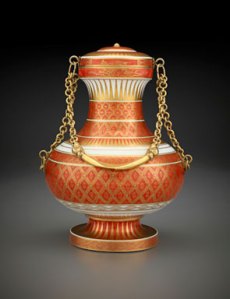
Vase Japon, 1774, Royal Manufactory of Sèvres, painted and gilded hard-paste porcelain with silver-gilt mounts, The Frick Collection; photo: Michael Bodycomb
The Frick’s Board of Trustees announces the acquisition of two objects that will enhance the museum’s holdings in areas that interested founder Henry Clay Frick at the end of his life: eighteenth-century French porcelain and Italian Renaissance drawings. A rare and beautiful vase created at the Royal Manufactory of Sèvres has been acquired in honor of Anne L. Poulet, who retired at the end of September after serving as Director for eight years. The vase, a partial purchase by the Frick and a partial gift from Alexis and Nicolas Kugel, is the first piece of hard-paste porcelain from the Royal Manufactory of Sèvres to enter the Collection. It complements the museum’s substantial Sèvres holdings made with the earlier soft-paste formula, objects obtained by Mr. Frick from the dealer Joseph Duveen. This latest acquisition is particularly appropriate given the interest of Director Emerita Anne Poulet in eighteenth-century French decorative arts. The vase will be displayed this winter alongside selections from a promised gift of hard-paste Meissen porcelain objects in the new Portico Gallery for Decorative Arts and Sculpture, which opens to the public on December 13. Also entering the collection is an important Italian Renaissance by drawing the Sienese artist Domenico Beccafumi (1486–1551), a two-sided sheet given to the Frick by Trustee Barbara G. Fleischman in honor of Deputy Director and Peter Jay Sharp Chief Curator Colin B. Bailey.
Despite its name, the Vase Japon is a French interpretation of a Chinese Yu (or Hu) vase from the Han Dynasty (206 B.C–A.D. 220). Examples of this type of baluster-shaped vessel survive in bronze and earthenware. Documents from the Sèvres archives indicate that the Frick vase was made in 1774 along with two others of the same size, shape, and decoration. Each bears the mark of the gilder-painter Jean-Armand Fallot, who was active at Sèvres between 1765 and 1790. Of the three, however, only the Frick vase is adorned with an elaborate silver-gilt handle and chain, which, like its shape and surface pattern, were directly inspired by the Chinese model. The mounts bear the mark of Charles Ouizille (1744–1830), who worked extensively for the French court throughout the 1770s and 1780s and became Marie-Antoinette’s favorite jeweler. He created exquisite gold mounts for the queen’s rare and precious collections of hard-stone vases and cups.
The shape and decoration of the Vase Japon derive from a woodblock print reproduced in a forty-volume catalogue of the vast Chinese imperial collections (a record compiled at the behest of the Qianlong Emperor who reigned 1735–1796). Included are entries for more than fifteen hundred ancient bronze objects—primarily ritual vessels, but also mirrors, lamps, and weapons—each accompanied by a brief description of its size and origin. Sometime during the 1770s, Father Joseph Amiot, a Jesuit missionary working in Peking, sent a copy of this catalogue to Henri Bertin in Paris. Bertin was France’s secretary of state and had recently been appointed the commissaire du roi at the Sèvres manufactory, an administrative position he held until 1780. In addition to being a politician and a businessman, Bertin was an art collector with a profound interest in China and Chinese art, and he likely played a key creative role in the production of this piece. (more…)
New Acquisition: Gainsborough and the Netherlands
News of this recent acquisition, as noted by Hélène Bremer, is remarkable in itself given the importance of the Dutch for eighteenth-century landscape paintings. That funds were raised in part through crowd funding makes it all the more interesting:
 The Rijksmuseum Twenthe in Enschede, a museum with an emphasis on seventeenth- and eighteenth-century art, has acquired the first painting by Thomas Gainsborough for a Dutch museum. Crowd funding this summer secured the painting for the museum collection. Wooded Landscape (1745-46), an early work made in Suffolk, will be on display in the specially created Landscape Gallery until early January. The addition of this landscape by Gainsborough to the collection will mean that Rijksmuseum Twenthe will be one of the few museums in the world which can show the influence that Dutch seventeenth century artists had on both English and Dutch painters of the eighteenth century.










leave a comment