Philadelphia Museum of Art Acquires ‘Fox and the Grapes’ Table
Thanks to Courtney Barnes for passing along this press release from the Philadelphia Museum of Art (dated 3 August 2012) . . .
 The Philadelphia Museum of Art has agreed to purchase the exceptional mahogany dressing table that has been on loan to the Museum for 36 years. Made in Philadelphia in the late 1760s or early 1770s, the table is the mate to the Museum’s monumental high chest, which was donated in 1957 by Amy Howe Steel Greenough. The dynamic carved decoration on both the high chest and the dressing table depicts a scene from Aesop’s fable of “The Fox and the Grapes” on their central drawers. The impressive proportions of these remarkable examples of 18th-century craftsmanship echo the architectural framework of the bedchamber for which they were made. Together, they epitomize the elegance and sophistication that distinguish Philadelphia furniture as the finest produced in British colonial North America.
“The Museum has now realized its cherished dream of keeping ‘The Fox and the Grapes’ dressing table together with its companion high chest,” said Timothy Rub, the Museum’s George D. Widener Director and Chief Executive Officer. “The two anchor our galleries of early American art; and now that their future together is secure, we can continue to display and interpret them as superlative artistic achievements.”
The high chest was known to Museum curators early in the 20th century when it was borrowed from Mary Fell Howe for the 1924 exhibition Philadelphia Chippendale. Lauded for its stately presence, highly figured mahogany, abundant carved ornament, and the rare depiction of a narrative from one of Aesop’s fables, the high chest also generated curiosity about whether or not its companion piece—the dressing table—was still in existence. “The Fox and the Grapes” dressing table was soon discovered and made its debut in William MacPherson Hornor, Jr.’s 1935 publication The Blue Book of Philadelphia Furniture: William Penn to George Washington. Joseph Kindig, Jr., the preeminent York, Pennsylvania, furniture and gun dealer, purchased the dressing table from Miss Eliza Davids in the late 1930s. Though Kindig was an antiques dealer, the dressing table was not offered for sale. Instead, it remained in the Kindig’s private home. Mr. Kindig died in 1971, and soon thereafter a friend of the Museum alerted curators to the whereabouts of the coveted “Fox and Grapes” dressing table. The Kindigs agreed to lend the dressing table so it could be displayed next to its high chest in 1976 for Philadelphia: Three Centuries of American Art, the great survey celebrating American art exhibited at the Museum during the bicentennial year. The two looked superb together—each had found its accompaniment—and after the exhibition closed, the dressing table remained on loan to the Museum. (more…)
Petition Related to Old Masters at the Gemäldegalerie
The following petition, written by Jeffrey Hamburger, Kuno Francke Professor of German Art & Culture at Harvard University, voices concerns for the exhibition fate of Old Masters at the Gemäldegalerie in Berlin. The German text is available at the petition website. Kate Connolly reported on the story for The Guardian (12 July 2012).
◊ ◊ ◊ ◊ ◊
We write to you to ask that you reconsider the current plan to empty the Gemäldegalerie to make room for a display of twentieth-century art from the Pietzsch collection.
We understand that Mies van der Rohe’s Nationalgalerie provides inadequate space for Berlin’s growing collections of modern art, and we welcome the prospect of a permanent home for them.
However, finding that space in the Gemäldegalerie at the expense of one of the world’s premier collections of Old Master paintings, without also making concrete plans to display that collection concurrently in its entirety, would be a tragedy. In the current plan, it appears that once again the past is being asked to make way for the present without sufficient attention to its future. The disappearance into storage of whatever paintings cannot be displayed in the Bode Museum – which we call on you to disclose — is not acceptable, even for only six years. In the current political and economic climate, and with stiff competition for funding from politically more expedient, if culturally more dubious, plans to rebuild the Stadtschloß, we fear that six years could easily become a decade or more.
All too often, it seems, great works of art in Berlin serve as pawns in a seemingly endless chess game, to be moved about and sacrificed at the will and whim of politicians. Germany is fortunate in that culture remains a focus of political and public concern. That concern, however, would best be expressed by finding a reasonable solution, one that respects a legacy that barely survived the centuries and that deserves better than to be rendered invisible for an indeterminate length of time.
We therefore write to ask, not that you shelve your plans for the Pietzsch collection, but rather that you complement them with an adequate strategy that will do justice to the whole of Berlin’s extraordinary collections. We believe that the Old Master collection should be moved to make way for the Pietzsch collection only after space on the Museuminsel has been found to accommodate it – hardly a rash proposal.
Yours sincerely, Jeffrey Hamburger, Kuno Francke Professor of German Art & Culture, Harvard University
To add your name to the petition, click here»
Catalogue for a New Museum | Simone Handbag Museum
This new book from Yale UP is published in conjunction with the new Simone Handbag Museum in Seoul, opening 16 July 2012 (the catalogue is scheduled to appear in September). Yuri Chong writes about the museum for The New York Times Magazine (12 June 2012).
◊ ◊ ◊ ◊ ◊
Judith Clark, ed., Handbags: The Making of a Museum (New Haven: Yale University Press, 2012), 272 pages, ISBN: 9780300186185, $50.
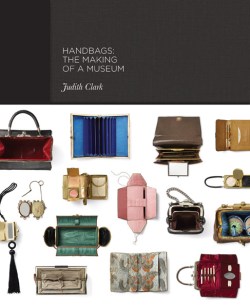 The history of the handbag—its design, how it has been made, used, and worn—reveals something essential about women’s lives over the past 500 years. Perhaps the most universal item of fashionable adornment, it can also be elusive, an object of desire, secrecy, and even fear. Handbags explores these rich histories and multiple meanings.
This book features specially commissioned photographs of an extraordinary, newly formed collection of fashionable handbags that date from the 16th century to the present day. It has been acquired for exhibition in the first museum devoted to the handbag, in Seoul, South Korea. The project is a commission undertaken by experimental exhibition-maker Judith Clark, whose innovative practices are revealed in Handbags.
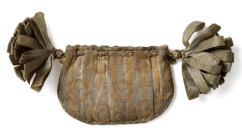
Sweetmeat purse, French, ca. 1670–80. Silk and metal brocade, braid and ribbon.
Essays by leading fashion historians and an acclaimed psychoanalyst investigate the history of gesture, the psychoanalysis of bags, and the museum’s state-of-the-art mannequins and archive cabinets. In order to preserve the words that describe the unique qualities of each bag, a terminology of handbags has been compiled.
Judith Clark is professor of fashion and museology at London College of Fashion. Caroline Evans is professor of fashion history and theory at Central St. Martin’s College of Art & Design. Amy de la Haye is professor of dress history and curatorship, Rootstein Hopkins Chair, at London College of Fashion. Adam Phillips is a psychoanalyst and writer. Claire Wilcox is senior fashion curator at the Victoria and Albert Museum.
Versailles 3D
Thanks to David Pullins for sharing news of this collaborative project between Versailles and Google:
◊ ◊ ◊ ◊ ◊
Palace History Gallery at Versailles
Château de Versailles, opened 14 June 2012
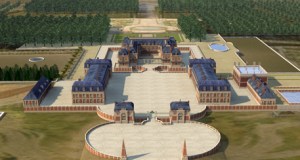 What did Versailles look like before Louis XIV? How did the small hunting lodge of Louis XIII become the largest Palace in Europe? What embellishments did the young Sun King want in his Palace of festivities and amusements? Did you know that the Hall of Mirrors was originally a terrace overlooking the gardens?
The palace of Versailles is a unique place, a royal residence, a history museum and a Republican palace. The complexity of the site needs to be explained to the over 6 million visitors from all over the world who come to Versailles each year. The Palace of Versailles, in partnership with Google, opens the Palace History Gallery on 14 June 2012. As a prologue to the visit to the State Apartments, eleven rooms explain to visitors the richly varied functions of the places they are about to explore. The visit combines the presentation of the collections of Versailles with physical scale models and striking 3D reconstructions.
Google / Versailles Partnership
The technological programme rolled out to accompany the opening of the Palace History Gallery is the fruit of close collaboration over more than a year between the teams of the Palace and those of Google. An ambitious technological policy has been implemented in Versailles for several years now to back up its scientific and cultural communication, disseminate knowledge about it more widely and develop new links with the visitors and with new audiences. From the origin of the project, the exhibition curators decided on the role and the scope of the multimedia in each exhibition and online. The partnership with Google provided the opportunity for a more in-depth approach to the use of technologies to develop, enliven and make more incisive its scientific and cultural communication. 3D technology, in particular, is used extensively in different media (in the rooms, on the Internet, on mobile terminals). Google’s Cultural Institute develops technological solutions for viewing, hosting and digitising materials to favour the creative presentation, protection and promotion of culture online.
Thanks to its dedicated team of engineers, Google’s Cultural Institute has already collaborated with organisations in several countries on different projects, notably for putting online thousands of artworks in the framework of the Art Project, the digitisation of the archives of Nelson Mandela and the Dead Sea Manuscripts.
Workshops on Sloane’s Treasures: A Plan for Reconstructing Sloane
I was lucky enough to attend the second workshop for the Sloane’s Treasures Project, held on 31 May at The British Museum, and I’m thrilled at the prospects of this massive research programme. The benefits will be enormous for a wide range of audiences. In addition to the following description from the BM’s website, see the advertisement for two collaborative doctoral awards. -CH
◊ ◊ ◊ ◊ ◊
Sloane’s Treasures
The Natural History Museum, The British Museum, The British Library, London, 2012
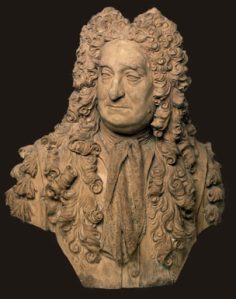 From the time of his voyage to Jamaica in the 1680s, Sir Hans Sloane (1660-1753), physician, natural historian and man of letters, began to gather together one of the largest and most comprehensive collections of ‘natural and artificial rarities’ ever formed. Sloane was later Physician to Queen Anne, George I and II, President of both the Royal College of Physicians and the Royal Society, and his manor in Chelsea included the Apothecaries’ Garden (now the Chelsea Physic Garden). At the centre of a worldwide network, he created an encyclopaedic collection of mineral, botanical, and zoological specimens, ethnographic objects, antiquities, prints, drawings, books and manuscripts, often inheriting or purchasing entire collections formed by others.
On his death in 1753 Sloane’s collection was acquired for the nation by an Act of Parliament which created the British Museum. But as the Museum re-organized its collections and acquired further objects, Sloane’s collection was dispersed among different departments and eventually also to the Natural History Museum in 1881 and to the British Library in 1973. This dispersal has hindered the study and understanding of ‘Sloane’s Treasures’, their sources, and their historical relationships with each other. This project will begin to address these problems.
Between February and September 2012, an Advisory group will be formed, workshops with invited attendees will be held (Natural History Museum, April, British Museum, May and British Library, July) and reports created, including recommendations for a larger project. The constitution of the Advisory group, summaries and videos of parts of the workshops, and updates on their outcomes will be made available, and news of project developments, including information on other research and public events related to Sloane and his collections, will be published here. If you are working on a Hans Sloane-related project or have an associated research or public engagement idea, contact a member of the project team.
Project Team
• Kim Sloan, Curator of British Drawings and Watercolours before 1880, The British Library, Department of Prints and drawings
• JD Hill, Research Manager
• Arnold Hunt, Curator of Modern Historical Manuscripts, The British Library
• Julie Harvey, Manager, Centre for Arts and Humanities Research, The Natural History Museum
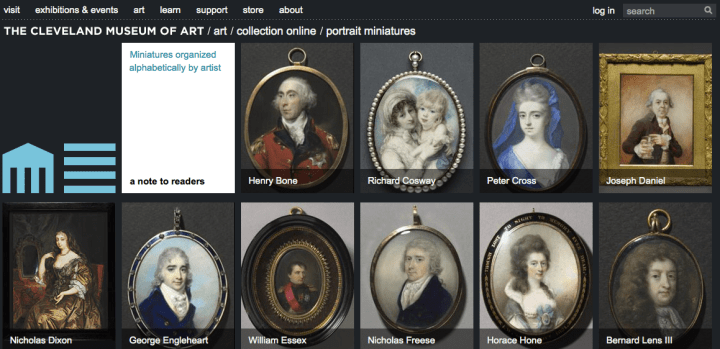
Catalogue of Cleveland’s Portrait Miniatures Published Online
Press release from The Cleveland Museum of Art:
◊ ◊ ◊ ◊ ◊
The Cleveland Museum of Art announces its pilot project in digital publishing, British Portrait Miniatures from the Cleveland Museum of Art. This catalogue showcases a substantial portion of the museum’s internationally known collection of around 170 portrait miniatures, one of the most significant in the country. The first stage of this searchable online catalogue includes 54 British portrait miniatures from the 17th, 18th, and 19th centuries, with publication of the remaining British works ongoing though out the year. The catalogue presents new research on the individual miniatures, explores the museum’s collection holistically and incorporates comparative images of works from other public and private collections. The miniatures catalogued online can be viewed at actual size, from the front and the back, and in unprecedented detail.
Authored by Cory Korkow, PhD, a Paintings and Drawings Society curatorial fellow whose initial research was funded by grants from the Samuel H. Kress Foundation, the catalogue includes new research about the artists, sitters, and successive owners of these miniatures, while incorporating conservation photographs and allowing the collection be studied in great detail for the first time. “This innovative project illustrates not only our deep commitment to original scholarly research on our collection, but our creativity in the presentation and dissemination of that knowledge,” said David Franklin, the Sarah S. and Alexander M. Cutler director.
Access to the British Portrait Miniatures catalogue is available here» (more…)
Queen Lovisa Ulrika’s memorial cup
Press release from Sweden’s National Museum:
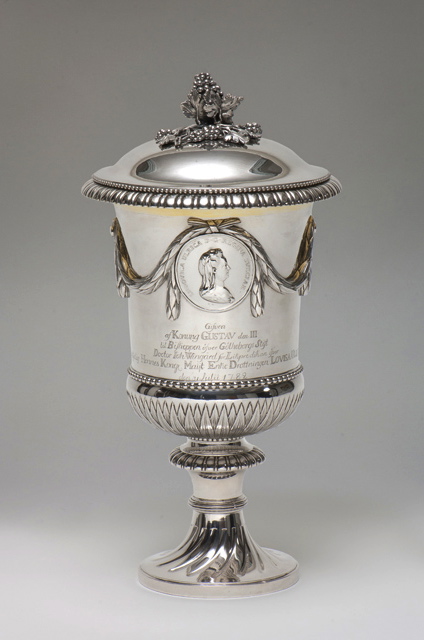
Pehr Zethelius, Queen Lovisa Ulrika’s Memorial Cup, silver, ca. 1782. Photo: Hans Thorwid/Nationalmuseum.
Queen Lovisa Ulrika’s memorial cup was donated to the museum at the annual meeting of the Friends of Nationalmuseum. This unique object was made by silversmith Pehr Zethelius and presented as a memento to Johan Wingård, Bishop of Gothenburg, in thanks for the funeral sermon that he gave for the deceased Queen in 1782.
The existence of Queen Lovisa Ulrika’s memorial cup, donated by the Friends of Nationalmuseum, has been unknown to most people until now. The silver cup is an impressive size and weighs almost three kilos, as befits a sister of King Fredrik the Great of Prussia. The rediscovery of the memorial cup adds an important jigsaw piece to the history of Swedish design at the Nationalmuseum. At the same time, this magnificent piece is an example of the long royal tradition of presenting an expensive gift to the key officials at ceremonies of state such as christenings and funerals.
The Dowager Queen Lovisa Ulrika died at Svartsjö Palace on 16 July 1782 and was buried in Riddarholmen Church on 31 July. The funeral sermon was given by Chaplain to the Queen Johan Wingård, Bishop of Gothenburg. In thanks for this, he was given this specially commissioned cup, which was then passed down through the family. The craftsman who made the memorial cup was Pehr Zethelius (1740-1810), a leading light in Swedish silversmithing during the late 18th century. Pieces from his workshop show both high artistic and technical quality. Zethelius became a real trendsetter and was responsible for introducing new styles from the Continent.
The memorial cup was donated in memory of Henry Montgomery (1927-2010), chairman of the Friends of Nationalmuseum from 1982-1994. The Barbro and Henry Montgomery Donation Fund was established in 1998 and is managed by the Friends of Nationalmuseum.
London’s National Gallery Acquires Portrait by Lawrence
Press release from London’s National Gallery:

Sir Thomas Lawrence, “Portrait of the Hon. Emily Mary Lamb,” 1803 (London: National Gallery)
A portrait by Sir Thomas Lawrence that has never been on public display since it was painted over two hundred years ago is now available for visitors to enjoy at the National Gallery in Room 34. Portrait of the Hon. Emily Mary Lamb (1787–1869), 1803, has been allocated to the National Gallery by Arts Council England under the Acceptance in Lieu scheme, which allows donors to leave major works of art to the nation in lieu of inheritance tax. Sir Thomas Lawrence (1769–1830) is generally regarded as one of the finest European portraitists of the late 18th and early 19th centuries, portraying some of the most important personalities of his day. This work is an important addition to the National Gallery’s British collection. The Gallery currently holds examples of formal and full-length works by Lawrence – John Julius Angerstein, aged about 55, about 1790; John Julius Angerstein, aged over 80, 1824; and Queen Charlotte, 1789 – but this painting exemplifies Lawrence’s influential but more informal depiction of children and families. Its inclusion in the collection will enable Gallery visitors to appreciate the breadth of Lawrence’s repertoire.
The oval portrait depicts the 16-year-old sitter in motion, her head turned towards the viewer in a pose that has a long tradition in the history of portraiture. However, Lawrence brings a freshness to the work, reflected in the informality and economy of his brushwork. The Hon. Emily Lamb went on to become an influential, politically prominent society hostess. She first married Peter Leopold Clavering-Cowper, 5th Earl Cowper. After his death, in 1839 she married Henry John Temple, 3rd Viscount Palmerston, who served twice as Prime Minister between 1855 and 1858 and again from 1859 to 1865. Her brother, Viscount Melbourne, also served as Prime Minister. His wife, Lady Caroline Lamb, was notorious for her affair with Lord Byron.
The work was commissioned by the subject’s father, Peniston Lamb, 1st Earl Melbourne, whose image can also be seen in the Gallery represented in a work by Stubbs, The Milbanke and Melbourne Families, about 1769. Lawrence’s painting has been in the possession of the sitter’s descendants since its completion. Born in Bristol, Lawrence was largely self-taught and a child prodigy; he was already producing accomplished portraits in crayon aged 10. He went on to become a pupil at the Royal Academy at the age of 18 and exhibited his first portrait the following year. He had a distinguished career during which he became a member of the Academy, going on to become its president in 1820. He was appointed Painter-in-Ordinary to King George III and received a knighthood in 1815.
Puzzle Jugs for Fools
I have long thought that museum gift shops would make a mint with good quality reproductions of these vessels, or perhaps even better, commissions for updated versions from local ceramicists. I first encountered the type as a graduate student, at The Smart Museum of Art in Chicago, and have been childishly enamored ever since. The following comes from Kathryn Kane’s posting at The Regency Redingote (3 July 2009). Happy Fool’s Day! -CH
◊ ◊ ◊ ◊ ◊
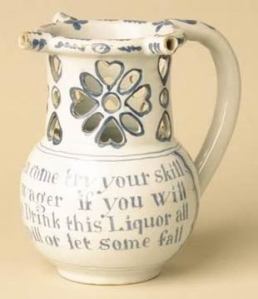
Puzzle Jug, tin-glazed earthenware, Liverpool, ca. 1750 (Liverpool: Walker Art Gallery)
Inscribed: "Here Gentlemen come try your skill, I'll hold a wager if you will, That you don't drink this liquor all, Without you spill and let some fall." For more information, click on the photo.
A diverting drinking vessel which could be found in village inns and public houses for centuries had a resurgence in popularity in the late eighteenth and early nineteenth centuries. These vessels had been made throughout England and northern Europe since at least the fifteenth century. Most commonly called puzzle jugs, they were also sometimes called teasing pitchers or wager jugs. It was a challenge to determine how to drink the liquor which they contained and wagers were often placed on the outcome of the attempt.
By the time of the Regency, puzzle jugs were being made not only for use in inns and taverns, but also for home use. Many gentlemen enjoyed entertaining their male visitors with drinking games using their own puzzle jugs.
Puzzle jugs are a puzzle because it is not obvious how to imbibe the beverage which they contain. The neck of the jug is perforated, often in ornamental patterns, so one cannot simply raise it to one’s lips and drink. Most puzzle jugs also have a hollow rim which can have between three to seven spouts which protrude from it. This hollow rim is connected to either a hollow handle, which opens into the lower part of the jug body, or the inside of the jug has a tube or pipe built into the jug wall. It is through this concealed piping that the liquid contents of the jug flow to the hollow rim. The secret of the puzzle jug is to know which of the spouts on the rim to plug with the fingers, while sucking the liquor out of the jug via the remaining spout. Some puzzle jugs have a small additional opening somewhere below the neck or beneath the handle which will spill the liquid on the hapless drinker if the jug is not held just so. . .
The full posting (including a brief reading list) is available at The Regency Redingote.
Applause for NGA’s Open Access Policy for Images
This open access announcement from the National Gallery of Art, in Washington, D.C., is, to my thinking, fabulous news! How exciting (and refreshing) to hear the museum articulate the policy in terms of the public good: “The Gallery’s open access policy is a natural extension of its mission to serve the United States of America by preserving, collecting, exhibiting, and fostering the understanding of works of art at the highest possible museum and scholarly standards.” Bravo! In addition to making the images available via open access, the museum provides a useful interface complete with lightbox and intuitive links for finding more information about particular images. -CH
National Gallery press release (16 March 2012) . . .
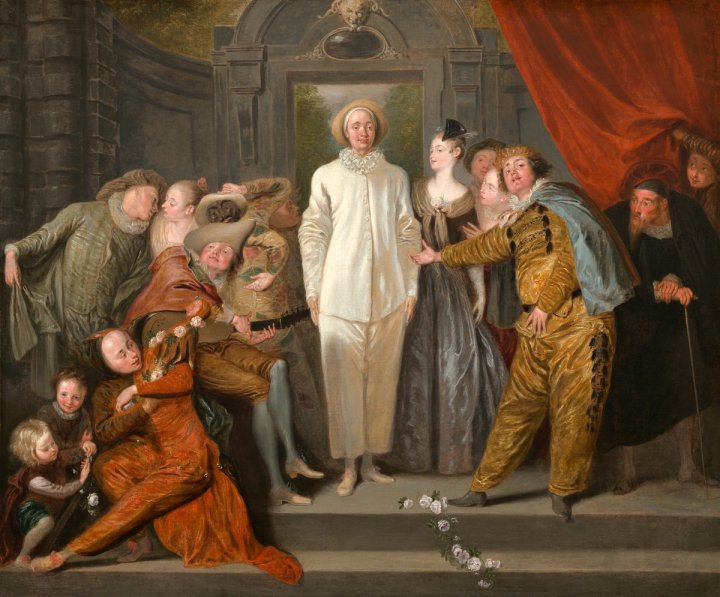
Antoine Watteau, The Italian Comedians, ca. 1720
Washington, D.C., National Gallery, Kress Collection, 1946.7.9
◊ ◊ ◊ ◊ ◊
The National Gallery of Art announces the launch today of NGA Images, a new online resource that revolutionizes the way the public may interact with its world-class collection at http://images.nga.gov. This repository of digital images documenting the National Gallery of Art collections allows users to search, browse, share, and download images believed to be in the public domain.
“As the Gallery marks its 71st anniversary, it is fitting that we introduce NGA Images and an accompanying open access policy, which underscore the Gallery’s mission and national role in making its collection images and information available to scholars, educators, and the general public,” said Earl A. Powell III, director, National Gallery of Art. “In turn this supports research, teaching, and personal enrichment; promotes interdisciplinary research; and nurtures an appreciation of all that inspires great works of art.”
Many of the open access images have been digitized with the generous support of the Samuel H. Kress Foundation.
Designed by Gallery experts to facilitate learning, enrichment, enjoyment, and exploration, NGA Images features more than 20,000 open access digital images, up to 3,000 pixels each, available free of charge for download and use. The resource is easily accessible through the Gallery’s website, and a standards-based reproduction guide and a help section provide advice for both novices and experts. Users may search by keyword in the Quick Search box on the home page of NGA Images, or they may browse the regularly updated “featured” image collections prepared by Gallery staff on topics such as 19th-century French art or frequently requested works. Other features for users include the ability to create one or more “lightboxes,” or images sets, and to save, share, and download multiple images at a time. Users may add individual labels and notes to their lightboxes or to images within them. Links to users’ customized lightboxes may be shared via e-mail or may be copied and pasted to social media sites.
Users may freely browse the NGA Images website and download screen- and lecture-size images without registering an account. Registration is required to use certain features of the NGA Images website, including saving and sharing lightboxes and e-mailing image links to others. Additionally, registration is required to fulfill certain image requests including direct downloads of reproduction-ready images.
With the launch of NGA Images, the National Gallery of Art implements an open access policy for digital images of works of art that the Gallery believes to be in the public domain (those not subject to copyright protection). Under the open access policy, users may download any of these images free of charge and without seeking authorization from the Gallery for any use, commercial or non-commercial. The Gallery’s open access policy is a natural extension of its mission to serve the United States of America by preserving, collecting, exhibiting, and fostering the understanding of works of art at the highest possible museum and scholarly standards. In applying the policy in a global digital environment, the Gallery also expands and enhances its educational and scholarly outreach. The Gallery believes that increased access to high-quality images of its works of art fuels knowledge, scholarship, and innovation, inspiring uses that continually transform the way we see and understand the world of art.
View the full Open Access Policy at http://images.nga.gov/openaccess.










leave a comment