Frick Acquires Hard-Paste Sèvres Vase in Honor of Anne Poulet
Press release from The Frick, as noted at ArtDaily:
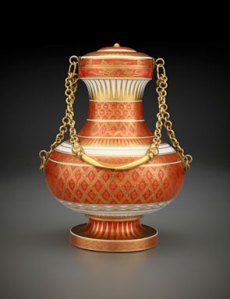
Vase Japon, 1774, Royal Manufactory of Sèvres, painted and gilded hard-paste porcelain with silver-gilt mounts, The Frick Collection; photo: Michael Bodycomb
The Frick’s Board of Trustees announces the acquisition of two objects that will enhance the museum’s holdings in areas that interested founder Henry Clay Frick at the end of his life: eighteenth-century French porcelain and Italian Renaissance drawings. A rare and beautiful vase created at the Royal Manufactory of Sèvres has been acquired in honor of Anne L. Poulet, who retired at the end of September after serving as Director for eight years. The vase, a partial purchase by the Frick and a partial gift from Alexis and Nicolas Kugel, is the first piece of hard-paste porcelain from the Royal Manufactory of Sèvres to enter the Collection. It complements the museum’s substantial Sèvres holdings made with the earlier soft-paste formula, objects obtained by Mr. Frick from the dealer Joseph Duveen. This latest acquisition is particularly appropriate given the interest of Director Emerita Anne Poulet in eighteenth-century French decorative arts. The vase will be displayed this winter alongside selections from a promised gift of hard-paste Meissen porcelain objects in the new Portico Gallery for Decorative Arts and Sculpture, which opens to the public on December 13. Also entering the collection is an important Italian Renaissance by drawing the Sienese artist Domenico Beccafumi (1486–1551), a two-sided sheet given to the Frick by Trustee Barbara G. Fleischman in honor of Deputy Director and Peter Jay Sharp Chief Curator Colin B. Bailey.
Despite its name, the Vase Japon is a French interpretation of a Chinese Yu (or Hu) vase from the Han Dynasty (206 B.C–A.D. 220). Examples of this type of baluster-shaped vessel survive in bronze and earthenware. Documents from the Sèvres archives indicate that the Frick vase was made in 1774 along with two others of the same size, shape, and decoration. Each bears the mark of the gilder-painter Jean-Armand Fallot, who was active at Sèvres between 1765 and 1790. Of the three, however, only the Frick vase is adorned with an elaborate silver-gilt handle and chain, which, like its shape and surface pattern, were directly inspired by the Chinese model. The mounts bear the mark of Charles Ouizille (1744–1830), who worked extensively for the French court throughout the 1770s and 1780s and became Marie-Antoinette’s favorite jeweler. He created exquisite gold mounts for the queen’s rare and precious collections of hard-stone vases and cups.
The shape and decoration of the Vase Japon derive from a woodblock print reproduced in a forty-volume catalogue of the vast Chinese imperial collections (a record compiled at the behest of the Qianlong Emperor who reigned 1735–1796). Included are entries for more than fifteen hundred ancient bronze objects—primarily ritual vessels, but also mirrors, lamps, and weapons—each accompanied by a brief description of its size and origin. Sometime during the 1770s, Father Joseph Amiot, a Jesuit missionary working in Peking, sent a copy of this catalogue to Henri Bertin in Paris. Bertin was France’s secretary of state and had recently been appointed the commissaire du roi at the Sèvres manufactory, an administrative position he held until 1780. In addition to being a politician and a businessman, Bertin was an art collector with a profound interest in China and Chinese art, and he likely played a key creative role in the production of this piece. (more…)
New Acquisition: Gainsborough and the Netherlands
News of this recent acquisition, as noted by Hélène Bremer, is remarkable in itself given the importance of the Dutch for eighteenth-century landscape paintings. That funds were raised in part through crowd funding makes it all the more interesting:
 The Rijksmuseum Twenthe in Enschede, a museum with an emphasis on seventeenth- and eighteenth-century art, has acquired the first painting by Thomas Gainsborough for a Dutch museum. Crowd funding this summer secured the painting for the museum collection. Wooded Landscape (1745-46), an early work made in Suffolk, will be on display in the specially created Landscape Gallery until early January. The addition of this landscape by Gainsborough to the collection will mean that Rijksmuseum Twenthe will be one of the few museums in the world which can show the influence that Dutch seventeenth century artists had on both English and Dutch painters of the eighteenth century.
Milwaukee Art Museum Acquires Portrait by Copley
Press release from the Milwaukee Art Museum (12 September 2011) . . .

John Singleton Copley, "Portrait of Alice Hooper," ca. 1763 (Milwaukee Art Museum)
The Milwaukee Art Museum has acquired the portrait Alice Hooper, a major colonial American painting by John Singleton Copley (1738–1815). Copley is recognized as one of the great American artists of the day—and one of the first native-born painters to achieve success both at home and abroad. Alice Hooper, painted by Copley around 1763, depicts the seventeen-year-old daughter of the wealthiest man in Marblehead, Massachusetts, Robert “King” Hooper. Alice’s father commissioned this portrait to mark his daughter’s engagement to Jacob Fowle, Jr.
“Alice Hooper displays the traits that made Copley desirable in colonial Boston. Copley’s rendering of her fashionable sacque gown dazzles the eye, with its profusion of glinting blue satin and frothy lace spilling from its underdress,” said William Rudolph, curator of American art and decorative arts at the Milwaukee Art Museum. “The artist lingered on the highlights of Alice’s ruby earrings and choker, revealing the great wealth of her family. Yet her pensive gaze and half-shadowed face allude to her graciousness; she looks modest, rather than proud.”
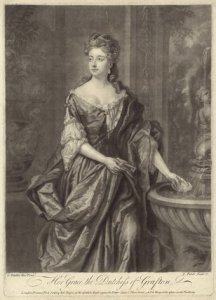
John Faber, after Sir Godfrey Kneller, "Isabella Fitzroy (née Bennet), Duchess of Grafton," (London: NPG #D30508)
According to Rudolph, Alice Hooper’s composition is one of a series of women depicted in fantasy garden settings, which all descend from John Faber’s 1691 engraving after Sir Godfrey Kneller’s Duchess of Grafton (ca. 1680).
The painting also provides vivid evidence of Copley’s working methods. Like many of his colleagues, the artist borrowed costumes and compositions from imported engravings of high-style British portraits. These appropriations were done with the full cooperation of his clients, who wanted to emulate the aristocrats of the mother country.
“The dress itself, although breathtakingly rendered, may not in fact be the property of Miss Hooper, given its remarkable similarity to that worn by several other sitters, and to the artist’s documented habit of copying elaborate gowns from mezzotints,” said Rudolph.
Copley’s work pleased the Hoopers and led to nine additional commissions for members of Alice’s immediate and extended families, securing Copley’s success.
“After winning the Hooper clan’s approval, Copley rocketed into the stratosphere as the go-to artist for fashionable New England—and for clients from as far away as Philadelphia and New York,” Rudolph said. (more…)










leave a comment