State Music Room at Stowe House To Be Restored
Press release from Sue Bond Public Relations:
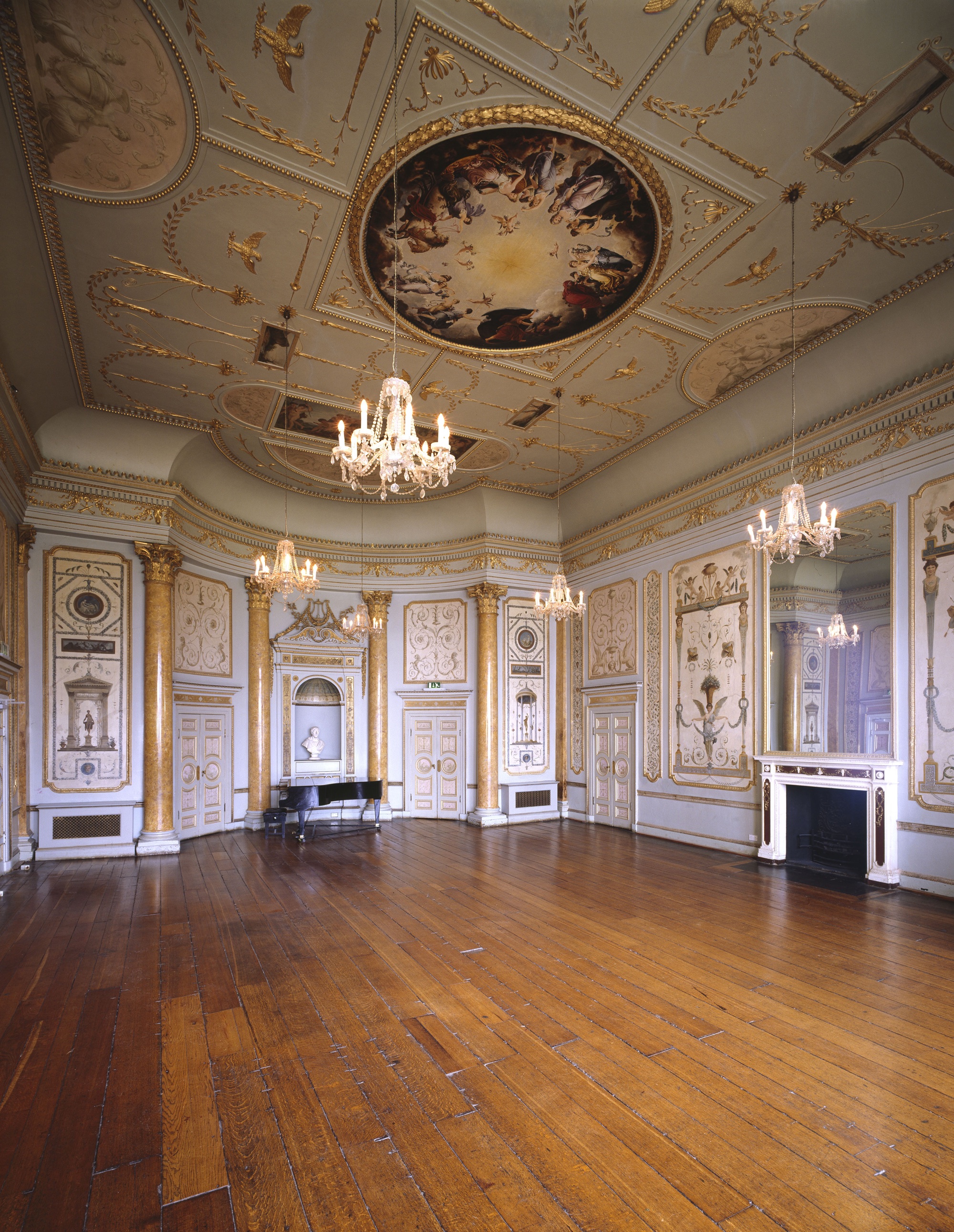
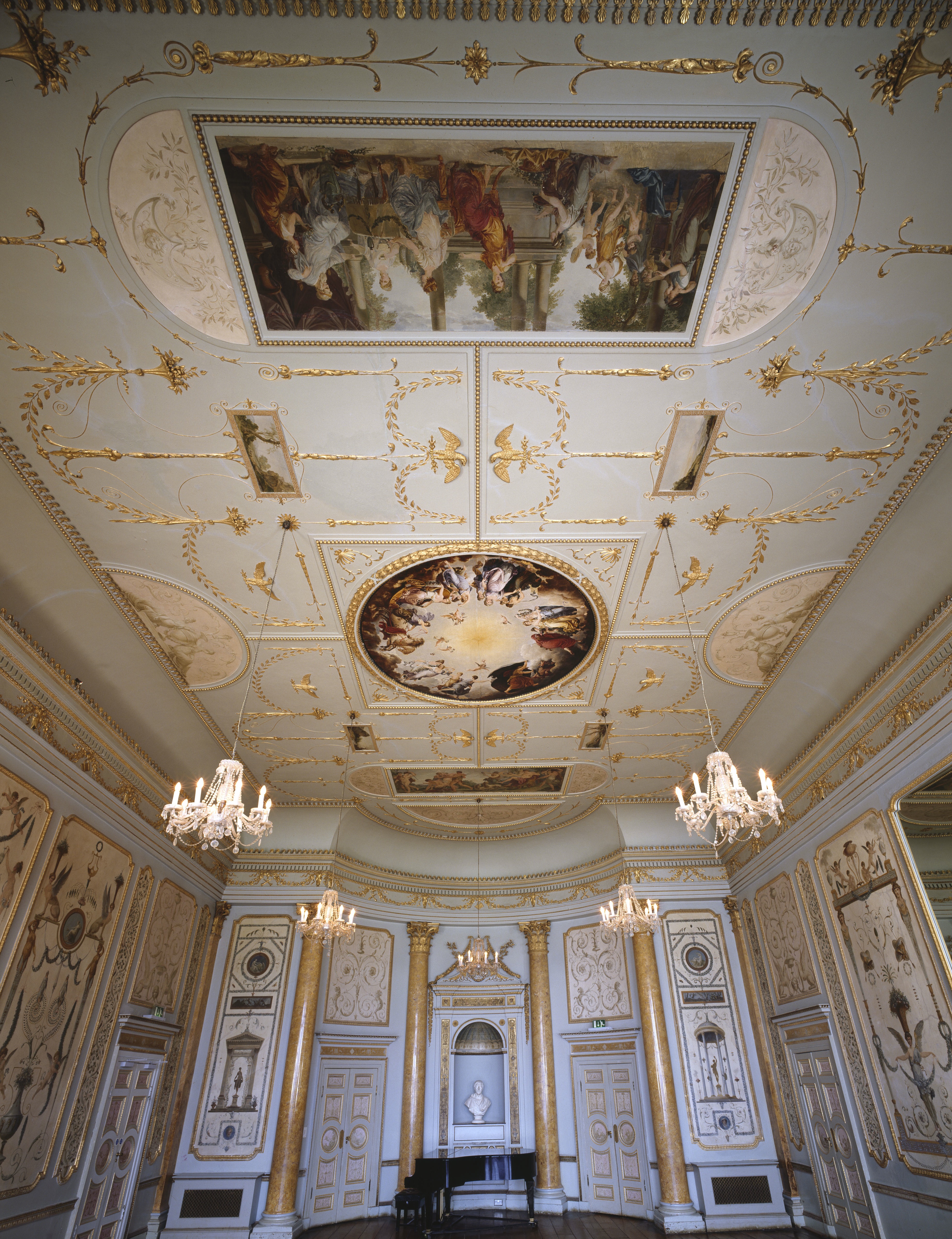 Through World Monuments Fund (WMF), The Paul Mellon Estate has announced a pledge of $250,000 towards the restoration of the State Music Room at Stowe House, the magnificent Grade I listed Neo-Classical palace set in 400 acres of landscaped park in Buckinghamshire. The funding means that the work will begin this year and should be completed by 2012-13.
WMF Britain’s Chief Executive Dr Jonathan Foyle said “The generous gift of The Paul Mellon Estate, along with donations from our members, trusts and foundations and others who responded to our recent Music Room Challenge, will allow one of the principal rooms of Stowe to be restored for everyone to enjoy. This magnificent response brings WMF’s £10 million fundraising challenge for Stowe to within £410,000 of its target – wonderfully positive news in these economically challenged times.” Completion of the State Music
Room will allow the core of historic spaces at Stowe to be presented as they
were at the turn of the 19th century, following the recent restoration of the
Marble Saloon and the Large Library.
 World Monuments Fund Britain (WMF) included Stowe in its 2002 Watch List of endangered sites and began to support the project by substantially funding the restoration of the astonishing Marble Saloon with its 57-foot-high dome which was completed in 2005. One of the largest and most spectacular spaces to be found in any British country house, the Saloon is an oval version of the Pantheon in Rome. WMF in partnership with Stowe House Preservation Trust (SHPT) has undertaken the daunting challenge of restoring this great mansion with its 400 rooms and 1/6 mile-wide façade.
Situated between the Marble Saloon and the Large Library, the State Music Room is one of the finest late 18th century spaces in Britain, showcasing Italian artistry in the heart of England. Whilst begun in 1676, it was only after a century of ceaseless building and landscape gardening that Richard Grenville-Temple (1711-79), 2nd Earl Temple to some, largely completed
Stowe House, including the south front, the Temple Room and the Music
Room in the 1770s. (more…)
Study Tour of Scotland / Conference on Edinburgh Cast Collection
This study tour sounds appealing enough on its own, but I was especially struck by the timing: it’s organized in conjunction with the EAHN/Docomomo conference. So often it seems that academic conferences could do a better job exploring the host area’s resources, and yet schedules tend to hold little room for excursions. This seems like an interesting solution. Also, as noted on the itinerary, there is at the same time a conference on the Edinburgh Cast Collection. -CH
EAHN Architectural Study Tour of Scotland
8-11 September 2011
Registration due by 1 June 2011

Princes Street Gardens, Edinburgh (Photo by James Denham, Wikimedia Commons)
Join the European Architectural History Network for an architectural study tour of Scotland from 8-11 September 2011. Tour highlights include Edinburgh, Glasgow, and five centuries of Scottish architecture, ranging from a selection of castles through postwar mass housing. The tour will be led by local scholars and will be accompanied by a coordinator from the EAHN. The tour fee of 96 euros includes guides and tour bus transportation; it does not include hotels, meals, or international transportation. For complete information and registration details, please consult the schedule.
◊ ◊ ◊ ◊ ◊
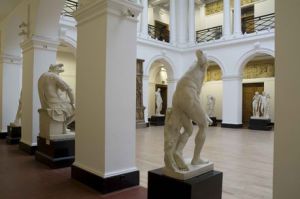
Cast Collection, Edinburgh College of Art
Also in September, the Edinburgh College of Art and the University of Edinburgh will host a conference on the Edinburgh Cast Collection. Founded in 1798, this is the second oldest educational collection in the UK, with donations by Lord Elgin, Canova, Thorvaldsen. The conference will be a major academic event with a section on Architecture and Cityscape. Details will be available in June.
St Paul’s in HD — Just Like Being There?
This panoramic view of St. Paul’s in London is extraordinary. I’ve excerpted below the marketing copy from the company’s website. Quite apart from the quality of the image, it’s interesting to see this latest installation in the rhetoric of the real: it’s “just like actually being there” along with requisite exclamation marks!!! Click on the photo to view the interior images. From Spherical Images:
 A London-based virtual tour company, Spherical Images provide HD quality virtual tours by photographing your venue using ground breaking technology – allowing you to bring your venue to the customer with unparalleled impact and quality. . . .
SPHERICAL IMAGES HD VIRTUAL TOURS BRING YOUR VENUE TO THE CUSTOMER IN UNRIVALLED DETAIL
They won’t just get an impression of your Venue, they will see what it is actually like to be there. This means they can plan an event and see the true potential and beauty of your Venue. Our Virtual Tours are shot using cutting edge photography techniques such as High Dynamic Range (HDR) and exposure blending to give you a full screen HD experience that is just like actually being there! Virtual Tours are becoming an essential tool for showing Venues online. Make your website convert by showing customers what you have.
ST PAUL’S CATHEDRAL 15.5 GIGA PIXEL PANORAMA (GIGAPAN)
One of the largest indoor photographs ever taken: 2,400 images stitched together to make a 15.5 Giga Pixel panorama. It took 3.5 hours to shoot – during which time the cathedral had completely filled up with tourists – hence the ‘half people’, floating heads etc! . . .
The State of Paris Churches
The last time I was in Paris (January 2010), I was especially struck by the city’s churches. Apart from Notre Dame, these seem to be largely overlooked by both travelers and (all too often) scholars. Apparently, those in charge of preserving the city’s historic sites may also be neglecting them; at least this is the contention of Didier Rykner.
Didier Rykner, “The State of Churches in Paris (1): Saint-Philippe-du-Roule,” The Art Tribune (18 December 2010).

Jean-François Chalgrin, Saint-Philippe-du-Roule, 1774-84 (Photo by Vincent Babilotte, Wikimedia Commons)
This article inaugurates a new series devoted to Parisian churches. Although we often point out endangered religious sites, those here in the capital have escaped our attention thus far as we tend to assume that they are well protected. Unfortunately, this is not at all the case. The department in charge of preserving and restoring art works and mural paintings (the COARC) works diligently on important projects, certain restorations of major sections of buildings have also been carried out in the past few years by the Bureau des Edifices Cultuels & Historiques (BECH), but the need is so great and some churches are so deteriorated that it is now time to admit that this is not enough. . . .
To show our good faith and thus also more positive points, some of the articles in our series will highlight churches which have been restored, or where work is underway. We begin today, however, with a building which is in extremely grave danger, though not visible to visitors who enter: the church of Saint-Philippe-du-Roule. It was built in the late 18th century, designed by Jean-François Chalgrin who submitted his plans in 1764 although construction did not begin until 1774 and the blessing of the church took place only in 1784. . . .
The full article on Saint-Philippe-du-Roule and its deteriorating condition is available here»
Attingham Applications Due Soon
The Attingham Trust for the Study of Historic Houses and Collections — 2011 Courses

Summer School 2010 at Chatsworth (Photo: Rebecca Parker)
The Attingham Trust is an educational charitable trust offering specialised study courses for people professionally engaged in the field of historic houses, their collections and settings including the history and contents of English Royal Palaces. Since its foundation in 1952 it has enjoyed success with its high academic standards. The courses are highly regarded by museums, universities, heritage bodies, architectural practices and conservation workshops all over the world as an excellent opportunity for career and continuing professional development.
The 60th Attingham Summer School
1–19 July 2011
Directed by Lisa White and Dr Helen Jacobsen, and accompanied by specialist tutors and lecturers, this intensive 18-day course will include visits to approximately 25 houses in Sussex, Nottinghamshire, Derbyshire and Shropshire. The Summer School will examine the country house in terms of architectural and social history, and the decorative arts. Full and partial scholarships are available and applications are invited from those working in related fields. Closing date for applications: 31st January 2011.
Royal Collection Studies
4–13 September 2011
Run on behalf of the Royal Collection Trust, this strenuous 10-day course based near Windsor is directed by Giles Waterfield. The school will visit royal palaces in and around London with specialist tutors (many from the Royal Collection) and study the extensive patronage and collecting of the royal family from the Middle Ages. The course is open to all but priority will be given to those with a professional or specialist knowledge of British architecture, history or the fine and decorative arts. Some scholarship assistance is available.
Closing date for applications: 15th February 2011.
The Attingham Study Programme, Glasgow and the West of Scotland
17–25 September 2011
This intensive 9-day programme directed by Giles Waterfield will be based in Glasgow and West Scotland and will examine the Scottish house. It will include visits to Dumfries House, Drumlanrig Castle, Mount Stuart, The Hill House, Helensburgh and Pollok House, Glasgow. Some scholarship assistance is available and applications are invited from those employed or seriously interested in architecture and the fine and decorative arts. Closing date for applications: 28th February 2011.
For further information please visit our website: www.attinghamtrust.org or email Rebecca Parker: attinghamtrust@btinternet.com or Mayuri Amuluru: attingham@verizon.net for applicants from the USA.
Christmas Dressed Period Rooms in London
From the Geffrye Museum:
Christmas Past: 400 Years Of Seasonal Traditions In English Homes
Geffrye Museum, London, 23 November 2010 — 5 January 2011
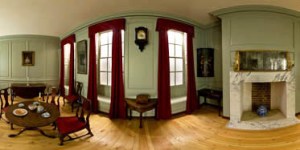
A parlour as envisioned from 1745 (sans Christmas decorations), London: Geffrye Museum. Photography Jonathan Greet. Click on the image for a panormic view.
Christmas Past offers visitors a fascinating insight into how Christmas has been celebrated in English middle-class homes from 1600 to the present day. Each year, authentic festive decorations transform the museum’s eleven period rooms, creating a vivid and evocative picture of how earlier generations of Londoners celebrated Christmas. The rooms provide the perfect setting for visitors to explore the origins of some of the rich and colourful traditions of Christmases past, from feasting, dancing and kissing under the mistletoe to playing parlour games, hanging up stockings, sending cards, decorating the tree and throwing cocktail parties.
◊ ◊ ◊ ◊ ◊
Visitors to the Geffrye can view our permanent display of eleven period rooms which span approximately 400 years from around 1600 to the present day. There is also a walled herb garden and a series of four period gardens, chronologically arranged to reflect the museum’s period rooms, which can be visited between 1 April and 31 October. To the front of the museum there is a large garden facing onto Kingsland Road, which is currently being refurbished. Additionally, there is a restored 18th-century almshouse, open to visitors on selected days, which has been taken back to its original condition and provides a glimpse into the lives of London’s poor and elderly in the 1780s and 1880s.
We know that not everyone is able to visit the Geffrye in person so we are always looking to create new ways for online visitors to experience the museum more fully. We have recently added panoramas of all the period rooms, gardens and almshouse rooms, which provide a highly detailed, immersive way to experience the museum. There is also our online Virtual Tour which offers a timeline through the museum and gardens and highlights significant objects and plants. You will also find short descriptions of all the rooms and gardens, adding context to the new visual material. . . .
Joan DeJean on the Château de Montgeoffroy
In the current issue of The Magazine Antiques, Joan DeJean offers a first-person account of the château de Montgeoffroy, “an exceptionally rare survivor of pre-Revolutionary French style . . . [that] remains much as it was in the 1770s, right down to the tables, chairs, and copper pots—gracious, comfortable, and mad for chintz.” Professor of French at the University of Pennsylvania, DeJean is the author of The Age of Comfort: When Paris Discovered Casual and the Modern Home Began and The Essence of Style: How the French Invented High Fashion, Fine Food, Chic Cafes, Style, Sophistication, and Glamour.
Joan DeJean, “Living with Antiques: Eighteenth-Century Modern,” The Magazine Antiques:

Château de Montgeoffroy, view along the window wall of the grand salon
I first visited the château de Montgeoffroy in the summer of 2006 when I was researching a book about the eighteenth-century French home. I found there something I would not have thought possible: an eighteenth-century residence so perfectly preserved that, as you walk through its rooms, you have the feeling of stepping right into what is often regarded as the golden age of French architecture, interior decoration, and decorative arts. . . .
Today, nearly two and a half centuries after its completion, Montgeoffroy remains almost exactly as in 1777. Its preservation is the result of several remarkable developments. To begin with, it was among the few great houses in France to survive the Revolution of 1789 unscathed. Unlike many aristocrats, the maréchal de Contades refused to emigrate. (Had he done so, the château would have become state property.) Family members lived at Montgeoffroy throughout the Revolution and thereby helped to protect it. . . .
The full article is available here»
Located in the Loire Valley near Angers, the château de Montgeoffroy is open to
the public each year from the end of March through November.
Bibliography for National Trust Properties
As reported by Emile de Bruijn at the ever useful Treasure Hunt, the National Trust has recently released a massive bibliography for its properties. It’s an immensely valuable research guide and — one hopes — a model for other such institutions. . . .

The Rotunda, with the Temple of Venus in the distance, at Stowe, Buckinghamshire. ©NTPL/Andrew Butler
Our curatorial and publishing teams have been collaborating on a bibliography listing all the books and articles about the properties of the National Trust. This bibliography has just been made available online. It currently contains over 4,000 entries – the earliest one is a record of a visit by Queen Elizabeth I to Melford Hall in Suffolk in 1578. The property with the most entries is Stowe in Buckinghamshire. This very grand garden full of pavilions and monuments has inspired texts and interpretations almost from its inception. Even in the mid eighteenth century it had its own guidebook explaining the monuments to visitors. . . .
Will the Wedgwood Museum Survive?
As reported by Martin Bailey in The Art Newspaper (18 August 2010) . . .
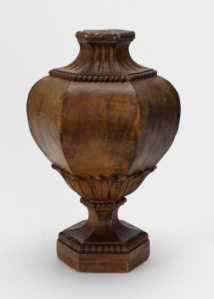
An 18th-century wooden block mould, © Wedgwood Museum
A fundraising campaign may be launched to save the Wedgwood Museum outside Stoke on Trent, if courts rule that its collection can be sold to pay the pensions liability of the Waterford Wedgwood company, which went into administration in January 2009.
Through a legal quirk, the Wedgwood Pension Fund trustees, who face a deficit of £134m for employees, may be able to claim against the museum. The museum had only six staff in the scheme, whose pension interest represented £60,000, but it could be liable for all of the fund’s 7,000 claimants.
Because of the pensions issue, the Wedgwood Museum Trust was itself put under administration in January, and it is temporarily run by insolvency practitioner Begbies Traynor. The next stage is for the courts to decide whether the museum’s assets could be seized. This is a complex legal matter and is likely to require a detailed hearing to resolve this autumn. In the meantime, the museum remains open to visitors, as normal.. . . .
The full story can be found here»
◊ ◊ ◊ ◊ ◊
Back in July, Lucy Ingliss provided a thoughtful response to the uncertain future of the Wedgwood Museum at Georgian London. Ironically, the Wedgwood Museum was awarded the Art Fund Prize in 2009, just after the completion of an extensive construction project. As noted on the museum’s website:
It’s official! The Wedgwood Museum is Britain’s best museum. The news that the independent Stoke on Trent museum has won the £100,000 Art Fund Prize 2009 – the UK’s largest single arts prize – was announced last night (18 June) at the Royal Institute of British Architects in London. The Art Fund Prize honours the most imaginative and original museum or gallery of the year and is a huge accolade for the museum, which only opened last October after the charitable Wedgwood Museum Trust spent nearly a decade raising funds to build it. . .
A Fine Time to Be in Belgium, Too
Open Monumentendag Vlaanderen / Heritage Days
Belgium, 12 September 2010
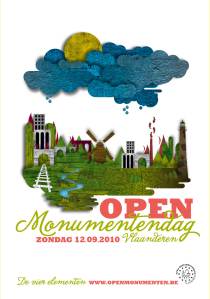 Open Monumentendag Vlaanderen (Heritage Day Flanders) is the holiday for the entire heritagein Dutch-speaking Belgium. It is held every second Sunday of September. On that day all the famous and not-so-famous patrimony of Flanders opens its doors for the general public. But it is not just monuments that are in the spotlights, also archaeological sites and landscapes occupy centre stage. Not only can you admire some of Flanders’ most exciting heritage, but there are also loads of activities, for young and old, presented to you as well (this includes exhibitions, walks, bicycle tours and much more). Every year we highlight one specific topic. This changes the wide variety of activities we offer you every year and it also makes sure that Open Monumentendag will never cease to amaze you. And what is more: all the visits and activities during Open Monumentendag are free of charge!
This year Open Monumentendag takes place on Sunday September 12. The theme of this year’s edition will be The Four Elements. So it will be earth, wind, water and fire that determine the programme. You can find the detailed schedule of the day here.










 Enfilade
3 comments