Telescope by James Short on Display at the Herschel Museum
On a day when many of us are looking to the skies . . . Press release from Bath’s Herschel Museum of Astronomy:

James Short, Gregorian reflector telescope, 1738–68 (Collection of Richard Blythe, on loan to the Herschel Museum of Astronomy).
The Herschel Museum of Astronomy recently revealed a new display: a Gregorian Reflector telescope created by James Short, the preeminent telescope maker of the 18th century. The brass telescope, on long-term loan to the museum from Richard N. Blythe of Shropshire, was created between 1738 and 1768. It has a focal length of 18 inches and sits on an equatorial mount. Similar telescopes made by Short were used to observe the transit of Venus in 1761 and 1769.
Gregorian Reflector telescopes are constructed with two concave mirrors. The primary mirror collects incoming light and brings it to a focal point. This focused light is then reflected off the secondary mirror, after which the light passes through a central aperture within the primary mirror. Ultimately, the light emerges from the bottom of the instrument, facilitating observation through the eyepiece.
In his 30-year career, Short made at least 1300 telescopes. Considered the finest available, they were sought after by observatories and customers all over the world. Short had no assistant, and when he died in 1768 his method of polishing mirrors was lost. Separately, William Herschel started experimenting with making telescopes in 1773 and went on to produce telescopes of even greater quality than those by Short.

Herschel Museum of Astronomy, 19 New King Street, Bath (Photo by Nick Veitch, Wikimedia Commons, August 2005). Brother and sister, William and Caroline Herschel moved into what was then a new town house in 1777, just a few years before William discovered Uranus (in March 1781). The Herschel museum was established in 1981.
Patrizia Ribul, Director of Museums for Bath Preservation Trust says: “The story of the Herschel siblings William and Caroline is very special, and our acquisitions policy is focused on objects that either belonged to them, or that add important context from the time. The James Short telescope provides visitors with an excellent example of the type of telescope that would have been known to William Herschel. The fact that William, with Caroline’s assistance, went on to create telescopes superior even to this excellent example by James Short, really underlines his expertise and dedication in the field of astronomy.”
The James Short telescope is the latest in a line of exciting long-term loans and acquisitions at the museum, including Caroline’s visitor book, a full-sized replica of William’s seven-foot reflecting telescope, and Caroline’s original memoir manuscript.
The Herschel Museum of Astronomy is dedicated to the achievements of the Herschels: distinguished astronomers and talented musicians. It was from this house that William discovered Uranus in 1781.
Upcoming | Dinah Memorial Unveiling, Stenton, Philadelphia
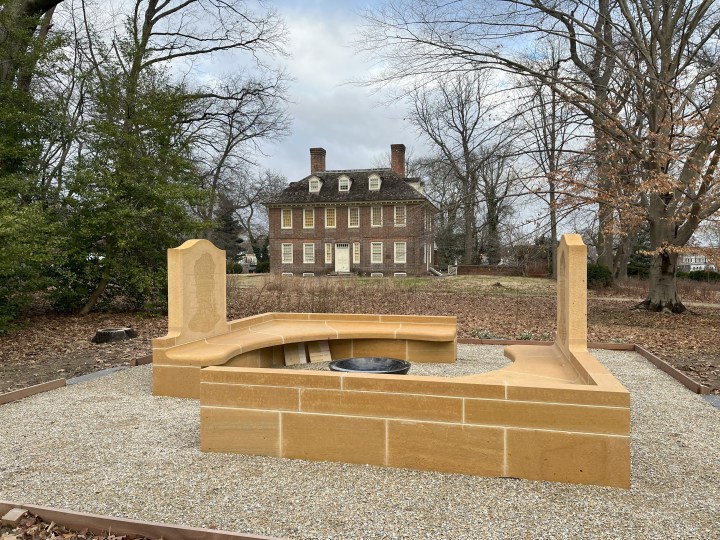
Karyn Olivier, Dinah Memorial, Stenton, Philadelphia, 2024. Nearly finished in this view, the memorial incorporates two brass plaques (one from 1912 and a new one), a small reflecting pool, and questions for both visitors and Dinah herself.
◊ ◊ ◊ ◊ ◊
I hope that Stenton’s Dinah Memorial Project garners the coverage it deserves in the coming weeks; what a compelling, important story! From the press release. . . –CH
Dinah Memorial Unveiling Celebration
Stenton Museum, Philadelphia, 20 April 2024, 2–4pm
On 20 April 2024, The Dinah Memorial, Philadelphia’s first monument dedicated to a formerly enslaved woman, will be unveiled on the grounds of Stenton, where she labored and was buried. This memorial is the physical culmination of Stenton’s Dinah Memorial Project, funded by The Pew Center for Arts & Heritage, a years-long community engagement discussion.
 Dinah’s complex life-story has been uncovered in archival sources in the Quaker Collection at Haverford College as well as in the Logan and related family papers collections at the Historical Society of Pennsylvania. Letters between family members, almanacs, ledgers, legal documents, and an investigation by the Quaker Meeting provided information that allowed Stenton staff to map Dinah’s life from her childhood in the home of Hannah Emlen, who would marry William Logan, to her death and burial in 1805. Though long celebrated for her storied role in saving Stenton from intended burning during the Revolutionary War, Stenton knew that there was more to Dinah than the ‘faithful slave’ narrative for which she was honored on a plaque erected in Stenton Park in 1912. This new memorial, a space in the Stenton landscape designed for questioning and reflection, conceived by acclaimed Philadelphia artist Karyn Olivier, seeks to rebalance Stenton’s historical interpretation, bringing to light the realities of Northern slavery and enslavement by Quakers while highlighting the fullness of Dinah’s humanity.
Executive Director Dennis Pickeral noted that “the Dinah Memorial Project has been transformative for the museum, revealing ignored and untold stories and histories of individuals who were enslaved and labored at Stenton, and for what the project has meant for the museum’s relationship with the surrounding community, who helped create the Dinah memorial and are now partners in charting Stenton’s course for the future.”
The unveiling falls on Stenton’s second annual Dinah Day celebration commemorating her requested release from bondage on 15 April 1776. Visitors can register here to attend the event.
◊ ◊ ◊ ◊ ◊
Built for James Logan, William Penn’s Secretary, between 1723 and 1730, Stenton is located in the historic Logan section of Philadelphia, at 4601 North 18th Street, four blocks east of Wayne Junction. The house is open for tours Tuesday through Saturday, from 1.00 to 4.00pm, April through December, and by appointment throughout the year. Stenton is a member of Historic Germantown, a consortium of nineteen cultural attractions and historic sites located in Northwest Philadelphia.
r e l a t e d p r o g r a m m i n g , r e c e n t a n d u p c o m i n g
Conversation with Memorial Artist Karyn Olivier and Remember My Name: Dinah’s Story Film Screening
Stenton, 2 February 2024, 6pm
The evening features Karyn Olivier, the artist who designed the Dinah Memorial, and a screening of Remember My Name: Dinah’s Story, a film written by Robert Branch and performed by Irma Gardner-Hamond and Marissa Kennedy.
Adrienne Whaley | A Glimpse into Dinah’s World: Revolutionary Black Philadelphia
Zoom, 22 February 2024, 6.30pm
Adrienne Whaley, Director of Education and Community Engagement at the Museum of the American Revolution, constructs Philadelphia through the eyes of Dinah. A recording is available here»
Laura Keim | From Archival Discoveries to Monumental Construction
Facebook Live, Historical Society of Pennsylvania, 1 March 2024, 4pm
Laura Keim has served as the Curator for Stenton since 1999. Images of archival sources for Dinah are available here. A recording of Keim’s presentation from the Historical Society of Pennsylvania is available here»
Amy Cohen | Black History in Philadelphia
Stenton, 4 April 2024, 12.30pm
After twenty years teaching social studies, Amy Cohen became Director of Education for History Making Productions and is a contributing writer for Hidden City Philadelphia. She’ll discuss her new book Black History in the Philadelphia Landscape: Deep Roots, Continuing Legacy (Temple University Press, 2024).
Restoration of Frescoes and Stuccowork at Palazzo Pisani
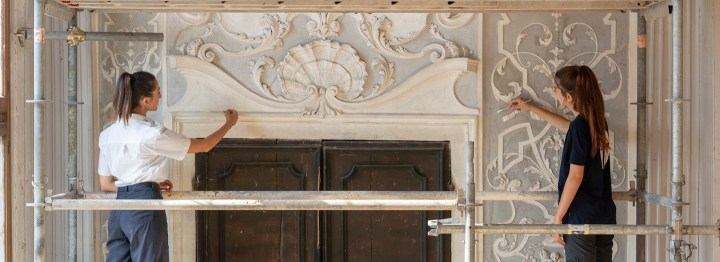
IVBC students restoring the stuccowork in the orchestra rehearsal room, summer 2023
(Venice: Palazzo Pisani; photo by Matteo De Fina)
◊ ◊ ◊ ◊ ◊
From the press release (via Art Daily) for the project (readers may know the Palazzo Pisani from the inclusion of its extraordinary rooftop for Hercule Poirot’s terrace earlier this year in A Haunting in Venice) . . .
Save Venice is proud to support the education and training of the next generation of art conservators by funding coursework and restoration fieldwork at the Istituto Veneto per i Beni Culturali’s restoration school. In 2023, this long-standing partnership fostered a new collaboration between the IVBC and Venice’s prestigious Conservatorio Benedetto Marcello in Palazzo Pisani, through a pilot initiative of conservation treatments funded by Save Venice with generous support by the Manitou Fund through Nora McNeely Hurley.
The 17th-century Palazzo Pisani, located next to Campo Santo Stefano, is the second largest palace in Venice, after Palazzo Ducale. The conservation of frescoes, stuccowork, and marble decoration in two rooms of the conservatory was undertaken in 2023 by the IVBC restoration school as a part of their post-graduate fieldwork program. The remarkable, initial results were presented to the public in December, and Save Venice is now continuing its engagement with the two institutions by funding a 2024 full-year program of stucco conservation in four rooms of the conservatory’s museum.
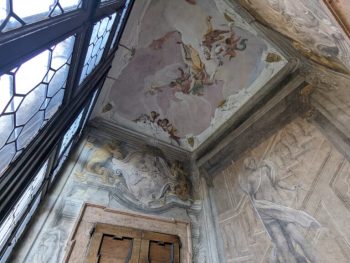
Fresco decoration in the antechamber (‘Adonis Room’), following conservation in 2023 (Venice: Palazzo Pisani; photo by Matteo De Fina).
Located on Palazzo Pisani’s 2nd floor—originally the primo piano nobile—the antechamber overlooks the interior courtyard and provides access to another, larger room. Frescoes, likely dating to the mid to late 18th century, adorn all four walls and depict illusionistic architecture with gargoyles and mythological and allegorical figures including Cupid, Venus, and Adonis. When the interior of the palazzo was heavily reworked in the 19th century, these frescoes were covered over for nearly a century before being revealed again in the mid-20th century.
The adjacent room—now used as the orchestra rehearsal room, as well as for art exhibitions—originally housed Almorò Pisani’s precious library and collection of medals and coins (sold in the 19th century). The rich stucco motifs feature mouldings with geometric designs intertwined with dynamic acanthus leaves, further enriched by coats of arms of the Catholic Church. Bas-relief portraits of John Calvin (on the north wall) and Martin Luther (on the south wall) may be attributed to the workshop of plasterers active at Palazzo Pisani in that period: Giuseppe Ferrari and Francesco Re.
Urgent intervention was needed to address the numerous cracks and fissures that were causing the delicate plaster to lift and detach from the wall beneath. The ornate decoration had been the subject of previous interventions involving the use of methods and materials that were not ideal. The stucco reliefs were whitewashed over with thick layer of lime milk and animal glues that had yellowed and distorted the elegant and refined detailing. The bas-reliefs of Calvinus and Luther were reworked using a yellow material that had discolored and was blotchy in appearance. Previous infiltrations of rainwater from the roof had left stains on the walls, and damp that passed through from the exterior masonry allowed for the formation of salt deposits. A thick layer of dirt and grime and other non-original surface residues were carefully removed, isolated areas of losses to the stucco decoration were recomposed, and the water damage and salt deposits were treated.
New Report | Survey of Asian Ceramics, National Trust for Scotland
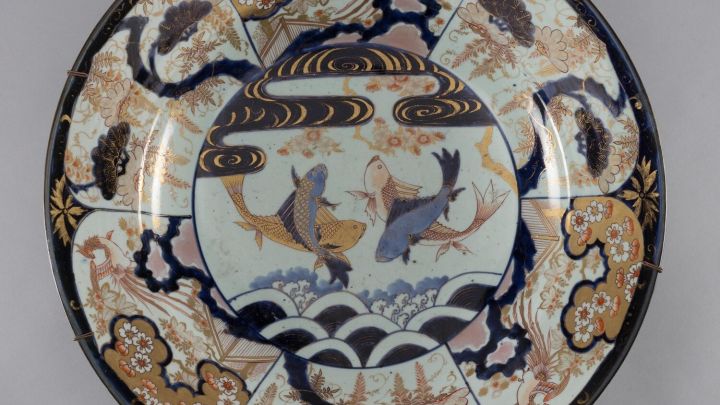
Large dish, porcelain, painted in underglaze blue, iron-red, and gold, Imari-type palette, made in Arita kilns, Japan, Edo period, c.1700–20
(National Trust for Scotland)
◊ ◊ ◊ ◊ ◊
The report was released early this year; Patricia Ferguson provides an introduction here. The full report is available (for free) as a PDF file here.
Patricia Ferguson, Survey of Asian Ceramics in the Collection of the National Trust for Scotland (National Trust for Scotland, 2023), 162 pages.
Between 2017 and 2019 the National Trust for Scotland delivered Project Reveal, a major collections project inventorying a collection of over 140,000 objects, distributed across 50 properties throughout Scotland. Encompassing major object groupings in the areas of fine and decorative art, household furniture and domestic life, these collections chart the experiences of people living in Scotland through 500 years of Scottish history, as well as demonstrating Scotland’s past relationships with the rest of the world.
This survey of Asian ceramics is a natural successor to Project Reveal. It delves deeper into the history and significance of a collection of circa 1,700 ceramic items. Undertaken by the independent researcher Patricia F. Ferguson this report sets out the survey findings, drawing together disparate existing research on the subject and contributing new collection research and knowledge. Focusing on key collections at nine different National Trust for Scotland properties, the report positions the collections within the broader context of historic ceramic production and collecting, with attention to influences such as: fashion and the role of royalty; production in and trade with China and Japan; and the growth of and changes in demand.
Patricia Ferguson is a ceramic specialist with an MA from the School of Oriental and African Studies (SOAS), London. She has worked in London at the British Museum and Victoria & Albert Museum, and as Honorary Adviser on Ceramics to the National Trust (England, Wales, and Northern Ireland). She published Ceramics: 400 Years of British Collecting in 100 Masterpieces in 2016.
New Book | America’s Collection
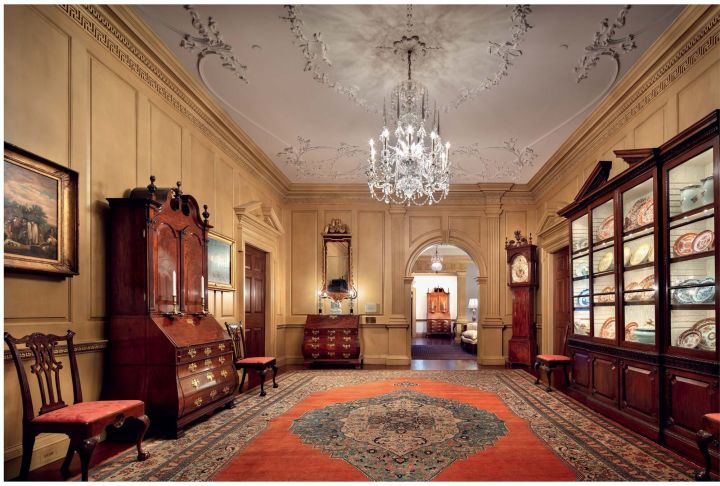
The entrance hall of the Diplomatic Reception Rooms at the U.S. Department of State; completed in 1979, the room includes a rococo ceiling taken in part from Philadelphia’s Powel House, now installed as a period room at the Philadelphia Museum of Art (Photograph by Durston Saylor). For more information on the book and the history of the reception rooms, see James Tarmy’s August 24th article for Bloomberg.
◊ ◊ ◊ ◊ ◊
From Rizzoli:
Virginia Hart, America’s Collection: The Art and Architecture of the Diplomatic Reception Rooms at the U.S. Department of State (New York: Rizzoli Electa, 2023), 352 pages, ISBN: 978-0847873272, $100. With a foreword by John Kerry and contributions by Bri Brophy, Allan Greenberg, Mark Alan Hewitt, Stacy Schiff, Elizabeth Mankin Kornhauser, Alice Cooney Frelinghuysen, Alexandra Alevizatos Kirtley, Elliot Bostwick Davis, Deborah Dependahl Waters, David Rubenstein, Carolyn Vaughan, and Laaren Brown.
The first volume in more than 20 years tells a new and modern story of the U.S. State Department’s Diplomatic Reception Rooms, one of the top collections of American fine and decorative arts in existence.
 The art of United States diplomacy has been conducted over more than two centuries with figures from all over the world, in peacetime and in conflict. For the last six decades, these negotiations have taken place in the rarified environment of the Diplomatic Reception Rooms at the U.S. Department of State. Tucked inside the modern Truman Building in the center of Washington, D.C., lies this special suite of rooms transformed by four renowned architects—gems of classical architecture brimming with exceptional American art and artifacts that tell the story of the nation’s founding and represent the singular ideals of the American character.
Housing one of the finest collections in the world, along with The Metropolitan Museum of Art and Winterthur, these rooms display more than 5,000 objects, including paintings by John Singleton Copley and Gilbert Stuart; silver and porcelain owned by George Washington and other presidents; fine furniture; maps and documents; prints and drawings, not to mention the very desk the Treaty of Paris that ended the Revolutionary War was signed on. With all-new photography and essays, this book captures the history of the rooms and explores more than 150 examples of the extraordinary American art that animates the exquisite spaces.
Virginia B. Hart is director and curator of the Diplomatic Reception Rooms and Bri Brophy is deputy chief curator. The Honorable John F. Kerry is U.S. Special Presidential Envoy for Climate, and former U.S. Secretary of State. Allan Greenberg is an architect and author. Mark Alan Hewitt is an architect and architectural historian. Stacy Schiff is a Pulitzer-Prize-winning author. Elizabeth Mankin Kornhauser is the Senior Curator for the 2026 Bicentennial at Frederic Chruch’s home Olana and Curator Emerita of American Paintings and Sculpture at The Metropolitan Museum of Art. Alice Cooney Frelinghuysen is the Anthony W. and Lulu C. Wang Curator of American Decorative Arts at The Metropolitan Museum of Art. Alexandra Alevizatos Kirtley is the Montgomery-Garvan Curator of American Decorative Arts at the Philadelphia Museum of Art. Elliot Bostwick Davis is Senior Editor, Harvard Social Impact Review, Arts and Culture and a former museum curator and director. Deborah Dependahl Waters is an independent decorative arts historian and part-time assistant professor at Parsons, New School University. David M. Rubenstein is a financier and philanthropist. Carolyn Vaughan is a writer and editor of art books and exhibition catalogues. Laaren Brown is a writer and editor for art and natural history topics. Durston Saylor is a photographer of contemporary interior design and architecture. Bruce M. White is a photographer of works of art and historic architecture. Sarah Gifford is an award-winning graphic designer.
Cultural Heritage Magazine, October 2023

Detail from one of a pair of Spanish-colonial screens depicting a landscape in the Japanese style, possibly made in Mexico City, perhaps 1660s, pigments on paper embellished with embossed and gilded clouds and arches, each screen 249 × 340 cm (Ham House, Surrey, NT 1139576, photograph by Leah Ban).
◊ ◊ ◊ ◊ ◊
Cultural Heritage Magazine is published twice each year, in May and October by the National Trust:
Cultural Heritage Magazine, issue 3 (October 2023)
4 Welcome — John Orna-Ornstein, the National Trust’s Director of Curation and Experience, introduces the autumn issue
6 Briefing: News, events, and publications, plus research and conservation round-ups
Taking the plunge | Archaeological excavations in the basement below Bath Assembly Rooms have revealed the remains of a rare 18th-century cold bath. It is thought to be the only one of its kind located in a historic assembly room, which in the 18th and 19th centuries was a popular place of entertainment, conversation, dancing, and gambling in fashionable towns. In the 18th century, medical practitioners recommended cold bathing as beneficial for various physical and mental ailments, including gout. As a result, plunge pools and cold baths surged in popularity . . . (7).
14 In Conversation — James Rothwell talks to John Benjamin about the National Trust’s under-explored jewellery collections
24 Textile Transmissions — James Clark and Emma Slocombe on repurposing church vestments in the Reformation

Nostell, West Yorkshire, neo-classical lodge, designed by Robert Adam, 1776–77, sandstone ashlar (purchased with HLF funds, 2002). Included in 60 Remarkable Buildings of the National Trust.
34 Set in Stone — George Clarke and Elizabeth Green discuss their shared love of built heritage
Preview of Green’s 60 Remarkable Buildings of the National Trust (National Trust Cultural Heritage Publishing, 2023), which includes an introduction by Clarke.
42 Modern Lives — John Chu and Sean Ketteringham on new research into 20th-century art collections
50 Election Threads — Helen Antrobus on dress, domesticity, and politics
60 Borrowing a Landscape — Emile de Bruijn on a Japanese-style folding screen at Ham House
Preview of de Bruijn’s Borrowed Landscapes: China and Japan in the Historic Houses and Gardens of Britain and Ireland (National Trust and Bloomsbury, 2023).
68 Acquisitions: Selected highlights, 2022–23
Acquisition of an important group of items historically associated with Chirk Castle, Wrexham (acquired by purchase, 2023) . . . The acquisition includes four important early 18th-century landscape paintings depicting the Chirk estate, three by the artist Pieter Tillemans (1684–1734) and one by John Wootton (c.1682–1764); family portraits by artists including Sir Godfrey Kneller and Sir Peter Lely; rare 17th-century furniture in the Servants’ Hall; estate documents including a manuscript of 1563 that shows the first known depiction of Chirk; Neo-classical furniture by Ince and Mayhew; and historic artefacts including items associated with the English Civil War and a rare 17th-century Puritan hat (69).
74 Meet the Expert, Heather Caven, Head of Collections Management and Care
18th-Century Hearth Cooking at the Queens County Farm Museum
From Eventbrite and Queens County Farm Museum:
Chris Lord-Barry, 18th-Century Hearth Cooking
Queens County Farm Museum, Floral Park, New York, Saturday, 4 November / 11 November 2023, 11am — 2pm
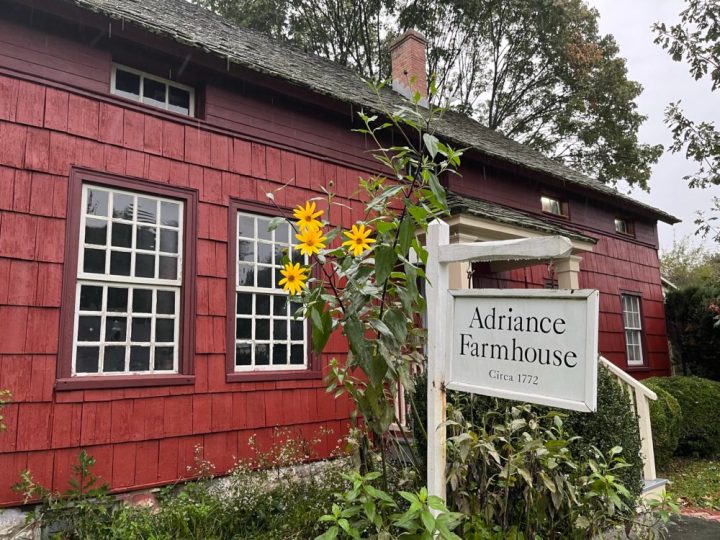
Join us in the kitchen of the Adriance Farmhouse at Queens County Farm Museum to learn how settlers prepared food over an open hearth.
 Original 18th-century recipes, seasonal ingredients, traditional cooking utensils, and the warm embers of the fire will bring history to life as participants assist in preparing and sampling several delightful dishes. Participants will receive modern adaptations of all recipes to try at home. Advance online tickets ($53) are required as space is limited. The class is part of the Public Education Program at Queens Farm and is open to ages 18 and up. In the fall the session is offered on November 4 and then repeated on November 11.
Chris Lord-Barry is an educator with over 20 years of experience, who specializes in teaching 18th-century cooking. Over the past 10+ years, she has studied historic cookery and foodways specific to early America and has designed this popular class to share her passion for early American recipes with others.
The Queens County Farm Museum is a New York City Landmark, is on the National Register of Historic Places, and is a member of the Historic House Trust of New York City. Dating back to 1697, it occupies New York City’s largest remaining tract of undisturbed farmland and is one of the longest continuously farmed sites in New York State. The site includes historic farm buildings, a greenhouse complex, livestock, farm vehicles and implements, planting fields, an orchard, and an herb garden. Queens Farm connects visitors to agriculture and the environment through the lens of its 47-acre historic site, providing learning opportunities and creating conversations about biodiversity, nutrition, health and wellness, climate change and preserving local history. The centerpiece of the farm complex, the Adriance Farmhouse was first built as a three-room Dutch farmhouse in 1772. The house and surrounding area mirror the evolution of this unique tract of land from a colonial homestead to a truck farm that served the needs of a growing city in the early twentieth century. . .
Exhibition | The Petit Trianon during the Empire
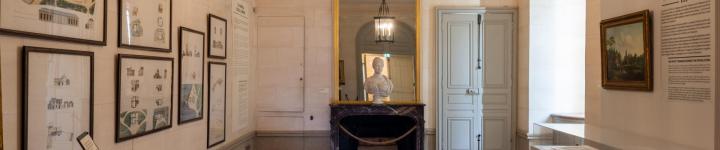
Installation view of The Petit Trianon during the Empire, 2023
(Photo by Sebastien Giles)
◊ ◊ ◊ ◊ ◊
On view this summer at the Château de Versailles:
The Petit Trianon during the Empire
Petit Trianon, Château de Versailles, 13 May — 17 September 2023
Presented by the Palace of Versailles, The Petit Trianon during the Empire tells the story of the restoration undertaken to turn Trianon into a country residence for Napoleon and Marie-Louise. The exhibition explains the work ordered by the emperor to restore the houses in the Hamlet, the farm, and the orangery—work that had become essential after twenty years of neglect.
During the Empire, the Petit Trianon was chosen as a country residence by Napoleon Bonaparte and his wife, Marie-Louise of Habsburg. Two decades of neglect, however, had left the houses in the Hamlet, the farm, and the orangery in urgent need of restoration. The work was carried out between 1805 and 1811, overseen by the architect Guillaume Trepsat and his assistant, Alexandre Dufour.

Installation view of The Petit Trianon during the Empire, 2023 (Photo by Sebastien Giles).
The working dairy, the barn, and the farmer’s cottage were all demolished. The farm was converted into a guard house, while the rest of the structures were restored and the thatched rooves repaired. The external staircases were removed, apart from the spiral staircase on the Queen’s House, which was replaced by a straight, covered staircase. The houses in the Hamlet reverted to the same use as under the Ancien Régime, with all the furniture and wall hangings replaced by classical, Empire-style pieces made by the cabinet-makers Jacob-Desmalter and Marcion, and the bronze-worker Galle.
Napoleon and Marie-Louise hosted several parties at the theatre and in the French Garden between 2 and 11 August 1810, and again, the following year, on 25 August, in the English Garden and the restored Hamlet, to celebrate the birth of their son. These parties harked back to the wonderful celebrations organised by Marie-Antoinette. The restoration work meant the heritage of the Petit Trianon was both protected and revived.
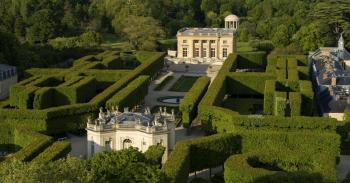
The Petit Trianon with the French Pavilion in the foreground at the left (Photo: Thomas Garnier).
During the French Revolution, from 1792, the Petit Trianon and the Queen’s Hamlet were emptied of their inhabitants and all their contents. The furniture, artworks, and everyday household items, such as mattresses, sheets, and cookware, as well as the fish in the lakes, were all auctioned off. The palace was rented to a restaurateur, while the garden became a public recreation area. The French Pavilion was turned into a café, the farm was rented to and worked by a farmer, and another restaurateur moved into the Queen’s House in the Hamlet.
By the beginning of the 19th century, the Hamlet was overgrown and decrepit. The roofs of several of the houses had collapsed and the external staircases were rotten. Two of the agricultural buildings—the barn and the working dairy—lay in ruins and the farm had been partially destroyed by fire. Sketches made by the English traveller and draughtsman John Claude Nattes in 1802 illustrate this state of neglect.
New Installation | Joana Vasconcelos’s Wedding Cake at Waddesdon
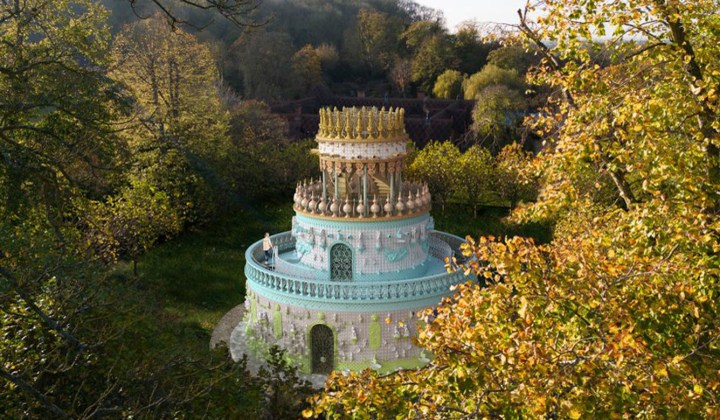
Joana Vasconcelos, Wedding Cake, at Waddesdon Manor in Aylesbury, installed 2023.
◊ ◊ ◊ ◊ ◊
From the press release for the new installation at Waddesdon:
Joana Vasconcelos: Wedding Cake at Waddesdon
The Dairy at Waddesdon Manor, open from 8 June 2023, with tours available until 26 October
Wedding Cake—a 12-metre-high sculptural pavilion in the form of a three-tiered wedding cake, clad entirely in ceramic tiles—is a major new work at Waddesdon by celebrated Portuguese artist Joana Vasconcelos (b. 1971). Almost five years in the making, Wedding Cake was commissioned by the Rothschild Foundation for Waddesdon, prompted by the relationship between visionary collector Lord Rothschild and Vasconcelos.
Part sculpture, part architectural garden folly, Wedding Cake is an extraordinary, enormous, fully immersive sculpture that combines pâtisserie and architecture. Gleaming and icing-like outside and in, it offers an intricate and richly sensory experience—glazed in pale pinks, greens, and blues, beset with sculptural ornament, and complete with the sounds of trickling water and a site-specific lighting scheme. Wedding Cake is Vasconcelos’s most ambitious commission to date, described by the artist as “a temple to love” celebrating festivity and marriage.
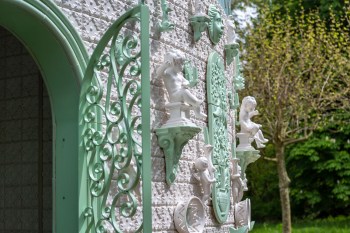
Joana Vasconcelos, Wedding Cake, at Waddesdon, detail of the ground level.
The history of the wedding cake is long and varied, full of symbolism and tradition—from ancient Rome where bread was broken over the bride’s head to bring good fortune to the couple, to contemporary confections that embody celebration and social status. Vasconcelos’s Wedding Cake is a playful addition to this rich history. Inspired by the exuberant Baroque buildings and highly decorative ceramic traditions of Lisbon—where Vasconcelos lives and works—the work is also a contemporary response to the great Rothschild traditions of hospitality with echoes of 18th-century garden pavilions.
At Waddesdon Wedding Cake will stand in a grove of trees alongside the 19th-century Dairy, built by Baron Ferdinand de Rothschild to entertain and charm guests at his famous house parties, and described by contemporaries as “a treasure house of what is beautiful, curious, or ancient.” It reminds us of the long European history of placing fanciful buildings in gardens and landscapes and forms part of a growing collection of significant contemporary and historic sculpture, brought together by Lord Rothschild. Today, the Dairy is still a much sought-after entertaining space, and the presence of the Wedding Cake, a symbol of love and happiness, is a perfect complement.
Wedding Cake is emblematic of Vasconcelos’s practice. She is deeply influenced by the artistic traditions of her home country, and the way in which she combines her materials reflects international influences on Portuguese culture over centuries—born from a history of exploring and seafaring, from Chinese and Japanese ceramics to Brazilian carnival, incorporating colour and light. Her work is often playful, manipulating scale to dramatic effect and using familiar daily objects in surprising, charming, and inventive ways. On a deeper level, her work explores notions of domesticity, femininity, empowerment, and the tension between private and public realms.
Vasconcelos’s work often challenges the assumptions of traditional hierarchies of ‘noble’ materials, such as marble, used frequently to embellish grand structures and often set above more everyday substances like ceramics and textiles. Her practice champions traditional, hand-made objects and techniques, and the ceramics for Wedding Cake have been made by the Viúva Lamego manufactory, which has been operating in Sintra for 170 years. The company’s standard 14×14cm tiles determined the size of the overall structure of Wedding Cake, whose 11m diameter is the smallest circle that can be made with whole tiles.
At Waddesdon, this combination of materials and the exploration of scale and technique is a perfect fit. The house is famous for its ceramics, particularly Sèvres and Meissen porcelain. The fashions and traditions of 18th- and 19th-century dining, entertaining, and festivity are also deeply embedded in the collections, whether a silver dinner service made for King George III, an 18th-century book recording the festivities laid on to mark a royal wedding, or a manual illustrating sugar sculpture. The sumptuous decoration of the Wedding Cake also speaks to the architecture of the house, itself covered in ornament and designed to complement the collections inside and the carefully laid out garden and landscape. These include the fanciful buildings in Waddesdon’s grounds like the Dairy, Flint House, and the Aviary, all intended to surprise and delight visitors.
According to Joana Vasconcelos, “An enormous project such as this one could only happen with the vision and encouragement provided by a generous and extraordinary patron such as Lord Rothschild. He could see its dreamlike potential, believe in it, and provide the means to make it come true. I have been addressing the subject of love through my career for almost 30 years now, but this is my biggest challenge so far. Many artists have the ‘impossible project’ and this is mine. I wanted people to have three different approaches to it: looking from the outside, enjoying the surroundings from the different levels or balconies, and rising to the top, finally completing the artwork with their presence. Above all, I always thought of it as a temple to love.”
Lord Rothschild says, “We are delighted to be collaborating again with Joana Vasconcelos, whose work is already magnificently represented at Waddesdon by her giant candlesticks, Lafite. The vision, imagination, and ambition exemplified in the Wedding Cake is a perfect match for the passion which drove Baron Ferdinand, the creator of Waddesdon, to build the Manor and the Dairy, where he intended that his many friends would be surprised and delighted at every turn. I am sure that the Wedding Cake will have just as great an impact on visitors and wedding guests today.”
Pippa Shirley, Director of Waddesdon says, “Waddesdon was built to entertain; so, what better way to mark the continuity today of that spirit of hospitality, artistic creativity, and Rothschild family patronage than through the commission of this magical object, an emblem of love and celebration. Projects like this require a leap of faith from both artist and patron, and we are proud to have been a partner in this innovative work.”
Recipe for Wedding Cake
• 1 creative artist
• 1 visionary patron
• 2 international teams
• Pinch of experts
• 3500 wrought iron parts
• 21,815kg iron sheet
• Approximately 25,150 Viúva Lamego ceramic tiles (99 different types) and 1,238 Viúva Lamego ceramic pieces (52 different types). Ceramic tile area: 365 m2
• Plethora of ornaments — mermaids, dolphins, candles, globes, etc
• Indoor and outdoor lights — 350 glass flames receiving optical fiber (about 3,000 meters)
• 592 light points
• Rivers of glaze
• Sprinklings of water
• Hope, belief, and effort
Blend the circa 50 tons with generous amounts of creativity and patience. Bind into different panels; raise tier by tier to height of 12 meters. Assemble at Waddesdon. Serve with love.
Joana Vasconcelos’s Lafite, two giant candlesticks made of illuminated Chateau Lafite Rothschild magnums (commissioned in 2015 by the Rothschild Foundation in celebration of the family associations with the world of great Bordeaux wine), will be moving to the Dairy. In 2012, her Pavillon de Thé, a giant wrought-iron tea pot, was the focal point of House of Cards, a contemporary sculpture exhibition in the gardens, and in 2016 her Cup Cake (2011) was exhibited on the North Front.
Vasconcelos’s work is also represented in major collections around the world, such as those of Calouste Gulbenkian, François Pinault, and the Louis Vuitton Foundation. She has exhibited regularly since the mid-1990s. Her work became known internationally after her participation in the 51st Venice Biennale in 2005, with the work A Noiva [The Bride] (2001–05). She was the first woman and the youngest artist to exhibit at the Palace of Versailles, in 2012. Other highlights of her career include a solo exhibition at Guggenheim Museum Bilbao (2019); the project Trafaria Praia for the Pavilion of Portugal at the 55th Venice Biennale (2013); the participation in the group exhibition The World Belongs to You at the Palazzo Grassi/François Pinault Foundation, Venice (2011); taking part in Un Certain Etat du Monde? A Selection of Works from the François Pinault Foundation at the Garage Center for Contemporary Culture in Moscow (2013); and her first retrospective Sem Rede held at the Museu Coleção Berardo, Lisbon (2010). Her solo show Time Machine was on view at Manchester Art Gallery in 2014; in London she exhibited at Royal Academy of Arts’ Summer Exhibition in 2018; and she was given a major show at the Yorkshire Sculpture Park, Beyond in 2021.
Visitors to Waddesdon will be able to visit Wedding Cake on a guided tour that will include the impressive collection of contemporary sculpture situated in the Water Garden at the Dairy. Wedding Cake tours will run from 8 June until 26 October on Thursdays and selected Sundays.
Cultural Heritage Magazine, May 2023

Cultural Heritage Magazine is published twice each year, in May and October by the National Trust:
Cultural Heritage Magazine, issue 2 (May 2023)
4 Welcome — Tarnya Cooper, the National Trust’s Curatorial and Conservation Director introduces the spring issue
6 Briefing: News, Events, and Publications, Plus Research and Conservation Round-ups
A la Ronde Interiors: The major project to conserve and repair this unique 18th-century property has now begun in earnest, with specialists working to secure the fragile and intricate decorative features. A la Ronde is a 16-sided house designed to catch the natural daylight through its unusual diamond-shaped windows as the sun moves around the building. The creation of Jane and Mary Parminter, two dynamic and well-travelled cousins who commissioned the house following their travels across Europe, it originally sat within a wider estate containing almshouses, gardens, a chapel and orchards.
14 In Conversation — John Orna-Ornstein talks to Tristram Hunt about design, creativity and the heritage sector today
24 Treasured Connections, Treasured Possessions: The Formation of Margaret Greville’s Collection — Richard Ashbourne, James Rothwell, and Alice Strickland
Treasured Possessions: Riches of Polesden Lacey — A major exhibition marking 80 years since Dame Margaret Greville left Polesden Lacey and her collection to the National Trust (1 March — 29 October 2023).
34 Dynamic and Resonant: The Sculpture of Anthony Twentyman at Dudmaston — Brendan Flynn
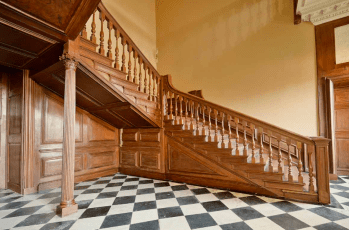
Old Staircase of Dyrham Hall, in 2019 after restoration, with old paint removed and completed graining (Photo: National Trust/David Evans).
40 Dyrham Transformed: Revealing Hidden Schemes and Re-examining Historic Narratives — Eilidh Auckland, Amy Knight-Archer and Claire Reed
Crossing the threshold back in 2015, there was a sense that something had been lost. Rooms and staircases had been painted white, decorative surfaces had deteriorated and spaces that had once glittered in candlelight seemed dimly lit and uninspiring. The National Trust’s project to transform the house, recently completed, has attempted to recapture something of its original vibrancy and dynamism and to enable visitors to step inside the world of the late 17th century. Historic schemes and historic narratives have been uncovered and unpicked, and the project concluded with the installation of new interpretation in January 2023. . . Senior National Curator Rupert Goulding’s research of the Blathwayt archives, which are scattered around the world, fuelled the core narrative.
Following this extensive research and preparation, those schemes that were anachronistic or failing were selected for re-presentation, with the aim of recreating the interiors of 1692–1710. This was the period in which the current house was built and furnished by William Blathwayt, then at the peak of his career.
As work to the main body of the house progressed, the stories it had to tell came into sharper focus. The building of the house at Dyrham Park took place in the early years of the transatlantic slave trade and William Blathwayt was one of the key colonial figures of that time. As Surveyor and Auditor General of Plantations, Blathwayt accounted for income due to the Crown from different royal colonies. He received part of his salary from colonies that were economically reliant on slavery—Barbados and Virginia each contributed £150 per year (the equivalent of around £18,000 today). Blathwayt’s house reflected his colonial connections. . .

From Melchisédech Thévenot, The Art of Swimming (1699) (National Trust Images/ Leah Band).
50 Sink or Swim: An Intriguing Manual from Kedleston’s Library — Nicola Thwaite
Melchisédech Thévenot (c.1620–92), a French diplomat fluent in several languages, was appointed Royal Librarian to Louis XIV in 1684. . . . Thévenot’s L’art de Nager—published posthumously in 1696—was largely based on De Arte Natandi by the English clergyman Everard Digby (d.1605), although there is only a brief acknowledgement of this in Thévenot’s preface. An English translation—The Art of Swimming—was published only three years later in two issues and both French and English editions were reissued over the next century, indicating a contemporary demand for instruction on the subject.
54 Shaped by Love and Loss: A Collection of Ancient Greek Vases at Nostell Priory — Abigail Allan
Nostell is full of treasures. Among the less well-known items is a group of painted Greek vases made in Athens and South Italy c.500–300BC, which were collected by John Winn (c.1794–1817) and his younger brother Charles (1795–1874). Mistakenly called ‘Etruscan’ until the mid-19th century, these 12 vases once belonged to a collection of over 130 at Nostell, sold at Christie’s in 1975 and 1998, before some were repurchased by the National Trust.
62 Loans: Selected Highlights, 2023
68 Meet the Expert: Lottie Allen, Head Gardener at Hidcote Manor, Gloucestershire










 Enfilade
leave a comment