Decorative Arts Trust Internship Grant to Focus on John Ashley House

John Ashley House, Sheffield, Massachusetts (photo from Wikimedia Commons, July 2007). Built in 1735, the house is owned and operated by The Trustees of Reservations.
◊ ◊ ◊ ◊ ◊
As an anchor site of the Upper Housatonic Valley African American Heritage Trail, the Ashley House is important for its connection to Elizabeth Freeman (Mum Bett), who was enslaved there before suing for–and winning–her freedom in 1781 under Massachusetts’ newly ratified state constitution. Readers may recall that a statue of Freeman was unveiled in Sheffield just a few months ago.
From The Decorative Arts Trust press release:
The Decorative Arts Trust is pleased to announce that The Trustees of Reservations (The Trustees) of Boston, MA, will serve as our 2023–25 Curatorial Internship Grant partner.

Susan Ridley Sedgwick, Portrait of Elizabeth Freeman (Mum Bett), ca. 1812, watercolor on ivory (Boston: Massachusetts Historical Society).
The two-year internship will focus on the Colonel John Ashley House in Sheffield, MA. The house’s importance primarily derives from a connection with Mum Bett, an enslaved woman who sued Ashley for her freedom along with an enslaved man named Brom. The intern will lead an in-depth analysis of the objects contained within the Ashley House with the aim to create easy access to all records through the Trustees’ new online collections interface. The intern will also develop a furnishing plan for the Ashley House that synthesizes a refined understanding of the contents and the interiors in which they are displayed. Based in Stockbridge at the Trustees’ Mission House, the intern will work alongside the organization’s highly regarded curatorial staff, including Christie Jackson, Director of Collections, and Mark Wilson, Associate Curator.
The Decorative Arts Trust is a nonprofit organization that underwrites curatorial internships for recent Masters or PhD graduates in collaboration with museums and historical societies. These internships allow host organizations to hire a deserving professional who will learn about the responsibilities and duties common to the curatorial field while working alongside a talented mentor.
The Trustees is the oldest conservation and preservation nonprofit of its kind in the country and the largest in Massachusetts, where it has protected 123 diverse sites, spanning more than 27,000 acres, including 20 historic houses and more than 50,000 objects.
Michelangelo as Pan?

Joseph Vernet, detail of a sketch showing the statue of Pan (with fig leaf), by the Aurelian Walls that bounded the Villa Ludovisi to the north, 1737. From D. Cordellier, P. Rosenberg, and P. Märker, Dessins français du musée de Darmstadt (2007), 459.
◊ ◊ ◊ ◊ ◊
I suspect many readers will find this series of postings about a Pan sculpture from Rome’s Villa Ludovisi of interest. Whatever the status of the attribution (itself intriguing), the statue clearly was linked with Michelangelo in the eighteenth century. –CH
Hatice Köroğlu Çam, “A New Self-Portrait of Michelangelo? The Statue of Pan at the Casino dell’Aurora in Rome,” 4 parts, Archivio Digitale Boncompagni Ludovisi (2022–23).
“Part 1: Correspondences” (20 March 2022).
“Part 2: Testimonia: Sketches and Earlier Inventories” (12 September 2022).
“Part 3: Reception” (5 November 2022).
“Part 4: Physical Condition and Conservation Mandates” (5 May 2023), a good place to start as it summarizes the earlier essays.
From Part 1, at the Archivio Digitale Boncompagni Ludovisi:

Pan, attributed to Michelangelo at the Casino dell’Aurora. Collection †HSH Prince Nicolò and HSH Princess Rita Boncompagni Ludovisi, Rome (Photo by T. Corey Brennan, October 2022).
A statue of Pan, for centuries located in the garden of Rome’s Villa Ludovisi, since 1901 has stood unprotected outside the southwest wing of the Casino dell’Aurora. Traditionally attributed to Michelangelo Buonarroti (1475–1564), and once deemed of great monetary value (4000 scudi in a 1749 Boncompagni Ludovisi inventory), it undoubtedly exhibits characteristic features of the master’s sculptural language.
Yet most surprisingly there is no detailed study focusing on this statue. The most recent treatment, that of Maria Elisa Micheli (Museo Nazionale Romane: Le Sculture I.6 I marmi Ludovisi dispersi [1986]), fills not quite a page and a half. Micheli dismisses seventeenth- and eighteenth-century attributions of the Pan to Michelangelo, considering it instead “a modern work of the late sixteenth century.”
The verdict strikes me as too hasty. After comparing the stylistic language of the Pan to that of Michelangelo in a wide range of his sculptures, paintings, and drawings, I have come to the conclusion that even if the sculpture is not by Michelangelo, it highlights many features of his style to a remarkable extent. And those attributes are recognizable even given the fact that the Pan today shows an unfortunate loss of details, especially the face—clear when comparing historic photos of the statue (from 1885) with its present state. . . .
The full posting is available here»
Hatice Köroğlu Çam studied journalism for three years with a double major in art history at Istanbul University in Turkey and then received her BA in art history at Rutgers University (2022), where she wrote her honors thesis on “Decoding Michelangelo’s Passion: Laocoön and Tityus.” She interned at the Archivio Digitale Boncompagni Ludovisi in the Spring and Summer of 2022, which made possible a visit to the Casino dell’Aurora, the home of Princess Rita Boncompagni Ludovisi, in July 2022. Hatice is currently on the staff of the museum store of the Princeton University Art Museum and plans to pursue her academic journey towards a PhD, including further research into the Pan project.
◊ ◊ ◊ ◊ ◊
More information about the Archivio Digitale Boncompagni Ludovisi—initiated by T. Corey Brennan (Rutgers University) while Andrew W. Mellon Professor in the American Academy in Rome (2009–12)—is available here.
◊ ◊ ◊ ◊ ◊
Note (added 5 May 2023) — The posting was updated to include a link to Part 4 of the series of essays.
Strawberry Hill Acquires Walpole’s Iconic Blue and White Tub
Yes, that tub! Lots of places to go for more information, but one might start with Luisa Calè, “Gray’s ‘Ode’ and Walpole’s China Tub: The Order of the Book and The Paper Lives of an Object,” Eighteenth-Century Studies 45.1 (Fall 2011): 105–25. From the press release, via Art Daily:
 One of the most iconic and macabre objects owned by Horace Walpole (1717–1797) has been reacquired by Strawberry Hill House, thanks to the UK’s Acceptance in Lieu scheme. The beautiful, large blue and white vase achieved a certain notoriety after Walpole’s favourite cat, Selima, drowned in it while trying to catch goldfish, which the author kept in it. The incident was later immortalised in a mock-heroic ode by Walpole’s friend, the poet Thomas Gray, “Ode on the Death of a Favourite Cat, Drowned in a Tub of Gold Fishes” (1747).
The cat’s death actually occurred at Walpole’s London house, in Arlington Street. The bowl, along with many other works of art, was moved to Strawberry Hill sometime in the 1760s. In 1773, Walpole commissioned a Gothic-style pedestal for the tub and a label to be affixed to it with the first stanza of the poem. After 1778 the tub was moved to the Little Cloister, outside of the house, with the 1784 Description describing the new location: “On a pedestal, stands the large blue and white china tub in which Mr. Walpole’s cat was drowned; on a label of the pedestal is written the first stanza of Mr. Gray’s beautiful ode on that occasion, ‘Twas on this lofty vase’s side, Where China’s gayest art has dy’d. The azure flow’rs that blow, Demurest of the tabby kind, The pensive Selima reclin’d, Gaz’d on the lake below’.”
Research prompted by last year’s In Focus exhibition devoted to the tub, together with the expertise required to secure its return to Strawberry Hill House, demonstrated that it is an outstanding work of art in its own right—albeit with an extraordinary backstory. The quality of every aspect of the jardiniere is superior; from the shaping of the pot, to the glazing and firing, all demonstrate a remarkable level of artistry.
Announcing the permanent return of the vase, Derek Purnell, Director, Strawberry Hill House & Garden, said: “Once again, we are grateful to the Acceptance in Lieu scheme, which has allowed us to reacquire one of the most iconic objects in the collection. An object whose true value recently emerged, thanks to the attention prompted by our 2021 In Focus exhibition featuring the goldfish bowl. Traditionally described as a typical 18th-century Chinese product, made for a foreign clientele, Walpole’s porcelain vase is in reality an older and more valuable object. The jardinière, of exceptional quality, dates from the 17th century and is decorated with a continuous design of the ‘Three Friends of Winter’—pine, prunus, and bamboo—within a fenced garden of rocks and plants.”
Edward Harley OBE, Chairman of the AIL Panel said: “This Chinese jardinière is remarkable for its association with Horace Walpole and the drowning of his favourite cat. It was placed on prominent display in the cloisters at Strawberry Hill during Walpole’s lifetime, and it is fitting that, thanks to the Acceptance in Lieu scheme, it has been returned to its former home.”
Arts Minister Stuart Andrew said: “The Acceptance in Lieu scheme exists so important works of art and heritage objects can be owned by the nation and displayed for everyone to enjoy. It is fantastic that this vase has been returned to Horace Warpole’s former estate where it can go on permanent display in its rightful home.”
The porcelain vase will go on permanent display in the Hall at Strawberry Hill House, from Wednesday, 26 October 2022.
Statue of Elizabeth Freeman Unveiled in Massachusetts
On Sunday (21 August) a statue of Elizabeth Freeman (ca.1744–1829) was unveiled in Sheffield, Massachusetts, as reported by the Associated Press:
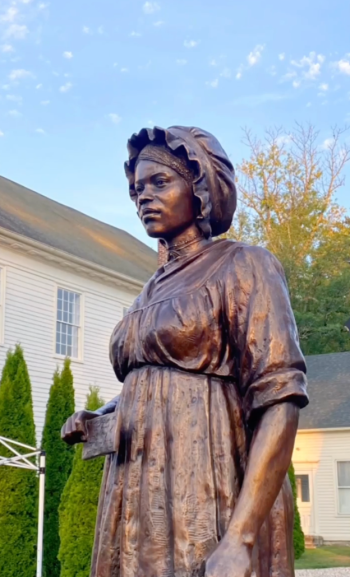
Brian Hanlon, Elizabeth Freeman, 2022 (Photo from the artist’s Instagram, hanlonstudio1). As noted by @PhyllisASears at Herstorical Monuments, there is also a sculpture of Freeman at the National Museum of African American History and Culture in Washington, DC.
The story of an enslaved woman who went to court to win her freedom [in 1781] more than 80 years before the Emancipation Proclamation had been pushed to the fringes of history.
A group of civic leaders, activists, and historians hope that ended Sunday in the quiet Massachusetts town of Sheffield with the unveiling of a bronze statue of the woman who chose the name Elizabeth Freeman, also when she shed the chains of slavery 241 years ago to the day.
Her story, while remarkable, remains relatively obscure. . . .
The enslaved woman, known as Bett, could not read or write, but she listened. And what she heard did not make sense.
While she toiled in bondage in the household of Col. John Ashley, he and other prominent citizens of Sheffield met to discuss their grievances about British tyranny. In 1773, they wrote in what are known as the Sheffield Resolves that “Mankind in a state of nature are equal, free, and independent of each other.”
Those words were echoed in Article 1 of the Massachusetts Constitution in 1780, which begins “All men are born free and equal, and have certain natural, essential, and unalienable rights.”
It is believed that Bett, after hearing a public reading of the constitution, walked roughly 5 miles from the Ashley household to the home of attorney Theodore Sedgwick, one of the citizens who drafted the Sheffield Resolves, and asked him to represent her in her legal quest for freedom, said Paul O’Brien, president of the Sheffield Historical Society.
Sedgwick and another attorney, Tapping Reeve, took the case. Women had limited legal rights in Massachusetts courts at the time, so a male slave in the Ashley household named Brom was added to the case. The jury agreed with the attorneys, freeing Bett and Brom on August 21, 1781. . . .
The full article is available here»
Exhibition | Design around 1800

Staatliche Kunstsammlungen Dresden:
Design around 1800 / Gestaltung um 1800
Schloss Pillnitz, Dresden
The Kaiserzimmer (imperial rooms) in Pillnitz Palace, still known to many as the Weinlig-Rooms, were reopened to the public in 2020 after several years of restoration. In the future, the new permanent exhibition Design around 1800 will be on display in the rooms steeped in history, showcasing outstanding arts and crafts pieces from the classicism period.

Centerpiece, French, ca. 1800, cast bronze, patinated and gilded, 49.7 cm high (Dresden: Kunstgewerbemuseum, 30982).
The time around 1800 was one of enormous dynamism: social, scientific, technological—the signs pointed everywhere to change, a new dawn, progress. Paradoxically, in the decorative arts the path to the future of design led back to classical antiquity. The excavations in Herculaneum and Pompeii from the middle of the 18th century and the beginning of intensive research triggered a new enthusiasm for antiquities. A decisive impulse for this came from Dresden. Johann Joachim Winckelmann (1717–1768) shaped the ideas of German classicism with his writings like no other. After the organically growing, wildly bizarre play of forms of the Rococo, ancient art offered new starting points, not only because of its clear structure and the ornamental and decorative world that was completely contrary to the Rococo. According to Winckelmann, Greek art had reached an aesthetic perfection that now had to be imitated.
The permanent exhibition Design around 1800 makes this spirit of classicism tangible on two levels. On the one hand, the lavishly restored imperial rooms, together with the preserved original interior, are themselves a splendid example of classicist interior design. The window and door crowns alone, finely proportioned in individual fields, illustrate the wealth of antique formal language: rams’ heads and sphinxes from ancient Egypt, scenes from Greek and Roman mythology, and ornaments such as urns, mascarons, palmettes, lotus blossoms, and acanthus foliage used in a quotation-like manner speak a clear picture.
The exhibition uses this early classicist interior, which is so important for Saxon art history, to illuminate various facets of applied art around 1800 on a second level. Here, the Kunstgewerbemuseum presents outstanding pieces of Classicist design from its own collection, including ceramics, textiles, glass and metalwork, furniture, paper wallpaper and clocks. Special attention is paid to the Saxon developments, the players acting in the environment of the Dresden court and the local craftsmanship of the time. For this purpose, the exhibits of the Kunstgewerbemuseum are additionally supplemented by loans from the Porcelain Collection, the Green Vault, the Numismatic Collection, and the Sculpture Collection.
After the first quarter of the 19th century, ancient art lost its primacy as a model. However, it never fell into oblivion again. In the stylistic melting pot of historicism, numerous classicist elements can be found, impressively seen, for example, in the works of the late Karl Friedrich Schinkel (1781–1841) and Gottfried Semper (1803–1879). Certain forms and ornaments also have a firm place in design, architecture and arts and crafts right up to the present day. In the exhibition, a separate room is dedicated to this classicist afterlife.
The archduke of Austria and Holy Roman Emperor Leopold II (1747–1792) was the name sponsor. On the occasion of the meeting with the Prussian King Frederick William II (1744–1797) in August 1791, the emperor took up residence in Pillnitz for a few days. The talks were later to go down in history as the Pillnitz Monarchs’ Meeting. As honored host for this event of European magnitude, the Saxon Elector Friedrich August III (1750–1827) had the wing buildings of the Bergpalais, which had been completed only a few months earlier, splendidly decorated. Just two years later, the palace inventory referred to the rooms in the west wing as ‘kayserliche Zimmer’.
The Imperial Rooms with their original wall paneling and carvings, mirrors, stove and fireplace are the only example of Early Classicist interior decoration around the Dresden court that has been preserved largely in its original state. During the extensive restoration of the rooms, the wall coverings in the two main rooms were also reconstructed with silk atlas fabric in the original color scheme, making the original design concept much more tangible again.
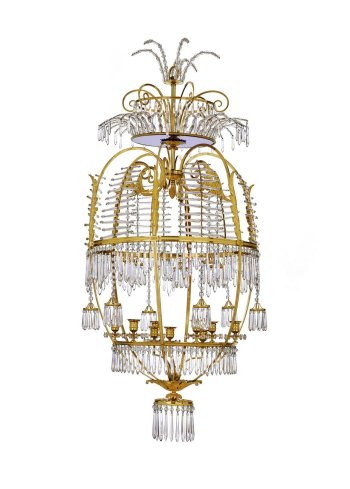 So far, there is no archival evidence of who designed the rooms. The attribution to and corresponding naming of the architect Christian Traugott Weinlig, which was valid for a long time due to stylistic analogies, is no longer supported by today’s research. Also in view of the approximation to the state of 1791 achieved during the restoration by the Sächsisches Immobilien- und Baumanagement (SIB), the name ‘Kaiserzimmer’, which was valid for a good 180 years, is now used again.
As the only object without a historical room reference, but with an all the stronger stylistic reference to Weinlig’s decorations, a new acquisition will be presented this fall, which the Kunstgewerbemuseum was able to realize with the support of the Ernst von Siemens Art Foundation: an early classicist chandelier in the shape of an egg. The chandelier is documented as a product of the Chursächsische Spiegelfabrik by a detailed review with accompanying pictorial plate in the March 1800 issue of the Journal des Luxus und der Moden. The piece is of outstanding quality, both in terms of design and technology. Its unconventional basket or egg shape is also a great unusual feature for the period of early classicism. The interplay of the gilded bronze frame with the richly varied Bohemian glass hanging is superb and testifies to the high level of Saxon craftsmanship of the time. In particular, the Chursächsische Spiegelfabrik was one of the leading Central European manufacturers of brass-mounted glassware and candlesticks around 1800.
New Exhibition | Governing the Nation from Fraunces Tavern, 1785–88
From the press release from the Fraunces Tavern Museum:
Governing the Nation from Fraunces Tavern, 1785–88
Fraunces Tavern Museum, New York, opening 22 June 2022
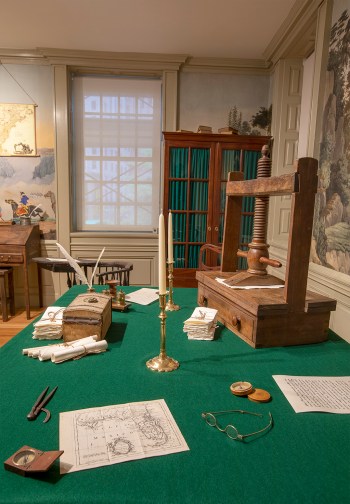
View of the negotiation table inside the Department of Foreign Affairs at Fraunces Tavern with map of east and west Florida in the foreground. Photo: Courtesy of Fraunces Tavern® Museum.
While Fraunces Tavern in New York City is one of the 18th century’s best-known taverns and the site of General George Washington’s famous farewell to his officers at the end of the American Revolution, it is less known that in the late 1700s, the site at 54 Pearl Street in lower Manhattan was also home to the nation’s first executive governmental building that housed three offices of the Confederation Congress. (Although Congress met in City Hall, the space was too small for the government’s departments and other office space had to be leased.) In 1785, the Department of Foreign Affairs, Department of War and offices of the Board of Treasury leased space at the Tavern and remained tenants there until 1788. Thanks to an extraordinary document—a cashbook that detailed the purchases for the Department of Foreign Affairs during its time at the Tavern that is now housed at the National Archives—the Department’s office will be recreated in a new permanent exhibition, Governing the Nation from Fraunces Tavern, set to open on June 22, 2022. Featuring approximately 60 objects, most of which are authentic to the period and many of which have never before been on public display, including tables, chairs, desks, maps, newspapers and other items, visitors will have the opportunity to travel back to post-colonial New York City and enter the Department of Foreign Affairs office as it appeared during a fascinating period in the nation’s history when John Jay was the first Secretary of Foreign Affairs. Visitors will learn about the diplomatic, military and financial challenges that all three departments faced after the Revolutionary War and how those challenges affected the formation of the U.S. Constitution.
“We are in the unique position of having access to a rare, surviving cashbook from the Department of Foreign Affairs,” explains Craig Hamilton Weaver, co-chairman of the Museum and Art Committee at Fraunces Tavern Museum. “We diligently researched each object in the cashbook and acquired authentic items to create an accurate setting that allows the visitor to step back into history. This is indeed a magnificent gift to the nation.”
 After an exhaustive search to locate objects that would have been found in the original office, visitors will not only see an extraordinary assemblage of fine American and British decorative arts, many pieces of which have been donated from private collections, but they will also gain insights into an often-overlooked period in American history. Objects such as A New and Accurate Map of East and West Florida Drawn from the best Authorities, a circa 1700s map engraved by J. Prockter, London, highlighting Spanish-controlled West Florida; a rare copy of the French-language newspaper Courier de L’Europe published in London on 29 September 1786, reporting on America’s diplomatic activities with Prussia and Spain; and an array of directional and mapping compasses will help to illustrate the Department’s first two pressing matters. The Barbary Pirate Crisis, which led to the 1787 diplomatic treaty with Morocco to end pirate seizures of American vessels in the Mediterranean Sea, and negotiations with Spain regarding control of the Mississippi River will be examined in the exhibition to offer visitors insights into what it took to form a new government as well as a deep appreciation for those individuals who rose to the challenge to do so.
“We want visitors to have an immersive experience,” said Scott Dwyer, director of Fraunces Tavern Museum. “The exhibition room was designed and will be arranged to give the sense that John Jay, his under secretary, diplomats, translators, clerks and messengers might enter and resume work at any moment.”
Additionally, the office’s furnishings will illuminate the socioeconomic stratification of the staff who worked in the room. From Henry Remsen, Jr., Jay’s undersecretary for foreign affairs, to the two clerks, a part-time French translator and a messenger, the hierarchy of those employed there will be clearly seen through the caliber of each staffer’s work space in his desk, chair and even desk set; the seniority of the employee’s position correlated to the finery of his work area and accoutrements. For example, Under Secretary Remsen’s desk has a full writing set made of late 18th-century fused Sheffield plate while the clerk’s desk has a pewter inkstand and the messenger’s station has a simple stoneware inkwell. The under secretary’s desk also features examples of Chinese porcelain that would have come to New York aboard the Empress of China, the first American ship to trade with China. The ship returned to New York Harbor and distributed its cargo for local merchants the same year the Department of Foreign Affairs office opened at Fraunces Tavern. Aboard was Samuel Shaw, who would become America’s first Consul to Canton (now Guangzhou), China.

Tea Table, New York, 1770–85, mahogany (New York: Fraunces Tavern Museum, 2022.01.007, gift of Craig Hamilton Weaver; photo by John Bigelow Taylor).
Assembling as many New York- or mid-Atlantic-made furnishings as possible to be seen in Governing the Nation from Fraunces Tavern was another goal in organizing the exhibition to ensure that the room would be authentic to what would likely have been in the original space. One example to be seen at the messenger’s station is a circa 18th-century, brace-back Windsor chair made by Walter MacBride, who worked at 63 Pearl Street in the vicinity of the Tavern. Another such object is a circa 1770–85, mahogany tilt-top tea table, which was likely made in the vicinity of lower Manhattan where many furniture makers were known to have worked at the time. The table features details characteristic of New York style, such as a flat top (rather than the dish top that was popular in other regions), a vase-form pedestal with a cup and square, webbed feet, all of which are typical of New York-made furniture. Although made later than the time period for the office (circa early 19th century), a pair of brass andirons with the rare mark of New York City craftsman David Phillips is included in the exhibition to exemplify other common, locally produced objects during that period. Phillips may have been working earlier as an apprentice near the neighboring South Street Seaport. In a small yet authentic homage to the important document that guided the reconstruction of the office, a leather-bound account book with entries dating from 1765 at the Garret Abel Company of South Street in lower Manhattan, will be seen placed on the clerk’s desk, representing the Foreign Affairs cashbook that informed the object selection for the exhibition. In addition, a facsimile of a page from the actual Foreign Affairs cashbook from 1785 will hang on the wall near the visitor area.
Other featured objects in the exhibition include the negotiation table, made in New York of mahogany and pine in the Chippendale style, circa 1780. The table has carved knees and claw-and-ball legs and is composed of three heavy, solid boards. The strongly carved, original legs have fully developed shells and robust feet. Placed centrally in the room, this is where much of the official business would have been conducted, maps examined and debate likely to have occurred. Another highlight of Governing the Nation from Fraunces Tavern will be found hanging above the clerk’s desk: British engineer Bernard Ratzer’s engraved map, Plan of the City of New York in North America, published in 1776 by Jeffreys & Faden, London, commonly referred to as the ‘Ratzer Map’. One of the best depictions of the city before the Revolutionary War, it was originally issued in 1770 and was heavily influenced by a 1767 map of New York by British engineer John Montresor. The map offers a bird’s-eye view of lower Manhattan Island, eastern New Jersey, and western Brooklyn and includes the city’s important landmarks, many of which are listed in the legend or key. Additionally, an excellent example of a late-18th-century book press with the rare feature of a built-in drawer will also be seen in the office. Such pieces of equipment were used to copy the multitude of correspondence and documents generated by the office.
Governing the Nation from Fraunces Tavern is made possible through a major gift from Stanley and Elizabeth Scott who are longtime supporters of the Museum.
Fraunces Tavern Museum’s mission is to preserve and interpret the history of the American Revolutionary era through public education. This mission is fulfilled through the interpretation and preservation of the Museum’s collections, landmarked buildings, and varied public programs that serve the community. Visit the rooms where General George Washington said farewell to his officers and where John Jay negotiated treaties with foreign nations. Explore six additional galleries focusing on America’s War for Independence and the preservation of early American history.
Library at Trinity College Dublin Preps for Restoration

The Long Room of the Old Library at Trinity College Dublin
(Wikimedia Commons, July 2015)
◊ ◊ ◊ ◊ ◊
From The NY Times:
Ed O’Loughlin, “An Irish National Treasure Gets Set for a Long-Needed Restoration,” The New York Times (28 May 2022). The majestic Old Library at Trinity College Dublin, where some of Ireland’s most ancient and valuable books are stored, is a popular tourist attraction.
The Long Room, with its imposing oak ceiling and two levels of bookshelves laden with some of Ireland’s most ancient and valuable volumes, is the oldest part of the library in Trinity College Dublin, in constant use since 1732.
But that remarkable record is about to be disrupted, as engineers, architects and conservation experts embark on a 90 million euro, or $95 million, program to restore and upgrade the college’s Old Library building, of which the Long Room is the main part.
The library, visited by as many as a million people a year, had been needing repairs for years, but the 2019 fire at Notre Dame cathedral in Paris was an urgent reminder that it needed to be protected, according to those involved in the conservation effort. . . .
Much of the effort will be focused on conserving the historic worked wood that makes up much of the library’s interior and the frames of its windows, as well as improving fireproofing and environmental controls needed to protect the valuable book collection.
Faced with the example of Notre Dame, and the realization that something similar could happen to an Irish national treasure, the government pledged €25 million, with the college and private donors adding €65 million more.
Work started in April, and in October 2023, the Old Library’s doors will close to visitors for at least three years as it moves into full gear. . . .
The full article is available here»

James Malton (1761—1803), Trinity College Library, The Long Room, eighteenth-century watercolour (Wikimedia Commons). From the Wikipedia entry for “Library of Trinity College Dublin”: “The 65-metre-long (213 ft) main chamber of the Old Library, the Long Room, was built between 1712 and 1732 and houses 200,000 of the Library’s oldest books. Initially, The Long Room had a flat ceiling, shelving for books only on the lower level, and an open gallery. By the 1850s the room had to be expanded as the shelves were filled due to the fact that the Library had been given permission to obtain a free copy of every book that had been published in Ireland and Britain. In 1860, The Long Room’s roof was raised to accommodate an upper gallery.”
Study Trip | Bavaria: Grandeur in Southern Germany

The trip is fully booked, but The Decorative Arts Trust is still accepting applications for one scholarship student:
Bavaria: Grandeur in Southern Germany Study Trip
The Decorative Arts Trust, 7–15 October 2022
Scholarship applications due by 30 June 2022
The Decorative Arts Trust is offering a Helen Scott Reed Study Trip Abroad Scholarship for an emerging professional or a graduate student to attend our Bavaria: Grandeur in Southern Germany Study Trip, 7–15 October 2022. Applicants are encouraged to send a letter of interest, a curriculum vitae (CV), and a reference letter to thetrust@decorativeartstrust.org by 30 June 2022. Preference will be given to applicants whose current research is related to the sites and objects we will experience in southern Germany. Preference will be given to those focusing on the decorative arts, but students, curators, and historians studying architecture, fine art, and landscape are also welcome to apply. See the trip itinerary here.
Display | Bedford Square: Creating Social Distance
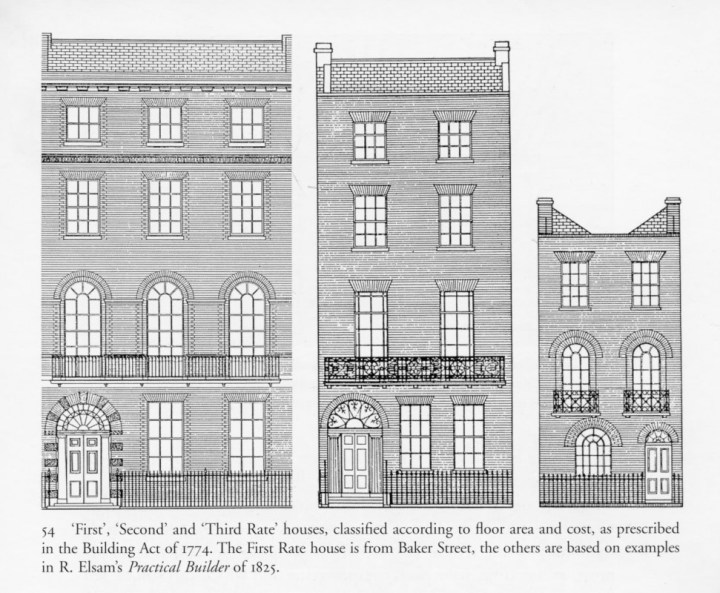
Alison Shepherd, Drawing of ‘First’, ‘Second’ and ‘Third Rate’ Houses, in John Summerson, Georgian London (Yale University Press, 2003), figure 54, image courtesy of Alison Shepherd / Trustees of the Estate of John Summerson..
◊ ◊ ◊ ◊ ◊
Now on view at the Paul Mellon Centre:
Bedford Square: Creating Social Distance
Drawing Room, Paul Mellon Centre, London, 31 January — 9 September 2022
Curated by Martin Myrone with Bryony Botwright-Rance
Bedford Square has always been acclaimed as an outstanding piece of urban planning. Built between 1775 and 1782, the fifty-three houses of the square—all but one arranged in apparently symmetrical order, in four ‘palace-fronted terraces’ around a gated, landscaped garden—are considered exemplars of Georgian architecture. The arrangement of the buildings remains intact, and many original architectural details and even interiors are preserved along with much of the character of the private garden, making Bedford Square one of the most complete survivals of Georgian London. Through literature on Bedford Square’s architectural history and records of its inhabitants, this Drawing Room display at the Paul Mellon Centre highlights the way that classic Georgian architecture created forms of social distancing: in its physical form; in creating closed and exclusive urban sites; through its internal spaces which separated inhabitants and allocated roles in highly predictable ways; and its aesthetic values which lay claim to supposedly timeless and universal principles of classical design and geometrical order.
The accompanying exhibition pamphlet by Martin Mryone is available for download at the PMC.
Het Loo Reopens after Renovations
Construction at Apeldoorn, in the Netherlands, continues until at least 2023, but the palace interiors are once again open. From the press release, via Art Daily (18 April 2022). . .
Paleis Het Loo—the largest 17th-century palace of the House of Orange-Nassau and a national museum since 1984—is once again open for visitors. Built in the 1680s, it has been closed since 2018 for a thorough renovation. Kossmanndejong is working with the museum to give the palace a new lease on life. The design firm is still developing the exhibitions in the new underground extension, but you can now visit the renewed palace routes, with new audio tours, and watch a presentation on the history of Paleis Het Loo in the renovated historic palace.

New carpet runners are printed to match the historic floor coverings and include audio cues.
Visits now begin at the servants’ entrance, a room Kossmanndejong transformed to tell the history of Paleis Het Loo. A film brings a model of the palace and gardens to life with a journey through time, from the construction of the palace to the current renovation. Visitors can also admire traces left by residents of Paleis Het Loo over the past centuries. Most are everyday objects, from pots and shards to the water pipes from the gardens’ first fountains. Archaeologists discovered some of these objects during the renovation.
The palace rooms look the same as they did when the royals roamed them. To allow visitors to experience more fully this historic atmosphere, Kossmanndejong omitted as many ‘museum’ elements as possible. Unnecessary distractions, such as text signs, disappear. Kossmanndejong also examined how visitors should move through the space. While Paleis Het Loo is one of the most visited museums in the Netherlands, it’s also full of small corridors and narrow rooms. By adjusting the routes and audio tour length to support the expected number of visitors, Kossmanndejong ensures a smooth and comfortable visit.
“If you don’t notice we were there, that means we’ve done our job well.” –Robin Schijfs, lead designer for Kossmanndejong
To enhance the authentic palace experience, Kossmanndejong developed an ‘invisible’ runner that is almost indistinguishable from the original floors. Kossmanndejong photographed the floors and printed the patterns directly onto the runners. The route markers and audio stops are also printed on the carpet. This way, Kossmanndejong protects the palace’s historic floors while maintaining the rooms’ immersive qualities.
There are two routes in Paleis Het Loo. Along the East Route, visitors walk through the 17th-century palace, one of the great centres of power in early modern Europe. During the audio tour, William III’s best friend whispers the secrets of the Stadtholder-King. The West Route reveals how later generations of the royal family lived in the palace. You can choose between two stories: the comical family show At Home with the Royals or a more intimate tour focused on Queen Wilhelmina and her immediate family. Screenwriters wrote the three audio tours, imbuing each with its own character and transforming the narrative into a progressive story that builds along the route.










 Enfilade
leave a comment