Online Talk | Pushing Boundaries of Photo-Based Work

Kyungmi Shin, Lunch on the Grass, 2020. The work layers an image of a picnic from 1960s Korea (an image which includes Shin’s father, a Protestant pastor) on top of an image of François Boucher’s Chinese Garden from around 1742. The oil painting by Boucher is in the Musée des Beaux-Arts et d’Archéologie de Besançon. For more information on Shin, see Susan Stamberg’s piece for NPR, “An Artist Explores What ‘Crosses the Ocean’ in Porcelain and Painted Collage,” (12 November 2020), produced in response to the exhibition Kyungmi Shin: Father Crosses the Ocean on view at the Orange County Museum of Art in Santa Ana, California from 24 September 2020 until 21 February 2021.
◊ ◊ ◊ ◊ ◊
From The Getty:
Mercedes Dorame, Kori Newkirk, and Kyungmi Shin
Beyond the Frame: Pushing Boundaries of Photo-Based Work
Online, The Getty, Tuesday, 20 July 2021, 5pm (Pacific Time)
In this conversation, multidisciplinary artists Mercedes Dorame, Kori Newkirk, and Kyungmi Shin discuss how their approaches to art making and activism push the boundaries of photography, transforming it beyond its perceived objectivity and conventional format. Their work is featured in the exhibition Photo Flux: Unshuttering LA, which disrupts the privileging of white narratives in photography by celebrating the diverse, dynamic practices of contemporary Los Angeles artists. The event is free, though advance sign-up is required.
FPS Online Lecture | Angiviller, Rambouillet, and ‘Etruscan’ Taste
From The French Porcelain Society:
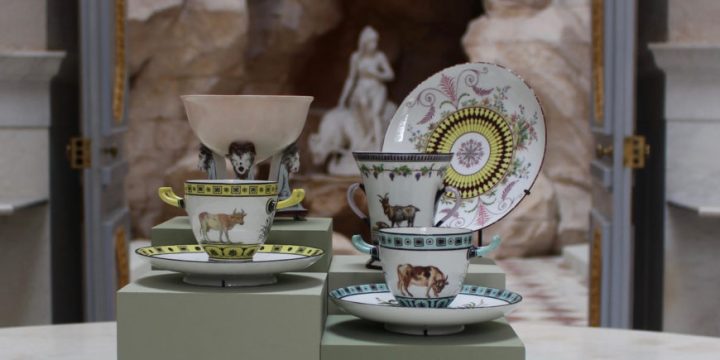
Gabriel Wick and John Whitehead | Angiviller, Rambouillet, and ‘Etruscan’ Taste
Sir Geoffrey de Bellaigue Memorial Lecture
FPS, Online, Sunday, 11 July 2021, 18.00 (BST)
The French Porcelain Society is delighted to host the Sir Geoffrey de Bellaigue Memorial Lecture with Gabriel Wick, curator of the exhibition Vivre à l’Antique, who will explore the fascinating history of Rambouillet, a château associated with the avant-garde ‘Etruscan’ taste championed by the comte d’Angiviller. John Whitehead will discuss the Sèvres-porcelain service created for its dairy. We hope you can join us!
FPS members will receive an email invitation with instructions on how to join the online lecture. If you want to join, please contact us for more details on FPSenquiries@gmail.com. This will be the last Living Room Lecture until Sunday, 5 September 2021.
Rambouillet, 30-miles southwest of Paris, is the most recent and the least-known of France’s royal palaces. Acquired by Louis XVI as a domaine privé only six-years before the Revolution, it served successive sovereigns and presidents as a hunting lodge and rustic retreat until 2009, when it was entrusted to the care of the Centre des Monuments Nationaux and opened to the public. In the second half of the 1780s, the king’s de facto minister of the arts, the comte d’Angiviller, developed a number of remarkable projects for the domain—a proposal for the reconstruction of the château à l’antique, a model farm, extensive plantations of American trees, and the menagerie and dairy. The last of these, conceived as a theatrical evocation of the arts and rituals of the Etruscans, benefitted from contributions by Hubert Robert, Jean-Jacques Lagrenée, Georges Jacob, and the Sèvres manufacture (which Angiviller directed since 1783).
Online Roundtable | New Approaches to Piranesi
From the program flyer:
New Approaches to Piranesi: A Virtual Roundtable
Online, Friday, 16 July 2021
Organized by Jeanne Britton and Zoe Langer
 Join us for a roundtable of lightning talks on interdisciplinary approaches to the works of Giovanni Battista Piranesi (1720–1778). Recent scholarship by Heather Hyde Minor, Carolyn Yerkes, and Susan Dixon, as well as the current bestselling novel Piranesi by Susanna Clarke, have started to open the field of Piranesi Studies to new avenues of research and potentially wider audiences. This roundtable consists of two panels of short presentations of 5–7 minutes followed by ample time for discussion. Papers engage with a wide range of disciplinary fields and methods including globalism, reception, collecting, virtual reality, exhibition curation, book history, archaeology, history of design, and architecture. We hope the themes and format of the roundtable will encourage lively conversation and prompt new critical perspectives that will continue to broaden the interpretation of Piranesi’s works.
Organized by Jeanne Britton and Zoe Langer, Digital Piranesi, Irvin Department of Rare Books and Special Collections, University of South Carolina
Sponsored by Historians of Eighteenth Century Art and Architecture (HECAA)
Panel 1: 10.00–11.30am (EST)
• Hélène Bremer (Art Historian and Independent Curator), For the Love of the Master, 25 Artists Fascinated by Piranesi
• Erik Herrmann (Ohio State University), Another Campo Marzio
• Mireille Linck (Museum Boijmans Van Beuningen), Watermark Research: The Beginning of a Research Tool
• Ari Lipkis (Tyler School of Art & Architecture), Imprisoned in the Fold: Piranesi and the Video Artist
• Jason Porter (University of South Carolina), The Virtual Piranesi: New Methods of Immersive Literacy
• Carla Scagliosi (Galleria Nazionale dell’Umbria), Exploring ‘the Dark Brain of Piranesi’
Panel 2: 1.00–2.30pm (EST)
• George Dodds (University of Tennessee), Giambattista Piranesi, Modernity, and the Continuous Avant-Garde
• Sara Hayat (School of the Art Institute of Chicago), What We Can Learn from 18th-Century Global Histories of Architecture
• Helen Marodin (University of South Carolina), The Magnificence of Rome in the Carceri: Flashes of Light into Piranesi’s Shadowy Prisons
• Thomas Mical (India), Scanning for Duration and Intensity in Piranesi’s Carceri
• Aleksander Musial (Princeton University), Beyond the Capriccio: Piranesi’s Candelabra, Classical Transgression, and their Reception in Warsaw and St. Petersburg
• Kate Retford (Birkbeck, University of London), Piranesi and the Print Room
• Betsey Robinson (Vanderbilt University), Tunnel Visions: Rendering Conventions and Process at the Alban Lake
Online Talks | Rubens Series

Peter Paul Rubens, The Rainbow Landscape (detail), ca. 1636
(London: The Wallace Collection)
◊ ◊ ◊ ◊ ◊
The last three talks in the series address the eighteenth- and nineteenth-century reception of Rubens. From The Wallace Collection:
Rubens Talk Series
Online, The Wallace Collection, 9 June — 21 July 2021
To accompany The Wallace Collection’s new exhibition Rubens: Reuniting the Great Landscapes, this series of seven talks will explore different aspects of Rubens’s extraordinary life and achievements, the fascinating social, cultural and economic circumstances of his age, and his enduring artistic legacy.
Series talks will be presented through Zoom Webinar. Each talk duration is 1 hour, including time for Q&A with the speaker. Tickets can be purchased for individual talks or the entire series. Ticket holders will receive their Zoom link, Webinar ID, and Passcode 24 hours in advance of each talk. Series talks, excluding 21 July, will be recorded. Following each talk, ticket holders will be emailed a link to view the recording, which will be available for one week only.
◊ ◊ ◊ ◊ ◊
John Chu | ‘Equal to the Great Masters’: Landscapes by Gainsborough and Rubens
Wednesday, 7 July 2021, 19.00 BST
Thomas Gainsborough (1727–1788) had a lifelong love of Netherlandish landscape art. As his career developed so too did the range and depth of his appreciation for the ‘Great Masters’ of the Low Countries—prominent in this pantheon was Peter Paul Rubens (1577–1640). In this talk, John Chu will consider the transformative influence of Rubens’s landscapes on Gainsborough’s art, examining what he learned from his predecessor and why these paintings became such an important model. Looking more broadly, he will also explore the reputation of Rubens’s landscapes in 18th-century Britain and establish the social and artistic conditions that shaped, and made possible, Gainsborough’s fruitful encounter with the works of the Flemish master.
Dr John Chu is Senior Curator of Pictures and Sculpture at the National Trust. He has taught and published widely on 18th-century British and French painting and specialises in the art of Thomas Gainsborough and Joshua Reynolds.
◊ ◊ ◊ ◊ ◊
Christoph Vogtherr | Flemish Painting in 18th-Century French Collections
Wednesday, 14 July 2021, 19.00 BST
Flemish painting rose to a prominent role in Parisian collections only in the late 17th century. Even Rubens started to be regarded as one of the major European painters considerably later than in territories of the German Empire or in Italy. This change in perception and taste went hand in hand with new modes of picture displays. In the first decades of the 18th century, the comparison of schools and painters became the guiding principle of art presentation. Flemish painting was introduced into Parisian collections in this context of emulation and competition between the schools. In the process, Flemish and French painting gained a prominence comparable to Italian art. In this talk, Christoph Vogtherr will trace the rise of Flemish and Dutch painting in Parisian collections, its important position in picture displays and art theory, as well as its role in the formation of French 18th-century painting.
Dr Christoph Martin Vogtherr is General Director of the Stiftung Preußische Schlösser und Gärten Berlin-Brandenburg. His main research interests are the history of the Prussian Royal palaces, French 18th-century painting, and the history of art collecting in the 18th and 19th centuries. He was previously Director of the Hamburger Kunsthalle (2016–19), and before that, Curator of paintings and then Director of the Wallace Collection from 2011 to 2016. He has published widely on 18th-century French painting.
◊ ◊ ◊ ◊ ◊
Tim Barringer | British Painters and Rubens’s Poetic Pastorals
Wednesday, 21 July 2021, 19.00 BST
Tim Barringer will explore the character of Rubens’s landscapes, which blend the legacies of classical poetry with the rough and tumble of rural life in the 17th century. Erudite references mix with rustic pastimes. While Rubens’s grand historical and religious paintings, like his portraits, commanded admiration across Europe, British artists and collectors found a special affinity with his pastoral works. Painters such as Constable, Turner, and Bonington were indelibly affected by the experience of seeing Rubens’s paintings and drawings, allowing them to see the natural world anew.
Dr Tim Barringer is Paul Mellon Professor and Chair of the Department of the History of Art at Yale University. He contributed to Rubens and his Legacy, the RA’s exhibition catalogue, and has co-curated exhibitions including American Sublime: Opulence and Anxiety; Pre-Raphaelites: Victorian Avant-Garde; Picturesque and Sublime: Thomas Cole’s Trans-Atlantic Inheritance; Unto This Last: Two Hundred Years of John Ruskin; and Victorian Radicals: From the Pre-Raphaelites to the Arts & Crafts Movement.
Online Talks | NDENCA, Series 4, May–July 2021
From NDENCA (click for lots more information on speakers and presentation abstracts).
New Directions in Eighteenth- and Nineteenth-Century Art (NDENCA)
Series 4: May–July 2021
Organised by Freya Gowrley and Madeleine Pelling
New Directions in Eighteenth- and Nineteenth-Century Art (NDENCA) is a digital seminar series aimed at championing new scholarly voices working across visual and material cultures in this period. It aims to take a global perspective, and in particular welcomes contributions by scholars from minority groups. Series 4 seminars take place on Mondays, via Zoom and are open to all. To book tickets, please email us at, ndencaseminar@gmail.com.
Papers are available on our YouTube channel for up to one month after their live session.
P R O G R A M M E
24 May 2021
1) Caroline McCaffrey-Howarth (Visiting Research Fellow, University of Leeds, Curator, 17th- and 18th-Century Ceramics and Glass, V&A Museum), Sèvres-mania’ and the Standardisation of Ceramics Connoisseurship
7 June 2021
2) Amara Thornton (Honorary Research Associate, UCL Institute of Archaeology), Caribbean Collections Histories: Archaeology and Empire
14 June 2021
3) Nat Reeve (PhD Candidate, Royal Holloway, University of London), Queer Tombs and Reframing Doom: Elizabeth Siddal and Georgiana Burne-Jones’s Unfinished Collaborative Project
21 June 2021
4) Emily Doucet (University of Toronto), Illuminating Infrastructures: Nadar’s Underwater Photography and the Expansion of Marseille’s Modern Port
28 June 2021
5) Miguel Angel Gaete (PhD Candidate, University of York), Territorial Fantasies, Sexual Nuances, and Savage Energy: Orientalism and Tropicality in Eugène Delacroix and Johann Moritz Rugendas
5 July 2021
6) Kate Heller (Research Associate, Art Institute of Chicago), Wrought(-Iron) Boundaries: A Victorian Ecology of Thomas Jeckyll’s Norwich Gates
12 July 2021
7) Camilla Pietrabissa (Postdoctoral fellow, IUAV University of Venice), Drawing in 18th-Century Venice: The Origins of the Veduta and the Modern Culture of Spectacle
19 July 2021
8) Samuel Raybone (Lecturer in Art History, Aberystwyth University), Global Impressionism and the Idea of Wales
26 July 2021
9) Cabelle Ahn (PhD Candidate, Harvard University), Drawing Site-Specificity: The 1797 Exhibition of Drawings in the Louvre
Online Workshop | The Power of Imagination
From ArtHist.net:
Die Kraft der Einbildung: Physiologie, Ästhetik, Medien
Online, 8–9 July 2021
Registration due by 6 July 2021
Die Einbildungskraft steht am Kreuzungspunkt der Problemlinien, die in der DFG-Kolleg-Forschungsgruppe »Imaginarien der Kraft« nachgezeichnet werden. Zum einen reguliert sie als menschliches Vermögen die Vermittlungen zwischen sinnlicher Wahrnehmung und begrifflichen Vorstellungen, zum anderen ist sie als ausgezeichnete Kraft des Menschen selbst Gegenstand unterschiedlicher, ja widersprüchlicher Konzeptualisierungen. Der Workshop diskutiert historische und gegenwärtige Modelle der Einbildungskraft, um ihre je unterschiedlich gefassten Fähigkeiten und Leistungen, aber auch ihre Grenzen und immer wieder besprochenen Gefahren zu beschreiben. Entwirft man sie als somatische Disposition oder pathologische Abweichung, als regelhaften kognitiven Prozess oder Effekt numinoser Einflüsse, als Reproduktion von Wahrgenommenem oder kreatives Potential?
Kontakt und weitere Informationen:
DFG-Kolleg-Forschungsgruppe “Imaginarien der Kraft”
Gorch-Fock-Wall 3, 1. Stock (links)
20354 Hamburg
Email: imaginarien.der.kraft@uni-hamburg.de
D O N N E R S T A G , 8 J U L I 2 0 2 1
15.00 Begrüßung, Frank Fehrenbach, Cornelia Zumbusch
15.30 Claudia Swan (St. Louis), Shells, Ebony, and the Dutch Colonial Imaginary
16.15 Rüdiger Campe (New Haven), Vorstellungskraft und Einbildungskraft. Leibniz’ vis repraesentativa und die ästhetischen Folgen
Moderation: Dominik Hünniger
17.00 Pause
17.30 Birgit Recki (Hamburg), Synthesis als bildgebendes Verfahren. Kant über Funktionen und Formen der Einbildungskraft
18.15 Rahel Villinger (Basel), ‘…wir können alles dieses aus der bildenden Kraft herleiten’. Kant und die Einbildungskraft der Tiere
Moderation: Adrian Renner
F R E I T A G , 9 J U L I 2 0 2 1
15.00 Öffnung des Konferenzraums
15.15 Daniel Irrgang (Berlin), Siegfried Zielinski (Saas-Fee), Die neue Einbildungskraft bei Vilém Flusser
16.00 Thomas Jacobsen (Hamburg), Träume, Wünsche, Fantasien … und divergentes Denken
Moderation: Lutz Hengst
17.15 David Freedberg (New York), VR, AR and Einbildungskraft
Lorraine Daston (Berlin): Respondenz
Moderation: Frank Fehrenbach
18.15 Schlussdiskussion
Online Conversation | Juneteenth

This CW Conversation is part of the Foundation’s Us: Past, Present, Future series (there are lots of terrific resources listed below; for course websites, I’m particularly excited about the timeline, which ranges from 1565 to 2020. –CH).
Juneteenth: A Conversation with Deirdre Jones Cardwell, Richard Josey, and Michael Twitty
Online, Colonial Willamsburg Foundation, 19 June 2021, 4pm (EDT)
General Order Number Three, which officially informed enslaved Texans of their legal freedom, stated that emancipation involved “an absolute equality of personal rights and rights of property.” Have we achieved the promises of Juneteenth, and how should it be observed? Join Deirdre Jones Cardwell, Programming Lead and Actor Interpreter with Colonial Williamsburg, Richard Josey, Founder and Principal Consultant for Collective Journeys LLC, and Michael Twitty, Culinary Historian, in a discussion about the story, significance, and meanings of Juneteenth.
Click here to join the livestream event on Saturday, 19 June 2021, at 4.00pm (EDT). You don’t have to have a Facebook Account to watch, but you will need to sign in to join the discussion.
◊ ◊ ◊ ◊ ◊
Whether you’re looking to read up on this topic before joining the conversation, or want some further reading afterward, here’s recommended reading from Colonial Williamsburg.
Colonial Williamsburg Juneteenth Resources
Colonial Williamsburg has created several related web resources, including an informational What is Juneteenth? page, a calendar of Juneteenth special events at Colonial Williamsburg, and a Juneteenth Historical Timeline that provides history and context for the commemoration.
The Colonial Williamsburg Resource Library provides access to numerous resources that explore relevant themes such as citizenship, civics, and government using video, lessons, and interactive web activities. The Resource Library features several relevant resources such as the When Freedom Came electronic field trip and Whose Emancipation?
Colonial Williamsburg’s YouTube Channel features 2020 productions “Juneteenth at Custis Square” and “Before Juneteenth.”
Juneteenth Resources from Other Cultural Institutions
• The Smithsonian National Museum of African American History & Culture offers “The Historical Legacy of Juneteenth.”
• The Library of Congress blog offers “The Birth of Juneteenth: Voices of the Enslaved” and “Emancipation Day in South Carolina . . .,” an 1863 illustration from Frank Leslie’s Illustrated Newspaper.
• The Library of Virginia’s The Uncommonwealth blog focuses on “Why Juneteenth?”
• PBS features “What is Juneteenth?” with Henry Louis Gates, Jr.
• The National Archives presents an online exhibit The Emancipation Proclamation, providing context on that document issued January 1, 1863.
Books
• Annette Gordon-Reed. On Juneteenth. New York: Liveright Publishing, 2021.
• Angela Johnson. All Different Now: Juneteenth, the First Day of Freedom. New York: Simon & Schuster Books for Young Readers, 2014.
Online Symposium | Kaleidoscope Conversations, Color and Meaning
From the symposium programme:
Kaleidoscope Conversations
Online, Masterpiece London Symposium, 16–17 June 2021, 5.00–6.30pm (BST)
Organized with Thomas Marks
 Masterpiece is delighted to host a programme of digital debate and discussion co-organised by the Fair and Thomas Marks, editor of Apollo, to bring together preeminent museum curators and conservators with the leading figures in the art and antiques trade, with the aim of encouraging constructive discussion, networking, and the exchange of knowledge and practical advice.
Kaleidoscopic Conversations is the fifth in a series of events that Masterpiece launched in 2018—and which in the past twelve months have fully embraced the possibilities of digital discussion, with recent online events focusing on conservation and artistic materials. This June the spotlight is on the history of colour, and particularly how the colours and pigments of artistic materials—and how those have been harnessed in works of art—have borne specific meanings in different times and cultures.
Over two days, experts will discuss how the local significance of colours should be fundamental to how we interpret and appreciate a range of artistic fields and how best the history and science of colour can be communicated to as wide an audience as possible in museums and other contexts. How do we move beyond the aesthetic presentation of paintings or brightly coloured objects to discussion of what colours once meant? How can we perceive or reimagine colours that have changed or faded over time? How do museums allow us to see colours in the best possible light and provide an understanding of the role that colour plays in display? As ever at the Masterpiece Symposium, attendees will be invited to participate in the discussion during break-out sessions that will follow the panels—with the aim of stimulating vibrant debate.
“This event builds on our online programme, which has aimed to foster a better understanding of works of art through the exploration of materials,” says Philip Hewat-Jaboor, Chairman of Masterpiece London. “The fifth Masterpiece Symposium will continue this thread by looking at the often forgotten role that colour plays in works of art themselves, as well as in historical interiors, and how colour is reconceived and communicated in modern museum displays.”
Register for the Masterpiece Symposium here»
All times listed are BST
W E D N E S D A Y , 1 6 J U N E 2 0 2 1
5.00 Introduction by Philip Hewat-Jaboor and Thomas Marks
5.05. Panel Discussion: Vivid Histories
The inclusion of specific colours in paintings and works of art has rarely, if ever, been merely decorative. From the value historically associated with splendid raw materials, such as lapis lazuli or natural dyes for textiles, to the symbolic meanings that different hues have held in different times and places, colour contains and reflects meaning—even if that meaning may fade over time. From magnificent marbles to splendid stained glass, vibrant colours or their combinations have not only awed viewers but have historically also spoken to them of a wide spectrum of significance. This panel will explore: the fastness or fleeting nature of some of the meanings historically attached to colour; the relationship between colour and style; that between colour and power or status; the challenges of retrieving the historical significance of color; the role of heritage scientists in recovering the history of colour; and the role of art historians in telling its stories.
• Renée Dreyfus | Distinguished Curator and Curator in Charge, Ancient Art and Interpretation, Fine Arts Museums of San Francisco
• Alexandra Loske | Curator, Royal Pavilion, Brighton
• Georges Roque | Philosopher, art historian, and author of La cochenille, de la teinture à la peinture: Une histoire matérielle de la couleur
• Matthew Winterbottom | Curator of Sculpture and Decorative Arts, The Ashmolean Museum, Oxford
6.00 Break-out Session: Bright Ideas
All symposium participants will be split into small discussion groups. In this 25-minute session, they will be invited to continue the conversation of the preceding panel, drawing on their own knowledge and experience to explore how the history of colour can and should still be integral to how we think about art—and why this might be more urgent that ever as we strive to understand objects in global and local contexts.
T H U R S D A Y , 1 7 J U N E 2 0 2 1
5.00 Panel Discussion: The Chromatic Museum
In our memories, perhaps, museums sometimes exist in black and white—or in sepia tones. But working with colour—working in colour, even—is fundamental to museum installations and displays. And interpreting the historical meaning of colours is vital to how collections are communicated to the public. Richly coloured objects may be eye-catching, certainly, but how do curators and museum professionals translate that into significance for as broad an audience as possible? And how far do decisions made by curators and exhibition designers affect how we perceive and appreciate colour—or even reconstruct it—in the museum? This panel will explore: communicating the history of colour and its relationship to materials in the museum; lighting and colour; white cubes and wall colours; and how far new technologies can help in the understanding of colour.
• Emerson Bowyer | Searle Associate Curator of European Painting and Sculpture, Art Institute of Chicago
• Lisa O’Neill | Projects & Company Director, Centre Screen
• Philippa Simpson | Director of Design, Estate and Public Programme at the Victoria & Albert Museum, London
• Jennifer Sliwka | Deputy Director of the VCS project, Senior Research Fellow and Visiting Lecturer at King’s College London
5.55 Break-out Session: Widening the Spectrum
All symposium participants will be split into small discussion groups. In this 30-minute session, they will be invited to discuss how museums, academics, and the art market can work together to build a better understanding of displaying colour, and how such knowledge can be communicated to a wide public. What practical steps would further public engagement with the colourful history of art?
6.25 Closing Remarks by Philip Hewat-Jaboor
Online Talk | Sarah Coffin on Fêtes and Feasts
From The Royal Oak Foundation:
Sarah Coffin | Fêtes and Feasts: Diplomatic Dining and the Noble Table, 1660–1830
Online, The Royal Oak Foundation, Wednesday, 16 June 2021, 6.00pm (EDT)

Martin van Meytens, Banquet at the Wedding of Joseph II to Isabella of Parma, 10 October 1760, detail, 1763, oil on canvas (Vienna: Schönbrunn Palace).
What do Italian architects, English, French, and German diplomats and noblemen, and French chefs all have in common? Between the 17th century and 1830, they served up fantastical ‘table architecture’ to honor their noble and royal guests. These tables showcased lavish temples, beautiful arrangements of food, specially created sugar and porcelain sculptures, silver and gilded display pieces, and even table fireworks.
Marriages, diplomatic visits, and treaty signings turned these meals into theatrical extravaganzas, in which the chef played the role of master of ceremonies, organizing all the details including musical entertainment to accompany the cuisine. When James II of England acceded to the throne in 1685, he sent Lord Castlemayne to Rome as Ambassador to the Vatican where he arranged an elaborate banquet in honor of the Pope.
While Italy and France led the way in culinary fashion, English visitors and diplomats were often the beneficiaries and sometimes the hosts. Chef Antonin Câreme’s splendid dinner for the Treaty of Versailles attended by Alexander I of Russia, Tallyrand and others led to the chef briefly being lured to England by George IV for a State Dinner for Tsar Alexander in 1816, who tempted the chef to then travel to Russia.
Sarah Coffin, will recount some of these amazing meals and illustrate the elaborate table settings and accoutrements devised to impress guests from the top echelons of European society and royalty. She will provide first-hand accounts by observers, as well as show prints and paintings that show the masterpieces that were created for the pleasures of the table.
Sarah D. Coffin is an independent decorative arts and design historian, curator, consultant, and lecturer who has extensively researched and explored the interaction of culinary design and history. Previously she was Senior Curator and Head of the Product Design and Decorative Arts Department at Cooper Hewitt for over 14 years, retiring in 2018. Her tenure at Cooper Hewitt included her curation of the exhibition Feeding Desire: Design and Tools of the Table, 1500–2005. Other exhibitions for Cooper-Hewitt included the blockbuster exhibition Set in Style: The Jewelry of Van Cleef & Arpels (2011); Rococo: The Continuing Curve, 1730–2008; and The Jazz Age: American Style in the 1920s, which she co-curated and co-authored the exhibition catalog. Most recently she co-authored the exhibition catalogue for a show on Art Nouveau architect and designer Hector Guimard, opening in 2022 at Cooper Hewitt, Smithsonian Design Museum in New York, and then The Driehaus Museum, Chicago.
Watch live on Wednesday, June 16 at 6.00pm (EDT), or rent the recording for 4 days. $15 Royal Oak members; $20 non-members.
Online Conference | The Evolving House Museum
From ArtHist.net and The Society for the History of Collecting:
The Evolving House Museum: Art Collectors and Their Residences, Then and Now
Online, The Society for the History of Collecting, 18–19 June 2021
Organized by Margaret Iacono and Esmée Quodbach
House museums are founded for a variety of reasons, from preserving architecturally significant structures to safeguarding the former homes of historically or culturally noteworthy men and women and their legacies. In other cases esteemed art collectors, such as Henry Clay Frick or Albert C. Barnes, established museums in their former residences to house their collections in perpetuity rather than donating them to preexisting institutions. While many successful examples like the Isabella Stewart Gardner Museum continue to thrive, other lesser-known house museums do not attract enough support to remain operational. House museums, it seems, must evolve in order to remain relevant and to continue to attract visitors.
This conference explores a variety of themes relating to art collectors as founders of house museums. Among these are discussions about the motivates that encouraged collectors to establish private house museums instead of donating their collections to preexisting institutions; how collectors’ original intention have manifested themselves in their museums; how house museums’ collections or buildings have evolved over time; and how museums have reinterpreted their collections to remain relevant to contemporary and diverse audiences. Other issues concern how major historic events like the 2008 financial crisis or the recent COVID-19 pandemic have impacted house museums. To attend the event, please register at events@societyhistorycollecting.org.
All times are given in Eastern Daylight Time (EDT)
F R I D A Y , 1 8 J U N E 2 0 2 1
11.00 Welcome and Introductory Remarks
11.15 Keynote Address
• Inge Reist (Director Emerita of the Center for the History of Collecting, The Frick Collection, New York), Whose House Is It Anyway?
11.45 Early Beginnings, the Gilded Age, and Beyond
• Anne Nellis Richter (Independent Scholar and Adjunct Faculty, Smith College, Northampton, Massachusetts), Cleveland House as Art Museum: ‘The Louvre of London’ (1806)
• Evelien de Visser (Curator of Fine Arts from 1750 and Information Specialist Van Gogh Worldwide, RKD—Netherlands Institute for Art History, The Hague), The Mesdag Collection in The Hague: The Lasting Legacy of Hendrik Willem Mesdag and Sientje van Houten
12.25 Q & A, followed by break
12.45 Early Beginnings, the Gilded Age, and Beyond, continued
• Mia Laufer (Associate Curator, Minnesota Museum of American Art, St. Paul), A Tale of Two Museums: The Legacies of the Parisian Collectors Isaac and Moïse de Camondo
• Lynne Ambrosini (Deputy Director/Chief Curator Emerita, Taft Museum of Art, Cincinnati, Ohio), The Evolution of Charles and Anna Taft’s Art Museum: Display, Space, Audience, and Acquisitions
• Martha Easton (Assistant Professor of Art History, St. Joseph’s University, Philadelphia), Medievalism, Museums, and Modern Audiences: The Case of the Hammond Castle Museum in Gloucester, Massachusetts
1.45 Q & A
S A T U R D A Y , 1 9 J U N E 2 0 2 1
11.00 Looking Back, Looking Forward: The Evolving House Museum over the Past Century
• Welcome and Introductory Remarks
• Marissa Hershon (Curator of Ca’ d’Zan and Decorative Arts, The John & Mable Ringling Museum of Art, Sarasota, Florida), The Ringling Museum’s Ca’ d’Zan: Its Evolution from Winter Residence to Historic House Museum
• Anne Hilker (Independent Scholar, New York), The Fortunes of War: The Brief Life of the Jules S. Bache House Museum in New York, 1937–1943
• Rebecca Tilles (Associate Curator of 18th-Century French & Western European Fine and Decorative Arts, Hillwood Estate, Museum & Gardens, Washington, DC), Marjorie Merriweather Post’s Hillwood and the Vision from a Private Collection to Public Museum
12.15 Q & A, followed by break
12.35 Looking Back, Looking Forward: The Evolving House Museum over the Past Century, continued
• Chih-En Chen (PhD Candidate, History of Art and Archaeology, SOAS, University of London), Hung’s Art Gallery: Shaping the History of Collecting in Taiwan in the New Millennium
• Georgina Walker (Honorary Research Fellow, University of Melbourne), A New Type of House Museum: Lyon Housemuseum, Melbourne (2009)
• Julie Codell (Professor, Art History, Arizona State University, Tempe), Ecologies of House Museums: Some Final Thoughts
1.40 Q & A










 Enfilade
leave a comment