Online Series | Graphic Landscape
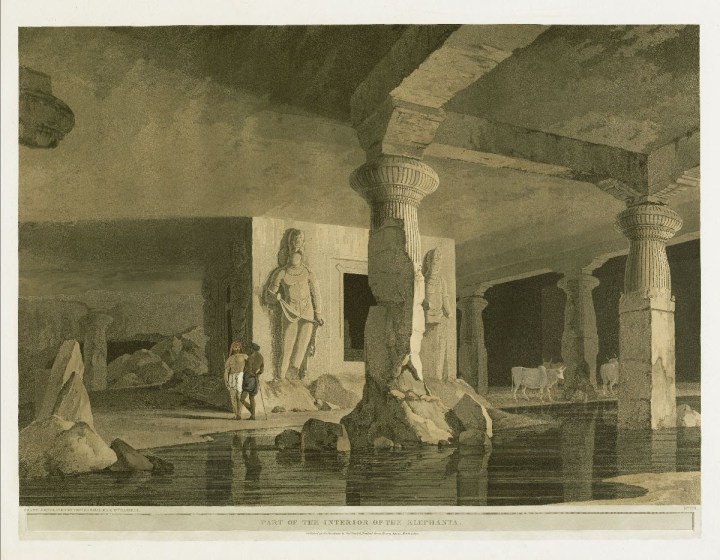
‘Part of the Interior of the Elephanta’, from Thomas and William Daniell, Antiquities of India, Oriental Scenery, aquatint, 1795.
◊ ◊ ◊ ◊ ◊
From the Paul Mellon Centre:
Graphic Landscape: The Landscape Print Series in Britain, 1775–1850
Online, Paul Mellon Centre and the British Library, 2, 4, 9, 11 November 2021
Organized by Mark Hallett and Felicity Myrone
Graphic Landscape: The Landscape Print Series in Britain, 1775–1850 is a four-day programme of online webinars taking place between 2 and 11 November 2021, presented jointly by the Paul Mellon Centre for Studies in British Art and the British Library.
Landscape and topographical print series proliferated in the late eighteenth century and in the first decades of the nineteenth century. Indeed, the format seems to have enjoyed an artistic and commercial boom in this period. Some examples of these series, such as Turner’s Liber Studiorum (1807–19) and Constable’s English Landscape Scenery (1830–33), are extremely well known. Many others, however, have still to receive sustained and critical attention. This programme of four online seminars is designed to look afresh at the late Georgian and early Victorian landscape print series and to stimulate new research on this important strand of graphic art. Participants will bring a wide range of perspectives to bear on the topic and address works in a variety of graphic media.
Graphic Landscape: The Landscape Print Series in Britain, 1775–1850 is co-convened by Mark Hallett at the Paul Mellon Centre and Felicity Myrone at the British Library.
Additional information—including paper abstracts, speaker biographies, specific times, and registration links—can be found here.
T U E S D A Y , 2 N O V E M B E R 2 0 2 1
Day 1 | 12.00–14.00
12.00 Print, Politics, and Industrialisation
• Introduction by Mark Hallett (Director, Paul Mellon Centre) and Felicity Myrone (Lead Curator, Western Prints and Drawings, British Library)
• Amy Concannon (Senior Curator, Historic British Art, Tate), ‘A Captur’d City Blazed’: Printmaking and the Bristol Riots of 1831
• Lizzie Jacklin (Keeper of Art, Tyne & Wear Archives & Museums), Mining Landscapes: Thomas Hair’s Views of the Collieries
• Morna O’Neill (Associate Professor of Art History, Art Department, Wake Forest University), John Constable, David Lucas, and Steel in English Landscape
T H U R S D A Y , 4 N O V E M B E R 2 0 2 1
Day 2 | 12.00–14.00
12.00 Print and Property
• Introduction by Richard Johns (Senior Lecturer in History of Art at the University of York)
• John Bonehill (Lecturer, History of Art, University of Glasgow), Picturing Property: The Estate Landscape and the Late Eighteenth-Century Print Market
• Kate Retford (Professor of Art History, Birkbeck, University of London), Views of the Lakes at the Vyne
• James Finch (Assistant Curator, 19th-Century British Art, Tate Britain), Amelia Long’s Views from Bromley Hill
T U E S D A Y , 9 N O V E M B E R 2 0 2 1
Day 3 | 12.00–14.00
12.00 Revisiting the Canon
• Introduction by Cora Gilroy-Ware (Associate Professor, History of Art, University of Oxford)
• Greg Smith (Independent Art Historian), Engaging with the Voyage Pittoresque de la France: Thomas Girtin’s Picturesque Views in Paris and Their Appeal to the ‘Most Eminent in the Profession’
• Timothy Wilcox (Independent Scholar), John Sell Cotman’s Architectural Antiquities of Normandy: A Catastrophic Miscalculation?
• Gillian Forrester (Independent Art Historian, Curator and Writer), A Glossary for the Anthropocene? Turner’s Liber Studiorum in the Era of Climate Change
T H U R S D A Y , 1 1 N O V E M B E R 2 0 2 1
Day 4 | 14.00–16.00
14.00 A Wider View: From Collaboration to Empire
• Introduction by Mark Hallett (Director, Paul Mellon Centre) and Felicity Myrone (Lead Curator, Western Prints and Drawings, British Library)
• Sarah Moulden (Curator of 19th-Century Collections, National Portrait Gallery), Creative Collaboration: Cotman’s Norfolk Etchings
• Eleanore Neumann (PhD Candidate, University of Virginia), Translating Topography: Women and the Publication of Landscape Illustrations of the Bible (1836)
• Alisa Bunbury (Grimwade Collection Curator, Ian Potter Museum of Art, University of Melbourne), Taken From Nature: Printed Views of Colonial Australia
• Douglas Fordham (Professor of Art History, University of Virginia), Travel Prints or Illustrated Books?
Conference | Body and Power: The Body in Political Art
From ArtHist.net:
Corps et pouvoir: le corps dans l’art politique des temps modernes
Body and Power: The Body in Political Art in Early Modern Times
Online and In-person, Hôtel d’Assézat, Toulouse, 6–8 October 2021
 During the Renaissance, it became common to see bodies—both male and female—transformed and strategically exploited through artworks. Real or mythical, aged or juvenile, often bearers of a complex imaginary, they were conceived and perceived as metaphors and regularly used as propaganda devices. In early modern times, the representation of the body had a fundamental place in the process of exaltation and legitimation of the elite.
‘Body and Power’ tends to emancipate from the figure of the prince—although central but not exclusive. Rulers relied on the idealisation of their own person to reinforce their pre-eminence. However, if their bodies were staged and glorified within their portraits—as an essential element to reassure or impress—they could also be juxtaposed with others. The bodies of these secondary figures, whether enemies or allies, could be used to intensify the message, either within or outside of their representations. Thus, all bodies could be evoked: those of the elites as well as those of auxiliaries, intended to support the idea of power from a semantic point of view.
Elements that make this power concrete, visible, and palpable will also be examined. Apparent objects covered the bodies to transcend them, while in response, bodies in turn covered the objects, all of which articulated a substantial discourse that must be deciphered. These same bodies adorned the space of palaces and other places where authority was exercised. Within both perennial and ephemeral decorations, they gave rhythm to the facades through anthropomorphic orders, populated niches, adorned the porticoes of triumphal entrances, inhabited fountains, staircases, fireplaces, etc. Here again, each of these expressions must give rise to a reflection on its context of creation and exhibition, as well as its intentions.
The programme revolves around the inherent relationship between the body and the polysemy of the terms ‘power’ and ‘potency’, referring to ability as well as strength and authority. Showing a body is an effective way to subjugate and convince. The posture, the gestures, the musculature attributed to it, the sensuality, the grace, the elegance that emerge from it, contribute to translate ideas. The body is both subordinated and esteemed by and for power and, like a mirror effect, it is also through its aesthetic, emotional, and symbolic power that it honours and valorises the powerful.
If for a long time the biblical reference served as a pretext for the exhibition of these bodies, the reappropriation of ancient culture brought them out of the private and sacred spheres and into the public space. This development reflects a widespread understanding of the hermeneutic power, the expressive and persuasive range of the body, whose evocative power is developed in relation to the close relationship between physical impression and psychological aspect. These compositions, full of vitality, affect, and dynamism, conferred an emotional and sensory force on ambivalent and sometimes violent subjects that was indispensable to the process of political seduction. It is then a question of assessing the place of the senses—optical and haptic—in political iconography, both formally and semiotically.
In short, the ambition of these two days is to explore issues related to the body as a bearer of political discourse by bringing together artworks created from the Renaissance to the dawn of the 19th century. By bringing together young and experienced researchers, both French and foreign, this event will allow us to compare methodologies (formal, iconographic, and aesthetic approaches, etc.) by bringing together various case studies discussing these imposing, heroic, seductive, disturbing, or repulsive bodies, whose anatomy was more or less revealed to embody, among other things, the figure of the invincible victor as well as that of the vulnerable victim.
For online access, please contact corps.pouvoir@gmail.com.
W E D N E S D A Y , 6 O C T O B E R 2 0 2 1
14.30 Introductions by Mathilda Blanquet and Juliette Souperbie
15.00 Opening Lecture
• Victor I. Stoïchita (Professeur émérite, Université de Friburg), Gardiens du corps, gardiens du visage
15.40 Discussion
T H U R S D A Y , 7 O C T O B E R 2 0 2 1
8.45 Welcome
9.15 Morning Session
Moderation: Juliette Souperbie (Doctorante, Université de Toulouse)
Le corps comme stratégie figurative dans les représentations des élites / The Body as a Figurative Strategy in the Representations of Elites
• Chloé Pluchon-Riera (Doctorante, Université de Grenoble), Petits corps, grandes ambitions. Enjeux politiques des portraits d’enfants dans l’Italie de la première modernité (XVe–XVIe siècles)
• Yann Lignereux (Professeur, Université de Nantes), Voy le portrait au vif de Henri quatrième. Sur une économie modeste de la persuasion politique : les portraits gravés d’Henri IV
• Émilie Ginestet (Doctorante, Université de Toulouse), Le corps inaltérable du roi, triompher du temps de Louis XIII à Louis XVI
• Andreas Plackinger (Maître de conférences, Université de Freiburg im Breisgau), Quelques observations sur l’imaginaire du souverain-père (XVe–XVIIIe siècles)
• Itay Sapir (Professeur, Université du Québec à Montréal), Le roi est mort, vive le roi ? : le corps royal à l’instant de son décès
• Dominic-Alain Boariu (Chercheur Senior, Université de Fribourg), Louis-Philippe à l’épreuve de la photographie
13.00 Lunch Break
14.30 Afternoon Session
Moderation: Frank Fehrenbach (Professeur, Hamburg Universität)
Pouvoirs du corps dans les objets d’apparat / Body’s Power in Pageantry Objects
• Gaylord Brouhot (Docteur, Historien de l’art et de la mode), Quand la mode façonne la persona privée d’une Reine : le « Cabinet Doré » de Marie de Médicis
• Simon Colombo (Doctorant, Université de Toulouse), Le corps-décor : fantaisies anatomiques dans les armes et armures de la Renaissance
• Yannis Hadjinicolaou (Chercheur associé, Université de Hambourg / Warburg Haus), The Ruler in Action: Falconry, Training, and the Body
• Diane Bodart (Professeure associée à Columbia University, en détachement de l’Université de Poitiers) – en visioconférence, Armures de lumière pour la Conquête
17.30 Discussion
F R I D A Y , 8 O C T O B E R 2 0 2 1
8.45 Welcome
9.15 Morning Session
Moderation: Pascal Julien (Professeur, Université de Toulouse)
Le pouvoir du corps : sens et émotions enflammés dans l’imaginaire politique / The Power of the Body: Meaning and Emotions Ignited in the Political Imagination
• Mathilda Blanquet (Doctorante, Université de Toulouse / Junior Fellow Hamburg Universität), De l’éphèbe à l’athlète : variations esthétiques dans la sculpture politique (Florence, XVIe siècle)
• Mathilde Jaccard (Doctorante, Université de Genève), Pistoia 1479 : une Déjanire dénudée en Fortitude endeuillée
• Juliette Souperbie (Doctorante, Université de Toulouse), Sublime et dévoilé, immonde et écrasé : les ambiguïtés du corps féminin dans l’iconographie bourbonnienne
• Nicolas Cordon (Chercheur associé, Université Panthéon-Sorbonne), La politique du corps dans la Sala Regia du Vatican : interface et pouvoir de sujétion
• Bastien Hermouet (Doctorant, Université de Toulouse), La draperie et le corps sacré du roi : le buste de Louis XIV par le Bernin
13.00 Lunch Break
14.00 Afternoon Session
Moderation: Émilie Roffidal (Chargée de recherche CNRS, laboratoire FRAMESPA)
Les règnes du corps dans les décors princiers / The Reigns of the Body in Princely Decorations
• Tania Levy (Maîtresse de conférences, Université de Brest), Aprochant de corsage & traict de visage a la noble personne du Roy nostre sire’. Le corps du roi dans les entrées royales françaises du XVIe siècle : décors et manuscrits
• Marie Bouichou (Masters de l’université Columbia et de Toulouse), Le corps dans l’apparat politique des princes et des élites. Carrosses et décors éphémères au XVIIe siècle à Rome
• Caroline Ruiz (Doctorante, Université de Toulouse / membre de la Casa de Velázquez), Des corps déchus, un corps célébré : La fontaine de la Renommée de Sa Majesté Catholique à San Ildefonso (1728–1738)
• Giulia Cicali (Post-doctorante, EPHE), Vers l’apothéose du corps absolu
16.15 Discussion
16.30 Concluding Remarks
Online Talk | Linda Binsted, Jefferson’s Brick Palladian Architecture
This afternoon, from Monticello:
Linda Binsted, Brick Palladian Architecture: Jefferson’s Transformation of Stone to Clay
Online, 21 September 2021, 4.00pm (Eastern Time)
Join the Robert H. Smith International Center for Jefferson Studies at Monticello for a virtual Fellow’s Forum with architect and architectural historian, Linda Binsted. Click here to join us on Zoom on Tuesday, 21 September at 4.00pm.
Thomas Jefferson’s international travels took him to the cities and countryside of England and France but not to Italy, the birthplace of Palladian design. His travels never took him to Rome and its classical buildings, nor did he see any works by Palladio firsthand. Yet, through architectural treatises, the prevalent pattern books of the 18th century, visits to architecturally significant structures in America, England, and France, and the intellectual thoughts of the day, he came to produce some of the most influential Palladian designs in the still young United States.
Palladio’s villas are visions of smooth planar beauty, crisp whiteness in the Italian piedmont sun. Jefferson’s Palladian work in the Virginia piedmont—Monticello, Poplar Forest and the University of Virginia—are clothed in molded red brick and striped with sand mortar. Other builders and architects of the era studied the same sources as Jefferson and used the same materials to produce worthy Palladian-inspired plans and volumes; however, their detailing of the façade merely replicated the prevalent Georgian and Federalist manner. This presentation examines the pathway Jefferson travelled and the methods he employed to purify the brick edifice to better attain the planar volumes depicted in Palladio’s folios.
Linda Binsted is a practicing architect working in Washington, DC. Her architectural designs have garnered design awards and appeared in local and national publications. She has conducted seminars focused on the intersection of the design, technology, and history of building materials including brick and concrete as well as mid-century urban renewal at American Institute of Architects (AIA) conferences including AIA Washington Chapter’s Design DC and Virginia AIA ArchEx. She is also a graduate of the University of Virginia’s Master’s program in architectural history. As an architectural historian, she has presented her preliminary findings on Jefferson’s brickwork design at the Southeast Chapter of the Society of Architectural Historians (SESAH) regional conference in 2017 and the New Discoveries of Thomas Jefferson’s Architecture and Design symposium sponsored by the University of Virginia in 2018.
Online Roundtable | Russia in Europe / Europe in Russia

Russia in Europe / Europe in Russia: Cross-Cultural Connections in a Recentered Art World
Rosalind Polly Blakesley, Catherine Phillips, Emily Roy, Margaret Samu, and Zalina Tetermazova
Online, 23 September 2021, noon (Eastern Time)
HECAA is pleased to announce the next installment in our Zoom event series. Please join us on Thursday, 23 September 2021 for Russia in Europe / Europe in Russia: Cross-Cultural Connections in a Recentered Art World. The roundtable will take place at the following times: 9.00 Los Angeles, 12.00 New York, 17.00 London, and 19.00 Moscow.
Registration is available here»
Online Symposium | Corning Museum’s 59th Annual Seminar on Glass
From the Corning Museum of Glass:
59th Annual Seminar on Glass
Online, Corning Museum of Glass, Corning, New York, 8–9 October 2021
 The Corning Museum’s 59th Annual Seminar on Glass will be presented virtually, in conjunction with the special exhibition In Sparkling Company: Glass and the Costs of Social Life in Britain during the 1700s. For the first time, the Annual Seminar on Glass will take place online, on Friday, 8 October, and Saturday, 9 October 2021. All are welcome to register for the free two-day seminar, which will include lectures and panel discussions, with pre- and post-seminar digital materials. We hope that this edition of the seminar will be of interest to Corning Museum of Glass members, students, museum and academic professionals, dealers, collectors, artists, glass enthusiasts, and anyone curious to learn more about glass in the 18th century. We look forward to welcoming speakers and attendees from around the world.
F R I D A Y , 8 O C T O B E R 2 0 2 1
Staging the 18th Century for 21st-Century Museum Audiences
Dr. Christopher Maxwell, curator of early modern glass, will introduce the major themes and highlights of the special exhibition In Sparkling Company: Glass and the Costs of Social Life in Britain during the 1700s. Three panel discussions will follow, in which CMoG staff and external collaborators will consider approaches to the interpretation, design, and digital components of the exhibition, including the remarkable virtual reality reconstruction of the now-lost glass drawing room at Northumberland House, London, designed in 1775 by Robert Adam for the 1st Duke and Duchess of Northumberland.
10.00 Welcome
10.10 Video tour of the exhibition In Sparkling Company: Glass and the Costs of Social Life in Britain during the 1700s
10:45 Panel One: In Sparkling Company and Interpretation
Moderator: Mieke Fay (Manager, Education and Interpretation, CMoG)
• Christopher ‘Kit’ Maxwell (Curator of Early Modern Glass, CMoG)
• Kris Wetterlund (former Director of Education and Interpretation, CMoG)
• Cheyney McKnight (Founder and Director of Not Your Momma’s History)
11.45 Break, with hot glass demonstration
12.15 Introduction to the Glass Drawing Room at Northumberland House
• Kit Maxwell (Curator of Early Modern Glass, CMoG)
12.30 Panel Two: In Sparkling Company and Digital Technology
Moderator: Scott Sayre (Chief Information Officer, CMoG)
• Niall Ó hOisín (Noho, Dublin)
• John Buckley (Noho, (Dublin)
• Maria Roussou (Assistant Professor in Interactive Systems, Department of Informatics & Telecommunications, National and Kapodistrian University of Athens)
• Tom Hambleton (Undertone Music, Minnesota)
• Mandy Kritzeck (Digital Media Producer and Project Manager, CMoG)
1.30 Panel Three: In Sparkling Company and Design
Moderator: Carole Ann Fabian (Director of Collections, CMoG)
• Selldorf Architects (New York)
• Warren Bunn (Collections Manager, CMoG)
• Kit Maxwell (Curator of Early Modern Glass, CMoG)
2.30 Q&A
S A T U R D A Y , 9 O C T O B E R 2 0 2 1
Glass and the 18th-Century Atlantic World
The day will open with a live introductory paper. A series of pre-recorded papers, made available a week before the event, will inform three live panel discussions relating to the many contexts, meanings, functions, and innovations of glass within cultures and communities throughout the Atlantic World during the long 18th century (about 1680–1820). The day will end with a state-of-the-field discussion considering the achievements of and possibilities for glass scholarship and 18th-century studies.
10.00 Welcome
10.15 Introduction
• Kit Maxwell (Curator of Early Modern Glass, CMoG), Glass in the 18th-Century Atlantic World
10:45 Panel One: De-centering Glass Production in the Atlantic World
Moderator: Elliot Blair (Assistant Professor of Anthropology and Curator of Southeastern Archaeology, University of Alabama)
• Karime Castillo Cárdenas (Assistant Professor of Anthropology, Bowdoin College), An 18th-Century Glass Workshop in Mexico City: Economic and Social Aspects of Colonial Glassmaking
• Liesbeth Langouche (PhD candidate, University of Antwerp), Clear Window Glass in the Age of Enlightenment
• Melania Ruiz Sanz de Bremond (PhD candidate, Universidad Autónoma de Madrid), Transfer and Reception of Reverse Painting on Glass in Spain and Latin America through Three Case Studies
11.45 Panel Two: Mobility, Identity, and Empire
Moderator: Kerry Sinanan (Assistant Professor in 18th- and 19th-Century Transatlantic Literature, University of Texas at San Antonio)
• Anna Laméris (Frides Laméris Art and Antiques, Netherlands), A History of Colonial Exploitation as Featured on Dutch Ceremonial Goblets
• Hannah Young (Lecturer in 19th-Century British History, University of Southampton), Glass and the Atlantic World: Ralph Bernal, Collecting, and Slave-Ownership
• Philippe Halbert (PhD candidate, History of Art, Yale University), La Belle Créole: Identity, Race, and the Dressing Table in the French Atlantic World
• Alexi Baker (Division of the History of Science and Technology, Yale Peabody Museum), Empire, Science, and Spectacle: Glass Instruments on the Transatlantic Stage
12.45 Break, with a glass-making demonstration
1.15 Panel Three: Cultural Practices of Glass
Moderator: Iris Moon (Department of European Sculpture and Decorative Arts, Metropolitan Museum of Art)
• Suzanne Phillips (PhD student, University of Buckingham), Francis Eginton (1737–1805): A Satellite in the Orbit of the Lunar Circle
• Sammi Lukic-Scott (PhD candidate, University of York), Illuminating Images: The Role of Glass in Developing Reproductive Translucent Images in the Long 18th Century
• Ann Smart Martin (Stanley and Polly Stone Professor of American Decorative Arts and Material Culture, University of Wisconsin), Blaze-Creators: A Material Culture of Lighting and Surfaces in 18th-Century Domestic Interiors
2.15 Panel Four: Wrap-Up Discussion
Moderator: Kit Maxwell
• Elliot Blair
• Kerry Sinanan
• Iris Moon
Online Seminar | Collecting and Displaying Rembrandt’s Pictures
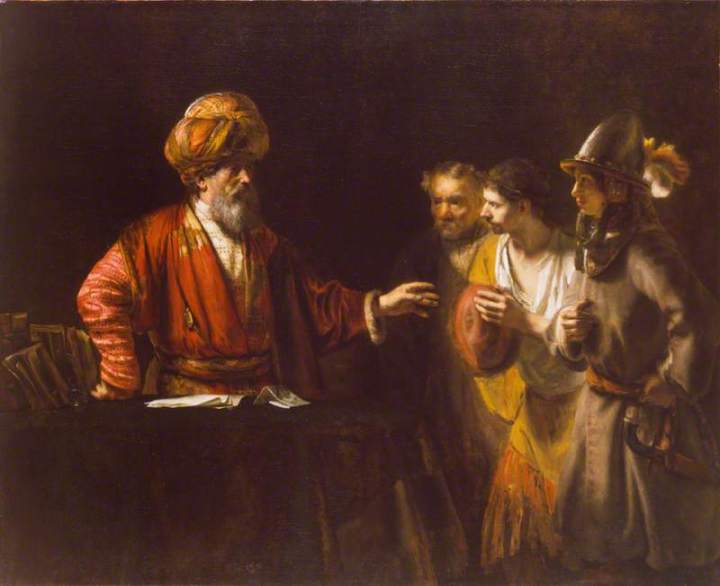
Follower of Rembrandt (1606–1669), The Centurion Cornelius (The Unmerciful Servant), ca. 1660, oil on canvas
(London: The Wallace Collection)
◊ ◊ ◊ ◊ ◊
From the seminar flyer:
Andrea Morgan, Collecting and Displaying Rembrandt’s Pictures in 18th- and 19th-Century England: Charles Jennens of Gopsall Hall and the ‘Rembrandt Room’ at Stowe
Wallace Collection Seminars on the History of Collections and Collecting
Online, Monday, 27 September 2021, 5.30pm
The history of collecting paintings attributed to Rembrandt in eighteenth- century England is especially rich. The English developed such a passion for the Dutch artist by the second half of the century that it led the Reverend Matthew Pilkington to worry in 1770 that “the genuine works of this master are rarely to be met with, and whenever they are to be purchased they afford incredible prices.” This talk will focus on two private collections of paintings attributed to Rembrandt that were formed beginning in the eighteenth century.
Charles Jennens is best remembered as the librettist to the composer George Frederic Handel, but he also owned a massive art collection. Among Jennens’s collection by the 1760s and hanging at his now lost estate, Gopsall Hall, formerly in Leicestershire, were six paintings attributed to Rembrandt and one contemporary copy. The copy was a painting by Pieter Tillemans after Rembrandt’s celebrated picture of Belshazzar’s Feast that was in the eighteenth century owned by the Earl of Derby at Knowsley Hall. While Jennens’s ‘Rembrandt’ pictures have since lost their attribution to the master, I propose some reasons why Jennens in particular might have had a special interest in Rembrandt’s painted oeuvre.
One of the largest but heretofore neglected English collections of paintings attributed to Rembrandt was formerly held at Stowe House, Buckinghamshire, having been amassed by various members of the aristocratic Temple-Grenville family. The first picture was recorded at Stowe as early as 1724, but by 1838 there were a total of ten paintings attributed to the Dutch artist at the estate, along with three said to be by artists in Rembrandt’s circle. I trace the history of this collection and conclude with a discussion of the aptly called ‘Rembrandt Room’ at Stowe.
Please note that this seminar will take place on Zoom and YouTube, and will not be held at the Wallace Collection. Admission is free, and registration is required. More information and details of future seminars can now be found here.
Workshop | 18th-C Persianate Albums Made in India

Musical and dance performance in the harem, from an Indo-Persianate album of Antoine Louis Polier, I 4594, fol. 19, Delhi or Faizabad before 1777
(Staatliche Museen zu Berlin, Museum für Islamische Kunst / Johannes Kramer)
◊ ◊ ◊ ◊ ◊
From ArtHist.net (11 September 2021) . . .
18th-Century Persianate Albums Made in India: Audiences – Artists – Patrons and Collectors
Online and In-Person, Museum of Asian Art and Museum of Islamic Art, Berlin, 15–17 September 2021
Organized by Friederike Weis
This workshop will address the role of Indo-Persianate albums (muraqqaʿs) that were assembled for or collected by the Mughal governors of Awadh (Uttar Pradesh): Shujaʿ al-Daula (r. 1754–75) and his successor Asaf al-Daula (r. 1775–97), as well as other local elites in Bengal and Bihar. Europeans also participated in the creation and consumption of albums, as patrons and collectors. In 1882, the Prussian State acquired a group of twenty albums from the twelfth Duke of Hamilton. So far, these artworks have received little study. Eight of them belonged to the Scottish surgeon and interpreter Archibald Swinton (1731–1804) and ten to the Franco-Swiss engineer-architect Antoine Louis Henri Polier (1741–1795)—both were Company officers deeply acquainted with Indo-Persian aristocratic culture. Many more albums are linked to well-known European figures, such as the Governor-General of Bengal Warren Hastings (1732–1818) and the French Company officer (and special agent to Shujaʿ al-Daula in Faizabad) Jean-Baptiste-Joseph Gentil (1726–1799). Numerous interrelated questions arise from the study of this material, concerning audiences, artists, patrons, collectors, and their wish to produce and preserve knowledge.
The workshop will be held as a blended format with a mix of online and on-site presentations at the Museum of Asian Art and the Museum of Islamic Art in Berlin. You are cordially invited to join all presentations via webex (free of charge). We anticipate that the event will be recorded. If you wish to attend the workshop in person, please note that the number of seats at both venues is limited. Advance registration for on-site attendance is essential: f.weis@smb.spk-berlin.de.
Times are listed according to CEST (Central European Summer Time)
W E D N E S D A Y , 1 5 S E P T E M B E R 2 0 2 1
Museum für Asiatische Kunst, 3.00–6.20pm | Link
3.00 Raffael Gadebusch (Berlin) — Welcome
3.15 Friederike Weis (Berlin) — Introduction
3.50 Session 1. Polier’s Albums and Manuscripts: Contents and Contexts
Chair: Friederike Weis
• Susan Stronge (London) — Collecting the Mughal Past
• Malini Roy (London) — Blurred Lines: Looking at the Paintings by the Artist Mihr Chand and Determining the Boundaries between Innovation, Imitation, or Intentional ‘Duplication’
• Firuza Abdullaeva-Melville (Cambridge) — Three Highlights of Polier’s Collection from Cambridge: Treasures or Leftovers
T H U R S D A Y , 1 6 S E P T E M B E R 2 0 2 1
Museum für Asiatische Kunst, 9.30am–4.30pm | Link
9.30 Session 2. Patrons, Collectors, and Compilation Strategies
Chair: Susan Stronge
• Emily Hannam (Windsor) — Fit for a King? Two Late Mughal Albums in the Royal Library at Windsor Castle
• Axel Langer (Zurich) — Obvious or Hidden Narratives in the Large Clive Album
• J.P. Losty (Sussex) — Archibald Swinton’s Indian Paintings and Albums: An Analysis
12.00 Lunch Break
1.20 Session 3. Recurrent Themes and Tropes in Indo-Persianate Albums
Chair: Laura Parodi
• Katherine Butler Schofield (London) — Performing Women in the Polier and Plowden Albums: Pursuing Khanum Jan
• Molly Aitken (New York) — Intoxicating Friendships: Figuring Classical Indian Aesthetic Regimes in Mughal Album Painting
• Yuthika Sharma (Edinburgh) — Topography as Mughal Utopia? Polier’s ‘Garden Series’ and Artistic Exchange in 18th-Century Periphery-Centre Imagination
• Anastassiia Botchkareva (New York) — Tropes and Outliers: Tracing Patterns of Iconography in the Polier Albums
F R I D A Y , 1 7 S E P T E M B E R 2 0 2 1
Archäologisches Zentrum (Offices of the Museum für Islamische Kunst), 9.45am–3.30pm | Link
9.45 Stefan Weber and Deniz Erduman-Çalış (Berlin) — Welcome
10.00 Session 4. Calligraphy in the Berlin Albums: Historicism and Contemporary Mughal Masters
Chair: Axel Langer
• Claus-Peter Haase (Berlin) — The Calligraphies of the 16th-17th Centuries in the Berlin Albums: Reflections on their Origins and Purpose in a Muraqqaʿ
• Will Kwiatkowski (Berlin) — Expanding the Canon: Mir Muhammad Husayn ʿAta Khan and the Polier Albums
11.50 Session 5. Indian Muraqqaʿs Collected by Europeans: Networks and Relationships
Chair: Deniz Erduman-Çalış
• Laura Parodi (Genova) — Allegory and Verisimilitude in Later Indian Albums
• Isabelle Imbert (Manchester) — Like a Garden Bedecked: Floral Margins in 18th-Century Awadhi Albums Produced for European Patrons
1.10 Lunch Break
2.20 Session 5: Indian Muraqqaʿs Collected by Europeans: Networks and Relationships, continued
• Yael Rice (Amherst, MA) — The London Market for South Asian Muraqqaʿs and the Hastings Albums
3.00 Final Discussion
Exhibition | The Jewish Past of Strawberry Hill
From the exhibition press release, via Art Daily,
The Unexpected Jewish Past of Strawberry Hill House
Online, starting in 2021
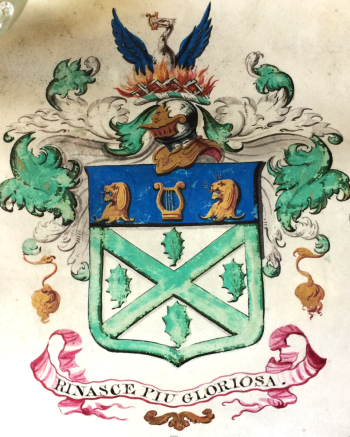
Grant of Arms to John Braham, detail, 1817, “Rinasce piu gloriosa” (It rises again more glorious).
As part of the events and activities celebrating the European Jewish Days of Culture festival, Strawberry Hill House has a free online exhibition exploring the lives of two of the historic west London villa’s former owners: Frances, Countess Waldegrave (1821–1879) and Herbert Stern, 1st Baron Michelham (1851–1919).
For many, Strawberry Hill House is synonymous with Horace Walpole, who built the neo-Gothic villa (1749–76), and filled it with his collections. However, following his death in 1797, the house was passed to a succession of owners, including the formidable Frances, Lady Waldegrave, the daughter of the internationally famous Jewish opera singer, John Braham, and later to Herbert Stern, the scion of a Jewish banking dynasty. As visitors will discover in Strawberry Hill’s comprehensive online exhibition, the House’s Jewish owners brought it back to the centre of the social and artistic milieu of their respective eras.
Through a variety of images and objects, online visitors can explore the aspects of Jewish culture and sociability that characterised the lives of Lady Waldegrave and the Stern Family. With themes including family ties, cosmopolitanism, art patronage, social status, religious identity, anti-Semitism, and different forms of philanthropy, the exhibition shines a spotlight onto the lives and activities of two very different chatelaines, whose time at Strawberry Hill has often been overshadowed by the presence of Walpole.
Visitors to Strawberry Hill House will be able to explore two objects on loan that complement the online exhibition: the Grant of Arms to John Braham (1817) and the Louis William Desanges painting Strawberry Hill: The Drawing Room (1865). Lady Waldegrave was very proud of the coat of arms granted to her father in 1817—a symbol of his success, and his patronage by important figures such as the Duke of Sussex. Appropriately enough for a poor orphan from the East End, who had sold pencils on the street as a young boy, he chose a phoenix rising from the ashes as his crest. The phoenix holds a lyre in its beak—a suitable symbol for a musician (the lyre was the crest of the Worshipful Company of Musicians), and the Grant is inscribed ‘Rinasce piu gloriosa’ (it rises again more glorious). One of the stained-glass windows in the Round Drawing Room at Strawberry Hill shows Braham’s Grant of Arms, and it can also be seen above the entrance gate. Lady Waldegrave became known as one of the foremost political hostesses of Victorian Britain. She, along with her last husband Chichester Fortescue, managed a wide circle of political friendships, both nationally and internationally. Whilst she was deeply involved with the fortunes of the Liberal Party, for which Fortescue was an MP and cabinet minister, the parties she hosted at Strawberry Hill were deliberately bipartisan. Lord Russell, Gladstone and Disraeli were all regular visitors to Strawberry Hill. The Desanges painting Strawberry Hill: The Drawing Room shows such a glittering gathering.
To coincide with the online exhibition, author and curator Nino Strachey will share her personal reflections on the life of her ancestor, Frances Waldegrave, with a talk on 29 September. Drawing on her research into the Braham family, Nino will share new insights from the papers recently acquired by the British Library.
Strawberry Hill House Curator, Silvia Davoli, says: “Our collaboration with the Jewish Country Houses Project has led me to develop a more in-depth documentary research on Lady Waldegrave and the Sterns. With this exhibition my hope is to engage our visitors with a new exciting dimension of the history of the house, a story full of surprises and yet to be told!”
Derek Purnell, Director, Strawberry Hill House & Garden, says: “I am delighted that by displaying these items we are able to begin to share some of the lesser-known stories of Strawberry Hill House’s illustrious history, and we are grateful to Nino Strachey for her contribution to making this project possible.”
Since 2018 Strawberry Hill House has collaborated with the Jewish Country Houses Project, a 4-year research project funded by the Arts and Humanities Research Council, you can find more information about the project and the ongoing initiatives here.
This exhibition is curated by Silvia Davoli (Curator, Strawberry Hill), in collaboration with Nino Strachey (Writer and former Head of Research for the National Trust), Tom Stammers (Associate Professor in Modern European Cultural History, University of Durham), Michele Klein (Independent Researcher), Chris Jones (Curator, Salomons Museum), Bethan Wood (Marketing and Communication Manager, Strawberry Hill), and Carole Tucker (Hon Librarian at Strawberry Hill).
Symposium | Everyday Rococo: Madame de Pompadour and the Arts
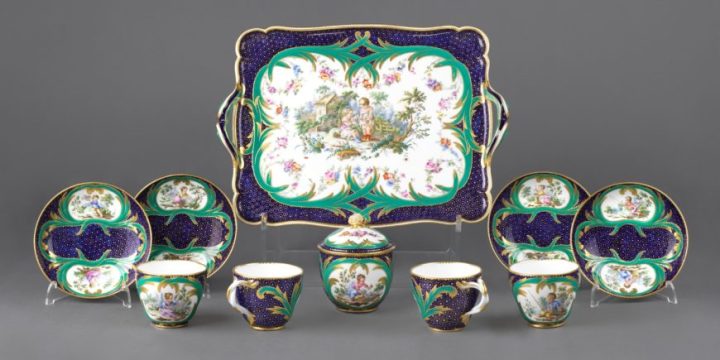
Tray and Tea Service (déjeuner ‘Courteille’, four gobelets ‘Hébert’ et soucoupes, pot à sucre ‘Bouret’), Manufacture de Sèvres, soft-paste porcelain, painted and gilded, lapis and green ground painted with children in landscapes by André-Vincent Vielliard, date letter F for 1759; probably bought by Mme de Pompadour in December 1759 (London: The Wallace Collection, C401-06).
◊ ◊ ◊ ◊ ◊
From The French Porcelain Society:
Everyday Rococo: Madame de Pompadour and the Arts
The Wallace Collection, London, 3–4 December 2021; rescheduled for 1–2 July 2022
The French Porcelain Society is pleased to announce its forthcoming symposium Everyday Rococo: Madame de Pompadour and the Arts to be held at the Wallace Collection, London, on 3–4 December 2021. With two days of papers, which we hope will also be available online, this will be the first reassessment of Jeanne-Antoinette Poisson’s artistic patronage since the landmark exhibition Madame de Pompadour et les Arts of 2002.
Commemorating the tercentenary of her birth, and marking the publication of Rosalind Savill’s book Everyday Rococo: Madame Pompadour and Sèvres Porcelain, this conference will welcome international experts discussing her interests in the fine and decorative arts from pets to porcelain and from prints to religious paintings. Further details will follow in the autumn, but please save the dates: Friday 3rd and Saturday 4th December.
Online Tour | European Porcelain at Villa Cagnola
Online this Sunday from the French Porcelain Society:
Alessandro Biancalana, European Porcelain at Villa Cagnola
FPS Living Room Lecture, 5 September 2021, 18.00 (BST)
 The French Porcelain Society is delighted to continue its online lectures with a very special private tour of Villa Cagnola, north of Milan. Alessandro Biancalana will discuss some highlights from the vast collection of European porcelain in the villa, including Doccia, Meissen, and Capodimonte. He will be joined during the Q&A session by director Don Eros Monti and curator Andrea Bardelli. We hope you can join us. For free links, please email FPSmailing@gmail.com.
“I would define Villa Cagnola not as a house museum in the strictest sense of the term, but rather as a Wunderkammer. Among its numerous treasures, including naturalia, porcelain plays a leading role: it is a composite collection, which has the eighteenth century as leitmotif, bringing together pieces from different manufactories all of them of high quality. Walking along Villa Cagnola’s rooms and looking at the showcases full of objects fascinates the visitor who travels between decorative systems and shapes that are different from each other: the most important European centres of production are represented with Meissen, Doccia, and the most relevant Venetian factories. I hope our journey is stimulating and a source of curiosity.” –Alessandro Biancalana










leave a comment