Online Workshop | Imperial Material: Napoleon’s Legacy
From Eventbrite:
Imperial Material: Napoleon’s Legacy in Culture, Art, and Heritage, 1821–2021
Online, 3 September 2021
Organized by Matilda Greig and Nicole Cochrane
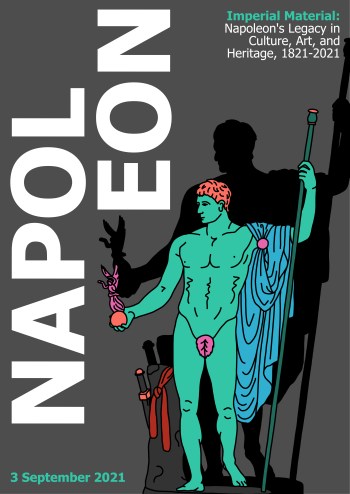 Two hundred years after Napoleon Bonaparte’s death, this online workshop confronts his vast material, visual, and cultural legacy.
Napoleon Bonaparte died exactly two hundred years ago on a small island in the middle of the Atlantic Ocean. He had spent the last six years of his life in exile on St Helena, removed from political and military power, in the unusual situation of being able to try to shape and preserve his own posthumous legacy. He was, in a way, phenomenally successful. Napoleon is an instantly recognisable name to this day, and despite growing efforts in recent years to critically revise his reputation and highlight his role in issues such as the reinstatement of slavery, he has largely managed to escape the same level of historical censure as other infamous military dictators. This is perhaps partly because his name has become such an adaptable brand, standing for an entire era of people, places, and events, as well as a full two centuries’ worth of art, craft, and consumer commodities. While other events marking the bicentenary of Napoleon’s death have weighed his contributions to legislative, political, and military reform, less work has been done to confront his vast material, visual, and cultural legacy. This workshop therefore brings together researchers and museum and heritage professionals to reflect on the enduring material and visual legacy of Napoleon, what our interpretation and use of it means for the future, as well as how it affects our understanding of the past. The workshop is free to attend; registration information is available here.
F R I D A Y , 3 S E P T E M B E R 2 0 2 1
All times are in BST
10.00 Opening Remarks
10.15 Keynote
• Napoleon: A Life Told in Gardens and Shadows, In Discussion — Ruth Scurr (University of Cambridge)
11.10 Break
11.30 Panel 1: National Responses
• Vive L’Empereur!: Napoleon’s Material Legacy in Australia — Emma Gleadhill (Macquarie University) and Ekaterina Heath (University of Sydney)
• Napoléon alla turca: The Ultimate European — Fezanur Karaağaçlıoğlu (Boğaziçi University)
12.15 Panel 2: Politics of Iconography
• Victory Shall Be Mine: The Form, Fate, and Fortune of the Vittoria di Fossombrone and Napoleon as Mars the Peacemaker — Melissa Gustin (University of York)
• Napoleon’s Iconography: Politics of Images and an ‘Imperial Corporate Design’? — Andrea Völker (Leuphana Universität Lüneburg)
13.00 Lunch Break
14.00 Panel 3: Napoleon in the Museum
• The Mysteries of Napoleon’s Toothbrush — Harriet Wheelock (Royal College of Physicians of Ireland and TU Dublin)
• Absence and Ubiquity in the Louvre’s Commemoration of Napoleonic Art Pillage — Nancy Karrels (University of Illinois Urbana-Champaign)
14.45 Panel 4: Representations on Stage and Screen
• I, Napoleon: Blurred Boundaries in Napoleonic Performance — Laura O’Brien (Northumbria University)
• The Emperor’s New Close-Up: Napoleon’s Enduring Impact on Contemporary Film as an Iconic Historical Brand — Aidan Moir (York University)
15.30 Break
16.00 Panel 5: Objects from the Sacred to the Mundane
• From Mania to Relics: The Artefacts of the 1890 Waterloo Panorama — Luke Reynolds (University of Connecticut)
• The Relics of Napoleon and Modern Memory — David O’Brien (University of Illinois Urbana-Champaign)
16.45 Panel 6: Urban and Cultural Legacies
• Perpetual Erasure: Napoleonian Politics and the Cemetery — Kaylee P. Alexander (Guilford College)
• The Legacy of the Napoleonic Era on Hairstyle and Hairdressing — Hervé Boudon (Independent scholar)
17.30 Closing Remarks
Exhibition | Slavery: Ten True Stories
Exhibition trailer by Boomerang Motion.
◊ ◊ ◊ ◊ ◊
From the press release for the exhibition now on view (an initial notice appeared here at Enfilade in September 2019, but here’s the full, updated information, including links for terrific online components). . .
Slavery: Ten True Stories
Rijksmuseum, Amsterdam, 5 June — 29 August 2021
United Nations Headquarters Visitors’ Lobby, New York, 26 February — 30 March 2023
Curated by Eveline Sint Nicolaas and Valika Smuelders
The Rijksmuseum, the national museum of arts and history of the Netherlands, presents its first ever major exhibition dedicated to the subject of slavery this summer. Slavery is inextricably bound up with Dutch history. This is the first time stories of slave trade across the Atlantic and the Indian Oceans are told together in one exhibition in the Netherlands. The exhibition presents ten true stories. Ten personal stories about enslaved people and slave owners, people who resisted, and people who were brought to the Netherlands in slavery. What were their lives like? What was their attitude to the system of slavery? Were they able to make their own decisions?
 The exhibition includes objects from national and international museums, archives, and private collections—including the Nationaal Museum voor Wereldculturen, British Museum, National Gallery of Denmark, Iziko Museums of South Africa, St Eustatius Historical Foundation, National Archeological Antropological Memory Management (NAAM) in Curaçao, the National Archives of South Africa, Indonesia and the Netherlands, and private collections in Sint Eustatius, Suriname, and the Netherlands.
Valika Smeulders, head of History Rijksmuseum: “By focusing on ten true personal stories, Slavery gives an insight into how individuals dealt with legalized injustice.”
Taco Dibbits, General Director Rijksmuseum: “The Rijksmuseum is the national museum of art and history. Slavery is an integral part of our history. By delving into it, we can form a more complete picture of our history and a better understanding of today’s society.”
Ten True Stories
During the 250-year colonial period, people were made into property and objects to be recorded in accounts. The exhibition highlights the lives of ten people who lived at the time. They each tell their own story: about living in slavery or taking advantage of it, about resistance, and—ultimately—freedom. They include enslaved people and slaveholders, as well as individuals who broke the shackles of slavery, an African servant in the Netherlands, and an Amsterdam sugar industrialist. An audio tour leads visitors through these widely differing lives. Among the narrators are Joy Delima, Remy Bonjasky and Anastacia Larmonie, who each have a connection with one of the ten people through their own background.
The exhibition includes objects, paintings, and unique archival documents. Visitors also will hear oral sources, poems, and music. To tell a more complete story, there will be exhibits that have never been shown in the Rijksmuseum before, such as objects that were cherished by people in slavery and tools that were used on plantations.
The Dutch Colonial Period on Four Continents

Alexander de Lavaux, Map of Suriname, 1737, silk, 187 × 216 cm (Amsterdam: Rijksmuseum).
The exhibition spans the Dutch colonial period from the 17th to the 19th century. It features the trans-Atlantic slavery in Suriname, Brazil, and the Caribbean, along with the part played by the Dutch West India Company (WIC) and Dutch colonial slavery in South Africa and Asia, where the Dutch East India Company (VOC) operated. The effects of the system in the Netherlands during the period are also highlighted. As a whole, it offers a geographically broad and at the same time specifically Dutch view that has never been seen before in a national museum.
Look at Me Now
The stories in the exhibition—about João, Wally, Oopjen, Paulus, Dirk, Lokhay, Van Bengalen, Surapati, Sapali and Tula—stand for millions of other stories about the slavery past of the Netherlands and its continued effects. At the end of the exhibition, the artists David Bade (Curacao, 1970) and Tirzo Martha (Curacao, 1965), both from Curacao’s Instituto Buena Bista, invite visitors to give expression to their own stories through the ten new artworks making up the Look at Me Now project. Visitors can follow the progress of this project via the website.
Online Exhibition
The Rijksmuseum is also presenting the ten stories in an online exhibition that features video and audio clips, animations, an overview of the exhibition galleries, and objects that can be viewed in exceptional detail. Visitors to the website will be able to see the Slavery exhibition in ten episodes, whenever and wherever it suits them.
Symposium
The Rijksmuseum partnered with the National Library of the Netherlands and the National Archive of the Netherlands to present an English-language online symposium on 23 April 2021, focusing on what it means to increase inclusivity in source usage by museums, archives, and libraries. What sources are available to people making presentations and conducting research on the subjects of slavery and the slave trade? Click here to view a recording of the symposium.
Rijksmuseum & Slavery
For the coming year, more than 70 objects in the permanent collection will have a second museum label that explores and highlights what has been, until now, an invisible relationship between the object and slavery. Subjects covered range from former rulers to the presence of people of colour and the way they are portrayed. Rijksmuseum & Slavery takes place concurrently with the Slavery exhibition, but it is not part of the exhibition.
Collaboration
The exhibition and accompanying events and activities are the result of collaboration with a wide variety of external experts, including historians, heritage experts, cultural entrepreneurs, artists, theatre practitioners, and performers.
Narrative advisor:
Jörgen Tjon A Fong
Think tank:
Reggie Baay, Raul Balai, Aspha Bijnaar, Mitchell Esajas, Karwan Fatah-Black, Martine Gosselink, Dienke Hondius, Wayne Modest, Ellen Neslo, Matthias van Rossum, Maurice San A Jong, Alex van Stipriaan, Jennifer Tosch, Urwin Vyent, Simone Zeefuik, and Suze Zijlstra
The exhibition design is by AFARAI, the agency led by architect Afaina de Jong. The graphic design of the exhibition and the book are by Irma Boom Office.
◊ ◊ ◊ ◊ ◊
Eveline Sint Nicolaas and Valika Smeulders, eds., Slavery: The Story of João, Wally, Oopjen, Paulus, Van Bengalen, Surapati, Sapali, Tula, Dirk, Lohkay (Amsterdam: Atlas Contact, 2021), 352 pages, ISBN: 978-9045044279, €28. (Also available in Dutch).
◊ ◊ ◊ ◊ ◊
Note (added 27 March 2023) — The posting has been updated to include the UN as a venue for a version of the exhibition.
Online Symposium | Printmaking between Art and Science in Britain
From Eventbrite:
The Itinerant Image: Printmaking between Art and Science in Enlightenment Britain
Online, University of St Andrews, 12–13 August 2021

Charles Reuben Ryley, Ring-Tailed Lemurs, in George Shaw, Museum Leverianum (1792), op. p. 43.
In early modern Britain, the printed image was a major practical and conceptual tool for scientists. As recent research into the graphic practices of the Royal Society has shown, illustrations and diagrams were indispensable to communicating scientific knowledge, both collectively and by individuals. In particular printed images circulated between the Royal Society’s periodicals and the published volumes of its fellows. Some of these images, such as the flea from Robert Hooke’s Micrographia (London 1665), subsequently became widely reproduced and iconic images in the history of science. Yet these printed images were rarely confined to scientific domains; not only were they usually the result of collaboration with artisans and in some cases artists, but the most successful images would often circulate far beyond the scientific communities for which they were initially produced. Further still, images were often copied or translated into new locations, where their meaning might be altered for new audiences.
Over two days, this symposium will bring together scholars and curators of British art, science, and print culture from the seventeenth and eighteenth centuries, to interrogate the creation, use, and function of prints in the production of new scientific knowledge. It considers how the ‘epistemic’ value of an image changed as it was reprinted, adapted, and modified; and pays particular attention to how and when a reproduced image might gain or lose scientific authority.
All sessions will take place over Zoom. Please register for an online ticket. A link will be sent to all attendees in advance of each day’s event.
T H U R S D A Y , 1 2 A U G U S T 2 0 2 1
14.00–16.30 BST
Welcome and Introduction, Stephanie O’Rourke (University of St. Andrews) and Katherine Reinhart (Bibliotheca Hertziana – Max Planck Institute for Art History)
• Megan Barford (Royal Museums Greenwich), Travelling Charts and Shrinking Paper: Royal Naval Hydrography in the 1830s
• Richard Bellis (University of St. Andrews), Printing the Structures and Textures of Disease: Matthew Baillie’s A Series of Engravings … to Illustrate the Morbid Anatomy (1799–1802)
• Elaine Ayers (New York University), Drawing at a Distance: Botanical Illustration in the East India Company in the Early Nineteenth Century
Respondents: Jack Hartnell (University of East Anglia) and Katy Barrett (Science Museum)
F R I D A Y , 1 3 A U G U S T 2 0 2 1
14.00–16.30 BST
• Anna Marie Roos (University of Lincoln), Lives and Afterlives of the Lithophylacii Britannici ichnographia (1699), the First Illustrated Field Guide to English Fossils
• John Bonehill (University of Glasgow) ‘Curious and Chargeable Cuts’: Michael Burghers and the Illustration of Robert Plot’s Natural Histories
• Meghan Doherty (Berea College), The Long Life of Ephemera: (Re)Printing the Philosophical Transactions of the Royal Society
Respondents: José Marcaida (University of St. Andrews) and Aileen Fyfe (University of St. Andrews)
Online Symposium | The Politics of the Portrait, in Three Parts
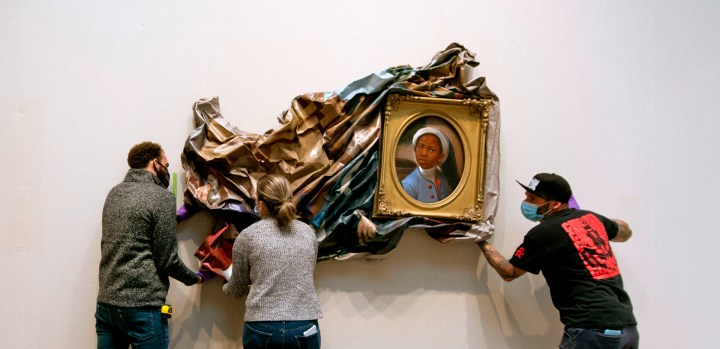
Titus Kaphar, Enough About You, 2016, oil on canvas with an antique frame, on loan from the Collection of Arthur Lewis and Hau Nguyen, Courtesy of the artist, photo by Richard Caspole. More information is available here.
◊ ◊ ◊ ◊ ◊
From the YCBA:
The Politics of the Portrait, in Three Parts
Online, Yale Center for British Art, 23 July — 17 September 2021
Featuring artists, collectors, curators, and scholars, The Politics of the Portrait is a three-part online symposium that considers potential solutions and alternatives regarding the history, display, and making of portraits and the role of representation in today’s sociopolitical climate.
In 2020 the Yale Center for British Art began a research project on Elihu Yale with Members of his Family and an Enslaved Child (ca. 1719), a painting in the collection that depicts one of Yale University’s founders with an enslaved child. This project became a springboard for this online series of conversations among artists, collectors, curators, and scholars to consider potential approaches, revisions, and additions to the canon of art history, curating, and artmaking.
◊ ◊ ◊ ◊ ◊
Part 1 | Art History: Hierarchies of Representation
Friday, 23 July 2021, 12–1:30pm
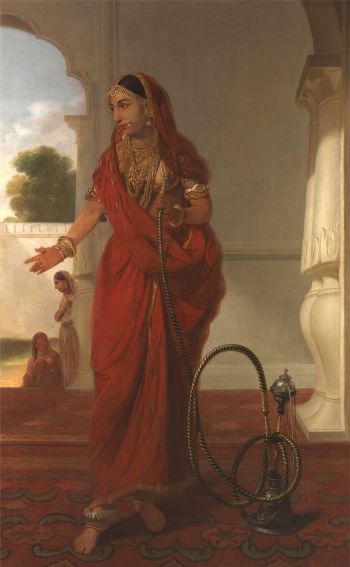
Tilly Kettle, Dancing Girl, 1772, oil on canvas (New Haven: Yale Center for British Art, Paul Mellon Collection).
Zirwat Chowdhury, Bridget R. Cooks, and Edward Town discuss potential approaches to and revisions of frameworks that are commonly used for telling the history of portraiture with a particular focus on the Black figure. How might we restructure art history to make it a more decentralized, inclusive discipline? What scholarly initiatives have been effective at countering systemic marginalization in the representation of Black and Brown bodies in Western art? How can we overcome the problem that there are few records—material, textual, or visual—of many of the Black figures represented in Western art? Notwithstanding these absences, what work is being done to center the lives of Black figures in historical portraits? What can we learn about these figures from close looking and study in museums?
Zirwat Chowdhury is Assistant Professor of 18th- and 19th-century European Art at the University of California, Los Angeles. Bridget R. Cooks is Associate Professor at the University of California, Irvine. Edward Town is Head of Collections Information and Access at the Yale Center for British Art. The conversations is moderated by Maryam Ohadi-Hamadani, Postdoctoral Research Associate at the Center.
To join us for this program, please register here.
◊ ◊ ◊ ◊ ◊
Part 2 | Curatorial Practice and the Museum: Contextualization and Narratives
Friday, 6 August 2021, 12–1:30pm
Curators Liz Andrews, Christine Y. Kim, Denise Murrell, and Keely Orgeman discuss their recent projects and upcoming exhibitions and consider the ethical, practical, and historical implications of displaying portraits and figurative artworks in museums.
Liz Andrews is Executive Director of the Spelman College Museum of Fine Art. Christine Y. Kim is Curator of Contemporary Art at the Los Angeles County Museum of Art. Denise Murrell is Associate Curator of 19th- and 20th-Century Art at The Metropolitan Museum of Art. Keely Orgeman is Associate Curator of Modern and Contemporary Art at the Yale University Art Gallery. The conversation is moderated by Maryam Ohadi-Hamadani, Postdoctoral Research Associate at the Yale Center for British Art.
To join us for this program, please register here.
◊ ◊ ◊ ◊ ◊
Part 3 | In Conversation: Titus Kaphar and Art Collectors Arthur Lewis and Hau Nguyen
Friday, September 17, 2021, 12–1pm
Titus Kaphar, Arthur Lewis, and Hau Nguyen discuss Kaphar’s practice and the importance of supporting emerging artists, artists of color, and local art communities. The conversation is moderated by Abigail Lamphier, Senior Curatorial Assistant in the Department of Paintings and Sculpture at the Yale Center for British Art.
Kaphar is an American artist whose paintings, sculptures, and installations examine the history of pictorial representation. Kaphar physically manipulates his canvases by cutting, shredding, twisting, breaking, and tearing his paintings and sculptures, reconfiguring them into works that reveal unspoken truths about the nature of history, often in an effort to consider overlooked subjects. By transforming these styles and mediums with formal innovations, he emphasizes the physicality and dimensionality of the canvas and the materials. His practice challenges art historical images and the narratives they normalize.
Kaphar received an MFA from the Yale School of Art in 2006 and is a distinguished recipient of numerous prizes and awards including a MacArthur Fellowship (2018), an Art for Justice Fund grant (2018), a Robert R. Rauschenberg Artist as Activist grant (2016), and a Creative Capital grant (2015). His work appears in the collections of the Crystal Bridges Museum in Arkansas, the Pérez Art Museum Miami, and several New York City museums, including the Brooklyn Museum, the Metropolitan Museum of Art, the Museum of Modern Art, and the Whitney Museum of American Art.
Kaphar lives and works in New Haven, Connecticut. In 2015, he cofounded NXTHVN, a 40,000-square-foot nonprofit arts incubator located in two former manufacturing plants in the Dixwell neighborhood of New Haven. NXTHVN offers fellowships, residencies, and other professional development opportunities to artists, curators, and students in the local community and beyond.
Lewis and Nguyen have built an art collection celebrated for its focus on contemporary women artists and artists of color and were named in the top 200 art collectors by ArtNews in 2020. Over the last thirteen years, the couple have intentionally focused on supporting a wide range of black artists and developing their local art community in Los Angeles. As a result, the core of Lewis and Nguyen’s collection features both emerging and established artists including Genevieve Gaignard, Jennie C. Jones, Titus Kaphar, Kerry James Marshall, Ebony G. Patterson, and Amy Sherald.
Lewis and Nguyen are further renowned for their intentional approach to collecting, which extends beyond building the market value for artworks. Seeing the role of the collector as one of guidance and care, the couple are active in the artist community and enjoy personal relationships with many artists represented in their collection. Lewis is creative director of United Talent Agency’s fine arts group and the UTA Artist Space in Beverly Hills, California. He is a member of the boards of the Hammer Museum and the Underground Museum in Los Angeles, as well as New York’s Studio Museum in Harlem. Nguyen is the owner and creative director of boutique hair salons.
In October 2020, Lewis and Nguyen lent Kaphar’s Enough About You (2016) to the Yale Center for British Art. This artwork was on view in the Center’s galleries for eight months in place of the eighteenth-century group portrait Elihu Yale with Members of his Family and an Enslaved Child. To learn more about why this change was made and a description of the ongoing research into this group portrait, visit New light on the group portrait of Elihu Yale, his family, and an enslaved child.
Online Conference | Travel and Archaeology in Ottoman Greece
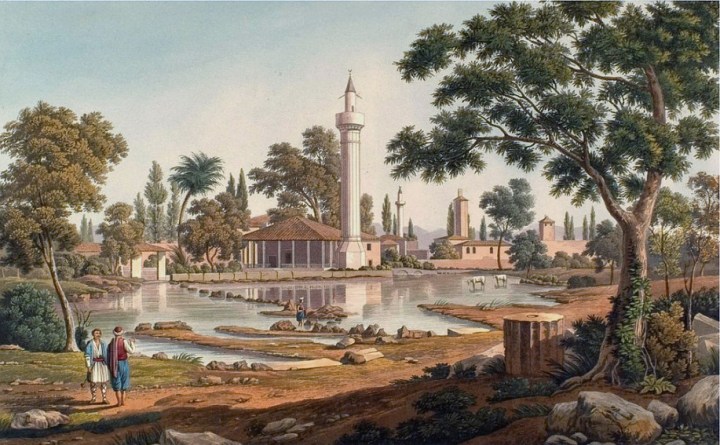
The Hyperian Fountain at Pherae, Edward Dodwell, Views in Greece (London 1821), p. 91.
◊ ◊ ◊ ◊ ◊
From the conference programme:
Travel and Archaeology in Ottoman Greece in the Age of Revolution, c.1800–1833
Online, British School at Athens, 16–17 September 2021
Organised by Alexia Petsalis-Diomidis
Registration due by 20 August 2021
The bicentenary of the Greek War of Independence of 1821 offers a timely opportunity for a re-evaluation of travel and archaeology in the age of revolution. The conference foregrounds diversity and small-scale engagements with the landscape and material past of Ottoman Greece at a time of political tension and explosive violence. The conference will explore the perspectives of both foreign travellers and local inhabitants in order to tease out diverse voices, keeping a sharp focus on the effects of ethnicity, race, gender, and social status.
Within this inclusive intellectual framework we will pose a series of questions to analyse the mediating role of the Greek landscape and its antiquities between travellers and local inhabitants in all their diversity. How did major intellectual and cultural developments of the late eighteenth century, ranging from revolutionary politics in France and America to scientific and museological developments, intersect with actual encounters ‘on the ground’ in Ottoman Greece, specifically with the landscape, local inhabitants, and small-scale objects and antiquities? How did the ethnic, cultural, and religious identities of Ottoman communities affect local perceptions of contemporary travel and the classical material past? How did status (including slave status) and gender shape encounters with the Greek landscape and its antiquities, not least with idealising white sculptured male bodies? How did archaeological-focused travel, with its emerging sophisticated discourses, intertwine with travel undertaken for scientific, military, and Romantic aims?
In this way the conference will give prominence to hitherto marginalised perspectives drawing on recent work to decolonise Ancient Mediterranean Studies, including sensory approaches to access silenced voices, and will develop a micro-cultural history of travel and archaeology in Ottoman Greece in this tumultuous period.
Hosted via Zoom, the conference is free and open to all who are interested, but registration is essential. Speakers’ full papers will be pre-circulated to registered participants at the end of August. To register for the conference, please email Dr Jenny Messenger at jenny@atomictypo.co.uk by 20 August. For Dr Alexia Petsalis-Diomidis’ lecture, registration is separate: a link to register will be available in the ‘Events’ section of the BSA website approximately one month in advance.
T H U R S D A Y , 1 6 S E P T E M B E R 2 0 2 1
13.00 John Bennet and Alexia Petsalis-Diomidis, Welcome and Introduction
13.15 Panel 1: Travel as a Kaleidoscope of Perspectives
Chair: Estelle Strazdins (University of Queensland)
• Charalampos Minaoglou (National and Kapodistrian University of Athens), Traveling in Europe, Exploring Greek Identity: Orientalism and ‘Westernism’ in Constantine Karatzas’ Diaries
• Federica Broilo (Universitá Degli Studi Urbino ‘Carlo Bo’), Simone Pomardi and the Rediscovery of the Modern Greek Landscape
• Jason König (University of St Andrews), Mineralogy, Ethnography, Antiquarianism: Images of Collecting in the Travel Writing of Edward Daniel Clarke
• Ayşe Ozil (Sabanci University), Local Greek Travel-Writing, Antiquities, and the Diverse Social Landscape in the Post-Revolutionary Ottoman Empire
14.15 Break
14.30 Panel 2: Ottoman Spaces and Identities
Chair: Edhem Eldem (Boğaziçi University and Collège de France)
• Nikos Magouliotis (ETH Zurich, Institute for the History and Theory of Architecture, PhD Candidate), Inside the Villager’s House: Views of European and Greek Authors on the Vernacular Architecture of Late-Ottoman Greece, ca. 1800–30
• Zafeirios Avgeris (Uppsala University, MA Candidate), From Text to Space: Mapping Sir William Gell and Edward Dodwell as Data Layers on an Ottoman Landscape
• Emily Neumeier (Temple University, Philadelphia), Orientalism in Ottoman Greece
• Elisabeth Fraser (University of South Florida), Louis Dupré in Ottoman Greece: Multiple Identities, Contradictory Encounters
15.30 Break
17.30 British School at Athens Public Lecture
• Alexia Petsalis-Diomidis (University of St Andrews), From Ottoman Smyrna to Georgian London: Travel, Excavation, and Collecting of Levant Company Merchant Thomas Burgon (1787–1858)
F R I D A Y , 1 7 S E P T E M B E R 2 0 2 1
13.00 Panel 3: Individuals Collecting Antiquities
Chair: Ayşe Ozil (Sabanci University)
• Estelle Strazdins (University of Queensland), Imagining Ethiopians in the Age of Revolution: Arrowheads from the Marathon Sôros and the Statue of Rhamnoussian Nemesis
• Alessia Zambon (Université Versailles Saint Quentin en Yvelines, Paris), ‘Je vois qu’à Paris on a une bien fausse idée des Grecs…’: Fauvel’s Perception of the Greeks and of the Greek Revolution
• Irini Apostolou, (National and Kapodistrian University of Athens), In Search of Antiquities: The Travels of Alexandre and Léon de Laborde during the Greek War of Independence of 1821
• Michael Metcalfe (The Syracuse Academy), Ancient Inscriptions and British Travellers to Ottoman Greece, 1800–21
14.00 Break
14.15 Panel 4: Antiquities and Official Discourses
Chair: Elisabeth Fraser (University of South Florida)
• Edhem Eldem (Boğaziçi University and Collège de France), ‘Viewing and Contemplating’ (Seyr ü Temaşa): Foreign Travelers and Antiquarians and the Sublime Porte, ca 1800–30
• Aikaterini-Iliana Rassia (King’s College London), Andreas Moustoxydes (1785–1860) and Kyriakos Pittakis (1798–1863) and the Rescue of Greek Antiquities
14.45 Break
15.15 Panel 5: Forms of Philhellenism
Chair: Jason König (University of St Andrews)
• Mélissa Bernier (Ecole Normale Supérieure de Paris, PhD candidate), Samuel Gridley Howe’s Travels: Classical, Romantic, and Philanthropic Philhellenism, 1800–30
• Fernando Valverde (University of Virginia), Greece in the Age of Revolution: An Intimate Poetics of Landscape, Travel, and Liberty
15.45 Break
16.00 Conclusions and Future Directions
• Breakout Rooms
• Roundtable Discussion
Conference | Afterlife of the Mausoleum of Halicarnassus, 1500–1850
From ArtHist.net:
Re-Conceiving an Ancient Wonder: The Afterlife of the Mausoleum of Halicarnassus, 1500–1850
RWTH Aachen University (online and in-person), 9–11 September 2021
Organized by Anke Naujokat, Desmond Bryan Kraege, and Felix Martin
The importance of the Mausoleum of Halicarnassus for European culture is revealed by its very name, which—in many languages—has become a noun signifying any sufficiently monumental tomb. However, the Mausoleum was destroyed during the Middle-Ages, and many aspects of its appearance remain uncertain, even since the excavation of its foundations in the 1850s. During the Early Modern Period, the main sources of information on this building were thus ancient texts, which were the only references concerning the Mausoleum’s dimensions and appearance. Accurately reconstructing architecture according to brief written descriptions, however, is an impossible task. Yet, despite this difficulty or perhaps due to the liberty it offered the imagination, numerous artists, architects and antiquaries took a keen interest in the monument during the timeframe 1500–1856, mainly using Pliny’s description to suggest reconstructions, devise pictorial representations and seek inspiration for new funerary projects or monumental public architecture.
This workshop aims to examine the afterlife of the Mausoleum during this period. Being an invisible reference, the monument left far more leeway to the imagination than other, existing ancient buildings that also attracted scholarly and artistic attention, such as the Pantheon. The Mausoleum’s invisibility entails that it is not the monument itself that will be investigated here, but rather the ensemble of texts, images and architectural projects referring to this central but unknowable model. Drawing upon recent developments in the methodologies of intermediality and temporality, the project aims to add a new dimension to this discussion by focusing on a precise case study examining the evolution of several key themes over a long period.
The workshop will be organised as a hybrid onsite/online event. It will be possible to listen to papers and join the discussions via Zoom. All are welcome to join, we will gladly provide the event link if you write to us at halicarnassus@ages.rwth-aachen.de.
Organising Committee
• Prof. Dr. Anke Naujokat (RWTH Aachen University)
• Dr. Desmond Bryan Kraege (AHO Oslo School of Architecture and Design)
• Felix Martin M.Sc. (RWTH Aachen University)
T H U R S D A Y , 9 S E P T E M B E R 2 0 2 1
14.00 Welcome
14.15 Anke Naujokat, RWTH Aachen University, Introduction
14.30 I. Tombs and Widows
• Inmaculada Rodriguez Moya (Universitat Jaume I Castellón) and Victor Minguez (Universitat Jaume I Castellón), The Mausoleum of Halicarnassus in the Renaissance Imagination: Royal and Noble Tombs, 1384–1545
• Simone Salvatore (Sapienza Università di Roma), The Iconographic Fortune of Artemisia and the Mausoleum of Halicarnassus in Early Modern Italy, 1500–1630
• Sheila Ffolliott (George Mason University), Embodying the Mausoleum: Artemisia as Model for 16th- and 17th-Century Women and Regents
18.00 Evening Lecture
• Poul Pedersen (University of Southern Denmark / The Danish Halikarnassos Project), The Maussolleion at Halikarnassos and the Ionian Renaissance in Greek Architecture
F R I D A Y , 1 0 S E P T E M B E R 2 0 2 1
9.30 II. The Sangallo Circle
• Peter Fane-Saunders (Birkbeck, University of London), The Mausoleum, Architectural Theory, and the Renaissance Church
• Andreas Raub (Alte Pinakothek, Munich), Antonio da Sangallo the Younger: Mausolea for St. Peter and the Popes
• Fabio Colonnese (Sapienza Università di Roma), Porsenna, Mausolus, and the Pyramids of Antonio da Sangallo the Younger
• Marco Brunetti (Bibliotheca Hertziana – Max-Planck-Institut für Kunstgeschichte), Dream of a Shadow: The Mausoleum of Halicarnassus and the Accademia della Virtù
12.00 Lunch Break
13.30 III. Print Culture and the Seven Wonders
• Katharina Hiery (Universität Tübingen), Maarten van Heemskerck’s Images and the Mausoleum in Print Culture
• Ainhoa de Miguel Irureta (Universidad Católica de Murcia), The Mausoleum of Halicarnassus in 17th-Century Series of the Seven Wonders: Following in the Wake of Maarten van Heemskerck
• Marco Folin (Università degli studi di Genova) and Monica Preti (Head of Academic Programmes, Musée du Louvre, Paris), Fischer von Erlach’s Mausoleum of Halicarnassus
15.00 Coffee Break
15.30 IV. The Mausoleum and the City
• Raphaëlle Merle (Université Paris 10 Nanterre), Travellers and Topography in Early Modern Halicarnassus, 1656–1857
• Daniel Sherer (Princeton University School of Architecture), Architecture and Print Culture in the Late 17th- and Early 18th-Century English Reception of the Mausoleum of Halicarnassus: Intermedium Signification in Hawksmoor’s St George’s Bloomsbury and Hogarth’s Gin Lane, 1670–1751
S A T U R D A Y , 1 1 S E P T E M B E R 2 0 2 1
9.30 IV. The Mausoleum and the City, continued
• Stefan Hertzig (Architectural Historian and Heritage Specialist, Dresden), An Ancient Wonder for Dresden: The So-Called Pyramid Building of Augustus the Strong on the Neustadt Bridgehead as a Paraphrase of the Mausoleum à la Heemskerck
• Desmond-Bryan Kraege (AHO Oslo School of Architecture and Design), Imaginary Architecture and the Mausoleum’s Move to a Peri-Urban Environment, France, ca. 1750s–1790s
10.30 Coffee Break
11.00 V. Scholarship and a New Vision of History
• Felix Martin (RWTH Aachen University), Building for Posterity: Friedrich Weinbrenner, the Mausoleum at Halicarnassus, and the Pursuit of Permanence around 1800
• Christian Raabe (RWTH Aachen University), Karl Friedrich Schinkel’s Tomb of King Mausolus of Caria
12.00 Lunch Break
13.30 V. Scholarship and a New Vision of History, continued
• Marina Leoni (Université de Genève), Quatremère de Quincy’s Mausoleum of Halicarnassus and French Scholarship
• Lynda Mulvin (University College Dublin), Charles Robert Cockerell (1788–1863): A Pioneering Study of the Mausoleum of Halicarnassus as Part of a Wider Project to Locate Other Unknown Sites and Monuments in ‘Ionian Antiquities’
14.30 Concluding Discussion
Online Lecture | Gem Impressions in the Portuguese Royal Collections
From the registration page:
Ana Mónica da Silva Rolo and Noé Conejo Delgado, A Dactyliothec from Pietro Bracci in the Portuguese Royal Family’s Collections
Wallace Collection Seminars on the History of Collections and Collecting
Online, Monday, 26 July 2021, 17.30
 During the eighteenth and nineteenth centuries, in Europe, the versatile education of erudite elites was indispensable to and synonymous with social distinction. In this cultural frame, travels through Europe, in the style of the Grand Tour, became especially appreciated among European aristocratic youth. At the same time, interest in Classical antiquity and collecting antiques was enhanced, giving rise to a flourishing activity of replica production and trade, especially in Italy.
The dactyliothec by the Italian artist Pietro Bracci (1700–1773) in the collections of the Museum-Library of the House of Bragança (Vila Viçosa, Portugal) illustrates eighteenth- and nineteenth-century taste, shared by the last generations of the Portuguese Royal House. The set presented is composed of 2,350 plaster moulds of gems and cameos, organized in three thematic series. The first and largest series is dedicated to emblematic pieces of ancient art and the Italian Renaissance. The second series is composed of a selection of reproductions of the best carvings originally made by eighteenth-century craftsmen, like Giovanni or Luigi Pichler and Natal Marchant. The third and last series brings together a total of 180 cameos dedicated to Emperors of Europe. Dated between the end of the eighteenth century and the first quarter of the nineteenth century, this dactyliothec reflects the importance that such casts assumed as souvenirs of Classical art and history for collectors and travellers, as well as their use as an educational resource in the academic training of young aristocrats.
You can register to view this talk via Zoom here, or plan to watch via The Wallace Collection’s YouTube channel.
Ana Mónica da Silva Rolo and Noé Conejo Delgado are both based at the Archaeology Centre UNIARQ of Lisbon University.
Online Exhibition | Making History: Shakespeare and the Royal Family
The exhibition is available here:
Making History: Shakespeare and the Royal Family
Online Exhibition, launching 15 July 2021

John Boyne, ‘Falstaff and his Prince’, 1783, etching showing Charles Fox as Falstaff to George’s Prince Hal.
The Shakespeare in the Royal Collection (ShaRC) project is delighted to announce a new digital exhibition, exploring the entwined stories of Shakespeare and the royal family across the centuries, launching on Thursday, 15 July 2021. Making History: Shakespeare and the Royal Family reveals how influential this relationship has been in shaping British culture.
Drawing on new archival research, the exhibition (in eight sections) explores the curious, political, and sometimes tragic connections between Shakespeare and the royal family through access to key objects in the Royal Collection and Royal Archives. A Shakespeare Folio contains handwritten annotations made by Charles I shortly before his 1649 execution. A painting by Thomas Gainsborough marks the short-lived affair of the actress and poet Mary ‘Perdita’ Robinson with George IV when Prince of Wales, casting him in the role of a dashing Prince Florizel. Digital visualisations put viewers in the audience of performances watched by Queen Victoria, bringing historical Shakespearean performances in the State Apartments at Windsor Castle vividly to life for the first time.
A wider online database, allowing users to search over 1,000 Shakespeare-related objects from the Royal Collection and Royal Archives, will also shortly be launched, and can be explored here: https://sharc.kcl.ac.uk/
Shakespeare in the Royal Collection is a three-year AHRC-funded research project led by King’s College London, in collaboration with Birkbeck University of London and The Royal Collection Trust. It investigates the Shakespeare-related holdings in the Royal Collection and Royal Archives, 1714–1945, and provides new information about a broad range of objects created, collected and displayed by generations of members of the royal family.
Online Lecture | David Adshead on Pompeii and Neoclassicism
From the Attingham Summer Lecture Series:
David Adshead, Pompeii and All That: Reimagining Ancient Worlds
Online, Wednesday, 14 July 2021, 6.00pm (BST)

Wilhelm Zahn, Die schönsten Ornamente und merkwürdigsten Gemälde aus Pompeji, Herculanum und Stabiae (Berlin, 1828).
David Adshead, Co-Director of the Attingham Summer School and Director of the London House Course, will look at the cultural impact of the discovery of Herculaneum and Pompeii. News of the excavation of these ancient Neopolitan cities sent an electric shock of excitement across Europe and beyond and served as a stimulus to the nascent Neoclassical movement. Grand Tourists, artists, and architects flocked to see the statuary, wall paintings, and other artefacts that emerged unscathed from their volcanic overburden. Illustrated publications followed. These cities also caught the attention of philhellenes at a time before travel to Greece and, modern day, Turkey was common, for they had been Greek colonies before they were Roman. The discovery at Pompeii of a temple dedicated to the goddess Isis, decades before Napoleon’s invasion of Egypt, also triggered a fascination in all things Egyptian. Aspects of collecting, design, and decoration were all directly or indirectly influenced as a result.
Registration is available here»
Online Talk | Pushing Boundaries of Photo-Based Work

Kyungmi Shin, Lunch on the Grass, 2020. The work layers an image of a picnic from 1960s Korea (an image which includes Shin’s father, a Protestant pastor) on top of an image of François Boucher’s Chinese Garden from around 1742. The oil painting by Boucher is in the Musée des Beaux-Arts et d’Archéologie de Besançon. For more information on Shin, see Susan Stamberg’s piece for NPR, “An Artist Explores What ‘Crosses the Ocean’ in Porcelain and Painted Collage,” (12 November 2020), produced in response to the exhibition Kyungmi Shin: Father Crosses the Ocean on view at the Orange County Museum of Art in Santa Ana, California from 24 September 2020 until 21 February 2021.
◊ ◊ ◊ ◊ ◊
From The Getty:
Mercedes Dorame, Kori Newkirk, and Kyungmi Shin
Beyond the Frame: Pushing Boundaries of Photo-Based Work
Online, The Getty, Tuesday, 20 July 2021, 5pm (Pacific Time)
In this conversation, multidisciplinary artists Mercedes Dorame, Kori Newkirk, and Kyungmi Shin discuss how their approaches to art making and activism push the boundaries of photography, transforming it beyond its perceived objectivity and conventional format. Their work is featured in the exhibition Photo Flux: Unshuttering LA, which disrupts the privileging of white narratives in photography by celebrating the diverse, dynamic practices of contemporary Los Angeles artists. The event is free, though advance sign-up is required.










leave a comment