Xavier Salomon on Clodion’s Dance of Time
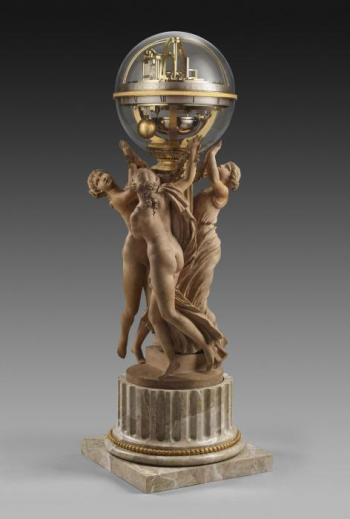
The Dance of Time, Three Nymphs Supporting a Clock, movement by Jean-Baptiste Lepaute, sculpture by Claude Michel Clodion, 1788, terracotta, gilt brass, and glass, H.: 41 inches (New York: The Frick Collection, bequest of Winthrop Kellogg Edey) Photo: Michael Bodycomb.
A very Happy New Year to all of you! I should have posted news of this brief talk earlier, but it will be available on YouTube whenever you might have the time and inclination to watch. I also point out the series more generally for those of you always looking for teaching resources. Past installments (typically 20 minutes) address paintings by Gainsborough, Stubbs, Romney, Tiepolo, Boucher, and Chardin, along with extraordinary decorative arts objects (and plenty of works beyond the eighteenth century). –CH
Xavier Salomon on Clodion’s Dance of Time
YouTube, 1 January 2021, 5pm (EST)
This week’s episode of Cocktails with a Curator toasts the new year with Deputy Director and Peter Jay Sharp Chief Curator Xavier F. Salomon as he examines a masterpiece of both sculpture and clockmaking: The Dance of Time, by Clodion (Claude Michel) and Jean-Baptiste Lepaute. In this 18th-century timepiece, three terracotta nymphs or Hours dance in a circle around an exquisite mechanism enclosed in a glass globe. The Frick has one of the country’s most important collections of clocks, many of which came to the museum through a gift from Winthrop Kellogg Edey. Welcome 2021 by raising a Metropolitan cocktail—Happy New Year!
Online Conference | Discovering Dalmatia VI
From the Exposition project website:
Discovering Dalmatia VI — Watching, Waiting: Empty Spaces and the Representation of Isolation
Online, 3–5 December 2020
This year, the annual Discovering Dalmatia conference will take place virtually, over the course of three days. Watching, Waiting: Empty Spaces and the Representation of Isolation is inspired by the Institute of Art History’s project Exposition [Ekspozicija]: Themes and Aspects of Croatian Photography from the 19th Century until Today, financed by the Croatian Science Foundation. It represents the sixth annual Discovering Dalmatia conference, a programme offering a week of events in scholarship and research.
Inspired by the current situation, this interdisciplinary conference will be dedicated to the history and theory of representing empty space through the media of photography, film, and other artistic practices. The conference is likewise open to the themes of empty spaces, isolation, and loneliness from the perspective of other scholarly disciplines.
In addition to the conference, and as part of this year’s Discovering Dalmatia, an exhibition curated by Joško Belamarić will be launched at the Split City Museum, entitled Split and Diocletian’s Palace in the Work of Danish Painter Johan Peter Kornbeck.
This year’s programme will conclude with an online presentation of the book Discovering Dalmatia: Dalmatia in Travelogues, Images, and Photographs, edited by Katrina O’Loughlin, Ana Šverko and Elke Katharina Wittich (Zagreb 2019), which brings together articles that emerged from earlier Discovering Dalmatia conferences.
Please join us via Zoom:
Thursday, 3 December 2020
https://us02web.zoom.us/j/81939301537?pwd=dENUcEdKdXpmaG54Tk9Sd205amprZz09
Friday, 4 December 2020
https://us02web.zoom.us/j/81752813627?pwd=RVJOd2o5S0tnck5SdW1VckJ6dUliZz09
Saturday, 5 December 2020
https://us02web.zoom.us/j/83531036592?pwd=Q20ydUI5VDFSd2ZNM1E2N1Y1cWxGdz09
T H U R S D A Y , 3 D E C E M B E R 2 0 2 0
9.00 Introduction by Sandra Križić Roban and Ana Šverko
9.15 Session 1
Moderated by Sandra Križić Roban
• Stuart Moore and Kayla Parker, Separation Anxiety: Filming the Nicosia Buffer Zone, with projection of the film, Father-land
• Isabelle Catucci, A Land of Collective Solitude
• Marina Milito and Maria Angélica da Silva, Visualizing Emptiness over Emptiness: Leaving Home in Pandemic Times (Maceió, Brazil)
• Cristina Moraru, Empty Spaces, Illuminated Minds: Towards a Time Withdrawn from the Capital
• Luca Nostri, Existential Topography: Photographs of Lugo During the Lockdown / 6–18 April 2020
11.45 Break
12.15 Session 2
Moderated by Lana Lovrenčić
• Anna Schober de Graaf, Occupying Empty Spaces: Political Protest and Public Solidarity in Times of Social Distancing
• Bec Rengel, The Empty Plinth and the Politics of Emptiness
F R I D A Y , 4 D E C E M B E R 2 0 2 0
9.30 Session 3
Moderated by Lana Lovrenčić and Ana Šverko
• Elke Katharina Wittich, Silent Ruins
• Emily Burns, Emptying Paris: Edward Hopper in Paris, 1910 / 2020
• Marija Barović, Ston’s Voids
• Jessie Martin, Deconstructing Understandings of Emptiness: An Examination of Representations of Transitory Space and ‘Non-place’ in Photography
• Ruth Baumeister, The Power of Emptiness
• Dominik Lengyel and Catherine Toulouse, The Representation of Empty Spaces in Architecture
11.45 Break
12.35 Session 4
Moderated by Mirko Sardelić
• Asija Ismailovski, Empty Space as Artistic Strategy
• Marta Chiara Olimpia Nicosia, Species of Spaces, Species of Emptiness: Idleness and Boredom
• Anči Leburić and Laura John, Visualization as a Qualitative Procedure in the Representation of the Meanings of What We Are Researching in Space
S A T U R D A Y , 5 D E C E M B E R 2 0 2 0
9.00 Session 5
Moderated by Mirko Sardelić
• Martin Kuhar and Stella Fatović-Ferenčić, Empty Spaces in Photographs of Public Health Remnants in Dalmatia
• Klaudija Sabo, Representations of Quarantine and Space in Visual Culture
9.45 Break
10.00 Session 6
Moderated by Liz Wells
• Catlin Langford, Staging Isolation: Images of Seclusion and Separation
• Tihana Rubić, Ethnographies of Waiting, Ethnographies of Emptiness: Time and Space through Photography
• Meg Wellington-Barratt, Hierarchy of History: Curation of Photography during the Covid-19 Lockdown Period
New Digital Publication | Art & the Country House

From the Mellon Centre:
Martin Postle, ed., Art & the Country House, launched November 2020.
Explore the collections of Castle Howard, Doddington Hall, Mells Manor, Mount Stuart, Petworth House, Raynham Hall, Trewithen and West Wycombe through the Paul Mellon Centre’s new online publication Art & the Country House.
Involving research by over forty authors, Art & the Country House brings together detailed catalogues, document transcriptions, commissioned essays, films and an abundance of specially commissioned photography. Through its search facility, objects, artists, art works and bibliographies can be located and compared in new, productive, and more rapid ways.

Each of the houses has been carefully selected so as to ensure a broad range of research topics and to provide an appropriately varied set of examples, in terms of geographical location, scale, patterns of ownership, chronologies, collections and displays.
Essay topics include the evolution of customised picture galleries; the conscious preservation of the past; women’s collecting and display strategies; country houses as homes and tourist destinations; and the economic and political structures that underpinned the extravagant acquisition policies of the owners of so-called ‘power houses’.
Art & the Country House, as with all other Paul Mellon Centre digital publications, is open access.
Conference | Working Wood in the 18th Century
From Colonial Williamsburg:
Back to Work: Functional Furniture for Home and Shop
23rd Annual Working Wood in the 18th Century Conference
(Online), Williamsburg, Virginia, 14–17 January 2021
 The 23rd annual Working Wood in the 18th Century conference is going virtual. Join our expert woodworking tradespeople as well as a distinguished lineup of guests for live-streamed, on-demand, and Q&A sessions.
Work, in the 18th century, took many forms from gentry avocations to the daily vocations and labors of most people regardless of race, gender, or age. This year’s conference theme Back to Work: Functional Furniture for Home and Shop invites you to join us virtually as we explore furnishings, fixtures, and tools designed for work at home and in the shop.
Christopher Schwarz, renowned woodworker, author, and founder of Lost Art Press, joins us to explore period work holding techniques drawn from years of research into historical workbenches. He will also demonstrate techniques used for building the staked seating furniture that is nearly ubiquitous in images of early work environments. From out of the shop and into the home, Bob Van Dyke (woodworker, teacher, and founder of the Connecticut Valley School of Woodworking) will guide attendees through the construction and decoration of a Federal era lady’s work table for needlecrafts. Colonial Williamsburg’s master cabinetmaker, Bill Pavlak, demonstrates a mahogany writing table with a ratcheting top and a drawer that includes its own ratcheting writing surface—the perfect piece for writing, reading, and drawing. Apprentice cabinetmakers John Peeler and Jeremy Tritchler will straddle the line of fine furniture and workaday utility with an intricate mahogany apothecary’s chest from the London shop of Philip Bell.
Meanwhile, back in the shop Brian Weldy, journeyman-supervisor joiner, demonstrates the construction and use of a treadle lathe based on numerous period illustrations and surviving examples. Apprentice joiners Amanda Doggett, Scott Krogh, and Peter Hudson explore a handful of shop-made woodworking tools and fixtures. As to the people working within these long-ago shops, the significant presence and role of skilled black craftspeople (enslaved and free) has often been left out of the literature. Carpenters Ayinde Martin and Harold Caldwell along with coachman Adam Canaday will lead a panel discussion on black tradespeople from the past, how we can learn about them, and how we can interpret their stories today.
Architectural historian Jeffrey Klee will tie these disparate subjects together in an opening keynote that explores how we can understand work in the 18th century from the design, use, and evolution of buildings from within the Historic Area and beyond. In this same spirit, master carpenter Garland Wood and orientation supervisor Janice Canaday will look at the Randolph House Kitchen from the perspective of the enslaved carpenters who would have participated in its construction and the enslaved people who worked and lived within its walls.
Should you have questions regarding our Educational Conferences, Forums & Symposiums, please give us a call at 1.800.603.0948, or send us an email at educationalconferences@cwf.org. Registration for the 2021 Working Wood conference is now open.
Online Conference | Décoration intérieure et plaisir des sens, 1700–1850

From the conference programme:
Décoration intérieure et plaisir des sens, 1700–1850
Online Colloquium, 3-4 December 2020
Organisé par l’Université de Genève (Unité d’histoire de l’art) et l’Université Paris 1 Panthéon-Sorbonne (Equipe de recherche HiCSA et Ecole doctorale d’histoire de l’art)
Lien pour l’inscription – jeudi 3 décembre :
https://unige.zoom.us/webinar/register/WN_6uqfcGYcTPKviyDc7H_sQA
Lien pour l’inscription – vendredi 4 décembre :
https://unige.zoom.us/webinar/register/WN_oe2wR8RUSAe1DNOS34S9EQ
Colloque organisé par Noémi Duperron (Université de Genève), Barbara Jouves-Hann (Université Paris 1 Panthéon-Sorbonne), Maxime Georges Métraux (Université Paris-Sorbonne/Galerie Hubert Duchemin), Bérangère Poulain (Université de Genève) et Marc-André Paulin (Université de Lille/Centre de Recherche et de Restauration des Musées de France).
Informations et contact : decoration.et.plaisir@gmail.com
◊ ◊ ◊ ◊ ◊
J E U D I , 3 D E C E M B R E 2 0 2 0
14.00 Introduction, Bérangère Poulain (Université de Genève) et Barbara Jouves-Hann (Université Paris 1 Panthéon-Sorbonne)
14.30 Session 1A: Mobilier
Modérée par Jean-Jacques Gautier (Mobilier national)
• Thibaut Wolvesperges (Université Paris-Sorbonne), Dessin d’ornemaniste et création du meuble
• Daniel Alcouffe (Musée du Louvre), La naissance du bureau et de la commode au XVIIe siècle
• Élisabeth Caude (Château de Versailles) et Frédéric Leblanc (C2RMF), Le cabinet particulier du roi Louis XIV à Versailles secrets autour des transformations d’un bureau
16.00 Pause
16.30 Session 1B: Mobilier
Modérée par Jean-Jacques Gautier (Mobilier national)
• Muriel Barbier (Mobilier national), « Une tente sous laquelle on dort » : l’alcôve et le lit d’alcôve dans la chambre au XVIIIe
• Ulrich Leben (Indépendant), Formes, matérialité et usages du mobilier
17.30 Conclusion, Marc-André Paulin (Université de Lille/C2RMF)
V E N D R E D I , 4 D E C E M B R E 2 0 2 0
9.00 Introduction, Noémi Duperron (Université de Genève) et Maxime Georges Métraux (Université Paris-Sorbonne/Galerie Hubert Duchemin)
9.30 Session 2A: Théorie
Modérée par Carl Magnusson (Université de Lausanne)
• Desmond-Bryan Kraege (Université de Lausanne), Fraîcheur, odeurs et procédés narratifs : Le génie de l’architecture de Le Camus de Mézières à la lumière de la théorie des jardins
• Aurélien Davrius (École nationale supérieure d’architecture Paris-Malaquais), Nouvelles typologies d’habitation au XVIIIe siècle
10.30 Pause
11.00 Session 2B: Théorie
Modérée par Carl Magnusson (Université de Lausanne)
• Joséphine Grimm (École nationale des Chartes), Construire le boudoir idéal : état de l’influence réciproque de la littérature sur les traités d’architecture au XVIIIe siècle
• Christina Contandriopoulos (Université du Québec à Montréal), Une spatialité intérieure, Madame de Maisonneuve et le Dôme des Invalides
14.30 Session 3A: Techniques
Modérée par Jan blanc (Université de Genève)
• Johanna Ilmakunnas (Åbo Akademi University), Thermal comfort, spatial order, and objects in country houses, Sweden c.1740–1800
• Olivier Jandot (Université Artois), Le feu caché. Introduction du confort thermique et métamorphoses de l’économie des sens, France, 1700–1850
15.30 Pause
16.30 Session 3B: Techniques
Modérée par Jan blanc (Université de Genève)
• Erika Wicky (Université Lumière Lyon 2), L’odeur des vernis ou la toxicité du confort au XVIIIe siècle
• Carine Desrondiers (Université Rennes 2), Les effets magnifiques ou les agréments de la serrurerie dans la décoration intérieure française de la fin du règne de Louis XIV à la Monarchie de Juillet
17.30 Conclusion générale et pistes de réflexion, Christian Michel (Université de Lausanne)
Today | HECAA Emerging Scholars Showcase
HECAA Emerging Scholars Showcase
Online, Saturday, 7 November 2020, 2:00–3:30pm (EST)
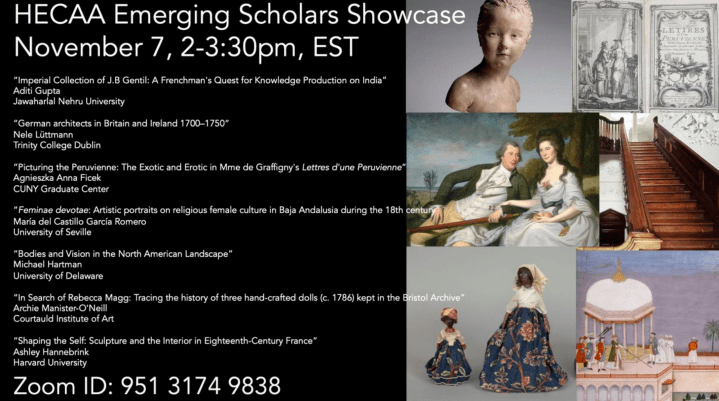
The first HECAA Emerging Scholars Showcase begins today at 2pm EST. Please join us via zoom to hear our first seven emerging scholars present their research. Each participant will present for 3–5 minutes, and after the presentations, we will host a question and answer session. The seven presenters and their presentation titles are listed below. If you have any questions or concerns, please contact Dani Ezor (dezor@smu.edu).
Best regards,
HECAA Board
◊ ◊ ◊ ◊ ◊
Zoom link: https://smu.zoom.us/j/95131749838
Meeting ID: 951 3174 9838
• Aditi Gupta, (Jawaharlal Nehru University), Imperial Collection of J.B Gentil: A Frenchman’s Quest for Knowledge Production on India
• Nele Lüttmann (Trinity College Dublin), German Architects in Britain and Ireland, 1700–1750
• Agnieszka Anna Ficek (CUNY Graduate Center), Picturing the Peruvienne: The Exotic and Erotic in Mme de Graffigny’s Lettres d’une Peruvienne
• María del Castillo García Romero (University of Seville), Feminae Devotae: Artistic Portraits on Religious Female Culture in Baja Andalusia during the Eighteenth Century
• Michael Hartman (University of Delaware), Bodies and Vision in the North American Landscape
• Archie Manister-O’Neill (Courtauld Institute of Art), In Search of Rebecca Magg: Tracing the History of Three Hand-Crafted Dolls (ca. 1786) Kept in the Bristol Archive
• Ashley Hannebrink (Harvard University), Shaping the Self: Sculpture and the Interior in Eighteenth-Century France
Online Conference | Hayley2020
From The Fitzwilliam:
Hayley2020: A Fitzwilliam Museum Conference
Online, 12–13 November 2020

George Romney, John Flaxman Modeling the Bust of William Hayley, 1795–96, oil on canvas, 89 × 57 inches (New Haven: Yale Center for British Art, Paul Mellon Collection, B1981.25.538).
Convened to mark the bicentenary of his death, Hayley2020 is the first ever conference dedicated to writer, scholar, and amateur doctor William Hayley (1745–1820). Hugely influential in his time, Hayley is now mostly remembered for persuading William Blake to move to the Sussex coast, commissioning illustrations and prints from him, and driving him to distraction. But there is much more to the man who wrote (in verse) a runaway bestseller advising young women on how to attract and keep a husband, refused the poet laureateship for political reasons, and was the first person to publish an English translation of a long extract from Dante’s Inferno. Join us online on November 12 and 13 for a series of presentations and discussions about Hayley and his world (listed times are GMT). All are welcome.
T H U R S D A Y , 1 2 N O V E M B E R 2 0 2 0
14.45 Welcome
Suzanne Reynolds, Lisa Gee, Naomi Billingsley, and Mark Crosby welcome you to virtual Eartham, but promise not to write you an adulatory sonnet.
15.00 On Romney, His Relationship with Hayley, and Works Arising
Alex Kidson talks about how Romney and Hayley’s relationship changed over the years, discussing works including the Cupid and Psyche cartoons, Flaxman Modelling the Bust of Hayley, and Romney’s illustrations for Hayley’s Essay on Old Maids (series of short videos). Parallel discussion in the chat with Alex present, followed by discussion. Video available for viewing beforehand and afterwards.
15.40 Coffee Break
You’ll have to bring your own hot beverage, but feel free to hang out, catch up with friends, and network like it’s 1795 in Hayley’s Library.
16.05 Hayley in His Contexts
Lisa Gee: Hayley – Essay on Sculpture, Mary Cockerell & the decline & death of Tom.; Alexandra Harris; Susan Matthews: Amina Wright: ‘Artist and Bard in Sweet Alliance: Joseph Wright of Derby and the Hermit of Eartham.’. Chaired by Mark Crosby.
16.45 Tea Break
17.00 Object-Oriented Session
Demo/test of the AMoR (A Museum of Relationships) pilot + discussion, with Lisa Gee and Suzanne Reynolds.
17.40 Plenary Discussions
F R I D A Y , 1 3 N O V E M B E R 2 0 2 0
13.00 Virtual Conference Picnic
Find us in the windswept (virtual) grounds of Eartham where, because it’s mid-November, we’re happy this is online rather than IRL.
15.00 On Hayley, Flaxman, and Blake
David Bindman discusses the memorials on which Flaxman and Hayley collaborated, one that Hayley tried to interfere in, and explains why Hayley’s relationship with Blake was so different to those with Flaxman and Romney.
15.40 Coffee Break
16.05 Hayley and Blake
Mark Crosby, Sarah Haggarty, Jason Whittaker: Hayley in Blake biographies. Chaired by Naomi Billingsley.
16.40 Tea Break
17.05 Future Scholarship
New collaborations, action planning. Chaired by Lisa Gee.
17.50 Concluding Remarks
HECAA Emerging Scholars Showcase

George Lambert, Classical Landscape, 1745, oil on canvas, 41 × 46 inches
(London: Tate)
◊ ◊ ◊ ◊ ◊
HECAA Emerging Scholars Showcase
Online, Saturday, 7 November 2020, 2:00–3:30pm (EST)
Please mark your calendars for the first HECAA Emerging Scholars Showcase on Saturday, November 7, from 2:00 to 3:30pm EST. We will hear from our first seven emerging scholars present their research in 3– to 5–minute presentations, after which we will open up the floor to questions and comments. The intention of these showcases is to create networking opportunities, and we look forward to your audience participation in support of our emerging scholars.
We received an overwhelming number of applications, ranging geographically from China, India, and Australia, to Brazil, Europe, and across the USA. The topics likewise range in their geographical origin, theoretical approach, materials, techniques, and methods. We will also hold two additional showcases on 6 February 2021 and 17 April 2021.
Registration is not required. A Zoom link will be sent out to all HECAA members the week before November 7. If you have any questions or concerns, please contact Dani Ezor (dezor@smu.edu). Thank you!
Public Lecture Course | Ceramics in Britain
The series, originally scheduled for the spring, will now take place online; from the Mellon Centre:
Public Lecture Course, Ceramics in Britain, 1750 to Now
Online, Paul Mellon Centre for Studies in British Art, London, Thursdays, 5 November — 10 December 2020
 Pre-recorded lectures to be released weekly at 3pm GMT on Thursdays and a live Q&A (Zoom) on 10 December 2020 at 6pm GMT
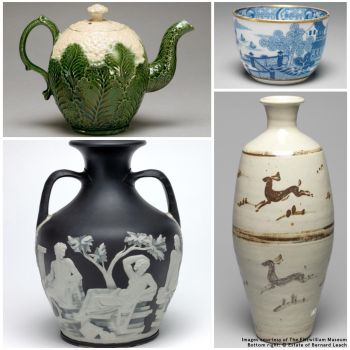
This course, delivered by experts in the field, will explore five key influential developments in the history of British ceramics since the mid-eighteenth century, examining the multiple ways in which innovators, entrepreneurs, and artists have reinvigorated the field. While the story of ceramics is a global one, Britain has played a leading role in the last three centuries, a period in which British invention has shaped developments and brought constant renewal to the industry.
By 1750, ceramics of different types were available to all levels of society. However, the uniquely British innovation of combining print culture and ceramics, transfer-printing political propaganda, and the graphic satire of London’s leading caricaturists onto earthenware, enabled these contemporary controversial messages to be understood by all classes. During the same period, scientific experimentation by Josiah Wedgwood led to the invention of new bodies and glazes, many copying the ceramics and glass of ancient Greece and Rome. His range and ambition, summed up by his aim to become ‘Vase Maker General to the Universe’, helped to change ceramic tastes to an unprecedented degree.
The production of an abundance of styles characterised the nineteenth century. However, blue and white—one of the most distinctive visual effects in ceramics—became, and remained, more popular than any other. Heavily influenced by porcelain exported from Asia, Britain became the leading ceramic producer of this style, driving international trade and retail opportunities. ‘Chinamania’ gripped the nation; debates about taste and authenticity drove collectors, consumers, and creators.
Ceramics was largely unaffected by the first wave of anti-industrialism in England. Neither William Morris nor the Arts and Crafts movement fully established a new type of pottery. However, an urge to turn away from the industrially-produced ceramics of the late nineteenth century, combined with a renewed interest in form, earlier Chinese ceramics, and abstract art, gave rise to a wave of pioneering British potters who insisted on the importance of the handmade and established the role of the ‘artist-potter’. This philosophy was widely popularised by the influential studio potter, Bernard Leach, who spent formative periods in China and Japan and wrote that ‘all my life I have been a courier between East and West’.
While studio ceramics continue to flourish today, global economics and advanced production technology have greatly impacted the ceramics industry in Staffordshire, the traditional heartland of British ceramics production. Artists have played a key role in documenting and commentating on these changes. The course will conclude with an artist’s examination of the decline of ceramic manufacturing and its associated artisanal skills, emphasising the importance of sustaining the intangible heritage of this longstanding and important industry.
No prior art historical knowledge is necessary.
Thursday, 5 November
Patricia Ferguson (Project Curator, British Museum), Pots with Attitude: British Satire on Ceramics, 1750–1820
Thursday, 12 November
Catrin Jones (Chief Curator, Wedgwood Museum), Josiah Wedgwood: Experimentation and Innovation
Thursday, 19 November
Rebecca Wallis (Curator, National Trust, London and South East), ‘Blue and White’ in Nineteenth-Century Britain and Beyond
Thursday, 26 November
Simon Olding (Director of the Crafts Study Centre, University for the Creative Arts, Farnham), ‘Beyond East and West’: The Founding of British Studio Ceramics
Thursday, 3 December
Neil Brownsword (Artist and Professor of Ceramics, Staffordshire University), Obsolescence and Renewal: Reimagining North Staffordshire’s Ceramic Heritage
Thursday, 10 December
Ceramics in Britain: Live Q&A
The French Porcelain Society’s Online Symposium, 2020
The programme includes some eighteenth-century offerings; from The French Porcelain Society:
The French Porcelain Society’s Online Symposium
Celebrating John Mallet’s 90th Birthday
7–8 November 2020
J. V. G. Mallet’s achievements in the field of ceramics are many as proved by his copious bibliography. It is however, John’s ground-breaking work in the field of istoriato maiolica of the 16th century and particularly his focus on the most important Renaissance maiolica-painters of the period, which has to be acknowledged as a major factor behind the resurgence of interest in this fascinating type of painting on pottery.
Our international online symposium, over two afternoons, will focus on John’s main area of research, istoriato maiolica or ‘narrative ware’. This extraordinary pictorial language flourished in the lands of the Dukes of Urbino, whose humanist court inspired Baldassar Castiglione’s The Book of the Courtier and which was Raphael birthplace. The imagery created in Raphael’s workshop was such a powerful influence on istoriato, that it was once believed that Raphael and his pupils actually painted the wares, leading it to be called ‘Raphael ware’.
Most notable are John’s magisterial articles on Urbino istoriato. Applying the same method that art historians use for painting, he has been able to group stylistically many different istoriato painters, and give names to otherwise unknown important maiolica masters, including: The ‘In Castel Durante Painter’, ‘The Master of the Apollo Basin’, ‘The Milan Marsyas Painter’, and ‘The Painter of the Coal Mine Dishes’. John also has written extensively on the painters active in the workshop of Guido Durantino, around the art of the great Nicola da Urbino, on Francesco ‘Urbini’, on Maestro Giorgio of Gubbio, and on Xanto—one of the most intriguing personalities in the world of ceramics, on whom John organised a ground-breaking monographic exhibition at the Wallace Collection in 2007. His catalogue of the maiolica in the Hockemeyer Collection in Bremen is a landmark of scholarship.
The symposium will give particular emphasis to the relationship between istoriato and graphic sources originating in and around Raphael’s workshop, 500 years after the death of the Urbino master in 1520. Reflecting John’s wide-ranging knowledge and interests in many other fields of ceramics, the symposium will also feature lectures on European pottery and porcelain.
The event is free and open to all, but donations are always appreciated. For more information and registration details, please contact the organiser Dr Elisa Paola Sani at FPSenquiries@gmail.com.
◊ ◊ ◊ ◊ ◊
Maiolica in the Shadow of Raphael
Saturday, 7 November 2020, 16.00–19.00 UK GMT
Welcome: Dame Rosalind Savill, DBE (President, The French Porcelain Society, London)
Introduction: Timothy Wilson (Honorary Keeper, Ashmolean Museum of Art, Oxford)
• Claudio Paolinelli (Co-curator of Raphael Ware, Urbino), Virtual Tour of Raphael Ware, the Maiolica Show in Urbino Ducal Palace
• David Ekserdjian (University of Leicester), Xanto and Raphael
• Suzanne Higgott (Curator, The Wallace Collection), The Wallace Collection Bathing Nymphs
• Carmen Ravanelli Guidotti (former Keeper, M.I.C., Faenza), Raphaelesque Taste: An Istoriato from an Ancient Italian Collection
• Marino Marini (Keeper, Museo del Bargello, Florence), Un’iconografia raffaellesca su una coppa faentina al Bargello
• Karine Tsoumis (Curator, Gardiner Museum of Ceramic Art, Toronto), Portable Worlds: Maiolica in the Serenissima
• Justin Raccanello (Author and Lecturer, London), Raphaelism and Raffaelleschi
• Michael J. Brody (Jefferson University, Philadelphia), A Mythological Dish by Sforza di Marcantonio Dated 1548
• Elisa Paola Sani (Research Fellow, The Courtauld Gallery, London), In the Shadow of Nicola da Urbino
◊ ◊ ◊ ◊ ◊
A Celebration of John Mallet
Sunday, 8 November 2020, 16.00–19.00 UK GMT
Chair: Timothy Wilson (Honorary Keeper, Ashmolean Museum of Art, Oxford)
• Valentina Mazzotti (Keeper of M.I.C., Faenza), John Mallet, Fundamental Contributions in ‘Faenza’
• Errol Manners, FSA (Author and Lecturer, London), Antoine-Salomon Taunay and Louis, Duc d’Orleans, the Travels of a Chemist
• Francoise Barbe (Conservateur en chef, Département des Objets d’art, Louvre, Paris), French Lead Glazes at the Time of Palissy
• Camille Leprince (Author and Lecturer, Paris), Collecting and Reproducing Raphael Ware in 17th-Century France
• Cristina Maritano (Curator of ceramics, Palazzo Madama, Turin), Raphael on the Pharmacy Shelf: An 18th-Century Ligurian Set
• Roger Massey (Author and Lecturer, London), A Bristol Porcelain Figure in the Schreiber Collection at the V&A
• Raffaella Ausenda (Author and Lecturer, Urbino), Maiolica in the Bossi Collection at the Castello Sforzesco, Milan
• Sir Timothy Clifford (former Director, National Gallery of Scotland), Few Thoughts for John
• Giulio Busti (Honorary Curator, Museo delle Ceramiche, Deruta), Un saluto a John
• John Mallet (Former Keeper of the Ceramics Department, Victoria and Albert Museum, London), Collecting for the V&A










 Enfilade
leave a comment