Online Exhibition Tour | Exotic Switzerland?
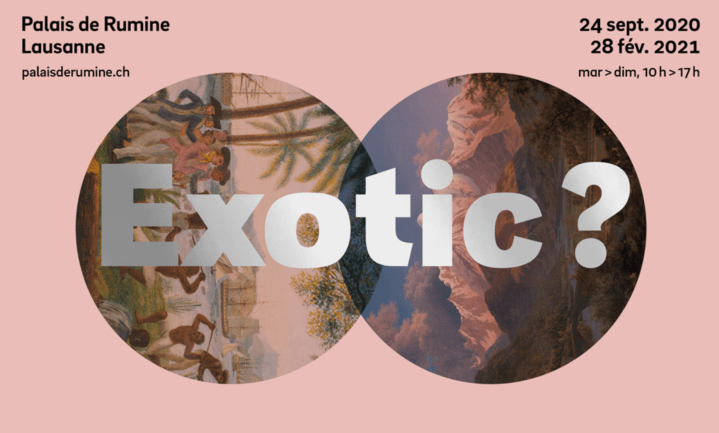
Une Suisse exotique? Regarder l’ailleurs en Suisse au siècle des Lumières
Exotic Switzerland? Looking Outward in the Age of Enlightenment
Palais de Rumine, Lausanne, 24 September 2020 — 28 February 2021
Organized by Noémie Étienne
While the exhibition was forced to close early, the Palais de Rumine is offering a series of free live guided tours, the last of which takes place (in English) on Monday, 22 February 2021, at 12.30, with Chonja Lee. Zoom link: https://lnkd.in/d8ikYnq
The virtual visit, available any time, is spectacular! –CH
Online Panel | Resonance of Stone
Masterpiece London launched its 2021 online programme, with podcasts, videos, and panel discussions focusing on a different material each month. This month’s session, which takes place this afternoon, addresses marble:
The Resonance of Stone
Online, Masterpiece London Panel Discussion, 18 February 2021, 5pm (GMT)
 Whether they are aware of it or not, when scholars dismiss the use of precious marbles and stones to decorate a building as merely a desire to show off the status of the patron, they are expressing a moralising Marxist interpretation of art history. Fabio Barry, author of Painting in Stone: Architecture and the Poetics of Marble from Antiquity to the Enlightenment (Yale UP 2020), debunks this approach by revealing what marble actually meant, from ancient Mesopotamia to the 18th century. What he reveals is infinitely more interesting, not just for art or architectural historians, but for anyone interested in pre-Enlightenment science, cosmology, and religion. For example, after reading this book, how you see a famous building such as Hagia Sophia is transformed because you discover that what looks like merely a grey and white marble floor, at the time represented the waves of the sea: we, the faithful are walking on water, with God’s throne set above the waters.
In this panel, Barry will explain his main revelations. Thomas Greenaway—the only artist in the UK to practise pietra dura (hardstone) inlay, the technique used by the ancient Romans and revived in Florence in the 16th century—will talk about the remarkable commission that he executed, the coat of arms for the tomb in Leicester Cathedral of the rediscovered remains of King Richard III. Tessa Murdoch will talk about a different category of illusionism, the ‘paintings’ made in micro-mosaics, artistic descendants of both mosaics and pietra dura work, while David Sestieri will talk about how far interest is reviving in ‘making’—in the ‘materiality’ of works of art—after a century or so in which craftsmanship and precious materials have been subordinate to belief in the conceptual.
Register for this panel discussion on Zoom
Moderator: Anna Somers Cocks OBE — journalist, editor, publisher, and collector
• Fabio Barry — Assistant Professor, Stanford University and author of Painting in Stone
• Thomas Greenaway — pietra dura specialist and conservator
• Tessa Murdoch — Research Curator, Gilbert Collection, V&A
• Davide Sestieri — art consultant
Fabio Barry studied architecture at Cambridge and practised as an architect before receiving a Ph.D. in art history from Columbia University. He was David E. Finley Fellow at the Center for Advanced Study in the Visual Arts at the National Gallery of Art, Washington DC, and will be the Samuel H. Kress Fellow there in 2021–22. He has taught at the University of St. Andrews and currently at Stanford University. He is a specialist in Roman Baroque, but has published more widely, and was awarded the Arthur Kingsley Porter Prize by the College Art Association for his article “Walking on Water: Cosmic Floors in Antiquity and the Middle Ages.” His book, Painting in Stone: Architecture and the Poetics of Marble from Antiquity to the Enlightenment (Yale University Press, 2020) was awarded the PROSE award for best book on Architecture by the Association of American Publishers.
Thomas Greenaway specialises in creating original works of art in pietra dura and is also a conservator working for museums, institutions, and private collectors. Having trained as a fine furniture maker in Scotland, Thomas spent four years in Florence learning traditional 16th-century techniques from some eminent masters. He has had his own studio in South Northamptonshire selling unique hand-made works of art since 2010. Thomas sources a wide range of valuable semi-precious stones and rare marbles from across the globe and carefully selects the perfect natural texture and shading in the stone to create what amounts to be a ‘painting in stone’. Thomas produces bespoke tables, boxes, plaques, games tables, and personalised paperweights and can also undertake restoration work of stone inlaid artifacts. A few notable works have included Richard III’s coat of arms set into the tombstone in Leicester Cathedral, a floor plaque inscription (commemorating Pope Benedictus XVI visit to the UK in 2010) laid in the entrance floor of Westminster Cathedral, and a Tudor Rose for the central floor in the House of Lords.
Tessa Murdoch is Rosalinde and Arthur Gilbert Research Curator at the V&A. In 2019 as Getty Rothschild Fellow in residence at the Getty Research Institute and Waddesdon Manor, she completed her forthcoming book Europe Divided: Huguenot Refugee Art and Culture, which will be published in November 2021. As Deputy Keeper, Sculpture, Metalwork, Ceramics and Glass at the V&A she has worked with the Gilbert Collection since 2008. Her interest in pietre dure developed whilst filming a video for the new V&A Gilbert Galleries at Paci Workshop, in Florence, where Thomas Greenaway led the interpretation. Tessa is a specialist adviser and contributor to Apollo Magazine and the National Trust. She is a Fellow of the Society of Antiquaries, a Liveryman of the Worshipful Company of Goldsmiths, and member of the their Contemporary Craft Committee. She publishes widely on the decorative arts, is an active member of the Furniture History and Silver Societies and Trustee of the Huguenot Museum, Rochester and the Idlewild Trust.
Davide Sestieri is a fifth-generation antiques dealer. After 15 years of experience with the family business, Davide started to collaborate with Finarte Casa D’Aste and Christie’s Rome, working for more than 16 years as an expert of furniture and works of arts. In 2006, Davide opened the consultancy firm Briganti Sestieri Art Consulting with his associate Guido Briganti, where he continues to work today.
Anna Somers Cocks OBE was born in Rome and educated at Oxford University and the Courtauld Institute, London University. She is the author of numerous articles on art, the politics of art, conservation, and the politics of Venice in The Guardian, Daily Telegraph, New Statesman, The Art Newspaper, Il Giornale dell’Arte, La Repubblica, and The New York Review of Books.
Online Series | Georgian Gardens and Landscapes
From The Georgian Group:
Georgian Gardens and Landscapes Series
Online, The Georgian Group, Tuesdays in March and April 2021, 6.30pm (GMT)
The Georgian Group presents seven talks this spring in connection with its series Georgian Gardens and Landscapes. Presentations take place on Tuesday evenings, starting at 6.30pm. Each talk is £3 for members and £5 for non-members. Joining details will be sent to attendees the day before. Talks will be recorded and made available to those who have purchased a ticket for a limited time period after the event takes place.
◊ ◊ ◊ ◊ ◊
2 March 2021
Fiona Davison — Hidden Horticulturists
This talk will tell the untold story of the men who shaped Britain’s gardens, with help from a recently unearthed book of handwritten notes by young gardeners in support of their applications to be received into the Horticultural Society’s training scheme at their Chiswick Garden in the 1820s. Some of these men went on to work on Britain’s finest country estates, while others ended up tending more modest gardens or found themselves in exotic locations around the glove. Nevertheless, these previously hidden figures played a central role in the history of British horticulture and helped to shape the way we garden today.
Fiona Davison is Head of Libraries and Exhibitions at the Royal Horticultural Society. Her book, The Hidden Horticulturists: The Untold Story of the Men who Shaped Britain’s Gardens, was published in 2019.
◊ ◊ ◊ ◊ ◊
9 March 2021
Emily Parker — Marble Hill: A Garden of Grottos and Groves
Henrietta Howard, mistress of George II and later Countess of Suffolk, created Marble Hill house in the 1720s as a retreat from court life and as a place to entertain her elite circle of influential cultural, intellectual and political friends. This was a time of significant change in garden designs and Howard’s friendship with Alexander Pope, Lord Bathurst, Lord Peterborough and Lord Ilay, meant that her garden at Marble Hill was influenced by some of the most fashionable garden enthusiasts of the time. This talk will explore how the garden was created and who might have been involved in its design.
Emily Parker is a Landscape Advisor at English Heritage. She specialises in garden history and designed landscape conservation. Emily’s primary research interests are garden design in the eighteenth century, including the role of Alexander Pope, ‘Capability’ Brown and Humphry Repton. Emily has also researched and written interpretation content for many English Heritage sites including Eltham Palace, Kirby Hall, Mount Grace Priory and Wrest Park. She has also produced Conservation Management Plans for English Heritage gardens including Belsay Hall, Marble Hill and Walmer Castle.
◊ ◊ ◊ ◊ ◊
16 March 2021
George Carter and Caroline Knight — William Kent: Garden Designer, Architect, Interior Designer
William Kent (1685-1748) was one of those all-round designers, like Bernini, who could turn his hand to anything—architecture, interior design, painting, garden design, even book illustration. The first half of the eighteenth century was a period when garden design in Britain was in a state of flux. Kent proved to have a crucial role in adapting an evolving naturalistic style to his own unique vision, and was praised by Horace Walpole in On Modern Gardening. According to Christopher Hussey, he provided exactly what the Early Georgians looked for in the new gardening: “elegant variation, evocation of an ideal past, and the visual embodiment of a philosophical idea.” This talk looks at some of Kent’s best work including Rousham, Esher, and Stowe and evaluates him in relation to his contemporaries, Charles Bridgeman, Stephen Switzer, and Robert Castell.
George Carter is a garden historian and designer who specialises in restoring and recreating historic gardens, particularly of the seventeenth and eighteenth centuries. He has written several books on garden design and his work has appeared in numerous books and magazines. Caroline Knight is an architectural historian specialising in British Architecture of the sixteenth to eighteenth centuries. She is an independent lecturer at the V&A Museum and for the Arts Society and the author of London’s Country Houses.
◊ ◊ ◊ ◊ ◊
23 March 2021
Penelope Corfield — Vauxhall, Sex, and Entertainment: The Invention of the Urban Pleasure Garden
This lecture will analyse the social dynamics of London’s most popular and celebrated Pleasure Garden in Vauxhall, which flourished between 1732 and its final closure in 1859. It pioneered the commercialisation of mass entertainment and the eroticisation of the leisure industry. In other words, it blended timeless human interests in sex and good company with the allure of celebrity culture plus the provision of a great range of leisure services in an organised and inclusive style. No wonder that countless similar urban Gardens across Britain, in Paris and, eventually, in cities around the world, were named after Vauxhall.
Penelope J. Corfield is an expert on Georgian urban, social and cultural history; and is currently researching the dynamics of inter-personal greetings in the long eighteenth century. She is Professor Emeritus at Royal Holloway, London University; Research Fellow at Newcastle University; and President of the International Society for Eighteenth-Century Studies.
◊ ◊ ◊ ◊ ◊
30 March 2021
Bettina Harden — Welsh Gardens and the Grand Tour
While working on her book The Most Glorious Prospect: Garden Visiting in Wales 1639–1900 (2017), Bettina Harden found that the experience of the Grand Tour to Italy ran as a leitmotif through the development of landscaped parks and gardens across Wales. Carrying on from the book, she has examined the links between the Grand Tour and its effect on the Welsh patrons and owners who, on their return from the Continent, set about bringing something of what they had seen abroad to their home surroundings. The result is a lecture exploring the intricacies of the Grand Tour, its demands and discoveries, its shopping and scholarship, focused on Welshmen who had travelled to Rome in the eighteenth century: Sirs Watkin Williams-Wynne, father and son, 3rd and 4th Baronets of Wynnstay; Thomas Mansel, 2nd Lord Mansel, and Thomas and Christopher Mansel-Talbot of Margam; Thomas Bulkeley, 7th Viscount Bulkeley of Baron Hill; Colonel John Campbell of Stackpole Court. The lecture aims to link these men, their Grand Tour, their purchases and Italian dreams of landscape beauty together to demonstrate how ‘gardening and refined connoisseurship were the obsession of the age.’
Bettina Harden is a lecturer and writer on historic gardens. She was formerly Chairman of the Welsh Historic Gardens Trust and was Founder Chairman of the Gateway Gardens Trust.
◊ ◊ ◊ ◊ ◊
6 April 2021
Rory Fraser — Follies: An Architectural Journey
Follies were an important feature of English landscape gardens in the long eighteenth century. They could take a multitude of forms, from lavish banqueting houses to temples to lost loves, while their designers read like a ‘Who’s Who’ of the greatest figures in Georgian architecture and landscape design—Wren, Vanbrugh, Kent, ‘Capability’ Brown, and Repton. In this talk, Rory Fraser will take us on an illustrated journey across England as he unearths the stories behind these often-overlooked architectural gems. Fraser’s philosophy is that follies, though often marginalised, serve as focal points for architecture, landscape, and literature. As such, they create a series of portals through which to understand the periods in which they were built, providing an alternative lens through which to track and celebrate the English character, culture, and love of individualism.
Rory Fraser was brought up between Rutland and Inverness. He worked for English Heritage and learnt Art History in Venice and Florence, before studying English at Oxford University where he specialised in landscape poetry and architecture, and wrote comedy for the Oxford Review. On graduating, he worked for John Simpson Architects in Bloomsbury. He is currently at Cambridge University, where he is doing an MPhil in Architectural History under Frank Salmon. His book, Follies: An Architectural Journey, was published in November 2020.
◊ ◊ ◊ ◊ ◊
13 April 2021
Kim Wilkie — The English Landscape Revolution
The eighteenth-century English Landscape Movement pioneered a radical new approach to sculpting and farming the land which gives great inspiration for the issues we face today. Landscape architect Kim Wilkie will trace this development through looking at some of the projects he has worked on, including the great landscapes of Boughton (for which he won a Georgian Group award in 2011 for Restoration of a Georgian Garden or Landscape) and Heveningham, as well as some more humble manor houses.
Kim Wilkie is a renowned landscape architect. After decades of running his own practice, Kim now works as a strategic and conceptual landscape consultant. He collaborates with architects and landscape architects around the world.
Online Talk | A New Copley Acquisition

This Wednesday, from Vermont’s Shelburne Museum, as announced at ArtDaily:
Together Again: A New Acquisition Reunites a Pair of Copley Portraits
Online, Shelburne Museum, 17 February 2021, 6pm (ET)
Join Shelburne Museum director Tom Denenberg to learn about an exciting new acquisition for the Museum’s American painting collection and the intriguing circumstances that led to the reunion of a long-separated couple.
The Shelburne Museum has acquired a portrait by John Singleton Copley entitled Mrs. Mercy Scollay (née Mercy Greenleaf), a pendant painting to the portrait in the museum’s permanent collection, Mr. John Scollay, reuniting the long-separated portraits of wife and husband, Shelburne Museum.

John Singleton Copley, Portrait of Mrs. Mercy Scollay, 1763, 90 × 71 cm (Shelburne, VT: Shelburne Museum).
John Scollay, a chairman of the Boston Board of Selectmen and member of the Sons of Liberty, commissioned Copley (1738–1815), the preeminent portraiture artist in the American colonies, for this portrait of his wife as a pendant to his own portrait. Completed in 1763, Mrs. Scollay’s portrait demonstrates Copley’s talents and abilities as a painter as evidenced through the beautifully rendered fabric draped around the sitter.
Shelburne Museum founder Electra Havemeyer Webb assembled the American paintings collection with the intention of juxtaposing well-known artists such as Copley with lesser-known itinerant or ‘folk’ painters. She purchased the portrait of John Scollay from Harry Shaw Newman at the Old Print Shop in New York City in 1959. The Museum’s extensive collection of American paintings tell a story about how the fine arts developed and came of age in the United States, and the reunion of these pendants continues to enrich the narrative.
The museum is presenting a webinar on the new acquisition and the story of how these two paintings were reunited. Denenberg will discuss the intriguing circumstances that led to the reunion of the long-separated couple. The evening will be a tale of revolutionary Boston, featuring the young John Singleton Copley and his portraits of Mercy Greenleaf and John Scollay. Live Q&A follows the presentation. Together Again: A New Acquisition Reunites a Pair of Copley Portraits is at 6pm on Wednesday, February 17. To register visit the museum’s website.
◊ ◊ ◊ ◊ ◊
The portrait of Mrs. Mercy Scollay sold at Sotheby’s American Art sale on 11 December 2020 (Lot 23) for $126,000.
Conference | The Salon and the Senses

Johan Zoffany, The Gore Family with George, 3rd Earl Cowper, ca. 1775, oil on canvas, 31 × 39 inches
(New Haven: Yale Center for British Art, Paul Mellon Collection, B1977.14.87)
◊ ◊ ◊ ◊ ◊
From the conference website:
The Salon and the Senses in the Long 18th Century: Interdisciplinary Perspectives
Online, Rutgers University, New Brunswick, New Jersey, 4–5 March 2021
The conference The Salon and the Senses in the Long 18th Century: Interdisciplinary Perspectives, seeks to join the intellectual heritage of the salons with their multidisciplinary, multisensory natures. We will explore the sights, sounds, smells, tastes, and tactile aspects of the salon, considering the arts and sensory pleasures of the salon alongside the verbal arts—the poetry, literature, theater, and conversation—that were cultivated there.
Salons of the 17th, 18th, and early 19th centuries knew no disciplinary boundaries. More than other institutions of the age, salons offered their habitués opportunities to engage with a wide range of social, cultural, artistic, literary, and verbal practices. A multidisciplinary approach requires that we—like salon hostesses and guests before us—open our minds across modern intellectual boundaries and reanimate the embodied practices of the institution. By bringing together scholars from numerous fields, we hope to shed new light on salons in all of their complexity. Above all, we seek to understand the multi-sensory nature of the salon: its sights, sounds, tastes, and smells; its conversations, texts, and subtexts.
4 M A R C H 2 0 2 1
1.00 Session 1: Welcome and 18th-Century Drama Workshop
• Jennifer Jones (History-SAS) and Rebecca Cypess (Music-Mason Gross) Welcome
• Christopher Cartmill (Rutgers University, Mason Gross School of the Arts), ‘The Chironomia’: Interactive workshop on 18th-century English and French dramatic practices
2.15 Session 2: The Senses of Smell, Touch, and Humor
• Iris Moon (The Metropolitan Museum of Art), Open, Shut Them: A Capodimonte Snuffbox and the Sense of Touch in the Salon
• Érika Wicky (Université Lumière Lyon 2), Olfaction and the Salon: The Smell of Paint from Mansion House to Art Critique
• Marjanne Elaine Goozé (University of Georgia), A Sense of Humor and Antisemitism in the Berlin Jewish Salons, ca. 1800
4.00 Session 3: Keynote Address
• Melanie Conroy (University of Memphis), On Networking: Enlightenment-Era French Salons
7.00 Session 4: Lecture-Recital
The Raritan Players, directed by Rebecca Cypess — ‘In the Salon of Elizabeth Graeme’, a program exploring the musical practices of a salon hostess in 1760s–70s Philadelphia; played on period instrument
5 M A R C H 2 0 2 1
9.00 Session 5: Music in the Salon
• Michael Bane (Indiana University, Jacobs School of Music), Amateur Musicians and their Audiences in French Salons around 1700, or, How to Compliment a Musical Friend
• Floris Meens (Radbound University), The ‘Other’ Languages of Private Sociability: Music and Emotion in Dutch Late 18th- and Early 19th-Century Salons
• Nicole Vilkner (Duquesne University), Opera prêt-à-porter: Gallope d’Onquaire and the Commercialization of Salon opéra, 1850–1870
10.45 Session 6: Music, Gender, and Politics
• Markus Rathey (Yale University), The Subversion of Gender Expectations in Bach’s Dramatic Cantatas
• Callum Blackmore (Columbia University), Hyacinthe Jadin and the Noise of Revolution: Recovering French String Quartet Aesthetics in 1790s Paris
• Lindsay Jones (University of Toronto), Mauro Giuliani and the Congress of Vienna: Musical Representations of Power and Politics
1.00 Session 7: Paris ca. 1760: How to Make a Pop-Up Salon
Concluding discussion
Online Panel | Art, Histories, and the Podcast

Cornelius Cardew, Treatise. Digital image courtesy of Loop 38.
◊ ◊ ◊ ◊ ◊
Organized by the Paul Mellon Centre, with registration at Eventbrite:
Speaking of Art: Art, Histories and the Podcast
Zoom, Wednesday, 17 March 2021, 6.00–7.30pm (GMT)
Podcasting is an increasingly popular form of communication in the arts, culture, and heritage sectors. Research is finding new ears, collections are reaching new audiences, and art objects are entering into new relationships with words as they are described verbally for listeners. Art and art history has a new soundscape. This panel will bring together speakers interested in the possibilities of the relationship of art, art history, voice, and sound. It will explore how this form of audio communication is prompting different, and often surprising, ways of describing objects and artistic practices, encouraging an intimacy that is often absent from academic research, and creating new points of encounter. The discussion will roam across topics, covering ideas such as the visual ear, the art object in sound, listening and looking, virtual travel, and the oral/aural textures of description.
This online event has been organised by Anna Reid (Senior Research Fellow, PMC) and Sarah Victoria Turner (Deputy Director for Research, PMC). They will reflect on their recent experiences of podcasting at the Paul Mellon Centre and their involvement in developing the British Art Talks and Sculpting Lives series. Joining Anna and Sarah is a panel of speakers; some will discuss their own podcasting projects and others will reflect more broadly on the relationship of art, sound, and voice
Panellists
• Jo Baring, Director of the Ingram Collection and co-host of Sculpting Lives
• Cathy Courtney, Project Director of National Life Stories: Artists’ Lives, British Library
• James Mansell, Associate Professor of Cultural Studies, University of Nottingham and Principal Investigator of the AHRC funded project Sonic Futures: Collecting, Curating and Engaging with Sound at the National Science and Media Museum
• Zakia Sewell, Audio Producer, Radio Host, and DJ
• Inigo Wilkins, writer and lecturer; CalArts, New School for Research and Practice
Online Lecture | Guillaume Nicoud on The Hermitage, 1770
From the lecture series Collecting Art in Imperial Russia, organized by Princeton’s REEES program:
Guillaume Nicoud (Mendrisio, Archivio del Moderno), The Hermitage, or a ‘Museum’ in 1770 according to Catherine the Great
Online, Thursday, 18 February 2021, 12.00–1.30pm (ET)
 Why did Catherine the Great build the entire complex of the Hermitage ? This question could constitute the main thread in our presentation. Behind the origins of the Hermitage was the initial idea of creating a hanging garden and additional apartments outside the Winter Palace, although linked to it by a bridge. It quickly faded in the face of Catherine II’s social and cultural intense practices. One should consider that everything she created there aimed at influencing in one way or another the Russian aristocracy as well as at showing to the rest of Europe that she could be, in addition to being an empress, a woman of letters and taste.
Then can we define the Hermitage as a whole? Certainly, its name suggests that it was a place to retreat, at least from the court, and thus a space where to behave under her own rules. In fact, the answer is probably contained in letters written in the 1780s by Catherine herself to Friedrich Melchior Grimm, her commissioner based in Paris, where she calls her Hermitage her own ‘museum’. What does a museum mean for Catherine? And for the Hermitage in terms of architectural typology? Can we in this case consider the paintings gallery of the Hermitage as a ‘museum’? After tracing the history of the construction of the building complex, in order to highlight its architectural characteristics, the presentation will try to summarize how this place and the collections it holds were described during Catherine’s reign, including her very own point of view. Her use of the term ‘museum’ must be related to the definition of the term in Diderot’s and Alembert’s Encyclopedia, that is to say the ‘museum of a woman of letters’. What if the Hermitage, even if it was not a ‘museum’ in the way we conceive it today until the middle of the 19th century, has nevertheless been ‘Catherine’s museum’?
Registration is available here»
Guillaume Nicoud is a postdoc researcher in art history and architecture at the Swiss National Science Foundation in the Archivio del Moderno, University of the Italian Switzerland, involved in the program “Milan and Ticino (1796–1848), Shaping the Spatiality of a European Capital” (FNS Sinergia n°177286 ; and from 2016 to 2019 in the program “The Architecture of ‘Moskovskij stil’Ampir’,” n°IZLRZ1_164062). He specializes in the history of European cultural relations and interactions around 1800. His doctoral thesis, defended at the EPHE, EPSL, Paris in 2016, is entitled “A Gallery Stemming from the Enlightenment: The Imperial Gallery of the Hermitage and France from Catherine the Great to Alexander the Great, 1762–1825” (to be published). He is also a member of the SAPRAT team (EPHE/PSL, EA 4116), co-directs with Dr. Markus Castor the research program “Collecting in the 18th Century: On the Archeology of a Perfect Collection” at the German Center for Art History (Paris) and participates meanwhile in the publication of the First Catalogue of the Hermitage Paintings Gallery (Vol. I, St. Petersburg, Hermitage Museum, 2018). His publications include the exhibition catalog Jérôme Napoleon, King of Westphalia (Château de Fontainebleau, 2008, in coll. with Chr. Beyeler); Jérôme Napoléon et l’art et la culture dans le Royaume de Westphalie (Dfk Paris, 2 vol, in press, in coll. with J. Ebeling and Th. Smidt); and L’empire de Catherine la Grande: nouvelles approches (symposium proceedings, SPM, Paris, publication scheduled for spring 2021, in coll. with J. Kusber, K.S. Jobst, Fr.-D. Liechtenhan and A. Pufelska).
CAA, 2021
With this year’s CAA conference now underway, a quick reminder of two HECAA-sponsored sessions, one today and one tomorrow!
109th Annual Conference of the College Art Association
Online, 10–13 February 2021
The ‘Long’ Eighteenth Century?
Live Q & A online, Friday, 12 February 2021, 2.00–2:30pm (ET)
Chairs: Sarah Betzer (University of Virginia) and Dipti Khera (New York University)
• Sussan Babaie (The Courtauld Institute of Art), Architectural ‘Worlding’: Fischer von Erlach and the Eighteenth-Century Fabrication of an History of Architecture
• Andrei Pop (University of Chicago), Enlightenment as Thought Made Public: A Philosophy and a Portrait
• Meredith Gamer (Columbia University), Britain, Empire, and Execution in the Long Eighteenth Century
• Maggie Cao (University of North Carolina at Chapel Hill), Maritime Media and the Long Eighteenth Century
• Bart Pushaw (University of Copenhagen), Poq’s Temporal Sovereignty and the Inuit Printing of Colonial History
Eco Deco: Art and the Environment in the Long Eighteenth Century
Live Q & A online, Saturday, 13 February 2021, 2.00–2.30pm (ET)
Chairs: Wendy A. Bellion (University of Delaware) and Kristel Smentek (Massachusetts Institute of Technology)
• Freya Gowrley, Fragmented Histories, Imperial Objects: The Specimen Table across Time and Space
• Shweta Raghu, Ebony Clothes / Ebony Bodies: Negotiating Ornament in Coromandel Coast Furniture
• Sarah Simpson Grandin (Harvard University), Trees, Orphans, and the Forgotten Figures of Savonnerie Carpet Manufacturing, 1662–1688
• Philippe Halbert (Yale University), ‘A Toilette in their Fashion’: Indigenizing the Dressing Table in France and New France
Online Talk | Duncan Macmillan on French Art and Scotch Ideas
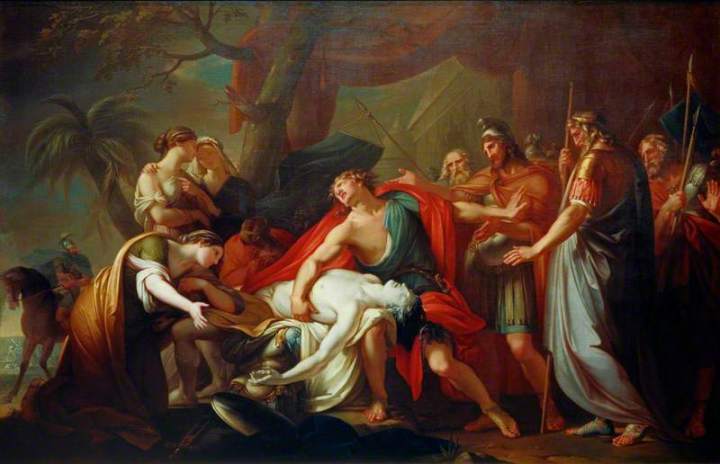
Gavin Hamilton, Achilles Lamenting the Death of Patroclus, 1760–63
(National Galleries of Scotland)
◊ ◊ ◊ ◊ ◊
From the Paul Mellon Centre:
Duncan Macmillan, French Art and Scotch Ideas: The Scottish Enlightenment and The Dawn of Modernity in French Art
Zoom, Wednesday, 10 February 2021, 2.00–3.30pm (GMT)
This online event is part of a collaboration between the Paul Mellon Centre and the Fleming Collection that will focus on aspects of Scottish art, both current and neglected. As a charity, the Fleming Collection promotes Scottish art and creativity through exhibitions, loans, and education, inspired by its own collection, deemed the finest outside institutions. Recently, the Fleming Collection gifted its specialist library to PMC as a contribution to building an unrivalled resource for British art studies open to all.
The Scottish philosophy of moral sense established the supremacy of the imagination which became one of the a priori of art. So too did its corollary, the idea that the imagination flourished more freely in the primitive condition of humanity, either in the remote past or among unsophisticated people in the present. In Rome, Gavin Hamilton pioneered these ideas in the visual arts and an international community of younger artists, including Canova and David, followed his lead. James Macpherson’s Ossian drew on the same ideas.
Later in the eighteenth century and well into the nineteenth, Thomas Reid’s philosophy of common sense enjoyed international currency. It also had particular appeal to artists as Reid argued that only they are aware of the raw sensations from which intuitively our perceptions are formed and that they must record these signs, not what they signify. This radical idea echoed through the nineteenth century. Reid also presented the same argument for expression and again gave artists privileged vision. His principal interpreter, Dugald Stewart, was a close friend of Henry Raeburn who was clearly influenced by Reid’s ideas. David Wilkie also followed Reid to make expression the basis of his art. His contemporary, the surgeon Charles Bell, made it the centre of his medical studies and his eventual identification of the function of the nervous system. Bell influenced Géricault.
Wilkie also responded to Reid’s ideas on perception, however, and also to how his arguments replaced imagined objectivity with actual subjectivity: art is personal and particular, not general. From this Archibald Alison developed an aesthetic theory of association. Drawing on these ideas, in Chelsea Pensioners reading the Waterloo Dispatch Wilkie quite consciously knocked history painting off its perch atop the hierarchy of painting. Wilkie also followed Burns and certainly influenced Constable. Along with Walter Scott, he was greatly admired in France where concurrently Reid’s philosophy became a fashionable topic amongst the artists in Delacroix’s circle. In Le Chef d’oeuvre inconnu, Balzac parodied its consequences for painting. Delacroix, Bonington and others were also deeply influenced by Wilkie and followed his example to explore a more personal and subjective kind of painting. Courbet also followed Wilkie, particularly in the idea reiterated by Reid that art is expressive, but to recover the simplicity of response, for both Wilkie and Courbet epitomised by folk music, artists must unlearn what they have learnt. Reid’s Works became a school text book for the Impressionist generation and his ideas on perception still find echoes in their work and that of Cézanne.
Online Talk | British Encounters with Indigenous Slavery, Nootka Sound
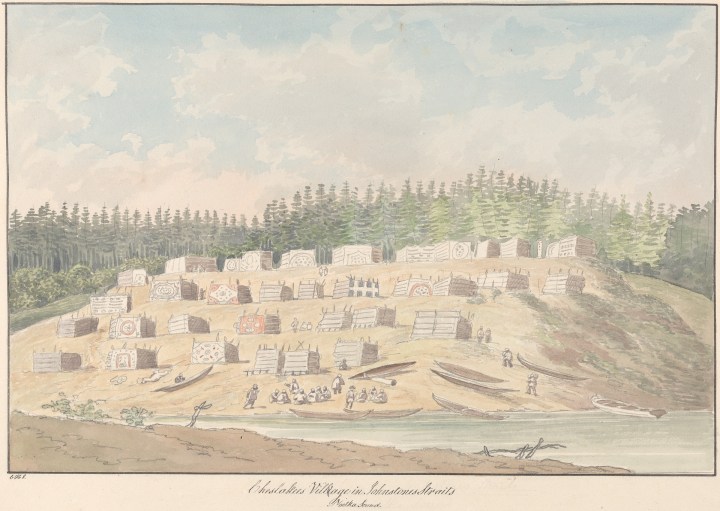
Charles Hamilton Smith (1776–1859, Belgian), Cheslakee’s Village in Johnstone’s Straits, undated, watercolor and graphite on moderately thick, moderately textured, cream wove paper; 41 × 33 cm; inscribed in pen and black ink, lower center: “Cheslakee’s Village in Johnstones Straits | Nootka Sound.” Signed in pen and black ink, lower right: “CHS” (New Haven: Yale Center for British Art, Paul Mellon Collection, B1978.43.1820(26)).
◊ ◊ ◊ ◊ ◊
Later this month, from YCBA:
Adam Chen, British Encounters with Indigenous Slavery at Nootka Sound
Online, Yale Center for British Art, New Haven, 23 February 2021, 12.30–1.00pm (ET)
At the end of the eighteenth century, British and Spanish mercantile expeditions descended upon an inlet known as Nootka Sound, on what is now the coast of Vancouver Island in British Columbia. Their reactions to the native Nuu-chah-nulth people and to the well-established indigenous slave trade on the Pacific Northwest Coast reveal the dissonance and nuances of eighteenth-century European attitudes toward slavery. Adam Chen will share several images of works from Yale and other collections to illustrate his talk.
Art in Context, the Center’s gallery talk series, is now online. Presented by faculty, staff, visiting scholars, and student guides, these lectures are held on the last Tuesday of each month during the academic year. Each talk focuses on a particular work of art in the Center’s collections, or a special exhibition, and takes an in-depth look at its style, subject matter, technique, or time period. The last ten minutes are reserved for conversation and will allow for participants to ask questions.
Adam Chen (TD 2022) is a Yale undergraduate majoring in the history of art and a Bartels Scholar at the Yale Center for British Art. He has previously worked in the European art departments of the Yale University Art Gallery and Seattle Art Museum. His historical interests include the eighteenth century and art of the British Empire. Chen is from the Pacific Northwest, and the topic of this talk is of personal significance. Chen is also an oil painter and carillon player.










leave a comment