Online Seminars | The Future of Country House Studies

Antonio Verrio, Heaven Room, ca. 1695–96
Burghley House, Lincolnshire
◊ ◊ ◊ ◊ ◊
From the research day programme:
The Future of Country House Studies
Online, University of Buckingham, Tuesday, 13 April 2021
A research day organized by the University of Buckingham Humanities Research Institute—one of a series of research seminars in the history of art.
This series of postgraduate Research Days revolve around some of the main research strengths of the department of History and History of Art of the University of Buckingham: the history of collecting and the evolution of taste; the reception of the classical tradition in the art and architecture of early modern Europe; the cultural history of the long eighteenth century; and the history of materials in art and architecture.
Each Research Day involves presentations by PhD students and members of staff, followed by a seminar given by an established scholar. Their structure is intended to facilitate dialogue and exchange between scholars at different stages of their career. Sessions are open to all, free of charge. To register, please send a simple one-line email to seminars-hri@buckingham.ac.uk.
◊ ◊ ◊ ◊ ◊
All times listed are for the UK.
2.30pm Session 1
Adrian Tinniswood, OBE — Fellow, Humanities Research Institute, University of Buckingham
The Guilt and the Gingerbread: The Country House 1945–1974
Adrian Tinniswood discusses his latest research project, Noble Ambitions, to be published by Jonathan Cape in September 2021. Adrian directs the MA in the History of the English Country House at the University of Buckingham. His most recent books include Behind the Throne: A Domestic History of the Royal Household and The Long Weekend: Life in the English Country House between the Wars.
3.30pm Session 2
Michael Bentley — PhD Student, University of Buckingham
‘Properly Bestowed’: Decorum and the Mural in the English Country House, from Verrio to Thornhill, 1672–1728
To what extent was decorum a factor in the decision-making process when commissioning wall and ceiling paintings for an English country house? If not decorum, then what? New light will be shed on Adlington Hall, Sudbury Hall, and Boughton in particular.
4.30pm Tea break
5.00pm Session 3
Martin Postle — Deputy Director, Paul Mellon Centre for Studies in British Art, Yale University
Collection and Display: Art and the Country House Digital Project
Martin Postle discusses the Mellon Centre’s latest digital project. Art & the Country House, launched in autumn 2020, is an online publication focused on the collection and display of works of art in the country house in Britain from the sixteenth century to the present day. Eight case studies (Castle Howard, Doddington Hall, Mells Manor, Mount Stuart, Petworth House, Raynham Hall, Trewithen, and West Wycombe) relate to a broad range of research topics and give a varied set of examples, in terms of geographical location, scale, patterns of ownership, chronologies, collections, and displays.
Online Talks from London Art Week, March 2021
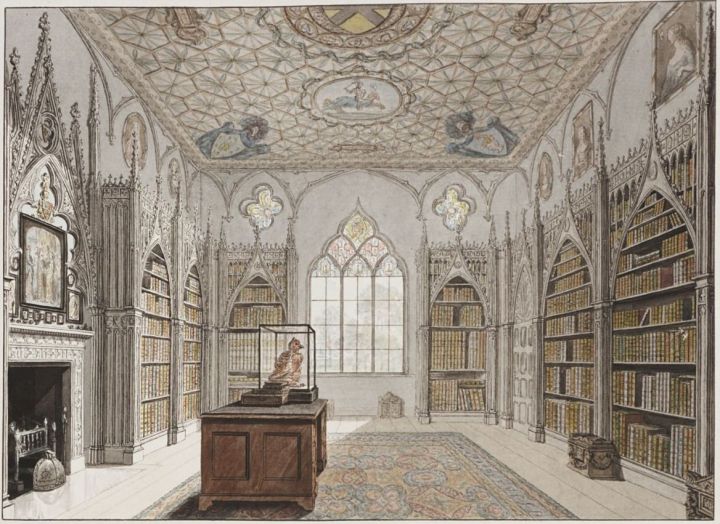
John Carter, View of the Library at Strawberry Hill, watercolour, 23.7 × 28.8 cm, from Horace Walpole, A Description of the Villa … at Strawberry-Hill (Strawberry Hill, 1784). The Lewis Walpole Library, Yale University.
◊ ◊ ◊ ◊ ◊
From the press release (via Art Daily) for this month’s Art History in Focus series:
London Art Week’s Art History in Focus
March 2021
Last October, London Art Week introduced a new series of interim online events, Art History in Focus. Another impressive line-up of insightful and lively talks is scheduled for March. All events will take place from 17.00 to 18.00 GMT.
16 March — The Female Artists, Actresses, and Playwrights of Strawberry Hill Theatricals
Introduced and moderated by Emanuela Tarizzo (Gallery Director of Tomasso Brothers Fine Art), this webinar will explore the role of female artists, actresses, and playwrights involved with theatre at Horace Walpole’s Strawberry Hill. The session will address illustrations of Walpole’s scandalous gothic play The Mysterious Mother by the artist Diana Beauclerk and the closet built to house them at Strawberry Hill. It will also touch on Walpole’s literary executor Mary Berry’s play Fashionable Friends, performed at Strawberry Hill with sets designed by her sister Agnes and with herself and the sculptor Anne Damer in the leading roles. Damer had a close relationship with the famous actress Eliza Farren, re-imagined in Emma Donoghue’s historical novel Life Mask.
Speakers include Judith Hawley (Professor of English, Royal Holloway, University of London), Cynthia Roman (Curator, Prints, Drawings, and Paintings, The Lewis Walpole Library, Yale University), and Laura Engel (Professor of English, Duquesne University).
23 March — Medieval Women: Subjects and Makers of Art
Arranged with Sam Fogg in conjunction with their online exhibition Medieval Women: Subjects and Makers of Art (25 February – 31 March 2021), the session provides a tour of the exhibition in its gallery setting, accompanied by commentary and an in-depth look at select individual works. With Jana Gajdošová of Sam Fogg, curator of the Medieval Women exhibition, and Alexandra Gajewski FSA, reviews editor at The Burlington Magazine and from 2010 to 2015, senior researcher at the CSIC in Madrid on a European Research Council funded project called Reassessing the Roles of Women as Makers of Medieval Art and Architecture.
24 March — Dürer’s Journeys
An in-depth discussion of the much-heralded National Gallery exhibition Dürer’s Journeys: Travels of a Renaissance Artist (opening soon) with Imogen Tedbury (National Gallery), Anthony Crichton-Stuart (Agnews), and Katrin Bellinger (Collector and Founder, Tavolozza Foundation). Dr. Tedbury is the Simon Sainsbury Curatorial Fellow for Paintings before 1500 at the National Gallery, where she is currently working on Dürer’s Journeys. Katrin Bellinger began collecting in 1985 in parallel to her career as a dealer in Old Master drawings; she was a partner at Colnaghi until the Gallery was sold in 2015. Fascinated by the artistic process and the mystique surrounding it, she chose to focus on one theme of the artist at work. She is a Trustee of the National Gallery and sits on the Board of the Tate.
25 March — Thomas Lawrence: Coming of Age
Amina Wright, author of a new book on Thomas Lawrence’s first twenty-five years, discusses the early works of this young prodigy with LAW dealers Lowell Libson (Lowell Libson & Jonny Yarker Ltd) and Ben Elwes (Ben Elwes Fine Art). Both galleries have recently handled early works by Lawrence that will feature in a forthcoming online exhibition at the website of the Holburne Museum in Bath entitled Thomas Lawrence: Coming of Age. Registrants to this talk can benefit from a discount on the book of the same title written by Amina Wright (Philip Wilson Publishers).
29 March — The Impact of the 20th Century on Women Artists
Florrie Evans and Jo Baring discuss the views and barriers surrounding women artists in 20th-century Britain. In 1955 a review in The Times described Elisabeth Frink’s first solo show as “Here is a sculptor of rare promise, indeed of rare quality, for Miss Frink’s handling of the problems of sculptural form is such that one has to make no allowances for her youth, or her sex.” This will be a reference point for the talk in which Jo will focus on women sculptors in particular, and Florrie will look at some of the key female artists handled by The Fine Art Society.
London Art Week, 1–16 July 2021
London Art Week will take place as a dual aspect event: online in a digital format, allowing participants from across the globe to take part, and as physical exhibitions in galleries as local guidelines allow.
A new introduction to LAW Digital Summer 2021 will be Revolution and Renewal, an online themed exhibition. London Art Week is delighted to welcome as guest curator the art historian, curator, and scholar Arturo Galansino, Director General of the Fondazione Palazzo Strozzi in Florence. Well-known among the London Art Week community, Dr. Galansino has been invited to curate this special exhibition by the LAW Board who have long admired his exceptional track record in curating and co-curating incredible shows spanning Old Masters to contemporary art: from Moroni, Giorgione and Rubens at the Royal Academy to Ai Weiwei, Bill Viola and Marina Abramović at the Palazzo Strozzi. “It will be interesting to see what thread, narrow or broad, he weaves from the submitted works to Revolution and Renewal,” comments Amelia Higgins, Director, London Art Week.
“The online exhibition will have its own section on the LAW website,” explains Luce Garrigues, Director, London Art Week Digital, “and all participants will be invited to submit a work on the theme for consideration by Dr. Galansino. As a collegial, curator-led exhibition, Arturo will select his highlights and write his own introduction on the theme. To give our dealers greater voice, we will be asking each participant to explain why they submit their chosen work.”
Online Panel | An Irish Odyssey
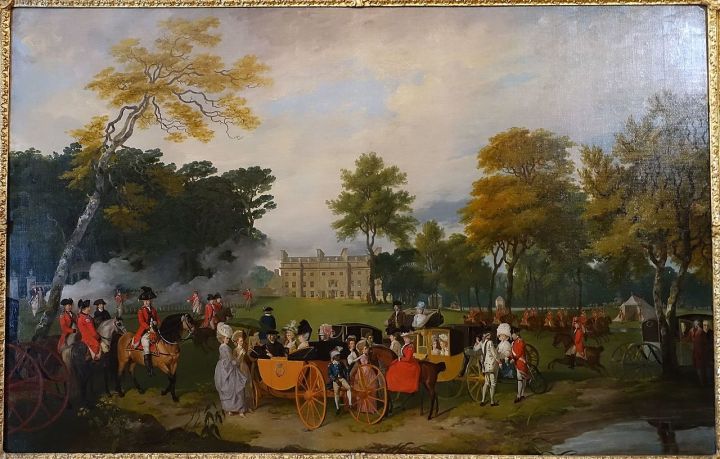
Francis Wheatley, The Earl of Aldborough Reviewing Volunteers at Belan House, County Kildare, 1782 (later changes ca.1787 and extended ca.1810), oil on canvas, 155 × 265 cm (National Trust, Waddesdon Manor, bequeathed by James de Rothschild, 1957).
◊ ◊ ◊ ◊ ◊
From The Attingham Trust’s spring lectures series:
An Irish Odyssey
The Attingham Trust for the Study of Historic Houses and Collections
Online, Tuesday, 16 March 2021, 6pm GMT
A virtual tour of Irish historic houses in film and music, followed by a live panel discussion with Terence Dooley (Centre for the Study of Historic Irish Houses and Estates), Mary Heffernan (Office of Public Works), Donough Cahill (Irish Georgian Society), and Fionnuala Ardee (Historic Houses of Ireland), hosted by Study Programme Director Elizabeth Jamieson
To register for this event, please click here. The event is free to attend, but there are options to purchase a donation ticket. All proceeds raised for The Attingham Trust will go directly to the Scholarship Fund and are gratefully received. You must be registered in order to receive the link.
NB. A day before the event the webinar link will come from The Attingham Trust, not Eventbrite. If you do not receive it or have any questions, please email Rebecca: rebecca.parker@attinghamtrust.org.
Online Lecture | Women Artists at the Court of Catherine the Great
From the lecture series Collecting Art in Imperial Russia, organized by Princeton’s REEES program:
Polly Blakesley, Power and Paint: The Patronage of Women Artists at the Court of Catherine II
Online, Thursday, 18 March 2021, 12.00–1.30pm (ET)
 Catherine the Great’s passion for the arts served a vital role in her efforts to position herself as a paragon of the Enlightenment. With avaricious focus she snaffled celebrated art collections from under the noses of other European rulers, while the quest to establish professional artists led her to champion Russia’s new Academy of Arts. This lecture considers the role that women artists played in Catherine’s pursuit of her artistic ambitions, and the dynamic ways in which they energized Russian cultural life.
Catherine’s far-sighted patronage propelled renowned painters such as Angelica Kauffman to new heights. Just as important were the empress’s relations with lesser-known artists, among them the troubled painter Anna Dorothea Therbusch-Lisiewska and Catherine’s daughter-in-law Maria Fedorovna, who sculpted accomplished cameos and objets de vertu. With stories of extraordinary artistic endeavour, this lecture places these and other artists centre stage at one of Europe’s most thrilling courts.
Registration is available here»
Rosalind Polly Blakesley is Professor of Russian and European Art at the University of Cambridge and co-founder of the Cambridge Courtauld Russian Art Centre. She has served on the boards of various museums and galleries, among them the National Portrait Gallery in London, where she curated the acclaimed exhibition Russia and the Arts and advised on its partner exhibition at the State Tretyakov Gallery in Moscow. Other collaborations around the world include an exhibition of works by women artists from the Hermitage that took place at the National Museum of Women in the Arts in Washington, D.C. in 2003. Blakesley’s many books include The Russian Canvas: Painting in Imperial Russia (2016), which was awarded the Pushkin House Russian Book Prize and The Art Newspaper Russia Best Book Award. She currently holds a Leverhulme Major Research Fellowship for her new project, Russia, Empire and the Baltic Imagination. In 2017 Blakesley was awarded the Pushkin Medal by the Russian Federation for services to Anglo-Russian relations and Russian art. Blakesley is a Trustee of the National Portrait Gallery, London; a Syndic of the Fitzwilliam Museum, Cambridge; and serves on the advisory councils of the Hamilton Kerr Institute and Kettle’s Yard Gallery, as well as the advisory boards of academic journals and professional associations.
The French Porcelain Society’s Online Spring Symposium, 2021
From The French Porcelain Society:
Ceramics & Wanderlust: Curators & Castles
The French Porcelain Society’s Online Spring Symposium, 13–14 March 2021
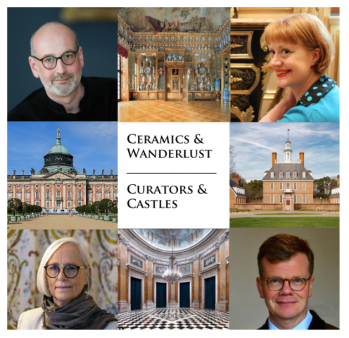 Wanderlust, our need to travel to study ceramic collections in museums and castles throughout Europe and Britain, is at the heart of the French Porcelain Society’s educational activities. It has been over a year since our last visit to France and our next visit may not be for several months. In order to share the pleasure of exploration, comradery, and discovery associated with these trips, Patricia Ferguson with the help of Félix Zorzo and other members of the French Porcelain Society committee have organised a two-day virtual symposium on the 13th and 14th of March. From the recently installed porcelain cabinet at the Château de Versailles to the stunning Porzellankabinett in Schloss Charlottenburg, as well as state, royal, and aristocratic collections from Lisbon, Kassel, and Colonial Williamsburg, their directors and curators have enthusiastically agreed to be part of our programme. We are extremely grateful to the knowledgeable custodians of some of our favourite castles and country houses, who have captured private tours for our global audience on video. Each unique and very personal tour has been pre-recorded, but there will be a live Q&A panel at the end of each day led by Dr. Caroline McCaffrey-Howarth.
Please do join us; the two-day symposium is free and open to all. For any questions, contact FPSenquiries@gmail.com. Please note that the programme is subject to change. Free links to the webinar are available here.
S A T U R D A Y , 1 3 M A R C H 2 0 2 1
16:00–18:30, UK GMT
Introduction — Caroline McCaffrey-Howarth
• Palácio Nacional da Ajuda, Lisbon — Cristina Neiva Correia, Conservadora
• Château de Versailles — Marie-Laure de Rochebrune, Conservateur en chef
• Schloss Wilhelmshöhe — Martin Eberle, Direktor, Museumslandschaft Hessen Kassel
• Museumslandschaft Hessen Kassel — Xenia Schürmann, Curatorial Assistant
Panel discussion
S U N D A Y , 1 4 M A R C H 2 0 2 1
16:00–18:30, UK GMT
Introduction — Caroline McCaffrey-Howarth
• Governor’s Palace in Colonial Williamsburg, Virginia — Angelika R. Kuettner, Associate Curator of Ceramics and Glass, and Janine Skerry, Senior Curator of Metals
• Waddesdon Manor — Mia Jackson, Curator of Decorative Arts
• Charlottenburg, Neues Palais and Belvedere — Samuel Wittwer, Direktor der Schlösser und Sammlungen, Stiftung Preußische Schlösser und Gärten Berlin-Brandenburg
Panel discussion
Online Seminars | O Gosto neoclássico: A Dimensão americana
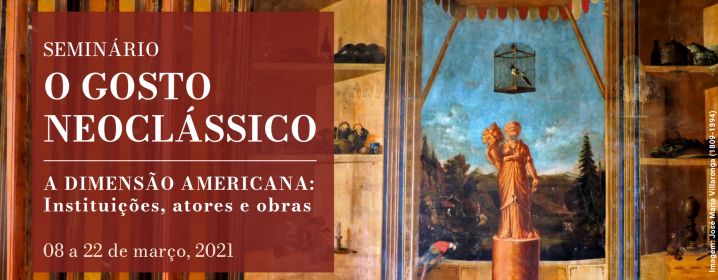
I’m sorry for not posting news of these seminars much sooner. –CH
O Gosto neoclássico — A Dimensão americana: instituições, atores e obras
Online, 8–22 March 2021
O seminário O Gosto neoclássico — A Dimensão americana: instituições, atores e obras será realizado de 8 a 22 de março de 2021, às 2ª-feiras e 4ª-feiras, às 15h, em transmissão remota. É promoção do grupo de pesquisa “O gosto neoclássico”, conduzido pela Fundação Casa de Rui Barbosa e o leU/Prourb/FAU/UFRJ, com o apoio do Instituto Rui Barbosa de Altos Estudos – IRbae.
O evento dá continuidade a uma agenda sistemática de discussões públicas sobre arte, arquitetura, cidade e cultura sob o impacto da circulação das ideias neoclássicas no período compreendido entre o final do século XVIII e meados do XIX. Já foram discutidas temáticas relativas aos contextos brasileiro, português e francês. Em 2021, propõe-se uma pauta ainda inédita e que permita uma visão articulada e comparada sobre o fenômeno também nas Américas.
O Gosto neoclássico — A dimensão americana, se organiza em cinco sessões compostas por palestras e mesas redondas com especialistas brasileiros e estrangeiros. As palestras serão voltadas para aspectos da questão no México, França, Brasil, Portugal, Estados Unidos e Caribe. As mesas-redondas irão enfocar quatro eixos principais: as questões de ensino das artes nas academias: visões estéticas, padrões de gosto e formas de transmissão; mudanças e permanências nas culturas acadêmicas; as práticas projetuais e construtivas e o campo das visualidades, suas inovações e continuidades. O encerramento se dará com uma palestra concerto em torno das questões da música no período.
O evento será coordenado por Ana Pessoa (FCRB) e Margareth Pereira (leU/Prourb/UFRJ) e organizado por Ana Lúcia V. Santos (EAU/UFF), Karolyna Koppke (PROARQ-UFRJ/Ibmec RJ), Luiza Xavier (leU/Prourb/UFRJ), Ornella Savini (PIC-FCRB/CNPq). Arte e diagramação: Luiza Xavier (leU/Prourb/UFRJ). Fotografia: Ana Claudia P. Torem.
O seminário ocorrerá através da plataforma Zoom.
8 M A R C H 2 0 2 1
15.00 (BRT) Palestra
• Kelly Donahue-Wallace (CVAD-UNT, EUA), Good Taste within Reach: The Mexican Medals of Jerónimo Antonio Gil
16.00 (BRT) Mesa Redonda
• Renata Baesso (PUC-Campinas), O lugar do gosto, do gênio e da invenção nas preceptivas arquitetônicas
• Elaine Dias (UNIFESP), François-René Moreaux na Galeria e Escola de Pintura: a exposição da coleção italiana e a afirmação do artista
• Sonia Gomes Pereira (EBA-UFRJ), A Academia Imperial de Belas Artes e a longa duração da tradição clássica
1 0 M A R C H 2 0 2 1
15.00 (BRT) Palestra
• Jean Philippe Garric (Univ.Paris 1-França), Grandjean de Montigny et la polychromie architecturale à l’école de Percier
16.00 (BRT) Mesa Redonda
• Maria Luiza Zanatta (UFSM), O “tratado das ordens” de Vignola em S. Paulo: do Neoclassicismo ao Ecletismo
• Gustavo Rocha-Peixoto (PROARQ-UFRJ), Uma questão de gosto
• Karolyna Koppke (PROARQ-UFRJ/Ibmec RJ), A urbe imaginada: a Academia e o projeto para os paços Imperial e do Senado
1 5 M A R C H 2 0 2 1
15.00 (BRT) Palestra
• Margareth da Silva Pereira (PROURB-UFRJ), A ressignificação da ideia de arquitetura: A cena americana e a educação dos sentidos
16.00 (BRT) Mesa Redonda
• Ana Lucia V. dos Santos (EAU-UFF), A casa do Passeio – estudo de um edifício residencial de Grandjean de Montigny
• José Pessôa (PPGAU-UFF), A Praça Municipal de Grandjean de Montigny
• Nelson Pôrto (DAU/UFES), Os engenheiros e o neoclassicismo
1 7 M A R C H 2 0 2 1
15.00 (BRT) Palestra
• Helder Carita (FCSH-UNL), Neoclassicismo tardio em Portugal: da arquitectura às artes decorativas
16.00 (BRT) Mesa Redonda
• Paulo Knauss (UFF), O desafio da pedra: o gosto neoclássico e a escultura no Brasil
• Ana Pessoa (PPGMA/FCRB) e Ornella Savini (PIC/FCRB), Uma arcádia tropical? Vassouras, RJ, sec. XIX
• Júlio Bandeira (BN/MTur), Do Capitão Carlos Julião a Mauricio Rugendas, a camisola neoclássica no Brasil
2 2 M A R C H 2 0 2 1
15.00 (BRT) Palestras
• Dell Upton (AH-UCLA, CASVA/NGA), Politics of Neoclassicism in the United States
• Paul Niell (AH-FSU, USA), No Taste for Thatching: Value, Aesthetics, and Urban Reform in the Bohíos of Nineteenth-Century Puerto Rico
16.20 (BRT) Palestra-Concerto
• Rosana Lanzelotte (Musica Brasilis), Clássica: a nova música
Online Lecture | Wendy Wassyng Roworth on Angelica Kauffman
Dr. Roworth’s talk, originally slated for last spring in St. Louis, has been rescheduled for later this month; from the Saint Louis Art Museum:
Wendy Wassyng Roworth, Angelica Kauffman: An Enterprising Artist in 18th-Century Britain
Mary Strauss Women in the Arts Lecture, Saint Louis Art Museum
Online, 25 March 2021, noon–1 pm (CDT)
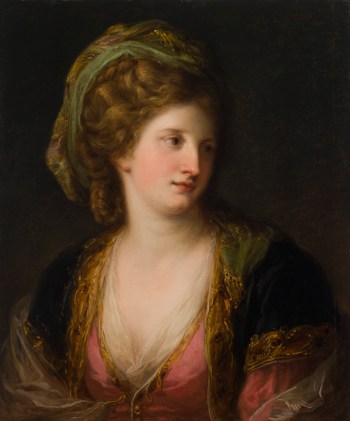
Angelica Kauffman, Woman in Turkish Dress, 1767, oil on canvas, 25 × 20 inches (Saint Louis Art Museum, Funds given by Dr. E. Robert and Carol Sue Schultz 704.2018).
Angelica Kauffman (1741–1807) was an Austrian-Swiss artist who began her career in Italy, where her clients included British tourists who encouraged the young painter to pursue her profession in England. Over the 15 years she worked in London, Kauffman achieved fame and fortune and returned to Italy as an international celebrity. This lecture celebrates a portrait recently acquired by the Museum. Wendy Wassyng Roworth will discuss Kauffman’s life and work in England as a fashionable painter and member of the Royal Academy of Arts, a rare distinction for a woman, and how the artist used her talents to her advantage.
Wendy Wassyng Roworth is Professor Emerita of Art History, University of Rhode Island.
This free, virtual program will take place on Thursday, 25 March 2021, via Zoom, and will include opportunities for participants to ask questions with the Q&A feature. Attendees’ mics and cameras will not be activated. Attendees must register to receive the Zoom link. Capacity for the live program is limited. A closed-captioned recording of the program will become available on the Museum’s YouTube channel in the weeks following. This program is supported by the Mary Strauss Women in the Arts Endowment.
Online Workshop | Analysis of Reverse Paintings on Glass
From ArtHist.net:
Possibilities and Limits of (Non-destructive) Analysis of Reverse Paintings on Glass
Online, Vitrocentre Romont, Switzerland, 12 March 2021
Organized by Sophie Wolf and Francesco Caruso
Registration due by 7 March 2021
As part of the SNSF research project on the travel and recipe book of Ulrich Daniel Metzger (1671), reverse glass paintings by the artist and by his close friend and master Gerhard Janssen are being examined. The investigation has two aims: first, a technical and material characterisation of the artworks and secondly, a comparison of the results with the recipes and painting instructions noted in the book. The analysis of materials and techniques, however, is associated with difficulties that are based on the technical specificity of the works, namely so-called ‘églomisé’. The paintings are backed with leaf metals and sometimes also protected by an additional cover of paper, which cannot always be easily removed. There is therefore no direct access to the painting layers. In this workshop, we would like to discuss the limits and possibilities of (non-destructive) analysis of reverse glass paintings and stained glass. Short presentations will give insights into the analytical practice of various research groups active in the field and provide the opportunity to discuss specific issues of analytical techniques and procedures.
The workshop is open to the public, but registration is required as the number of places is limited. If you are interested in participating as a listener, please register via email by 7 March 2021: sophie.wolf@vitrocentre.ch. The video-conference will start at 9.00am. Please start joining the meeting at 8.45am. We regret that latecomers cannot be admitted until a suitable break.
P R O G R A M M E
9.00 Sophie WOLF (Vitrocentre Romont), Welcome and introduction
9.15 Uta BERGMANN (Vitrocentre Romont), Das Reise- und Rezeptbuch Ulrich Daniel Metzgers
9.30 Francesco CARUSO (SIK-ISEA, Zürich) and Sophie WOLF (Vitrocentre Romont), Non-destructive study of early 18th-century reverse glass paintings
10.00 Simon STEGER (Staatliche Akademie der Künste, Stuttgart), Non-invasive spectroscopic investigation of cultural artefacts: shedding light on modern reverse glass paintings (1905–1955)
10.30 Break
11.00 Patrick DIETEMANN (Doerner Institut, München), Challenges and limits of (non-destructive) modern binding medium analysis
11.30 Katharina SCHMIDT-OTT (Swiss National Museum, Collection Centre, Affoltern a. Albis), Comparability of two XRF analyzers on sanguine in stained glass paintings by H. J. Güder (1630–1691)
12.00 Panel Discussion
• Patrick DIETEMANN (Doerner Institut, München)
• Susanne GREIFF (Römisch-Germanisches Zentralmuseum, Mainz)
• Maite MAGUREGUI HERNANDO (Universidad del País Vasco, Bilbao)
• Simon STEGER (Staatliche Akademie der Künste, Stuttgart)
Organisation
Sophie Wolf (Vitrocentre Romont), sophie.wolf@vitrocentre.ch
Francesco Caruso (Schweizerisches Institut für Kunstwissenschaft SIK-ISEA), francesco.caruso@sik-isea.ch
Online Conference | Building an Engaged Art History
From ArtHist.net:
Building an Engaged Art History
Online, Case Western Reserve University and Indiana University IUPUI, 22–23 April 2021
Registration due by 1 March 2021
A virtual convening about public scholarship, civic engagement, and community-based practices in the study and teaching of art history and visual culture.
How can art historians honor ways of seeing and knowing that have been historically marginalized in the art worlds and the academy? How can we work in ways that serve communities beyond our institutions? How can we learn from the methods of engagement that are well-established in other disciplines? How can we build structures within our institutions that support this kind of work? Where are we now, and where do we go from here? Experienced scholars in the public humanities will share their perspectives on the methods, ethics, and value of engaged approaches. Through a series of facilitated conversations, participants will reflect on their own engaged work and create a plan for making engaged art history more robust and more feasible in our institutions and our communities. The symposium is free of charge for all. Please send any questions to the symposium organizers, Erin Benay (eeb50@case.edu) and Laura Holzman (HolzmanL@iu.edu). Click here to register by March 1.
T H U R S D A Y , 2 2 A P R I L 2 0 2 1
10.00 Opening Remarks
Building a More Inclusive and Equitable Art History with Erin Benay (Case Western Reserve University) and Laura Holzman (Indiana University IUPUI)
10.30 Public Humanities, Public Art History
Panel Discussion with Susan Smulyan (Brown University), Renée Ater (Brown University), and Larry Zimmerman (Indiana University IUPUI)
Art history arguably lags behind other fields in the humanities, such as public history (which has an established professional organization and scholarly journal of the same name) with established publicly engaged trajectories. What can we learn from these disciplines about our own?
11.30 Lunch break
12.30 Discussion Session One: Toward an Engaged Art History
With Laura Holzman (Indiana University IUPUI)
Drawing first from disciplinary training and practice, participants will identify key values, awareness, skills, and abilities that can shape our engaged work.
1.30 Coffee break
2.00 Discussion Session Two: What Can Art History Learn from the Community?
With Erin Benay (Case Western Reserve University)
Building a more engaged art history means moving beyond classrooms and museums; this session asks what art history (and art historians) can learn from our community partners and experts outside the academy.
F R I D A Y , 2 3 A P R I L 2 0 2 1
10.00 Opening Remarks
Erin Benay (Case Western Reserve University) and Laura Holzman (Indiana University IUPUI)
10.30 Discussion Session One: Museums and Methods
With Key Jo Lee (Cleveland Museum of Art)
How can engaged practices and the philosophies behind them help make art museums more equitable institutions and how can museums’ methods of sharing knowledge shape engaged research and teaching?
11.30 Lunch break
12.30 Discussion Session Two: Teaching with Engaged Art History
With Jennifer Borland and Louise Siddons (Oklahoma State University)
What is the place of engaged art history in our classrooms and curricula? We will consider philosophies of teaching and learning as well as our experiences with activities such as applied projects service learning, and structuring degree programs.
1.30 Coffee break
2.00 Discussion Session Three: Engaged Art History in the Academy
With Carolyn Butler-Palmer (University of Victoria), Cynthia Persinger (California University of Pennsylvania), and Azar Rejaie (University of Houston-Downtown)
In breakout sessions dedicated to issues such as tenure and promotion and academic publishing, we discuss how to evaluate excellence in engaged art history and how to navigate systems of power that may not yet include its actions in policy or practice.
3.30 Concluding Discussion: Synthesizing the Priorities for Engaged Art History
With Mary Price (Indiana University IUPUI)
Participants will identify next steps for building an engaged art history and produce a Directory of Engaged Art History practitioners.
Online Lecture | Rebecca Tilles, Highlights from Hillwood

Abraham and David Roentgen, Roll-top desk, Germany (Neuwied), 1770–74; oak, cherry, and other woods, veneered with tulipwood, rosewood, maple, mother of pearl, gilt bronze (Washington, DC: Hillwood, Bequest of Marjorie Merriweather Post, 1973, 33.222).
◊ ◊ ◊ ◊ ◊
From The Furniture History Society:
Rebecca Tilles, Highlights from Hillwood: Marjorie Merriweather Post’s Taste for 18th-Century European Furniture
The Furniture History Society Online Lecture, Sunday, 21 February 2021, 19.00 (GMT)
Marjorie Merriweather Post (1887–1973) was one of the most influential female collectors, philanthropists, and businesswomen of the twentieth century. Born in Springfield, Illinois to a middle-class family, she inherited the helm of the Postum Cereal Company, eventually becoming the director of General Foods, from her father at the age of 27, making her one of the wealthiest women in America. She designed and decorated a multitude of impressive residences, notably a sprawling 54-room triplex apartment on Fifth Avenue in Manhattan (1925), the Mar-A-Lago estate in Palm Beach (1927), Adirondack Great Camp Topridge, New York (1923), and finally Hillwood, Washington, DC (1955).
This lecture will explore Post’s interest in collecting 18th-century European furniture, highlights from Hillwood’s collection (as well as a few that got away), and the dealers she bought from— spanning from the mid-1920s until the late 1960s, during which time Post acquired, renovated, and furnished Hillwood estate with the intention of bequeathing the house and collection to the public following her death. The lecture will also feature future research projects, new acquisitions, and upcoming exhibitions. This event is free for FHS members, £5 for non-members; to pay for this event online please follow this link.
Rebecca Tilles is Associate Curator of 18th-Century French & Western European Fine & Decorative Arts at Hillwood Estate, Museum & Gardens in Washington, DC. She is currently organizing an exhibition of outdoor garden sculpture by the artist Kristine Mays entitled Rich Soil (June 2021–January 2022), as well as an exhibition on the evolution of porcelain in Western Europe and Marjorie Merriweather Post’s interest in diplomatic gifts and international commissions between Western European and Russian factories (February–June 2022). Rebecca is also organizing a spotlight exhibition entitled “Marjorie Merriweather Post and the Diplomacy of Philanthropy,” in partnership with the State Department, at the National Museum of American Diplomacy in Washington, D.C. (2022). Rebecca completed her PhD in Art History from the University of Sussex where her dissertation was entitled “George and Florence Blumenthal: A Collecting Partnership in the Gilded Age, 1858–1941.” She recently published “The Artistic Patronage and Transatlantic Connections of Florence Blumenthal” in the most recent issue of 19: Interdisciplinary Studies in the Long Nineteenth Century and is currently working on a new publication on Marjorie Merriweather Post’s collection and residences with Hillwood’s curatorial team that will be published by Rizzoli in 2022.










leave a comment