Online Talk | British Encounters with Indigenous Slavery, Nootka Sound
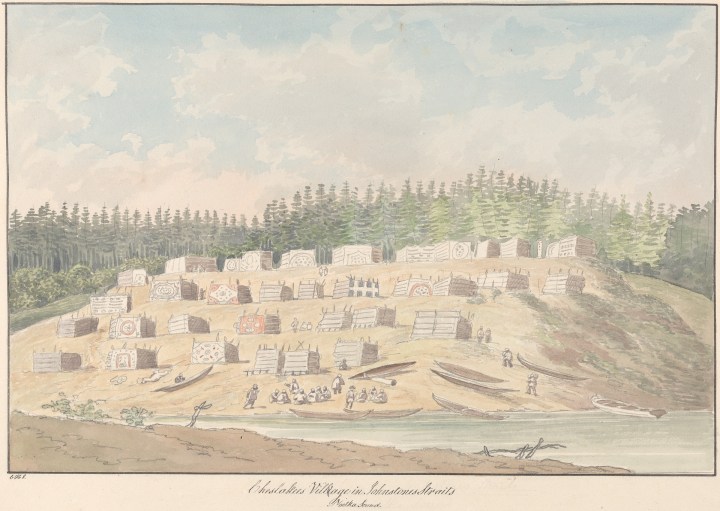
Charles Hamilton Smith (1776–1859, Belgian), Cheslakee’s Village in Johnstone’s Straits, undated, watercolor and graphite on moderately thick, moderately textured, cream wove paper; 41 × 33 cm; inscribed in pen and black ink, lower center: “Cheslakee’s Village in Johnstones Straits | Nootka Sound.” Signed in pen and black ink, lower right: “CHS” (New Haven: Yale Center for British Art, Paul Mellon Collection, B1978.43.1820(26)).
◊ ◊ ◊ ◊ ◊
Later this month, from YCBA:
Adam Chen, British Encounters with Indigenous Slavery at Nootka Sound
Online, Yale Center for British Art, New Haven, 23 February 2021, 12.30–1.00pm (ET)
At the end of the eighteenth century, British and Spanish mercantile expeditions descended upon an inlet known as Nootka Sound, on what is now the coast of Vancouver Island in British Columbia. Their reactions to the native Nuu-chah-nulth people and to the well-established indigenous slave trade on the Pacific Northwest Coast reveal the dissonance and nuances of eighteenth-century European attitudes toward slavery. Adam Chen will share several images of works from Yale and other collections to illustrate his talk.
Art in Context, the Center’s gallery talk series, is now online. Presented by faculty, staff, visiting scholars, and student guides, these lectures are held on the last Tuesday of each month during the academic year. Each talk focuses on a particular work of art in the Center’s collections, or a special exhibition, and takes an in-depth look at its style, subject matter, technique, or time period. The last ten minutes are reserved for conversation and will allow for participants to ask questions.
Adam Chen (TD 2022) is a Yale undergraduate majoring in the history of art and a Bartels Scholar at the Yale Center for British Art. He has previously worked in the European art departments of the Yale University Art Gallery and Seattle Art Museum. His historical interests include the eighteenth century and art of the British Empire. Chen is from the Pacific Northwest, and the topic of this talk is of personal significance. Chen is also an oil painter and carillon player.
Online Lecture | Jason Farago, A Global Criticism for a Global Art World
This Wednesday, from YCBA:
Jason Farago, Lytton Lecture: A Global Criticism for a Global Art World
Online, Yale Center for British Art, New Haven, 10 February 2021, 12.00–1.00pm (ET)
In the last 30 years, museums, galleries, fairs, and publications have taken a worldwide approach to art—but how can an art critic make substantive judgements when his or her beat spans the entire globe? In this talk, Jason Farago, art critic for the New York Times, considers how museums should approach the art of foreign cultures, how viewers can appreciate things they don’t fully understand, and how criticism can offer a view of art as a continuous flow of people, images, and ideas.
Generous support for this program has been provided by the Norma Lytton Fund for Docent Education, established in memory of Norma Lytton by her family. Lytton was an active docent at the Center for more than twenty years and subsequently spent a decade engaged in research for the Center’s Department of Paintings and Sculpture.
Jason Farago (Yale BA 2005) has served as an art critic for The New York Times since 2017. Before that, he was the first US-based art critic for The Guardian, and he has been a regular contributor to The New Yorker, The New York Review of Books, and other publications. Farago was also the editor and co-founder of the art and culture magazine Even, whose run is anthologized in Out of Practice: Ten Issues of Even, 2015–18 (Motto Books). He has published catalogue essays on the art of Sheila Hicks, Simon Hantaï, Kishio Suga, Julia Dault, Meleko Mogkosi, and others. In 2017 he was awarded the inaugural Rabkin Prize for art criticism.
Please register for the program here»
Painting Edo: Japanese Art from the Feinberg Collection
The exhibition Painting Edo: Japanese Art from the Feinberg Collection opened briefly at Harvard, before the museum was forced to close due to the pandemic. The catalogue of the collection, however, is scheduled to be published next month, and online programming continues, including a discussion of the film Edo Avant Garde.
Film Discussion: Edo Avant-Garde
Online, Tuesday, 9 February 2021, 7pm (EST)
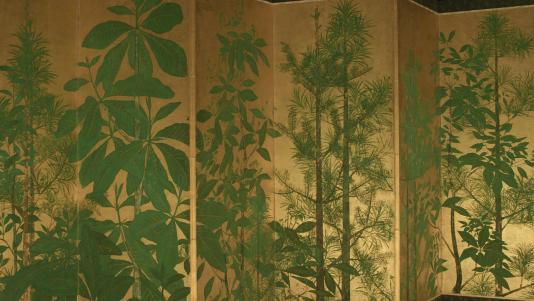
Still from ‘Edo Avant-Garde’ (2019). Master of the I’nen Seal (1600–1630), Sōtatsu school, Trees, Japanese, Edo period, mid-17th century; pair of six-panel folding screens; ink, colors, and gold on paper (Washington, D.C.: Freer Gallery of Art, F1962.30).
Join us on Zoom for a discussion of the film Edo Avant-Garde with curator Rachel Saunders and director Linda Hoaglund, presented in conjunction with the special exhibition Painting Edo: Japanese Art from the Feinberg Collection.
Edo Avant-Garde (2019) reveals the story of how Japanese artists of the explosively creative Edo period (1615–1868) pioneered innovative approaches to painting that many in the west associate most readily with so-called modern art of the 20th century. Through groundbreaking interviews with scholars, priests, art dealers, and collectors in Japan and the United States, the film explores how the concepts of abstraction, minimalism, and surrealism are all to be found in Edo painting. The film’s exquisite cinematography and outstanding original soundtrack, composed in response to individual paintings, present a remarkable immersive experience of some of Japan’s most celebrated and yet least-filmed paintings, many of them outside traditional museum and gallery settings. Simultaneously dynamic and mesmerizing, at its heart Edo Avant-Garde offers a unique opportunity to look closely and see differently.
This conversation will take place online via Zoom. Free admission, but registration is required. To register, please complete this online form.
Edo Avant-Garde will be available to stream for free through the Harvard Art Museums from Friday, February 5 to Friday, February 12. Upon registration, you will receive a link and password to access the film. We encourage you to view the film in advance of the discussion! The film is also available to rent through the Pacific Film Archive at the Berkeley Art Museum (BAMPFA). Please click here for further details.
If you have any questions, please contact am_register@harvard.edu.
◊ ◊ ◊ ◊ ◊
Distributed by Yale University Press:
Rachel Saunders, ed., Catalogue of the Feinberg Collection of Japanese Art (Cambridge: Harvard Art Museums, 2021), 264 pages, ISBN: 978-0300250909, $65.
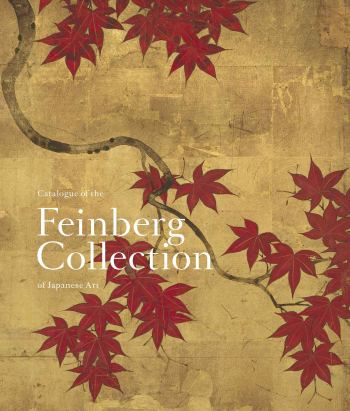 The sophistication and variety of painting in Japan’s Edo period, as seen through a preeminent US collection.
Over more than four decades, Robert and Betsy Feinberg have assembled the finest private collection of Edo-period Japanese painting in the United States. The collection is notable for its size, its remarkable quality, and its comprehensiveness. It represents virtually every stylistic lineage of the Edo-period (1615–1868)—from the gorgeous decorative works of the Rinpa school to the luminous clarity of the Maruyama-Shijo school, from the ‘pictures of the floating world’ (ukiyo-e) to the inky innovations of the so-called eccentrics—in addition to sculpture from the medieval and early modern periods. Hanging scrolls, folding screens, handscrolls, albums, and fan paintings: the objects are as breathtaking as they are varied. This catalogue’s twelve contributors, including established names in the field alongside emerging voices, use the latest scholarship to offer sensitive close readings that bring these remarkable works to life.
Rachel Saunders is the Abby Aldrich Rockefeller Associate Curator of Asian Art at the Harvard Art Museums.
Online Talks | HECAA Emerging Scholars Showcase
HECAA Emerging Scholars Showcase
Online, Saturday, 6 February 2021, 2:00–3:30pm (EST)
Our next HECAA Emerging Scholars Showcase is on Saturday, February 6, 2–3:30pm (EST). Please join us via Zoom (link below) to hear our next seven emerging scholars present their research. Each participant will present for 3–5 minutes, and after the presentations, we will host a question-and-answer session. If you have any questions or concerns, please contact Dani Ezor (dezor@smu.edu).
Best regards,
HECAA Board
◊ ◊ ◊ ◊ ◊
Zoom: https://smu.zoom.us/j/98321231325
• Priscilla Sonnier (University College, Dublin), ‘Ierne’s Ladies of Quality’: Self-Fashioning Elite Female Social Identity in Ascendancy Ireland, 1730–90
• Jennifer Laffick (Southern Methodist University), Sentimentalizing Soldiers: Lamentation and Theatricality in Jean Broc’s Death of General Desaix
• Emily Peikin (University of Delaware), Rubens Peale with a Geranium: Botanical Science and Slavery in the Early Republic
• Damiët Schneeweisz (Rijksmuseum), Coloured Ivory: Portrait Miniatures in the Dutch Atlantic World
• María del Castillo García Romero (University of Seville), Feminae devotae: Artistic Portraits on Religious Female Culture in Baja Andalusia during the 18th Century
• Leo Stefani (Courtauld Institute of Art), Surface Learning: Tables, Royal Education, and Louis XV’s Pavilion at the Tuileries
• Joseph Litts (Princeton University), Afterlives and Francis Parsons’s 1762 Painting of Cherokee Diplomat Cunne Shote
Online Series | 2021 Wallace Seminars on Collections and Collecting
From The Wallace Collection:
2021 Wallace Collection Seminars on the History of Collections and Collecting
Online, The Wallace Collection, London, last Monday of the Month, 17.30
This seminar series was established in 2006 as part of the Wallace Collection’s commitment to the research and study of the history of collections and collecting, especially in the eighteenth and nineteenth centuries in Paris and London. The seminars—normally held on the last Monday of every month during the calendar year, excluding August and December—act as a forum for the presentation and discussion of new research into the history of collecting. Seminars are open to curators, academics, historians, archivists, and all those with an interest in the subject. Papers are generally 45–60 minutes long.
Please note that the seminars will take place on Zoom and will not be held at the Wallace Collection.
Monday, 22 February
Sara Ayres (Fellow at the Centre for Privacy Studies, University of Copenhagen), Descriptions of Collections and Their Display at the Stuart Court in 1669 in a Manuscript Account of Prince George of Denmark’s Grand Tour (1668–70)
Monday, 29 March
Janet M. Brooke (Independent Scholar, Montreal), The Gilded Age in Canada: Reconstructing the Life and Afterlife of the Sir William Van Horne Collection
Monday, 26 April
Ellinoor Bergvelt (Guest Researcher, University of Amsterdam / Research Fellow, Dulwich Picture Gallery), The Dutch King Willem II (1792–1849) as Collector and Source of Some Important Pictures in The Wallace Collection
Monday, 24 May
Krystle Attard Trevisan (PhD Candidate, Institute of English Studies, School of Advanced Study, University of London), The ‘Primo Costo’ inventory of Count Saverio Marchese (1757–1833): Mapping the Print Market in Malta and Its European Connections
Monday, 28 June
Timothy Schroder (Trustee, The Wallace Collection), Inside the Dragon’s Lair: Henry VIII’s Kunstkammer at Whitehall Palace
Monday, 26 July
Ana Mónica da Silva Rolo (Archaeologist, Archaeology Centre UNIARQ, Lisbon University) and Noé Conejo Delgado (Archaeologist, Numismatist, Archaeology Centre UNIARQ, Lisbon University), A Dactyliothec from Pietro Bracci in the Portuguese Royal Family’s Collections: A Different Look at Art Collecting
Monday, 27 September
Andrea Morgan (PhD Candidate, Queen’s University, Kingston, Ontario), Collecting and Displaying Rembrandt’s Pictures in Eighteenth– and Nineteenth–Century England: Charles Jennens of Gopsall Hall and the ‘Rembrandt Room’ at Stowe
Monday, 25 October
Mark Hall (Collections Officer for Culture Perth & Kinross, Perth Museum & Art Gallery), The Perth Literary and Antiquarian Society, 1784–1914: Collecting Scotland, Collecting the World
Monday, 29 November
Rachel Peat (Assistant Curator of Non-European Works of Art, Royal Collection Trust, London), ‘A Most Distinguished Collector and Patron’: Prince Alfred, Duke of Edinburgh and Japanese Art, 1869–1900
Online Talk | Robert Darnton, Pirating and Publishing
This Wednesday, from the Boston Athenæum:
Book Talk: Pirating and Publishing: The Book Trade in the Age of Enlightenment
Robert Darnton in Conversation with John Buchtel
3 February 2021, 6:00pm (EST)
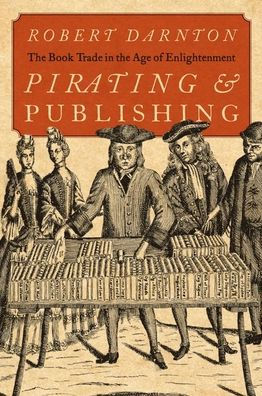 In the late-18th century, a group of publishers in what historian Robert Darnton calls the ‘Fertile Crescent’ countries located along the French border, stretching from Holland to Switzerland pirated the works of prominent (and often banned) French writers and distributed them in France, where laws governing piracy were in flux and any notion of ‘copyright’ very much in its infancy. Piracy was entirely legal and everyone acknowledged tacitly or openly that these pirated editions of works by Rousseau, Voltaire, and Diderot, among other luminaries, supplied a growing readership within France, one whose needs could not be met by the monopolistic and tightly controlled Paris Guild.
Pirating and Publishing: The Book Trade in the Age of Enlightenment focuses on a publisher in Switzerland, one of the largest and whose archives are the most complete. Through the lens of this concern, Darnton offers a sweeping view of the world of writing, publishing, and especially bookselling in pre-Revolutionary France—a vibrantly detailed inside look at a cut-throat industry that was struggling to keep up with the times and, if possible, make a profit off them. Featuring a fascinating cast of characters lofty idealists and down-and-dirty opportunists this new book expands upon on Darnton’s celebrated work on book-publishing in France, most recently found in A Literary Tour de France. Pirating and Publishing reveals how and why piracy brought the Enlightenment to every corner of France, feeding the ideas that would explode into revolution.
Registration is requested. Boston Athenæum Members and VESP holders: free. Visitors: $5.
Robert Darnton is Carl H. Pforzheimer University Professor and University Librarian, Emeritus of Harvard University, and the author of The Great Cat Massacre (1984) and A Literary Tour de France (2018), among others.
John Buchtel is Curator of Rare Books and Head of Special Collections at the Boston Athenaeum.
◊ ◊ ◊ ◊ ◊
Robert Darnton, Pirating and Publishing: The Book Trade in the Age of Enlightenment (Oxford: Oxford University Press, 2021), 400 pages, ISBN: 978-0195144529, $35.
C O N T E N T S
Introduction
Publishing
1 The Rules of the Game and How the Game was Played
2 The Landscape in Paris
3 The Fertile Crescent
Pirating
4 How to Pirate a Book
5 Portraits of Pirates and Their Businesses
6 Underground Geneva
7 A Confederation of Pirates
8 The Struggle to Pirate Rousseau and Voltaire
Inside a Swiss Publishing House
9 Business as Usual
10 Our Man in Paris
11 Relations with Authors
12 Making and Losing Money
Conclusion
Online Panel | Print Culture and Propaganda in the American Revolution
Christie’s presents this free online panel (via Zoom) in conjunction with its Americana week:
 Print Culture and Propaganda in the American Revolution: Selections from the Collection of Ambassador J. William Middendorf
Tuesday, 19 January 2021, noon (EST)
Moderated by Peter Klarnet, Senior Specialist, with a tribute by John Hays, Deputy Chairman
Panelists
• Philip Mead (Director of Curatorial Affairs and Chief Historian, Museum of the American Revolution, Philadelphia)
• Nancy Siegel (Professor of Art History and Museum Studies Coordinator, Towson University, Towson, Maryland)
• Allison Stagg
• Amy Torbert (Andrew W. Mellon Foundation Assistant Curator of American Art, Saint Louis Art Museum)
Image: Lot 306 of sale 18947. Phillip Dawe, engraver, The Bostonian’s Paying the Excise Man or Tarring and Feathering (London: Robert Sayer & John Bennett, 1774; Collection of Ambassador J. William Middendorf II).
Online Lecture | John Whitehead, Japanese Lacquer on French Furniture
From the FHS announcement:
John Whitehead, The Use of Japanese Lacquer on French 18th-Century Furniture
Furniture History Society Online Lecture, Sunday, 17 January 2021, 19.00 (GMT)
 Japanese lacquer has been recognised in Europe as the best of all Asian lacquers since the seventeenth century, and in the eighteenth century it was much used to decorate furniture in France and elsewhere. Paris marchands-merciers and ébénistes clearly had no respect for the integrity of pieces, as we would have now, and created some delightful furniture with chopped-up pieces of lacquer. This subject was first discussed by the FHS at a memorable symposium in 1988 and continues to amuse us today.
John Whitehead is a dealer in French eighteenth-century decorative arts, with an emphasis on Sèvres porcelain. He is the author of The French Interior in the Eighteenth Century (1992) and two books on eighteenth century Sèvres porcelain (2010). With Oliver Impey, he has written on Japanese lacquer and French furniture, including the entry in the exhibition catalogue, William Beckford, 1760–1844: An Eye for the Magnificent (2001).
This event is free for FHS members and £5 for non-members; please contact events@furniturehistorysociety.org for tickets.
Research Lunch | Rebecca Tropp on the Picturesque and Country Houses
This talk was slated for last March; it’s been rescheduled as an online event, sponsored by the Mellon Centre:
Rebecca Tropp, Accommodating the Picturesque: The Country Houses of James Wyatt, John Nash, and Sir John Soane, 1793–1815
(Zoom) Paul Mellon Centre for Studies in British Art, London, 29 January 2021

James Wyatt, Ashridge House, commissioned by the 7th Earl of Bridgewater.
Whilst much has been written about the development of Picturesque theory at the end of the eighteenth century, regarding both the landscape itself and prescriptions for the sitting of buildings within it, these discussions have generally been limited to two-dimensional snapshots, such as those represented in Humphry Repton’s Red Books. This paper, based upon ongoing research for a doctoral dissertation, seeks to push beyond the visual to investigate some of the physical implications and repercussions of the Picturesque ideal – the intersection between the visual two-dimensional picture-plane and the practical three-dimensional architectural response – on the design and construction of country houses at the turn of the nineteenth century.
Focusing on the work of James Wyatt (1746–1813), John Nash (1752–1835), and Sir John Soane (1753–1837), and limiting investigation to those country houses designed during the pivotal period from 1793 to 1815, the paper investigates two specific implications related to the lowering of the principal floor from piano nobile to ground level, as part of a general repositioning of the house within the landscape. First is the use of level changes within the ground floor—the inclusion of a few steps up or down in entrance halls or between rooms, as distinct from staircases between floors—considering some possible reasons for their incorporation and the purposes they served. Second, and sometimes connected to these level changes, is an increase in permeability between interior and exterior, through the use of full-length windows, loggias and attached conservatories—social/botanical spaces that were first incorporated into the design of the house during this period. Taken together, these developments furthered the evolving relationship between house and landscape and, as a result, the experience of moving through and between those spaces.
Rebecca Tropp is currently finishing her PhD in History of Art at St John’s College, University of Cambridge, working under the supervision of Dr Frank Salmon. She completed her MPhil in History of Art and Architecture at Cambridge in 2015, investigating recurring spatial arrangements and patterns of movement in the country houses of John Nash. Prior to commencing postgraduate studies in the UK, she received her bachelor’s degree from Columbia University in New York, where she majored in the History and Theory of Architecture.
Xavier Salomon on Clodion’s Dance of Time
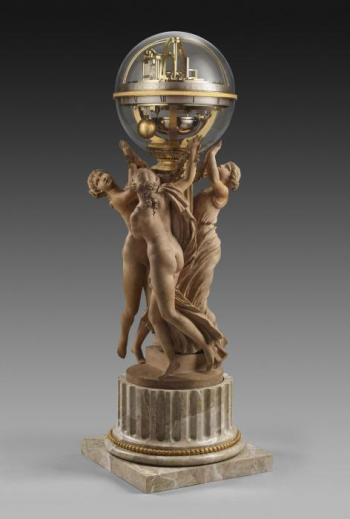
The Dance of Time, Three Nymphs Supporting a Clock, movement by Jean-Baptiste Lepaute, sculpture by Claude Michel Clodion, 1788, terracotta, gilt brass, and glass, H.: 41 inches (New York: The Frick Collection, bequest of Winthrop Kellogg Edey) Photo: Michael Bodycomb.
A very Happy New Year to all of you! I should have posted news of this brief talk earlier, but it will be available on YouTube whenever you might have the time and inclination to watch. I also point out the series more generally for those of you always looking for teaching resources. Past installments (typically 20 minutes) address paintings by Gainsborough, Stubbs, Romney, Tiepolo, Boucher, and Chardin, along with extraordinary decorative arts objects (and plenty of works beyond the eighteenth century). –CH
Xavier Salomon on Clodion’s Dance of Time
YouTube, 1 January 2021, 5pm (EST)
This week’s episode of Cocktails with a Curator toasts the new year with Deputy Director and Peter Jay Sharp Chief Curator Xavier F. Salomon as he examines a masterpiece of both sculpture and clockmaking: The Dance of Time, by Clodion (Claude Michel) and Jean-Baptiste Lepaute. In this 18th-century timepiece, three terracotta nymphs or Hours dance in a circle around an exquisite mechanism enclosed in a glass globe. The Frick has one of the country’s most important collections of clocks, many of which came to the museum through a gift from Winthrop Kellogg Edey. Welcome 2021 by raising a Metropolitan cocktail—Happy New Year!










leave a comment