Online Conference | Palaces in Eighteenth-Century Madrid
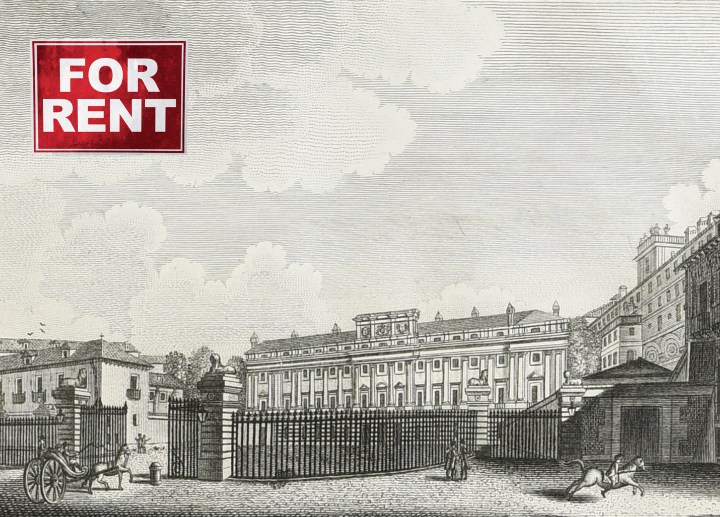
From the conference programme:
Palaces for Rent: Real Estate in Madrid in the Eighteenth Century / Palacios en alquiler: Patrimonio inmobiliario en el Madrid del siglo XVIII
Online, Universidad Nacional de Educación a Distancia (UNED), Madrid, 12 November 2020
Lugar de celebración
Sala virtual de conferencias
https://zoom.us/j/97638995759?pwd=b1l3Qko3WkFpNzVkdjc1eExPQ20wZz09
Acceso libre hasta completar el aforo de sala. Las sesiones estarán posteriormente disponibles en el portal de Canal UNED.
Destinatarios
Estudiantes de Máster y Doctorado en las áreas de historia, historia del arte, historia de la arquitectura, estudios urbanos, estudios sobre la nobleza, historia de la vida cotidiana, estudios de cultura visual y material, etc.
Se facilitará certificado de asistencia a los estudiantes interesados previa petición por correo.
Más información
palacesforrent@gmail.com
Dirección científica
Dra. Pilar Diez del Corral Corredoira, UNED.
Dr. Álvaro Molina Martín, UNED.
Dra. Miriam Cera Brea, Universidad Autónoma de Madrid.
Comité científico
Dra. Natalia González Heras, Universidad Complutense de Madrid.
Dra. Giada Lepri, La Sapienza, Roma.
Dr. Carlos Sambricio, Universidad Politécnica de Madrid.
Dra. Mercedes Simal, Universidad de Jaén.
Dr. José Antonio Vigara Zafra, UNED.
P R O G R A M A
9:30 BIENVENIDA Y PRESENTACIÓN
Consuelo Gómez López (Directora del Departamento de Historia del Arte, UNED)
Pilar Diez del Corral Corredoira y Álvaro Molina Martín (UNED), Miriam Cera Brea (UAM)
10:00 RESIDIR Y ALOJARSE EN MADRID: MÁS ALLÁ DE LA VILLA Y CORTE
Modera: Álvaro Molina Martín
• Natalia González Heras (Universidad Complutense de Madrid), El alquiler yRegalía de Aposento: Tipologías de ocupación residencial en la Corte del siglo XVIII
• José Antonio Vigara Zafra (UNED), La problemática entre el centro y la periferia en las residencias palaciegas de las élites nobiliarias españolas del siglo XVIII
• Magdalena Merlos Romero (Archivo Municipal de Aranjuez), Palacios y alojamientos del siglo XVIII en un real sitio: previsión urbana de Aranjuez para días de primavera
12:00 DESCANSO
12:15 PENSAR Y DISEÑAR EL PALACIO: LA CONFORMACIÓN DE UNA CULTURA ARQUITECTÓNICA
Modera: Miriam Cera Brea
• Juan Luis Blanco Mozo (Universidad Autónoma de Madrid), La maqueta de Filippo Juvarra para el palacio real nuevo de Madrid. Historia en su contexto
• Adrián Fernández Almoguera (Sorbonne-Université – École française de Rome), Jorge Durán y el palacio del conde de Tepa: ¿un caso de “italomanía” en el Madrid de finales de la Ilustración?
• José Riello (Universidad Autónoma de Madrid), Cárceles doradas del arte: cultura de la ostentación en el Museo de Antonio Palomino
14:15 DESCANSO
16:00 VESTIR EL PALACIO: USOS, PRÁCTICAS Y SÍMBOLOS EN TORNO AL ADORNO DOMÉSTICO
Modera: Pilar Diez del Corral Corredoira
• Álvaro Molina (UNED), Hacia una cartografía del adorno en las residencias palaciegas de la corte de Carlos IV
• Milton Pacheco (Universidade Nova de Lisboa), Cenários de Himeneu: A residência madrilena do embaixador extraordinário português, o IIImarquês de Louriçal, por ocasião das festividades dos duplos matrimónios reais celebradas em 1785
• Mirella Romero Recio (Universidad Carlos III), Pompeya y la Antigüedad en las decoraciones pictóricas de los palacios de Godoy en Madrid
• Sandra Antúnez López (Universidad Autónoma de Madrid), El Real Guardarropa y las nuevas modas en la corte de Carlos IV y María Luisa de Parma (1789–1808)
18:30 CLAUSURA
Online Panel | Race and the Boundaries of the Book

I’m especially excited about the prerecorded videos (most 6–8 minutes); it’s an interesting way to maximize the potential of this RBS online session and also extend the value of the event well beyond the confines of the original session. –CH
Race and the Boundaries of the Book: Seven Early American Perspectives
Rare Book School Online, 20 October 2020, 5–6pm (ET)
A 45-minute panel discussion followed by 15 minutes of Q&A scheduled for Tuesday, 20 October 2020, 5–6pm ET, via Zoom. Owing to Zoom’s restrictions, this event is limited to the first 300 people who register. The event will be recorded and made available for viewing on the RBS YouTube channel.
 Through video presentations of individual case studies, seven early Americanists zoom in on a range of bookish artifacts and employ critical bibliography to recover overlooked narratives about race from the historical record. Specifically, they examine how racialized and marginalized early American subjects speak through bibliographical concepts and formats. What can the materialities of textual artifacts tell us about the elaboration of racial identities? How does specific attention to African American and Indigenous readers and writers in early American literature and culture—a field that has traditionally privileged white subjects—gain traction by looking at formats, bindings, and paper surfaces on which writing and printing occur? Formats, the panelists argue, are everything but neutral containers. Following a chronological order, the video presentations examine the boundaries of “the book” and the complex richness of small and overlooked forms for recovering dismissed and erased readers, writers, and print artisans.
Rather than a traditional academic conference panel, the participants intend to create an engaging conversation by incorporating an innovative blend of pre-recorded video, focused analysis of specific material texts, and a live-streamed panel discussion of how their work engages with larger questions raised by the fields of early American literature and book history.
The panelists are Tara A. Bynum (University of Iowa), Alan Corbiere (York University), Michael Galban (Seneca Art & Cultural Center, Ganondagan State Historic Site), John H. Pollack (University of Pennsylvania), Phillip Round (University of Iowa), Michaël Roy (Université Paris Nanterre), and Derrick Spires (Cornell University). Steffi Dippold (Kansas State University) and John J. Garcia (Florida State University) are moderating the session.
The panelists have pre-recorded BiblioVideos in preparation for the panel discussion, which can be accessed here or by clicking on the titles below. They plan to summarize the argument during the panel, but the audience should watch the BiblioVideos in advance to prepare for their discussion. The videos are listed in the recommended viewing order below:
- “Early Indigenous Bookmaking: The Indian Primer (1669),” Steffi Dippold and Michael Galban
- “Cesar Lyndon: A Sundry Account Book,” Tara A. Bynum
- “Runaways: African American Papermakers During the American Revolution,” John J. Garcia
- “Ephemeral Caskets,” Michaël Roy
- “Jarena Lee’s Life and Religious Experience (1836),” Derrick R. Spires
- “Indigenizing Print,” Alan Corbiere and Phillip Round
- “Proclaiming Emancipation,” John H. Pollack
Everyone is welcome to attend. To ensure the security of the event, advance registration is required; to register, click here. Registration closes at 8am ET the day of the event. Your registration will be automatically accepted. You will receive an email reminder the day before the event. The day of the event, we will send you the Zoom URL and password. Please direct any questions to RBS Programs at rbs-events@virginia.edu.
Follow the conversation on social media using hashtags #RBSOnline and #RBSEarlyAmBookHistory.
Online Conference | Ecologies of Paper
From The Huntington:
Ecologies of Paper in the Early Modern World
Online, 5-6 November 2020
Registration due by 30 October 2020
 Presented by The Huntington Library, Art Museum, and Botanical Gardens, Ecologies of Paper in the Early Modern World will explore the transmutation, preservation, and loss of paper as a cycle of archiving and forgetting that defined early modern artistic practice, economic transaction, and political statecraft. Speakers will map paper’s various guises, its ability to retain meanings associated with its material origins, as well as its desire to conceal its former states or to encourage belief in a value beyond its material reality. Charting the journeys of early modern paper in drawing, print, and document, this program will not only restructure our understanding of paper’s importance in early modern artistic practice and political life but also reconstruct the governing roles of environment, place, and origin in modes of making and address. If you would like to receive a copy of the speakers’ papers for this event, please register here by October 30. All times are Pacific Standard Time (PST).
T H U R S D A Y , 5 N O V E M B E R 2 0 2 0
9:00 Welcome and Introduction
• Steve Hindle (The Huntington), Shira Brisman (University of Pennsylvania), and Caroline Fowler (Clark Art Institute)
9:15 Session 1: Documents and Foundations
• Asheesh Kapur Siddique (University of Massachusetts-Amherst), Documenting the Body of State: Paper, Early Modernity, and the Matter of the U.S. Constitution
• Cheryl Finley (Cornell University and the Atlanta University Center Collective for the Study of Art History & Curatorial Studies), Paper, Print, and Activism
• John Gagné (University of Sydney), Toward a History of the Conservation of the Premodern Documentary Heritage
10:30 Break
10:45 Session 2: Backgrounds and Foregrounds
• Jennifer Chuong (Harvard University), Overmarbling and Paper’s Disorderly Metamorphoses
• Iris Brahms (Freie Universität Berlin), Blue Paper as Metaphor and Efficient Solution
• Caroline Fowler (Clark Art Institute), The Matrix and The Mould: Counter-Histories of Reproduction
• Heather Wolfe (Folger Shakespeare Library), Interpreting the Materiality of Paper through Digital Images
12:15 Discussion, led by Shira Brisman (University of Pennsylvania)
F R I D A Y , 6 N O V E M B E R 2 0 2 0
9:15 Session 3: Scarcity
• Joshua Calhoun (University of Wisconsin-Madison), The Transformation of a Plant; or, Rags Do Not Make Paper
• Shira Brisman (University of Pennsylvania), Contriving Scarcity in Early Modern Art and Law
10:15 Break
10:30 Session 4: The Paper Age
• Esther Chadwick (The Courtauld Institute of Art), Material Sinews of the Paper Age
• Nina Dubin (University of Illinois-Chicago), Rags to Riches: Paper Culture in the Age of Bubbles
• Richard Taws (University College London), Laissez-passer: Afterimages of Revolutionary France
11:45 Break
12:30 Discussion, led by Caroline Fowler (Clark Art Institute)
Online Talks | Riesener at The Wallace
This fall at The Wallace Collection (the Riesener project has been underway since June 2012 as curators and conservators at The Wallace Collection have worked alongside colleagues from Waddesdon Manor and the Royal Collection to better understand these extraordinary objects).
Alex Collins and Jurgen Huber | Riesener at The Wallace Collection
In conjunction with London Craft Week
Online, Thursday, 8 October 2020, 17.30–18.30 (BST)
Jean-Henri Riesener, along with Thomas Chippendale and David Roentgen, was one of the greatest furniture-makers of the eighteenth century. Born in Gladbeck, Germany, Riesener emigrated to Paris early in his career and became a highly successful cabinetmaker who supplied luxurious furniture to Louis XVI, Marie-Antoinette, and the French court. Join this free online talk (via Zoom) during London Craft Week 2020 to explore the designs, materials, and techniques Riesener used to create his masterpieces. Please click here to register.
Alex Collins is the former Riesener Project Leverhulme Fellow at The Wallace Collection. Jurgen Huber is Senior Furniture Conservator at The Wallace Collection.
◊ ◊ ◊ ◊ ◊
Helen Jacobsen | Creating a Market: Dealers, Auctioneers, and the Passion for Riesener Furniture, 1800–1882
Seminar in the History of Collecting
Online, Monday, 30 November 2020, 17.30–19.00 (BST)
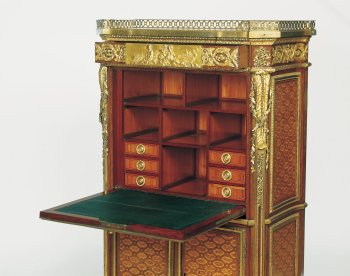
Jean-Henri Riesener, Secretaire, 1783, 140 × 81 × 42 cm (London: The Wallace Collection).
Jean-Henri Riesener (1734–1806), cabinetmaker to Louis XVI, was one of the most celebrated cabinetmakers of the French eighteenth century. He was also a phenomenon in the history of British art collecting, becoming a byword in the nineteenth century for all that was admired in French furniture. Before the French Revolution we have no evidence of a British patron, yet just fifty years later collectors like William Beckford, George IV and the 4th Marquess of Hertford had contributed to both his celebrity and the prices his furniture achieved. The nineteenth-century popularity of Riesener furniture was more than just an appreciation of the cabinetmaker’s designs and the quality of their execution; it was driven by a fascination for the ancien régime and romanticized views of the doomed Bourbon Court. It was also an indication of the resourcefulness of the innovative entrepreneurs and dealers in France and England who helped establish Riesener’s reputation in the decades following the Revolution. Through clever marketing techniques and a certain amount of ‘enhancement’, they educated a new generation of buyers and established Riesener’s name alongside that of André-Charles Boulle as being worthy of connoisseurs.
This paper will analyze the rise of Riesener’s celebrity and the dealers who made it happen. It will discuss the sales techniques of the early nineteenth-century auctioneers, the role played by connoisseurs such as Lord Hertford, and the democratization of Riesener furniture through the market for copies and reproductions. It will end with the Hamilton Palace sale of 1882, which opened up yet another new market for Riesener: the Americans.
Helen Jacobsen is Curator of French 18th-Century Decorative Arts at The Wallace Collection.
This seminar series in the History of Collecting was established in 2006 as part of the Wallace Collection’s commitment to the research and study of the history of collections and collecting, especially in the eighteenth and nineteenth centuries in Paris and London. The seminars, which are normally held on the last Monday of every month during the calendar year, excluding August and December, act as a forum for the presentation and discussion of new research into the history of collecting. Seminars are open to curators, academics, historians, archivists and all those with an interest in the subject.
This online seminar is also the first of three evening talks on Riesener held in collaboration with the Furniture History Society. Please click here to register.
◊ ◊ ◊ ◊ ◊
Rufus Bird, Mia Jackson, and Helen Jacobsen | Riesener Masterpieces: Royal Furniture in Britain
Online, Monday, 7 December 2020, 17.30–19.00 (BST)
Three of the most important collections of Riesener furniture in the world are in Britain. In the second talk in our series, speakers from the Wallace Collection, Royal Collection and Waddesdon Manor will discuss some of the 30 pieces in their care. These include celebrated works made for Marie-Antoinette, Louis XVI, and the French royal family that demonstrate the extraordinary levels of skilled craftsmanship achieved in the Riesener workshop and the design sophistication of which Riesener was capable. Our speakers will consider the popularity of French royal furniture in Britain in the 19th century and will illustrate the talk with stunning new photography from all three collections, revealing findings from the collaborative Riesener Project and shedding new light on both Riesener’s techniques and the provenance of some of the furniture.
Rufus Bird is Surveyor of The Queen’s Works of Art at The Royal Collection. Mia Jackson is Curator of Decorative Arts at Waddesdon Manor. Helen Jacobsen is Curator of French 18th-Century Decorative Arts at The Wallace Collection.
This online seminar is the second of three evening talks on Riesener held in collaboration with the Furniture History Society. Please click here to register.
◊ ◊ ◊ ◊ ◊
Alexander Collins | Mémoires for the Garde-Meuble: Riesener’s Perspective on Royal Furniture
Online, Monday, 14 December 2020, 17.30–19.00 (BST)
Riesener was court cabinetmaker for over ten years, supplying over 700 pieces to the French royal household. The details of these commissions were recorded in the Journal of the Garde-Meuble (the department of the royal household responsible for ordering and managing furnishings), as well as Riesener’s mémoires. These were invoices which contained detailed descriptions of the furniture, as well as the materials and techniques used to make them. Many of Riesener’s invoices survive and can be found in the collections of the Archives nationales and Bibliothèque nationale de France. This final talk in the series will explore a selection of invoices for pieces of royal furniture at Waddesdon Manor and the Royal Collection. They will tell us more about Riesener’s design and workshop processes, as well as the challenges he encountered during exceptionally ambitious projects.
Alexander Collins is the former Riesener Project Leverhulme Fellow at The Wallace Collection.
This online seminar is the third of three evening talks on Riesener held in collaboration with the Furniture History Society. Please click here to register.
Digital History | Fashion History Timeline
From the Fashion History Timeline, a project by FIT’s History of Art Department:

◊ ◊ ◊ ◊ ◊
The Fashion History Timeline is an open-access source for fashion history knowledge, featuring objects and artworks from over a hundred museums and libraries that span the globe. The Timeline website offers well-researched, accessibly written entries on specific artworks, garments and films for those interested in fashion and dress history. Started as a pilot project by Fashion Institute of Technology art history faculty and students in the Fall of 2015, the Timeline aims to be an important contribution to public knowledge of the history of fashion and to serve as a constantly growing and evolving resource not only for students and faculty, but also for the wider world of those interested in fashion and dress history–from the Renaissance scholar to the simply curious.


Robert Jacob Gordon’s Drawings and Papers Now Available Online
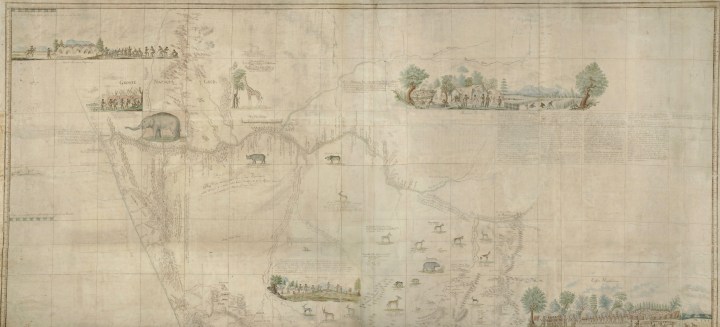
Attributed to Robert Jacob Gordon, Upper (Northern) Half of Gordon’s ‘Great Map of Southern Africa, ca. 1786; ink, pencil, and watercolor on paper, 91.5 × 203 cm (Amsterdam: Rijksmuseum, RP-T-1914-17-3-A). More information and a high resolution image is available here»
◊ ◊ ◊ ◊ ◊
Press release (14 February 2017) from the Rijksmuseum:
Today the Rijksmuseum launches www.robertjacobgordon.nl through which all of Robert Jacob Gordon’s drawings, diaries and letters are made accessible to all for the first time. The 18th-century Dutch explorer documented South Africa’s inhabitants, flora, and fauna in more than 450 detailed drawings. He meticulously noted down in his diaries and letters everything he experienced during his expeditions. The drawings, which include unique 8-metre-long panoramas, form part of the collection at the Rijksmuseum. The diaries and letters are kept in the Brendhurst Library in Johannesburg. On the occasion of the exhibition Good Hope: South Africa and the Netherlands from 1600, all of Gordon’s diaries and drawings are reunited for the first time and thus present a comprehensive view of 18th-century South Africa.
Zoom in on 18th-Century South Africa
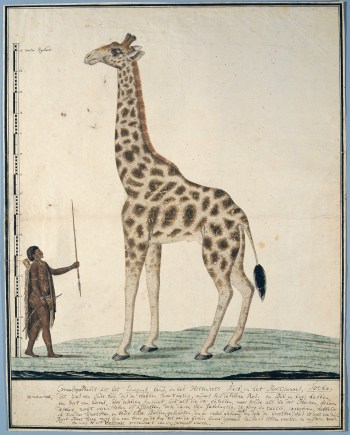
Robert Jacob Gordon, Giraffa camelopardalis (Giraffe), 1779 (Amsterdam: Rijksmuseum, RP-T-1914-17-149).
Through robertjacobgordon.nl, visitors are given a complete portrait of what Gordon encountered, and where. The site enables visitors to zoom in on the 18th-century map Gordon created alongside contemporary South Africa via Google Maps. The comparison revealed the uncanny accuracy of Gordon’s measurements. His diaries and letters are also made available digitally for the first time via the website. Gordon’s travel notes, discovered in 1960, are kept in the Brandhurst Library in Johannesburg. Through the website, these documents are made accessible for the first time. The original texts have been transcribed and translated into English for the occasion, with special functions linking Gordon’s texts to his drawings.
Robert Jacob Gordon
The 18th-century Dutch scientist Robert Jacob Gordon (1743–1795) travelled through the interior of South Africa during the second half of the 18th century. As a zoologist, cartographer, geographer, linguist, meteorologist, and anthropologist, he recorded his discoveries in an ‘Atlas’—a treasure trove of 450 drawings along with spectacular panoramas, multiple metres in length, that show precisely how Gordon portrayed the land, its inhabitants and the flora and fauna. To record all of this in words and in pictures, he made four extensive expeditions deep into the interior of South Africa, where he was frequently the mediator between the local people and the colonists, resolving conflicts arisen from arson, murders, and cattle thefts. As a representative of the European Enlightenment, Gordon poured his knowledge and expertise into the creation of ‘Great Map’, his compendium which remained unfinished due to his suicide in 1795 post the British invasion. A large number of Gordon’s drawings and metres-long, meticulously drawn panoramas can be seen in Rijksmuseum’s exhibition Good Hope: South Africa and the Netherlands from 1600 (17 February to 21 May 2017).
robertjacobgordon.nl is made possible by Cees en Ingeborg van der Burg and is created by the Rijksmuseum in association with Fabrique and Q42. The web address is obtained thanks to the Doesburgs’ Historical Society HetHuisDoesburg.
Six-Week Online Course | The Gothic Revival, 1700–1850
◊ ◊ ◊ ◊ ◊
From Open Education:
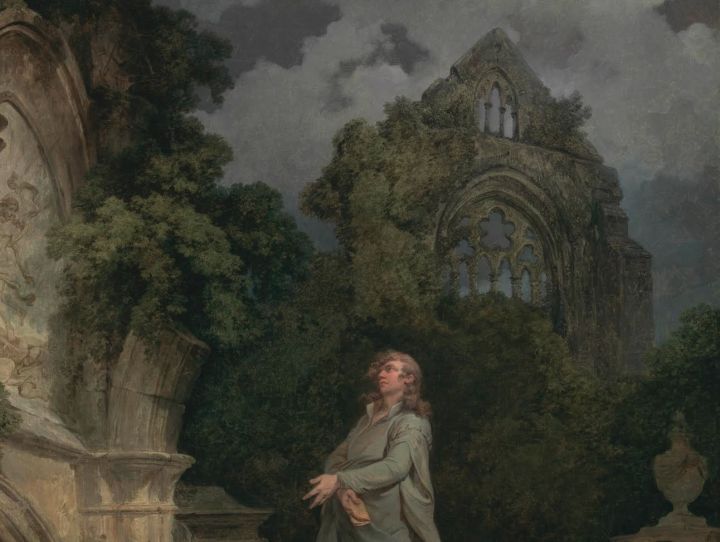
Six-Week MOOC | The Gothic Revival, 1700–1850: Interdisciplinary Perspectives
Beginning 29 February 2016
Taught by Dale Townshend and Peter Lindfield
Designed for the non-specialist learner, this six-week course is intended as an introduction to the inter-disciplinary dimensions of the Gothic Revival in British culture of the long eighteenth century (1700–1850). Over 6 weekly sessions, you will be guided by acknowledged experts in the field of Gothic studies through the following topics:
1 Introduction, and the Meanings of the Term ‘Gothic’ in the Eighteenth Century
2 An Introduction to Gothic Literature: Horace Walpole’s The Castle of Otranto (1764)
3 Gothic Literature after Walpole
4 The Gothic Revival in Architecture
5 Gothic Interiors in the Eighteenth Century
6 Gothic in Eighteenth-Century Visual Art
The MOOC commences on Monday 29 February 2016. Each session consists of three mini-lectures, quizzes, the use of reflective diaries, and peer discussion. Your tutors will be available for a one-hour live Question and Answer session per week. Further details about this will follow in due course.
Prerequisites: None, other than an abiding interest in the early Gothic aesthetic.
Time Commitments: Approximately 1 hour of formal instruction time per week, excluding your own personal study and reading.
Rules of Progression: Each successive week will only become available to you once you have completed the quiz for the previous week. Although these weekly exercises to do not count towards your certificate of completion, you are encouraged to complete them in preparation for the final quiz.
Certificates of Completion: Proof of having successfully completed the MOOC will be available at the end of the course. In order to qualify for a certificate, you will have to have scored at least 50% in the final quiz, an informal test comprised of a selection of questions encountered in earlier sessions.
Instructors: Dale Townshend (Senior Lecturer in Gothic and Romantic Studies Division of English Studies, University of Stirling) and Peter Lindfield (Postdoctoral Research Fellow, Literature and Languages, University of Stirling)
◊ ◊ ◊ ◊ ◊
Online Learning | Sexing the Canvas: Art and Gender

Giovanni Battista Tiepolo, The Banquet of Cleopatra, 1744
(Melbourne: National Gallery of Victoria)
◊ ◊ ◊ ◊ ◊
Now in progress through Coursera (directed by Jeanette Hoorn with familiar faces including Jennifer Milam). . .
Coursera: Sexing the Canvas: Art and Gender
Directed by Jeanette Hoorn, 26 October — 13 December 2015
What do paintings tell us about sex? How is art gendered? Here we get up close to some of the great paintings in the world’s most famous museums, giving you insight into how art speaks to us about sex, sexuality and gender.
This course teaches masterpieces through the lens of sex and gender. We take you to the rich collections of New York’s Museum of Modern Art, Melbourne’s National Gallery of Victoria and California’s Huntington Library giving you access to outstanding works from the western tradition and expert tuition from specialist curators and renowned art historians.
Each unit will examine the circumstances in which paintings are produced and received, and how contemporary spectators and consumers of art view them. Why do works of art made centuries ago continue to speak so profoundly to us today? What do art historians mean when they talk about ‘the gaze’? Are Matisse’s paintings ‘sexy’? What do the nude and the sleeping gypsy signify in Henri Rousseau’s extraordinary pictures? Why do viewers find Frida Kahlo’s small and very personal paintings so powerful? What do Gainsborough’s portraits tell us about masculinity and sensibility in eighteenth century Britain? How is the Australian ‘dreaming’ gendered? These are some of the intriguing questions you will study in Sexing the Canvas: Art and Gender.
Course Syllabus
The course is taught over 7 weeks and is made up of 9 modules:
1 Introduction: Tiepolo’s Cleopatra: Painting, Agency and the Gaze
2 The Culture of Sensibility and the ‘Man of Feeling’: Thomas Gainsborough’s Portrait of the Officer of the Fourth Regiment of Foot
3 Gainsborough at the Huntington: The Role of Music, Costume, Theatre, Charity and Passion in the Gendered Culture of Sensibility
4 Sexual Codes in French Courtly Painting of the Eighteenth Century
5 Orientalism, Gender and Display: Painting in Morocco
6 Henri Rousseau: Challenging the Myth of the Passive Woman
7 Henri Matisse, Paul Cezanne and Max Dupain: Modernism, Gender and the Science of Movement
8 Sexuality and Dissonance: Frida Kahlo and the Struggle to Paint
9 What is Women’s Business?: Australian Indigenous Art and the Dreaming
Recommended Background
No background is required; all are welcome. Visit your local art museum or gallery and look at some paintings.
Suggested Readings
All readings needed to successfully complete the course will be supplied. A rich list of resources will also be supplied within the course to assist you with you study for this subject.
Course Format
The class will consist of lecture videos, which are between 8 and 12 minutes in length. Each unit has key readings, which, with the lectures, provide the content for the short weekly quizzes based on a multiple choice format.










 Enfilade
leave a comment