Fellowships | Bard Graduate Center Research Fellowships
From BGC:
Bard Graduate Center Research Fellowship for 2016–17
Bard Graduate Center invites scholars from university, museum, and independent backgrounds with a PhD or equivalent professional experience to apply for funded research fellowships, to be held during the 2016–2017 academic year. The fellowships are intended to fund collections-based research at Bard Graduate Center or elsewhere in New York, as well as writing or reading projects in which being part of Bard Graduate Center’s dynamic research environment is intellectually valuable. Eligible disciplines and fields of study include—but are not limited to—art history, architecture and design history, economic and cultural history, history of technology, philosophy, anthropology, and archaeology.
The stipend rate is $3,500 per month, and housing is available. Both long- and short-term fellowships are available (for example, 6, 4 and 2 months). The timing of dates will be negotiated with individual awardees. Fellows will be given a workspace in the Bard Graduate Center Research Center at 38 West 86th Street, between Columbus Avenue and Central Park West, in New York City.
Bard Graduate Center is a graduate research institute devoted to the study of the decorative arts, design history, and material culture, drawing on methodologies and approaches from art history, economic and cultural history, history of technology, philosophy, anthropology, and archaeology. It offers MA and PhD degrees, possesses a specialized library of 60,000 volumes exclusive of serials, and publishes West 86th: A Journal of Decorative Arts, Design History and Material Culture and Cultural Histories of the Material World (both with The University of Chicago Press), and the catalogues that accompany the four exhibitions it presents every year in its Gallery space (with Yale University Press). Over 50 research seminars, lectures and symposia are scheduled annually and are live-streamed around the world on Bard Graduate Center’s YouTube channel.
To apply, please submit the following materials electronically, via email to fellowships@bgc.bard.edu, in a single PDF file: (1) cover letter explaining why Bard Graduate Center is an appropriate research affiliation and indicating the preferred length and dates of the fellowship; (2) detailed project description; (3) CV; (4) publication or academic writing sample of approximately 20-30 pages. In addition, please arrange for two letters of reference to be submitted either via email (to fellowships@bgc.bard.edu) or post (to Bard Graduate Center, Research Fellowship Committee, c/o Dean Elena Pinto Simon, 38 West 86th Street, New York, NY, 10024). All materials must be received by November 15, 2015. Incomplete or late applications will not be considered. Please direct questions to the Research Fellowship Committee via email (fellowships@bgc.bard.edu).
Bard Graduate Center does not reimburse fellows for travel, relocation, or visa-related costs in connection with this fellowship award. Also, please note that the fellowship stipend and the value of the provided housing may be subject to taxes for both US citizens and non-US citizens in accordance with US tax code. Fellowships are awarded without regard to race, color, gender, religion, national origin, sexual orientation, age, or disability. Please also see our Frequently Asked Questions page.
Call for Nominations | Eldredge Book Prize
Call for Nominations: 2016 Charles C. Eldredge Prize
The Smithsonian American Art Museum is now accepting nominations for the 2016 Charles C. Eldredge Prize. The prize is awarded annually by the Museum for outstanding scholarship in the field of American art. A cash award of $3,000 is made to the author of a recent book-length publication that provides new insight into works of art, the artists who made them, or aspects of history and theory that enrich our understanding of the artistic heritage of the United States. The Eldredge Prize seeks to recognize originality and thoroughness of research, excellence of writing, clarity of method, and significance for professional or public audiences. It is especially meant to honor those authors who deepen or focus debates in the field, or who broaden the discipline by reaching beyond traditional boundaries.
Single-author books devoted to any aspect of the visual arts of the United States and published in the three previous calendar years (2013, 2014, 2015) are eligible. To nominate a book, send a one-page letter explaining the work’s significance to the field of American art history and discussing the quality of the author’s scholarship and methodology. Nominations by authors or publishers for their own books will not be considered. The deadline for nominations is December 1, 2015. Please send them to: The Charles C. Eldredge Prize, Research and Scholars Center, Smithsonian American Art Museum, P.O. Box 37012, MRC 970, Washington, D.C. 20013-7012. Nominations will also be accepted by email: eldredge@si.edu or fax: (202) 633-8373.
Further information about the prize may be found here»
New MA in the Art Market and History of Collecting
From The University of Buckingham and The National Gallery:
MA in the Art Market and History of Collecting
 The University of Buckingham and the National Gallery, in association with Waddesdon Manor (The Rothschild Collection), are delighted to announce the launch of a new MA course on the History of Collecting and the Art Market in January 2016.
The study of the art market and the history of collecting has been one of the most significant growth areas within Art History in the last 30 years, attracting wide interest internationally, particularly in Europe and the United States. Competitively priced, this new MA will investigate American and European art markets and cultures of collecting from the Renaissance to the present day. The first of its kind in the UK, it will be taught by staff from the University of Buckingham, the National Gallery and Waddesdon Manor. The course will include study trips to Paris and Florence. All the London-based teaching, spread over two terms, will be based at the National Gallery in London.
A unique feature of the course will be access to two of the greatest surviving art dealers’ archives: Agnew’s, acquired by the National Gallery in 2014, and Colnaghi’s, housed in the Windmill Hill Archive, Waddesdon, since February 2014. Under the guidance of experts, students will be given practical training on how to use, unlock and analyse their rich holdings. Aimed at art historians, would-be curators, collectors, those with a professional interest in the art market or a general interest in the arts, the programme provides a pathway to a career in the art world or a step towards further postgraduate research.
University of Buckingham Programme Director, Jeremy Howard said: “I am thrilled by the exciting opportunities that our new MA will offer. Developed and delivered by the University of Buckingham and the National Gallery in association with Waddesdon, the MA will enable Buckingham to offer students privileged access to the two greatest London-based dealer archives, first-class research training, and an entrée to one of the fastest-growing areas of art history. For those with an eye on a PhD, a possible career in curatorship or the art market, the course will provide a valuable spring-board; but we are also hoping that this new MA will appeal to those who are interested in studying the history of collecting as a fascinating subject in its own right.”
Sir Nicholas Penny, Director of The National Gallery, said: “I am delighted that the National Gallery is collaborating with the University of Buckingham’s research-led MA focusing on the history of collecting and the art market. In an increasingly popular area of research, this course, designed and taught by leading figures in the field, will introduce students to the many and varied facets of the subject, as well as providing much-needed training in the use of archives, drawing on some of the National Gallery’s own important holdings, including the recently-acquired Agnew’s archive.”
Pippa Shirley, Head of Collections and Gardens at Waddesdon Manor said: “We are delighted to be working with the University of Buckingham and the National Gallery on this new MA, which explores a critical aspect of the nineteenth-century art market. There is a particular appropriateness for Waddesdon to be a part of this collaboration—not only is the Colnaghi Archive housed with us, but the collections at the Manor are a reflection of the passions of one of the most influential of nineteenth-century collecting dynasties, the Rothschilds, who bought through both Colnaghi and Agnew, which allows their archives to be brought to life in a very vivid way.”
Buckingham, set up in 1976, was the only university to be independent of direct government support in the United Kingdom and has used its independence to pioneer a distinctive approach to higher education.
The programme brochure is available as a PDF file here»
Fellowships | The Baroque in Turin
From H-ArtHist:
Study Program on the Age and the Culture of Baroque
Borse di alti studi sul Barocco
La Fondazione 1563 per l’Arte e la Cultura, Torino
Applications due by 15 July 2015
Call for applications for three fellowships on the theme Baroque civilization and the notions of historia
The Study Program on the Age and the Culture of Baroque is a strategic priority for the Foundation for a number of reasons. Turin was a cradle of Baroque creativity, as witnessed by its appearance. Devoting a program of advanced studies and research to this field also contributes to a deeper understanding of this major historical and cultural feature of the city. Over the past few years Turin has become a more attractive destination for cultural tourists from Italy and the world who perceive it as a ‘Baroque’ town. As such it is important that Turin gains international recognition as a research center of excellence in this field. The study of Baroque as an international cultural system, which found in Piedmont an original expression, is an ambitious goal that rests on a solid tradition of historical and critical studies but requires continuity and new inputs. There is also a more eminently ‘generational’ objective: the program aims to open up career opportunities for young researchers in humanities in a national context that provides very limited options.
The Study Program will be closely integrated with the other main activity of the Foundation, namely the management of the Historical Archives of Compagnia di San Paolo. Following in the footsteps of the international workshop Rethinking Baroque that was organised in Turin in March 2012, the Program will focus on ‘European history from a local perspective’ to delve into the multifaceted aspects of the age of Baroque that, in spite of significant advancements, remain largely unknown and even uncertain as regards its definition and collocation in time.
In this sense the project aims to explore the literary, musical, theater, artistic, architectural, historical and political heritage of Baroque in the 17th and 18th centuries from a comparative and multidisciplinary national and international perspective. This activity will be carried out through the awarding of fellowship grants, the organization of seminars and conferences, the filing and cataloguing of research outcomes for the purpose of creating databases, archival sources, photographic and library documentation to be made available to scholars both on- and off-line.
Special emphasis will be placed on younger generations both as researchers and as beneficiaries of the expected results, for the purpose of opening up new career opportunities (e.g., Universities, Artistic and Cultural Institutions, Conservatories, and other cultural organizations) and contributing to providing advanced cultural education and training in partnership with the cultural institutions in charge.
This Program aims to put in place constructive relations with universities and cultural institutions and to create opportunities for collaboration, in line with the mission of each organization, so as to allow the Foundation to promote greater quality in research. The 2015 Notice of Competition and the online application forms are available on the Foundation’s website.
American Art in Translation Book Prize
From Yale UP:
The Terra Foundation-Yale University Press American Art in Translation Book Prize
Applications due by 3 August 2015
 The Terra Foundation for American Art, in partnership with Yale University Press, is offering a new prize for an unpublished manuscript or previously published manuscript in a language other than English written by a non-U.S. author. The manuscript should make a significant contribution to scholarship on the historical visual arts of what is now the geographic United States.
 In helping to overcome the language barrier that often divides scholars and deters international research and collaboration, the prize aims to advance and internationalize scholarship on American art and seeks to recognize original and thorough research, sound methodology, and significance in the field. The award is especially intended to encourage authors who take the field of American art history into new historical and interpretive terrain, or who establish connections among the work of scholars within and outside the United States, providing a model of international exchange important to sustaining relevance and academic rigor for the future of the field.
The winner will receive a $5,000 cash prize; the Terra Foundation will fund production of the book, which will be published (in print and electronic form) in English by Yale University Press. In addition, Yale University Press will invite the winner to present a lecture on the book, upon publication, at Yale University. Scholars who have received PhDs within the past five years are strongly encouraged to apply.
Applicants must submit a letter of inquiry by August 3, 2015. The deadline for the receipt of completed applications is October 15, 2015. For more information about application guidelines and the application process, schedule, and checklist, please visit the Yale University Press website.
Historic Buildings of Armagh and Monaghan in Context
◊ ◊ ◊ ◊ ◊
From the Irish Georgian Society:
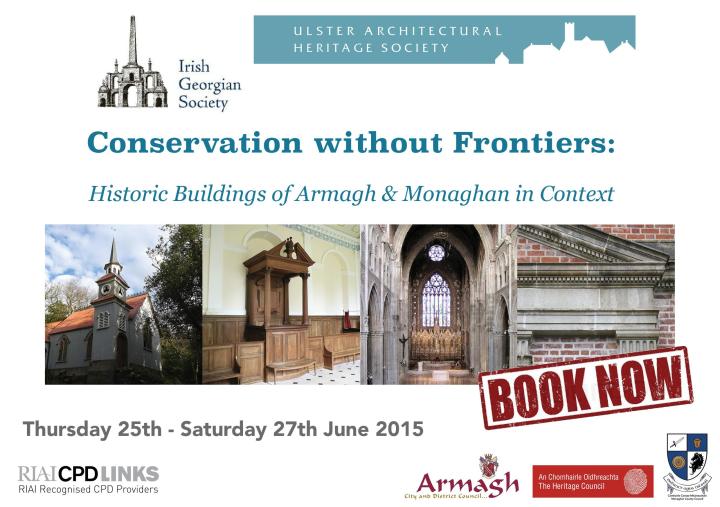
Conservation without Frontiers: Historic Buildings of Armagh and Monaghan in Context
Armagh and Monaghan, 25–27 June 2015
For the first time, the joint Ulster Architectural Heritage Society and Irish Georgian Society summer school will bring together students, enthusiasts and practitioners to explore, discuss and debate issues relating to our shared Irish heritage in the context of Armagh and Monaghan. A key theme of the event is conservation and regeneration for community benefit which will demonstrate the critical importance of built heritage in maintaining the distinctive qualities of the region and supporting the growth of tourism, economic development and prosperity. The summer school will provide a platform to showcase the best that both counties have to offer in terms of their history and heritage. Leaders will include well known academics, architectural historians, architects, planners, conservation and heritage officers. The support of both councils will also reinforce the positive developing relationship between them and our respective organisations. An Eventbrite payment has been set up to facilitate online bookings in euro or sterling. The summer school director is Kevin V. Mulligan, author of The Buildings of Ireland: South Ulster.
◊ ◊ ◊ ◊ ◊
T H U R S D A Y , 2 5 J U N E 2 0 1 5
Armagh
• Conservation Areas — the legislation and implementation
• New work and reordering: current practice in England
• Tour of cathedrals with Alistair Rowan
• Tour of Mall and Market Square with Alastair Coey
• Presentation on the work of Thomas Cooley and Francis Johnston by Judith Hill at Armagh Public Library
• Tour of Palace Demesne with Edward McParland
Speakers: Patrick Duffy, Michael O’Neill, Frederick O’Dwyer, Andrew Derrick, Marcus Patton
F R I D A Y , 2 6 J U N E 2 0 1 5
Monaghan
• Tour of Castle Leslie
• Introduction to heritage and housing
• Discussion on cross border heritage initiatives
• The Buildings of Ireland Series
• Tour of Glaslough
• Visit Lady Anne Dawson Mausoleum, Dartrey, St. Peter’s Church, Laragh and St. Macartan’s Cathedral, Monaghan
• Walking tour of Monaghan with Kevin Mulligan
• Discussion and debate at Market House, Monaghan
Speakers: Dawson Stelfox, Andrew McClelland, Alistair Rowan, Bishop Joseph Duffy
S A T U R D A Y , 2 7 J U N E 2 0 1 5
Annaghmakerrig
• Tour of Annaghmakerrig House
• Debate: Contemplating the Contemporary — Modernist vs. traditional approach to building in the historic environment in the 21st century, chaired by Frank McNally with speakers Aidan McGrath, Liam Mulligan, Nicholas Groves-Raines
• Results and viewing of student competition
• Presentation of Summer School Student Awards
• Conclusion with celebratory lunch
This course is approved for CPD by the Royal Institute of Architects of Ireland; the programme is subject to change.
Georeferencing the British Library’s Map Collection
◊ ◊ ◊ ◊ ◊
A recent posting at at the British Library’s Maps and Views blog (25 March 2015) describes the latest phase of the project to georeference the BL’s map collection. As a crowdsourcing project, it’s fascinating. And even if you’re not interested in contributing your time, there are lots of resources already available (to search for maps previously georeferenced, use the map portal Old Maps Online, which searches across numerous online map collections, including the British Library). The video below provides an effective introduction to the basic concept of georeferencing. –CH
◊ ◊ ◊ ◊ ◊
From the BL’s Georeference Home:
Help! British Library needs 50,000+ maps georeferenced
 You can join the latest phase of our project, which features over 50,000 more maps from the British Library collections. Help us identify accurate locations for these historic maps! Bear in mind that some places have changed significantly or disappeared completely, creating a puzzle that reveals an exciting contrast.
Your name will be credited, and your efforts will significantly improve public access to these collections. Contributors can see the results of their work, as well as the progress of the pilot and other participants, and the top contributor will be publicly announced.
Sotheby’s Institute of Art | European Decorative Arts, 1600–1900

◊ ◊ ◊ ◊ ◊
From Sotheby’s Institute of Art:
Summer Study in London | European Decorative Arts: From Baroque to Art Nouveau
Sotheby’s Institute of Art, London, 26 May — 19 June 2015
Sotheby’s Institute of Art’s Summer Study programme offers intensive short courses in areas of art business, art history and finance. The programme is designed for undergraduates, career changers, study abroad participants and those interested in art and cultural history. This summer the Institute is offering a four-week intensive and immersive European Decorative Art course.
Beginning in the seventeenth century with the rise of the Baroque and culminating in Art Nouveau at the end of the nineteenth, this varied and exciting course provides a comprehensive understanding of key stylistic developments in Western European design and the decorative arts. The course focuses on furniture, ceramics, glass and metalwork, explored within the context of architecture and interiors and the broader historical and cultural forces that have influenced the production and consumption of decorative art objects. It seeks also to provide students with a basic knowledge of materials and techniques.
A diverse programme of lectures is complemented by visits to leading museums, galleries and historic houses. Students will make a private visit to Sotheby’s Warehouse, to see art objects consigned for sale and learn about the auction process, and will also have the opportunity to visit the Olympia International Art and Antiques Fair. The teaching approach is object-based and enables students to gain confidence in analyzing and identifying a wide range of art objects. Students are taught by a range of in-house tutors and visiting experts from the art world; the course is led by Jane Gardiner and Helena Pickup. For a single course, the fee is £2,650.
Suggested Reading
Gere, C. and M. Whiteway. Nineteenth-Century Design from Pugin to Mackintosh. 1993.
Riley, N. (ed.). The Elements of Design. 2003.
Snodin, M. and J. Styles (eds.). Design and the Decorative Arts: Georgian Britain, 1714–1837. 2004.
Thornton, Peter. Seventeenth-Century Interior Decoration in England, France and Holland. 1981.
Newly Formed ANZSECS
Australian and New Zealand Society for Eighteenth-Century Studies

Jean-Baptiste Joseph Pater, The Fair at Bezons, ca. 1733 (New York: Metroplitan Museum of Art)
The newly formed Australian and New Zealand Society for Eighteenth-Century Studies (ANZSECS) exists to promote the study of the culture and history of the long eighteenth century within Australia and New Zealand. The Society encourages research in eighteenth-century studies on a broad interdisciplinary basis—its members work in fields including art history, history, literature, philosophy, bibliography, and the history and philosophy of science. It is an affiliate of ISECS, the International Congress for Eighteenth-Century Studies.
Established in December 2014, the Society draws on a distinguished history of eighteenth-century scholarship in Australia and New Zealand. It advances the exchange of information and ideas among researchers engaged in eighteenth-century studies through various activities and events, including the 3–4 yearly David Nichol Smith Seminar. For more information about the Society, membership, and related events, please visit our website.
University of Buckingham’s MA in Decorative Arts and Historic Interiors
From The University of Buckingham:
MA in Decorative Arts and Historic Interiors
The University of Buckingham (based in London)
This unique MA in French and British Decorative Arts and Interiors focuses on the development of interiors and decorative arts in England and France in the long eighteenth century (c.1660–c.1830) and their subsequent reinterpretation in the nineteenth and twentieth centuries.
A key element of the course is the emphasis on the first-hand study of furniture, silver and ceramics in the context of historic interiors. Based in central London at the Society of Antiquaries, it is taught by the University of Buckingham, with contributions from leading international experts. It draws on the outstanding decorative arts collections of the Wallace Collection and the Victoria and Albert Museum with study trips to many other museum and historic house collections in and around London.
We are now recruiting for the new academic year and the course can be taken full-time or part-time.
For details of entry requirements, tuition fees, funding opportunities, detailed information about assessment English language requirements, disability, accommodation and how to apply, please consult the University webpages or contact Claire Prendergast: Claire.prendergast@buckingham.ac.uk.










leave a comment