Seminar | The Uses of Antiquity in European Art, 1300–1800
The following announcement may be of interest for full-time faculty who regularly teach art history at institutions affiliated with the Council of Independent College (there are over 600 member schools). While addressing the eighteenth century, the seminar will focus on previous periods; I imagine it’s ideally suited for dix-huitièmistes who find themselves teaching late medieval and Renaissance courses. Up to 20 individuals will be selected. Details are available from the brochure. -CH
◊ ◊ ◊ ◊ ◊
The Uses of Antiquity: A Seminar on Teaching Pre-Modern European Art in Context
Smart Museum of Art, University of Chicago, 13–18 July 2014
Nominations due by 2 December 2013
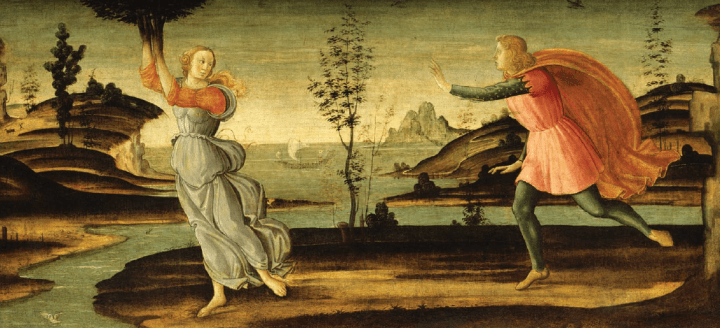
Daphne Fleeing from Apollo, ca. 1500
(Chicago: Smart Museum of Art)
◊ ◊ ◊ ◊ ◊
This seminar will be led by Rebecca Zorach, professor of art history and the college at the University of Chicago, and will be held at the University of Chicago’s Smart Museum of Art. It will take as its starting point European objects spanning the years 1300–1800 at the Smart Museum and participants will have the chance to examine prints and rare printed books in the Regenstein Library’s Special Collections Research Center, principally the very large collection of the Speculum Romanae Magnificentiae and related prints after Roman monuments and antiquities, considering the role of prints, books, and other small objects in disseminating and popularizing classical styles and imagery. Moving beyond the European early modern period, the seminar also will visit other local sites—the Oriental Institute, campus and neighborhood murals, and buildings such as the nearby Museum of Science and Industry—to think about how participants can use their own local resources creatively to discuss with students ways in which artists, architects, patrons, and others have understood and reinterpreted the past. The seminar will examine recent and older scholarship on the uses of the past and draw on the expertise and teaching experience of participants. For many of our students, differences between an ancient Greek temple and a Renaissance church (or a 19th-century Beaux-Arts museum, for that matter) barely register. But the benefits of teasing out the nuances of
references and associations go beyond awareness of the chronology of style. Pedagogical discussions will address close looking, the relationship of texts to objects, and ways faculty members can help students think critically about the texture of history and the practices and decisions of artists.
 Zorach teaches late medieval and Renaissance art, primarily French and Italian; gender studies and critical theory; print culture and technology; and contemporary activist art. Her books include The Passionate Triangle (2011) and Blood, Milk, Ink, Gold: Abundance and Excess in the French Renaissance (which received the Society for the Study of Early Modern Women 2005 Book Award), both published by the University of Chicago Press. In addition, she has created catalogues for several exhibitions, including The Virtual Tourist in Renaissance Rome: Printing and Collecting the Speculum Romanae Magnificentiae produced in conjunction with The Speculum Romanae Magnificentiae Digital Collection, and Paper Museums: The Reproductive Print in Europe 1500–1800, co-edited with Elizabeth Rodini.
2013 Attingham Course: French Eighteenth-Century Studies
From The Attingham Trust:
Attingham Course: French Eighteenth-Century Studies
The Wallace Collection, London, 14–18 October 2013
Applications due by 12 July 2013

◊ ◊ ◊ ◊ ◊
French Eighteenth-Century Studies is a new course organised by The Attingham Trust on behalf of the Wallace Collection. Based at Hertford House, this intensive, non-residential study programme aims to foster a deeper knowledge and understanding of French eighteenth-century fine and decorative art and is intended primarily to aid professional development. A day at Waddesdon Manor, Ferdinand de Rothschild’s former country house, will help broaden the scope of the course still further.
The academic programme will provide privileged access to the world-class collections of furniture, paintings, sculpture, textiles, metalwork and porcelain in these two collections. The group will be limited to fifteen people to allow for detailed, object-based study, handling sessions and a look at behind-the-scenes conservation.
Study sessions and lectures will be led by Dr. Christoph Vogtherr, Director of the Wallace Collection, and the relevant curatorial staff; other international authorities and the curators at Waddesdon will provide further specialist teaching. The Course Director is Dr. Helen Jacobsen, Curator of French eighteenth-century Decorative Arts at the Wallace Collection.
Trying to Think Seriously about Pinterest, Part 2
From the Editor
Open Position: Clerk of the Pinterest Boards

Silivered brass pins, 1620-1800 (London: V&A Museum, given by R. J. Andrews, #123D-1900) Pinned to Cheryl Leigh’s Pinterest Board, 18th-Century Accessories
Last May I invited Enfilade readers to consider how Pinterest might be put to better use for scholars of the eighteenth century. Over the past few months, I’ve grown even more bullish, optimistic about the potential utility of pinning images with texts (organized under headings) and then distributing those pins via a social network (recent stats for Pinterest usage are available here). Pinterest Business accounts were launched in November, and while these may not be precisely the model for establishing scholarly credibility, the offering suggests Pinterest may slowly be growing up. If art historians are well placed to say what’s wrong with most of what happens on Pinterest, it seems to me we might also start contributing models for making a tool like this work better.
For all of these reasons, I’m now accepting applications for a volunteer position I’ve dubbed Clerk of the Pinterest Boards. I’m especially interested in exploring the following problems:
• How and to what extent might Pinterest be used in the production of knowledge, particularly in terms of collecting information (visual and textual information) and presenting that information together?
• How can we make a Pinterest board into something more than merely a collection of ‘pretty’ pictures?
• Are there things Pinterest could do that other digital formats (blogs, Twitter, Facebook, &c.) don’t do or don’t do well?
• How might we increase broad interest in the art and architecture of the eighteenth century via Pinterest?
I’m envisioning this position as extremely flexible and open-ended. As an experiment, it should probably run for at least a year, but the amount of work should be minimal to modest, perhaps an hour or two each week. For the best candidates, you’re probably already spending this much time on exactly the kinds of searches the positions would require; I just need you to start pinning those results and giving some thought to larger questions of organization and goals.
To apply, please send a message of interest and a recent CV to me at CraigAshleyHanson@gmail.com. As always, comments and feedback are welcome.
— Craig Hanson
P.S. — If this talk of pins brings to mind Adam Smith’s example of a “trifling manufacture,” all the better; you’re in the right place.
New HGCEA Emerging Scholar Publication Prize
HGCEA Emerging Scholar Publication Prize
Nominations due by 14 December 2012
The Historians of German and Central European Art (HGCEA), an affiliated society of CAA, announces a new Emerging Scholar Publication Prize. The Prize will be awarded annually to a distinguished essay published the previous year by an emerging scholar. Submissions may be on any topic in the history of German or Central European art, architecture, design or visual culture. This year, essays published in 2011 and 2012 will be considered; submissions will be accepted from current PhD students and from those who earned a PhD in or after 2007. The recipient of the Prize, which will be announced at CAA and comes with an award of $500, must be a current member of HGCEA. Nominations and self-nominations are welcome; the deadline for submissions (the publication and a CV) by electronic attachment to the HGCEA president, Marsha Morton at mortonmarsha10@gmail.com, is December 14, 2012.
Applying for a Clark Fellowship
From the Clark:
Clark Fellowships
Applications due by 15 October 2012
 The Sterling and Francine Clark Art Institute combines a public art museum with a complex of research and academic programs, including a major art history library. The Clark is an international center for discussion on the nature of art and its history.
The Clark offers between fifteen and twenty Clark Fellowships each year, ranging in duration from six weeks to ten months. National and international scholars, critics, and museum professionals are welcome to propose projects that extend and enhance the understanding of the visual arts and their role in culture. Stipends are dependent on salary and sabbatical replacement needs. Housing in the Institute’s Scholars’ Residence, located across the street from the Clark, is also provided. Fellows are furnished with offices in the library, which contains a collection of 200,000 books and 700 periodicals. The Institute’s collections, its library, visual resources collection, and the Fellows’ program are housed together with the Williams College Graduate Program in the History of Art. The Clark is within walking distance of Williams College, its libraries, and its art museum. The Massachusetts Museum of Contemporary Art (MASS MoCA) is a ten-minute drive away.
Candidates must already have a Ph.D. or equivalent professional experience. The Clark does not award pre-doctoral fellowships, and given the intense competition for fellowships, we do not normally make awards to those who have received their Ph.D. within the last four years.
A number of special fellowships are also offered, as seen here»
Call for Applications | Getty 2013-14: Connecting Seas
From the Getty:
Getty Scholars Program — Connecting Seas: Cultural and Artistic Exchange
Getty Research Institute, Los Angeles, 2013-14
Applications due by 1 November 2012
 Water has long been a significant means for the movement of goods and people. Sophisticated networks, at a variety of scales, were established in antiquity around the Mediterranean and the Black Seas, and later in the Atlantic, Indian, and Pacific Oceans. Together with sporadic and accidental encounters, these networks fostered commerce in raw materials and finished objects, along with the exchange of ideas and cultural concepts. Far from being barriers, seas and oceans were vital links connecting cultures. The 2013–2014 academic year at the Getty Research Institute and Getty Villa will be devoted to exploring the art-historical impact of maritime transport.
How has the desire for specific commodities from overseas shaped social, political, and religious institutions? How has the introduction of foreign materials and ideas transformed local artistic traditions, and what novel forms and practices have developed from trade and other exchanges, both systematic and informal? What role do the objects born of these interactions have in enhancing cultural understandings or perpetuating misunderstandings? How has the rapidly accelerating pace of exchange in recent years influenced cross-cultural developments? The goal of this research theme is to explore how bodies of water have served, and continue to facilitate, a rich and complex interchange in the visual arts.
The Getty Research Institute and the Getty Villa invite proposals focusing on artistic exchange and the transmission of knowledge across bodies of water from ancient times to the present day. Scholars actively engaged in studying the role of artists, patrons, priests, merchants, and explorers in oceanic exchange are encouraged to apply, and projects focusing on the Pacific are particularly welcome.
Internship | NPG in London
As noted at BARS:
Internship at the National Portrait Gallery, London
Applications due by 12 August 2012
The National Portrait Gallery is seeking to appoint an intern for six months with a proven interest in portraiture to gain experience in general curatorial work and research across a number of projects. The main focus of the internship will be on the 18th-Century Collections but an interest in the portraiture of other periods is desirable. Tasks may include answering public enquiries, scoping out ideas for the annual redisplay of Regency miniatures, research towards a forthcoming display on World War Two and the RAF at Beningbrough Hall, Yorkshire and research support towards an academic study of portrait print collecting and extra-illustration in eighteenth-century Britain. As a large part of the internship will involve research in libraries and archives in London, it would be an advantage to have completed an MA or be engaged in a programme of PhD study. The intern will be supervised by the 18th Century Curator and Assistant Curator, 18th Century.
Hours: 1 day (8 hours) per week for six months to be agreed with the curator
Travel Expenses: Travel costs of up to ten pounds (£10) per week can be claimed
Ideally we would like candidates to be available for a 6-month period.
Qualifications and Experience
• Good general knowledge of British art history and/or history
• A proven interest in the eighteenth century and a reasonable understanding of portraiture as a genre
• The internship would ideally suit those candidates who have completed an Art History or History MA or are engaged in a programme of PhD study who have an interest in pursuing museum work
Skills and Attributes
• Ideal candidates will need to have a flexible approach and be prepared to contribute to a number of different projects
• Candidates will also need to be able to demonstrate a careful approach and attention to detail
• Excellent written English is an essential requirement
Please send your CV and a covering letter either by e-mailing: curatorialoffice@npg.org.uk or by writing to: Emily Burns, Curatorial Office, National Portrait Gallery, 2 St Martin’s Place, London WC2H 0HE. Closing date for returned applications: 9.00am Monday, 13 August 2012. Interviews will take place in the week beginning 20 August 2012.
CAA International Travel Grant Program for 2013
International Travel Grant Program for the 2013 CAA Conference
New York, 11-16 February 2013
Applications due by 15 August 2012
CAA invites individuals to apply to the International Travel Grant Program, generously supported by the Getty Foundation. This program provides funding to twenty art historians, museum curators, and artists who teach art history to attend the 101st Annual Conference, taking place February 13–16, 2013, in New York. The grant covers travel expenses, hotel accommodations, per diems, conference registrations, and one-year CAA memberships. For 2013, CAA will offer preconference meetings on February 11 and 12 for grant recipients to present and discuss their common professional interests and issues.
The goal of the program is to increase international participation in CAA and to diversify the organization’s membership (presently seventy-two countries are represented). CAA also wishes to familiarize international participants with the submission process for conference sessions and to expand their professional network in the visual arts. As they did last year, members of CAA’s International Committee and the National Committee for the History of Art have agreed to host the participants.
Are You Eligible? (more…)
Call for Nominations | Marc Raeff Book Prize
Marc Raeff Book Prize for Outstanding Work on Imperial Russia
Nominations due by 30 June 2012
The Eighteenth-Century Russian Studies Association, an affiliate organization of the Association for Slavic, East European, and Eurasian Studies (ASEEES), is now accepting submissions for the second annual Marc Raeff Book Prize. The prize is awarded annually for a publication that is of exceptional merit and lasting significance for understanding Imperial Russia, particularly during the long eighteenth-century. The recipient of the award will be recognized with a cash prize, which will be presented in November 2012, during the ASEEES annual convention. The award is sponsored by the ECRSA and named in honor of Marc Raeff (1923-2008), historian, teacher, and dix–huitièmiste par excellence. (more…)
Edinburgh’s Master’s Program in Eighteenth-Century Cultures

Allan Ramsay, "Portrait of the Artist's Wife," 1754-55 (Edinburgh: National Gallery of Scotland)
The University of Edinburgh’s one-year Master’s program in Eighteenth-Century Cultures — the only program of its kind, based in the world’s first UNESCO City of Literature, and the capital city of the Scottish Enlightenment, that focuses on eighteenth-century culture from British, Continental, and transatlantic perspectives. Students work closely with an international team of scholars, curators, and archivists, to develop a solid yet innovative understanding of the cultural history of the eighteenth century. The program combines an on-site internship in one of Edinburgh’s world-class galleries or museums or archives with seminar-based academic training.
Students taking this programme work closely with a team of international experts in visual, material, literary, and social history, including scholars based in History, History of Art, Divinity, and Law. We collaborate with archivists and curators from National Museums Scotland, the National Galleries of Scotland, and other cultural repositories.
Our expertise covers British, European, and transatlantic approaches to this period. This programme provides students with a wide-ranging introduction to the cultural life of the eighteenth century, from a perspective befitting our location in Scotland’s capital. In addition to weekly seminars and research training, leading to a summer spent preparing their dissertations, students on this programme take an internship in one of Edinburgh’s world-class repositories of Europe’s cultural heritage. They develop skills in curatorship, archival management, conservation, restoration of architectural monuments and gardens, or engage in public history. Upon graduation, you will have gained the research and practical expertise in cultural history for a career within or beyond the scholarly world. You will also have had the unique opportunity to make a meaningful contribution to our understanding of cultural life in the eighteenth century.
For further details, click here:
http://bit.ly/xEGVsu










leave a comment