Call for Proposals | IDEAL Internship Grants, Decorative Arts Trust
From the press release:
IDEAL Internship Grants from the Decorative Arts Trust
Proposals due by 30 November 2021
The Decorative Arts Trust invites art museums, history museums, and historic sites to submit IDEAL Internship Grant proposals by 30 November 2021. The IDEAL Internship Initiative is part of the Trust’s growing Emerging Scholars Program. Non-profit institutions are eligible for IDEAL Internship Grants of up to $5,000.
IDEAL Internships focus on inclusivity, diversity, equity, access, and leadership. The Trust recognizes the homogeneity of the museum field and will strive to improve access to curatorial careers for students of color as a path toward achieving systemic change. In early 2021, the Trust awarded the inaugural IDEAL Internship Grants to the Atwater Kent Collection at Drexel University; The Historic New Orleans Collection and the Backstreet Cultural Museum; the Museum of Fine Arts, Boston; and the Newport Restoration Foundation and the Rhode Island Black Heritage Society. More information about IDEAL Internship Grants is available here.
The Decorative Arts Trust is a non-profit organization that promotes and fosters the appreciation and study of the decorative arts through: exchanging information through domestic and international programming; collaborating and partnering with museums and preservation organizations; and underwriting internships, research grants, and scholarships for graduate students and young professionals. Learn more about the Trust here or by contacting thetrust@decorativeartstrust.org.
Decorative Arts Trust Announces Recipients of IDEAL Internship Grants
Press release (9 March 2021) from The Decorative Arts Trust:

Samuel Whitehorne House (1811), Newport, Rhode Island. Newport Restoration Foundation bought the Federal period brick mansion in 1969. Five years later, it was opened as a public museum dedicated to 18th-century Newport furniture and related decorative arts.
The Decorative Arts Trust is pleased to announce that the Atwater Kent Collection at Drexel University; The Historic New Orleans Collection and the Backstreet Cultural Museum; the Museum of Fine Arts, Boston; and the Newport Restoration Foundation are the inaugural recipients of IDEAL Internship Grants.
Part of the Trust’s growing Emerging Scholars Program, IDEAL Internships focus on inclusivity, diversity, equity, access, and leadership. Internship grants are awarded to non-profit institutions and require a strong mentorship component.
“The Decorative Arts Trust is striving to improve access to curatorial careers for students of color as a path toward achieving systemic change,” Trust Executive Director Matthew Thurlow states. “These partners were selected based on the impact of the internship, which will offer students experience and stipends while providing the host organizations the opportunity to continue meaningful discussions about inclusion, diversity, and equity.”
Drexel University is stewarding the collection of the former Philadelphia History Museum at the Atwater Kent, which closed in 2018. Drexel’s Lenfest Center for Cultural Partnerships is conducting a multiyear evaluation of the Atwater Kent Collection of over 133,000 works of art and other objects. The intern will focus on exhibitions highlighting little-known objects for galleries at the Peck Alumni Center and the Pearlstein Gallery.
The Historic New Orleans Collection (THNOC), in partnership with the Backstreet Cultural Museum, seeks an intern to further the study and preservation of Mardi Gras Indian suits. The intern will catalog a newly acquired suit, document its history by interviewing the artist, plan a permanent storage solution, prepare the suit for display in an upcoming exhibition, and write an article for an online publication.
The Museum of Fine Arts, Boston intern will focus on a gallery reinstallation project that explores the connections between art, modern design, and jazz in the 1930s, 40s, and 50s. The intern will assist with object research, develop interpretive text, lead gallery tours, and host programs to engage a range of communities with the project.
The Newport Restoration Foundation will hire an intern to analyze their collection of 18th-century furniture at the Whitehorne House Museum. The intern will work with the interpretive staff to address the absences of African-Heritage craftspeople (both enslaved and free) as well as Narragansett peoples in Colonial-era Newport’s material culture.
The Decorative Arts Trust is a non-profit organization that promotes and fosters the appreciation and study of the decorative arts through exchanging information through domestic and international programming; collaborating and partnering with museums and preservation organizations; and underwriting internships, research grants, and scholarships for graduate students and young professionals. Learn more about the Trust at decorativeartstrust.org.
Call for Submissions | Horowitz Book Prize
From Bard Graduate Center:
The Mr. and Mrs. Raymond J. Horowitz Book Prize
For titles on the decorative arts or material culture of the Americas published in 2019 or 2020
Submissions must be postmarked by 1 April 2021
Bard Graduate Center welcomes submissions for the Mr. and Mrs. Raymond J. Horowitz Book Prize, awarded annually to the best book on the decorative arts, design history, or material culture of the Americas. The prize will reward scholarly excellence and commitment to cross-disciplinary conversation. Eligible titles include monographs, exhibition catalogues, and collections of essays in any language, published in print or in digital format. The winning author(s) or editor(s) will be chosen by a committee of Bard Graduate Center faculty and will be honored with a symposium on the subject of the book. Submissions must have a 2019 or 2020 publication date.
Three copies of each print title should be sent to the below address along with an entry submission form. For digital publications, please email a copy of the form along with a link to the publication and a PDF of the publication to horowitz.prize@bgc.bard.edu.
Horowitz Book Prize Committee
Bard Graduate Center
38 West 86th Street
New York, NY 10024
Submissions must be postmarked by 1 April 2021. There is no limit to the number of submissions, but please note we are unable to return items submitted for review. Incomplete submissions will not be considered. Shipping is the responsibility of the applicant and we are not able to confirm receipt of submissions. The winning title will be announced in late summer 2021. For questions, contact Laura Minsky, Associate Director of Research Programs, at horowitz.prize@bgc.bard.edu.
4th Annual Ricciardi Prize from Master Drawings
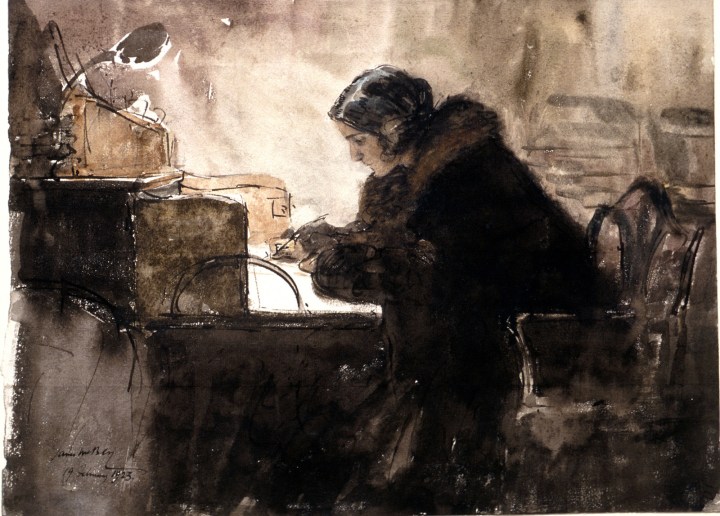
James Mcbey, Girl Writing A Letter, watercolor and pencil on paper (The Clark Art Institute, MA).
◊ ◊ ◊ ◊ ◊
From Master Drawings:
Fourth Annual Ricciardi Prize from Master Drawings
Submissions due by 15 November 2021
Master Drawings is seeking submissions by scholars under the age of 40 for our Fourth Annual Ricciardi Prize! The winning submission will be awarded $5,000, with a publication date in 2022. This year’s deadline is November 15, 2021. Remember, only essays on drawings topics will be considered. Finalists are also recognized with a prize and publication in the journal. You can read this year’s winning article in the June 2021 issue of Master Drawings. More information on how to apply is available here.
Grinling Gibbons Society Looks to Tercentenary in 2021
The joys of thinking about next year! This announcement from the Grinling Gibbons Society:
Grinling Gibbons Society: Carving a Place in History
The Grinling Gibbons Society is a newly-formed membership organisation and charity at the centre of planning the celebration of Grinling Gibbons’ tercentenary in 2021.
 The Gibbons 300 festival is a collaborative venture involving a wide network of museums, houses and collections, supported by the Mercers’ and Drapers’ Companies, architects, present-day carvers, designers, practitioners and individuals with an interest in Gibbons and his remarkable legacy. The festival will combine a programme of public events, creative projects, education, research, and collaborative scholarship between museums, collections, and institutions. A key part of the programme will be an important loan exhibition of Gibbons’ work from August 2021, which will also consider sculptors, carvers, and artists who have been inspired by his innovative genius across the passage of three hundred years, right up to the present day. Exploring the living legacy of Gibbons is a vital part of the exhibition’s purpose, as is engagement with contemporary practice, in furthering the Society’s objectives of outreach, education, and making links across the UK.
To this end, the Society is developing two education projects: a Traineeship in stone and wood-carving, enabling the exchange of skills and expertise from master carvers to emerging artists; and a National Award (linked to the exhibition) for emerging craftspeople and carvers, providing a prestigious platform for showcasing their work, with exposure to public and professional recognition and expert feedback.
The vision for the Society now goes well beyond 2021–22 and its aim is that it will provide an ongoing platform and focus for continued scholarship, education, and enjoyment of seventeenth- and eighteenth-century carving and sculpture, and the figures and associates around Gibbons who remain obscure in the field of study.
If you are interested in becoming a member of the Grinling Gibbons Society, being involved in the tercentenary programme, or in supporting us financially, we would be delighted to hear from you. Please email grinlinggibbonssociety@gmail.com for more information and a membership form.
We are also looking for a Membership Secretary and Treasurer. Both posts offer exciting opportunities for those with an interest in Gibbons and in furthering his legacy, or with a broader interest in the history of carving and sculpture, to be part of a new and ambitious Society. For more information please email grinlinggibbonssociety@gmail.com.
Hannah Phillip
Programme Director
Grinling Gibbons Tercentenary 2021
REGISTERED CHARITY 1190987
Walpole Library Pauses Visiting Fellowship and Travel Grant Program
The Lewis Walpole Library announces the temporary suspension of its Visiting Fellowship and Travel Grant program due to the pandemic.
The program has been postponed indefinitely, and we will not be accepting applications this year. We hope to be able to put out a call in the autumn of 2021 for applications with a deadline in January 2022 for Fellowships to be taken up between July 2022 and June 2023.
The Library is committed to ensuring that this postponement is temporary, and 2019–20 and 2020–21 Fellowship and Travel Grant award recipients who have not been able to come to the Library to take up their research know they will be accommodated when we are finally able to resume welcoming in-person residential non-Yale researchers.
Details of the Visiting Fellowship and Travel Grant program and information about application requirements are still on our website where we will post updates as we have them. Be sure to check the page from time to time to get the most current information.
We look forward to brighter days when we can restart our active Fellowship program. Please contact us at walpole@yale.edu with any questions.
Annibel Jenkins Prize in Performance and Theater Studies
Have you published an article on 18th-century performance studies or theater in the past two years? Consider submitting it for the Annibel Jenkins Prize in Performance and Theater Studies. From SEASECS:
Annibel Jenkins Prize in Performance and Theater Studies
Awarded under the auspices of SEASECS
Submissions due by 30 November 2020
In 2012, SEASECS established a prize in honor of its founding member, Annibel Jenkins. This biennial prize of $500 recognizes the best article in performance and theater studies published in a scholarly journal, annual, or collection. The Jenkins Prize will next be awarded at the 2021 SEASECS conference. Eligible publications for this award must have been published between 1 September 2018 and 31 August 2020. Authors must be members of SEASECS at the time of submission. Articles may be submitted by the author or by another member.
The deadline for submissions is 30 November 2020. Please send submissions as PDF files and address any queries about the prize to the Committee Chair, Diane Kelley, at dkelley@pugetsound.edu.
P A S T W I N N E R S
2019 Leah Benedict, “Impotence Made Public: Reading Sex on the Stage and in the Courtroom,” ELH 85 (Summer 2018): 441–69.
2018 Diana Solomon, “The Jolt of Jacobean Tragicomedy: Double Falsehood on the Eighteenth-Century English Stage,” in Revisiting Shakespeare’s Lost Play: Cardenio/Double Falsehood in the Eighteenth Century, edited by Deborah Payne (Palgrave, 2016).
2017 Terry F. Robinson, “Becoming Somebody: Refashioning the Body Politic in Mary Robinson’s Nobody,” Studies in Romanticism 55 (Summer 2016): 143–84.
2016 Heather McPherson, “Tragic Pallor and Siddons,” Eighteenth-Century Studies 48 (Summer 2015): 479–502.
2015 Daniel J. Ennis, “Christopher Smart, Mary Midnight and the Haymarket, 1755,” in Reading Christopher Smart in the 21st Century, edited by Min Wild and Noel Chevalier (Lewisburg: Bucknell University Press, 2013).
2014 Anne Greenfield, “D’Avenant’s Lady Macduff: Ideal Femininity and Subversive Politics,” Restoration 37 (Spring 2013): 39–60.
HECAA Pandemic Relief Fund, Give Today

Jean-Baptiste Lesueur (1749–1826), “Citoyennes de Paris faisant hommage de leurs bijoux à l’Assemblée Constituante, le 7 septembre 1789” (Citizens of Paris paying tribute with their jewels at the Constituent Assembly, 7 September 1789), gouache (Paris: musée Carnavalet).
◊ ◊ ◊ ◊ ◊
Historians of Eighteenth-Century Art and Architecture
Pandemic Relief Fund
Scholars of eighteenth-century art are facing unprecedented challenges this fall as we struggle to adjust to the realities of the global pandemic. The officers and board of Historians of Eighteenth-Century Art and Architecture (HECAA) have been working on developing resources to help our members cope with these challenges.
One thing is immediately clear — institutional funding for research is going to be in short supply this year. This is going to have the greatest impact on our graduate student and contingent faculty members. So our first priority was to create a new grant fund, and to raise and disburse money as quickly as possible to help our members.
HECAA has a proud tradition of supporting fellow members, especially emerging scholars. I experienced this personally as a graduate student — HECAA was my first intellectual home, and helped me imagine my career as a teacher and scholar. Every member of our board has a similar story. Will you join us in creating a Pandemic Relief Fund? Any and all gifts will help, but we’re going to set our sights high — let’s see if we can raise $4000 to award to applicants this fall.
Thanks in advance,
Amy Freund, President
with
Elizabeth Eager, Vice President
Amanda Strasik, Secretary
Monica Anke Hahn, Treasurer
Wendy Bellion, Board Member
Danielle Ezor, Board Member
Jessica Fripp, Board Member
Fellowships | Smithsonian American Art Museum, 2021–22
From SAAM:
Smithsonian American Art Museum Fellowships, 2021–2022
Applications due by 1 November 2020

The 2018–19 Smithsonian American Art Museum Fellows
The Smithsonian American Art Museum (SAAM) and its Renwick Gallery invite applications for research fellowships in the art and visual culture of the United States. Fellowships are residential and support full-time independent and dissertation research. SAAM is home to one of the largest and most inclusive collections of American art in the world. Housed in a National Historic Landmark building—shared with the National Portrait Gallery and the Archives of American Art—the museum is a short walk from other Smithsonian museums and libraries, the Library of Congress, the National Archives, and the National Gallery of Art. Regular lunchtime seminars, workshops, and symposia organized by SAAM’s Research and Scholars Center provide a forum for lively scholarly exchange and professional advancement.
The stipend for a one-year fellowship is $40,000 for predoctoral scholars and $55,000 for postdoctoral and senior scholars, with an allowance of up to $4,000 available for short research trips. Additional allowances may be provided to help with temporary relocation and the cost of health insurance. Senior-level recipients of the Terra Foundation Fellowships are eligible for an augmented stipend of $60,000 for the full year. The standard term of residency is twelve months, but terms as short as three months are available with prorated stipends. All fellowships must take place between June 1, 2021, and August 31, 2022. The Smithsonian Office of International Relations will assist with arranging J-1 exchange visas for fellowship recipients who require them.
November 1st is the application deadline. For a link to the application, general information, or research consultation visit AmericanArt.si.edu/fellowships or email SAAMFellowships@si.edu.
Write with Aphra: A Summer Writing Community
From ABO: Journal on Twitter:
Write with Aphra: A Summer Writing Community
22 June — August 2020
New research has made clear that accommodations for the covid-19 pandemic have had a negative impact on women scholars and their research productivity. With the added imperative to participate in protests demanding justice for black lives, for many the emotional and intellectual energy to write and research has been understandably low. Despite this reality, many universities have not extended tenure clocks or graduate student funding and contingent scholars continue to receive no additional support. For many of us, publishing is a necessity for career advancement.
As a feminist journal, we want to create a space to allow scholars who are struggling to find the support they need to publish so their careers are not further damaged by the many, many challenges of 2020. In a recent statement, the journal recommitted to its mission of publishing work that “interrogates and reveals the causes, histories, and narratives of the harmful intersections of patriarchy, sexism, racism, slavery, colonialism, and gender discrimination.” As a material way of engaging with this mission, we are committing editorial time to help foster scholarship in progress and a structure to improve its chances of timely publication.
Toward that end, this summer we invite you to a writing community called Write with Aphra that is focused on starting, progressing, or finishing a scholarly article. For eight weeks, we will send weekly emails with tips and accountability measures and offer the guidance and feedback of our editorial board with weekly drop-in ‘office hours’. These will be themed around certain kinds of drafts (scholarly article, pedagogy, digital humanities, etc.) and sessions for discussing different experiences (contingency, early career scholar, etc.).
Participants are asked to commit to the following minimum goals:
• Commit to writing about 500 words a week from June 22 to August 14 with the overall goal of 4,000 words
• Share your progress using the hashtag #writewithaphra on Twitter (if you use Twitter) or via our email list with weekly check-ins
• Attend, if able, a Zoom meeting on Tuesday, June 23 at 2.00pm EST where we will answer your questions and set goals together; there will be a midway meeting and a wrap-up meeting as well
• Attend, if able, at least one office hours session with an editor in the area you are working with and seek feedback on your work in progress; for a current list of section editors, see here.
All participants will be invited to submit to the journal, but you are not required to do so. ABO: Interactive Journal for Women in the Arts, 1640–1830 (ISSN 2157-7129) is an online open-access journal that serves as a forum for interactive scholarly discussion on all aspects of women in arts between 1640 and 1830, especially literature, visual arts, music, performance art, film criticism, and production arts. The journal features peer-reviewed articles encompassing subjects on a global range, with a global readership, and is intended for scholars and students. The journal comprises five departments: Scholarship; Pedagogy; Digital Humanities; Reviews; Notes and Discussions. Our editorial policies cultivate responsive, supportive academic work, highlighted by an open review process.
To join, sign up here»










 Enfilade
leave a comment