New Website for Yale Center for British Art
The new website for the Yale Center for British Art sets high the standard for digital art historical resources. The site features an online catalogue of the Center’s holdings, allowing seamless searching across the art collections and related library materials, AND publication-quality images of all art objects in the public domain are available for free downloading. As outlined in the press release below, more content will be added in the coming months. And what better way to draw attention to the new site, than an exhibition? -CH
Connections
Yale Center for British Art, New Haven, 20 May — 11 September 2011
Curated by Matthew Hargraves and and Imogen Hart
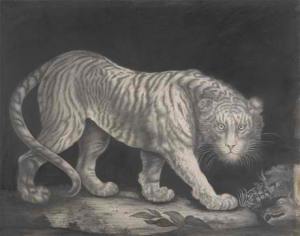
Elizabeth Pringle, "A Prowling Tiger," graphite, brushed black ink and white gouache, ca. 1800 (Yale Center for British Art)
To mark the launch of the YCBA’s online catalogue, Connections, a companion exhibition, replicates the experience of searching across the Center’s extraordinary collections. With more than two hundred paintings, sculptures, prints, drawings, rare books, and manuscripts from the early seventeenth to the early twentieth century, Connections presents familiar works as well as some surprises. Alongside popular collection highlights such as Rubens’s bravura oil sketch Peace Embracing Plenty will be rarely exhibited works, including outstanding prints and drawings by Thomas Gainsborough. The exhibition reveals the depth and breadth of material in the Center’s physical collections, which will now be accessible in a single searchable catalogue. Among the themes explored in the exhibition are: British Art in the 1630s; Hogarth and History; Sporting Art; the Academy and the Human Body; Egypt; British Modernism in the 1930s; Paul Sandby; George Stubbs; Thomas Gainsborough; and Samuel Palmer. The section devoted to George Stubbs (1724–1806) is representative of the exhibition in its span of different genres, as it showcases Stubbs’s extraordinary artistic range and some of the Center’s great treasures: paintings on canvas, copper, and earthenware; Wedgwood plaques and enamels; a selection of his technically innovative prints and drawings; anatomical studies; and books and manuscripts of midwifery and anatomy.
◊ ◊ ◊ ◊ ◊
Yale Center Offers Unprecedented Access to Largest Collection of British Art Outside the UK through New Online Catalogue

William Gilpin, leaves 33v–34r (with color chart laid in) from "Hints to form the taste & regulate ye judgment in sketching Landscape," manuscript, in pen and ink, with watercolor, ca. 1790 (Yale Center for British Art, Paul Mellon Collection)
Beginning May 20, the Yale Center for British Art, which houses the largest and most comprehensive collection of British art outside of the United Kingdom, will share its extraordinary holdings with the world through a new online catalogue. For the first time, visitors to the museum’s redesigned and expanded website—britishart.yale.edu—will have the ability to search across the Center’s entire collection of paintings, sculpture, prints, drawings, rare books, manuscripts, and works in the Reference Library. In addition, they will be able to download high-resolution images of objects in the public domain, free of charge. This new policy should transform scholarship in the field of British art by allowing universal access to the Center’s unparalleled collection. The launch of the Center’s online catalogue dovetails with Yale University’s recently announced “Open Access” policy, which will make high-quality digital images of Yale’s vast cultural heritage collections in the public domain openly and freely available. (more…)
London Shh . . . small historic houses
 Thanks to Alicia Weisberg-Roberts who draws our attention to London Shh. . . “a tiny museum association of tiny house museums, mostly Georgian in theme or fabric.” From the association’s website:
London Shh… is a collection of the city’s hidden-gems; small historic houses which tell the stories of fascinating and famous former residents. Tucked away down intriguing streets and alleys, off the beaten tourist track you will find some of the city’s best kept secrets. London Shh… formed in 2008 with a view to encourage more people to discover and enjoy these beautiful houses. To step through one of our front doors is to be transported back in time and experience first-hand the places which famous names from Freud to Franklin chose to call home. So come and visit us and get closer to the people whose innovations and actions changed the world we live in. All the houses are independent registered charities and generate their own income through exciting programmes of exhibitions, events and more.
◊ ◊ ◊ ◊ ◊
In addition to coordinating digital access for the properties, the association’s site also provides a single point of access for upcoming events. On May 19, for instance, at the Handel House Museum
Jennifer Bennett (baroque violin) and Dan Tidhar (harpsichord) will explore the evolution of the sonata in the 18th century starting with J.S. Bach via his son C.P.E. Bach and ending with Mozart.
And on May 23, at the Benjamin Franklin House,
Dr Allan, historian of the Royal Society of Arts (RSA) and Honorary President of the William Shipley Group for RSA History, will highlight the friendship between Franklin and RSA Founder William Shipley and his family. For over fifty years, Dr. Allan has lectured and written extensively on aspects of the Society’s history, including the Benjamin Franklin connection, and he remains involved in its affairs.
◊ ◊ ◊ ◊ ◊
The houses currently represented include:
- Freud Museum London
- Benjamin Franklin House
- Kelmscott House
- Dr Johnson’s House
- Handel House Museum
- Burgh House & Hampstead Museum
- Emery Walker House
- Wesley House
- Keats House
Opening this Weekend: Hepworth Wakefield Gallery in Yorkshire
The new Hepworth Wakefield Gallery opens this weekend (21 May 2010). As described at the museum’s website:
This stunning building, designed by the award-winning David Chipperfield Architects, will be a place to explore art, architecture and your imagination. With over 1,600 square metres of light-filled gallery spaces, The Hepworth Wakefield will be the largest purpose-built exhibition space outside London. The gallery will bring together work from Wakefield’s art collection, exhibitions by contemporary artists and rarely seen works by Barbara Hepworth, one of the 20th century’s most important artists who was born and grew up in Wakefield.

Other recent projects by David Chipperfield include the Turner Contemporary in Margate and renovations of the Neues Museum in Berlin and the St Louis Art Museum. While the twentieth-century collections are sure to be the focus of the Hepworth Wakefield’s opening, the Gott Collection is also finally getting its due:
An important attraction for visitors will be the rarely seen Gott Collection, gifted to the City’s art collection in 1930. The Gott Collection was assembled in the 19th century by John Gott (1830-1906), Vicar of Leeds and later Bishop of Truro, and his father William (1797-1863), a wool merchant. It was presented to Wakefield Art Gallery in 1930 by Frank Green, a Yorkshire industrialist and philanthropist. The bound 10-volume collection includes 1,200 images, consisting of 65 watercolours, 315 drawings, 749 prints (including hand-coloured prints and one albumen print) and 50 double-sided letterpress pages from a book. It is arguably the finest surviving collection in the region, with over 200 Yorkshire villages, towns and cities depicted within its pages. Through funding by the Esmée Fairbairn Foundation this unique resource including maps, topographical drawings and watercolours will be made publicly accessible. Collectively they show how Yorkshire has long been a place of artistic inspiration. . .
International Museum Day & European Night of Museums
Press release from the IMD:
International Museum Day – Museum and Memory: Objects Tell Your Story
18 May 2011
 On and around 18 May, museums worldwide will celebrate International Museum Day. Established in 1977 by the International Council of Museums, more than 30,000 museums in around 100 countries will hold special activities on this occasion. In 2011, the theme of International Museum Day is Museum and Memory. Through the objects they store, museums collect stories and convey the memory of our communities. These objects are the expressions of our natural and cultural heritage. Many of them are fragile, some endangered and they need special care and conservation. International Museum Day 2011 will be an occasion for visitors to discover and rediscover individual and collective memory. . . .
The conservation and transmission of collective memory is a preoccupation for other heritage players, beyond the museum community. For this reason, for the first time ever, the International Council of Museums has initiated close institutional partnerships with other organisations that feel concerned by these questions and share ICOM’s preoccupation for the preservation of memory: the UNESCO “Memory of the World” programme, the Co-ordinating council of Audiovisual Archives Associations (CCAAA), the International Council on Archives (ICA), the International Council on Monuments and Sites (ICOMOS) and the International Federation of Library Associations and Institutions (IFLA). In addition, ICOM will be a patron of the European Night of Museums on 14 May, 2011 for the first time since the event was launched. . . .
◊ ◊ ◊ ◊ ◊
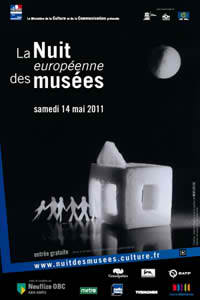 The European Night of Museums / La Nuit Européenne des Musées
14 May 2011
The European Night of Museums was created in 2005 by the French Ministry of Culture and Communication. During a late-night opening, visitors can discover, for free, museums’ collections and all the special events organised for the festival. The Night of Museums aims to make museums more accessible to the general public and in particular to a new younger public and to federate a network of European museums around a common festive and friendly event. In 2010, more than 3,000 European museums in 40 different countries participated in the Night of Museums.
Additional information is available here»
Raysor Print Collection Acquired by Richmond’s VMFA
This lovely show that just closed at the VMFA provided a tantalizing glimpse of a major new print collection recently donated to the museum. With a $150 million construction project completed last spring (a glowing review from Architectural Record is available here), the VMFA is now in the process of developing a first-rate study room for works on paper. Within the next year or so, the entirety of the Raysor Collection of 10,000 works should be relocated to its new home and the print room finished. Stay tuned. For anyone remotely near the museum, know that there is an outstanding new collection of prints in your area. Incidentally, I feel quite fortunate to have attended the big celebration gala at the beginning of last month(!), and I’m thrilled at the promise of the Raysor Collection. -CH
Art A Celebration of Print: 500 Years of Graphic Art
Virginia Museum of Fine Arts, Richmond, 29 January — 22 May 2011
Curated by Mitchell Merling
This exhibition celebrates the extraordinary gift of approximately 10,000 prints from the collection of collector, connoisseur, and scholar Frank Raysor, who grew up in Richmond. Over the past 35 years Raysor has amassed a collection which covers the history of printmaking, as seen in this exhibition, and which also contains special deep holdings in artists such as Charles Meryon, Félix Bracquemond, Seymour Haden and Wenceslaus Hollar. The collection will increase by one third the total number of objects in VMFA’s collection.
◊ ◊ ◊ ◊ ◊
Press release from the museum:
The Virginia Museum of Fine Art’s Collectors’ Circle named Richmond-raised Frank Raysor ‘Collector of the Year’ at a gala on Saturday, 2 April 2011. During the evening’s celebration, VMFA Director Alex Nyerges announced Raysor’s plans to bequeath more than $3 million to the museum. Raysor already has promised VMFA a gift of 10,000 prints that he has amassed throughout the past 35 years. In recognition of this unprecedented gift, the museum’s previous library is being named the “Frank Raysor Center for the Study of Works on Paper.” The center will house more than 15,000 works on paper and will provide the space and resources needed for the study of the history of western print-making, among other subjects. The study center will open after a complete renovation and refurbishment of the existing space. The gifted prints cover the history of print-making, spanning the 15th century to present day, and are by both European and American artists. The works will increase the museum’s total number of objects by one-third.
“The Virginia Museum of Fine Arts’ relationship with Frank Raysor dates back to his childhood visits,” Nyerges said. “In the past we have benefitted from a number of antiquities, which he donated in the early 1990’s. His rich and fascinating collection of prints is a gift for all Virginians.”
As Collector of the Year, Raysor joins a group of distinguished donors and museum supporters. Past recipients include: Linda H. Kaufman, Jane Joel Knox, Mrs. Nelson L. St. Clair, Jr., Robert and Nancy Nooter, Paul Mellon, Jerome and Rita Gans, Arnold L. Lehman and Nelson A. Rockefeller.
Raysor grew up in Richmond, attending Thomas Jefferson High School, before going on to Duke University and Harvard Business School. He has loaned works from his collection to special exhibitions at the Albuquerque Museum, the Yale Center for British Art and the J. Paul Getty Museum. In 1982, Raysor guest-curated a small exhibition at VMFA of 18th-century prints with classical subjects drawn from his collection in conjunction with the museum’s internationally important exhibition, Vases from Magna Graecia. In addition to his collecting, Raysor has made important contributions to print scholarship, including his collaboration on the catalogue raisonné of the works of Charles Meryon.
St Paul’s in HD — Just Like Being There?
This panoramic view of St. Paul’s in London is extraordinary. I’ve excerpted below the marketing copy from the company’s website. Quite apart from the quality of the image, it’s interesting to see this latest installation in the rhetoric of the real: it’s “just like actually being there” along with requisite exclamation marks!!! Click on the photo to view the interior images. From Spherical Images:
 A London-based virtual tour company, Spherical Images provide HD quality virtual tours by photographing your venue using ground breaking technology – allowing you to bring your venue to the customer with unparalleled impact and quality. . . .
SPHERICAL IMAGES HD VIRTUAL TOURS BRING YOUR VENUE TO THE CUSTOMER IN UNRIVALLED DETAIL
They won’t just get an impression of your Venue, they will see what it is actually like to be there. This means they can plan an event and see the true potential and beauty of your Venue. Our Virtual Tours are shot using cutting edge photography techniques such as High Dynamic Range (HDR) and exposure blending to give you a full screen HD experience that is just like actually being there! Virtual Tours are becoming an essential tool for showing Venues online. Make your website convert by showing customers what you have.
ST PAUL’S CATHEDRAL 15.5 GIGA PIXEL PANORAMA (GIGAPAN)
One of the largest indoor photographs ever taken: 2,400 images stitched together to make a 15.5 Giga Pixel panorama. It took 3.5 hours to shoot – during which time the cathedral had completely filled up with tourists – hence the ‘half people’, floating heads etc! . . .
At EMOB: Free Trial of Gale Cengage’s British Literary MSS Online
As noted at Early Modern Online Bibliography (10 April 2011) . . .
◊ ◊ ◊ ◊ ◊
For the next three weeks, emob readers can explore Gale Cengage’s British Literary Manuscripts Online for free. The database contains facsimile images of manuscripts digitized from microfilm. Though the texts themselves cannot be searched, their metadata can be. Authors can also be browsed alphabetically. The resolution is good, and legibility can be enhanced through digital magnification and brightness and contrast controls. Line tools and highlighting tools allow for digital annotation.
The product consists of two parts, both of which are included in the free trial: part one includes Medieval and Renaissance manuscripts; part two includes manuscripts written between 1660-1900.
On the database’s home page, the following links to online tutorials help with basic paleography. . . .
◊ ◊ ◊ ◊ ◊
The full posting at EMOB along with the link for free access is available here»
How I wish, incidentally, I had had access to the paleography tutorials before my first forays into manuscript research! These alone make the posting worth visiting (exploring the other offerings will, for me, have to wait until the weekend). Warm thanks to Anna Battigelli and Eleanor Shevlin for sharing news of the free trial with Enfilade readers. -CAH
Art History Publication Initiative for First Books
Art History Publication Initiative
A multi-press collaboration to create new publishing opportunities for scholars of art history
 This exciting new publishing opportunity offers art historians seeking publication of their first book the chance to be part of a groundbreaking collaborative publishing project. Authors whose books are selected for inclusion in AHPI will find many benefits, including:
• Financial assistance and guidance in acquiring and securing permission for illustrations
• Publication in both print and electronic editions
• A shared website hosting additional electronic enhancements to the book, including but not limited to audio, video, illustrative material, animation, and podcasts
• A strong marketing program including both print and digital
advertising (more…)
Pockets in the Eighteenth Century
Pockets of History
A Database Funded by the Arts and Humanities Research Council and the University of Southampton

Pair of embroidered pockets, mid-eighteenth century, (Halifax: Bankfield Museum)
It’s a commonplace, by now, but one of the remarkable things about the virtual world is the way one bit of familiar terrain quickly leads to who new sites. In an interesting enough posting at The Art History Newsletter, Jeremy Miller provides cases of peer-reviewed online journals and asks how they will come to fit into the established body of scholarly venues. One of the examples he cites is Worn Through, which addresses “apparel from an academic perspective.” After a small bit of exploring, I was impressed with the credentials of the contributors and the site’s two interns (an idea for Enfilade?), though I saw little evidence of peer-reviewed articles. Regardless, it is a fascinating site for anyone interested in
serious engagement with fashion and clothing.
More to the point for Enfilade readers, Heather Vaughan in a posting from November of 2009 addresses eighteenth-century clothing, including then current exhibitions related to the topic. Toward the end of the posting, she notes that “the University of Southampton has put together a database of 17th-20th century tie-on pockets. The collection not only includes beautifully embroidered pockets, but also historic fashion dolls (whose costumes included pockets).” And what a wonderful database it is! Here’s the beginning of the description from the Southampton site itself:
The Pockets of History collection contains new digital photographs of over three hundred tie-on pockets of the 1700 and 1800s, with overviews and close-ups of details. The photographs come from the first survey ever made of women’s tie-on pockets surviving in Britain. Very few have been photographed before.
In addition to example of pockets, there are various supporting images that picture pockets. In addition, Barbara Burman and Seth Denbo supply a “History of Tie-on Pockets” (PDF).
-CAH
Online Journal: ‘Vivante Drawings’
Featured Digital Resource: Vivante Drawings
Vivante Drawings addresses a broad range of issues relevant to early modern drawings generally, but there’s a lot here for the dix-huitièmiste. The following description comes from the site:
◊ ◊ ◊ ◊ ◊
 Vivante Drawings is an online journal. Its purpose is to provide information on the nature and history of drawings and to address the question: just what is it that makes drawings so appealing, so attractive?
Lucy Vivante, editor, first learned about prints and drawings in a seminar taught by Christiane Andersson at Columbia University. Soon after graduating from Barnard
College she went to work as a curator for Ian Woodner. She stayed with the Ian Woodner Family Foundation for three years. In the 90s she and Michael Miller sold drawings as private dealers based in New York City. The Louvre, British Museum, and National Gallery of Art, Washington were some of their clients. From 2000 to 2008 Lucy worked at The Bank of New York as a vice president in the bank’s philanthropy department. In September 2008 she moved to Italy where she is writing pieces for The Berkshire Review for the Arts and volunteering, through the Università della Tuscia, at an archive in Tarquinia.
◊ ◊ ◊ ◊ ◊
For a sample of a posting that stretches from the Renaissance to the eighteenth century, see “Silhouetted and Silhouettes,” from 22 August 2010:
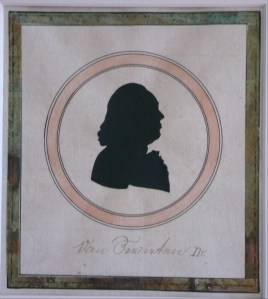
Anonymous, "Profile Bust of Dr. Gerard Van Sweiten," Black paper silhouette mounted on cream paper (Private Collection: image from Vivante Drawings)
Long before Etienne de Silhouette (1709-67), whose name was appropriated for black cut-out images, collectors were snipping the outlines of drawings. . . . Drawings weren’t the only snipped works. Medieval manuscripts have been clipped, even for making lampshades. Starting in the early 18th century prints were trimmed, glued to furniture and decorative objects, then varnished, creating the look of lacquered items. Sometimes the prints were made on purpose to be cut out for decorative projects. The descriptive word decoupage was the name for it and the leisure class took it up as a pass time–crafting for fun. . . . Etienne de Silhouette, the budget-minded Controller General of France’s Finances (1759) was known for cost cutting, to the point of calling for pocketless trousers. His name became associated with frugality and “à la silhouette” meant something that was no-frills. The cut-outs, generally portraits, were first known as “portraits à la silhouette,” then simply as silhouetttes. The big difference is that blank paper was used. This example just below [to the right] is by an anonymous cutter and is of Gerard van Swieten (1700-72), the personal doctor of Maria Theresa (1717-80), an important figure in developing the University of Vienna’s Medical School and a debunker of belief in vampires. . . .
The full posting is available here»










 Enfilade
leave a comment