Art History Publication Initiative for First Books
Art History Publication Initiative
A multi-press collaboration to create new publishing opportunities for scholars of art history
 This exciting new publishing opportunity offers art historians seeking publication of their first book the chance to be part of a groundbreaking collaborative publishing project. Authors whose books are selected for inclusion in AHPI will find many benefits, including:
• Financial assistance and guidance in acquiring and securing permission for illustrations
• Publication in both print and electronic editions
• A shared website hosting additional electronic enhancements to the book, including but not limited to audio, video, illustrative material, animation, and podcasts
• A strong marketing program including both print and digital
advertising (more…)
Pockets in the Eighteenth Century
Pockets of History
A Database Funded by the Arts and Humanities Research Council and the University of Southampton

Pair of embroidered pockets, mid-eighteenth century, (Halifax: Bankfield Museum)
It’s a commonplace, by now, but one of the remarkable things about the virtual world is the way one bit of familiar terrain quickly leads to who new sites. In an interesting enough posting at The Art History Newsletter, Jeremy Miller provides cases of peer-reviewed online journals and asks how they will come to fit into the established body of scholarly venues. One of the examples he cites is Worn Through, which addresses “apparel from an academic perspective.” After a small bit of exploring, I was impressed with the credentials of the contributors and the site’s two interns (an idea for Enfilade?), though I saw little evidence of peer-reviewed articles. Regardless, it is a fascinating site for anyone interested in
serious engagement with fashion and clothing.
More to the point for Enfilade readers, Heather Vaughan in a posting from November of 2009 addresses eighteenth-century clothing, including then current exhibitions related to the topic. Toward the end of the posting, she notes that “the University of Southampton has put together a database of 17th-20th century tie-on pockets. The collection not only includes beautifully embroidered pockets, but also historic fashion dolls (whose costumes included pockets).” And what a wonderful database it is! Here’s the beginning of the description from the Southampton site itself:
The Pockets of History collection contains new digital photographs of over three hundred tie-on pockets of the 1700 and 1800s, with overviews and close-ups of details. The photographs come from the first survey ever made of women’s tie-on pockets surviving in Britain. Very few have been photographed before.
In addition to example of pockets, there are various supporting images that picture pockets. In addition, Barbara Burman and Seth Denbo supply a “History of Tie-on Pockets” (PDF).
-CAH
Online Journal: ‘Vivante Drawings’
Featured Digital Resource: Vivante Drawings
Vivante Drawings addresses a broad range of issues relevant to early modern drawings generally, but there’s a lot here for the dix-huitièmiste. The following description comes from the site:
◊ ◊ ◊ ◊ ◊
 Vivante Drawings is an online journal. Its purpose is to provide information on the nature and history of drawings and to address the question: just what is it that makes drawings so appealing, so attractive?
Lucy Vivante, editor, first learned about prints and drawings in a seminar taught by Christiane Andersson at Columbia University. Soon after graduating from Barnard
College she went to work as a curator for Ian Woodner. She stayed with the Ian Woodner Family Foundation for three years. In the 90s she and Michael Miller sold drawings as private dealers based in New York City. The Louvre, British Museum, and National Gallery of Art, Washington were some of their clients. From 2000 to 2008 Lucy worked at The Bank of New York as a vice president in the bank’s philanthropy department. In September 2008 she moved to Italy where she is writing pieces for The Berkshire Review for the Arts and volunteering, through the Università della Tuscia, at an archive in Tarquinia.
◊ ◊ ◊ ◊ ◊
For a sample of a posting that stretches from the Renaissance to the eighteenth century, see “Silhouetted and Silhouettes,” from 22 August 2010:
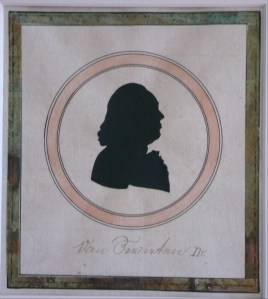
Anonymous, "Profile Bust of Dr. Gerard Van Sweiten," Black paper silhouette mounted on cream paper (Private Collection: image from Vivante Drawings)
Long before Etienne de Silhouette (1709-67), whose name was appropriated for black cut-out images, collectors were snipping the outlines of drawings. . . . Drawings weren’t the only snipped works. Medieval manuscripts have been clipped, even for making lampshades. Starting in the early 18th century prints were trimmed, glued to furniture and decorative objects, then varnished, creating the look of lacquered items. Sometimes the prints were made on purpose to be cut out for decorative projects. The descriptive word decoupage was the name for it and the leisure class took it up as a pass time–crafting for fun. . . . Etienne de Silhouette, the budget-minded Controller General of France’s Finances (1759) was known for cost cutting, to the point of calling for pocketless trousers. His name became associated with frugality and “à la silhouette” meant something that was no-frills. The cut-outs, generally portraits, were first known as “portraits à la silhouette,” then simply as silhouetttes. The big difference is that blank paper was used. This example just below [to the right] is by an anonymous cutter and is of Gerard van Swieten (1700-72), the personal doctor of Maria Theresa (1717-80), an important figure in developing the University of Vienna’s Medical School and a debunker of belief in vampires. . . .
The full posting is available here»
Graduate Students and Young Scholars: Newberry Summer Workshop
Summer Workshop: Reintegrating British and American History, 1660-1750
The Newberry Library, Chicago, 11-22 July 2011
Applications due by 21 March 2011
Directors: Mark Knights and Trevor Burnard of the University of Warwick
Speakers: Kevin Sharpe, Queen Mary, University of London; David Hancock, University of Michigan; Evan Haefeli, Columbia University; Phil Withington, University of Cambridge; John Garrigus, University of Texas at Arlington; Lisa Cody, Claremont McKenna College.
Themes: British and American historiographies; trade and political economy; space and time; toleration, witchcraft and religious diversity; citizenship and communities; political culture; visual culture; race, Native Americans and slavery; French and Spanish America; gender. Participants will also have an opportunity to present a paper based on their own research.
Eligibility: Advanced graduate students and early career researchers who have completed a Ph.D. in a relevant field within the last two years. Up to two graduate students studying in the UK with an interest in the late seventeenth and early eighteenth centuries will be chosen to attend. Priority will be given to students/early postdoctoral scholars connected to institutions that are members of the Newberry Center for Renaissance Studies consortium.
Awards: Successful applicants will receive economy airfare to Chicago, accommodation near the Newberry Library, and a per diem for meals.
To apply: Complete the form here and upload a cover letter setting out why you would like to attend the workshop and how its themes relate to your research, and a curriculum vitae of no more than two pages. Include the names and contact details of two referees in your cover letter.
This program is funded by a generous grant from the Andrew W. Mellon Foundation.
Millard Meiss Publication Grant
Millard Meiss Publication Grants
Applications due by 1 April / 1 October 2011
The College Art Association will offer awards this spring through the Millard Meiss Publication Fund. Thanks to a generous bequest by the late art historian Millard Meiss, CAA continues this twice-yearly program begun in 1975. Meiss grants support book-length scholarly manuscripts in any period of the history of art and related subjects that have been accepted by a publisher but require further subsidy to be published in the fullest form. The publisher, rather than the author, must submit the application to CAA by the annual deadlines of April 1 and October 1. Awards are made at the discretion of the jury and vary according to merit, need, and number of applications. Awardees are announced six to eight weeks following the deadline. For complete guidelines, application forms, a grant description, and list of past winners, visit www.collegeart.org/meiss. Please review and follow the application guidelines carefully as some requirements have changed.
New Blog for French Art History
A warm welcome to a new digital resource detailing art history books, news, and opportunities, especially in the francophone world: Le Blog de l’APAHAU (Association des Professeurs d’Archéologie et d’Histoire de l’Art des Universités). The site launched late last year and is already brimming with useful information. As announced in a posting from December 2:

Bienvenue sur le nouveau blog de l’APAHAU, un forum d’information, de discussion et de réflexion sur l’enseignement et la recherche en histoire de l’art et archéologie. Ce blog est encore en cours de constitution, et certains points doivent être perfectionnés, aussi en bénéficiant de vos conseils. Mais vous êtes invités à réagir et proposer des articles. Un tutoriel vous indiquant comment y proposer des articles est mis en ligne, et son fonctionnement est très simple. . . Bonne lecture, en vous souhaitant une active participation.
New Website for ‘Early Modern Architecture’

Announcing: there is a new website devoted to the architecture of Europe and its colonies, 1400-1800 at: http://earlymodernarchitecture.com. The site aims to:
- highlight new research trends (through announcements of CFPs, upcoming conferences, and recently published volumes)
- provide basic information about the field (from images to fellowships and jobs)
- offer the opportunity for discussion and photo exchange.
-Editors, Freek Schmidt and Kimberley Skelton
HBA Publication Grant
Historians of British Art 2010 Publication Grant
Due by 31 January 2011
The Historians of British Art (HBA) invites applications for its 2011 publication grant. The society will award up to $500 to offset publication costs of, or to support additional research for, a journal article or book manuscript in the field of British visual culture that has been accepted by a publisher. Applicants must be current members of HBA. To apply, send a 500-word project description, publication information (name of journal or press and projected publication date), budget, and CV to Renate Dohmen, HBA Prize Committee chair.
Digital Resources, Part III: What Are the Best?
The 2011 BSECS Prize for Digital Resources
Nominations due by 1 December 2010
 The British Society for Eighteenth-Century Studies (BSECS) is pleased to call for nominations for the 2011 Prize for the best digital resource supporting eighteenth-century studies. The prize is funded by Adam Matthew Digital, GALE Cengage Learning, the Joint Information Systems Committee (JISC) and ProQuest. It is judged and awarded by BSECS. This prize promotes the highest standards in the development, utility and presentation of digital resources that assist scholars in the field of eighteenth-century studies broadly defined. Nominated resources should meet the highest academic standards and should contribute in one or more of the following ways:
- by making available new materials, or presenting existing materials in new ways;
- by supporting teaching of the period at university level;
- by facilitating, or itself undertaking, innovative research.
The prize is intended to benefit the international research community, and the competition is open to projects from any country. Resources supporting any scholarly discipline are eligible. Websites or other resources and projects may be nominated by either creators or users. They must have been first launched on or after 1 January five years prior to the year in which the prize is awarded. The winner will be announced at the BSECS Annual Conference in January. The award of £200 is made annually. Nominations close on 1 December in any year. For a nomination form, visit the BSECS website.
◊ ◊ ◊ ◊ ◊
Last year’s prize was awarded to Electronic Enlightenment. As noted at the Oxford University Press website:
Electronic Enlightenment, a unique website which reconstructs the vital web of correspondence that made the long 18th century the birthplace of the modern world, has won the British Society for Eighteenth-Century Studies Digital Prize for 2010. Electronic Enlightenment (EE) is a scholarly research project of the Bodleian Library, University of Oxford, and is distributed exclusively by Oxford University Press at www.e-enlightenment.com. With a unique collection of primary documents, based on scholarly critical editions and never-before-published materials, EE’s current offering of over 55,000 letters and 6,500 correspondents provides a new vision of the early modern world. Linking people and ideas across Europe, the Americas and Asia from the early 17th to the mid-19th century, EE recasts our understanding of the Enlightenment and ourselves in a more detailed and personal context than ever before. . . .
In response to the award, Dr Robert McNamee, Director of the Electronic Enlightenment Project, said: “There are a growing number of extraordinary resources being offered to scholars in the period; to have EE’s hard work and scholarship recognized as ‘best in class’ by one of the key learned societies in the field is a great honour. Our small but dedicated team works hard to provide students and researchers with an imaginative yet scholarly recreation of the Republic of Letters within a broad social context, with the opportunity for our users to contribute to the growth in depth and breadth of the resource through digital publication of annotations, biographies and editions of further primary documents. We are sure that this seal of approval will further raise EE’s profile and encourage participation by the scholarly community.” . . .
Digital Resources, Part II: ‘The Grand Tour’
I recently stumbled across the following digital resource, though I’ve not yet had the opportunity to use it (relatively few libraries seem to have yet picked it up). Comments are especially welcome from anyone who has begun to explore it. -CH. The following description comes from the website of Adam Matthew Digital:
The Grand Tour, a collection of research materials from Adam Matthew Digital
Editorial Board: Jeremy Black (University of Exeter), Melissa Calaresu (University of Cambridge), Edward Chaney (Southampton Solent University), Rosemary Sweet (University of Leicester), Emma Winter (Columbia University)
Source Libraries: Beinecke Rare Book and Manuscript Library at Yale University, British Library, Yale Center for British Art, Paul Mellon Centre for Studies in British Art, Private Library of Edward Chaney, Birmingham Art Gallery, Durham University Library, Surrey History Centre, Southampton University, Cornwall Record Office, Northumberland County Archive, Buckinghamshire Archives, West Yorkshire Archive, Devon County Record Office
Nature of the Material
This collection of manuscript, visual and printed works allows scholars to compare a range of sources on the history of travel for the first time, including many from private or neglected collections. Printed texts have been double-keyed enabling full text-search; manuscript items have been indexed. A good number of images are in full colour, including all paintings. We include:
- Letters
- Diaries and journals
- Account books
- Printed guidebooks
- Published travel writing
- Paintings and sketches
- Architectural drawings
- Maps
Scope of the Collection
Taking the phenomenon of the Grand Tour as a starting point, this resource explores the relationship between Britain and Europe between c1550 and c1850, exploring the British response to travel on the Continent for pleasure, business and diplomacy. The Grand Tour includes the travel writings and works of some of Britain’s greatest artists, writers and thinkers, revealing how interaction with European culture shaped their creative and intellectual sensibilities. It also includes many writings by forgotten or anonymous travellers, including many women, whose daily experiences offer a vivid insight into the experience and practicalities of travel over the centuries. This collection of manuscript, visual and printed works allows scholars to explore Anglo-European relations during this period from every angle. Topics covered include:
- European political and religious life
- British diplomacy
- Material culture, taste and collecting
- Everyday life
- Life at court and social customs on the Continent
There is a wealth of detail about cities such as Paris, Geneva, Venice, Rome, Florence and Naples, that will excite both urban and architectural historians. The Grand Tour is also wonderful source of information about daily life between 1550 and 1850, highlighting such everyday issues as transportation, money, communications, food and drink, health and sex. The collection has a very broad appeal, and will be of great interest to: social, cultural and political historians interested in the period 1550-1850; literary scholars; and art history or fine art departments. (more…)










leave a comment