National Research Council Releases Rankings for Ph.D. Programs
As David Glenn reports for The Chronicle of Higher Education (28 September 2010) . . .
Now it can be told. The American doctoral program with the longest median time-to-degree is the music program at Washington University in St. Louis: 16.3 years. That’s just one of a quarter million data points that appear in the National Research Council’s new report on doctoral education in the United States, which was finally unveiled Tuesday afternoon after years of delay. (The Chronicle has published an interactive tool that allows readers to compare doctoral programs across 21 variables.) The NRC’s new ranking system will draw the most immediate attention. It is far more complex than the method the agency used in its 1982 and 1995 doctoral-education reports. . .
The full article is available here. Useful discussion of the Art History rankings appear at The Art History Newsletter: here, here, here, and here.
American Friends of the Warburg Institute
In regards to the uncertain future of the Warburg Library, Mary Garrard offers the following information (posted on the caah listserv) . . .
There exists a group called the American Friends of the Warburg Institute (AFWI), which solicits and accepts contributions to support the Warburg Library. On September 28, their board voted to help substantially defray the costs of legal procedures to keep the Warburg Institute from being subsumed into the general London University Library system. Those interested in joining the AFWI and/or contributing to this effort are encouraged to contact Carla Lord at carlalord@aol.com or 212-757-2774.
New ‘Burlington Magazine’ Index — and Reasons to Use It
The Benefits of Traditional Indexing versus Free-Text Searches
The Burlington Magazine has produced its own index with content up to December 1997. The editor of the Index, Barbara Pezzini, outlines some of the advantages it holds over JStor (from a recent discussion at ARLIS-L). To use the index, register at http://index.burlington.org.uk/ and a password will be emailed to you.
Illustrations
1) In the Burlington Index you can search for illustrations, which have been indexed and are vocabulary controlled. In JStor you can free-text search for captions, but in many captions the name of the artist is not included (especially in issues up to the 1970s), and when the artist is included, names are often cited with various and inconsistent spellings: i.e. Roger de La Pasture for Rogier Van Der Weyden, John Van Eyck for Jan Van Eyck, Baciccio for Gaulli, etc.
2) Illustrations in the Burlington Index can be browsed according to media and artists, and artist searches can be refined for works attributed to artists, formerly attributed, and a list of 10 other roles. For instance, one can search for prints after Raphael, for paintings formerly attributed to Giotto, Drawings from the circle of Michelangelo etc. This is simply not possible to do in JStor. This makes the Burlington digital photographic index, where users can search for images that appeared linked to exhibitions or in the art market, which then can be used to establish provenance and attribution history of works.
Content
1) In the Burlington Index there is the opportunity to browse a complete census of all the contributors who wrote for the Burlington Magazine. Especially in the first fifty years of publications, many contributors signed articles with their initials only. In the Index it has been taken great care to associate those initials with authors, whereas on JStor the initials RF and Roger Fry are quoted as two different authors. This is particularly important when establishing bibliographies or reconstructing the critical personality of an author.
2) As for the illustrations, the contents indexed are vocabulary controlled. As above, many artists’ names have inconsistent spelling and variations; in the Burlington Index they are cited consistently and linked to the Getty Ulan thesaurus to facilitate searching.
3) The keywords are vocabulary controlled as opposed to a free text search. For instance, there could be articles of Chinese Aesthetics where the word ‘Aesthetics’ is never used and so it would be missed, whereas in the Burlington, articles on Chinese aesthetics have been clearly indexed as such. The Burlington really surpasses JStor in this more ‘general keywords’ search. For instance, if you try to search for ‘museums architecture’ in JStor (Burlington Magazine 1903/03-1977/12), you obtain 1045 results, of which the first two are already false hits. In the Burlington Index, you will have 22 results of which only one is a false hit. Even more blatant the results for ‘National Gallery architecture’: over 1,500 hits in Jstor (of which 99.9% are false) and 4 true hits in the Burlington Index.
4) In the Burlington Index, searches can be highly refined. For instance, you can specify if you want to see results only pertaining to Vasari as an artist (opposed to a source) or Henry VII as patron (opposed to a simple subject) or Empoli as the artist Empoli as opposed to the town in Italy.
5) In the Burlington Index you can browse critical lists of museums, private galleries, artists, collectors, and patrons. This allows the user to gauge the depth of the indexing and makes the structure of the system more transparent.
These are all examples of differences between indexing and free-text searching. Then there are some limitations pertinent to JStor; the most annoying for me is that all the articles in one page have the same code, so that, say you are searching for Picasso, you have a list of all the articles present in one page, even if only one of them has got the reference Picasso in them.
Lastly, there is one thing that Jstor does better than the Burlington because it is a free-text search. If you are studying a minor personality, say the painter Nina Hamnett, JStor will give you all mentions (and some more, see point above) whereas in the Burlington, you’ll have only the most important critical citations.
New British Studies Center Opens at Rutgers
As reported earlier this year by Fredda Sacharow in Rutgers Today. From the website of the new British Studies Center at Rutgers:
“What’s in a name?” Juliet famously asks in Shakespeare’s iconic tale of young love. For the Rutgers British Studies Center – nee the Rutgers British Studies Project – a name not only confers new, formal status, but also suggests that the state university is positioning itself to become a pre-eminent venue for interdisciplinary scholarship on topics from Beowulf to Tony Blair. Bolstered by a $407,000 grant from the Andrew W. Mellon Foundation, the Rutgers British Studies Center symbolically opened its doors earlier this semester with programs designed to attract academics across multiple fields, including history, English, anthropology, art history, and political science.
“We want to be a destination for the region – scholars based in New York and Pennsylvania, for example, will say, ‘Okay, here’s a place where you can come and interact with others in your field and outside of it,’ ” says Alastair Bellany, director of the fledgling center and a professor of history in Rutgers’ School of Arts and Sciences. “We hope to start a high-quality conversation: There will be arguments, there will be debates, but the interaction will all be productive. Colleagues from other fields will help you fill in the gaps in your own knowledge.”
They began modestly in the fall of 2006, a small band of English and history professors divided by disciplines but united in their passion for all things British. Hoping to turn intermittent conversations over coffee into something more formal, they began scheduling faculty workshops, importing visiting scholars, and co-sponsoring daylong conferences under the auspices of what became known as the British Studies Project.
Then, a milestone: The inaugural public lecture, by John Brewer, drew a substantial audience in October 2007, including a healthy contingent of graduate students. The professor of history at Cal Tech and an influential modern historian of 18th-century British politics, society, and culture spoke on “Taste and Modernity: Sensibility and Spectacle in Late Georgian Britain” . . . .
The full article is available here»
Rare Books Workshop in Bloomington — Latin for Title Pages
RBMS Regional Workshop: Latin for Rare Materials Catalogers
Indiana University Bloomington, 22 October 2010, 9:00-4:30
Registration deadline: 1 October 2010
This Rare Books and Manuscripts Sections regional workshop is intended for rare materials catalogers with little or no familiarity with Latin. The workshop will provide tools for navigating the title page, including identifying the key verbs and inflected forms of nouns for persons, places, and things in order to accurately record title and remainder of title information, author(s) and other names, editions, and publication information (i.e. DCRM(B)/AACR2 descriptive areas 1, 2, and 4), and any related notes. Among the issues addressed will be identifying and expanding contracted forms, Latin terminology used for publishing, and other issues unique to Latin materials.
Presenters: Jennifer MacDonald (University of Delaware) and Jennifer Nelson (The Robbins Collection, University of California Berkeley School of Law). Registration materials are available online. Registration is limited to 30 participants. Fees: ACRL member – $189; Nonmember – $239. Join ACRL today to take advantage of valuable members-only discounts, professional connections, and community. Questions: Contact Tory Ondrla at tondrla@ala.org, or call 312-280-2515.
French Book Trade in Enlightenment Europe, 1769-1794
From Mark Curran at the University of Leeds:
As we are now less than a year away from the public release of our database, we would like to draw your attention to the existence of the AHRC-funded French Book Trade in Enlightenment Europe, 1769-1794 project. Our team would be especially grateful if you could take the time to look at our project website and post feedback on our blog at c18booktrade.wordpress.com.
Our project uses the archives of the Société typographique de Neuchâtel (STN) to trace the passage of over 400,000 copies of around 4,000 books across eighteenth-century Europe, from London to Lisbon, Moscow to Rome. It reconstructs, where possible, the STN’s entire trade with its vast network of clients. We hope that it will be a major research and teaching tool of interest to all eighteenth-century and book-history scholars, especially those interested in the dissemination of works and ideas, the comparative history of the book and cross-cultural transfer.
Moreover, we have extensive plans to expand our platform to a broader c18 book history resource that would be extensively collaborative. Between now and the public release of the database in the summer of 2011, we are especially keen to forge links with specialists in the field with competences in online c18 databases (especially those looking to develop c18 book history platforms) and GIS in the historical context, as well as scholars working on the late-eighteenth century book trade, and particularly the Société typographique de Neuchâtel or their many clients. Because of the scale and richness of this project, we are keen to assist research already in progress, and have already been able to give extensive assistance to other scholars. So if you are interested in any of aspect of our project or plans, please get in touch,
Thanks in advance,
Mark Curran, m.d.curran@leeds.ac.uk
Research Fellow, University of Leeds
Bibliography for National Trust Properties
As reported by Emile de Bruijn at the ever useful Treasure Hunt, the National Trust has recently released a massive bibliography for its properties. It’s an immensely valuable research guide and — one hopes — a model for other such institutions. . . .

The Rotunda, with the Temple of Venus in the distance, at Stowe, Buckinghamshire. ©NTPL/Andrew Butler
Our curatorial and publishing teams have been collaborating on a bibliography listing all the books and articles about the properties of the National Trust. This bibliography has just been made available online. It currently contains over 4,000 entries – the earliest one is a record of a visit by Queen Elizabeth I to Melford Hall in Suffolk in 1578. The property with the most entries is Stowe in Buckinghamshire. This very grand garden full of pavilions and monuments has inspired texts and interpretations almost from its inception. Even in the mid eighteenth century it had its own guidebook explaining the monuments to visitors. . . .
Hamburger and Grafton on the Warburg Library
From The New York Review Blog (1 September 2010) . . .
Jeffrey Hamburger and Anthony Grafton, “Save the Warburg Library!”
. . . both Labour and Tory governments seem bent on rearing hierarchies, crushing autonomy, and destroying morale. The idea, apparently, is to reconfigure the universities on a corporate model—not, however, the democratic model used by Google and other corporations that are flourishing now, but the older one of the 1950s, which did wonders for such British industries as shipbuilding and car manufacturing.
Particularly painful is the University of London’s attempt to disperse the unparalleled collections of the Warburg Institute. Named for a supremely imaginative historian of art and culture, Aby Warburg, the institute began as his library in Hamburg, which was devoted to the study of the impact of classical antiquity on European civilization. The library was rescued from Hamburg in 1933, following Hitler’s rise to power, thanks in part to the help of British benefactors. . . .
Recent articles in the German and Swiss press have called attention to the Warburg’s travails. If the University of London insists on following through with its plan, perhaps the German authorities can find the means to bring the Warburg back to its original home. That would certainly be preferable to watching as philistines demolish a great European institution.
The rest of this version of the essay can be found here at the New York Review Blog; a longer version will appear in the September 30 issue of The New York Review.
CAA Travel Grants for the 2011 Conference in New York
Although funds are modest, CAA will offer a limited number of Annual Conference Travel Grants to graduate students in art history and studio art and to international artists and scholars. Travel grants are funded solely by donations from CAA members—please contribute today. Charitable contributions are 100 percent tax deductible.
Graduate Student Conference Travel Grant
This $150 grant is awarded to a limited number of advanced PhD and MFA graduate students as partial reimbursement of expenses for travel to the 2011 Centennial Conference in New York. To qualify for the grant, students must be current CAA members. Candidates should include a completed application form, a brief statement by the student stipulating that he or she has no external support for travel to the conference, and a letter of support from the student’s adviser or head of department. For an application and more information, please contact Lauren Stark, CAA manager of programs, at 212-691-1051, ext. 248. Send application materials to: Lauren Stark, Graduate Student Conference Travel Grant, CAA, 275 Seventh Ave., 18th Floor, New York, NY 10001. Deadline: September 24, 2010.
International Member Conference Travel Grant
CAA presents a $300 grant to a limited number of artists or scholars from outside the United States as partial reimbursement of expenses for travel to the Centennial Conference in New York. To qualify for the grant, applicants must be current CAA members. Candidates should include a completed application form, a brief statement by the applicant stipulating that he or she has no external support for travel to the conference, and two letters of support. For an application form and additional information, please contact Lauren Stark, CAA manager of programs, at 212-691-1051, ext. 248. Send materials to: Lauren Stark, International Member Conference Travel Grant, CAA, 275 Seventh Ave., 18th Floor, New York, NY 10001. Deadline: September 24, 2010.
Resource: ‘Treasure Hunt’ and the National Trust
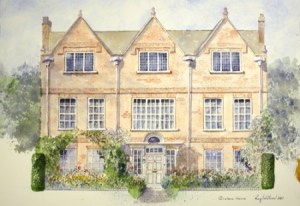
Quebec House, by Roy Willard. ©Estate of Roy Willard
As noted in previous postings, the blog format seems to lend itself nicely to acquisition news. Emile de Bruijn of the National Trust edits a terrific site for just such a purpose. Treasure Hunt regularly includes fascinating postings, often with information that one would be hard-pressed to find elsewhere (or at least hard-pressed to know one should look for such things anywhere). A recent posting, for instance, addresses Quebec House, in Westerham, Kent, “the childhood home of James Wolfe, who was born there in 1727 and spent the first 11 years of his life there.” As is often the case with historic properties, one faces the vexing dilemma of choosing a particular period to present over others: in this case, should the Trust go with the a newly-discovered 1630s scheme for the main bedroom or maintain the mid-eighteenth-century presentation that prevails throughout the rest of the house?
A number of recent postings also address Emile’s experience at this year’s Ashridge Garden History Summer School (30 July — 4 August). It looks like an amazing program.










 Enfilade
leave a comment