Looking for Clocks from ‘Peter Stretch’s Corner’
As noted by Cynthia Drayton at The Magazine Antiques (29 July 2010) . . .

Tall clock. works by Peter Stretch, Philadelphia, 1735-1746 (Winterthur)
The early Philadelphia clockmaker Peter Stretch (1670–1746) and his two clockmaking sons, Thomas (1697-1765) and William (1701-1748), are the subject of a forthcoming catalogue raisonné to be published by the Winterthur Museum and Country Estate in Delaware.
Peter Stretch was born in Leek in Staffordshire, England, and apprenticed with his older brother Samuel, a clockmaker who specialized in lantern clocks there. A Quaker, Peter Stretch and his wife and three sons left England for Philadelphia in 1703. He set up his shop on the southwest corner of Second and Chestnut Streets known as “Peter Stretch’s Corner,” where he made and sold clocks and imported wares. He joined the Common Council of Philadelphia in 1708, and nine years later received a commission from the council to work on the town clock. . . .
Readers with clocks made by Peter, William, or Thomas Stretch or bills, personal correspondence, account books, letter books, diaries, advertisements, or business records are asked to contact Donald L. Fennimore, Curator Emeritus, by mail at Winterthur Museum and Country Estate, Winterthur, Delaware, 19735; telephone 302-888-4598; or e-mail dfennimore@winterthur.org.
The notice at The Magazine Antiques is available here»
Dissertations beyond North America
Looking for a dissertation? In addition to the guide provided by the College Art Association of theses completed and in process (now found at caa.reviews), arthistoricum.net covers not only German programs but also (as noted below) “in ausgewählten weiteren Ländern.” I’m not sure how comprehensive such a description is intended to be, but there are titles included from the United States, the UK, and France. The arthistoricum site also suggests checking the database at INHA. Other recommendations for Enfilade readers are most welcome.
◊ ◊ ◊ ◊ ◊
Informationen zur Forschungsdatenbank
Die Datengrundlage der Forschungsdatenbank bilden die in der Zeitschrift Kunstchronik jährlich in den August- und September/Oktober-Heften publizierten Meldungen über abgeschlossene Magister-, Master- und Diplomarbeiten sowie über begonnene und abgeschlossene Dissertationen in Deutschland und in ausgewählten weiteren Ländern. Die seit 1985 veröffentlichten Daten wurden bis Anfang 2009 auf der Website vom Bildarchiv Foto Marburg in einer Datenbank präsentiert. Diese Datenbank wird nicht mehr angeboten, sondern hat nun unter dem Namen ‘Forschungsdatenbank’ mit veränderter Funktionalität hier auf arthistoricum.net ihren Platz gefunden. Die jahrgangsweise geordneten Übersichten auf der Homepage des Zentralinstituts für Kunstgeschichte (1996-2007) werden künftig ebenfalls durch die Forschungsdatenbank auf arthistoricum.net ersetzt werden. Recherchierbar sind die Datensätze der Jahrgänge 1985 bis 2009. Die Datensätze sind komplett thematisch erschlossen (Systematik, Geographica, Künstler und andere behandelte Personen). In einer weiteren Ausbaustufe soll es den meldenden Institutionen ermöglicht werden, ihre Datensätze direkt im System einzutragen. Die gedruckte Veröffentlichung in der Kunstchronik wird dann aus der Datenbank generiert werden. Weitere Verzeichnisse und Datenbanken von kunsthistorischen Forschungsarbeiten:
New Research Tools from the Getty
As recently posted to the caah listserv (Consortium of Art and Architectural Historians) . . .
The Getty Research Institute is pleased to announce the new Provenance Index® database “Payments to Artists.”
 The wealth of most Renaissance and Baroque painters was principally derived from what they earned selling their art. Data that documents payments to artists—as opposed to resale prices or inventory evaluations—is the primary means for analyzing the socioeconomic lives of painters in early modern Europe. This new online database contains approximately 1,000 payments recorded in Rome between 1576 and 1711.
We are grateful to Richard Spear who gathered this set of data in order to write the Rome section of his book Painting for Profit: The Economic Lives of Seventeenth-Century Italian Painters (New Haven: Yale University Press, 2010), which focuses on painters active in five major Italian cities. In its initial phase, this new Provenance Index® database is limited to information from Richard Spear’s research. It nonetheless is conceived as an open-ended, pilot project that can be easily corrected and significantly expanded as other scholars provide information from all periods of Western painting.
In addition, we would like to let patrons know of the following resources actively being added to and made freely available from the Getty website. The Getty Provenance Index® databases, part of the Project for the Study of Collecting and Provenance (PSCP), are compiled with the collaborative participation of institutions and individuals in Europe and the United States. The databases contain indexed transcriptions of inventories, auction catalogs, and stock books. More than one million records covering the period from the late sixteenth to the early twentieth century are searchable online. Originally designed as research tool for the ownership history of individual masterpieces, the index also allows scholars to model complex market developments, social networks, and cultural transfers.
- 64,000 new records from French auction catalogs of the 1770s and 1780s have recently been added to the Sales databases, completing a collaborative project with the Institut National d’Histoire de l’Art in Paris. The French auction market from the early 17th to the early 19th centuries is therefore fully covered.
- A new custom display and downloading feature has been implemented which accommodates statistical analysis and data visualizations. Users are now able to save up to 10,000 records onto their computers and manipulate them according to their own scholarly purposes.
Publication Grants
Millard Meiss Publication Grants
Applications due by 1 October 2010
Millard Meiss Publication Grants CAA awards Millard Meiss Publication Grants to support book-length scholarly manuscripts in the history of art and related subjects that have been accepted by a publisher on their merits but cannot be published in the most desirable form without a subsidy. For complete guidelines, application forms, and grant description, please visit http://www.collegeart.org/meiss or write to publications@collegeart.org.
Garden History
From the Editor
It’s been bothering for me a while that Enfilade hasn’t done more with the history of eighteenth-century gardens. Those of you who keep better tabs on the field than I, please don’t be shy about submitting any notices regarding conferences, CFPs, reviews, or new publications.
For readers who would like to know more, you might spend some time at the fine website of the London-based Garden History Society, which includes news of upcoming events, recent book reviews from the society’s journal Garden History, and general information about the work of the GHS. Also have a look at the fine blog, Early American Gardens, which focuses on “America’s colonial Atlantic coast & early republic” particularly in terms of “what primary sources reveal was actually in these gardens, when various garden components were noted, & what people were doing in these gardens & why” (my thanks to Janet Blyberg for the reference). I’m afraid this sort of sampling just reinforces how much I’ve overlooked, but it’s a start. -C.H.
Ruminations with a Recommendation or Two

From the Editor
Summer is here, but I think we’re living in the late autumn of the print magazine. There’s been lots of talk in academic circles about the dubious future of paper-format journals, but it’s perhaps interesting to consider the migration to the digital realm from both sides of the periodical spectrum — not only from the the Ivory Tower of erudition but also from the populism of Main Street.
The point has been brought home to me over the past year on a number of occasions as I’ve first learned of the end of various design magazines from design blogs. An article in Sunday’s edition of The New York Times (20 June 2010) presents the next logical step. Claire Cain Miller explains the origins of a new online design magazine, Lonny: “Michelle Adams, 27, a former market assistant at Domino, and Patrick Cline, 34, a photographer and photo retoucher, were talking . . . in May 2009 after Condé Nast closed Domino, its sprightly home magazine. Over dinner at Chili’s, they mourned the loss of the magazine and other design magazines, like Blueprint and House & Garden, and joked that they should start their own.” So they did, and 600,000 readers later, theirs looks to me like the future.
 A blog, of course, isn’t exactly the same thing as a digital magazine, but this relatively new format seems to be coming of age in its own right, and there are certainly loads of fine examples that facilitate an exchange of information that simply couldn’t have happened in any way even ten years ago. To underscore just two: I’m still a big fan of Courtney Barnes’s Style Court, and I’ve recently discovered a new favorite from Janet Blyberg, JCB. Janet was on the Attingham Program with me earlier this month (she supplies a terrific episodic account of the trip with amazing photographs). As an art historian and museum professional, she brings a smart sensibility to a wide range of topics — including lots of gems for dix-huitièmistes: postings, for instance, on Woodford Mansion in Philadelphia’s Fairmount Park and the house built by the botanist John Bartram (also in Philadelphia). The food postings are pretty terrific, too.
In the midst of this media migration from paper to the digital realm (reinforced by the likes of Scribd), things will surely be lost . . . and lots gained. It seems to me that one challenge for scholarly publications is finding a way not simply to mimic the older paper versions but to take advantage of the potential for entirely new features that just weren’t possible previously. The likes of Style Court and JCB might just be doing crucial, experimental work with important implications for even stuffy, scholarly publications. They definitely make the world a brighter place.
ProQuest to Take Over Future Indexing at BHA
While the Getty’s decision this past spring to take over the Bibliography of the History of Art saved the resource from simply disappearing (and made it available to the public free of charge), its usefulness remained in question since without ongoing updates, the BHA would gradually become less and less credible as an indexing tool. Well, this just in . . .
The Getty Research Institute (GRI) has announced an agreement with ProQuest, an information-technology firm supporting global research, that will allow ProQuest to take over the indexing of the International Bibliography of Art (IBA), better known as the Bibliography of the History of Art (BHA). The agreement will not only provide a secure future for a resource considered central to the study of art history, but will also assure its continuing development and its accessibility to researchers around the world. . .
For the full story, see the posting at CAA News (23 June 2010)
Update on the Well-Being of the Wellcome Library
I’m glad to note that I received the following message of assurance from Simon Chaplin, the Head of the Wellcome Library, in regard to my earlier question about the fate of the Library. I observed that it’s difficult for me to imagine the Library without the Centre — it seems that, in fact, the Library is starting to make plans for assuming some of the responsibilities previously handled by the Centre, such as support of visiting scholars. Many thanks, Simon, for the clarification, and my apologies for perpetuating any unreliable information. -C.H.
◊ ◊ ◊ ◊ ◊
I’m happy to say that the decision about the Centre hasn’t raised any questions about the library — our position is very secure. We’re about to embark on a big project to put more of our collections online – the Trust has earmarked four million pounds for this over the next two years, with up to another sixteen million pounds available once the project is up and running – and the numbers of physical users are also going up by 25% a year, so there is no danger that the move to digital will reduce our physical presence. I’ve been talking with colleagues in the Centre and the Trust about how we can support visiting researchers using the library if the Centre moves out of its present location, so we should be able to maintain this service regardless of the changes. I’d be grateful if you could offer Enfilade readers some reassurance on this – there have been several other reports about the Wellcome Library’s ‘closure’, and I’m keen that the rumour doesn’t put down roots. With best wishes – and hoping to see you in the library soon!
Dr Simon Chaplin
Head of the Wellcome Library
Wellcome Library
183 Euston Road, London NW1 2BE
A World without the Wellcome?
From the Editor
As a former research associate at the Wellcome Trust Centre for the History of Medicine, I’m as dismayed as anyone at the recent announcement that the Centre will be closing. The Wellcome has played an immensely valuable role for scholars across multiple disciplines, including art history. Thanks in part to the importance of Roy Porter for the Centre (and of course the importance of the Enlightenment for the history of medicine), the Wellcome has provided valuable institutional support for the field of eighteenth-century studies generally. The announcement also raises questions about the fate of the Wellcome Library, which includes an unrivaled collection of visual resources, much of which has been available online (reassurances have been made, but it’s difficult for me to imagine the Library without the Centre; at the very least, its mission would change).* For more information, see the announcement at the UCL website, a brief article at The Times Higher Education, and this editorial from the Telegraph. I hope you’ll consider signing the following petition.
-Craig Hanson
To: UCL/The Wellcome Trust
On March 31st the Wellcome Trust and UCL announced the closure of the Wellcome Trust Centre for the History of Medicine. This decision came in the middle of negotiations concerning the normal quinquennial review of funding for the Centre. The proposal to close the Centre was made by a handful of persons within the Wellcome Trust without, as far as is known, the involvement of any historian of medicine. We call upon the Trust to reconsider its decision, reinstate the independent peer review process, and permit any subsequent Centre to remain within the Wellcome building. We call upon UCL to maintain the history of medicine as a visible entity within College serving both historians and medics.
* N.B. –– Regarding the fate of the Library, please see this posting, added 26 May 2010.
◊ ◊ ◊ ◊ ◊
Roy Porter Memorial Lecture by Quentin Skinner, Political Liberty: The Enlightenment Debate
Wellcome Building, 183 Euston Road, London, 26 May 2010
With the announcement of the closure of the Centre by UCL and the Wellcome Trust, and the uncertainty regarding the precise details of the two-year wind-down, the 2010 Roy Porter Memorial lecture will be the last. Professor Quentin Skinner will talk on Political Liberty: The Enlightenment Debate, a subject Roy would have particularly enjoyed.
Jeremy Bentham announced in 1776 that he had made a ‘discovery’ about the concept of liberty. John Lind put forward a similar view in his official response to the Declaration of Independence, but Lind was persuaded (not least by Bentham himself) to accept that Bentham had been the first to articulate the argument. Bentham’s view was primarily directed against the pamphlets of the common lawyer Richard Hey, while Lind’s was more ambitiously directed against the pro-American writings of Richard Price. The lecture begins by examining the background to the theory that Lind denounced, and then turns to examine the background to the rival theory that he and Bentham both espoused. As the latter discussion unfolds, a doubt about Bentham’s claims to originality begins to arise. The lecture ends by suggesting that the earliest articulation of the theory that he claimed as his own was in fact the work of Thomas Hobbes.
The lecture will be held on May 26th in the Wellcome Building, 183 Euston Road. Attendance is free on receipt of an e-ticket which may be obtained by emailing: hom-events@ucl.ac.uk.
Keeping Track — New Acquisitions Blog at the Walpole Library
Scholarship in the digital age of connectivity creates enormous possibilities, and yet these possibilities also pose new problems. It’s terrific that collections of visual and textual materials are increasingly available online, but knowing what’s where can be tricky. Further complicating matters is the fact that institutional collections are always adding more. Just because something wasn’t available online last summer doesn’t mean that it’s not there now. In some ways, this is just a new version of the old problem of spreading the word about new acquisitions. Fortunately, the digital age provides us with tools that could help. Listservs and blogs are ideally suited for such announcements, and Enfilade is certainly one forum for sharing these kinds of updates.
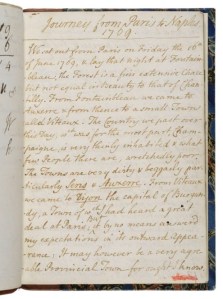
"Journey from Paris to Naples, 1769"

LWL Mss Vol 181, William Henry Bunbury
In a more focused manner, the Lewis Walpole Library hosts a blog dedicated to its own “Recent Antiquarian Acquisitions.” The posting from 11 May 2010, for instance, takes note of the travel diary of William Henry Bunbury (1750-1821), which documents his journey from Paris to Naples in 1769. Now best known for his caricatures, William was the younger brother of Sir Charles Bunbery, whose first wife was famously painted by Sir Joshua Reynolds (the portrait of Lady Sarah Sacrificing to the Graces is in the collection of the Art Institute of Chicago). Of course, the Walpole Library blog becomes one more site to keep tabs on, but it would seem like a workable solution. Any thoughts?










 Enfilade
leave a comment