Podcast | 18th-Century Dining with Ivan Day
From Spotify:
Neil Buttery and Ivan Day, “18th-Century Dining with Ivan Day,” The British Food History Podcast, Season 5 (22 January 2023), 43 minutes.

Martha Bradley, The British Housewife (1760). From Ivan Day’s Instagram account.
For this episode, Neil’s guest is esteemed food historian Ivan Day. Ivan is a social historian of food culture and a professional chef and confectioner. He has contributed to dozens of TV and radio programmes over the years. He is the author of numerous books and papers on the history of food, and he has curated major exhibitions on food history in the UK, US, and Europe. This special episode compliments Neil’s upcoming book, a biography the 18th-century cookery writer Elizabeth Raffald. Ivan kindly invited Neil into his home to talk about all things 18th-century dining: ostentatious coronation feasts; the rise of female food writers, including Elizabeth Raffald; market gardens; the presentation of food at the table; jelly; flummery moulds; authenticity; and the practicalities of spit roasting—how crockery, cutlery and, well, the whole dining experience changed going into and out of the 18th century.
Information on Day’s courses for October, November, and December, offered through The School of Artisan Food, is available here»
Forthcoming from Pen and Sword History:
Neil Buttery, Before Mrs Beeton: Elizabeth Raffald, England’s Most Influential Housekeeper (Barnsley: Pen and Sword History, 2023), 224 pages, ISBN: 978-1399084475, £20 / $40.
Handling Session | Hausmaler at the V&A
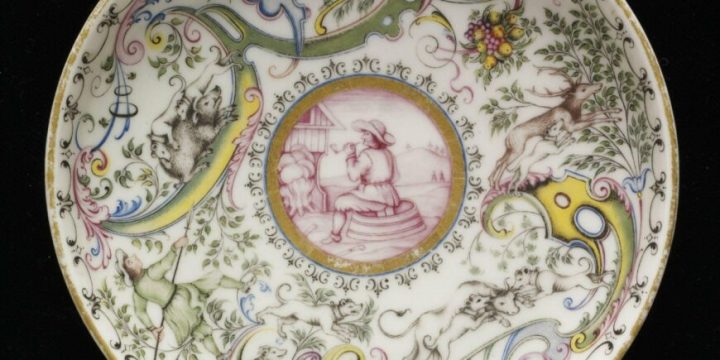
Saucer, made at the Meissen Porcelain Manufactory, ca. 1720–25 and then painted by an unknown ‘hausmaler’ painter, ca. 1720–30
(London: Victoria and Albert Museum, C.218A-1938)
◊ ◊ ◊ ◊ ◊
A good reason to join The French Porcelain Society:
Hausmaler at the V&A
Victoria and Albert Museum, London, 23 February 2023
The French Porcelain Society’s handling session examining German Hausmalerei—faïence and porcelain painted in small workshops outside their factories (Hausmaler, ‘home painter’)—from the V&A collection will take place on Thursday, 23 February, in the morning. The session will be led by Simon Spier, Curator of Ceramics and Glass 1600–1800, and Errol Manners. Numbers will be limited, and the cost is £25, with a reduced rate available for emerging scholars. If interested, please contact FPS administrator Kelsey Weeks, FPSmailing@gmail.com.
Call for Collaborators | The Digital Piranesi

View of the Flavian Amphitheatre, called the Colosseum (Veduta dell’Anfiteatro Flavio detto il Colosseo), from Giovanni Battista Piranesi’s Opere, volume 1 of 29 (Paris: Firmin Didot, 1837–39). Piranesi’s original copper plates were used for this posthumously published collection; this specific print comes from a complete set of volumes at the University of South Carolina, home to The Digital Piranesi project.
◊ ◊ ◊ ◊ ◊
From the Call for Participants:
Essay Contributors for The Digital Piranesi
Applications due by 1 March 2023
 Digital art history, word-image studies, architectural history, and book history meet in The Digital Piranesi, a developing digital humanities project devoted to the complete works of Giambattista Piranesi (1720–1778). With funding from the Kress Foundation, six collaborators will be invited to contribute to the project. Following an introductory in-person workshop in Columbia, South Carolina, in late Summer 2023, regular virtual meetings through Summer 2024 will be dedicated to writing brief, impactful scholarly essays about each image in the first volume of his Roman Antiquities / Le Anthichità Romane (1756). Travel and accommodation will be supported by grant funds.
Each image of the first volume of the Roman Antiquities appears with original annotations and (in metadata) English translations here.
Please send a CV and one-page statement detailing qualifications, experience, and interest to Jeanne Britton at jbritton@mailbox.sc.edu by 1 March 2023. Inquiries are welcome.
The Digital Piranesi has received generous support from the NEH Division of Preservation and Access, the Kress Foundation, and, at the University of South Carolina, the Office of the Vice President for Research, the Center for Digital Humanities, the Magellan Scholar Program, the Maners-Pappas Endowment, the Humanities Collaborative, and the Irvin Department of Rare Books and Special Collections.
Institutional Membership, New York Society Library
From the SHARP-L listserv (14 December 2022) . . .
The New York Society Library offers e-memberships for those interested in access to its collection of 20+ electronic resources, including JSTOR, Project Muse, the America Founding Era Collection (papers and correspondence from several 18th-and early 19th-century figures), back issue archives for The TLS, The New York Review of Books, and the London Review of Books, various Oxford University Press databases (including the The Grove Dictionary of Art and the Oxford DNB), American National Biography, and many more. For leisure reading, the Library also offers databases of popular e-books and magazines (The Economist, The New Yorker, Harper’s, thousands more). Assistance with research questions is available by emailing the Reference Desk.
The E-membership costs $100 / year.
E-memberships also include 10 building visits annually, with access to the quiet study spaces and reading rooms in our beautiful, landmark Italianate building. (The membership does not include circulating privileges for the print collection or access to individual study rooms.)
The New York Society Library was founded in 1754 as a membership library. Various membership options provide circulating privileges from our collection of 300,000 volumes in open stacks, electronic resources, reading and study spaces, member-only events, and more. The Library is open to all for reading, reference, and many events. More information on e-memberships is available here: https://www.nysoclib.org/members/e-memberships.
UK’s National Trust Launches the Cultural Heritage Magazine
Published between 2006 and 2022, the National Trust’s Arts, Buildings, and Collections Bulletin (ABC Bulletin) was replaced this fall by the Cultural Heritage Magazine. Recent issues of ABC Bulletin can still be downloaded here, and earlier issues can be requested by emailing the ABC Bulletin team. The first issue of Cultural Heritage Magazine includes the following note of welcome from NT Director-General, Hilary McGrady:
 Building on the success of the National Trust Arts, Buildings & Collections (ABC) Bulletin, the Cultural Heritage Magazine will be the place to explore the work of the Trust’s cultural heritage teams in depth, with a broad range across curation, conservation, research, and beyond. It will also share shorter features, including interviews and photo essays, aimed at giving a deeper insight into the work being undertaken on cultural heritage within the Trust. In addition to the opening ‘Briefing’ pages, which share news of forthcoming cultural heritage events and publications, there are also regular sections on new acquisitions to the Trust’s collections, loans to major new exhibitions (in the spring issue), and research and conservation project round-ups. The magazine will be published twice a year, in spring and autumn, and is available to download from the Trust website. You can also ask to be added to the mailing list to receive it direct to your inbox by emailing chm@nationaltrust.org.uk. . . .
The full welcome is available here»
Front cover: Giant Leaf Verdure, ca.1540–50, Hardwick Hall, Derbyshire, NT 1129595 (Photo: National Trust Images/Leah Band).
Decorative Arts Trust Announces Failey Grant Recipients for 2023

The British and Irish Furniture Makers Online (BIFMO) project researches makers such as Giles Grendey, whose 1735–40 card table is in The Metropolitan Museum of Art’s collection; lacquered and gilded beech, lined with felt (New York: The Met, Gift of Louis J. Boury, 1937, 37.114).
◊ ◊ ◊ ◊ ◊
From the press release:
The Decorative Arts Trust announced that the 2023 Dean F. Failey Grant recipients will be British and Irish Furniture Makers Online (BIFMO) in London, England; The Center for Painted Wall Preservation (CPWP) in Hallowell, Maine; Preservation Long Island (PLI) in Cold Spring Harbor, New York; and Stenton in Philadelphia, Pennsylvania. The Failey Grant program provides support for noteworthy research, exhibition, publication, and conservation projects through the Dean F. Failey Fund, named in honor of the Trust’s late Governor. Preference is given to projects that employ or are led by emerging professionals in the museum field. Failey Grant applications are due October 31 annually.

Anne Reckless Emlen, Shellwork grotto, 1757, Philadelphia (Stenton, The National Society of The Colonial Dames of America in the Commonwealth of Pennsylvania).
• BIFMO will hire interns to research immigrant tradespeople in New York City, Philadelphia, Annapolis, and Baltimore under the guidance of BIFMO managing editor Laurie Lindey, digital editor Jonathan Blaney, and BIFMO project manager Adriana Turpin.
• CPWP will develop a virtual museum of historic painted interiors under the direction of project coordinators Margaret Gaertner and Linda Carter Lefko.
• PLI will produce the book Promoting Long Island: The Art of Edward Lange, 1870–1889, edited by PLI curator Lauren Brincat and PLI curatorial fellow Peter Fedoryk with essays from these editors as well as from Jennifer L. Anderson, Thomas Busciglio-Ritter, Sarah Kautz, and Joshua Ruff.
• Stenton, a historic house museum administered by The National Society of the Colonial Dames of America in the Commonwealth of Pennsylvania, will conserve a 1757 shellwork grotto by Anne Reckless Emlen, led by Stenton curator Laura Keim, Stenton curatorial assistant Kaila Temple, and conservator Lara Kaplan.
More information is available here»
Smithsonian Commitments to the Center for the Study of Global Slavery
Brownell’s recent article for The New York Times highlights priorities of the National Museum of African American History and Culture—as first established under the leadership of Lonnie Bunch, the museum’s founding director, who now oversees the entire Smithsonian Institution—as well as forthcoming projects including the international exhibition In Slavery’s Wake.
Ginanne Brownell, “A Smithsonian Museum Sharpens Focus on the History of Slavery,” The New York Times (14 October 2022). Despite ambivalence from some on the topic, the institution’s latest leader “knew that slavery had to be at the heart of the museum.”
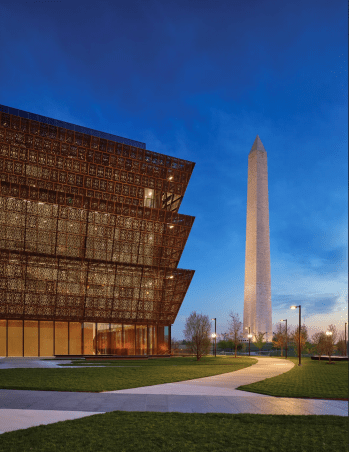
Exterior view of the National Museum of African American History and Culture; Washington, DC (Photo by Alan Karchmer/NMAAHC).
“Every nation is ambivalent about slavery,” said Mr. [Lonnie] Bunch, the first African American to lead the Smithsonian. “The people of color are ambivalent: Is this something to be embarrassed by? Is this something that is better left unsaid? So basically, I knew that slavery had to be at the heart of the museum.”
When the museum [National Museum of African American History and Culture] opened in 2017, so did the Center for the Study of Global Slavery within it. The center’s work focuses on three international collaborative initiatives: the Slave Wrecks Project, the Global Curatorial Project, and the Slave Voyages Consortium.
The Slave Wrecks Project helps coordinate searches for sunken slave ships and works on maritime archaeological research and historical recovery. This month in Senegal, the inaugural Slave Wrecks Project Academy’s cohort of African and diaspora students are being trained in diving and learning about the global slave trade. The center also works with slavevoyages.org to help expand data collection beyond the trans-Atlantic slave trade and is working to broaden research into both the Indian Ocean and inter-American slave trades.
Under the auspices of the Global Curatorial Project, a number of partner institutions—including Liverpool’s International Slavery Museum, Iziko Slave Lodge in Cape Town, and Belgium’s Royal Museum of Central Africa—are in the midst of putting together In Slavery’s Wake, a traveling exhibition that will open first at the museum in Washington in late 2024 and then move to Africa, Europe, and the Americas.
The center will be hosting an event in Lisbon, Portugal in January, with a tentative title Reckoning with Race: The Social Memory of the Slave Trade in Our World, that will aim to bring more public attention to the role that Portugal played in the slave trade. Mr. Bunch will be one of the event’s speakers. . . .
The full article is available here»
Research Seminar | Greg Smith on Girtin and the Artist Catalogue
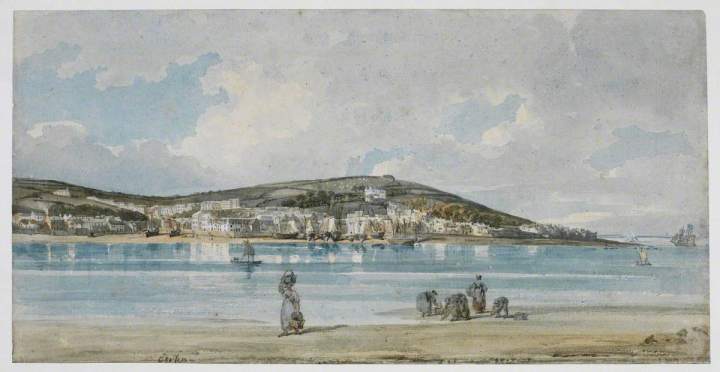
Thomas Girtin, Appledore, from Instow Sands, ca. 1800, graphite and watercolour on laid paper, 25 × 47 cm
(London: The Courtauld, D.1952.RW.846)
◊ ◊ ◊ ◊ ◊
From PMC:
Greg Smith | Rethinking the Artist Catalogue for the Online Age: Thomas Girtin (1775–1802)
Paul Mellon Centre, London, 5 October 2022, 6pm
This lecture relates to the publication Thomas Girtin (1775–1802): An Online Catalogue, Archive, and Introduction to the Artist, due to be released on 4 October.
I will begin by outlining the scope of the project and my thinking behind the site’s tri-partite structure and title: An Online Catalogue, Archive, and Introduction to the Artist. Particular attention will be paid to two challenges: how to make a free-to-access site straightforward to use for a non-specialist audience; and then, how best to ensure the future of the site as an academic resource that can develop through the incorporation of new material and research. I will then move on to consider the different sections of the site, beginning with the approximately 1550 catalogue entries that form its core. Emphasis will be placed on the features that distinguish the site from a conventionally published catalogue and why it is that I have studiously avoided using the term catalogue raisonné. I will then look at each of the sections of the Archive, focusing first on the challenge of relating the material to the rest of the site, and then summarising their current status in relation to my ambition to produce a comprehensive if not definitive record of sales, exhibitions and publications, together with extensive transcriptions of all the early biographical accounts and related manuscript material. I will conclude my introduction to the site by looking at some of its inevitable limitations, not least as a challenge to my audience to use it as a resource for the investigation of themes beyond the project’s scope. Book tickets»
Greg Smith is an independent art historian, who has published extensively on the history of British watercolours and watercolourists, as well as landscape artists working in Italy. He has also worked as a curator at the Whitworth Art Gallery, Manchester, the Design Museum, London, and the Barber Institute of Fine Art, Birmingham, and has organised exhibitions on the work of Thomas Girtin (Tate Britain), Thomas Jones (National Gallery of Wales), and Thomas Fearnley (Barber Institute of Fine Art). As Senior Research Fellow at the Paul Mellon Centre for Studies in British Art, Greg Smith is developing a major online project: Thomas Girtin (1775–1802): An Online Catalogue, Archive and Introduction to the Artist.
New Resource | Russian Books of the 18th Century

Атлас российской, состоящей из девятнадцати специальных карт представляющих Всероссийскую империю… / Atlas rossiiskoi, sostoiashchei iz deviatnadtsati spetsial’nykh kart predstavliaiushchikh Vserossiiskuiu imperiiu… / (Atlas of Russia, consisting of nineteen special maps representing the All-Russian Empire), 1745. Link»
◊ ◊ ◊ ◊ ◊
Thanks to Margaret Samu for noting this new digital collection. The examples of particular titles are her selections, underscoring the range of books included. –CH
As noted several days ago at H-SHERA (Society of Historians of Eastern European, Eurasian, and Russian Art and Architecture). . .
The Slavic Reference Service at the University of Illinois has just announced the publication of a new digital collection: Russian Books of the 18th Century, which is now freely available on Internet Archive.
This collection is an ongoing project to make all of the books listed in Svodnyi katalog russkoi knigi grazhdanskoi pechati XVIII veka digitally available. It is designed to be used in tandem with the catalog: each item is cross-referenced with its entry number and transliterated title for easy access. We hope this will be a more convenient option for finding 18th-century Russian books than its microform predecessor. There are currently over 400 items uploaded, with our eventual goal being to have the full contents of the catalog online. Digitized books have been curated from the Russian National Electronic Library (RusNEB).
From the Internet Archive. . .
Russian Books of the 18th Century is a newly available collection of books printed in Russia from 1725 to 1801 based on the Union Catalogue of Russian 18th-Century Civil Typeface Books (Svodnyi katalog russkoi knigi grazhdanskoi pechati XVIII veka). Most titles were curated from the impressive digitization project, Natsional’naia Elektronnaia Biblioteka, operated by the Russian State Library in Moscow. This collection is curated by the Slavic Reference Service (SRS) at the University of Illinois Urbana-Champaign and is open to all researchers. Items are cross-referenced with Svodnyi katalog entry numbers and ALA-romanized titles. Descriptions contain a truncated version of the item’s listing in Svodnyi katalog. Users can use the ‘Search this collection’ function to search by entry number, title, and author in Latin or Cyrillic letters.
The ‘civil type’ refers to the new, simplified typeface introduced by Peter the Great in 1708, intended for secular publications, replacing the earlier Church Slavonic. Some titles are original Russian works, others are texts translated from European languages, while still others appear in bilingual editions, such as this Allegorical Imagery of Fireworks in Honor of Her Imperial Highness Elizaveta Petrovna in Russian and German.
Other notable books:
• The Life and Deeds of Marcus Aurelius (1740), link»
• A 1745 atlas with maps, link»
• The Adventures of Chevalier de ***. A True Story, by Jean-Baptiste de Boyer, marquis d’Argens (1772), link»
• Theoretical and Practical Arithmetics, by D. S. Anichkov (1775), link»
Online Conference | Periodization of the History of Art
From ArtHist.net:
Le parole della periodizzazione della storia dell’arte: Epoche, stili, maniere nei testi di guidistica e storiografia del Seicento e del Settecento
Online / Palazzo Barberini, Roma, 25–27 May 2022
Le giornate di studio Le parole della periodizzazione della storia dell’arte: epoche, stili, maniere nei testi di guidistica e storiografia del Seicento e del Settecento si inseriscono all’interno delle attività di ricerca sulla storiografia artistica e sul lessico dell’arte che da molti anni sono condotte presso il Dipartimento di studi letterari, filosofici e di storia dell’arte dell’Università degli studi di Roma “Tor Vergata” sotto il coordinamento del prof. Carmelo Occhipinti. Questi incontri sono incentrati sull’esame di una o più parole, attestate negli scritti d’arte tra XVII e XVIII secolo, con particolare riguardo alla focalizzazione delle epoche della storia della pittura, scultura e architettura, ovvero alla percezione delle maniere e delle rispettive fasi di sviluppo, e alla caratterizzazione stilistica delle opere ad essa riferite.
Alle giornate di studio seguirà una tavola rotonda conclusiva e per l’occasione sarà presentato il progetto «Titi Online», edizione digitale delle guide romane di Filippo Titi (1639–1702) incluse nello scaffale elettronico di Horti Hesperidum, unitamente ad altri testi tra i quali si segnalano quelli di Francesco Scannelli, Luigi Scaramuccia, Giovan Battista Passeri e Lione Pascoli.
L’accesso è regolamentato nel rispetto delle norme di prevenzione del contagio disposte dalla legge. Per accedere è necessario indossare la mascherina. Per partecipare via TEAMS: https://bit.ly/3vKiQBe
2 5 M A G G I O 2 0 2 2
9.30 Carmelo Occhipinti (Università degli Studi di Roma Tor Vergata’), Saluti e introduzione alla giornata di studi
9.40 Damiano Delle Fave (Università degli Studi di Roma ‛Tor Vergata’), Presentazione
9.50 Carmelo Occhipinti (Università degli Studi di Roma Tor Vergata’), Periodizzazione e prospettive storiografiche tra Sei e Settecento
10.10 Session 1
Chair Maria Giulia Aurigemma
• Paolo Pastres (Storico dell’arte), Scuola pittorica: un concetto ambiguo
• Chiara Dominioni (Università degli studi di ‛Roma Tre’), Il lessico d’arte nel Discorso sopra la pittura (1776) di Giovanni Battista Giovio
• Daniela Caracciolo (Università degli Studi del Salento), «Le varie maniere de’ Pittori, o antichi, o moderni». Concetti di storia, origine e progresso nelle Vite di De Dominici
• Ilaria Serati (Fondazione 1563 per l’Arte e la Cultura della Compagnia di San Paolo), La periodizzazione storiografica delle Vite de’ pittori, scultori e architetti bergamaschi (1793) di Francesco Maria Tassi: cause metodologiche di un’assenza
• Francesca Daniele (Università degli Studi di Padova), Il concetto di “patina” pittorica nella letteratura artistica veneziana del Seicento
12.10 Pausa pranzo
13.10 Session 2
Chair Cristiano Giometti
• Mariaceleste Di Meo (Università degli Studi di Udine), Il concetto di “ordine” per Baldinucci: cronologia e storiografia nei primitivi delle Notizie
• Francesco Freddolini (Università degli Studi di Roma ‘La Sapienza’), Filippo Baldinucci, Gian Lorenzo Bernini e la “tenerezza” del marmo
• Chiara Carpentieri (Università degli Studi di Firenze), Il concetto di “pittoresque”: sfumature e usi nella letteratura artistica francese del XVIII secolo
• Violeta Kovalenko (Università degli Studi di Roma ‘La Sapienza’), “Vigor piccante da fissar lo sguardo”. Riflessioni sulla ricezione del rilievo in pittura nel Settecento
14.50 Coffee Break
15.10 Session 3
Chair Carmelo Occhipinti
• Eliana Monaca (Università degli Studi di Roma ‛Tor Vergata’), La nozione di “riforma” nella letteratura artistica di Sei e Settecento. Alcuni esempi a partire dal Microcosmo della pittura di Francesco Scannelli
• Maria Giulia Cervelli (Università degli Studi di Roma ‛Tor Vergata’), Un «mirabile giardino fiorito»: le epoche della storia dell’arte ne Le Finezze de’ pennelli italiani di Luigi Scaramuccia
• Marina Cafà (Università degli Studi di Roma ‛Tor Vergata’), La nozione del “ben inteso misto” nelle Vite di Lione Pascoli, con uno sguardo al passato
• Emanuela Marino (Università degli Studi di Roma ‛Tor Vergata’), Attestazioni e uso dei termini “barbaro” e “gotico” nella letteratura artistica di Sei e Settecento. Alcuni esempi
• Lucrezia Lucchetti (Università degli Studi di Roma ‛Tor Vergata’), Il “Gotico” nella storiografia inglese del Settecento tra Hogarth, Reynolds e Ramsay
2 6 M A G G I O 2 0 2 2
14.10 Session 4
Chair Francesco Grisolia
• Floriana Conte (Università degli Studi di Foggia), “Età”: la storia dell’arte in volgare coincide con la vita delle opere
• Marco Massoni (Scuola Normale Superiore di Pisa), Il lessico artistico nelle fonti giuridico-agiografiche: il caso delle Positiones dei Servi di Maria
• Nadia Raimo (Università degli Studi di Genova), L’evoluzione del linguaggio dell’arte nel patrimonio genovese: analisi delle guide e diari di viaggio
• Luca Pezzuto (Università degli Studi dell’Aquila), Stefania Ventra (Università ‘Ca’ Foscari’ di Venezia), Fachinademie e capoccioni «innalzati con non più intese iperboli alle stelle». La Roma di primo Settecento negli scritti polemici di Lodovico Antonio David pittore ticinese
15.50 Coffee Break
16.10 Session 5
Chair Claudio Castelletti
• Paolo Bertoncini Sabatini (Università degli Studi di Pisa), Il “carattere” dell’architettura secondo Quatremère de Quincy: il “più, il meno e il medio” dell’ordre nell’Encyclopédie Méthodique Architecture (1788)
• Elisa Bastianello (Bibliotheca Hertziana), «Della Basilica di Vicenza Opera moderna non inferiore all’antiche romane»: Vicenza romana e palladiana negli scritti di Ortensio Zago (1654–1737)
• Elena Granuzzo (Università ‘Ca’ Foscari’ di Venezia), “Gusto”, “manierismo” e “natura” nella periodizzazione della storia dell’architettura: Le Vite di Tommaso Temanza
2 7 M A G G I O 2 0 2 2
15.00 Tavola rotonda aperta al pubblico
Palazzo Barberini, Sala conferenze
Introduce
• Carmelo Occhipinti (Università degli Studi di Roma ‛Tor Vergata’)
Intervengono
• Damiano Delle Fave (Università degli Studi di Roma ‛Tor Vergata’)
• Eliana Monaca (Università degli Studi di Roma ‛Tor Vergata’)
• Maria Giulia Cervelli (Università degli Studi di Roma ‛Tor Vergata’)
• Stefano Pierguidi (Università degli Studi di Roma ‘La Sapienza’)
• Raffaella Morselli (Università degli Studi di Teramo)
• Maria Giulia Aurigemma (Università degli Studi ‛Gabriele d’Annunzio’ di Chieti-Pescara)
• Alessandro Zuccari (Università degli Studi di Roma ‘La Sapienza’)
• Marzia Faietti (Kunsthistorisches Institut in Florenz – Max-Planck-Institut)
Convegno promosso da
• Horti Hesperidum
• Università degli Studi di Roma ‛Tor Vergata’
• Gallerie Nazionali Barberini Corsini
• MANT (Nuove tecnologie per la comunicazione, il cultural management e la didattica della storia dell’arte: per una fruizione immersiva e multisensoriale dei Beni Culturali)
Curatela scientifica
• Damiano Delle Fave (Università degli Studi di Roma ‛Tor Vergata’)
Comitato scientifico
• Carmelo Occhipinti (Università degli Studi di Roma Tor Vergata’)
• Barbara Agosti (Università degli Studi di Roma Tor Vergata’)
• Eliana Carrara (Università degli Studi di Genova)
• Alessandro Zuccari (Università degli Studi di Roma ‘La Sapienza’)
• Marzia Faietti (Kunsthistorisches Institut in Florenz – Max-Planck-Institut)










 Enfilade
leave a comment