The Burlington Magazine, February 2025
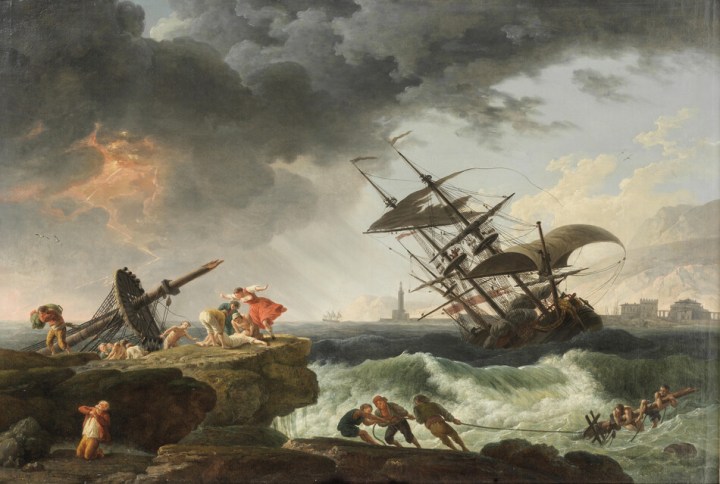
Claude-Joseph Vernet, Shipwreck on a Rocky Coast, 1775, oil on canvas, 74 × 108 cm (Private Collection). The work and its pendant, Harbour Scene at Sunset, are identified by Yuriko Jackall as paintings acquired directly from the artist by François-Marie Ménage de Pressigny, who likely commissioned The Swing by Fragonard. In contrast to the latter, which in 1794 was valued at 400 livres, the two paintings by Vernet were valued at 4,000 livres—the most valuable paintings owned by Ménage de Pressigny.
◊ ◊ ◊ ◊ ◊
The long 18th century in the February issue of The Burlington:
The Burlington Magazine 167 (February 2025)
e d i t o r i a l
• “Cataloguing,” p. 79.
It is one of the basic responsibilities of major collections to research and publish the works of art in their care. Such projects can take many years to mature and are often abandoned because of a lack of funding or shifting institutional priorities. It might be imagined, therefore, that because of these threats and the formidable cost of producing specialist and richly illustrated books, that collection catalogues would have become an extinct species. However, happily, a close reading of this Magazine in recent months would suggest otherwise, across a wide range of media and in terms of a broad chronological span . . .
 a r t i c l e s
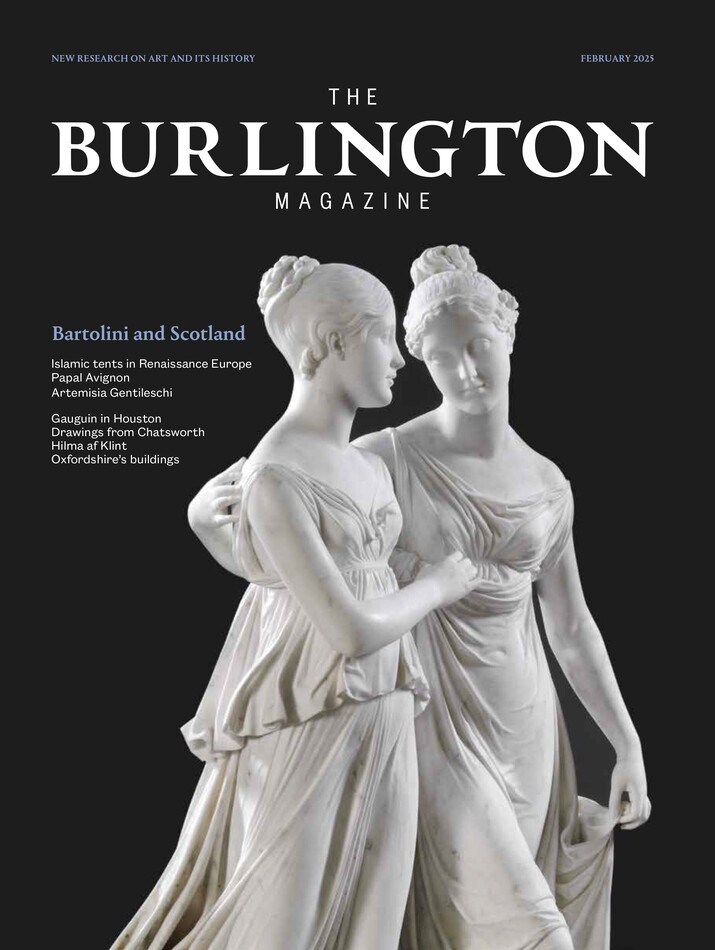
• Lucy Wood and Timothy Stevens, “The Elder Sisters of The Campbell Sisters: William Gordon Cumming’s Patronage of Lorenzo Bartolini,” pp. 126–53.
s h o r t e r n o t i c e s
• Yuriko Jackall, “Ménage de Pressigny and His Art Collection,” pp. 157–61.
• Dyfri Williams, “Lusieri’s Mysterious Wooded Lake Identified,” pp. 161–63.
r e v i e w s
• Marjorie Trusted, Review of the exhibition Luisa Roldán: Escultora Real (Museo Nacional de Escultura, Valladolid, 2024–25), pp. 164–66.
• Karin Hellwig, Review of the exhibition Hand in Hand: Sculpture and Colour in the Spanish Golden Age (Prado, 2024–25), pp. 166–69.
• William Whyte, Review of Simon Bradley, Nikolaus Pevsner and Jennifer Sherwood, Oxfordshire: Oxford and the South-East, The Buildings of England (Yale UP, 2023), pp. 188–89.
• Elizabeth Savage, Review of Esther Chadwick, The Radical Print: Art and Politics in Late Eighteenth-Century Britain (Paul Mellon Centre for Studies in British Art, 2024), pp. 194–96.
Master Drawings, Winter 2024
In the latest issue of Master Drawings:
Master Drawings 62.4 (Winter 2024)
 a r t i c l e s
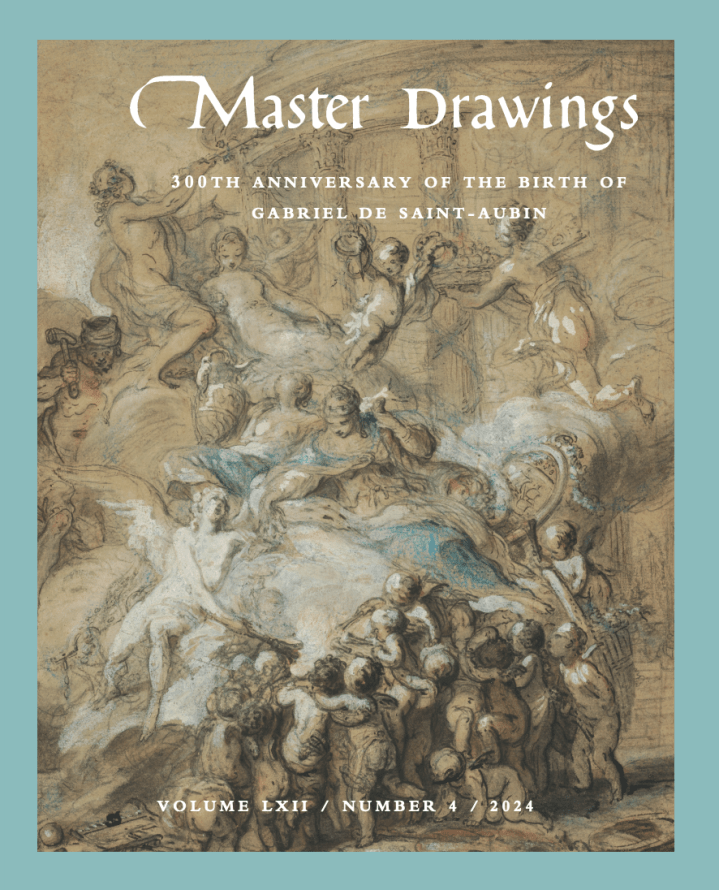
• Perrin Stein, “The Crown, the City, and the Public: Saint-Aubin’s Images of Paris.”
• Kim de Beaumont, “A Curious Swan Song for Gabriel de Saint-Aubin: The Comte d’Estaing’s New World Naval Exploits.”
• Margaret Morgan Grasselli, “A Drawing by Hubert Robert and Jean Robert Ango: Correcting a Technical Description.”
• Sarah Catala, “Signed ‘Roberti’: Drawings by Hubert Robert and Jean Robert Ango.”
• Kee Il Choi Jr., “Learning to Draw: The Éducation visuelle of Alois Ko and Étienne Yang.”
r e v i e w s
• Aaron Wile, Review of the exhibition catalogue Claude Gillot: Satire in the Age of Reason, by Jennifer Tonkovich.
• Eduoard Kopp, Review of the exhibition catalogue, Promenades on Paper: Eighteenth-Century French Drawings from the Bibliothèque Nationale de France, edited by Esther Bell, Sarah Grandin, Corinne Le Bitouzé, and Anne Leonard.
• Ashley E. Dunn, Review of the exhibition catalogue Impressionists on Paper: Degas to Toulouse-Lautrec, by Ann Dumas, Leïla Jarbouai, Christopher Lloyd, and Harriet Stratis.
o b i t u a r y
• Perrin Stein, Obituary for Alaster Laing.
The Burlington Magazine, January 2025
.
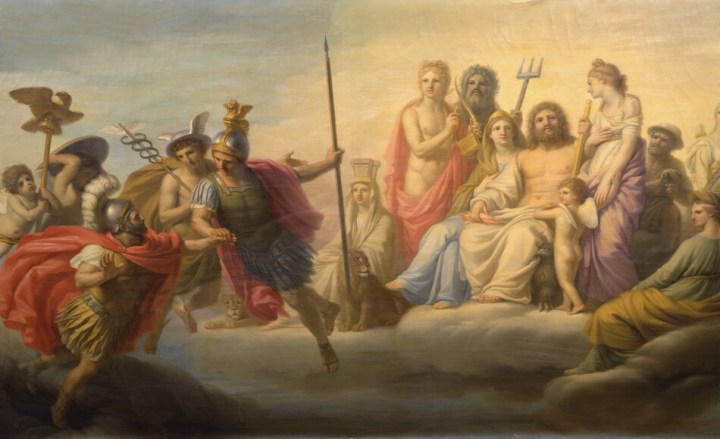
Stefano Tofanelli, Apotheosis of Romulus before the Gods of Olympus, 1790, oil on canvas, 208 × 318 cm
(Rome: Palazzo Altieri)
◊ ◊ ◊ ◊ ◊
The long 18th century in the January issue of The Burlington:
The Burlington Magazine 167 (January 2025)
e d i t o r i a l
• “A One Billion Pound Gift,” p. 3.
“Now you can gasp,” said the Chairman of the Trustees of the British Museum to guests at a recent fundraising dinner. He had just revealed the valuation of £1billion for the magnificent collection of Chinese ceramics that has been given to the museum by the Sir Percival David Foundation. Munificence on this scale is normally only associated with the richest of American museums, so a new record seems to have been set in the European context by this extraordinary gesture.
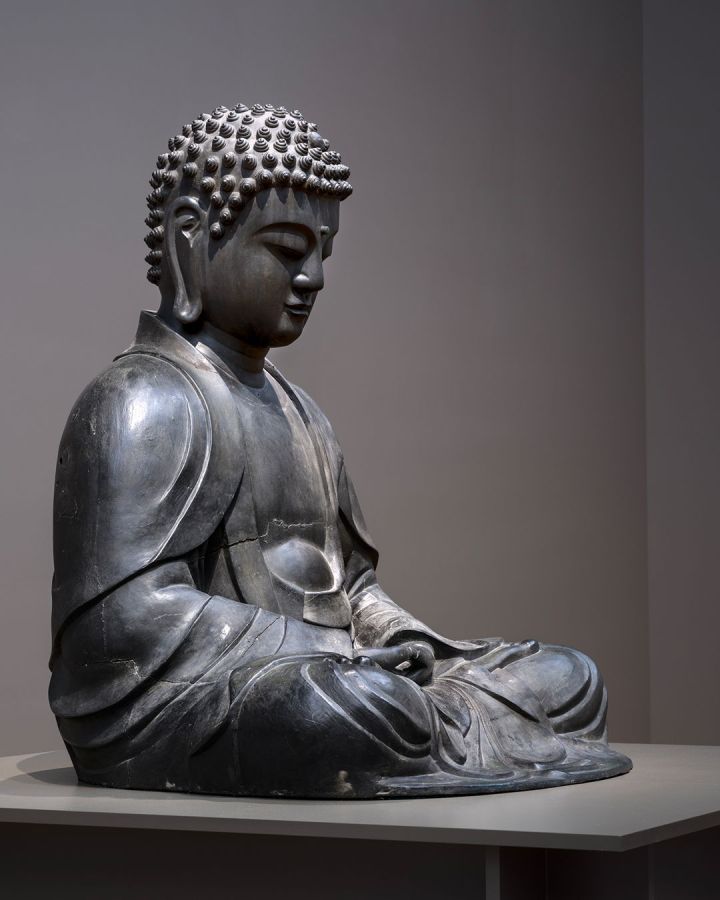
Buddha Amida (Amitabha), Japan, 1716 (Collection Wereldmuseum). Included in the exhibition Asian Bronze: 4,000 Years of Beauty.
s h o r t e r n o t i c e s
• Pilar Diez del Corral Corredoira, “A Project for the Church of Menino Deus, Lisbon, by Vieira Lusitano,” pp. 26–29.
• Alessio Cerchi, “Stefano Tofanelli’s Deification of Aeneas by Venus Rediscovered,” pp. 29–31.
r e v i e w s
• Lori Wong and Sujatha Arundathi Meegama, Review of the exhibition Asian Bronze: 4,000 Years of Beauty (Rijksmuseum, 2024–25), pp. 35–37.
• Delphine Bastet, Review of Grands décors restaurés de Notre-Dame de Paris, edited by Caroline Piel and Emmanuel Pénicaut (Silvana Editoriale, 2024), pp. 62–63.
• Peter Humfrey, Review of Anne Nellis Richter, The Gallery at Cleveland House: Displaying Art and Society in Late Georgian London (Bloomsbury, 2024), pp. 71–72.
The Burlington Magazine, December 2024
The long 18th century in the December issue of The Burlington:
The Burlington Magazine 166 (December 2024)
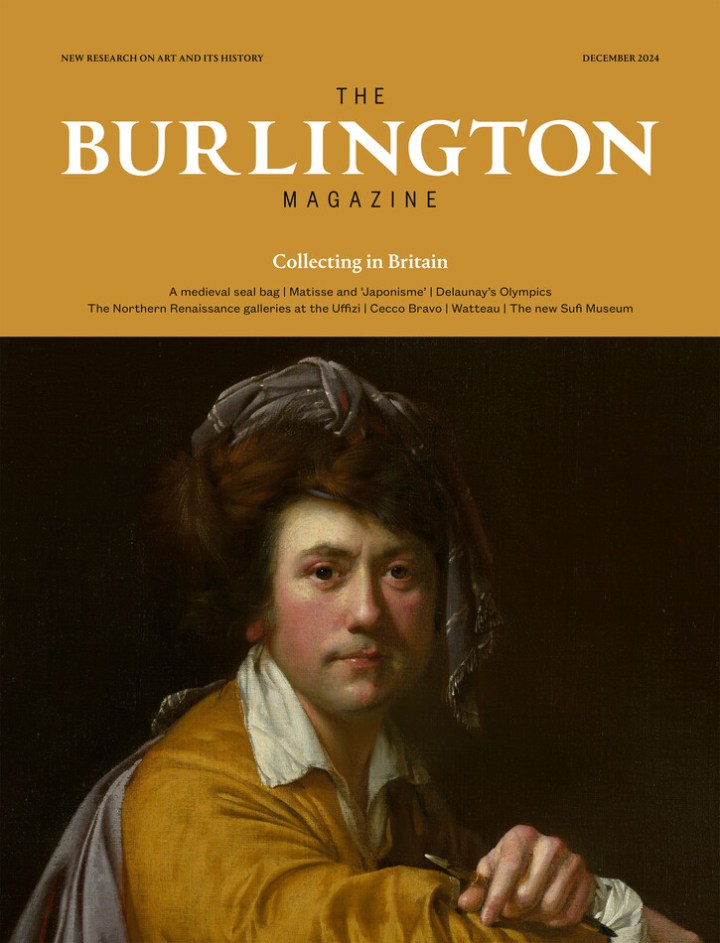 e d i t o r i a l
• “A ‘Grand Life’: Belle da Costa Greene,” pp. 1203–04.
New York’s Morgan Library & Museum was founded as a public institution in 1924 and its centenary this year has been celebrated in style. The most substantial project to form part of the anniversary is the exhibition (25th October–4th May 2025) on Belle da Costa Greene (1879–1950), the museum’s inaugural Director. This is an exercise in fascinating institutional storytelling, but at the same time also considerably more, as Greene was an extraordinary and accomplished figure.
l e t t e r
• Elizabeth Cropper, “Further Notes on boîtes à portrait’,” p. 1205.
A response to Samantha Happé’s article in the October issue of The Burlington: “Portable Diplomacy: Louis XIV’s ‘boîtes à portrait’,” pp. 1036–43.
r e v i e w s
• Richard Rand, Review of the exhibition Revoir Watteau: Un comédien sans réplique. Pierrot, dit le ‘Gilles’ (Louvre, 2024–25), pp. 1238–40.
• Gauvin Alexander Bailey, Review of the exhibition Paris through the Eyes of Saint-Aubin (The Metropolitan Museum of Art, 2024-25), pp. 1249–50.
• Denise Amy Baxter, Review of the exhibition The Legacy of Vesuvius: Bourbon Discoveries on the Bay of Naples (Meadows Musem, 2024), pp. 1251–53.
• Camilla Pietrabissa, Review of the exhibition catalogue L’arte di tradurre l’arte: John Baptist Jackson incisore nella Venezia del Settecento, ed. by Orsola Braides, Giovanni Maria Fara, and Alessia Giachery (Biblioteca Marciana, 2024), pp. 1270–72.
The British printmaker John Baptist Jackson was active in Venice from 1731 to 1745.
• Tom Stammers, Review of Oliver Wunsch, A Delicate Matter: Art, Fragility, and Consumption in Eighteenth-Century France (Pennsylvania State University Press, 2024), pp. 1285–86.
o b i t u a r y
• Simon Jervis, Obituary for Georg Himmelheber (1929–2024), pp. 1287–88.
A pioneering historian of furniture and a curator at Karlsruhe and Munich, Georg Himmelheber was also a founder member of the Furniture History Society; although his expertise encompassed many periods and styles, he was perhaps best known for his work on ‘Biedermeier’ furniture.
s u p p l e m e n t
• “Acquisitions by Public Collections across the UK (2013–23) Made Possible by the Acceptance in Lieu of Tax and Cultural Gifts Schemes,” pp. 1289ff.
The Burlington Magazine, November 2024
The long 18th century in the November issue of The Burlington:
The Burlington Magazine 166 (November 2024)
e d i t o r i a l
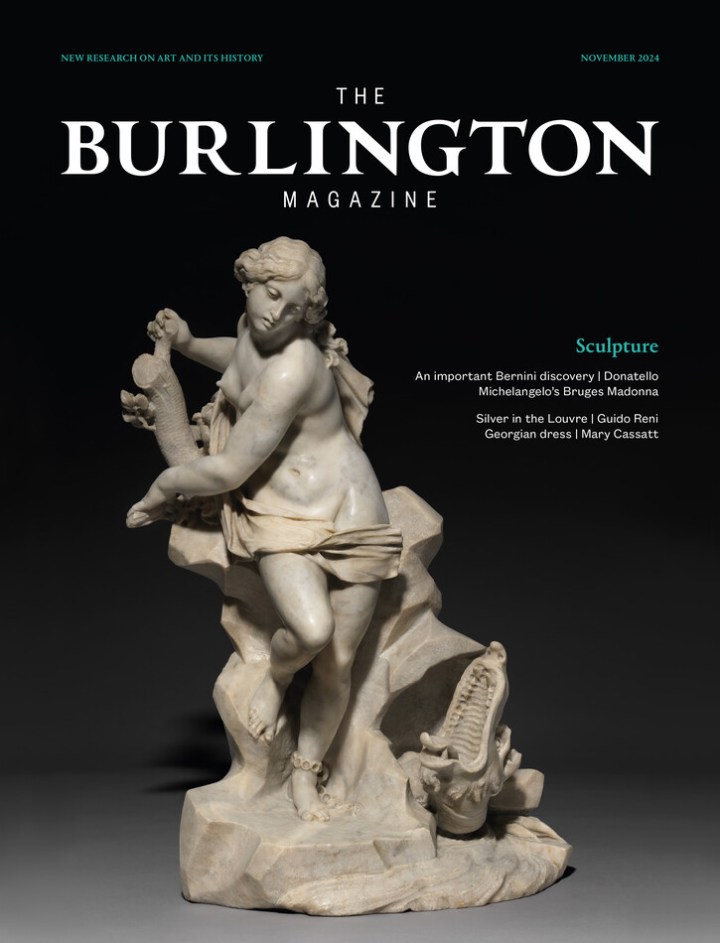 “The Life Cycle of Art History,” p. 1099.
Art history is withering. Art history is flourishing. Which of these statements is true? Very mixed impressions can be gathered from across the United Kingdom, where the future health and reach of the academic discipline is far from clear. Amid all this uncertainty, however, there are some inspiring developments that should be applauded.
a r t i c l e s
• Maichol Clemente, “‘Une pièce fort singulière’: The Rediscovery of Gian Lorenzo Bernini’s Andromeda and the Sea Monster,” pp. 1100–22.
An important early sculpture by Gian Lorenzo Bernini, Andromeda and the Sea Monster, is here attributed to him and published for the first time. It displays all the finesse and invention that characterises the work of his youth and is also notable for having been offered to Jean-Baptiste Colbert, First Minister of Louis XIV, before forming part of the collection of the Prince of Soubise [in the eighteenth century.]
r e v i e w s
• William Barcham, Review of the exhibition catalogue, Les Tiepolo: Invention et Virtuosité à Venise, edited by Hélène Gasnault with Giulia Longo and a contribution by Catherine Loisel (Beaux-Arts de Paris, 2024), pp. 1176–78.
• Erin Griffey, Review of the exhibition catalogue, Style & Society: Dressing the Georgians, by Anna Reynolds (Royal Collection Trust, 2023), pp. 1178–80.
• Philippa Glanville, Review of the catalogue of the Louvre’s silverware, Orfèvrerie de la Renaissance et des temps modernes: XVIe, XVIIe et XVIIIe siècles: La Collection du Musée du Louvre, by Michèle Bimbenet-Privat, Florian Doux, and Catherine Gougeon, with Philippe Palasi, 3 volumes (Éditions Faton, 2022), pp. 1186–87.
• Giulio Dalvit, Review of the catalogue, Galleria Borghese: Catalogo Generale I: Scultura Moderna, edited by Anna Coliva with Vittoria Brunetti (Officina Libraria, 2022), pp. 1192–93.
• Gauvin Alexander Bailey, Collective Creativity and Artistic Agency in Colonial Latin America, edited by Maya Stanfield-Mazzi and Margarita Vargas-Betancourt (University of Florida Press, 2023), pp. 1193–94.
• Charles Avery, Review of Die Bronzen des Massimiliano Soldani Benzi (1656–1740): Representationsstrategien des europäischen Adels um 1700, by Carina Weißmann (De Gruyter, 2022), p. 1195.
• Pierre Rosenberg, Review of the catalogue, French Paintings 1500–1900: National Galleries of Scotland, by Michael Clarke and Frances Fowle, 2 volumes (National Galleries of Scotland, 2023), pp. 1196–97.
The Burlington Magazine, October 2024
The long 18th century in the October issue of The Burlington:
The Burlington Magazine 166 (October 2024)
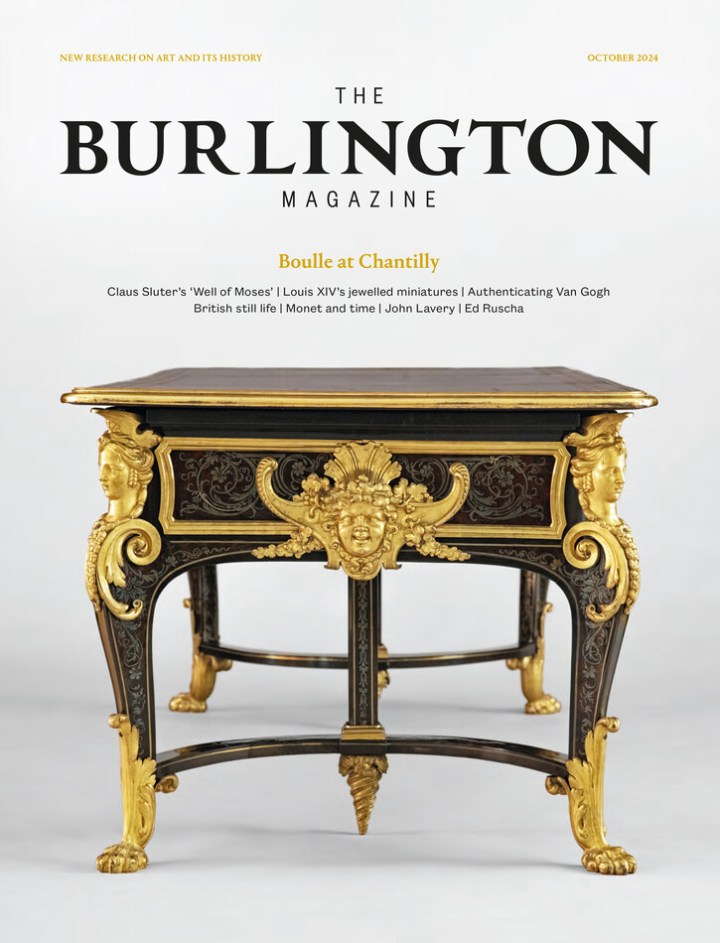 e d i t o r i a l
• “Restoring the ‘belle époque’,” pp. 995–96.
The Musee Jacquemart-André is a treasure house that graces the Haussmann boulevards in Paris and is perhaps not nearly as well-known as it should be. The recent re-opening of the museum on 6th September, following a period of closure for conservation, therefore provides a welcome opportunity to draw fresh attention to this most romantic and beguiling of collections and the elegant building that houses it.
a r t i c l e s
• Jacob Willer, “Annibale Carracci and the Forgotten Magdalene,” pp. 1028–35.
A painting the collection of the National Trust at Kedleston Hall, Derbyshire, is published here as a work of Annibale Carracci’s maturity. Related to comparable compositions which derive from it, in collections in Rome and Cambridge, it was acquired in Florence in 1758 for the 1st Baron Scarsdale.
• Samantha Happé, “Portable Diplomacy: Louis XIV’s ‘boîtes à portrait’,” pp. 1036–43.
Louix XIV’s ambitious and carefully orchestrated diplomatic programme included gifts of jewelled miniature portraits known as ‘boîtes à portrait’. Using the ‘Présents du Roi’, the circumstances around the commissioning and creation of these precious objects can be explored and a possible recipient suggested for a well-preserved example now in the Musée du Louvre, Paris.
r e v i e w s
• Alexander Collins, Review of the exhibition André Charles Boulle (Musée Condé, Château de Chantilly, 2024), pp. 1056–59.
• Claudia Tobin, Review of the exhibition The Shape of Things: Still Life in Britain (Pallant House Gallery, 2024), pp. 1067–69.
Helen Hillyard, Review of of the recently renovated galleries of the Barber Institute of Fine Arts, Birmingham, pp. 1077–79.
• Colin Thom, Review of Steven Brindle, Architecture in Britain and Ireland, 1530–1830 (Paul Mellon Centre, 2024), pp. 1080–81.
• Christopher Baker, Review of Bruce Boucher, John Soane’s Cabinet of Curiosities: Reflections on an Architect and His Collection (Yale University Press, 2024), pp. 1087–88.
o b i t u a r y
• Christopher Rowell, Obituary for Alastair David Laing (1944–2024), pp. 1094–96.
Although renowned in particular for his expertise on the art of François Boucher, Alastair Laing had very wide-ranging art historical taste and knowledge, which he shared with great generosity of spirit. He curated some important exhibitions and brought scholarly rigour to his inspired custodianship of the art collections of the National Trust.
Print Quarterly, September 2024
The long eighteenth century in the latest issue of Print Quarterly:
Print Quarterly 41.3 (September 2024)
a r t i c l e s
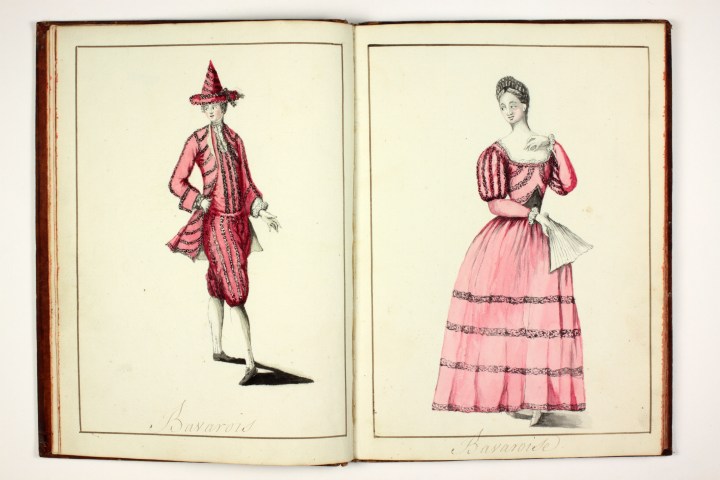
Anonymous artist, A Bavarian Man and A Bavarian Woman, ca. 1759, watercolour, 269 × 190 mm (Welbeck, Nottinghamshire: Welbeck Abbey).
• Derek Adlam and Maureen Cassidy-Geiger, “The Duke of Portland’s Album of Masquerade Costumes Worn in Warsaw in 1759”, pp. 268–84.
This article examines an album of watercolours in the library of the Dukes of Portland at Welbeck Abbey near Worksop, Nottinghamshire, depicting costumed figures and the print sources that inspired them. Seemingly related to the Polish masked balls and banquets mounted in Warsaw on 26 and 27 February 1759 by Jerzy August Mniszech (1715–78), King August III, the album is closely related to imagery seen in Abraham a Sancta Clara’s Neu-eröffnete Welt-Galleria (Nuremberg, 1703), among others, listed in an Appendix at the end of the article. Its commission and creator remain unknown.
n o t e s a n d r e v i e w s
• Daniel Godfrey, Review of Anna Marie Roos, Martin Lister and his Remarkable Daughters: The Art of Science in the Seventeenth Century (Bodleian Library, 2019), pp. 313–16.
• Antoinette Friedenthal, Review of Erminia Gentile Ortona, Le Lettere di Pierre-Jean Mariette ‘Eccellente nella Intelligenza delle Tre Arti’ a Giovanni Gaetano Bottari. Il Codice 1606 (32-E-27) della Biblioteca dell’Accademia Nazionale dei Lincei e Corsiniana (Bardi Edizioni and Accademia Nazionale dei Lincei, 2022), pp. 316–19.

Letitia Byrne, Title-Page to the series ‘Animals’, 1795, etching, 145 × 181 mm (London: British Museum).
• Andaleeb Badiee Banta, Review of Artemis Alexiou and Rose Roberto, eds., Women in Print 1: Design and Identities (Peter Lang, 2022) and Caroline Archer-Parré, Christine Moog and John Hinks, eds., Women in Print 2: Production, Distribution and Consumption (Peter Lang, 2022), pp. 319–20.
• Antony Griffiths, Review of Nigel Tattersfield, Dealing in Deceit: Edwin Pearson of the ‘Bewick Repository Bookshop’, 1838–1901 (The Bewick Society, 2020), pp. 320–21.
• Suzanne Boorsch, Review of Arianna Quaglio, Linda Schädler and Patrizia Keller, eds., From Albrecht Dürer to Andy Warhol: Masterpieces from the Graphische Sammlung ETH Zürich (MASI Lugano and Graphische Sammlung ETH Zürich, 2023) and Elizabeth Nogrady and Alyx Raz, eds., Making & Meaning: The Frances Lehman Loeb Art Center / Vassar College (Hirmer, 2023), pp. 327–30.
• Rena Hoisington, Review of Edouard Kopp, Elizabeth Rudy and Kristel Smentek, eds., Dare to Know: Prints and Drawings in the Age of the Enlightenment (Harvard Art Museums, 2022), pp. 346–50.
• Tim Clayton, Review of Allison Stagg, Prints of a New Kind: Political Caricature in the United States, 1789–1828 (Pennsylvania State University Press, 2023), pp. 351–54; recipient of Ewell L. Newman Book Award from the American Historical Print Collectors Society.
b o o k s r e c e i v e d
• Clarissa von Spee and Yiwen Liu, eds., China’s Southern Paradise: Treasures from the Lower Yangzi Delta (Cleveland Museum of Art, 2024), pp, 340–41.
• Iris Brahms, ed., Marginale Zeichentechniken: Pause, Abklatsch, Cut&Paste als ästhetische Strategien in der Vormoderne (De Gruyter, 2022), p. 341. The book explores ‘marginal drawing practices’ through a collection of essays focusing on works on paper from the sixteenth to eighteenth centuries.
The Burlington Magazine, August 2024
The long 18th century in the August issue of The Burlington—and special thanks to The Burlington for making Rosalind Savill’s article available to Enfilade readers for free.
The Burlington Magazine 166 (August 2024) — Decorative Arts
a r t i c l e s

Unidentified artist, Portrait of Paul Crespin, ca.1726, oil on canvas laid on board, 114 × 90 cm (London: Victoria and Albert Museum).
• Lucy Wood and Olivia Fryman, “The 1st Duke of Devonshire’s ‘Queen Mary’ Beds at Devonshire House, Chatsworth, and Hardwick Hall,” pp. 780–809.
In 1696 the 1st Duke of Devonshire purchased two beds that had belonged to Mary II, one of which was made by Louis XIV’s upholsterer, Simon Delobel. Documents and fragments of its crimson velvet embroidered hangings record a lost example of Stuart state furniture of the highest quality.
• Stefano Rinadli, “Six Horses for the King of Poland: Making and Staging a Diplomatic Gift at the Court of Louis XIV,” pp. 810–25.
In July 1715 Augustus the Strong of Saxony-Poland received a splendid present from the Sun King: a team of six Spanish stallions, each equipped with embroidered trappings and a pair of elaborate flintlock holster pistols. Documents published here for the first time help establish the gift’s political context and chronology and provide detailed insight into the payment and the identity of all the craftsmen involved.
• Teresa Leonor M. Vale, “Eighteenth-Century English Silver for King João V of Portugal,” pp. 826–33.
João V of Portugal acquired works of art from Rome and Paris; analysis of diplomatic correspondence illustrates how he also commissioned objects from Britain in the 1720s, notably spectacular examples of silverware. These included and exceptionally large and renowned silver-gilt bath by Paul Crespin, the Huguenot silversmith who lived and worked in Soho, London.

Detail of the bottom tray of worktable mounted with two trays, attributed to Bernard II van Risenburgh, ca.1761–63. Table: wood, green varnish and gilt-bronze mounts, 68.6 × 36.8 × 30.5 cm; trays: Sèvres soft-paste porcelain, green ground, enamel colours and gilding, 32 × 26 cm (New York: Metropolitan Museum of Art, 58.75.45).
• Rosalind Savill, “From Storeroom to Stardom: The Revelations of Two Sèvres Porcelain Trays,” pp. 834–47.
Two porcelain trays set into a Rococo table in the early 1760s, now in the Metropolitan Museum of Art, New York, are reassessed and here confirmed as Sèvres. Their subjects are probably the family of the Marquis de Courteille, Louis XV’s representative at the porcelain factory, and their intimate representation in this manner is almost unique in eighteenth-century Sèvres.
The full article is available for free here»
r e v i e w s
• Elizabeth Savage, Review of two exhibition catalogues: Edina Adam and Julian Brooks, with an essay by Matthew Hargraves, William Blake: Visionary (J. Paul Getty Museum, 2020); and David Bindman and Esther Chadwick, eds., William Blake’s Universe (Philip Wilson Publishers, 2024), pp. 862–65.
• John Pinto, Review of the exhibition catalogue, John Marciari, Sublime Ideas: Drawings by Giovanni Battista Piranesi (Paul Holberton Publishing, 2023), pp. 865–67,
• Gauvin Alexander Bailey, Review of the exhibition catalogue, Rosario Inés Granados, ed., Painted Cloth: Fashion and Ritual in Colonial Latin America (University of Texas Press, 2022), pp. 867–69.
• Camilla Pietrabissa, Review of the exhibition catalogue, Anita Viola Sganzerla and Stephanie Buck, eds., Connecting Worlds: Artists and Travel (Paul Holberton Publishing, 2023), pp. 870–72.
• Giullaume Kientz, Review of the exhibition catalogue, Víctor Nieto Alcaide, ed., Goya: La ribellione della ragione (ORE Cultura, 2023), pp. 872–74.
• Timothy Wilson, Review of Marino Marini, Maiolica and Ceramics in the Museo Nazionale del Bargello, translated by Anna Moore Valeri (Allemandi, 2024), pp. 876–77.
• J. V. G. Mallet, Review of Caterina Marcantoni Cherido, Maioliche italiane del Rinascimento (Fondazione Musei Civici di Venezia, 2022), pp. 877–79.
• Aurora Laurenti, Review of Esther Bell, Pauline Chougnet, Sarah Grandin, Charlotte Guichard, Corinne Le Bitouzé, Anne Leonard, and Meredith Martin, Promenades on Paper: Eighteenth-Century French Drawings from the Bibliotheque nationale de France / Promenades de papier: Dessins du XVIIIe siècle des collections de la Bibliothèque nationale de France (Clark Art Institute and BnF Editions, 2023), pp. 883–84.
• Clare Hornsby, Review of Christopher M.S. Johns, Tommaso Manfredi, and Karin Wolfe, eds., American Latium: American Artists and Travelers in and around Rome in the Age of the Grand Tour (Accademia Nazionale di San Luca, 2023), pp. 884–86.
• Lydia Hamlett, Review of John Laycock, William Kent’s Ceiling Paintings at Houghton Hall (Houghton Arts Foundation, 2021), p. 887.
• Lin Sun, Review of Shane McCausland, The Art of the Chinese Picture-Scroll (Reaktion Books, 2023), pp. 887–88.
The Magazine of the Decorative Arts Trust, Summer 2024
The Decorative Arts Trust has shared select articles from the summer issue of their member magazine as online articles for all to enjoy. The following articles are related to the 18th century:
The Magazine of the Decorative Arts Trust, Summer 2024
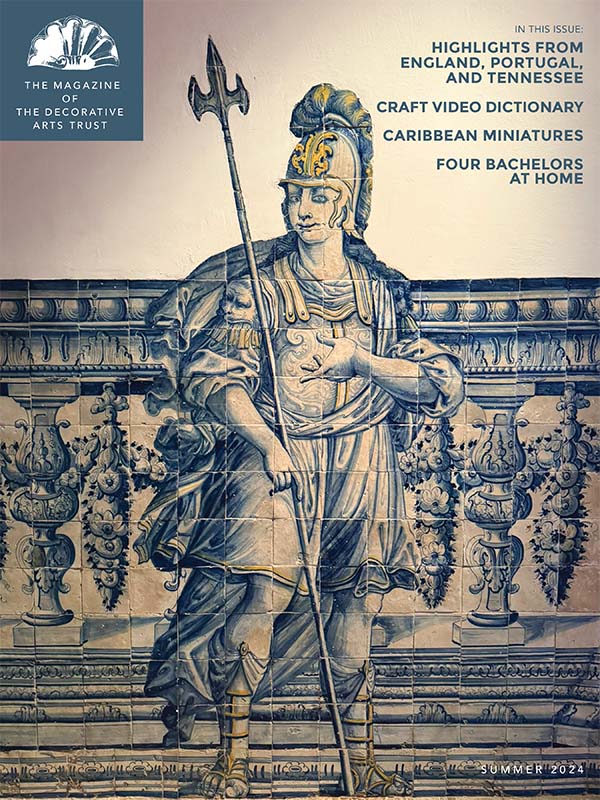 • “A Primer on Portugal” by Matthew A. Thurlow Link»
• “Saltram’s Saloon: Adam, Chippendale, and Reynolds in England’s West Country” by Catherine Carlisle Link»
• “Understanding Craft: A New Digital Tool Debuts” by Emily Zaiden Link»
• “Art and Imagination in Spanish America, 1500–1800: Highlights from LACMA’s Collection” by the Saint Louis Art Museum Link»
• “Painted Walls: New Virtual Museum Offers an Immersive Experience” by by Margaret Gaertner and Kathleen Criscitiello Link»
• “Seafaring Portraits in Bermuda and the Atlantic Basin” by Damiët Schneeweisz Link»
• “Summer Reading Recommendation: Ceramic Art” by Jessie Dean Link»
The printed Magazine of the Decorative Arts Trust is mailed to Trust members twice per year. Memberships start at $50, with $25 memberships for students.
Pictured: The magazine cover features a detail of wall tile from the stair hall of the Palácio Azurara in Lisbon, home of the Fundação Ricardo do Espírito Santo Silva’s decorative arts museum. Bartholomeu Antunes, Tile with the Figure of a Praetorian Guard, 1730–40, Lisbon. Earthenware tile with blue and yellow decoration.
The Burlington Magazine, June 2024
Summer is for falling behind . . . and for catching up . . . The long 18th century in the June issue of The Burlington:
The Burlington Magazine 166 (June 2024)
e d i t o r i a l
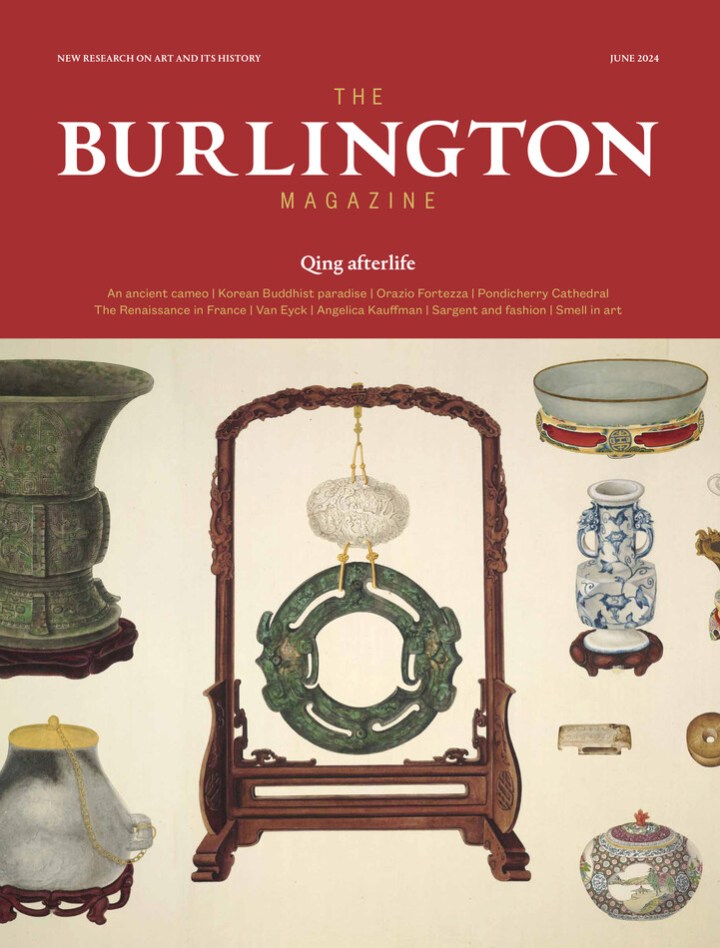 • “La Serenissima,” p, 543.
Henry James famously wrote in his Italian Hours (1909) that there is nothing more to be said about Venice. As so much ink has been spilt over its charms you can see his point. However, James then proceeded to rhapsodise at length about its beauty; and it is imperative that we, similarly, keep talking and writing and championing it, not least because all that it represents seems to be more precious and precarious than ever.
a r t i c l e s
• Ittai Gradel, “Nothing To Do with Menander: A Rediscovered Roman Cameo from the Caylus Collection,” pp. 546–53.
A Roman cameo published in 1752, but since lost, has been rediscovered. It shows actors rehearsing The Pimp by Posidippus, who portrait is included on the cameo. All other identifiable scenes of comedies in Roman art depict plays by Menander, the most popular Greek comic poet on the Roman stage.
• Gauvin Alexander Bailey, “The Cathedral of Notre-Dame-de-la-Conception, Pondicherry,” pp. 580–95.
When the cathedral at Pondicherry, the most ambitious in French India, was begun in 1771, its anonymous designer was obliged to make allowance for separation of the castes, despite a papal edict that they must attend public worship together. The cathedral was completed with the construction of its west facade in 1788–91; its design was based on seventeenth-century Parisian models and is here attributed to the engineer-architect François-Anne-Maire Rapine de Saxy.
• Ricarda Brosch, “The Art of Qing Imperial Afterlife: The Pictures of Ancient Playthings (Guwantu 古玩圖) Revisited,” pp. 596–611.
Two magnificent eighteenth-century handscrolls depict myriad precious objects made of jade, bronze, porcelain, glass, and bamboo. A novel interpretation of their function suggests that the illustrations were originally for wall decorations and remounted as scrolls for the Yongzheng Emperor’s tomb. The paintings’ remediation and repurposing offer a compelling example of the art of Qing imperial afterlife.
r e v i e w s

• Johnny Yarker, Review of the exhibition Angelica Kauffman (London: Royal Academy of Arts, 2024), pp. 620–23.
• William Barcham, Review of Martin Gayford, Venice: City of Pictures (Thames & Hudson, 2023), p. 653.
• Lianming Wang, Review of Henriette Lavaulx-Vrécourt and Niklas Leverenz, Berliner Schlachtenkupfer: 34 Druckplatten der Kaiser von China / Berlin Battle Engravings: 34 Copperplates for the Emperors of China (Deutscher Kunstverlag, 2021), pp. 654–55.
• Amina Wright, Review of Frédéric Ogée, Thomas Lawrence: Le génie du portrait anglais (Cohen & Cohen, 2022), pp. 655–56.
• Barry Bergdoll, Review of Didem Ekici, Patricia Blessing, Basile Baudez, eds., Textile in Architecture: From the Middle Ages to Modernism (Routledge, 2023), pp. 662–63.










leave a comment