Oxford Art Journal, March 2024
In the latest issue of the Oxford Art Journal:
Oxford Art Journal 47.1 (March 2024), published June 2024.
a r t i c l e s
 • Matthew C. Hunter and Avigail Moss, “Art and the Actuarial Imagination: Propositions,” pp. 1–12.
Noting insurance’s importance will hardly come as a surprise to curators, artists, conservators, and others concerned with current practices of exhibiting art. “Art insurance,” as one commentator observes, “is huge business and not least now that artworks move around the world in far greater volume and frequency than ever before.”6 Similarly, insurance and its extensive profiteering—from the trade in enslaved peoples to its biopolitical work in capitalist modernity—have been powerfully thematised by Cameron Rowland, Rana Hamadeh, and numerous other contemporary artists (Fig. 1).7 Yet, academic art history has been conspicuously slow to reckon with insurance’s force, functions, and fictions. This special issue is meant less as a reprimand for that blind spot than as a prompt to disciplined conversation. Drawing primarily upon the archive of European and North American art practices from the eighteenth century to the present, we mean to agitate for greater attention to how, when, where, and why insurance has come to penetrate art’s making, moving, showing, selling, storing, and being.
• Nina Dubin, “‘Infidelity, Imposture, and Bad Faith’: Reproducing an Insurance Bubble,” pp. 13–37.
When Grayson Perry commemorated the 2008 financial crisis with an etching titled Animal Spirit, he participated in a longstanding tradition of deploying printed images to satirize and demystify a boom-and-bust economy. More specifically, his print recalls a wave of caricatures that circulated in 1720 amidst a pan-European crash: one precipitated by a bubble in hypothetical commodities, foremost among them shares in joint-stock insurance companies. Produced by a group of Amsterdam-based artists including Bernard Picart, such engravings catered to a public that, already in 1720, viewed the business of insurance as occupying the vanguard of an inscrutable financial culture. Not only do these works exemplify early modern artistic efforts to translate into visual form the abstractions of an increasingly financialized economy. They also critically engage with the insurance operations of print, at a time when engraved reproductions presented themselves as policies that safeguarded works of art from the risks of accident and loss.
• Matthew C. Hunter, “The Sun Is God: Turner, Angerstein, and Insurance,” pp. 39–65.
J. M. W. Turner’s Slavers Throwing Overboard the Dead and Dying—Typhon Coming On (also known as The Slave Ship) is probably the iconic visualization of insurance logic in Western art. Exhibited in 1840, the painting has come to be taken as a meditation on the jettison of one hundred thirty three captives from the slave ship Zong off Jamaica in late 1781, murders notoriously claimed as insurable losses from the ship’s underwriters. Less noted is the pervasive presence of insurance within Turner’s practice and milieu. This article follows the tandem of Turner and John Julius Angerstein (1735–1823), a leading underwriter at Lloyd’s of London and an early patron. It places them within a world of artists’ organizations being remade as political instruments by embracing life insurers’ actuarial tables. It traces the pair into the National Gallery (originally housed in Angerstein’s home) as Turner willed his art to the institution, contingent on the purchase of fire insurance. Revisiting The Slave Ship through this skein of underwriting activity, the article posits the Turner/Angerstein coupling as an instructive moment in insurance’s penetration through the thick of artistic practice.
• Richard Taws, “Charles Meryon’s Graphic Risks,” pp. 67–94.
This article considers the place of risk and fictitious value in the work of French printmaker Charles Meryon. Meryon is best-known for the Eaux-fortes sur Paris, the vertiginous etchings of the city he made between 1850 and 1854. Yet despite his close association with the metropolis, Meryon’s visual world was not limited to the French capital. Previously a sailor, he had travelled widely, notably to the South Pacific, to protect speculative whaling interests in New Zealand. At the peak of his career, in 1855, Meryon designed share certificates for an unrealised Franco-Californian property development company, whose owners commissioned from Meryon a panorama of San Francisco. Meryon’s certificate prints have not been discussed at length in the literature on the artist. In the years following the 1848 Revolution, thousands of French workers emigrated to California, and Meryon’s famous etchings of Paris were made against the backdrop of contemporary enthusiasm for the California Gold Rush; these phenomena should, I suggest, be understood together. Focusing on Meryon’s connections to construction and extraction schemes, lotteries, mass emigration, and insurance, this paper reorients analysis of Meryon’s work away from Paris towards more transnational, transatlantic networks of people and things. Reviewing Meryon’s practice in the light of these works, I argue that they illuminate an actuarial imagination at work.
• Ross Barrett, “Sculpting the ‘Idea of Insurance’: John Quincy Adams Ward’s Protection Group and the Rise of the American Life Sector,” pp. 95–115.
This essay examines John Quincy Adams Ward’s Protection Group (1871), a now-lost sculpture that ornamented the original New York headquarters of the Equitable Life Assurance Society, as a complex cultural response to the array of public relations problems that its patron and the broader life insurance sector faced in the decades after the Civil War. Adopted as a company logo at the very moment that the Equitable took steps to expand its insurance portfolio and extend the geographic range of its operations, the Protection Group outlined an imaginative allegory of indemnification that explained the benefits of the company’s policies, popularized actuarial conceptions of status, risk, and uncertainty, and set the terms for a wave of cultural promotions and rebranding efforts that would be undertaken by American life companies in the decades that followed. Tracing the work that the Protection Group did to smooth the way for the Equitable’s development into a multinational insurer and inure turn-of-the century consumers to the financial products and risk sensibilities of the life sector, this essay sheds new light on the pivotal contributions that academic sculptors made to the development of the modern US life insurance industry.
• Avigail Moss, “Ars Longa,Vita Brevis: The Fine Art & General Insurance Company, Ltd,” pp. 117–40.
In late-nineteenth-century Britain, artworks circulated widely between exhibitions, institutions, and marketplaces, increasing the risks of destruction and loss. Administrators, artists, and collectors offset these risks by turning to a key incidental service in capitalism: insurance. But how did artworks and artifacts test insurance underwriters’ capacities? And how did the insurance world impact the art world? This article introduces the Fine Art & General Insurance Company, Ltd, a firm established in London in 1890. As a unique collaboration between art workers and powerful City merchants and underwriters, the company operated for nearly a century, insuring works that travelled to international and domestic expositions, and underwriting collections like the National Gallery’s Chantrey Bequest. With branches and agents stationed in global metropoles, and with ties to the broader British imperium, the company was a key, if inconspicuous, power broker and proxy on the global cultural stage. As an economic and aesthetic gatekeeper, the company also adjudicated on the artworks it perceived to be acceptable risks, and I argue that by analysing its early activities we gain insight into the ways that art insurance—an inherently collective and even speculative activity—was already affecting art’s ecosystems before the twentieth century.
• Sophie Cras, “Art and Insurance after the Era of Statistics,” pp. 141–57.
This article focuses on two artworks made in 2010 by two French artists of different generations: Christian Boltanski’s The Life of C.B. and Julien Prévieux’s Les connus connus, les inconnus connus et les inconnus inconnus. Both resulted from the collaboration between the artist and an actuary-mathematician, at a time when the theoretical, technical and professional assumptions about statistics-based insurance were deeply shaken by the emergence of so-called ‘big data’ and ‘global catastrophic risks’. This vacillation is perceptible in the artists’ choices to represent—and make use of—quantitative, actuarial knowledge. Boltanksi’s video work stages the transformations of life insurance under the data deluge produced by connected technologies of ‘quantified self’. Prévieux’s sound installation displays the techniques of prospective actuarial imagination, when experts mix fact and fiction so as to quantify global catastrophic risks that exceed our capacities to foresight. Therefore, instead of showcasing the implacable efficiency of data-driven technologies, both artists humorously emphasize their inadequacy in the chain of knowledge, prediction, and action.
b o o k r e v i e w s
• Arie Hartog, “Viewing Broken Things: Review of Stacy Boldrick, Iconoclasm and the Museum (Routledge, 2020),” pp. 159–62.
• Ty Vanover — The Spectacle of Crime: Review of Frederic Schwartz, The Culture of the Case: Madness, Crime, and Justice in Modern German Art (The MIT Press, 2023),” pp. 162–66.
• Jennifer Sichel — A Feminist Queering: Review of Julia Bryan-Wilson, Louise Nevelson’s Sculpture: Drag, Color, Join, Face (Yale University Press, 2023),” pp. 166–68.
Abstracts
Notes on Contributors
The Burlington Magazine, May 2024
From the May issue of The Burlington, which is dedicated to French art — and please note that Yuriko Jackall’s important article is currently available for free, even without a subscription.
Burlington Magazine 166 (May 2024)

Jean-Honoré Fragonard, The Swing, 1767, oil on canvas, 81 × 64 cm (London: Wallace Collection).
a r t i c l e s
• Ludovic Jouvet, “A Medal of the Sun King by Claude I Ballin,” pp. 440–45.
• Yuriko Jackall, “The Swing by Jean-Honoré Fragonard: New Hypotheses,” pp. 446–69.
• Thadeus Dowad, “Dāvūd Gürcü, Ottoman Refugee, and Girodet’s First Mamluk Model,” pp. 479–87.
• Humphrey Wine, “The Paintings Collection of Denis Mariette,” pp. 488–92.
r e v i e w s
• Richard Stemp, Review of Ingenious Women: Women Artists and their Companions (Hamburg: Bucerius Kunst Forum / Basel: Kunstmuseum, 2023–24), pp. 501–04.
• Christoph Martin Vogtherr, Review of Louis XV: Passion d’un roi (Château de Versailles, 2022), pp. 508–10.
• Eric Zafran, Review of The Hub of the World: Art in Eighteenth-Century Rome (Nicholas Hall, 2023), pp. 515–18.
• Saffron East, Review of Black Atlantic: Power, People, Resistance (Cambridge: Fitzwilliam, 2023), 523–25.
• Gauvin Alexander Bailey, Review of Marsely Kehoe, Trade, Globalization, and Dutch Art and Architecture:
Interrogating Dutchness and the Golden Age (Amsterdam UP, 2023), pp. 534–35.
• Helen Clifford, Review of Vanessa Brett, Knick-Knackery: The Deards’ Family and Their Luxury Shops, 1685–1785 (2023) pp. 535–37.
o b i t u a r y
• Michael Hall, Obituary for Jacob Rothschild (1936–2024), pp. 538–40.
One of the leading public figures in the arts in the United Kingdom, Lord Rothschild was a major collector of historic art and a patron of contemporary artists and architects. His principal focus was Waddesdon Manor, his family’s Victorian country house and estate in Buckinghamshire.
◊ ◊ ◊ ◊ ◊
Jean-Honoré Fragonard was one of the supreme exponents of the French Rococo style and his painting The Swing in the Wallace Collection, London, is perhaps his most famous work. Yet despite this elevated status, mystery surrounds its origins. New documentary and technical research presented here by Yuriko Jackall may, however, have finally established for whom it was painted and why the painting was hidden away for the first few years of its existence.
The May issue also includes the publication by Ludovic Jouvet of a previously unknown and spectacular medal of the Sun King, Louis XIV, as well as Humphrey Wine’s study of the intriguing collection of the publisher Denis Mariette (the uncle of the more famous Pierre-Jean Mariette). Other articles feature the work of French Romantic painters: Andrew Watson establishes the early history of Delacroix’s The Death of Sardanapalus in the Musée du Louvre, Paris, and Thadeus Dowad identifies Girodet’s first Mamluk model.
Exhibition reviews include Sarah Whitfield discussing Bonnard’s Worlds (Kimbell Art Museum, Fort Worth, and the Phillips Collection, Washington) and Lisa Stein assessing Saul Leiter (MK Gallery, Milton Keynes). Catalogue reviews feature Christoph Martin Vogtherr on Louis XV, Lunarita Sterpetti on Eleonora of Toledo, and Eric M. Zafran surveying art in eighteenth-century Rome. Meanwhile, an impressive and wide range of new books are examined: these feature Megan McNamee on diagrams in medieval manuscripts, Christine Gardner-Dseagu on photographing Pompeii and Richard Thomson on Henry Lerolle.
◊ ◊ ◊ ◊ ◊
Note (added 31 July 2024) — The posting was updated to include additional content.
Print Quarterly, June 2024
The long eighteenth century in the latest issue of Print Quarterly:
Print Quarterly 41.2 (June 2024)
a r t i c l e s
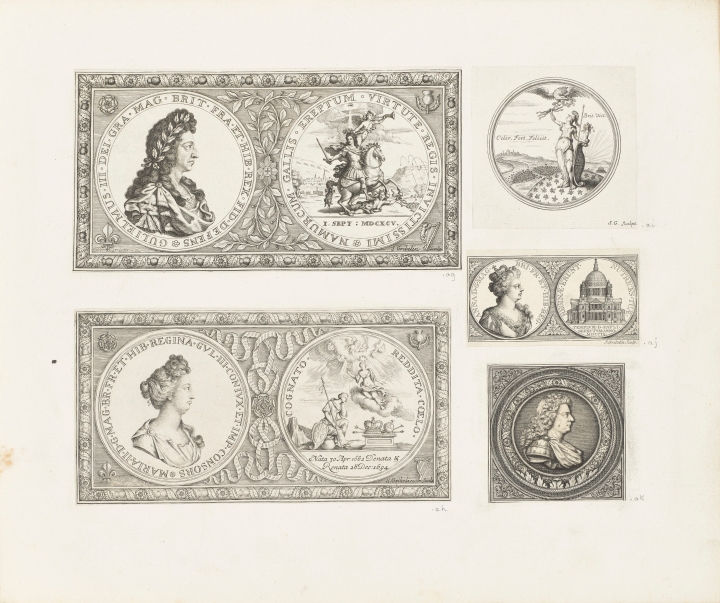
Simon Gribelin, A Medal of William III Commemorating the Fall of Namur, 1695 and other engravings, in the Works of Gribelin album, sheet 311 × 372 mm (Windsor Castle, Royal Collection. Image Royal Collection Trust / © His Majesty King Charles III 2023).
• Rhian Wong, “Simon Gribelin’s Presentation Albums,” pp. 157–71.
The article examines two previously unpublished presentation albums in the Royal Collection, compiled by the engraver Simon Gribelin (1661–1733). The Works of Gribelin album was compiled in 1715 for George II (when Prince of Wales), while an album of prints of the ceiling of the Banqueting House, London was presented around 1720 to George I. A consideration of the contents of the Works of Gribelin album reveals that Gribelin followed a deliberate programme for the arrangement of its contents. The article looks at the purpose of the albums and places their creation in the context of four other albums known to have been assembled by Gribelin.
n o t e s a n d r e v i e w s
• Galina Mardilovich, Review of Julia Khodko, Peterburg Mikhaila Makhaeva. Grafika I zhivopis’ vtoroi poloviny XVIII veka (The State Russian Museum, 2022), pp. 183–85. This is the catalogue for an exhibition addressing the drawings (and resulting prints) of St Petersburg made by Mikhail Makhaev (1717–1770).
• Shijia Yu, Review of The Art of the Deal (Daniel Crouch Rare Books, 2023), pp. 185–87. This is catalogue of the playing card collection assembled by the Dutch collector Frank van den Bergh.
• Thea Goldring, Review of Esther Bell, Sarah Grandin, Corinne Le Bitouzé, and Anne Leonard, Promenades on Paper: Eighteenth-Century French Drawings from the Bibliothèque National de France (Yale University Press, 2022), pp. 188–90.
• Joanna Sheers Seidenstein, Review of Amy Golahny, Rembrandt’s Hundred Guilder Print (Lund Humphries, 2021), pp. 221–26. Includes the reception history of the print, and the section on William Baillie’s restrikes in the 1770s is relevant.
Print Quarterly, March 2024
The long eighteenth century in the latest issue of Print Quarterly:
Print Quarterly 41.1 (March 2024)
a r t i c l e s
• Przemysław Wątroba, “Jacques Rigaud’s Drawings in Warsaw of the Residences of Louis XIV,” pp. 23–32.
“In the collection of the last king of Poland, Stanisław August Poniatowski (1732–98), kept in the Print Room of the University of Warsaw Library, there is a renowned volume titled Recueil choisi des plus belles vues des palais et maisons royales de Paris et des environs containing a series of 106 engravings by Jacques Rigaud (1681–1754). . . . A set eight hitherto unpublished drawings by Rigaud [also in Warsaw and] formerly kept in Portfolio 174 are here presented as designs” for eight of the prints (23, 25).
n o t e s a n d r e v i e w s

Seven Creamware Plates, ca. 1808–36, diameters 20–23 cm, transfer-printed with various scenes, clockwise from top: Defoe’s Robinson, Choisy factory; Cervantes’s Don Quixote, Montereau factory; Perrault’s Fairies, Montereau factory; Fontaine’s Fable of the Fox and Grapes, Sèvres factory; Ovid’s Metamorphoses, Judgement of Midas, Choisy factory; Chateaubriand’s Atala Found with Chactus by Father Aubry, Choisy factory; and at centre, Cottin’s Matilda Saved by Malek Adhel, Choisy factory (Germany, Peter-Christian Wegner Collection).
• Marzia Faietti, Review of Heather Madar, ed., Prints as Agents of Global Exchange: 1500–1800 (Amsterdam UP, 2021), pp. 37–39.
• Sheila McTighe, Review of Francesco Ceretti and Roberta D’Adda, eds., Immaginario Ceruti: Le stampe nel laboratorio del pittore (Skira, 2023), pp. 42–43. This catalogue accompanied an exhibition that explored the work of the painter Giacomo Ceruti (1698–1767) and his reliance on printed images. “A complementary show of Ceruti’s paintings, Miseria & Nobiltà: Giacomo Ceruti nell’Europa del Settecento was also held in 2023 at the Museo Santa Giulia in Brescia, followed by a reduced version at the J. Paul Getty Museum, Los Angeles during the second half of that year, Giacomo Ceruti: A Compassionate Eye” (42).
• Natasha Ruiz-Gómez, Review of Rebecca Whiteley, Birth Figures: Early Modern Prints and the Pregnant Body (University of Chicago Press, 2023), pp. 43–45.
• Antony Griffiths, Review of Chiara Travisonni with Luca Fiorentino and Andrea Muzzi, Pietro Giacomo Palmieri (Edifir, 2023), pp. 45–46. This monograph on the draughtsman and printmaker, Pietro Giacomo Palmieri (1737–1804), “will become the definitive source of information” for the artist and his work (46).
• Patricia Ferguson, Review of Peter-Christian Wegner, Literatur auf französischen Steingut-Tellern des frühen 19. Jahrhunderts (Georg Olms, 2022), pp. 46–47. Wegner addresses the popularity of subjects drawn from French literature for transfer-printed ceramics, starting in 1808. “While we await a larger in-depth survey of this engaging material, Wegner’s publication is a huge contribution to its appreciation” (46).
• Elizabeth Savage, Review of Christien Melzer and Georg Josef Dietz, Holzschnitt: 1400 bis heute (Hatje Cantz, 2022), pp. 48–50. This is the catalogue for an exhibition that “featured more than 100 prints from the Kupferstichkabinett [in Berlin], as well as what was effectively the first large-scale display of woodblocks from its enormous yet relatively little-known collection” (50).

Johann Christoph Weigel, Sheet for Découpage with Figures on Cloudlike Landscapes and a Fantastical Bird, c. 1700–25, from album Inventions Chinoises V, handcoloured engraving, 216 x 151 mm (Dresden, Kupferstich-Kabinett).
• Brief notice of Katy Barrett, Looking for Longitude: A Cultural History (Liverpool UP, 2022), p. 76. Rather than a retelling of the familiar story of accurately calculating longitude, this book “is a remarkably well-researched account of the ways in which this long-running sage impacted on many areas of public discourse, thought, and imagery” (76).
• Emanuele Lugli, Review of Miriam Vogelaar, The Mokken Collection: Books and Manuscripts on Fencing before 1800 (MMIT Publishing, 2020), pp. 88–92.
• Nadine Orenstein, Review of Maureen Warren, ed., Paper Knives, Paper Crowns: Political Prints in the Dutch Republic (Champaign: Krannert Art Museum, 2022), 92–96. “Never have these prints been so lavishly presented. The beautifully produced catalogue, winner of the 2023 IFPDA Book Award, exceptionally allocates plenty of space to the images. It allows the reader to see entire works along with accompanying text and provides space for multi-plate productions” (93).
• Maureen Cassidy-Geiger, Review of Cordula Bischoff and Petra Kuhlmann-Hodick, eds, La Chine: Die China-Sammlung Des 18. Jahrhunderts Im Dresdner Kupferstich-Kabinett (Sandstein Verlag, 2021), 97–103. This “is the catalogue of an exhibition at the Dresden State Museum devoted to the Chinese works on paper and European chinoiserie prints acquired by the Saxon Electors before 1750” (97). It “was an ambitious project that took many years to come to fruition and required collaboration between colleagues in different disciplines with different working languages” (102).
Oxford Art Journal, December 2023
The 18th century in the latest issue of the Oxford Art Journal:
Oxford Art Journal 46.3 (December 2023)
a r t i c l e s
• Aaron Wile, “Absolutism, the Royal Body, and the Origins of Mythologie galante: Charles de La Fosse at the Trianon,” pp. 327–55.

Charles de La Fosse, The Rest of Diana, 1688, oil on canvas, 128 × 160 cm (Versailles, Châteaux de Versailles et de Trianon).
Mythologie galante, a sensual mode of mythological painting that is one the defining developments of eighteenth-century French art, is usually associated with aristocratic resistance to Louis XIV. This article examines three mythological paintings created by Charles de La Fosse for one of the king’s pleasure palaces in 1688, long identified as a major turning point towards mythologie galante, in order to reassess the origins and meaning of the genre. Situating the paintings within the long arc of Louis XIV’s representational politics, I propose that the collapse of the fiction of the king’s two bodies during the second half of his reign and the subsequent redefinition of the king’s public and private spheres allowed La Fosse to develop a new mythological idiom based in touch, intimacy, and sentiment. The resulting works contravened painting’s traditional role under absolutism to form royal subjects, redefining it as a medium of sympathetic encounter. La Fosse’s paintings open up, from this perspective, an alternate account of modern art and subjectivity—one that took shape not in opposition to absolutist culture but from its very heart.
• Robert Jones, “Joshua Reynolds and Deafness: Listening, Hearing, and Not Hearing in Eighteenth-Century Portraiture,” pp. 357–77.
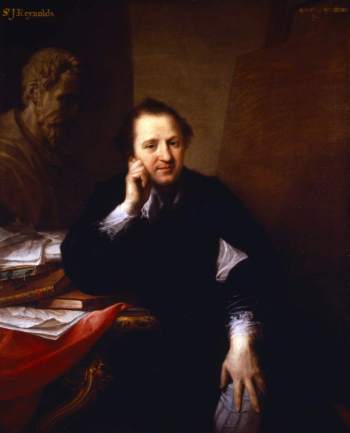
Angelica Kauffman, Portrait of Joshua Reynolds, 1767, oil on canvas, 127 × 102 cm (National Trust, Saltram).
This article examines the significance of deafness in painting and proposes a new trope for the form of picturing undertaken by eighteenth-century art, ‘the listening portrait’. As a first step it recovers and explores the significance of Sir Joshua Reynolds’s own deafness, as represented by his self-portraits as well as images by Nathanial Dance, Angelica Kauffman, and Johan Zoffany. Sound is necessarily absent from painting, audible speech impossible. Having explored these apparent limits (found in eighteenth-century theorizations of art) the essay asks more fundamentally what work is done by the representation of someone striving to listen. By considering this question, it is possible to understand these images as engaging in a more sensitive ethical enquiry concerned with what an aural impairment might mean, and how it is distinct from a refusal or unwillingness to listen. Deafness is consequently shown to be not merely something that paintings show, rather the issue of hearing or not hearing frames their pictorial and moral purpose. Throughout the article recognition of the specificity of Georgian sociability on the one hand, and eighteenth-century artistic theory and practice on the other, seeks to enable the claims of Medical Humanities to recognize previously hidden narratives.
r e v i e w s
• Andrew McClellan, “Purpose, Power, and Possibility: A History of Museums Past and Present,” pp. 493–501.
Review of Krzysztof Pomian, Le musée, une histoire mondiale, 3 volumes (Paris: Gallimard, 2020–22), volume 1: Du trésor au musée, 687 pages, ISBN: 978-2070742370, €35; volume 2: L’ancrage européen, 1789–1850, 546 pages, ISBN: 978-2072924705, €35; volume 3: À la conquête du monde, 1850–2020, 936 pages, ISBN: 978-2072982781, €45.
The Burlington Magazine, December 2023
The eighteenth century in the December issue of The Burlington, which focuses on Spain:
The Burlington Magazine 165 (December 2023)

Francisco de Goya, Self-Portrait with Dr Arrieta, 1820, oil on canvas, 115 × 77 cm (Minneapolis Institute of Art, 52.14).
a r t i c l e
• Mercedes Cerón Peña, “Goya’s Self-Portrait with Dr Arrieta,” pp. 1300–04.
In 1820 Goya painted a portrait of himself as he had appeared during his serious illness of the year before, attended by his doctor, Eugenio García Arrieta. Newly discovered biographical information about Arrieta suggests that the painting’s red and and green colour scheme may allude to the political views he shared with Goya.
r e v i e w s
• Michael Hall, Review of the new Galería de las Colecciones Reales (Royal Collections Gallery) in Madrid (opened 28 June 2023), pp. 1339–43.
• Stephen Lloyd, Review of the exhibition Return of the Gods (World Museum, Liverpool, (April 2023 — February 2024), pp. 1343–45. “Britain’s largest assemblage of Classical sculpture outside London belongs to National Museums Liverpool . . . In 1959 Liverpool City Council and its museums were gifted the entirety of the Ince Blundell collection—approximately six hundred heavily restored Roman marbles . . . collected by . . . Henry Blundell (1724–1810), a wealthy Catholic landowner, between 1776 and 1809.”
• Humphrey Wine, Review of the catalogue raisonné by Joseph Assémat-Tessandier, Louis Lagrenée, dit l’Aîné (1725–1805) (Arthena, 2022), pp. 1364–65.
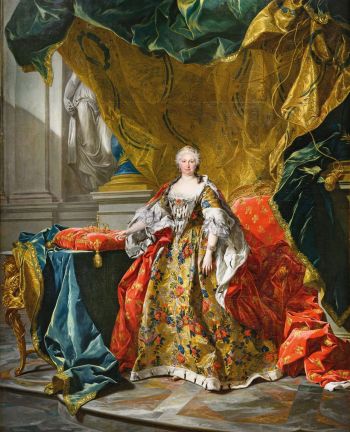
Louis-Michel van Loo, Portrait of Isabel Farnese, 1737, oil on canvas, 341 × 264 cm (Madrid: Galería de las Colecciones Reales).
• Rebeka Hodgkinson, Review of Stephanie Barczewski, How the Country House Became English (Reaktion, 2023), pp. 1370–71.
• Peter Humfrey, Review of Eveline Baseggio, Tiziana Franco, and Luca Molà, eds., La chiesa di Santa Maria dei Servi e la comunità veneziana dei Servi di Maria, secoli XIV–XIX (Viella, 2023), pp. 1374–75. “The demolition of the great fourteenth-century church of the Servi in about 1812–13 represents one of the most grievous of the many losses suffered by Venice’s artistic heritage during the Napoleonic period.”
o b i t u a r y
• Saloni Mathur, Obituary for Kavita Singh (1964–2023), pp. 1379–80.
Professor of art history and Dean of the School of Arts and Aesthetics at Jawaharlal Nehru University, Kavita Singh became internationally known for her publications on the history and politics of museums and the pre-modern art of South Asia. An authority on Indian court paintings, she was an inspiring colleague and teacher who publicly championed both her university and the study of Mughal art in the subcontinent.
Vivliofika, Volume 11 (2023)
This year’s issue of Vivliofika has just been released; in addition to the articles and book reviews noted below, the issue includes sections for obituaries and debates (both in Russian).
Vivliofika: E-Journal of Russian Eighteenth-Century Studies 11 (2023)
Vivliofika (Вивлiоѳика) is the flagship online publication of the Eighteenth Century Russian Empire Studies Association (ECRESA), an affiliate group of the Association for Slavic, Eurasian, and East European Studies (ASEEES). Volume 11 of the journal includes a special forum on “Russo-European Artistic Encounters in the Eighteenth Century,” guest edited by Margaret Samu, which highlights recent research on the Russian art world and its engagement with Western Europe in the eighteenth century. It arose from an online program in September of 2021 hosted by the Historians of Eighteenth-Century Art and Architecture (HECAA).
f o r u m : r u s s o – e u r o p e a n a r t i s t i c e n c o u n t e r s

Ivan Argunov, Portrait of Anna Nikolaevna Kalmykova, 1767, oil on canvas, 62 × 50 cm (Moscow: Kuskovo Estate Museum).
• Margaret Samu, “Introduction: Russo-European Encounters in the Eighteenth Century,” pp. 1–4.
The introduction summarizes the special forum and explains the effect that Russia’s full-scale invasion of Ukraine has had on art historical research. It argues for the importance of both trans-national and post-colonial approaches to the study of eighteenth-century Imperial Russian art.
• Margaret Samu, “Andrei Matveev: Painting Allegory from Antwerp to Russia,” pp. 5–36.
Margaret Samu explores Russia’s adoption of allegorical language in art, as well as the practice of sending art students to Europe in the Petrine era, through a close examination of Andrei Matveev’s Allegory of Painting (1725).
• Anna Korndorf, “The ‘Sketes’ of Cheerful Elizabeth: Mid-Eighteenth-Century Russian Hermitages” (in Russian), pp. 37–60.
Anna Korndorf’s article looks at hermitages as intimate, informal spaces for elite sociability. Her study helps us to rediscover the hermitages of Elizabeth Petrovna (r. 1741–62) by emphasizing their personal significance to the empress and their connections to similar structures in Europe.
• Zalina Tetermazova, “Self-Portrait Prints and Portraits of Printmakers: On the Social Status and Self-Image of Printmakers in Russia in the Second Half of the Eighteenth Century” (in Russian), pp. 61–81.
Zalina Tetermazova’s work uses self-portraits by printmakers as a lens through which to investigate their social status, as well as the role of engraving in the academic hierarchy of arts during the second half of the eighteenth century.
• Alexandra Helprin, “Ivan Argunov’s Portrait of Anna Kalmykova,” pp. 82–101.
Alexandra Helprin focuses on Ivan Argunov’s portrait of Anna Nikolaevna Kalmykova (1767) to explore the relative positions of the enserfed artist and Kalmyk child in the Sheremetev family. She analyzes the ways in which European conventions of portraiture took on new meanings under Russia’s particular conditions of serfdom and colonization.
• Emily Roy, “St. Petersburg through Venetian Eyes: An Episode in Late Eighteenth-Century Book Illustration,” pp. 102–24.
Emily Roy’s article explores Venetian perceptions of Peter I’s founding of Saint Petersburg by studying an etching published by Antonio Zatta in 1797 as part of a six-volume biography of Catherine II.
a d d i t i o n a l a r t i c l e s
• Erica Camisa Morale, “In Search of Nature and Consciousness in Andrei Bialobotskii’s Pentateugum: Classical Echoes and Modern Impulses,” pp. 125–41.
• W. Forrest Holden, “Making Sense of the Empire’s Others: Mikhail Chulkov’s Dictionary of Russian Superstitions and the European Enlightenment,” pp. 142–62.
• Rodolphe Baudin, “Translation as Politics: Translating Nikolai Karamzin’s Letters of a Russian Traveler in Nineteenth-Century France,” pp. 163–84.
r e v i e w s
• Barbara Skinner, Review of Zenon Kohut, Volodymyr Sklokin, and Frank Sysyn, with Larysa Bilous, eds., Eighteenth-Century Ukraine: New Perspectives on Social, Cultural, and Intellectual History (Montreal and Kingston: McGill-Queens University Press / Edmonton and Toronto: Canadian Institute of Ukrainian Studies Press, 2023), pp. 271–75.
• Kelsey Rubin-Detlev, Review of Vera Proskurina, The Imperial Script of Catherine the Great: Governing with the Literary Pen (Boston: Academic Studies Press, 2023), pp. 276–80.
• Rodolphe Baudin, Review of S. V. Pol’skoi and V. S. Rzheutskii, eds., Laboratoriia poniatii: Perevod i iazyki politiki v Rossii XVIII veka (Moscow: Novoe literaturnoe obozrenie, 2022), pp. 281–83.
• Sara Dickinson, Review of Nikolai Karamzin, Lettres d’un voyageur russe, introduction, translation, notes, and commentary by Rodolphe Baudin (Paris: Institut d’Études Slaves, 2022), pp. 284–86.
• Brian Davies, Review of A.G. Gus’kov, K. A. Kochegarov, S. M. Shamin, Russko-turetskaia voina 1686–1700 godov (Moscow: Russkoe slovo, 2022), pp. 287–89.
Print Quarterly, December 2023

J. J. Grandville, after Francisco de Goya, And So Was His Grandfather (‘Hasta su abuelo’), 1834, graphite, over stylus indentations, 79 × 119 mm
(Nancy: Musée des Beaux-Arts)
◊ ◊ ◊ ◊ ◊
The long eighteenth century in the latest issue of Print Quarterly:
Print Quarterly 40.4 (December 2023)
a r t i c l e s
• Thea Goldring, “Beyond Siberia: Drawings by Le Prince for the Histoire Générale des Voyages,” pp. 391–406.
This article examines two signed and dated drawings by Jean-Baptiste Le Prince (1734–1781) that were acquired by the Metropolitan Museum of Art in 2012 and identifies their origins and purpose, proving Le Prince’s hitherto unknown participation in the Histoire Générale des Voyages project. The author discusses their relationship with the commissioned illustrations to Voyage en Sibérie by Jean Chappe d’Auteroche (1728–1769), as well as Le Prince’s contribution to other illustrated books. Throughout the paper, there is a detailed analysis of his common practice to appropriate and modify visual information from earlier sources, reworking them for illustrated travel texts.

Jean-Baptiste Le Prince, Inuit Manner of Dress, 1769, pen and black ink, brush and grey wash, over black chalk, with additions in graphite, 170 × 120 mm (New York: The Metropolitan Museum of Art).
• Paula Fayos-Pérez, “La Fontaine, Goya, Grandville: A Study of Visual and Literary Sources,” pp. 406–419.
This article considers how J.J. Grandville (1803–1847) was deeply influenced by Francisco de Goya y Lucientes (1746–1828), particularly how the plates from the Caprichos inspired the former’s illustrations to Jean de la Fontaine’s Fables and other illustrated books. Incidentally, Goya had also previously derived his sources for the Caprichos and Desastres de la Guerra from earlier illustrations to La Fontaine’s 17th-century text. In doing so, the interconnection of literary and visual sources in both artists is revealed, highlighting their shared concern for public education and masked political undertones.
n o t e s a n d r e v i e w s
• Tim Clayton, Review of David Alexander, A Biographical Dictionary of British and Irish Engravers, 1714–1820 (Paul Mellon Centre for Studies in British Art and Yale University Press, 2021), pp. 442–43.
This review is just as much a praise of David Alexander’s research methods and resourcefulness as it is to the book’s groundbreaking contributions in this field. Clayton highlights the book’s revelations concerning invisible women engravers, who often worked alongside and carried on the business after their husbands had died. In keeping with Alexander’s wide area of focus, the book also includes native and foreign engravers in branches of the trade outside of fine art, leading to a far more expansive and representational dictionary than previous ones.
• Alexandra C. Axtmann, Review of Dominique Lerch, Kristina Mitalaité, Claire Rousseau and Isabelle Seruzier, eds., Les Images de Dévotion en Europe XVIe–XXIe Siècle. Une précieuse histoire (Bibliothèque Beauchesne, 2021), pp. 477–79.
This review summarises a copious book based on papers presented at a two-day conference in Paris in 2019 organized by the Dominican library of Le Saulchoir together with the Académie des Inscriptions et Belles-Lettres. The content offers a European-wide perspective on small printed devotional prints that are often considered ‘kitsch’, enabling them to be studied with a variety of approaches concerning their creation, function, and reception up to the present day.
The Burlington Magazine, November 2023
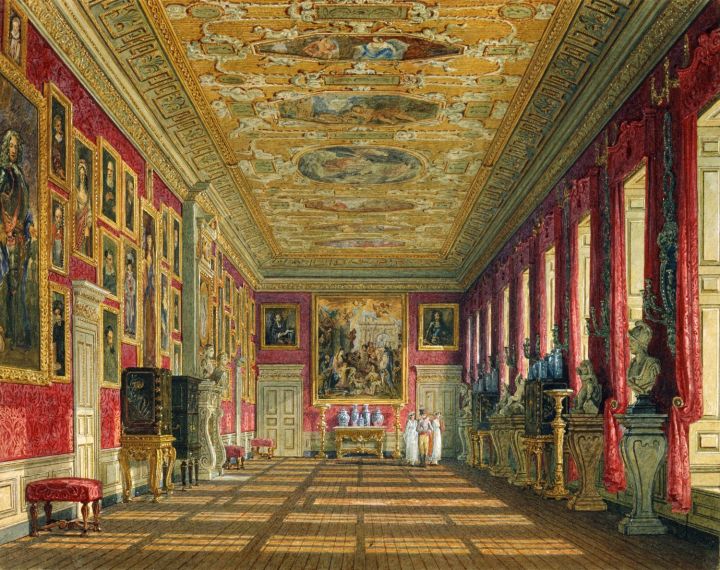
Charles Wild, Kensington Palace: The King’s Gallery, 1816, watercolour with touches of bodycolour over etched outlines, 20 × 25 cm c
(Royal Collection Trust, 922158)
◊ ◊ ◊ ◊ ◊
The eighteenth century in the November issue of The Burlington, which focuses on sculpture:
The Burlington Magazine 165 (November 2023)
e d i t o r i a l
• History of Art after Brexit, p. 1171.
It is probably fair to say that the United Kingdom’s withdrawal from the European Union in 2020 as a consequence of the referendum of 2016 was not greeted with much enthusiasm by professional art historians. The subject as it has developed over the past century is by its very nature transnational in outlook.
 a r t i c l e
• Jonathan Marsden, “George I’s Kensington Palace: The Sculptural Dimension,” pp. 1196–1205.
William Kent’s decoration of the new state rooms at Kensington Palace, London, for George I in 1722–27 has long been recognised as a pioneering exercise in neo-Palladianism. It was also an early example of the use of Classical sculpture in English interiors, a development in which Michael Rysbrack played a larger role than has formerly been recognised.
s h o r t e r n o t i c e
• Nicola Ciarlo, “Domenico Guidi in Padula: A Rediscovered Annunciation,” pp. 1206–09.
r e v i e w s
• Adriano Aymonino, “Albanimania,” pp. 1214–19.
A series of recent publications has turned the spotlight on Cardinal Alessandro Albani—described by Winckelmann as ‘the greatest patron in the world’—his villa in Rome, and collection of Classical antiquities, which have become newly accessible to scholars and the public after decades of seclusion.
• Heather Hyde Minor, Review of the exhibition catalogue, Victor Plahte Tschudi, Piranesi and the Modern Age (Nationalmuseum, Oslo / MIT Press, 2022), pp. 1239–41.
• Adam Bowett, Review of Ada De Wit, Grinling Gibbons and His Contemporaries (1650–1700): The Golden Age of Woodcarving in the Netherlands and Britain (Brepols, 2022), pp. 1247–49.
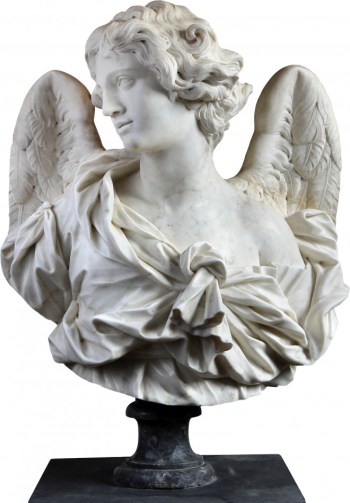
Archangel Gabriel, attributed by Nicola Ciarlo to Domenico Guidi, ca.1699–1701, marble, 94 × 81 × 39 cm, with socle (Padula: Charterhouse of S. Lorenzo).
• Marjorie Trusted, Review of Jan Zahle, Thorvaldsen: Collector of Plaster Casts from Antiquity and the Early Modern Period, 3 volumes (Thorvaldsens Museum and Aarhus University Press, 2020), pp. 1249–50.
• Natacha Coquery, Review of Iris Moon, Luxury after the Terror (Pennsylvania State University Press, 2022), pp. 1254–56.
• Joshua Mardell, Review of Jane Grenville, Pevsner’s Yorkshire, North Riding (Yale University Press, 2023), pp. 1256–57.
o b i t u a r y
• Paul Williamson, Obituary for Michael Kauffmann (1931–2023), pp. 1258–60.
Keeper of the Department of Prints & Drawings and Paintings at the Victoria and Albert Museum and subsequently Director of the Courtauld Institute of of Art, Michael Kauffmann was a scholar with a remarkable breadth of interest, as well as a widely respected and sensitive administrator and manager.
s u p p l e m e n t
• “Recent Acquisitions (2007–2023) of European Sculpture at the Victoria and Albert Museum, London,” pp. 1261–68.
Seventeen years have passed since the publication of the last supplement in this Magazine describing the recent sculpture acquisitions made by the Victoria and Albert Museum, London (V&A). The present supplement therefore highlights a selection of the most noteworthy works acquired in the intervening years.
The Burlington Magazine, October 2023
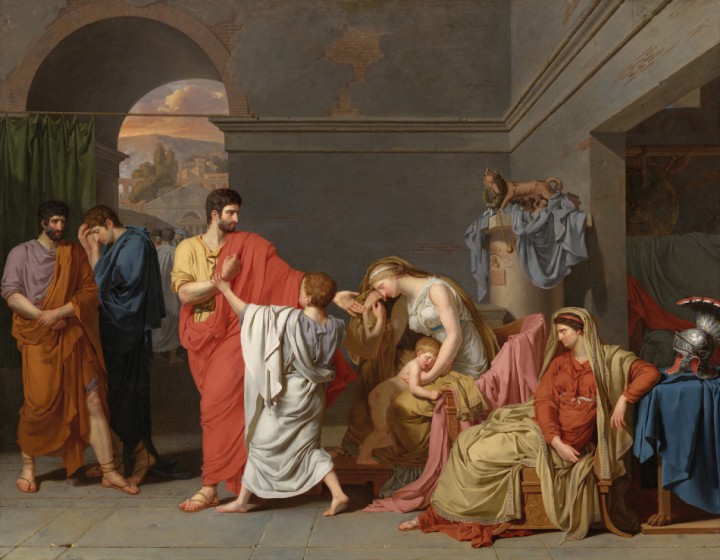
Anne-Louis Girodet de Roussy-Trioson, Coriolanus Taking Leave of His Family, 1786, oil on canvas, 114 × 146 cm
(National Gallery of Art, Washington)
◊ ◊ ◊ ◊ ◊
The eighteenth century in the October issue of The Burlington:
The Burlington Magazine 165 (October 2023)
a r t i c l e
• Aaron Wile, “Girodet’s Coriolanus Taking Leave of His Family Rediscovered,” pp. 1094–1105.
In 2019 Girodet’s lost entry for the 1786 Grand prix de peinture came to light and was acquired by the National Gallery of Art, Washington. The painting, which depicts a rarely represented incident from the story of Coriolanus—a subject that may have had contemporary political relevance—was not awarded the prize, probably because Girodet was regarded as being too close to Jacques-Louis David, a relationship to which the work may allude.
s h o r t e r n o t i c e
• Antoinette Friedenthal, “Image of a Connoisseur: An Unknown Portrait of Pierre Jean Mariette,” pp. 1106–10.
Among the unpublished miniatures in the Victoria & Albert Museum, London (V&A), is an eighteenth-century bust-length portrait of a middle-aged gentleman. A basic unillustrated inventory sheet for this work appeared in 2020 on the museum’s website. It stated that the portrait represents Pierre Jean Mariette (1694–1774) but gave no reasons for this identification and did not provide any information on the object’s provenance. It will be argued here that a combination of visual and documentary evidence confirms the identification.
r e v i e w s
 • Mark Bill, Review of the exhibition Reframing Reynolds: A Celebration (The Box, Plymouth, 2023), pp. 1124–27.
• Stephen Lloyd, Review of the refurbished Medieval, Renaissance, and Baroque galleries at the Walker Art Gallery, Liverpool, pp. 1130–33.
• Beth McKillop, Review of the exhibition China’s Hidden Century (The British Museum, London, 2023), pp. 1136–38.
• Satish Padiyar, Review of the exhibition Sade: Freedom or Evil (CCCB, Barcelona, 2023), pp. 1143–46.
• Malcolm McNeill, Review of Anne Farrer and Kevin McLoughlin, eds., Handbook of the Colour Print in China, 1600–1800 (Brill, 2022), pp. 1150–52.
• Edward Cooke, Review of Elisa Ambrosio, Francine Giese, Alina Martimyanova, and Hans Bjarne Thomsen, eds., China and the West: Reconsidering Chinese Reverse Glass Painting (De Gruyter, 2022), pp. 1152–53.
• David Ekserdjian, Review of the catalogue, Denise Allen, Linda Borsch, James David Draper, Jeffrey Fraiman, and Richard Stone, eds., Italian Renaissance and Baroque Bronzes in the Metropolitan Museum of Art (The Metropolitan Museum of Art, 2022), pp. 1156–58. The book is available as a free PDF The Met’s website.
• Rowan Watson, Review of Christopher de Hamel, The Posthumous Papers of the Manuscripts Club (Allen Lane, 2022), pp. 1160–62.
• Stefan Albl, Review of Francesco Lofano, Un pittore conteso nella Napoli del Settecento: L’epistolario e gli affari di Francesco de Mura (Istituto Italiano Studi Filosofici, 2022), pp. 1163–64.










leave a comment