The Burlington Magazine, September 2023
The eighteenth century in the September issue of The Burlington:
The Burlington Magazine 165 (September 2023)

Bed, by Ince and Mayhew, 1768, mahogany and other woods, with original blue silk ‘flowered tabby’ in the ‘Large Antique Headboard’, tester and cornice, height 356 cm (Stamford: The Burghley House Collection).
a r t i c l e r e v i e w
• Lucy Wood, “The Industry and Ingenuity of William Ince and John Mayhew,” pp. 996–1001.
Fifty years ago, the question was asked what had become of the furniture made by Ince and Mayhew, one of the most successful and long-lasting firms of cabinetmakers in eighteenth-century London? A monograph by Hugh Roberts and Charles Cator, decades in the making, provides the answer in a revelatory picture of the achievements of these rivals of Thomas Chippendale.
r e v i e w s
• Christoph Martin Vogtherr, Review of the exhibition Rosalba Carriera – Perfection in Pastel (Gemäldegalerie Alte Meister, Zwinger, Dresden, 2023), pp. 1007–10.
• Christopher Baker, Review of the Redevelopment of the National Portrait Gallery, London (reopened in June 2023), pp. 1013–17.
• Raha Shahidi, Review of the exhibition catalogue L’Amour en scène! François Boucher, du théâtre à l’opéra, ed. by Hélène Jagot, Jessica Degain, and Guillaume Kzerouni (Éditions Snoeck, 2022), pp. 1029–31.
• Christopher Rowell, Review of Tessa Murdoch, ed., Great Irish Households: Inventories from the Long Eighteenth Century (John Adamson, 2022) and Conor Lucey, ed., House and Home in Georgian Ireland: Spaces and Cultures of Domestic Life (Four Courts Press, 2022), pp. 1038–40.
• Armin Kunz, Review of Mareike Hennig and Neela Struck, eds., Zeichnen im Zeitalter Goethes: Zeichnungen und Aquarelle aus dem Freien Deutschen Hochstift (Hirmer, 2022), pp. 1040–42.

Sewell Bequest, 2008,3008.1). Room 18 of the National Portrait Gallery, London, showing the newly acquired Portrait of Mai (Omai) by Joshua Reynolds (c. 1776) as the centrepiece of a group of eighteenth-century portraits (Photography by Dave Parry).
Print Quarterly, September 2023
The long eighteenth century in the latest issue of Print Quarterly:
Print Quarterly 40.3 (September 2023)
a r t i c l e s
 • Vitalii Tkachuk, “Averkiy Kozachkovskyi and Western Sources of Kyiv Prints, 1720s–40s,” pp. 265–86.
This article features the oeuvre of the Ukrainian engraver Averkiy Kozachkovskyi (active 1721–46), whose illustrated output by the press of the Orthodox monastery Kyiv of the Caves (Kyiv Pechersk Lavra) numbers about forty engravings. He primarily produced book illustrations, but also illustrated printed oaths taken by new members of the local student confraternity. His sources derived largely from seventeenth- and eighteenth-century Catholic imagery from German, Flemish, and French schools, several of which are discussed in detail throughout the article, especially the compositions of Peter Paul Rubens. Such borrowings testify to the willingness of Orthodox recipients to accept imagery—unaltered in iconography or style—stemming from other denominations and cultures. The paper contributes to our knowledge of Ukrainian engraving and to the study of the global transfer of images during the early modern period.
• Nicholas J.S. Knowles, “Thomas Rowlandson’s The Women of Muscovy and Other Russeries after Jean-Baptiste Le Prince,” pp. 287–301.
This article discusses a previously unidentified series of prints by Thomas Rowlandson (1757–1827), after Jean-Baptiste Le Prince (1734–1781), mentioned only as a single lot in the sale of his art collection and studio contents. No definitive set of these “Various Dresses of the Women in Muscovy” has been found, but the author has identified several substantial groups in public and private collections; the largest of these, with twenty-two prints, is in the British Museum. Most of these Rowlandson impressions reside among Le Prince originals and have previously been catalogued as by or after Le Prince. As a series overall, five hundred and forty impressions are claimed to have been produced in the lot description. The article continues with an in-depth discussion of the series and its context. An appendix lists all known impressions of Rowlandson’s Women of Muscovy prints and their location.
n o t e s a n d r e v i e w s
• Mark McDonald, Review of Susan Stewart, The Ruins Lesson: Meaning and Material in Western Culture (The University of Chicago Press, 2020), pp. 322–25. This book explores the significance of ruins in Western art and literature, paying close attention to the evidentiary role of prints and how the printmaking process parallels the ruinous lifecycle of its subject matter. In the review, Piranesi is cited as a fascinating example of creating trompe l’oeil in his prints, while later discussions focus on the discovery and metaphorical associations of Rome’s antique ruins in the eighteenth century.
• David Bindman, Review of the exhibition catalogue, Edina Adam and Julian Brooks, William Blake: Visionary (Getty Publications, 2020), pp. 330–31. This brief review pertains to a previously rescheduled, now forthcoming, exhibition on William Blake at the J. Paul Getty Museum. The author examines the collecting of Blake in America and some of the curatorial choices for this anticipated show.
 • Patricia Mainardi, Review of Pascal Dupuy and Rolf Reichardt, La caricature sous le signe des révolutions. Mutations et permanences, XVIIIe–XIXe siècles (Presses Universitaires de Rouen et du Havre, 2021), pp. 331–34. This book and review introduce the origins and rapid development of caricature during the French Revolutionary period, focusing on how topical imagery and signs manifested into an accessible visual language capable of being understood by ordinary citizens at the time. More importantly, many of these signifying tropes, such as severed heads and raids on government buildings have become universally recognisable up to the present day.
• Mark Bills, Review of Tim Clayton, James Gillray: A Revolution in Satire (Paul Mellon Centre for Studies in British Art, 2022), pp. 353–57. This extensive review of the latest monograph on James Gillray highlights the British artist’s unique achievements in the world of graphic satire. The book bravely tackles some of his previously neglected areas, such as very early and pornographic prints, or previously unpublished ones that can now be contextualised. The same is true of Gillray’s interplay of word and image (his titles, conversations and commentary of the images), which the author believes is Clayton’s most original piece of scholarship in this book.
• Jeannie Kenmotsu, Review of the exhibition catalogue, Hans Bjarne Thomsen, ed., Japanische Holzschnitte: Aus der Sammlung Ernst Grosse / Japanese Woodblock Prints: From the Ernst Grosse Collection (Michael Imhof Verlag, 2018), pp. 357–60. This review recognises the value of this catalogue in bringing Ernst Grosse and his collecting practices to a larger audience, especially since the Museum Natur und Mensch’s collection of Japanese woodblock prints was a historically important case of intersection between European japonisme and ethnological approaches to non-Western cultures. Most of Grosse’s acquisitions were made through the art dealer Hayashi Tadamasa.
The Burlington Magazine, June 2023
The eighteenth century in the June issue of The Burlington (with apologies for being so slow to post, –CH) . . .
The Burlington Magazine 165 (June 2023)
 e d i t o r i a l
• “The Future of the RIBA Drawings Collection,” p. 583.
a r t i c l e s
• Tessa Murdoch, “Roubiliac and Sprimont: A Friendship Revisited,” pp. 600–11.
Recent research into the circles of Huguenot artists and craftsmen working in London in the mid-eighteenth century has provided new evidence about the friendship and working relationship between the sculptor Louis-François Roubiliac and the goldsmith Nicholas Sprimont. This lends weight to the belief that Roubiliac provided small models for casting in silver and bronze as well as for the porcelain manufactory co-founded by Sprimont in Chelsea in 1745.
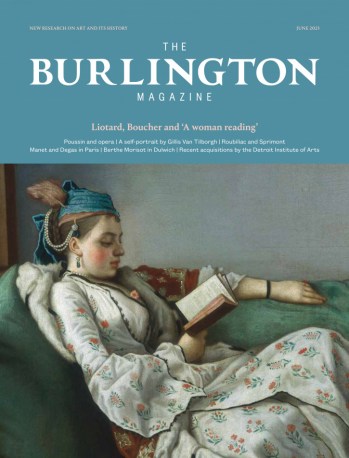
• Perrin Stein, “Liotard and Boucher: A Question of Precedence,” pp. 612–19.
There has been much debate about whether Liotard or Boucher invented the motif of a woman in Turkish costume reading a book while reclining on a sofa, which appears in both their work in the 1740s. New evidence that resolves the question highlights the very different ways these two artists constructed exoticism.
• Ann Gunn, “Titian’s Perseus and Andromeda: A Missing Link in the Chain of Provenance,” pp. 620–22.
• Simon Spier and Judith Phillips, “Joséphine Bowes’s Gift to Napoleon III: Antoine-Jean Gros’s Napoleon Distributing the Cross of the Legion of Honour to Artists during His Visit to the Salon of 1808,” pp. 626–29.
r e v i e w s
• Alexandra Gajewski, “The New Museum in the Bibliothèque Nationale, Paris,” pp. 630–37.
When in 1995–98 the books of the Bibliothèque nationale, Paris, were moved to their monumental new home in the west of the city, the library’s historic collections of antiquities, coins, medals, and other precious objects remained in the original complex of buildings in central Paris where they had been shown since the eighteenth century. Their reinstallation in the library’s newly restored museum rooms was opened last year.
• Kirstin Kennedy, Review of the exhibition Treasures from Faraway: Medieval and Renaissance Objects from The Schroder Collection (Strawberry Hill, 2023), pp. 641–43.
• Aileen Dawson, Review of the exhibition English Delftware (Bristol Museum and Art Gallery (from February 2023), pp. 652–54.
• Belinda Thomson, Review of the exhibition Berthe Morisot: Shaping Impressionism (Dulwich Picture Gallery, 2023), pp. 654–57. [In Paris, the show is entitled Berthe Morisot et l’art du XVIIIe siècle: Watteau, Boucher, Fragonard, Perronneau]
• J. V. G. Mallet, Review of Lilli Hollein, Rainald Franz, and Timothy Wilson, eds., Tin-Glaze and Image Culture: The MAK Maiolica Collection in its Wider Context (Arnoldsche Art Publishers, 2022), pp. 660–62.
• Clare Hornsby, Review of Andrew Robinson, Piranesi: Earliest Drawings / I primi disegni (Artemide Edizioni, 2022), pp. 666–67.
• G. A. Bremner, Review of Gauvin Alexander Bailey, The Architecture of Empire: France in India and Southeast Asia, 1664–1962 (McGill-Queen’s University Press, 2022), pp. 667–68
o b i t u a r y
• Peter Hecht, Obituary for Ger Luijten (1956–2022), pp. 675–76.
s u p p l e m e n t
• Recent Acquisitions (2016–22) of European Works of Art at the Detroit Institute of Arts
Print Quarterly, June 2023

Left: Edmé Jeaurat after Antoine Watteau, Talagrepo, Monk of Pégou, ca. 1731, etching and engraving, 24 × 17 cm (Cambridge, MA, Harvard Art Museums / Fogg Museum). Right: Gabriel Huquier after François Boucher, Flautist and Child Timpanist, ca. 1742, etching and engraving, sheet, trimmed 30 × 24 cm (New York, The Metropolitan Museum of Art).
◊ ◊ ◊ ◊ ◊
The long eighteenth century in the latest issue of Print Quarterly:
Print Quarterly 40.2 (June 2023)
A R T I C L E S

Roger Vandercruse Lacroix, Secretaire with Marquetry, ca. 1765, tulipwood, stained marquetry with bronze mounts and marble top, 114 × 73 × 38 cm (Private collection, Image courtesy Christie’s, London).
• Kee Il Choi Jr., “Watteau and Boucher Conjoined: Imagining China in Marquetry,” pp. 138–49.
This article examines the previously unknown pairing of Chinoiserie prints based on designs by Antoine Watteau (1684–1721) and François Boucher (1703–70) to create the pictorial marquetry veneered onto two nearly identical writing desks (secrétaires en armoire) attributed to the cabinetmaker Roger Vandercruse called La Croix or Lacroix (1727–99). Each cabinet retains traces of either the original engraving or the colour deployed to bring these ‘paintings in wood’ to life. This discovery not only exemplifies the role of prints in disseminating the chinoiseries of both Watteau and Boucher but also sheds light on the working practices of marqueteurs in eighteenth-century Paris.
• Lesley Fulton, “Johann Heinrich Wilhelm Tischbein’s Album of Prints in the British Museum,” pp. 150–69.
Fulton explores the Homeric subject matter and scenes depicted in the British Museum’s album of 81 previously unidentified etchings and engravings. Intended for Tischbein’s Vases and Homer projects, the etchings and engravings were prepared in Naples towards the end of the eighteenth century. Connections are made to motifs derived from painted vases and their relationship to Tischbein’s project for Sir William Hamilton’s Collection of Engravings from Ancient Vases (Naples and Germany, 1791–1803). Further analysis links the prints to the artist’s massive Illustrated Homer project in the first quarter of the 19th century. The paper highlights the discrepancy between the identification of an antique motif made in the late eighteenth century and how it is interpreted today. A contemporary document—probably a stocklist—from the Tischbein archive at Oldenburg in Germany, undated but drawn up between 1799 and 1808, has made it possible to identify the subject of each print and also to explain its original place in the album. The Appendix correlates the British Museum prints with their description as given in the Oldenburg document and also their correspondence with Tischbein’s various publication projects. Fulton concludes that the British Museum album probably served as a sales catalogue to which new material could be added as it arrived in the artist’s workshop.
N O T E S A N D R E V I E W S
• An Van Camp, Review of Gitta Bertram, Nils Büttner, and Claus Zittel, eds., Gateways to the Book: Frontispieces and Title Pages in Early Modern Europe (Brill, 2021), pp. 175–76. This edited volume presents fifteen essays on frontispieces and title-pages found in books printed between 1500 and 1800. Written by established academics as well as PhD candidates, the contributions explore how frontispieces intersect art and literature and how the printed images can be interpreted (contributions by Malcolm Baker, Martijn van Beek, Miranda L. Elston, Alison C. Fleming, Daniel Fulco, Lea Hagedorn, Constanze Keilhoz, Fabian Kolb, Hole Rößler, Delphine Schreuder, Alice Zamboni, and Cornel Zwierlein).
• Séverine Lepape, Review of Małgorzata Łazicka, ed., Old Master Prints from the 15th Century to the 1820s: German School, Barthel Beham and Sebald Beham. The Print Room of the University of Warsaw Library, Catalogue of the Collection (University of Warsay Library, 2019), pp. 176–78.
 • Michael Matile, Review of the exhibition catalogue, Kurt Zeitler, ed., Venedig, La Serenissima: Zeichnungen und Druckgraphik aus vier Jahrhunderten (Deutscher Kunstverlag, 2022), pp. 180–83. The Staatliche Graphische Sammlung in Munich recently presented a cross-section of its rich treasures of Venetian prints and drawings from the late fifteenth to the eighteenth century.
• Antony Griffiths, Review of Joyce Zelen, Blinded by Curiosity: The Collector-Dealer Hadriaan Beverland (1650–1716) and his Radical Approach to the Printed Image (Primavera Pers, 2021), pp. 186–89. The book focuses on Hadriaan Beverland’s activities during his last years, from 1680, which he spent as a ‘paranoid alcoholic drifting through the pubs and brothels of London’. He also assembled at least two little known manuscripts with new images composed of cut-out fragments of prints. The review highlights two portrait prints seemingly commissioned by Beverland himself which Griffiths believes ‘stand far outside the traditional canons of portraiture’, as well as the discovery by Zelen of a major sale of Beverland’s print collection held in 1690.
• Kristel Smentek, Review of Marianne Grivel, Estelle Leutrat, Véronique Meyer and Pierre Wachenheim, eds., Curieux d’Estampes. Collections et collectionneurs de gravures en Europe, 1500–1815 (Universitaires de Rennes, 2020), pp. 189–91. This review presents a swift overview of newly found documentary insights relating to individual and institutional collections of prints, largely focusing on French collectors and on the eighteenth century. Of the latter, mention is made of Albert Duke of Saxe-Teschen correspondences, Joseph-Dominique d’Inguimbert’s display practices, which included mounting between rollers, the collecting and marketing of French fashion prints, and the formation of print collections documenting the history of France, as was the case with Charles-Marie Fevret de Fontette.
• Mark McDonald, Review of Jessica Maier, The Eternal City: A History of Rome in Maps (University of Chicago Press, 2020) pp. 192–94. This review highlights interesting anachronistic features in topographical depictions of a reinvented Rome, for example, in Leonardo Bufalini’s woodcut map from 1551, the Baths of Trajan are depicted as a complete structure when it was in fact ruinous at the time. Further analysis pertains to the functions of printed maps, often as guides for pilgrims and secular tourists visiting important churches and historic sites.
• Christian Rümelin, Review of the exhibition catalogue, Celia Haller-Klinger, and Anette Michels, eds., Graphiksammler Ernst Riecker (1845–1918) und Otto Freiherr von Breitschwert (1829–1910) (Graphik-Kabinett Backnang, 2018), pp. 194–95. A review relating to two German collections formed around the turn of the nineteenth century, one of which focused on eighteenth- and nineteenth-century regional artists.
• Michael Matile, Review of the exhibition catalogue, Anne Buschoff, Marcus Dekiert and Sven Schütte, eds., Linie lernen: Die Kunst zu zeichnen (Wallraf-Richartz Museum & Fondation Corboud, 2021), pp. 195–96. This review pertains to a catalogue illustrating the history of drawing education from Cennino Cennini to their depictions in sixteenth- to eighteenth-century prints.
◊ ◊ ◊ ◊ ◊
Note (added 12 June 2023) — The original posting was updated to include reproductions of the two prints after Watteau and Boucher.
The Burlington Magazine, May 2023
The eighteenth century in the May issue of The Burlington . . .
The Burlington Magazine 165 (May 2023)
E D I T O R I A L
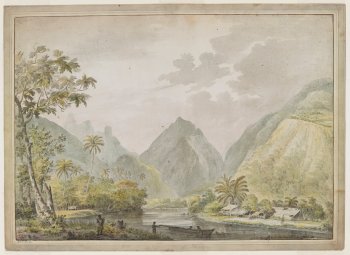
John Webber, A View Looking up the Vaitepiha River with Two Tahitians in a Canoe in the Foreground and Two Others on the Bank with Tahitian Houses to the Right. August 1777, 1777, pen, wash, and watercolour, 45 × 63 cm (London: British Library, Add. 15513, No.13).
• Digitizing the Conway and Witt Libraries, p. 491.
L E T T E R S
• Peter Barber, “The Background of Portrait of Mai,” pp. 492–93.
“Given Reynolds’s lack of interest in landscape painting, but the special place of the portrait of Mai in his oeuvre, it is at least possible that Reynolds may have decided to paint an authentically Tahitian background in order to add further ‘authenticity’. Given his high opinion of [John] Webber, it would have been natural to have copied the scene from one of his friend’s ‘excellent’ paintings of Vaitepiha Bay” (493).
• Christina Strunck, “Laguerre’s Painted Hall at Chatsworth,” p. 493.
“Since in his article ‘A Modello by Louis Laguerre and the Programme of the Painted Hall at Chatsworth’, published in The Burlington Magazine in August 2022 (pp. 760–67), François Marandet came to the same conclusions [that I did in my 2021 monograph Britain and the Continent, 1660–1727: Political Crisis and Conflict Resolution in Mural Paintings at Windsor, Chelsea, Chatsworth, Hampton Court and Greenwich], I thought your readers might like to be referred to the more extended analysis of the programme in both my book and an article I published in January 2022 that discusses the channels through which the two versions of Maratta’s painting may have been known to Laguerre and his patron, William Cavendish.”
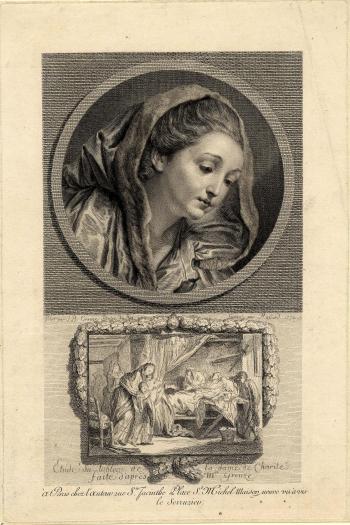
Jean Massard, after Jean Baptiste Greuze, A Woman (Madame Greuze) with a Fur-trimmed Hood Drawn over Her Head, Detail from Greuze’s ‘La Dame de Charité’ above a Sketch of the Painting, 1772, etching and engraving, 24 × 16 cm (London: British Museum, 1978,0121.291).
R E V I E W S
• Mark Evans, Review of Leopoldine van Hogendorp Prosperetti, Woodland Imagery in Northern Art, c.1500–1800: Poetry and Ecology (Lund Humphries, 2022), pp. 568–69.
• Alastair Lang, Review of Yuriko Jackall, Jean-Baptiste Greuze et ses têtes d’expression: La fortune d’une genre (CTHS and INHA, 2022), pp. 569–71.
• Lisa Monnas, Review of Michael Peter, Gewebtes Gold: Eine Kleine Geschichte der Metallfadenweberei von der Antike bis um 1800 (Abegg-Stiftung, 2022), p. 576.
• Alexandre Maral, Review of Christopher Tadgell, The Louvre and Versailles: The Evolution of the Proto-Typical Palace in the Age of Absolutism (Routledge, 2020), pp. 576–77.
• Wim Nys, Review of Beatriz Chadour-Sampson, Sandra Hindman, and Carla Van De Puttelaar, eds., Liber Amicorum in Honour of Diana Scarisbrick: A Life in Jewels (Ad Ilissvm, 2022), p. 577.
O B I T U A R Y
• Elizabeth Pergam, Obituary for Duncan Robinson (1943–2022), p. 578–79.
Successively the Director of the Yale Center for British Art, New Haven, and the Fitzwilliam Museum, Cambridge, Duncan Robinson had a major influence on the appreciation, study, and collecting of historic and modern British art in both the United States and the United Kingdom.
New Book | Blinded by Curiosity
Kate Heard’s review of Zelen’s book (published online in August 2022) appears in the latest issue of the Journal of the History of Collections 35.1 (March 2023). From Primavera Pers:
Joyce Zelen, Blinded by Curiosity: The Collector-Dealer Hadriaan Beverland (1650–1716) and His Radical Approach to the Printed Image (Leiden: Primavera Pers, 2022), 272 pages, ISBN: 978-9059973305, €35.
 This book explores a phenomenon in the history of print collecting that has never been extensively investigated: the cutting and pasting of prints in the early modern period. The book focuses on the colourful Dutch classical scholar and libertine Hadriaan Beverland (1650–1716). Beverland was banished from the Dutch Republic in 1679 for publishing blasphemous, heterodox, and provocative scholarly texts on sex and sin. Books that dealt with prostitution in ancient times, original sin as the first act of sexual intercourse, and the sexual lust of women, were considered dangerous to Dutch public morality. In 1680, Beverland fled to England, where his friend Isaac Vossius took him in. It was here that Beverland began cutting (nowadays) costly etchings and engravings and arranging the cuttings into collages. These collages, which again demonstrated his interest in sexual matters, survived in two illustrated manuscripts, now in the British Library in London and the Bodleian Library in Oxford.
This study aims: 1) to reconstruct Beverland’s life in England, primarily concentrating on his interests and dealing in art and books; 2) to map the early modern practice of cutting and pasting prints, on the basis of remaining cuttings as well as textual sources from Beverland’s day; and 3) to present a comprehensive analysis of the two illustrated Beverland-manuscripts in terms of form and function.
Joyce Zelen is a Jacoba Lugt-Klever Research Fellow at the RKD (Dutch Institute for Art History) in The Hague and the Fondation Custodia in Paris.
C O N T E N T S
Acknowledgments
Introduction
Part I | Hadriaan Beverland: A Passionate Man with a Passion for Art
1 The Life of Hadriaan Beverland: A Biographical Sketch
2 ‘Fair and Candid in all his Dealings’: Beverland as Agent and Collector of Art, Books, and Curiosities
3 The Self-Promotion of a Bad Boy: Beverland’s Portraits
Part II | Beverland’s Manuscripts with Prints
4 Early Modern Print Collecting: A Context for Beverland’s Manuscripts with Prints
5 Prints, Scissors, and Antiquarian Aspirations: Beverland’s Inscriptiones Singulares Manuscript
6 ‘Dirty’ Notes and Print Collages: Beverland’s Crepundia Lugdunensia Manuscript
Conclusion
Appendices
Abbreviations, Transcriptions, and Translations
Notes
Bibliography
Index
◊ ◊ ◊ ◊ ◊
Note (added 11 April 2023) — Also see Karen Hollewand’s recent book The Banishment of Beverland: Sex, Sin, and Scholarship in the Seventeenth-Century Dutch Republic (Leiden: Brill, 2019), reviewed by Benjamin Bernard in the latest issue of Eighteenth-Century Studies 56 (Spring 2023), pp. 473–79.
The Burlington Magazine, March 2023
The eighteenth century in the March issue of The Burlington . . .
The Burlington Magazine 165 (March 2023)
 E D I T O R I A L
• “Omai,” p. 219.
Given his undisputed central place in the history of British art, it is surprising that the three-hundredth anniversary of the birth of Joshua Reynolds is not being celebrated this year with more éclat. The principal tribute will be an exhibition Reframing Reynolds: A Celebration (24 June – 29 October 2023) at the Box in Plymouth, the city where Reynolds made his reputation—he was born on 16th July 1723 at Plympton, on its outskirts. The exhibition will explore the patronage he enjoyed from the Eliot family of Port Eliot, St Germans, and will be supplemented by the museum’s collection of paintings by Reynolds, the largest outside London.
Reynolds’s reputation rests largely on his portraits, so it might have been expected that the museum that contains the largest number, the National Portrait Gallery, London (NPG), would have marked the occasion with an exhibition of its own, but given that it has been closed for the past three years for a comprehensive redevelopment and redisplay, due to be unveiled on 22nd June, it has had other priorities. Yet any disappointment that the NPG is neglecting Reynolds in his anniversary year was allayed by the announcement last August that it is seeking to raise £50 million to acquire one of his greatest paintings, the full-length portrait of Omai, the first Polynesian to visit Britain. Universally praised ever since it was first seen in public, at the Royal Academy of Arts in 1776, it is a work both of great beauty and of compelling historic interest as a document of the earliest European encounter with Pacific cultures. . . Keep reading here»
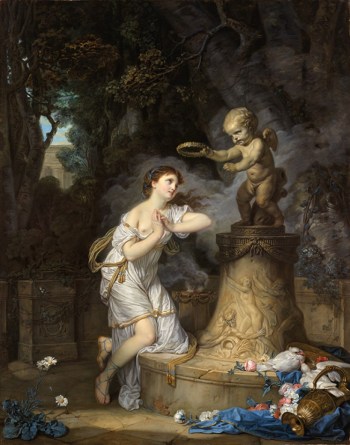
Jean-Baptiste Greuze, A Young Woman Praying at the Altar of Love (Votive Offering to Cupid), 1767, oil on canvas, 146 × 113 cm (London: The Wallace Collection).
A R T I C L E S
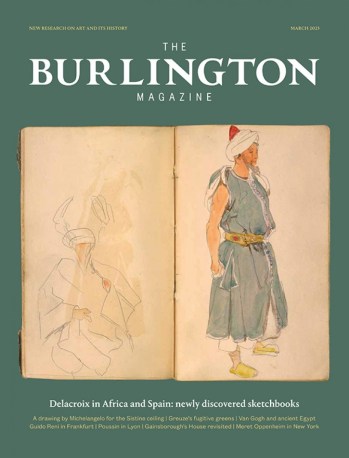
• Yuriko Jackall, Barbara H. Berrie, John K. Delaney, and Michael Swicklik, “Greuze’s Greens: Ephemeral Colours, Classical Ambitions,” pp. 268–79.
Jean-Baptiste Greuze was criticized in his lifetime for the unduly muted palette of some of his paintings. New technical analysis, combined with the recent discovery of a list in his handwriting of pigments he used, has revealed that his greens have faded because they incorporate fugitive yellow lakes, a practice Greuze continued even after its disadvantages were obvious.
R E V I E W S
• Roko Rumora, Review of the exhibition Chroma: Ancient Sculpture in Color (The Metropolitan Museum of Art, 2022–23), pp. 312–15.
• Desmond Shawe-Taylor, Review of the newly opened, expanded Gainsborough’s House (Sudbury), pp. 322–25.
• Friso Lammertse, Review of the newly renovated Royal Museum of Fine Arts, Antwerp (KMSKA), pp. 332–35.
• Simon Swynfen Jervis, Review of Jean-Pierre Fournet, Cuirs dorés, ‘Cuirs de Cordoue’: un art européen (Éditions d’art Monelle Hayot, 2019), pp. 342–43.
• Gauvin Alexander Bailey, Review of Aaron Hyman, Rubens in Repeat: The Logic of the Copy in Colonial Latin America (Getty Research Institute, 2021), pp. 343–44.
• Stephen Bann, Review of Joanthan Ribner, Loss in French Romantic Art, Literature, and Politics (Routledge, 2022), pp. 344–45.
• Charlotte Gere, Review of Julius Bryant, Enriching the V&A: A Collection of Collections, 1862–1914 (Lund Humphries and V&A Publishing, 2022), pp. 345–46.
• Jennifer Johnson, Review of Sam Rose, Interpreting Art (UCL Press, 2022), p. 350.
New Book | Scripts of Blackness
From Penn Press—and see Ellen Welch’s recent review for Journal18 . . .
Noémie Ndiaye, Scripts of Blackness: Early Modern Performance Culture and the Making of Race (Philadelphia: University of Pennsylvania Press, 2022), 376 pages, ISBN: 978-1512822632, $65. RaceB4Race: Critical Race Studies of the Premodern series
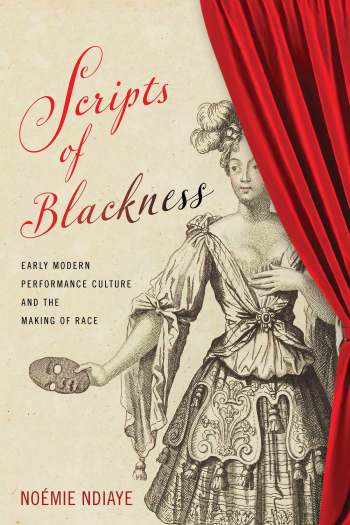 Scripts of Blackness shows how the early modern mass media of theatre and performance culture at-large helped turn blackness into a racial category, that is, into a type of difference justifying emerging social hierarchies and power relations in a new world order driven by colonialism and capitalism. Noemie Ndiaye explores the techniques of impersonation used by white performers to represent Afro-diasporic people in England, France, and Spain in the sixteenth and seventeenth centuries, using a comparative and transnational framework. She reconstructs three specific performance techniques―black-up (cosmetic blackness), blackspeak (acoustic blackness), and black dances (kinetic blackness)―in order to map out the poetics of those techniques, and track a number of metaphorical strains that early modern playtexts regularly associated with them. Those metaphorical strains, the titular scripts of blackness of this book, operated across national borders and constituted resources, as they provided spectators and participants with new ways of thinking about the Afro-diasporic people who lived or could/would ultimately live in their midst. Those scripts were often gendered and hinged on notions of demonization, exclusion, exploitation, animalization, commodification, sexualization, consensual enslavement, misogynoir, infantilization, and evocative association with other racialized minorities. Scripts of Blackness attempts to grasp the stories that Western Europeans told themselves through performative blackness, and the effects of those fictions on early modern Afro-diasporic subjects.
Noémie Ndiaye is Assistant Professor of English at the University of Chicago.
C O N T E N T S
Introduction: Performative Blackness in Early Modern Europe
1 A Brief History of Baroque Black-Up: Cosmetic Blackness and Religion
2 A Brief History of Baroque Black-Up: Cosmetic Blackness, Gender, and Sexuality
3 Blackspeak: Acoustic Blackness and Accents of Race
4 Black Moves: Race, Dance, and Power
Post-Script: Ecologies of Racial Performance
Appendix: Selection of Early Modern Plays Featuring Black Characters
Notes
Bibliography
Index
Acknowledgments
Print Quarterly, March 2023
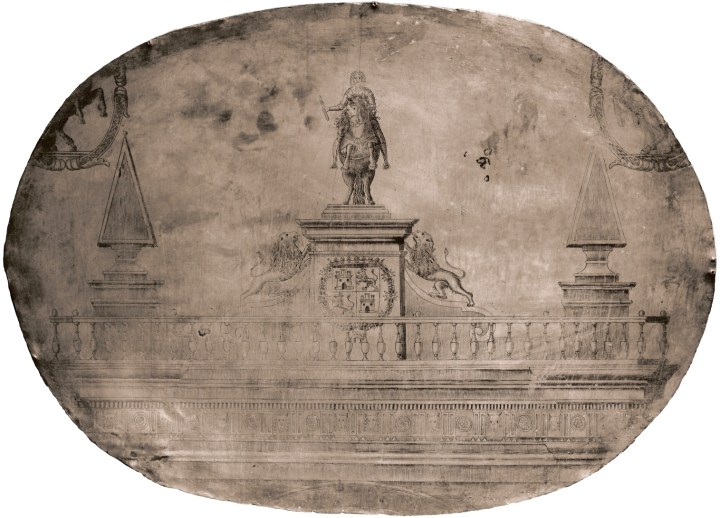
Juan Francisco Rosa, Equestrian Monument to Philip V, ca. 1738–45, engraved copper-plate, 26 × 36 cm (Chicago: Carl and Marilynn Thoma Foundation). The plate was cut into an oval, likely from what was originally a rectangle, and used as a support for an oil painting; on the other side is The Christ Child with St Joseph.
◊ ◊ ◊ ◊ ◊
The long eighteenth century in the latest issue of Print Quarterly:
Print Quarterly 40.1 (March 2023)
A R T I C L E S
• Emily C. Floyd with Suzanne Stratton-Pruitt, “Juan Francisco Rosa: Engraver to the Elite in Eighteenth-Century Lima,” pp. 33–51.
This article explores the life and works of the limeño engraver Juan Francisco Rosa (active in Lima, Peru, 1735–1756), with in-depth discussions pertaining to popular themes in his prints, patrons and contributions to the historic documentation of events and lost works in Lima. It adds two remarkable works to his oeuvre—a copperplate, now cut in two, and an illumination associated with a patent of nobility. The plate documents a famous statue of Philip V that was placed in 1738 on the bridge over the river Rímac and soon destroyed in the 1746 earthquake. The article demonstrates that Rosa produced important commissions for powerful organizations and individuals in the viceregal hierarchy, suggesting his prominence as an artist in mid-eighteenth-century Lima.
N O T E S A N D R E V I E W S
• Antony Griffiths, “Altered Plates,” pp. 63–66. Drawing attention to an anecdote in a 1726 biography of the London publisher, newspaper editor, and controversialist Abel Roper, this note charts the chronology of an altered plate by William van de Passe depicting the Duke of Buckingham on horseback in the first state, published 1625. The plate was then modified around 1630/32 in the second state to represent James, 1st Duke of Hamilton, before being transformed again in the third state of 1654–58 to portray Oliver Cromwell as Lord Protector. The plate is documented to have been subjected to a fourth “very profitable” change, altered to portray William III, though no impression has yet been found.

Romeyn de Hooghe, Les Monarches Tombants (James II falls off the back of a unicorn at left, Louis XIV on a globe at right, while William III is raised on a shield in the background), 1689, etching, sheet includes letterpress text below the image (Amsterdam: Rijksmuseum).
• Peter van der Coelen, Review of Meredith McNeill Hale, The Birth of Modern Political Satire: Romeyn de Hooghe (1645–1708) and the Glorious Revolution (Oxford University Press, 2020), pp. 66–68. Peter van der Coelen is persuaded by Hale’s argument that the satires De Hooghe produced between 1688 and 1690 were decisive for the development of political satire as a genre and that the birth of the genre should therefore be located not in eighteenth-century England but in the Dutch Republic of the late seventeenth century.
• Helmut Gier, Review of Eckhard Leuschner and Friedrich Polleross, eds., “Der Augsburger Kupferstecher und Verleger Johann Ulrich Kraus (1655–1719),” in Frühneuzeit-Info 32 (2021), pp. 68–71. A review of nine conference papers addressing Johann Ulrich Kraus, one of whose most important contributions to the history of art was the reception and dissemination in central Europe of the art favoured at the court of Louis XIV.
• Stephen Salel, Review of Timothy Clark, Hokusai: The Great Picture Book of Everything (British Museum Press, 2021), pp. 71–73.
• Janis A. Tomlinson, Review of the exhibition catalogue, Véronique Gerard, ed., Goya: Génie d’Avant-Garde. Le Maître et son École (Musée des Beaux-Arts and Éditions Snoeck, 2020), and “Goya peintre,” in Technè 53 (2022), pp. 73–75. Did Goya have a workshop? Whereas Goya’s prints seem to be a well-defined body of work, whose technique has been well-studied, as have their preparatory drawings and visual and historical sources, the paintings are another matter. Imitations, copies and forgeries began to circulate within a decade of Goya’s death and continue to complicate our understanding of his oeuvre. . . [These] two contributions . . . address some of these questions in very different ways.
• Heather Hyde Minor, Review of Ginevra Mariani, ed., Giambattista Piranesi: Matrici incise 1743–1753 (Edizioni Gabriele Mazzotta, 2010); Giambattista Piranesi: Matrici incise 1756–1757. Le Antichità Romane Lettere di giustificazione 2 (Edizioni Gabriele Mazzotta, 2014); Giambattista Piranesi: Matrici incise 1761–1765 (Editalia, 2017); and Giambattista Piranesi: Matrici incise 1762–1769 (De Luca Editori d’arte, 2020), pp. 102–06. This review explores the four-volume series of publications dedicated to cataloguing and discussing the 964 autograph printing plates by Giovanni Battista Piranesi in the collection of the Istituto Centrale per la Grafica in Rome. Further Matrici incise volumes are expected to be published in due course.
• Roger Kneebone, Review of the exhibition catalogue, Monique Kornell, ed., Flesh and Bones: The Art of Anatomy (Getty Research Institute, 2022), pp. 106–11. This review highlights the complex intersections between artists, engravers, anatomists and clinicians over four centuries. Worthy of note are the ways multiple perspectives from different kinds of parties informed the appearance of anatomical illustrations depending on their purpose and audience, resulting in images that were not always neutral in their ‘factual’ representations.
The Art Bulletin, December 2022
The eighteenth century in the latest issue of The Art Bulletin 104 (December 2022), along with the methodological ‘perspective’ conversation from Fricke and Flood:
A R T I C L E S
 • Beate Fricke and Finbarr Barry Flood, “Premodern Globalism in Art History: A Conversation,” pp. 6–19.
A conversation took place in 2021 between two art historians whose research focuses on different regions of the premodern world and who have recently collaborated on a project dealing with early histories of globalism. The discussion considers the potential archival value of ‘flotsam’—that is, extant artifacts and images lacking extensive textual metadata—for (re)constructing transcultural and transregional histories of circulation and reception. It addresses divergences in the nature of the available archival materials and the ethical and methodological challenges this poses. The discussants consider the need to move beyond earlier, largely celebratory narratives of the global to engage the ways in which transregional and transcultural networks intersected with more rooted or regional traditions of art making and material culture.
• Paris A. Spies-Gans, “Why Do We Think There Have Been No Great Women Artists? Revisiting Linda Nochlin and the Archive,” pp. 70–94.
In 1971 Linda Nochlin published her quickly canonical “Why Have There Been No Great Women Artists?” (ARTnews 69, no. 9). She offered a powerful narrative, claiming that Western institutional structures and a lack of access to vital educational opportunities had historically prevented women from becoming ‘great’ artists—indeed from even having the potential to achieve greatness. I suggest new visual and textual lenses through which we can update Nochlin’s narrative and reconsider women artists on their own societies’ terms, arguing that by returning to the archive, we can identify greatness and professionalism where they have eluded us before.
R E V I E W S
• Amy Knight Powell, Review of Aaron Hyman, Rubens in Repeat: The Logic of the Copy in Colonial Latin America (Getty Publications, 2021), pp. 120–23.
• Amanda Lahikainen, Review of Joseph Monteyne, Media Critique in the Age of Gillray: Scratches, Scraps, and Spectres (University of Toronto Press, 2022), pp. 123–26.










leave a comment