The Burlington Magazine, December 2023
The eighteenth century in the December issue of The Burlington, which focuses on Spain:
The Burlington Magazine 165 (December 2023)

Francisco de Goya, Self-Portrait with Dr Arrieta, 1820, oil on canvas, 115 × 77 cm (Minneapolis Institute of Art, 52.14).
a r t i c l e
• Mercedes Cerón Peña, “Goya’s Self-Portrait with Dr Arrieta,” pp. 1300–04.
In 1820 Goya painted a portrait of himself as he had appeared during his serious illness of the year before, attended by his doctor, Eugenio García Arrieta. Newly discovered biographical information about Arrieta suggests that the painting’s red and and green colour scheme may allude to the political views he shared with Goya.
r e v i e w s
• Michael Hall, Review of the new Galería de las Colecciones Reales (Royal Collections Gallery) in Madrid (opened 28 June 2023), pp. 1339–43.
• Stephen Lloyd, Review of the exhibition Return of the Gods (World Museum, Liverpool, (April 2023 — February 2024), pp. 1343–45. “Britain’s largest assemblage of Classical sculpture outside London belongs to National Museums Liverpool . . . In 1959 Liverpool City Council and its museums were gifted the entirety of the Ince Blundell collection—approximately six hundred heavily restored Roman marbles . . . collected by . . . Henry Blundell (1724–1810), a wealthy Catholic landowner, between 1776 and 1809.”
• Humphrey Wine, Review of the catalogue raisonné by Joseph Assémat-Tessandier, Louis Lagrenée, dit l’Aîné (1725–1805) (Arthena, 2022), pp. 1364–65.
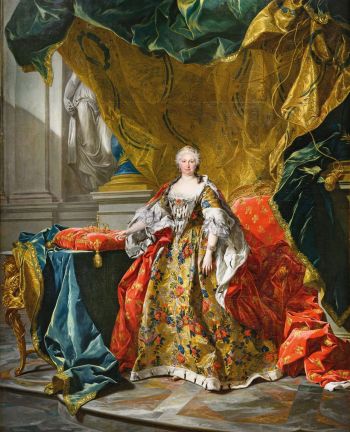
Louis-Michel van Loo, Portrait of Isabel Farnese, 1737, oil on canvas, 341 × 264 cm (Madrid: Galería de las Colecciones Reales).
• Rebeka Hodgkinson, Review of Stephanie Barczewski, How the Country House Became English (Reaktion, 2023), pp. 1370–71.
• Peter Humfrey, Review of Eveline Baseggio, Tiziana Franco, and Luca Molà, eds., La chiesa di Santa Maria dei Servi e la comunità veneziana dei Servi di Maria, secoli XIV–XIX (Viella, 2023), pp. 1374–75. “The demolition of the great fourteenth-century church of the Servi in about 1812–13 represents one of the most grievous of the many losses suffered by Venice’s artistic heritage during the Napoleonic period.”
o b i t u a r y
• Saloni Mathur, Obituary for Kavita Singh (1964–2023), pp. 1379–80.
Professor of art history and Dean of the School of Arts and Aesthetics at Jawaharlal Nehru University, Kavita Singh became internationally known for her publications on the history and politics of museums and the pre-modern art of South Asia. An authority on Indian court paintings, she was an inspiring colleague and teacher who publicly championed both her university and the study of Mughal art in the subcontinent.
Vivliofika, Volume 11 (2023)
This year’s issue of Vivliofika has just been released; in addition to the articles and book reviews noted below, the issue includes sections for obituaries and debates (both in Russian).
Vivliofika: E-Journal of Russian Eighteenth-Century Studies 11 (2023)
Vivliofika (Вивлiоѳика) is the flagship online publication of the Eighteenth Century Russian Empire Studies Association (ECRESA), an affiliate group of the Association for Slavic, Eurasian, and East European Studies (ASEEES). Volume 11 of the journal includes a special forum on “Russo-European Artistic Encounters in the Eighteenth Century,” guest edited by Margaret Samu, which highlights recent research on the Russian art world and its engagement with Western Europe in the eighteenth century. It arose from an online program in September of 2021 hosted by the Historians of Eighteenth-Century Art and Architecture (HECAA).
f o r u m : r u s s o – e u r o p e a n a r t i s t i c e n c o u n t e r s

Ivan Argunov, Portrait of Anna Nikolaevna Kalmykova, 1767, oil on canvas, 62 × 50 cm (Moscow: Kuskovo Estate Museum).
• Margaret Samu, “Introduction: Russo-European Encounters in the Eighteenth Century,” pp. 1–4.
The introduction summarizes the special forum and explains the effect that Russia’s full-scale invasion of Ukraine has had on art historical research. It argues for the importance of both trans-national and post-colonial approaches to the study of eighteenth-century Imperial Russian art.
• Margaret Samu, “Andrei Matveev: Painting Allegory from Antwerp to Russia,” pp. 5–36.
Margaret Samu explores Russia’s adoption of allegorical language in art, as well as the practice of sending art students to Europe in the Petrine era, through a close examination of Andrei Matveev’s Allegory of Painting (1725).
• Anna Korndorf, “The ‘Sketes’ of Cheerful Elizabeth: Mid-Eighteenth-Century Russian Hermitages” (in Russian), pp. 37–60.
Anna Korndorf’s article looks at hermitages as intimate, informal spaces for elite sociability. Her study helps us to rediscover the hermitages of Elizabeth Petrovna (r. 1741–62) by emphasizing their personal significance to the empress and their connections to similar structures in Europe.
• Zalina Tetermazova, “Self-Portrait Prints and Portraits of Printmakers: On the Social Status and Self-Image of Printmakers in Russia in the Second Half of the Eighteenth Century” (in Russian), pp. 61–81.
Zalina Tetermazova’s work uses self-portraits by printmakers as a lens through which to investigate their social status, as well as the role of engraving in the academic hierarchy of arts during the second half of the eighteenth century.
• Alexandra Helprin, “Ivan Argunov’s Portrait of Anna Kalmykova,” pp. 82–101.
Alexandra Helprin focuses on Ivan Argunov’s portrait of Anna Nikolaevna Kalmykova (1767) to explore the relative positions of the enserfed artist and Kalmyk child in the Sheremetev family. She analyzes the ways in which European conventions of portraiture took on new meanings under Russia’s particular conditions of serfdom and colonization.
• Emily Roy, “St. Petersburg through Venetian Eyes: An Episode in Late Eighteenth-Century Book Illustration,” pp. 102–24.
Emily Roy’s article explores Venetian perceptions of Peter I’s founding of Saint Petersburg by studying an etching published by Antonio Zatta in 1797 as part of a six-volume biography of Catherine II.
a d d i t i o n a l a r t i c l e s
• Erica Camisa Morale, “In Search of Nature and Consciousness in Andrei Bialobotskii’s Pentateugum: Classical Echoes and Modern Impulses,” pp. 125–41.
• W. Forrest Holden, “Making Sense of the Empire’s Others: Mikhail Chulkov’s Dictionary of Russian Superstitions and the European Enlightenment,” pp. 142–62.
• Rodolphe Baudin, “Translation as Politics: Translating Nikolai Karamzin’s Letters of a Russian Traveler in Nineteenth-Century France,” pp. 163–84.
r e v i e w s
• Barbara Skinner, Review of Zenon Kohut, Volodymyr Sklokin, and Frank Sysyn, with Larysa Bilous, eds., Eighteenth-Century Ukraine: New Perspectives on Social, Cultural, and Intellectual History (Montreal and Kingston: McGill-Queens University Press / Edmonton and Toronto: Canadian Institute of Ukrainian Studies Press, 2023), pp. 271–75.
• Kelsey Rubin-Detlev, Review of Vera Proskurina, The Imperial Script of Catherine the Great: Governing with the Literary Pen (Boston: Academic Studies Press, 2023), pp. 276–80.
• Rodolphe Baudin, Review of S. V. Pol’skoi and V. S. Rzheutskii, eds., Laboratoriia poniatii: Perevod i iazyki politiki v Rossii XVIII veka (Moscow: Novoe literaturnoe obozrenie, 2022), pp. 281–83.
• Sara Dickinson, Review of Nikolai Karamzin, Lettres d’un voyageur russe, introduction, translation, notes, and commentary by Rodolphe Baudin (Paris: Institut d’Études Slaves, 2022), pp. 284–86.
• Brian Davies, Review of A.G. Gus’kov, K. A. Kochegarov, S. M. Shamin, Russko-turetskaia voina 1686–1700 godov (Moscow: Russkoe slovo, 2022), pp. 287–89.
Print Quarterly, December 2023

J. J. Grandville, after Francisco de Goya, And So Was His Grandfather (‘Hasta su abuelo’), 1834, graphite, over stylus indentations, 79 × 119 mm
(Nancy: Musée des Beaux-Arts)
◊ ◊ ◊ ◊ ◊
The long eighteenth century in the latest issue of Print Quarterly:
Print Quarterly 40.4 (December 2023)
a r t i c l e s
• Thea Goldring, “Beyond Siberia: Drawings by Le Prince for the Histoire Générale des Voyages,” pp. 391–406.
This article examines two signed and dated drawings by Jean-Baptiste Le Prince (1734–1781) that were acquired by the Metropolitan Museum of Art in 2012 and identifies their origins and purpose, proving Le Prince’s hitherto unknown participation in the Histoire Générale des Voyages project. The author discusses their relationship with the commissioned illustrations to Voyage en Sibérie by Jean Chappe d’Auteroche (1728–1769), as well as Le Prince’s contribution to other illustrated books. Throughout the paper, there is a detailed analysis of his common practice to appropriate and modify visual information from earlier sources, reworking them for illustrated travel texts.

Jean-Baptiste Le Prince, Inuit Manner of Dress, 1769, pen and black ink, brush and grey wash, over black chalk, with additions in graphite, 170 × 120 mm (New York: The Metropolitan Museum of Art).
• Paula Fayos-Pérez, “La Fontaine, Goya, Grandville: A Study of Visual and Literary Sources,” pp. 406–419.
This article considers how J.J. Grandville (1803–1847) was deeply influenced by Francisco de Goya y Lucientes (1746–1828), particularly how the plates from the Caprichos inspired the former’s illustrations to Jean de la Fontaine’s Fables and other illustrated books. Incidentally, Goya had also previously derived his sources for the Caprichos and Desastres de la Guerra from earlier illustrations to La Fontaine’s 17th-century text. In doing so, the interconnection of literary and visual sources in both artists is revealed, highlighting their shared concern for public education and masked political undertones.
n o t e s a n d r e v i e w s
• Tim Clayton, Review of David Alexander, A Biographical Dictionary of British and Irish Engravers, 1714–1820 (Paul Mellon Centre for Studies in British Art and Yale University Press, 2021), pp. 442–43.
This review is just as much a praise of David Alexander’s research methods and resourcefulness as it is to the book’s groundbreaking contributions in this field. Clayton highlights the book’s revelations concerning invisible women engravers, who often worked alongside and carried on the business after their husbands had died. In keeping with Alexander’s wide area of focus, the book also includes native and foreign engravers in branches of the trade outside of fine art, leading to a far more expansive and representational dictionary than previous ones.
• Alexandra C. Axtmann, Review of Dominique Lerch, Kristina Mitalaité, Claire Rousseau and Isabelle Seruzier, eds., Les Images de Dévotion en Europe XVIe–XXIe Siècle. Une précieuse histoire (Bibliothèque Beauchesne, 2021), pp. 477–79.
This review summarises a copious book based on papers presented at a two-day conference in Paris in 2019 organized by the Dominican library of Le Saulchoir together with the Académie des Inscriptions et Belles-Lettres. The content offers a European-wide perspective on small printed devotional prints that are often considered ‘kitsch’, enabling them to be studied with a variety of approaches concerning their creation, function, and reception up to the present day.
The Burlington Magazine, November 2023
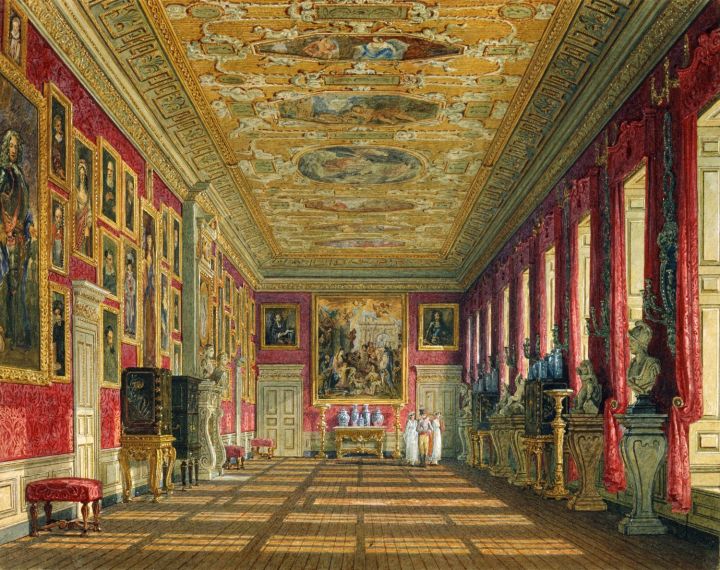
Charles Wild, Kensington Palace: The King’s Gallery, 1816, watercolour with touches of bodycolour over etched outlines, 20 × 25 cm c
(Royal Collection Trust, 922158)
◊ ◊ ◊ ◊ ◊
The eighteenth century in the November issue of The Burlington, which focuses on sculpture:
The Burlington Magazine 165 (November 2023)
e d i t o r i a l
• History of Art after Brexit, p. 1171.
It is probably fair to say that the United Kingdom’s withdrawal from the European Union in 2020 as a consequence of the referendum of 2016 was not greeted with much enthusiasm by professional art historians. The subject as it has developed over the past century is by its very nature transnational in outlook.
 a r t i c l e
• Jonathan Marsden, “George I’s Kensington Palace: The Sculptural Dimension,” pp. 1196–1205.
William Kent’s decoration of the new state rooms at Kensington Palace, London, for George I in 1722–27 has long been recognised as a pioneering exercise in neo-Palladianism. It was also an early example of the use of Classical sculpture in English interiors, a development in which Michael Rysbrack played a larger role than has formerly been recognised.
s h o r t e r n o t i c e
• Nicola Ciarlo, “Domenico Guidi in Padula: A Rediscovered Annunciation,” pp. 1206–09.
r e v i e w s
• Adriano Aymonino, “Albanimania,” pp. 1214–19.
A series of recent publications has turned the spotlight on Cardinal Alessandro Albani—described by Winckelmann as ‘the greatest patron in the world’—his villa in Rome, and collection of Classical antiquities, which have become newly accessible to scholars and the public after decades of seclusion.
• Heather Hyde Minor, Review of the exhibition catalogue, Victor Plahte Tschudi, Piranesi and the Modern Age (Nationalmuseum, Oslo / MIT Press, 2022), pp. 1239–41.
• Adam Bowett, Review of Ada De Wit, Grinling Gibbons and His Contemporaries (1650–1700): The Golden Age of Woodcarving in the Netherlands and Britain (Brepols, 2022), pp. 1247–49.
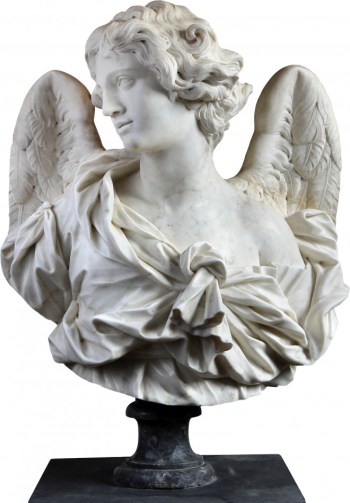
Archangel Gabriel, attributed by Nicola Ciarlo to Domenico Guidi, ca.1699–1701, marble, 94 × 81 × 39 cm, with socle (Padula: Charterhouse of S. Lorenzo).
• Marjorie Trusted, Review of Jan Zahle, Thorvaldsen: Collector of Plaster Casts from Antiquity and the Early Modern Period, 3 volumes (Thorvaldsens Museum and Aarhus University Press, 2020), pp. 1249–50.
• Natacha Coquery, Review of Iris Moon, Luxury after the Terror (Pennsylvania State University Press, 2022), pp. 1254–56.
• Joshua Mardell, Review of Jane Grenville, Pevsner’s Yorkshire, North Riding (Yale University Press, 2023), pp. 1256–57.
o b i t u a r y
• Paul Williamson, Obituary for Michael Kauffmann (1931–2023), pp. 1258–60.
Keeper of the Department of Prints & Drawings and Paintings at the Victoria and Albert Museum and subsequently Director of the Courtauld Institute of of Art, Michael Kauffmann was a scholar with a remarkable breadth of interest, as well as a widely respected and sensitive administrator and manager.
s u p p l e m e n t
• “Recent Acquisitions (2007–2023) of European Sculpture at the Victoria and Albert Museum, London,” pp. 1261–68.
Seventeen years have passed since the publication of the last supplement in this Magazine describing the recent sculpture acquisitions made by the Victoria and Albert Museum, London (V&A). The present supplement therefore highlights a selection of the most noteworthy works acquired in the intervening years.
The Burlington Magazine, October 2023
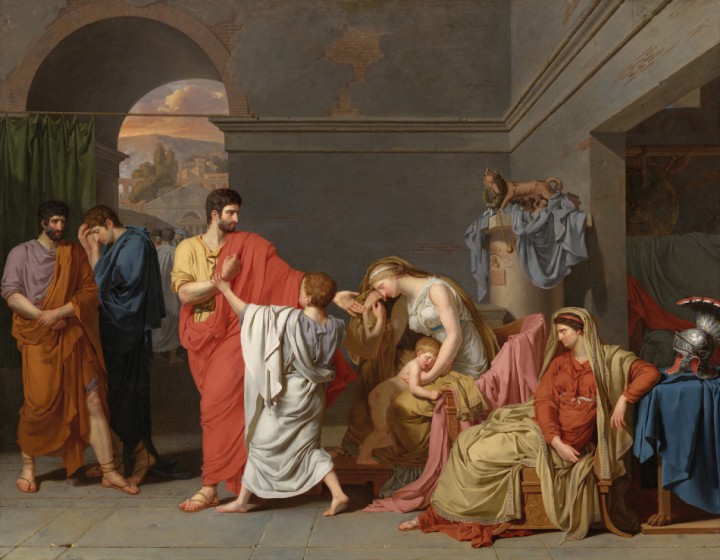
Anne-Louis Girodet de Roussy-Trioson, Coriolanus Taking Leave of His Family, 1786, oil on canvas, 114 × 146 cm
(National Gallery of Art, Washington)
◊ ◊ ◊ ◊ ◊
The eighteenth century in the October issue of The Burlington:
The Burlington Magazine 165 (October 2023)
a r t i c l e
• Aaron Wile, “Girodet’s Coriolanus Taking Leave of His Family Rediscovered,” pp. 1094–1105.
In 2019 Girodet’s lost entry for the 1786 Grand prix de peinture came to light and was acquired by the National Gallery of Art, Washington. The painting, which depicts a rarely represented incident from the story of Coriolanus—a subject that may have had contemporary political relevance—was not awarded the prize, probably because Girodet was regarded as being too close to Jacques-Louis David, a relationship to which the work may allude.
s h o r t e r n o t i c e
• Antoinette Friedenthal, “Image of a Connoisseur: An Unknown Portrait of Pierre Jean Mariette,” pp. 1106–10.
Among the unpublished miniatures in the Victoria & Albert Museum, London (V&A), is an eighteenth-century bust-length portrait of a middle-aged gentleman. A basic unillustrated inventory sheet for this work appeared in 2020 on the museum’s website. It stated that the portrait represents Pierre Jean Mariette (1694–1774) but gave no reasons for this identification and did not provide any information on the object’s provenance. It will be argued here that a combination of visual and documentary evidence confirms the identification.
r e v i e w s
 • Mark Bill, Review of the exhibition Reframing Reynolds: A Celebration (The Box, Plymouth, 2023), pp. 1124–27.
• Stephen Lloyd, Review of the refurbished Medieval, Renaissance, and Baroque galleries at the Walker Art Gallery, Liverpool, pp. 1130–33.
• Beth McKillop, Review of the exhibition China’s Hidden Century (The British Museum, London, 2023), pp. 1136–38.
• Satish Padiyar, Review of the exhibition Sade: Freedom or Evil (CCCB, Barcelona, 2023), pp. 1143–46.
• Malcolm McNeill, Review of Anne Farrer and Kevin McLoughlin, eds., Handbook of the Colour Print in China, 1600–1800 (Brill, 2022), pp. 1150–52.
• Edward Cooke, Review of Elisa Ambrosio, Francine Giese, Alina Martimyanova, and Hans Bjarne Thomsen, eds., China and the West: Reconsidering Chinese Reverse Glass Painting (De Gruyter, 2022), pp. 1152–53.
• David Ekserdjian, Review of the catalogue, Denise Allen, Linda Borsch, James David Draper, Jeffrey Fraiman, and Richard Stone, eds., Italian Renaissance and Baroque Bronzes in the Metropolitan Museum of Art (The Metropolitan Museum of Art, 2022), pp. 1156–58. The book is available as a free PDF The Met’s website.
• Rowan Watson, Review of Christopher de Hamel, The Posthumous Papers of the Manuscripts Club (Allen Lane, 2022), pp. 1160–62.
• Stefan Albl, Review of Francesco Lofano, Un pittore conteso nella Napoli del Settecento: L’epistolario e gli affari di Francesco de Mura (Istituto Italiano Studi Filosofici, 2022), pp. 1163–64.
The Burlington Magazine, September 2023
The eighteenth century in the September issue of The Burlington:
The Burlington Magazine 165 (September 2023)

Bed, by Ince and Mayhew, 1768, mahogany and other woods, with original blue silk ‘flowered tabby’ in the ‘Large Antique Headboard’, tester and cornice, height 356 cm (Stamford: The Burghley House Collection).
a r t i c l e r e v i e w
• Lucy Wood, “The Industry and Ingenuity of William Ince and John Mayhew,” pp. 996–1001.
Fifty years ago, the question was asked what had become of the furniture made by Ince and Mayhew, one of the most successful and long-lasting firms of cabinetmakers in eighteenth-century London? A monograph by Hugh Roberts and Charles Cator, decades in the making, provides the answer in a revelatory picture of the achievements of these rivals of Thomas Chippendale.
r e v i e w s
• Christoph Martin Vogtherr, Review of the exhibition Rosalba Carriera – Perfection in Pastel (Gemäldegalerie Alte Meister, Zwinger, Dresden, 2023), pp. 1007–10.
• Christopher Baker, Review of the Redevelopment of the National Portrait Gallery, London (reopened in June 2023), pp. 1013–17.
• Raha Shahidi, Review of the exhibition catalogue L’Amour en scène! François Boucher, du théâtre à l’opéra, ed. by Hélène Jagot, Jessica Degain, and Guillaume Kzerouni (Éditions Snoeck, 2022), pp. 1029–31.
• Christopher Rowell, Review of Tessa Murdoch, ed., Great Irish Households: Inventories from the Long Eighteenth Century (John Adamson, 2022) and Conor Lucey, ed., House and Home in Georgian Ireland: Spaces and Cultures of Domestic Life (Four Courts Press, 2022), pp. 1038–40.
• Armin Kunz, Review of Mareike Hennig and Neela Struck, eds., Zeichnen im Zeitalter Goethes: Zeichnungen und Aquarelle aus dem Freien Deutschen Hochstift (Hirmer, 2022), pp. 1040–42.

Sewell Bequest, 2008,3008.1). Room 18 of the National Portrait Gallery, London, showing the newly acquired Portrait of Mai (Omai) by Joshua Reynolds (c. 1776) as the centrepiece of a group of eighteenth-century portraits (Photography by Dave Parry).
Print Quarterly, September 2023
The long eighteenth century in the latest issue of Print Quarterly:
Print Quarterly 40.3 (September 2023)
a r t i c l e s
 • Vitalii Tkachuk, “Averkiy Kozachkovskyi and Western Sources of Kyiv Prints, 1720s–40s,” pp. 265–86.
This article features the oeuvre of the Ukrainian engraver Averkiy Kozachkovskyi (active 1721–46), whose illustrated output by the press of the Orthodox monastery Kyiv of the Caves (Kyiv Pechersk Lavra) numbers about forty engravings. He primarily produced book illustrations, but also illustrated printed oaths taken by new members of the local student confraternity. His sources derived largely from seventeenth- and eighteenth-century Catholic imagery from German, Flemish, and French schools, several of which are discussed in detail throughout the article, especially the compositions of Peter Paul Rubens. Such borrowings testify to the willingness of Orthodox recipients to accept imagery—unaltered in iconography or style—stemming from other denominations and cultures. The paper contributes to our knowledge of Ukrainian engraving and to the study of the global transfer of images during the early modern period.
• Nicholas J.S. Knowles, “Thomas Rowlandson’s The Women of Muscovy and Other Russeries after Jean-Baptiste Le Prince,” pp. 287–301.
This article discusses a previously unidentified series of prints by Thomas Rowlandson (1757–1827), after Jean-Baptiste Le Prince (1734–1781), mentioned only as a single lot in the sale of his art collection and studio contents. No definitive set of these “Various Dresses of the Women in Muscovy” has been found, but the author has identified several substantial groups in public and private collections; the largest of these, with twenty-two prints, is in the British Museum. Most of these Rowlandson impressions reside among Le Prince originals and have previously been catalogued as by or after Le Prince. As a series overall, five hundred and forty impressions are claimed to have been produced in the lot description. The article continues with an in-depth discussion of the series and its context. An appendix lists all known impressions of Rowlandson’s Women of Muscovy prints and their location.
n o t e s a n d r e v i e w s
• Mark McDonald, Review of Susan Stewart, The Ruins Lesson: Meaning and Material in Western Culture (The University of Chicago Press, 2020), pp. 322–25. This book explores the significance of ruins in Western art and literature, paying close attention to the evidentiary role of prints and how the printmaking process parallels the ruinous lifecycle of its subject matter. In the review, Piranesi is cited as a fascinating example of creating trompe l’oeil in his prints, while later discussions focus on the discovery and metaphorical associations of Rome’s antique ruins in the eighteenth century.
• David Bindman, Review of the exhibition catalogue, Edina Adam and Julian Brooks, William Blake: Visionary (Getty Publications, 2020), pp. 330–31. This brief review pertains to a previously rescheduled, now forthcoming, exhibition on William Blake at the J. Paul Getty Museum. The author examines the collecting of Blake in America and some of the curatorial choices for this anticipated show.
 • Patricia Mainardi, Review of Pascal Dupuy and Rolf Reichardt, La caricature sous le signe des révolutions. Mutations et permanences, XVIIIe–XIXe siècles (Presses Universitaires de Rouen et du Havre, 2021), pp. 331–34. This book and review introduce the origins and rapid development of caricature during the French Revolutionary period, focusing on how topical imagery and signs manifested into an accessible visual language capable of being understood by ordinary citizens at the time. More importantly, many of these signifying tropes, such as severed heads and raids on government buildings have become universally recognisable up to the present day.
• Mark Bills, Review of Tim Clayton, James Gillray: A Revolution in Satire (Paul Mellon Centre for Studies in British Art, 2022), pp. 353–57. This extensive review of the latest monograph on James Gillray highlights the British artist’s unique achievements in the world of graphic satire. The book bravely tackles some of his previously neglected areas, such as very early and pornographic prints, or previously unpublished ones that can now be contextualised. The same is true of Gillray’s interplay of word and image (his titles, conversations and commentary of the images), which the author believes is Clayton’s most original piece of scholarship in this book.
• Jeannie Kenmotsu, Review of the exhibition catalogue, Hans Bjarne Thomsen, ed., Japanische Holzschnitte: Aus der Sammlung Ernst Grosse / Japanese Woodblock Prints: From the Ernst Grosse Collection (Michael Imhof Verlag, 2018), pp. 357–60. This review recognises the value of this catalogue in bringing Ernst Grosse and his collecting practices to a larger audience, especially since the Museum Natur und Mensch’s collection of Japanese woodblock prints was a historically important case of intersection between European japonisme and ethnological approaches to non-Western cultures. Most of Grosse’s acquisitions were made through the art dealer Hayashi Tadamasa.
The Burlington Magazine, June 2023
The eighteenth century in the June issue of The Burlington (with apologies for being so slow to post, –CH) . . .
The Burlington Magazine 165 (June 2023)
 e d i t o r i a l
• “The Future of the RIBA Drawings Collection,” p. 583.
a r t i c l e s
• Tessa Murdoch, “Roubiliac and Sprimont: A Friendship Revisited,” pp. 600–11.
Recent research into the circles of Huguenot artists and craftsmen working in London in the mid-eighteenth century has provided new evidence about the friendship and working relationship between the sculptor Louis-François Roubiliac and the goldsmith Nicholas Sprimont. This lends weight to the belief that Roubiliac provided small models for casting in silver and bronze as well as for the porcelain manufactory co-founded by Sprimont in Chelsea in 1745.
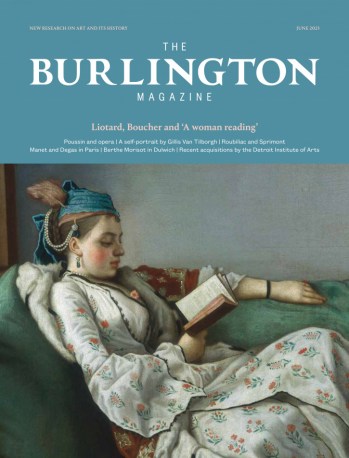
• Perrin Stein, “Liotard and Boucher: A Question of Precedence,” pp. 612–19.
There has been much debate about whether Liotard or Boucher invented the motif of a woman in Turkish costume reading a book while reclining on a sofa, which appears in both their work in the 1740s. New evidence that resolves the question highlights the very different ways these two artists constructed exoticism.
• Ann Gunn, “Titian’s Perseus and Andromeda: A Missing Link in the Chain of Provenance,” pp. 620–22.
• Simon Spier and Judith Phillips, “Joséphine Bowes’s Gift to Napoleon III: Antoine-Jean Gros’s Napoleon Distributing the Cross of the Legion of Honour to Artists during His Visit to the Salon of 1808,” pp. 626–29.
r e v i e w s
• Alexandra Gajewski, “The New Museum in the Bibliothèque Nationale, Paris,” pp. 630–37.
When in 1995–98 the books of the Bibliothèque nationale, Paris, were moved to their monumental new home in the west of the city, the library’s historic collections of antiquities, coins, medals, and other precious objects remained in the original complex of buildings in central Paris where they had been shown since the eighteenth century. Their reinstallation in the library’s newly restored museum rooms was opened last year.
• Kirstin Kennedy, Review of the exhibition Treasures from Faraway: Medieval and Renaissance Objects from The Schroder Collection (Strawberry Hill, 2023), pp. 641–43.
• Aileen Dawson, Review of the exhibition English Delftware (Bristol Museum and Art Gallery (from February 2023), pp. 652–54.
• Belinda Thomson, Review of the exhibition Berthe Morisot: Shaping Impressionism (Dulwich Picture Gallery, 2023), pp. 654–57. [In Paris, the show is entitled Berthe Morisot et l’art du XVIIIe siècle: Watteau, Boucher, Fragonard, Perronneau]
• J. V. G. Mallet, Review of Lilli Hollein, Rainald Franz, and Timothy Wilson, eds., Tin-Glaze and Image Culture: The MAK Maiolica Collection in its Wider Context (Arnoldsche Art Publishers, 2022), pp. 660–62.
• Clare Hornsby, Review of Andrew Robinson, Piranesi: Earliest Drawings / I primi disegni (Artemide Edizioni, 2022), pp. 666–67.
• G. A. Bremner, Review of Gauvin Alexander Bailey, The Architecture of Empire: France in India and Southeast Asia, 1664–1962 (McGill-Queen’s University Press, 2022), pp. 667–68
o b i t u a r y
• Peter Hecht, Obituary for Ger Luijten (1956–2022), pp. 675–76.
s u p p l e m e n t
• Recent Acquisitions (2016–22) of European Works of Art at the Detroit Institute of Arts
Print Quarterly, June 2023

Left: Edmé Jeaurat after Antoine Watteau, Talagrepo, Monk of Pégou, ca. 1731, etching and engraving, 24 × 17 cm (Cambridge, MA, Harvard Art Museums / Fogg Museum). Right: Gabriel Huquier after François Boucher, Flautist and Child Timpanist, ca. 1742, etching and engraving, sheet, trimmed 30 × 24 cm (New York, The Metropolitan Museum of Art).
◊ ◊ ◊ ◊ ◊
The long eighteenth century in the latest issue of Print Quarterly:
Print Quarterly 40.2 (June 2023)
A R T I C L E S

Roger Vandercruse Lacroix, Secretaire with Marquetry, ca. 1765, tulipwood, stained marquetry with bronze mounts and marble top, 114 × 73 × 38 cm (Private collection, Image courtesy Christie’s, London).
• Kee Il Choi Jr., “Watteau and Boucher Conjoined: Imagining China in Marquetry,” pp. 138–49.
This article examines the previously unknown pairing of Chinoiserie prints based on designs by Antoine Watteau (1684–1721) and François Boucher (1703–70) to create the pictorial marquetry veneered onto two nearly identical writing desks (secrétaires en armoire) attributed to the cabinetmaker Roger Vandercruse called La Croix or Lacroix (1727–99). Each cabinet retains traces of either the original engraving or the colour deployed to bring these ‘paintings in wood’ to life. This discovery not only exemplifies the role of prints in disseminating the chinoiseries of both Watteau and Boucher but also sheds light on the working practices of marqueteurs in eighteenth-century Paris.
• Lesley Fulton, “Johann Heinrich Wilhelm Tischbein’s Album of Prints in the British Museum,” pp. 150–69.
Fulton explores the Homeric subject matter and scenes depicted in the British Museum’s album of 81 previously unidentified etchings and engravings. Intended for Tischbein’s Vases and Homer projects, the etchings and engravings were prepared in Naples towards the end of the eighteenth century. Connections are made to motifs derived from painted vases and their relationship to Tischbein’s project for Sir William Hamilton’s Collection of Engravings from Ancient Vases (Naples and Germany, 1791–1803). Further analysis links the prints to the artist’s massive Illustrated Homer project in the first quarter of the 19th century. The paper highlights the discrepancy between the identification of an antique motif made in the late eighteenth century and how it is interpreted today. A contemporary document—probably a stocklist—from the Tischbein archive at Oldenburg in Germany, undated but drawn up between 1799 and 1808, has made it possible to identify the subject of each print and also to explain its original place in the album. The Appendix correlates the British Museum prints with their description as given in the Oldenburg document and also their correspondence with Tischbein’s various publication projects. Fulton concludes that the British Museum album probably served as a sales catalogue to which new material could be added as it arrived in the artist’s workshop.
N O T E S A N D R E V I E W S
• An Van Camp, Review of Gitta Bertram, Nils Büttner, and Claus Zittel, eds., Gateways to the Book: Frontispieces and Title Pages in Early Modern Europe (Brill, 2021), pp. 175–76. This edited volume presents fifteen essays on frontispieces and title-pages found in books printed between 1500 and 1800. Written by established academics as well as PhD candidates, the contributions explore how frontispieces intersect art and literature and how the printed images can be interpreted (contributions by Malcolm Baker, Martijn van Beek, Miranda L. Elston, Alison C. Fleming, Daniel Fulco, Lea Hagedorn, Constanze Keilhoz, Fabian Kolb, Hole Rößler, Delphine Schreuder, Alice Zamboni, and Cornel Zwierlein).
• Séverine Lepape, Review of Małgorzata Łazicka, ed., Old Master Prints from the 15th Century to the 1820s: German School, Barthel Beham and Sebald Beham. The Print Room of the University of Warsaw Library, Catalogue of the Collection (University of Warsay Library, 2019), pp. 176–78.
 • Michael Matile, Review of the exhibition catalogue, Kurt Zeitler, ed., Venedig, La Serenissima: Zeichnungen und Druckgraphik aus vier Jahrhunderten (Deutscher Kunstverlag, 2022), pp. 180–83. The Staatliche Graphische Sammlung in Munich recently presented a cross-section of its rich treasures of Venetian prints and drawings from the late fifteenth to the eighteenth century.
• Antony Griffiths, Review of Joyce Zelen, Blinded by Curiosity: The Collector-Dealer Hadriaan Beverland (1650–1716) and his Radical Approach to the Printed Image (Primavera Pers, 2021), pp. 186–89. The book focuses on Hadriaan Beverland’s activities during his last years, from 1680, which he spent as a ‘paranoid alcoholic drifting through the pubs and brothels of London’. He also assembled at least two little known manuscripts with new images composed of cut-out fragments of prints. The review highlights two portrait prints seemingly commissioned by Beverland himself which Griffiths believes ‘stand far outside the traditional canons of portraiture’, as well as the discovery by Zelen of a major sale of Beverland’s print collection held in 1690.
• Kristel Smentek, Review of Marianne Grivel, Estelle Leutrat, Véronique Meyer and Pierre Wachenheim, eds., Curieux d’Estampes. Collections et collectionneurs de gravures en Europe, 1500–1815 (Universitaires de Rennes, 2020), pp. 189–91. This review presents a swift overview of newly found documentary insights relating to individual and institutional collections of prints, largely focusing on French collectors and on the eighteenth century. Of the latter, mention is made of Albert Duke of Saxe-Teschen correspondences, Joseph-Dominique d’Inguimbert’s display practices, which included mounting between rollers, the collecting and marketing of French fashion prints, and the formation of print collections documenting the history of France, as was the case with Charles-Marie Fevret de Fontette.
• Mark McDonald, Review of Jessica Maier, The Eternal City: A History of Rome in Maps (University of Chicago Press, 2020) pp. 192–94. This review highlights interesting anachronistic features in topographical depictions of a reinvented Rome, for example, in Leonardo Bufalini’s woodcut map from 1551, the Baths of Trajan are depicted as a complete structure when it was in fact ruinous at the time. Further analysis pertains to the functions of printed maps, often as guides for pilgrims and secular tourists visiting important churches and historic sites.
• Christian Rümelin, Review of the exhibition catalogue, Celia Haller-Klinger, and Anette Michels, eds., Graphiksammler Ernst Riecker (1845–1918) und Otto Freiherr von Breitschwert (1829–1910) (Graphik-Kabinett Backnang, 2018), pp. 194–95. A review relating to two German collections formed around the turn of the nineteenth century, one of which focused on eighteenth- and nineteenth-century regional artists.
• Michael Matile, Review of the exhibition catalogue, Anne Buschoff, Marcus Dekiert and Sven Schütte, eds., Linie lernen: Die Kunst zu zeichnen (Wallraf-Richartz Museum & Fondation Corboud, 2021), pp. 195–96. This review pertains to a catalogue illustrating the history of drawing education from Cennino Cennini to their depictions in sixteenth- to eighteenth-century prints.
◊ ◊ ◊ ◊ ◊
Note (added 12 June 2023) — The original posting was updated to include reproductions of the two prints after Watteau and Boucher.
The Burlington Magazine, May 2023
The eighteenth century in the May issue of The Burlington . . .
The Burlington Magazine 165 (May 2023)
E D I T O R I A L
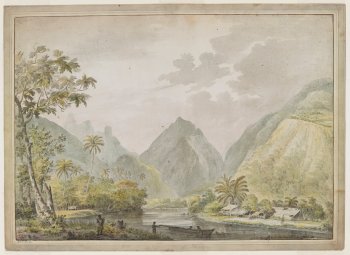
John Webber, A View Looking up the Vaitepiha River with Two Tahitians in a Canoe in the Foreground and Two Others on the Bank with Tahitian Houses to the Right. August 1777, 1777, pen, wash, and watercolour, 45 × 63 cm (London: British Library, Add. 15513, No.13).
• Digitizing the Conway and Witt Libraries, p. 491.
L E T T E R S
• Peter Barber, “The Background of Portrait of Mai,” pp. 492–93.
“Given Reynolds’s lack of interest in landscape painting, but the special place of the portrait of Mai in his oeuvre, it is at least possible that Reynolds may have decided to paint an authentically Tahitian background in order to add further ‘authenticity’. Given his high opinion of [John] Webber, it would have been natural to have copied the scene from one of his friend’s ‘excellent’ paintings of Vaitepiha Bay” (493).
• Christina Strunck, “Laguerre’s Painted Hall at Chatsworth,” p. 493.
“Since in his article ‘A Modello by Louis Laguerre and the Programme of the Painted Hall at Chatsworth’, published in The Burlington Magazine in August 2022 (pp. 760–67), François Marandet came to the same conclusions [that I did in my 2021 monograph Britain and the Continent, 1660–1727: Political Crisis and Conflict Resolution in Mural Paintings at Windsor, Chelsea, Chatsworth, Hampton Court and Greenwich], I thought your readers might like to be referred to the more extended analysis of the programme in both my book and an article I published in January 2022 that discusses the channels through which the two versions of Maratta’s painting may have been known to Laguerre and his patron, William Cavendish.”
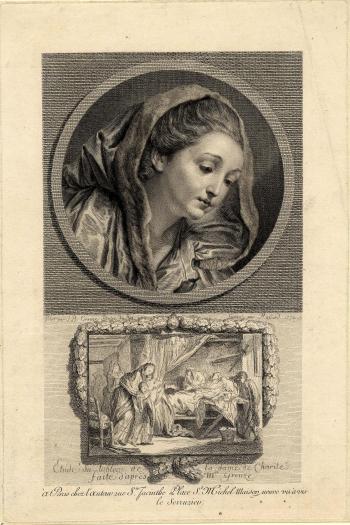
Jean Massard, after Jean Baptiste Greuze, A Woman (Madame Greuze) with a Fur-trimmed Hood Drawn over Her Head, Detail from Greuze’s ‘La Dame de Charité’ above a Sketch of the Painting, 1772, etching and engraving, 24 × 16 cm (London: British Museum, 1978,0121.291).
R E V I E W S
• Mark Evans, Review of Leopoldine van Hogendorp Prosperetti, Woodland Imagery in Northern Art, c.1500–1800: Poetry and Ecology (Lund Humphries, 2022), pp. 568–69.
• Alastair Lang, Review of Yuriko Jackall, Jean-Baptiste Greuze et ses têtes d’expression: La fortune d’une genre (CTHS and INHA, 2022), pp. 569–71.
• Lisa Monnas, Review of Michael Peter, Gewebtes Gold: Eine Kleine Geschichte der Metallfadenweberei von der Antike bis um 1800 (Abegg-Stiftung, 2022), p. 576.
• Alexandre Maral, Review of Christopher Tadgell, The Louvre and Versailles: The Evolution of the Proto-Typical Palace in the Age of Absolutism (Routledge, 2020), pp. 576–77.
• Wim Nys, Review of Beatriz Chadour-Sampson, Sandra Hindman, and Carla Van De Puttelaar, eds., Liber Amicorum in Honour of Diana Scarisbrick: A Life in Jewels (Ad Ilissvm, 2022), p. 577.
O B I T U A R Y
• Elizabeth Pergam, Obituary for Duncan Robinson (1943–2022), p. 578–79.
Successively the Director of the Yale Center for British Art, New Haven, and the Fitzwilliam Museum, Cambridge, Duncan Robinson had a major influence on the appreciation, study, and collecting of historic and modern British art in both the United States and the United Kingdom.










 Enfilade
leave a comment