This Month’s ‘Burlington Magazine’
This month’s issue of The Burlington Magazine is devoted to British Art with the following eighteenth-century offerings:
 The Burlington Magazine 153 (April 2011)
- Richard Hewlings, “Nicholas Hawksmoor in Chester,” pp. 224-28.
- Hugh Belsey, “Reading the Caricature Groups of Thomas Patch,” pp. 229-31.
- Malcolm Warner, Review of British Paintings in the Metropolitan Museum of Art, 1575-1875, Katharine Baetjer, p. 257.
- Brian Allen, Review of James Barry, 1741-1806: History Painter, ed. Tom Dunne and William Pressly, pp. 258-59.
- Timothy Wilcox, Review of Constable, Jonathan Clarkson, pp. 259-60.
- Giles Waterfield, Review of The English Virtuoso: Art, Medicine, and Antiquarianism in the Age of Empiricism, Craig Hanson, pp. 266-67.
- Alex Kidson, Review of the exhibition Georgian Faces: Portrait of a County, pp. 274-75.
Ding, Ding, Ding, Ding, Ding . . .
Note from the Editor
Yesterday, Enfilade topped the 100,000 mark! In just over 20 months, there have been 100,062 views for the site (and counting). I realize that by most digital standards (certainly any commercial standards), this is pretty insignificant, but given Enfilade’s focus on serious engagements with eighteenth-century art, architecture, and visual culture, I think it’s immensely exciting. Thanks so much to all of you for reading and for submitting. Our monthly numbers continue to grow, steadily if slowly (February was our best month to date, with over 6,900 views). As a result of seeing how much energy there is for the period — in terms of exhibitions, new publications, and conferences — I’m quite optimistic about the future of eighteenth-century studies.
It’s especially appropriate and gratifying that we would pass this milestone at the start of this year’s ASECS conference in Vancouver. I arrived with my wife and eight-month old daughter earlier today. What a wonderful city! I look forward to catching up with many of you over the next few days. And to everyone else, thanks again for all you’ve done to support HECAA and Enfilade.
best,
Craig Hanson, editor
Reviewing for Enfilade
From the Editor
I recently received three books with requests that I consider publishing reviews of them here at Enfilade. Given that expanding the site’s original content is one goal, I’m certainly open to the idea. Consequently, I’m writing to solicit reviewers. In many ways, Enfilade remains a work-in-progress, and I would imagine this new direction (even if it succeeds) will call for adjustments along the way. I would like to propose the following ideas as a starting point. I welcome any feedback or advice readers might have.
A. Reviewers must be HECAA members in good standing.
B. Given that Enfilade is intended to serve as a newsletter for those interested in eighteenth-century art and architecture — as opposed to serving as an academic journal in its own right — it seems that the goal of a review at Enfilade is different than a review published in an academic journal. Description of contents and assessment of potential audiences are probably more important, for instance, than teasing out the nuances of a particular argument. An informed characterization premised on the scholarly expertise of the reviewer should still be an important goal, but the model for emulation might be more akin to a brief notice in The New York Review of Books or the TLS than The Art Bulletin or Eighteenth-Century Studies.
C. The blog format lends itself to relatively brief postings: 400-800 words might be an appropriate length. Prompt turn-around seems especially important for a newsletter format, and again the brevity should help in this regard.
D. One big problem: HECAA has no budget to fund the logistics of reviewing books (Enfilade costs absolutely nothing to produce). If publishers send me books, I have no money to send out copies to reviewers. In the case of the three books at hand, I’m happy to haul them to New York with me for CAA and distribute copies there (likewise with ASECS in Vancouver). Otherwise, I think the cost of shipping would have to be paid by the reviewer. It’s less than ideal, but given the cost of art books (easily ranging from $50 to 125), paying several dollars for shipping is perhaps not unreasonable.
The three books I presently have address two current exhibitions in the United States and the topic of eighteenth-century furniture. If you would like to be added to the list of potential reviewers, please send me an email outlining your particular areas of expertise (a brief CV would be helpful, too). Graduate students are encouraged to contribute, though any member of HECAA should feel free to volunteer. Again, I welcome your suggestions. -C.H.
Welcoming in 2011
Thanks so much to all of you for your ongoing support of Enfilade. The site has received over 81,000 hits since its founding in the summer of 2009. It now receives over 900 visits each month from return readers. I’m especially grateful for your submissions. It makes my job easier and the site better.
Here at the end of the year, let me also put in a plug for your financial support for the Historians of Eighteenth-Century Art & Architecture. Now is a good time to send in your HECAA membership dues for 2011 (just $20/$5 for graduate students). Please also consider making an additional donation to help fund the Dora Wiebenson Prize or the Mary Vidal Memorial Fund. Checks should be sent directly to Denise Baxter. Anyone interested in the eighteenth century is welcome as a HECAA member. So if you’re reading, consider joining.
I’m taking a few days off, but postings will resume the first week of January. All the best for what little remains of 2010 and warm wishes for the new year! -CH
Happy Thanksgiving
From the Editor
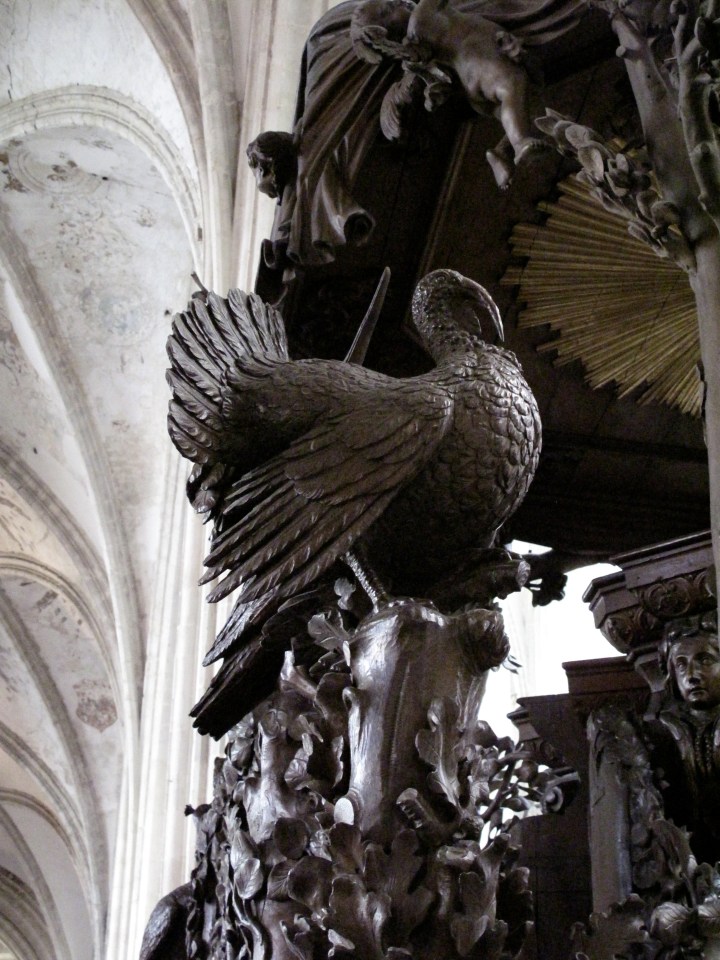
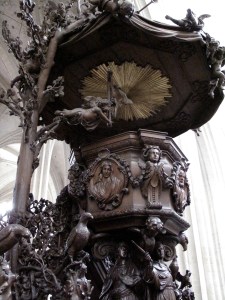 As I’ve mentioned before, a highlight of my summer was the chance to participate in the Attingham Program for the Study of Dutch Historic Houses. Before meeting up with the group in Amsterdam, I spent a couple of days in Antwerp and was especially delighted to stumble across this extraordinary pulpit from 1713. On several occasions, I was intrigued with important eighteenth-century additions to much older churches (the extraordinary organ at Haarlem’s St. Bavo is another example). The pulpit offers an amazing collection of wildlife, but at this time of the year, it is, of course, the turkey that stands out. To all of Enfilade’s American readers, a very Happy Thanksgiving. -CH
From the wall text at The Cathedral of Our Lady in Antwerp:
Michiel Van der Voort (1667-1737), Pulpit, 7 meters high
The pulpit stems from the former Saint Bernard’s Abbey located in Hemiksem,
south of Antwerp, and was brough in 1803 by the church council of the
Cathedral. The base and support symbolize the dissemination of faith across
the four continents. It is a superb example of the naturalistic Baroque.
Happy Birthday, Enfilade!
From the Editor

Keven Law, Wikimedia Commons
As I’ve said in the past, I’m extremely grateful to all of you for visiting the site and especially to Enfilade’s regular readers — all the more so on this one-year anniversary! What I envisioned as a convenient forum for sharing the occasional news item for HECAA members has surpassed my wildest expectations. To be sure, Enfilade is still a work in progress, and based on feedback from others, I’m optimistic about the future of this experiment.
I’m especially happy to welcome aboard Jennifer Ferng as our first Correspondent staff member. A former practicing architect, Jennifer is a Ph.D. candidate in the History, Theory, & Criticism of Architecture and Art program at MIT. Her dissertation focuses on the intersections between architecture, the decorative arts, and geology during the eighteenth and nineteenth centuries in Britain and France. From 2009 until 2011 she is based in Paris at the INHA as a Kress Fellow. Particularly in light of how many of you think of France as the geographical, intellectual, and artistic center of your work, I’m thrilled about the addition.
As I’ve also emphasized in the past, Enfilade readers are genuinely interested in what HECAA members are doing. So please continue to send reports regarding your own publications and research activities along with general notices of news items that relate to the art and visual culture of the long eighteenth century.
Finally, let me put in a plea for your financial support. The cost of an annual HECAA membership is just $20 (only $5 for students). If you’re not a member or if your membership has expired, please consider joining or renewing now (additional financial support is also most welcome). HECAA is affiliated with two scholarly organizations (the College Art Association and the American Society for Eighteenth-Century Studies), but anyone interested in the eighteenth century is most welcome here. Your payment will help fund the work of graduate students and junior scholars. Moreover, in being counted as a HECAA member, you help make the case that the eighteenth century really does matter for how we think about art history, visual culture, and the history of the built environment in general (in our world where keeping count becomes increasingly important, membership size is itself an indication of support).
Thanks again, and I leave with you an assortment of statistics:
- 396: number of postings published in the first year
- 44,600: total number of views Enfilade received in the first year
- 12,512: number of individual visitors to Enfilade during the second quarter of 2010
- 1516: number of views from returning visitors during the second quarter of 2010
- 2804: total number of views from returning visitors
Craig Hanson
Back in Mid-June
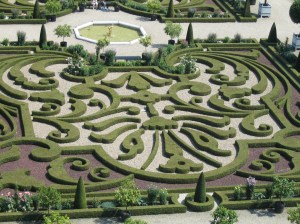
Formal Gardens at Het Loo Palace (Photo: Wikimedia Commons)
For the next two weeks, I’ll be in the Netherlands — first for the Historians of Netherlandish Art Conference in Amsterdam and then for the Attingham Study Programme for the Dutch Historic House (I’m especially grateful to the Attingham Trust and the American Friends of Attingham for a generous scholarship). Postings will resume around the middle of June. All the best for the start of a productive and relaxing summer!
-Craig Hanson
Tome Tweet Tome?
From the Editor
An admission: I’ve never tweeted, nor regularly followed anyone who does. I’m hardly opposed to Twitter on principle, and as someone who stresses to my students the importance of tightly-edited writing, I think there could be immense value in forcing individuals to communicate with just 140 characters at a time. Still, I’ve yet to be persuaded it’s for me. Nonetheless, the following pieces at least have me thinking about it (given that the text up to this point weighs in at 428 characters, I clearly have a long way to go).
◊ ◊ ◊ ◊ ◊
Jon Lackman, the editor of The Art History Newsletter, kindly sent me a link to this story, “Twitter Updates, the 18th-Century Edition,” posted at The Wall Street Journal by Jennifer Valentino-DeVries:
There aren’t too many things more 21st century than Twitter. But it turns out that the way people share information on Twitter bears some similarities to the way they shared it more than 200 years before the service was created in 2006, according to Cornell professor Lee Humphreys, who has been comparing messages from Twitter and those from diaries in the 18th and 19th centuries. A quick look at a few of the entries from several diaries shows that Twitter’s famous 140-character limit wouldn’t have been a problem for these writers:
April 27, 1770: Made Mead. At the assembly.
May 14, 1770: Mrs. Mascarene here and Mrs. Cownsheild. Taken very ill. The Doctor bled me. Took an anodyne.
Sept. 7, 1792: Fidelia Mirick here a visiting to-day.
Jan. 26, 1873: Cold disagreeable day. Felt very badly all day long and lay on the sofa all day. Nothing took place worth noting.
◊ ◊ ◊ ◊ ◊
Writing for The New York Times (30 April 2010), Randall Stross notes that today’s millions of tweets may in fact be the stuff of primary source material for future historians.
. . . Not a few are pure drivel. But, taken together, they are likely to be of considerable value to future historians. They contain more observations, recorded at the same times by more people, than ever preserved in any medium before.
“Twitter is tens of millions of active users. There is no archive with tens of millions of diaries,” said Daniel J. Cohen, an associate professor of history at George Mason University and co-author of a 2006 book, “Digital History.” What’s more, he said, “Twitter is of the moment; it’s where people are the most honest.”
Last month, Twitter announced that it would donate its archive of public messages to the Library of Congress, and supply it with continuous updates. . . .
◊ ◊ ◊ ◊ ◊
And if anyone’s looking for examples of art historical tweets, the following list of “100 Excellent Twitter Feeds for Art Scholars,” might be useful.
All the same, at this point, I’ve no immediate plans to tweet for Enfilade. Yet, if any HECAA members feel strongly that we’re missing out on something, I certainly am open to offers from interested volunteers. . . Or just your own sense of Twitter’s scholarly or institutional value. -C.H.
‘Curious Specimens’ and the Great Volcanic Cloud

Rooftop of Strawberry Hill, April 2010. The new Gothic pinnacles have been recreated from oak. The chimney pots date from the 19th century; they, like the rest of the exterior, will be painted the same original white as the wooden ornaments; yes, it's going to be bright.

The Strawberry Hill Trust was formed in August of 2002 to restore Horace Walpole's Gothic Villa at Twickenham, just outside of London. With a budget of £8.2 million ($13million), the project is scheduled to be finished by the end of the year.
Good News: The Curious Specimens conference in London was even better than I had expected (and I expected a lot). The Walpole and Mrs. Delany exhibitions are both stunning as installed, respectively, at the V&A and Soane’s Museum. The conference panels were stimulating, and Saturday’s visit to Strawberry Hill was thrilling (hard to beat a rooftop tour). Many thanks to the organizers, especially Luisa Calè and Lisa Ford but also Michael Snodin, Amy Meyers, Margaret Powell, Alicia Weisberg-Roberts, and Brian Allen.
Bad News: Because I’m caught in the UK under a massive cloud of ash, with irregular access to email, Enfilade will be updated less frequently than normal during the next few days. ‘Caught’ hardly conveys my joy at having a few extra days in London; nor does talk of the ash cloud conjure the wonderful sunny weather that the city is currently experiencing, but it does perhaps suggest the utter strangeness of the situation (and to be fair, for untold numbers of people, the travel freeze is proving to be an horrendous ordeal). Please feel free to continue sending details for any announcements or news items you would like to see posted. I’ll add them as soon as I can. Thanks for your patience. -CH
Thanks so much!
Enfilade numbers continue to grow, and March was another record-breaking month. The site attracted nearly 5800 unique visitors and tallied 578 visits from return readers. Thanks so much for your continued support!
I’m sorry that I was unable to attend this year’s ASECS meeting; it sounded like a great conference. Thanks so much for the voice of support at the annual HECAA luncheon. I’ve heard some terrific ideas, and I look forward to receiving more. As always, don’t be bashful in sending in updates about your work as well as general announcements (please don’t assume I know about any particular conference or exhibition; even if I am aware of it, reminders are nice).
Finally, please be aware that in addition to subscribing to the site via an RSS Feed, you can also subscribe via email (posts will simply arrive in your inbox). Links for either service are available toward the bottom of the right-hand column. -C.H.










 Enfilade
leave a comment