HECAA’s Pinterest Boards Unveiled
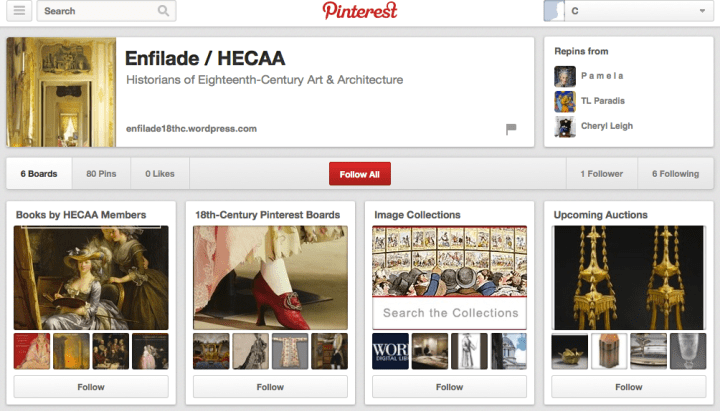
With two fabulous Clerks of the Pinterest Boards — Katrina London and Debs Wiles — taking the lead, I’m delighted to announce that HECAA and Enfilade now have a Pinterest presence! Having written about the site in the past (21 May 2012 and 17 January 2013), I’m now even more optimistic. Lots of you are already pinning. Some of you, on the other hand, are rolling your eyes at the very mention of it — not another new digital platform to make sense of! As one who signed up for a Pinterest account (yes, accounts are free) and then did nothing with it for months, I understand feelings of nagging annoyance and even disdain. But after a year of using Pinterest for personal interests and projects, I’ve been won over. It’s not nearly as good as it should (or could) be, but I think there is enormous potential for scholars to provide some leadership and make this new vehicle serve our own interests. It’s still an experiment, and six months from now, we’ll likely have a much better sense of the limits. On the front end, I offer the following suggestions; and don’t worry, we have no plans to change what happens here at the regular site for Enfilade. As always, feedback is welcome. -CH
◊ ◊ ◊ ◊ ◊
1) Plan. You’ll need to sign up for an account — but even before that — you need to consider how you want to use your account. As a social media platform, Pinterest will want to intertwine you with the people you ‘follow’ and the things you ‘pin’. It’s entirely common for people to use their real names, and if you’re using it to extend a professional presence, that’s probably advantageous. On the other hand, if you’re pinning cleaning tips, then maybe you’ll want something a bit more discreet (initials, pseudonyms, &c.).
2) Press on. When you sign up for an account, you’ll list several sites you want to ‘follow’. Over time, that list will grow as you hone your preferences and likes. For most people, Pinterest is only as satisfying as the things they’re following. Warning: here’s there’s a small learning curve. After you first sign up, you’ll likely be bombarded by lots of images (‘pins’) that have little to do how you want to use the site. Don’t fret. In a day or two, you’ll gradually begin to make sense of how it works, the visual clutter will dissipate, and it’s easy enough to ‘unfollow’ things you want to go away.
3) Follow HECAA! We currently have several ‘boards’. Whenever we post a new pin, it will automatically be pinned to your homepage, too. People who follow you will see it only if you ‘repin’ it yourself.
4) Explore. There are lots of museums, academic presses, and other scholarly institutions to ‘follow’ (Yale UP is one example). There are also lots of images of amazing eighteenth-century artifacts — often posted by historical novelists. At the level of strategy, Enfilade is not aiming to assemble large collections of interesting objects — paintings by Chardin or Kauffman, for instance. We have all kinds of resources for such collections: books, databases, &c. Instead, we’re interested in exploring what kinds of information would be a good fit with Pinterest and how we would take advantage of Pinterest as a venue for distributing visual information. Ultimately, we’ll be exploring how we might marshal collective efforts to maximize a critical mass of interest in eighteenth-century studies.
5) Think about organization. You’ll be able to create your own boards, assigning each pin to one of these. Generally, the more precise a board, the more useful it will be — to yourself and to others who may follow you. If you’re unsettled by the social media component, users are allowed three ‘secret boards’.
6) Think about who might see what you’re pinning. If you’re wondering how Pinterest could possibly be useful, consider this. Say you’re working on a paper on eighteenth-century picture frames. Through web searches, you find 10-20 sites and images you’d like to keep in mind. In a matter of seconds, it’s easy to pin each of those examples to a board you call ‘Frames’. With a system much easier than bookmarking or printing hard copies, you’re able to make a visual record, with brief captions and links. But also bear in mind: if those examples turn out to be crucial to your paper, anyone following you can, now, in effect, peer over your shoulder as you’re working. Perhaps that’s fine. Or perhaps you should use one of your ‘secret boards’ for that material. It’s easy enough to turn a ‘secret board’ into a public one later on, but you can’t go the other way.
HECAA’s Pinterest boards are available here»
Introducing: Clerks of the Pinterest Boards
I’m delighted to introduce two new Enfilade interns: Katrina London and Debs Wiles. For the next six months they’ll be exploring the scholarly potential of Pinterest. As Clerks of the Pinterest Boards, they’ll not only be pinning themselves but also helping us think through issue of organization and anticipating pitfalls. In fact, they’ve been working on all of this already for several weeks now. I’m thrilled at their interest and enthusiasm. Welcome aboard!
For an introduction and invitation to HECAA’s Pinterest boards, please see this posting.
-Craig Hanson
◊ ◊ ◊ ◊ ◊
Katrina London
 I am delighted to join Enfilade as a Clerk of the Pinterest Boards. I recently earned my master’s degree in Decorative Arts, Design History, and Material Culture at the Bard Graduate Center, where I specialized in the decorative arts of eighteenth-century France. Also at the Bard Graduate Center, I was a contributor to the exhibition and catalogue Salvaging the Past: Georges Hoentschel and French Decorative Arts from The Metropolitan Museum of Art, which opened earlier this month. I currently work in the Academic Programs department at the Bard Graduate Center as a program assistant for an NEH Summer Institute directed by Professor David Jaffee, and I am considering doctoral programs in art history.
Deborah (Debs) Wiles
 I came to horticulture as a career change. The more I learned about gardening and gardens, the more interested I became in the history of gardening. This led me to complete an MA in garden history at the University of Greenwich in London where I studied the history of Kensington Gardens and the evolution of the country house garden from the late seventeenth to early eighteenth centuries. I’ve since continued to research the biography of seventeenth-century traveler Celia Fiennes. I look forward to exploring ways to use social media as a scholarly tool!
Trying to Think Seriously about Pinterest, Part 2
From the Editor
Open Position: Clerk of the Pinterest Boards

Silivered brass pins, 1620-1800 (London: V&A Museum, given by R. J. Andrews, #123D-1900) Pinned to Cheryl Leigh’s Pinterest Board, 18th-Century Accessories
Last May I invited Enfilade readers to consider how Pinterest might be put to better use for scholars of the eighteenth century. Over the past few months, I’ve grown even more bullish, optimistic about the potential utility of pinning images with texts (organized under headings) and then distributing those pins via a social network (recent stats for Pinterest usage are available here). Pinterest Business accounts were launched in November, and while these may not be precisely the model for establishing scholarly credibility, the offering suggests Pinterest may slowly be growing up. If art historians are well placed to say what’s wrong with most of what happens on Pinterest, it seems to me we might also start contributing models for making a tool like this work better.
For all of these reasons, I’m now accepting applications for a volunteer position I’ve dubbed Clerk of the Pinterest Boards. I’m especially interested in exploring the following problems:
• How and to what extent might Pinterest be used in the production of knowledge, particularly in terms of collecting information (visual and textual information) and presenting that information together?
• How can we make a Pinterest board into something more than merely a collection of ‘pretty’ pictures?
• Are there things Pinterest could do that other digital formats (blogs, Twitter, Facebook, &c.) don’t do or don’t do well?
• How might we increase broad interest in the art and architecture of the eighteenth century via Pinterest?
I’m envisioning this position as extremely flexible and open-ended. As an experiment, it should probably run for at least a year, but the amount of work should be minimal to modest, perhaps an hour or two each week. For the best candidates, you’re probably already spending this much time on exactly the kinds of searches the positions would require; I just need you to start pinning those results and giving some thought to larger questions of organization and goals.
To apply, please send a message of interest and a recent CV to me at CraigAshleyHanson@gmail.com. As always, comments and feedback are welcome.
— Craig Hanson
P.S. — If this talk of pins brings to mind Adam Smith’s example of a “trifling manufacture,” all the better; you’re in the right place.
Supporting HECAA: Dues and Contributions via PayPal
From the President
After some remarkable digital wrangling by our treasurer, Jennifer Germann, we are once again able to receive HECAA dues via PayPal! So, if you’re a regular reader, please consider making a contribution to the Historians of Eighteenth-Century Art & Architecture. The organization needs your financial support to pursue its mission, an important part of which includes modest grants for graduate students through the Vidal and Wiebenson Awards. For current members, now is a good time to send in your dues for 2013 (just $20/$5 for graduate students), and if you didn’t pay dues for 2012, please consider making an additional contribution (also easily done via PayPal). You may also pay by mailing Jennifer a check, as directed on the membership page.
Anyone interested in the eighteenth century is welcome as a HECAA member. So if you’re reading, consider joining!
— Michael Yonan
Enfilade at Three — Buy a Book and Open a Door
From the Editor
 Enfilade turns three today, and to celebrate, I’m announcing a campaign to establish June 22 as Buy-an-Art-Book Day. As I’ve said repeatedly, you deserve credit for making this site so much more than I could have possibly envisioned when I stepped on-board several years ago as newsletter editor. With more than 220,000 hits on some 1300 posts, Enfilade attests to the global depth of interest in eighteenth-century art — both among scholars and a wider, engaged public. The site now receives around 10,000 hits each month with some 1500 from returning visits. In short, there are hundreds of you who read Enfilade on a regular basis, and the site’s success depends on you. Thank you!
With these numbers in mind, it seems to me that Enfilade readers could mobilize to make an impact — modest perhaps but still an impact. In transitioning from traditional print formats to the digital realm, academic publishing, particularly art historical publishing, faces tremendous challenges. With the ‘business’ of the academy more generally plagued by questions of sustainability, it’s easy to see how hard decisions about budgets have wreaked havoc on the sales of books (when major universities are cutting whole departments, declining library budgets may seem relatively benign, but in both cases, fewer books will be sold). For most of us, such gloomy observations are all too familiar, and you don’t turn to Enfilade for more bad news. Today is after all a birthday celebration!
So as a gesture of positive action, I’m asking all of you to buy a book today (and fellow bloggers to spread the word). It’s easy to think that it won’t matter, but it does. Most people are astounded to learn just how small the circulation numbers are for art history books published by university presses. However humbling it may be for those of us who spend years of our lives producing a book, it’s not uncommon for only 400 or 500 copies to be sold. Surpass 1000 and you’re a superstar. There’s a tendency to assume that university presses receive generous funding from their host universities. It’s almost never the case. If they’re not in the business to turn huge profits, they must still be economically viable. Several years ago, I heard Susan Bielstein, executive editor at the University of Chicago Press, give a talk on the nuts and bolts of publishing. How did she begin? By asking members of her audience (almost entirely composed of art historians) to go buy a book. She was entirely serious. So am I.

Many of you buy lots of art history books already. Bravo! Buying a book today won’t be any major change for you. As I think about my own buying habits, they tend to go something like this: I buy discounted display copies at conferences, I buy things I need for an upcoming talk, I buy remaindered copies of books I should have bought a year or two earlier, or I buy used copies I need for an article via Amazon. None of that’s what I have in mind in launching Buy-an-Art-Book Day. Those used books do nothing to help the authors or the university presses who produced them. For that matter, new purchases through Amazon often result in smaller royalties than buying from the publisher directly. Ever wonder who shoulders the expense of that reduced price? Yes, the publisher and the writer.
If 200 or 300 of you buy an art history book this week — ideally one treating the eighteenth century and, better yet, one written by a HECAA member — it would send a strong message that there is an eager audience for such books. Whether you spend $6 or $1000, buy a book.
I like the metaphor of an enfilade because of the way it suggests an open — almost limitless — vista, with each room leading to a deeper, more intimate experience. But such a vision is premised on those doors being opened. Reading a book — buying a book — is one way we turn the handle, one way we open doors to the eighteenth century.
-Craig Hanson
Greetings from Venezia!

My apologies for the recent interruption in posting. I’m in Venice with fourteen students for our January term and just haven’t been able to spend as much time with the site as I had envisioned (traveling with an eighteen-month old has added its own further complications, if also joys).
Regular posts should resume soon, and I’ll include some of the terrific eighteenth-century offerings I’ve encountered — often as lovely surprises alongside materials from very different periods. In the short-term, thanks for your patience. I’ll be back soon. -CH
Meet Our New Intern: Ashley Hannebrink
I’m happy to introduce Enfilade’s current intern, Ashley Hannebrink, who already has lots of great ideas in store for the next couple of months. -CH
◊ ◊ ◊ ◊ ◊
Note (added 5 May 2025) — The full postings for interns have been archived offline.
Meet Our New Intern: Amanda Strasik
I’m glad to report that the Enfilade internship program is off to a fabulous start. Freya Gowrley did a brilliant job getting things rolling, and she now passes the baton on to Amanda Strasik. Welcome, Amanda! -CH
◊ ◊ ◊ ◊ ◊
Note (added 21 October 2022) — The full postings for interns have been archived offline.
Follow Us to the Eighteenth Century
Note from the Editor

Palladian Bridge, Prior Park, 1755 (Photo Stephen McKay, Wikimedia Commons)
I’m happy to report that the internship program is off to a terrific start! Now in the final weeks of her two-month position, Freya Gowrley has done a fabulous job, pointing out new resources, keeping tabs on other sites, and putting together posts of her own.
In addition, Freya has single-handedly guided us into the realm of social media. I know, many of you are wondering what took so long! I’m completely to blame for the delay, but finally Enfilade is available via Twitter and Facebook.
As you may have already noticed, at the bottom of each posting, there’s now a +Share button: with a couple of clicks, you can send postings to your email account, your LinkedIn page, or your own Twitter feed. So if you use any of these resources, add us as we meet your needs. Friend us, Like us, Tweet us. Follow us to the eighteenth century. -CH


Introducing Enfilade’s First Intern: Freya Gowrley
I’ve been delighted by the emails I’ve received expressing interest in Enfilade’s new internship program. At least tentatively, I have the spot filled until the end of the year. And this morning, I’m really excited to introduce our first intern, Freya Gowrley — or more precisely, to allow her to introduce herself. Welcome aboard, Freya! -CH.
◊ ◊ ◊ ◊ ◊
Note (added 5 May 2025) — The full postings for interns have been archived offline.










5 comments