Innovation in Teaching Award
ASECS Innovative Course Design Competition
Deadline: 1 October 2009
To encourage excellence in undergraduate teaching of the eighteenth century, the American Society for Eighteenth-Century Studies invites proposals from members in any of its constituent disciplines. Proposals should be for a new approach to teaching a unit within a course on the eighteenth century, covering perhaps one to four weeks of instruction, or for an entire new course. For example, participants may offer a new approach to a specific work or theme, a comparison of two related works from different fields (music and history, art and theology), an interdisciplinary approach to a particular social or historical event, new uses of instructional technology (e.g., web sites, internet resources and activities), or a new course that has never been taught or has been taught only very recently for the first time. Participants are encourage to include why books and topics were selected and how they worked. Applicants should submit five (5) copies of a 3-5 page proposal (double-spaced) and should focus sharply on the leading ideas distinguishing the unit to be developed. Where relevant, a syllabus draft of the course should also be provided.
The Committee will select the top three proposals by November 15. A major criterion for judging the proposals is how specific they are in relation to design, readings, pedagogy, and/or activities. The authors will be asked to develop a brief presentation for delivery in the Teaching Competition seminar at the 2010 Annual Meeting. A distinguished teacher-scholar will be invited to moderate the session. A $500 award will be presented to each of the participants, and they will be invited to submit a twelve-page account of the unit or course, with a syllabus or other supplementary materials for publication on the website. (more…)
Speaking of Eighteenth-Century Rome . . .
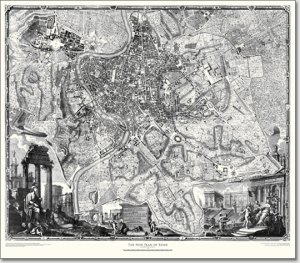
From the Interactive Nolli Map Website, University of Oregon
Under the direction of Jim Tice and Erik Steiner, the University of Oregon has constructed a stunning interactive version of Giambattista Nolli’s Map of Rome from 1748. The digital version, available online for free, is user-friendly, searchable, and comes with several essays that introduce Roman geography, social history, and eighteenth-century cartography. There’s also a fine bibliography. The map can be overlaid with a variety of layers: Gardens, the Tiber River, Rioni, Fountains, City Gates, Walls of Rome, Pathways, Map Icons, and Satellite Images. In addition to exploring (and now modelling) standards that we should expect of scholarly digital projects, the Nolli Map could offer immediately practical uses for teaching assignments. And if you find that the virtual map just makes you want a paper version all the more, the project organizers have teamed up with Raven Maps to produce a new edition available for $95 (in 2005, around the time of the launch of the Nolli wesbsite, one of the original maps sold at Christie’s for £7800, or just over $13,000). The University of Oregon website makes the Raven edition sound irresistible:
At approximately two-thirds the original size, it measures 45 inches by 52.6 inches (114cm x 133cm). It is printed at a scale of 1:4,500, where 1 inch equals 375 feet. Produced to the highest standards in mind, the edition is printed with stochastic screening on 100 lb Finch Fine paper. Stochastic screening is recognized for its superior representation of fine lines and tonal values, and is commonly used for printing high quality black and white photography. The process (in which printed dots are spread randomly throughout the image area instead of in a grid pattern) yields a warmer, less mechanical result perfect for a map of this vintage. A process black ink was used for the printed area and an antique tint lends the map an elegant look and feel.










 Enfilade
leave a comment