Yinka Shonibare in DC
Yinka Shonibare, MBE
Smithsonian National Museum of African Art, Washington D.C., 10 November 2009 — 7 March 2010
Curated by Rachel Kent
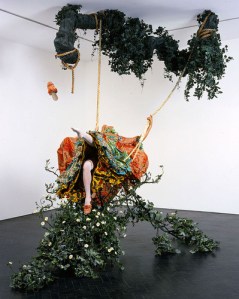
Yinka Shonibare, "The Swing (After Fragonard)," 2001
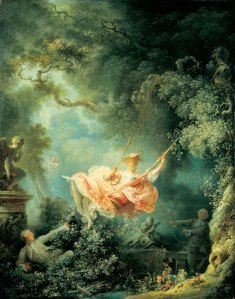
Jean-Honoré Fragonard, "The Swing," 1767 (London: Wallace Collection)
This morning on NPR’s Morning Edition, Susan Stamberg profiled the Yinka Shonibare exhibition now on display at the Smithsonian National Museum of African Art (it was organized by the Museum of Contemporary Art in Sydney). Writing in The New York Times (17 June 2009) of the show when it was at the Brooklyn Museum this past summer, Deborah Sontag described Shonibare as an “erudite and wide-ranging” artist, whom

Rachel Kent
at 47, is a senior figure in the British art world but one who intentionally eludes easy categorization. A disabled black artist who continuously challenges assumptions and stereotypes — “That’s the point of my work really,” he said — Mr. Shonibare makes art that is sumptuously aesthetic and often wickedly funny. When he deals with pithy matters like race, class, disability, colonialism and war, he does so deftly and often indirectly. “I don’t produce propaganda art,” he said. “I’m more interested in the poetic than the didactic.”
While many of the works address contemporary issues through Victorian conventions, there are intriguing eighteenth-century references, too — including this reworking of Fragonard’s Swing.
Lunar Landscapes, Part II
In connection with the previous lunar posting, Michael Yonan notes the fascinating series of paintings in the Vatican Collection by Donato Creti. Commissioned by Luigi Marsili in 1711, the eight pictures depict landscapes by Creti with heavenly bodies rendered by the miniaturist Manzini — largely as the forms would have appeared with the aid of eighteenth-century telescopes. In a 1992 article Christopher Johns addresses the paintings “as a cultural bribe to Clement XI, works of art that give unique testimony to the significance of Newtonianism to astronomical observation in Italy and to the intimate relationship between early eighteenth-century art and science.” See Johns, “Art and Science in Eighteenth-Century Bologna: Donato Creti’s Astronomical Landscape Paintings,” Zeitschrift für Kunstgeschichte 55 (1992): 578-89. The article also includes the lovely drawing by Creti, “The Astronomers,” now in the collection of the Art Institute of Chicago.
One Small Step, One Giant Leap
Scaramouche: “You must know, Madam, your Father (my Master, the Doctor) is a little Whimsical, Romantick, or Don Quick-sottish . . . Lunatick we may call him without breaking the Decorum of good Manners; for he is always travelling to the moon.”
-Aphra Behn, The Emperor of the Moon (1687)
On the 40th anniversary of Neil Armstrong’s moon walk, a selection of lunar images from the eighteenth century seems in order. And as often is the case with this crucial century, we see important foundations established (and some from the sixteenth century reinforced). From Aphra Behn’s use of the moon as a potent source of satire for the Royal Society – recently explored by Al Coppola in “Retraining the Virtuoso’s Gaze: Behn’s Emperor of the Moon, the Royal Society, and the Spectacles of Science and Politics,” Eighteenth-Century Studies 41 (Summer 2008) – to William Hogarth’s Principal Inhabitants of the Moon, the celestial orb proved a useful foil for assessing life as experienced in more local terms.
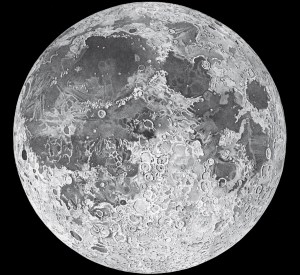
 By the end of the century, however, John Russell (Royal Academician and Painter to George III) would fix his entirely serious and scrupulous gaze to the heavens. Along with a series of drawings, he produced a handsome lunar globe and a striking pastel, measuring 5ft across. Both are now found at the Museum of the History of Science in Oxford, which possesses the major collection of work relating to Russell’s lunar observations. For details, see the museum’s website, which contains especially useful information from a 2007 exhibition dedicated to the subject, “Moonscope.”
Others that come to mind?










leave a comment