V&A Design a Wig

◊ ◊ ◊ ◊ ◊
As noted by various sources (Hyperallergic and Harper’s Bazaar, among others), the V&A has recently launched its ‘Design a Wig‘ game, the perfect antidote to procrastinating a bit longer the chores still waiting in your inbox. . .
Exhibition | Under the Guillotine: James Gillray

◊ ◊ ◊ ◊ ◊
From Metropolitan State University of Denver:
Under the Guillotine: James Gillray and Contemporary Counterparts
Center for Visual Art, Metropolitan State University of Denver, 18 December 2015 — 19 March 2016
Curated by Arthur Gilbert and Cecily Cullen
The Center for Visual Art, for the first time in its history, is presenting work that dates back more than two hundred years in Under the Guillotine: James Gillray and Contemporary Counterparts. Over 60 original hand-colored etchings will be shown from the collection of Arthur Gilbert, professor at the University of Denver. London artist James Gillray (1756–1815), hailed as the father of modern caricature, was not reserved in his biting critique of European politics and social norms of his day. In this work we see Gillray’s dark humor unleashed at the expense of the royal family, the institution of marriage and healthcare, among other current issues.
Although Gillray’s etchings date back over 200 years, the themes are familiar to contemporary society, highlighting the cyclical nature of history. In response to the ongoing relevance of Gillray’s subject matter, a contemporary take on political satire is presented by the work of three living artists, Molly Crabapple, Chris Dacre, and Deb Sokolow. These artists wield wit and irony in their critique of today’s political and social norms.
New York artist and writer Molly Crabapple is a contributing editor for VICE magazine. Her illustrations take a line from Gillray’s brand of satire, pointing out the ridiculous and unjust with irreverence. Illustrations in the exhibition draw from her press tour of Guantanamo Bay prison and other articles in VICE and Vanity Fair, in which she targets Donald Trump and ISIS. Crabapple’s memoir, Drawing Blood, will be released in December 2015.
The work of Chris Dacre reflects upon his own experience in the US military. Shining a light on the hypocrisy of war glorification and recruiting techniques targeted at the naïve, Dacre’s toy-sized porcelain tanks and pirouetting soldiers beckon the curious to play at the game of war. His installation also includes lithographs depicting war scenes emblazoned with commands to “Be A Man!” or “Do Something for Once in Your Life,” sentiments felt if not heard once the game of war becomes reality.
Chicago-based artist Deb Sokolow combines fiction and humor to create work that parallels real life events and characters. For this exhibition, Sokolow is contributing text-based works focused on the conspiracy theories swirling around Denver International Airport and the shady campaign strategy of a fictional politician.
The work of James Gillray was curated by Arthur Gilbert and CVA Managing Director and Curator Cecily Cullen. The contemporary response was curated by Cecily Cullen.
‘Mr Foote’s Other Leg’ Onstage in London

Joseph Millson as David Garrick, Dervla Kirwan as Peg Woffington, and Simon Russell Beale as Samuel Foote; Mr Foote’s Other Leg, directed by Richard Eyre, Hampstead Theatre, London. Credit: Alastair Muir.
◊ ◊ ◊ ◊ ◊
Ian Kelly’s biography of Samuel Foote made Enfilade’s 2012 year-end gift guide. The eponymous play, Mr Foote’s Other Leg, has just moved to Theatre Royal, Haymarket. Writing for The Guardian, Michael Billington finds in it “a ramshackle vigour” with “a shining performance from Simon Russell Beale” as Foote. Reviewing the play while it was at the Hampstead Theatre, Sussanah Clap, also writing for The Guardian, found much to enjoy, singling out (among others) Dervla Kirwan: she “is enchanting—frilly and filthy—as Peg Woffington, in ‘breeches’ roles.” And here’s the beginning of Jane Shilling’s piece for The Telegraph (5 November 2015). . .
 It is curious that the reputation of Samuel Foote should be almost forgotten when so many of his less amusing 18th-century contemporaries are still remembered. A one-legged actor-manager with a fondness for appearing in extravagant female costume and a dangerous talent for satire, Foote bestrode (or rather, hopped commandingly across) the stage of the Theatre Royal, Haymarket—the venue to which Richard Eyre’s production of Ian Kelly’s play has transferred after a sell-out premiere at the Hampstead Theatre.
Kelly, who appears in his own play as the future King George III, published a biography of Foote in 2012, but evidently felt that his subject’s natural milieu was the stage rather than the page. His adaptation is a wild, picaresque romp through the theatrical,
social and scientific landscape of the 18th century. . . .
The full review is available here»
Exhibition | Dutch Dining: Four Centuries of Table Settings
Thanks to Hélène Bremer for noting this exhibition (along with installation by Bouke de Vries). . .
Nederland Dineert: Vier Eeuwen Tafelcultuur
Dutch Dining: Four Centuries of Table Settings
Gemeentemuseum, The Hague, 28 February 2016
Fine dining is a form of sensory seduction. It operates not only via the taste buds, but also via the visual appeal of the food and table setting. Beautiful porcelain and silverware, glittering crystal, fine damask and extravagant sugarwork table ornaments all have a part to play. This exhibition at the Gemeentemuseum Den Haag uses a spectacular display of complete table settings, complemented by drawings, paintings and liveries, to bring the history of formal dining among the Netherlands’ wealthy elite, ruling class and royal house to vivid life. The perfect place to find inspiration for that very special Christmas dinner table!
 Dutch Dining paints a fascinating picture of the way people in the top echelons of Dutch society were once accustomed to dine together. At tables laden with exquisite culinary delights and surrounded by an army of liveried footmen. The show is both a feast for the eye and a unique insight into the past. All of the objects in the reconstructed table settings are completely authentic—from the tableware to the ornaments, and even the furniture. The table linen comes from the very linen cupboard in which it has lain ever since the 18th century.
No table setting would be complete without meticulously folded napkins. The European fashion for the decorative use of table linen dates back to the Renaissance. In our own day, Catalan artist Joan Sallas is reviving this ‘forgotten art’ with his astonishingly skilful birds, fish and rabbits. The exhibition will feature ten such virtuoso constructions, all specially folded for the occasion.
An exclusive peek inside the royal porcelain and silverware cabinet will transport visitors right to the heart of the Noordeinde Palace. Stars of the show are two complete table services—a silver one of modern design and its more traditional porcelain counterpart—on loan from the collection of the Dutch Royal House. Both services were presented to Queen Wilhelmina and Prince Hendrik on the occasion of their marriage in 1901 and the exhibition discloses which of the two found most favour with the royal couple.
The design of the exhibition is by Maarten Spruyt and Tsur Reshef. The lavishly illustrated Dutch-language catalogue, Nederland dineert. Vier eeuwen tafelcultuur, offers the first ever reliable survey of four centuries of Dutch table settings and contains historical essays. For the museum’s youngest visitors there is also a children’s picture book and a related exhibition in the children’s gallery. The Gemeentemuseum Den Haag and the Netherlands Nutrition Centre (Voedingscentrum) are joining forces to organize a range of activities during the Dutch Dining exhibition.
The exhibition includes items generously loaned by the Rijksmuseum, Amsterdam Museum, Museum Van Loon, Kastelen Middachten, Amerongen, Twickel and de Haar, Fundatie van Renswoude Utrecht, Koninklijke Verzamelingen Den Haag, RCE/Jachthuis St. Hubertus, Huis der Provincie Arnhem and private collections.
Nederland Dineert: Vier Eeuwen Tafelcultuur (Zwolle: Waanders, 2015), 320 pages, ISBN: 978-9462620575, €34.50.
Koken en eten hoort als vanzelfsprekend bij het leven. Veel esthetiek komt hier in eerste instantie niet bij kijken. Maar zodra gezamenlijk wordt gegeten, wordt eten een sociale bezigheid, een middel tot communicatie, tot representatie, tot onderscheid. Voor dit boek is een keur aan specialisten op zoek gegaan naar de specifieke eetcultuur van Nederland. Aan de hand van een tiental authentieke ensembles van eetvertrekken van verschillende landgoederen en paleizen met daarbij bewaard gebleven voorwerpen, wordt het dineren in de afgelopen vier eeuwen geïllustreerd. Laat u betoveren door de verhalen rond de maaltijd en de uitstraling van volledig opgetuigde tafels, gedekt met tafellinnen, porselein en zilver, decoraties van suikerwerk en bloemen, van de bijbehorende meubels en het dienstpersoneel in livrei.
Opening in December 2015: V&A’s ‘Europe 1600–1815’ Galleries
From the V&A press release:

Writing cabinet, 1750s, possibly by Michael Kimmel, or Kümmel (1715-1794) a cabinet-maker in Dresden (London: V&A, Purchased by H.M. Government from the estate of the 6th Earl of Rosebery and allocated to the Victoria and Albert Museum, W.63-1977)
The V&A’s Europe 1600–1815 galleries will open to the public in December 2015, following the transformation of seven galleries for the redisplay of the Museum’s unrivalled collection of 17th- and 18th-century European art and design. A major part of the V&A’s ongoing redevelopment programme known as FuturePlan, the £12.5m project will complete the restoration of the entire front wing of the Museum for the display of more than 1,100 objects.
In its prominent position next to the V&A’s grand entrance, Europe 1600–1815 will continue the story of art and design that begins in the award-winning Medieval & Renaissance Galleries (opened 2009). Four large galleries will introduce the story in chronological sequence, alternating with three smaller galleries that focus on specific activities: collecting in the Cabinet, enlightened thought in the Salon and entertainment and glamour in the Masquerade. In addition, three period rooms will invite visitors to imagine life in the personal spaces of the time including a 17th-century French bedroom, Madame de Sérilly’s cabinet and a mirrored room from 18th-century Italy.
The collection comprises some of the most magnificent works held by the V&A, including spectacular examples of textiles and fashion, painting and sculpture, ceramics and glass, furniture and metalwork, prints and books. Many objects were made in Europe by its finest artists and craftsmen for the period’s most discerning leaders of taste such as Louis XIV, Marie Antoinette, Catherine the Great and Napoleon.
Martin Roth, V&A Director, said: “These new galleries are a major development in our ambitious programme to renew the architecture of the V&A for the 21st century and, at the same time, re-examine and re-present our collection for our visitors. At a time when roles and relationships within Europe and the world are under scrutiny, it is interesting to explore the objects, makers and patrons of a period that was so influential upon the habits and lifestyle of Europe today.”
A large, highly ornate Rococo writing cabinet made for Augustus III and acquired in 1977 from the celebrated sale of Mentmore Towers, Buckinghamshire will be exhibited for the first time since its recent conservation. Another newly conserved highlight on display will be a grand 18th-century bed from the Parisian workshop of George Jacob. A supplier to royal courts across Europe, Jacob survived the French Revolution and later made furniture for Napoleon.
The displays will demonstrate how France succeeded Italy as the undisputed leader of fashionable art and design in Europe in the second half of the 17th century. They will also show how—for the first time ever—Europeans systematically explored, exploited and collected resources from Africa, Asia and the Americas.
The collection includes several outstanding bequests, notably from John Jones, a military tailor who left his exceptional collection of French decorative arts to the Museum in 1882 and who is the subject of a special display within the galleries. A number of significant new acquisitions will be exhibited for the first time at the Museum including a 17th- century Venetian table by Lucio de Lucci, acquired after a temporary export ban in 2012. The magnificent oil painting The Château de Juvisy, by Pierre-Denis Martin, a rare, accurate depiction of the architecture and bustling life of an estate near Paris in the 17th century, will be a centrepiece of the gallery exploring the rise of French cultural dominance during the period. The work was secured for the nation in 2014 thanks to a major public appeal and donations from the Friends of the V&A and the Art Fund.
Preparation for the reopening is underway with a full reinterpretation of the collection and important objects undergoing conservation: several large tapestries have been cleaned at De Wit Royal Manufacturers of Tapestries in Mechelen, Belgium, including the Gobelins tapestry after the Poussin painting The infant Moses tramples on Pharoah’s crown manufactured in Paris in the 1680s. Fashion garments, furniture and textiles have been conserved in the V&A’s world- renowned studios and a Meissen table fountain has been meticulously researched and rebuilt for the first time since its acquisition in 1870.
The V&A is working with architectural practice ZMMA on the redesign of the galleries. The project will see the complete removal of the interior cladding added in the 1970s and will reclaim back of house storage space. The combined effect will enlarge the galleries by almost a third to 1,550 square meters. Natural light will be returned to the spaces by uncovering windows previously obscured. Environmental controls will be upgraded to provide sustainable and stable conditions for the collection and new state-of-the-art cases that meet modern environmental and security requirements will be installed.
The Europe 1600-1815 galleries are being made possible thanks to a generous £4.75m lead grant from the Heritage Lottery Fund with further support from many other Trusts, Foundations and individuals.
Lesley Miller is lead curator and Joanna Norman is project curator of Europe 1600–1815. To mark the opening of the new galleries, the V&A will publish The Arts of Living: Europe 1600–1815, edited by Elizabeth Miller and Hilary Young.
Dawn Hoskin provides details (with photos) at the V&A’s Blog»
◊ ◊ ◊ ◊ ◊
From the V&A press release:
The V&A has commissioned the artist collective Los Carpinteros to create a contemporary installation for the Museum’s new Europe 1600–1815 galleries, opening to the public in December 2015. Established in 1992, Los Carpinteros have received international acclaim for their sculptural pieces. The duo work between Madrid and Havana, and this will be their first major project for a London museum.
Charged with devising a large-scale, imaginative and thought-provoking piece that would sit within the gallery examining the Enlightenment, Los Carpinteros proposed The Globe. It is a curved architectural sculpture made from a lattice of engineered beech that will form a ‘room within a room’ at the heart of the new Europe displays. Occupying a pivotal space—both architecturally and in terms of the narrative of the galleries—it will offer visitors an opportunity to pause and reflect, as well as encourage engagement with the complex concept of the Enlightenment. Seating up to 30 people, The Globe will also be used as a space for programmed salons, events and discussions.
The period represented the triumph of intellectual curiosity and enquiry, a culture of increasing literacy and debate, and a desire to acquire and classify knowledge. This is encapsulated in one of the most important publications of the 18th century, Diderot and Alembert’s Encyclopedia (1751–1772). A vast collaborative project involving many of the leading thinkers of the day, it aimed to gather all available knowledge, to examine it critically and rationally, and to bring it to a wide public. Bernard and Picart’s Religious Ceremonies and Customs of All the Peoples of the World (1723–1743) will be on display in the gallery. A number of sculptural busts from the period will be placed in dialogue around The Globe and be visible from inside the installation, recalling the intellectual environment and salon culture, and making connections between past and present.
Lesley Miller, lead curator for Europe 1600–1815, said: “Bringing alive the Enlightenment is a challenge for a curator—how might we represent intellectual thought and debate in a gallery? Los Carpinteros’ work, set among sculpture and books from the period, creates a fundamentally different experience for visitors—inviting them into a contemplative, calm place to reflect and think. The design of The Globe reflects not only the world but also, in its bookshelf, cell-like construction, the organisation of knowledge—central to Enlightenment thought. It also creates space for intellectual debate in a relatively informal setting—the V&A’s own 21st-century take on an 18th-century salon, if you like.”
Los Carpinteros said: “Our commission for the V&A is the culmination of a 20-year fascination with the idea of the ‘panopticon’. First devised in the 18th century by Jeremy Bentham, these structures promoted surveillance and control and were originally intended for prisons. The Globe reinterprets this format as an observation point midway through the Museum’s new galleries. It is a station for rest, contemplation and discussion that will relate closely to the objects that surround it. Our work to date has mainly been with museums and galleries dedicated to contemporary art, so it has been very exciting to work in the context of the V&A’s historical collection of objects, fine art and design; a world with which our practice has many familiarities and connections. Here our work as artists, craftsmen, designers and carpenters has a rare practical utility and function alongside its symbolism—with pleasingly ambiguous results.”
The V&A has an established reputation for working with contemporary artists and designers to respond to the permanent collections. Past collaborations have included site-specific commissions from Elmgreen & Dragset, Cornelia Parker, Edmund De Waal, Felice Varini, rAndom International, and Troika. . . .
Los Carpinteros (The Carpenters) are Marco Antonio Castillo Valdes (b. 1971) and Dagoberto Rodríguez Sanchez (b. 1969). A Havana-based collective, they have created some of the most important work to emerge from Latin America in the past decade. Formed in 1992 (with Alexandre Arrechea until his departure in June 2003), Los Carpinteros took their name in 1994, deciding to renounce the notion of individual authorship and refer back to an older guild tradition of artisans and skilled craftsmen. Merging architecture, design, and sculpture in unexpected and often playful ways, their work negotiates between the functional and the non-functional. Their carefully crafted drawings and installations use wit to set up contradiction between object and function as well as practicality and uselessness. Their work is in the permanent collections of many leading international museums and galleries.
The V&A invited proposals for “the creation of an imaginative, exciting and thought provoking work, or concept, that not only challenges and engages the audience but which also introduces them to a different kind of aesthetic experience”. The commission was conceived as a way of drawing visitors to the space and of encouraging visitors to engage with the challenging ideas of the Enlightenment.
The Globe has been made and installed by Tin Tab, a specialist creative engineering group and producers of highly innovative furniture and staircases. With the V&A and Los Carpinteros, they designed, engineered and manufactured hundreds of components out of Beech Multiply, worked on by hand and machine and completed like a giant 3D puzzle. Tin Tab has been established for over 17 years. Based in Newhaven, East Sussex, Tin Tab’s workshop has a team of 15 expert designers and makers from multi-disciplinary backgrounds.
Living the History of George Washington’s Tent
There were, for me, many stimulating offerings available at this year’s ASECS conference in Williamsburg, including a fine session on “Historical Reenactment,” sponsored by the Society of Early Americanists and chaired by Joy Howard. While I found all seven of the brief contributions thought-provoking (none more so than Michael Twitty’s presentation of his extraordinary work, including the Southern Discomfort Tour), Tyler Rudd Putman’s account of working as an intern on The First Oval Office Project during the summer of 2013 seemed perfectly suited to a posting here at Enfilade. I was thrilled he agreed. -CH

Living the History of George Washington’s Tent
T Y L E R R U D D P U T M AN
I spent the summer of 2013 dressed for work in the 1770s. As a historic trades intern working in costume in a workshop at Colonial Williamsburg, I was part of the First Oval Office Project, an initiative to recreate the sleeping tent, or marquee, used by George Washington during the American Revolution. Amazingly, this 22-foot-long oval tent still exists in the collection of the Museum of the American Revolution. Of thousands of tents made and used during the Revolution, only two survived to 2014; both belonged to Washington, saved for posterity.
Why would people spend years of research and months of sewing to make a big piece of canvas, especially when we already have the original? You can imagine what the old marquee is like after two centuries. It’s fragile. When the new Museum in Philadelphia installs it in Philadelphia in a new building about to begin construction, it will rest on a custom support system, so it doesn’t tear itself apart. But we wanted a tent that could travel, a tent that people could touch, a tent that people could walk into, look up at the ceiling inside, and wonder what it was like to be Washington during the Revolutionary War. Moreover, for all the hours experts have spent scrutinizing Washington’s marquee, there were still all sorts of mysteries we hoped to solve by making an exact copy. There were strange stitches, hints of repairs and adjustments, and other oddities we hoped to explain in the process of sewing a new tent, stitch by stitch, by hand (there were no sewing machines in the 1770s).
We also know almost nothing about the men and women who sewed Washington’s tent in 1777. They left few documentary traces, but recreating labor can help historians recapture lives. What was it like to sit ‘tailor fashion’, cross-legged atop a worktable, for a long day? Documents indicate that some women worked sewing tents during the Revolution as well. How was sewing work different for them? What does regular hand-sewing do to your hands?

The author at work sewing tent canvas.
◊ ◊ ◊ ◊ ◊
Experimental archaeology, or recreating an object or activity from the past to better understand the culture from which it emerged, is not time travel. I don’t know what it’s like to work a fourteen-hour day on a bread and small beer diet, in a body weathered from years of such labor, with an eighteenth-century mind. But I know how it hurts when you break a needle against your thumb, and I’ve felt the jubilation of finishing a hopelessly long seam. If you had been there this summer, you would have felt your back muscles tire and your posture change after only a day of sewing. You would have started to notice things. Linen lint floating in the air. The peculiar, miniscule catching when a steel needle has a small barb growing at its tip. How it’s possible to daydream and almost fall asleep amid the rhythmic motions of sewing a long seam. It’s in these microscopic moments that we connect with people long gone. No matter how much cultural baggage and time separates us, there’s something here we share with our long-ago predecessors.
We could have figured all this out in a warehouse somewhere. That certainly would have made our big experiment more efficient. But we wanted to make the tent in front of the public, so that the process of creation would both answer our questions and educate everyday people. To this end, the Museum of the American Revolution teamed with the Colonial Williamsburg Foundation and, in the summer and fall of 2013, operated a tentmaking shop in Williamsburg.
Washington’s tent was made in Reading, Pennsylvania, in 1777, but we know that artificers and other tradesmen who worked for the army sewed plenty of tents in Williamsburg during the Revolution, so operating such a shop in the city fit well with the Foundation’s interpretive goals. A crew of costumed tradesmen, including myself, spent five days a week sewing common tents used by ordinary soldiers, uniforms, knapsacks, and George Washington’s marquee. We didn’t pretend to be historical characters but instead spoke with visitors as ourselves. The costumes were just another one of our tools, allowing us to understand and discuss things like posture, cleanliness, and fashion from a contemporary viewpoint.
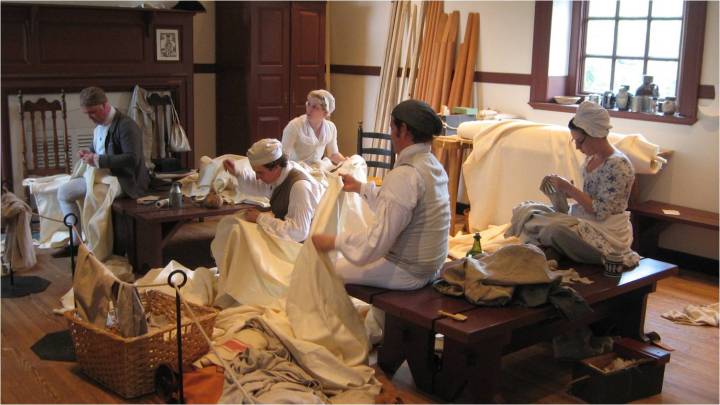
Tailor Mark Hutter and interns Aaron Walker, Nicole Rudolph, Michael Ramsey, and Gwendolyn Basala at work in the tentmaking shop.
◊ ◊ ◊ ◊ ◊
Over eight months, we answered a lot of our questions and came up with all sorts of new ones. We had an exceptional, interdisciplinary crew of sewers, including experts in historic trades, artists, students, and historians. Behind the scenes, we relied on curators, conservators, weavers, woodworkers, and social media workers to keep our project on track. These diverse viewpoints generated valuable insights. In the process, we had to answer persistent visitor questions. “Were these tents waterproof?” many people asked. We wondered that, too, and we were lucky enough to have a rainy summer in Williamsburg, giving everyone the opportunity to see how linen canvas resists even torrential rain, how tightly sewn seams hold up well, and how everything depends on good tent poles, tight ropes, and firmly planted stakes.
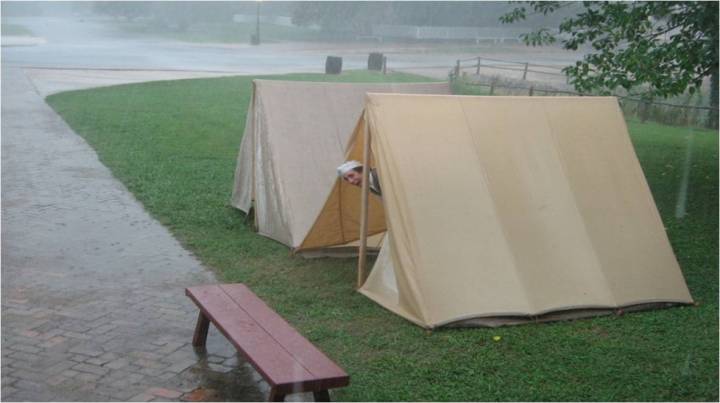
Intern Aaron Walker tests a common tent, home to six Revolutionary soldiers, in a Williamsburg rain.
◊ ◊ ◊ ◊ ◊
I would also argue that we gained at least as much from the public as they did from visiting our workshop. Public interpretation, after all, is just interdisciplinarity in another form. What better way to test explanations of Revolutionary War society and politics than to present them to a banker, an IT specialist, or a med student visiting Colonial Williamsburg? Do the arguments of historians such as Gordon Wood, David Waldstreicher, or Rosemarie Zagarri fly with the average American? This isn’t about dumbing-down information, it’s about translating it. That’s why it’s called interpretation. One of the best conversations I had all summer came after I had been explaining colonial labor and social hierarchy to a middle-aged man. “So,” he asked, pausing in thought, “When did America become a good country for poor people?” As we talked about changing standards of freedom, individual rights, and American ideologies, you could see his eyes light up as he thought about his world, America today, in new ways. Who would have thought you could get all the way there, starting with a tent?
A month ago, a user of the online reddit forum “Ask Historians,” posed this question:
Are there any merits to these ‘doing history’ acts? I’m not a fan of battle reenactments… I see them as telling us more about ourselves now than they do about the past and I think it’s a mistake (detrimental?) to use them as ways in which history/the past is taught to the public and to students.
Perhaps this is a fair criticism of living history. I’ve certainly seen my share of bad costumed interpretation at museums, like the sort of tours led by guides in vaguely historic costumes demonstrating ‘traditional’ activities and repeating tired clichés. But there are also places and people that get it right. Michael Twitty, a historian and interpreter of early African-American foodways, argues that his interpretation is the result of a conversation between historical sources and current practices. Likewise, George Washington’s marquee means different things to retirees, boy scouts, or Midwestern families. But good living history interpretation makes it relevant to each of them in a personalized way. I think the reddit question offers the justification for this sort of quality living history. When it’s well done, when it engages with academic questions as well as public audiences, living history does tell us at least as much about ourselves as about the past. When that works, it’s beautiful—as beautiful as a clean white tent, the work of many hands, sitting on a grassy patch at Colonial Williamsburg.

◊ ◊ ◊ ◊ ◊
Tyler Rudd Putman is a PhD student in the History of American Civilization Program in the Department of History at the University of Delaware. He thanks Scott Stephenson, Mark Hutter, Neal Hurst, Gwendolyn Basala, Jay Howlett, Michael McCarty, Samantha McCarty, Brendan Menz, Joseph Privott, Michael Ramsey, Nicole Rudolph, Aaron Walker, the Museum of the American Revolution, the Colonial Williamsburg Foundation, Nicole Belolan, Joy Howard, and the other members of the “Historical Reenactment, Living History, and Public History” panel at ASECS 2014.
Installation | Molly Hatch’s ‘Physic Garden’ at the High Museum
Warm thanks to Courtney Barnes of Style Court for noting this one. More information and photos are available at her website. -CH
Press release (5 February 2014) from Atlanta’s High Museum of Art:
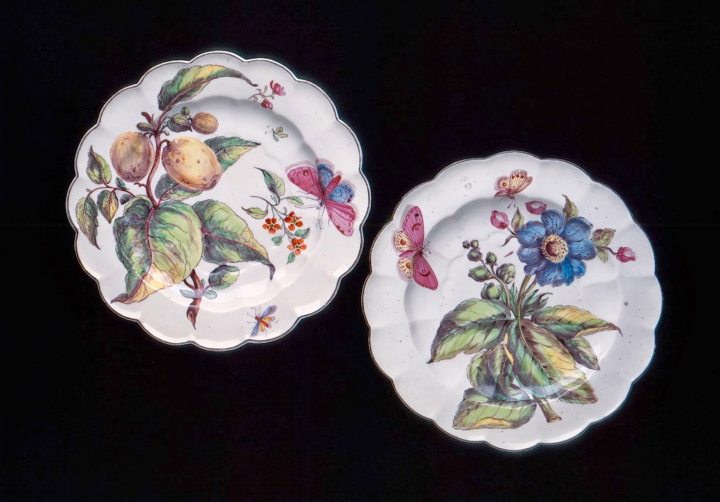
Two-story tall installation of 450 hand-painted plates were inspired by works in the High Museum’s Frances and Emory Cocke Collection of English Ceramics
◊ ◊ ◊ ◊ ◊
The High Museum of Art has commissioned contemporary ceramicist Molly Hatch to present Physic Garden, a two-story tall, hand-painted ‘plate painting’, which reinterprets works from its renowned decorative arts and design collection. On view starting March 12, the ‘plate painting’ will be installed in the High’s Margaretta Taylor Lobby and will be comprised of 456 plates featuring an original design inspired by two ca. 1755 Chelsea Factory plates from the Museum’s Frances and Emory Cocke Collection of English Ceramics, which totals more than 300 works.
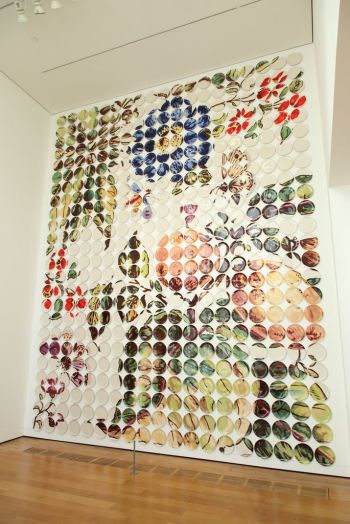 The historic source plates depict realistic flora and fauna in the Chelsea ‘Hans Sloane’ style of the early 1750s. The influential Chelsea Physic Garden, a botanical garden founded by the Society of Apothecaries in London in 1673, was leased by collector Hans Sloane and likely inspired neighboring factory porcelain decorators.
The High’s installation will be the largest ever produced by Hatch. She has created other works based on source material from the Metropolitan Museum of Art and Museum of Fine Arts, Boston. Hatch also designs her own line of products for national retailers such as Anthropologie.
“I am thrilled to work with such a talented contemporary artist as Molly and to have the outcome be such a dynamic and monumental acquisition for the High. One of the most exciting aspects of ‘Physic Garden’ is seeing the historic decorative arts and design collection through the lens of a creative young artist. We can’t wait for our visitors to experience this new work as well as revisit our important and beloved collection of English ceramics,” says Sarah Schleuning, curator of decorative arts and design at the High.
Hatch often sources historic works to make a contemporary counterpart, however this project marks the first time she is sourcing historic decorative arts from a museum collection to create a site-specific ‘plate painting’. To create the ‘plate painting’, Hatch digitally altered high-resolution images of the surface decoration of the source material to draft a new composition. She altered the original color, scale and composition of the Chelsea designs and then projected the new images onto 456 dinner plates (each 9.5 inches in diameter). She then hand-painted each plate using the projected image as a guide.
The complete installation will measure approximately 20 feet high by 17 feet wide. The Chelsea source plates are also on view in the High’s permanent collection Gallery 200, which patrons may visit to view the historic material. The High is acquiring the piece, which can re-installed by the Museum at future dates in smaller incarnations or in other locations.
“I encourage the viewer to see ceramics as a part of the fine art continuum—viewing plates as one would view a painting,” said Hatch. “For this installation, I’ve re-worked the surface imagery to create a new composition that reflects the historic. The artwork becomes an exploration of the relationship between the historic and the contemporary – crossing over categories of decorative art, design and fine art.”
Molly Hatch
Born in 1978, the daughter of a painter and a dairy farmer, Molly Hatch divided her childhood between physical labor, play, and creating art. She studied drawing, painting, printmaking, and ceramics and receiving her bachelor’s degree of fine arts from the Museum School in Boston in 2000. After several ceramic residencies and apprenticeships in the U.S. and abroad, she received her master’s degree of fine arts degree in ceramics at the University of Colorado in Boulder in 2008. In 2009, she was awarded the Arts/Industry Residency in Pottery at the John Michael Kohler Arts Center in Wisconsin, which laid the foundation for her career as an artist designer. Hatch works from her home studio in Northampton, Mass., on everything from designing and illustration to one-of-a-kind pieces. Her work has been widely collected and commissioned and is exhibited nationally and internationally at art fairs and museums. Hatch’s work has also been widely licensed in partnership with Anthropologie, Galison, Chronicle, and other companies for homeware and stationery products. Her work has been featured in numerous publications from House Beautiful magazine to online publications such as Design*Sponge and Apartment Therapy. For the last two years, Hatch has been teaching a tableware course at Rhode Island School of Design. She also teaches ceramic and illustration workshops across the country as well as online courses through Creativebug. Her first book will be released in 2015.
The First Georgians and Eighteenth-Century Britain on BBC
Yes, I realize the ‘300th observations’ just keep coming from the UK, but here’s more, this time from the BBC. –CH
The BBC has unveiled full details of Eighteenth-Century Britain: Majesty, Music and Mischief, a major new season exploring the extraordinary transformation that took place across the arts throughout the 18th century. The season will include programming on BBC Two, BBC Four and BBC Radio 3 in April 2014.
Details are available here»
◊ ◊ ◊ ◊ ◊
Among the offerings is the new television series by Lucy Worsley, chief curator of Historic Royal Palaces. The first episode is scheduled to be screened at the Oxford Literary Festival, on Monday, 24 March, at 4pm (with the ASECS conference in Williamsburg just a week away, Worsley should be particularly interesting to readers interested in the possibilities of historical re-enactment).
The First Georgians: The German Kings Who Made Britain (w/t)
BBC Four, Spring 2014
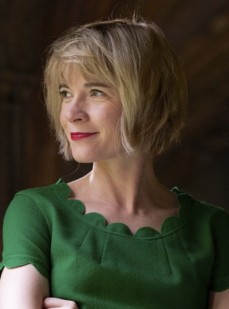 2014 marks the 300th anniversary of the Hanoverian succession to the British throne. To mark the occasion, the BBC and Royal Collection Trust are embarking on a unique partnership—encompassing a three-part series presented by Dr Lucy Worsley for BBC Four, and an exhibition at The Queen’s Gallery, Buckingham Palace.
The First Georgians: The German Kings Who Made Britain (w/t), will present the revealing and surprising story of Britain in the reigns of George I and George II (1714–60)—the age of the ‘German Georges’. In 1714, Britain imported a new German royal family from Hanover, headed by Georg Ludwig (aka George I)—an uncharismatic, middle-aged man with a limited grasp of English. Lucy Worsley will reveal how this unlikely new dynasty secured the throne—and how they kept it.
An intimate and close-up portrait of these German kings of Britain, the series will follow George I, his son George II, and their feuding family as they slowly established themselves in their adopted kingdom, despite ongoing threats from invading Jacobites and a lukewarm initial response from the British public.
Lucy will show how what was happening at court intersected with enormous changes that were reshaping Britain. The years 1714–60 felt like a ‘peculiar experiment in the future’: modern cabinet government began under the Hanoverian kings, satire spoke the truth to power, and ‘liberty’ was the watchword of the age.
Lucy will travel to Hanover to discover that the politics and dynastic squabbles, which defined the reigns of George I and George II, frequently had a continental backstory. And she will unravel the central paradox of the German Georges: it was their weaknesses—the infighting between king and Prince of Wales, and their frequent absences in Hanover—that, in a very real way, helped to secure the dynasty and shape our modern British political system.
The First Georgians: The German Kings Who Made Britain (w/t) is being produced in partnership with Royal Collection Trust, to coincide with the exhibition The First Georgians: Art & Monarchy 1714–1760 at The Queen’s Gallery, Buckingham Palace from 11 April to 12 October 2014. Curated by Desmond Shawe-Taylor, Surveyor of The Queen’s Pictures, the exhibition is the first to explore the reigns of George 1 and George II, shedding light on the role of this new dynasty in the transformation of political, intellectual and cultural life. Through over 300 works from the Royal Collection collected or commissioned by the Georgian royal family, it tells the story of Britain’s emergence as the world’s most liberal, commercial and cosmopolitan society, embracing freedom of expression and the unfettered exchange of ideas.
Lucy will discover the personal side of the early Georgians through the spectacular paintings, drawings and furniture on display in the exhibition. With Royal Collection Trust curators, she will see how objects in the Collection reveal Britain at the very moment it was becoming the modern country we know today.
Exhibition | Late Barbarians
Now on at London’s Gasworks:
Late Barbarians
Gasworks, London, 24 January — 9 March 2014

Matts Leiderstam, After Image (Portrait of a Gentleman), 2010
Gasworks presents the group exhibition Late Barbarians, which includes video, photography, and sculpture by Juan Downey, Lili Dujourie, Sidsel Meineche Hansen, Matts Leiderstam, and Chris Marker.
Focusing on the notion of corporeal memory, the exhibition explores how shifting social codes and cultural values have been embodied in historical Western European art and architecture. The exhibition takes its title from an expression by German sociologist Norbert Elias, which suggests that our future descendants may eventually consider us to have lived during an extended medieval period, implying that we share far greater affinities with our Barbarian ancestors than we might like to think. Similarly, the works on show question linear interpretations of history, invoking a present that is haunted by the gestures of our ancestors.
Paying particular attention to art historical representations of the body, works range from photographs that propose a queer re-reading of the gestures depicted in Renaissance paintings (Matts Leiderstam) to abstract, single-take “dances to camera” that attempt to divorce particular habits of the body from their entrenched social connotations (Lili Dujourie) and a virtual exhibition tour that takes place in the online world of Second Life (Chris Marker). In addition, Juan Downey’s video essay The Looking Glass (1981) decodes the iconography of the mirror in well-known artworks by Velázquez, Holbein and Picasso, and a new commission by Sidsel Meineche Hansen entitled His Head (2013–) comprises a clay sculpture and symposium that together examine the human head, separate from the body, as a symbol of patriarchy and power.
Late Barbarians is the second exhibition of The Civilising Process, a yearlong programme of exhibitions and events at Gasworks inspired by Elias’ eponymous 1939 book, which looks at the development of the tastes, manners and sensibilities of Western Europeans since the Middle Ages. Between October 2013 and November 2014 Gasworks is working with invited artists, designers, curators and researchers to tackle a wide range of issues raised by this book in an attempt to understand their relevance for contemporary debates and practices.
The Civilising Process comprises five exhibitions, a programme of interdisciplinary events, contributions to Gasworks’ online platform Pipeline, and a printed publication.
Gasworks
155 Vauxhall Street
London SE11 5RH United Kingdom
Exhibition | The Loves of Aaron Burr: Portraits in Corsetry and Binding
From the exhibition press release:
The Loves of Aaron Burr: Portraits in Corsetry and Binding
Installation by Camilla Huey
Morris-Jumel Mansion, New York, 2 May — 12 September 2013
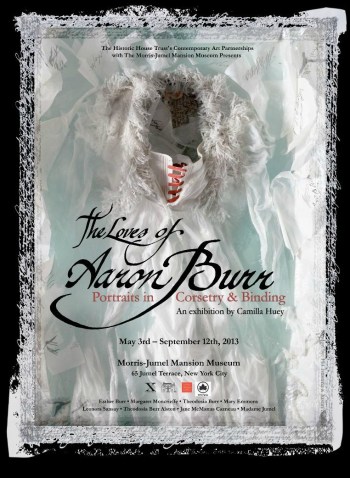 Couture artist Camilla Huey has produced gowns and corsets for celebrities such as Oprah, Janet Jackson, and Katy Perry in her famed garment district atelier, The House of Execution, a magical studio where fashion and history mingle. After almost ten years of extensive research, she began creating corsets to personify eight fascinating but nearly forgotten women writers of the 18th and 19th centuries. Huey has been invited to exhibit these exquisitely constructed pieces in the period rooms of the Morris-Jumel Mansion, Manhattan’s oldest residence, which also serves as the backdrop for many of the women’s eventful lives, truly fulfilling the project’s vision.
The Loves of Aaron Burr: Portraits in Corsetry and Binding resurrects the lives of eight women of letters involved in the adventures of Aaron Burr, Vice President to Thomas Jefferson and the assassin of Alexander Hamilton. Appropriately staged at the Morris-Jumel Mansion, where Burr spent a brief, though ill-fated, marriage to Madame Jumel, the exhibition tells the compelling stories of these women through the craft of bookbinding and the art of couture corsets. Each ‘portrait’ is comprised of a period appropriate corset bound around hand transcribed letters and ephemera, symbolizing each woman’s ‘body of work’ in sheer volume.
• Esther Burr (1732-1758), Aaron Burr’s mother, silk and velvet corset
• Margaret Moncrieffe (1763-?) Aaron Burr’s first love, damask corset cradling a first edition of her book, The Memoirs of Mrs. Coughlan
• Theodosia Burr (1746-1794), first wife of Aaron Burr, corset encased in isinglass
• Mary Emmons (1760-1835), consort of Aaron Burr, leather and quill corset
• Leonora Sansay (1773-?) confidant and mistress, leather caned corset with signatures of onion skin paper, steel and mirrored armature
• Theodosia Burr Alston (1783-1813), daughter of Aaron Burr, silk corset, steel boned with signatures of 100% cotton rag paper stitched in silk
• Jane McManus Cazneau (1807-1878) American journalist and lobbyist, accused as correspondent in Jumel v. Burr divorce
• Eliza Jumel (1775-1865), second wife of Aaron Burr, 10-year-old revolutionary era corset bound within an illuminated boned bodice
Photos are available from an article at the New York Daily News»
◊ ◊ ◊ ◊ ◊
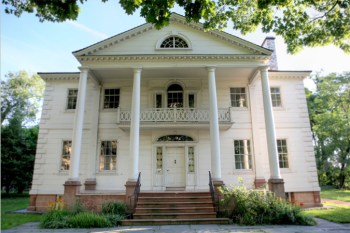 The Morris-Jumel Mansion is Manhattan’s oldest residence, built in 1765 as a summer retreat by British Colonel Roger Morris for his wife, Mary Philipse. The original estate reached from the Harlem River to the Hudson, with commanding views of the New York Harbor, the New Jersey Palisades, and Westchester. During the Revolutionary War the house served as headquarters for General George Washington drawn by the house’s superior military vantage point. In 1810 the estate was purchased by French wine merchant and importer Stephen Jumel and his wife Eliza. Remarkably the Jumel’s are noted as having restored the house to its original grandeur, throwing a party to which all of New York Society was invited to feast on oysters and drink the superb offerings of M. Jumel’s cellar, including excellent champagnes, as noted in the diary of Mayor Philip Hone. The Mansion is a National Historic Landmark and a New York City Landmark, managed by the Historic House Trust of New York City. Now a museum, it’s located between 160th and 162nd Streets east of St. Nicolas Avenue in historic Harlem Heights.










 Enfilade
leave a comment