Call for Papers | The Global History of Knowledge, 1450–1750
From ArtHist.net and Scientiae:
Scientiae Fall Conference: The Global History of Knowledge, 1450–1750
Brown University, Providence, 25–26 October 2024
Proposals due by 15 May 2024

Samuel de Champlain, Brief discours des choses plus remarquables que Samuel Champlain de Brouage á reconneues aux Indes occidentales, 1602, 35r (igre. Loupcervier Leopard). Providence: John Carter Brown Library, Codex Fr 1.
Scientiae is very pleased to announce its first fall conference. This event will take place at, and with support of Brown University, Providence, Rhode Island, on Friday 25 and Saturday 26 October 2024. For this conference we have chosen the theme The Global History of Knowledge with a specific, but not exclusive, focus on the Americas and the Atlantic in the period 1450–1750. Historians of science, philosophers, literary scholars, art historians, and many other seemingly distant experts are encouraged to reflect together on the complexities of the early modern period. We are proud to announce a keynote address by Pablo F. Gómez (University of Wisconsin-Madison).
The organizing committee consists of Matthijs Jonker (Scientiae/Utrecht University), Tara Nummedal (Brown University), and Hal Cook (Brown University). Inquiries can be addressed to m.j.jonker@uu.nl.
We envision three ways to join:
• Individual, 20-minute papers: please submit a descriptive title, 200-word abstract, and one-page CV.
• Complete panels: same as above for each paper, plus 200-word rationale for the panel (maximum four presenters, including chair and/or respondent).
• Workshops or seminars: one-page CV for each session leader, plus 200-word plan explaining the topic’s suitability and its techniques or resources.
Please submit your proposal online before midnight, 15 May 2024, at scientiae.uk@gmail.com.
Providence has a good airport and is well-connected to New York City and Boston by train. The conference organizers look forward to welcoming you to Providence in October!
Print Quarterly, March 2024
The long eighteenth century in the latest issue of Print Quarterly:
Print Quarterly 41.1 (March 2024)
a r t i c l e s
• Przemysław Wątroba, “Jacques Rigaud’s Drawings in Warsaw of the Residences of Louis XIV,” pp. 23–32.
“In the collection of the last king of Poland, Stanisław August Poniatowski (1732–98), kept in the Print Room of the University of Warsaw Library, there is a renowned volume titled Recueil choisi des plus belles vues des palais et maisons royales de Paris et des environs containing a series of 106 engravings by Jacques Rigaud (1681–1754). . . . A set eight hitherto unpublished drawings by Rigaud [also in Warsaw and] formerly kept in Portfolio 174 are here presented as designs” for eight of the prints (23, 25).
n o t e s a n d r e v i e w s

Seven Creamware Plates, ca. 1808–36, diameters 20–23 cm, transfer-printed with various scenes, clockwise from top: Defoe’s Robinson, Choisy factory; Cervantes’s Don Quixote, Montereau factory; Perrault’s Fairies, Montereau factory; Fontaine’s Fable of the Fox and Grapes, Sèvres factory; Ovid’s Metamorphoses, Judgement of Midas, Choisy factory; Chateaubriand’s Atala Found with Chactus by Father Aubry, Choisy factory; and at centre, Cottin’s Matilda Saved by Malek Adhel, Choisy factory (Germany, Peter-Christian Wegner Collection).
• Marzia Faietti, Review of Heather Madar, ed., Prints as Agents of Global Exchange: 1500–1800 (Amsterdam UP, 2021), pp. 37–39.
• Sheila McTighe, Review of Francesco Ceretti and Roberta D’Adda, eds., Immaginario Ceruti: Le stampe nel laboratorio del pittore (Skira, 2023), pp. 42–43. This catalogue accompanied an exhibition that explored the work of the painter Giacomo Ceruti (1698–1767) and his reliance on printed images. “A complementary show of Ceruti’s paintings, Miseria & Nobiltà: Giacomo Ceruti nell’Europa del Settecento was also held in 2023 at the Museo Santa Giulia in Brescia, followed by a reduced version at the J. Paul Getty Museum, Los Angeles during the second half of that year, Giacomo Ceruti: A Compassionate Eye” (42).
• Natasha Ruiz-Gómez, Review of Rebecca Whiteley, Birth Figures: Early Modern Prints and the Pregnant Body (University of Chicago Press, 2023), pp. 43–45.
• Antony Griffiths, Review of Chiara Travisonni with Luca Fiorentino and Andrea Muzzi, Pietro Giacomo Palmieri (Edifir, 2023), pp. 45–46. This monograph on the draughtsman and printmaker, Pietro Giacomo Palmieri (1737–1804), “will become the definitive source of information” for the artist and his work (46).
• Patricia Ferguson, Review of Peter-Christian Wegner, Literatur auf französischen Steingut-Tellern des frühen 19. Jahrhunderts (Georg Olms, 2022), pp. 46–47. Wegner addresses the popularity of subjects drawn from French literature for transfer-printed ceramics, starting in 1808. “While we await a larger in-depth survey of this engaging material, Wegner’s publication is a huge contribution to its appreciation” (46).
• Elizabeth Savage, Review of Christien Melzer and Georg Josef Dietz, Holzschnitt: 1400 bis heute (Hatje Cantz, 2022), pp. 48–50. This is the catalogue for an exhibition that “featured more than 100 prints from the Kupferstichkabinett [in Berlin], as well as what was effectively the first large-scale display of woodblocks from its enormous yet relatively little-known collection” (50).

Johann Christoph Weigel, Sheet for Découpage with Figures on Cloudlike Landscapes and a Fantastical Bird, c. 1700–25, from album Inventions Chinoises V, handcoloured engraving, 216 x 151 mm (Dresden, Kupferstich-Kabinett).
• Brief notice of Katy Barrett, Looking for Longitude: A Cultural History (Liverpool UP, 2022), p. 76. Rather than a retelling of the familiar story of accurately calculating longitude, this book “is a remarkably well-researched account of the ways in which this long-running sage impacted on many areas of public discourse, thought, and imagery” (76).
• Emanuele Lugli, Review of Miriam Vogelaar, The Mokken Collection: Books and Manuscripts on Fencing before 1800 (MMIT Publishing, 2020), pp. 88–92.
• Nadine Orenstein, Review of Maureen Warren, ed., Paper Knives, Paper Crowns: Political Prints in the Dutch Republic (Champaign: Krannert Art Museum, 2022), 92–96. “Never have these prints been so lavishly presented. The beautifully produced catalogue, winner of the 2023 IFPDA Book Award, exceptionally allocates plenty of space to the images. It allows the reader to see entire works along with accompanying text and provides space for multi-plate productions” (93).
• Maureen Cassidy-Geiger, Review of Cordula Bischoff and Petra Kuhlmann-Hodick, eds, La Chine: Die China-Sammlung Des 18. Jahrhunderts Im Dresdner Kupferstich-Kabinett (Sandstein Verlag, 2021), 97–103. This “is the catalogue of an exhibition at the Dresden State Museum devoted to the Chinese works on paper and European chinoiserie prints acquired by the Saxon Electors before 1750” (97). It “was an ambitious project that took many years to come to fruition and required collaboration between colleagues in different disciplines with different working languages” (102).
New Book | Where Words and Images Meet
From Bloomsbury:
Ludmilla Jordanova and Florence Grant, eds., Where Words and Images Meet (London: Bloomsbury Visual Arts, 2024), 248 pages, ISBN: 978-1350300569 (hardback), $120 / ISBN: 978-1350300552 (paperback), $40.

From 19th-century frontispieces to Soviet photo albums, from the relationships between portraits and biographies to museum labels, the book’s richly illustrated chapters open up historically specific connections between word and image to collective examination and fruitful analysis. Written by both established and emerging scholars in a range of interrelated fields, the chapters deliberately foreground previously overlooked topics as well as unfamiliar disciplinary approaches, to offer a stimulating and carefully developed framework for looking at these ubiquitous phenomena afresh. Where Words and Images Meet opens up for analysis and reflection the forms of attention, practices, skills and assumptions that underlie visual interpretation and meaning-making in the writing of history. By bringing the features of the materials we read and look at into focus, we can grasp more effectively the complex interrelationships involved, and enhance our practice and understanding.
Ludmilla Jordanova is Emeritus Professor of History and Visual Culture at Durham University. She is also the author of History in Practice, 3rd Edition (Bloomsbury, 2019).
Florence Grant holds a PhD in History from King’s College London and is currently an independent writer and editor based in Western North Carolina.
c o n t e n t s
List of Plates
List of Illustrations
List of Contributors
Preface and Acknowledgements
Introduction
Part I | Identifying with Books
Discussion
1 Fronts Matter: The Role of the Authorial Frontispiece in Germaine de Staël’s Corinne: or, Italy — Seren Nolan, Durham University
2 Othering the Ex-Libris: Israel Solomons (1860–1923) and the Invention of the Jewish Bookplate — Tom Stammers, Durham University
Bridge
Part II | Representing Authority
Discussion
3 Picturing Criminal Law in Old Regime France: Brunel, Known as Bétancourt, Being Led to the Scaffold (1670) — Tom Hamilton, Durham University
4 Word and Image in Popular Science— Joseph D. Martin, Durham University
Bridge
Part III | Order and Disorder
Discussion
5 Museum Labels: Word and Object on Display — Lola Sánchez-Jáuregui, University of Glasgow
6 Play with Literacy in Edward Lear’s Nonsense Alphabets — A. Robin Hoffman, Art Institute of Chicago
Bridge
Part IV | Authenticity and Interpretation
Discussion
7 On Taking Artists at Their Word: Artists’ Writings and Statements from 1850 to the Present — Lucy Whelan, University of Cambridge
8 Portraiture and Biography: Harmonious Marriage or Difficult Relationship? — Ludmilla Jordanova, Durham University
Bridge
Part V | Making, Compiling, Arranging
Discussion
9 Extra-Illustration in Early Twentieth-Century England — Ludmilla Jordanova, Durham University
10 Beyond the Caption: Words and Images in an Interwar Soviet Amateur Photograph Album — Antonia Miejluk, Durham University
Bridge
Part VI | Words in the Visual Field
Discussion
11 Word as Image: The Verbal in the Photograph — J. J. Long, Durham University
12 Text-Image Hybridity in Know Thyself and Early Modern English Print — Finola Finn, Independent Scholar, Germany
Bridge
Afterword: Word, Image, and Play
Bibliography
Index
Exhibition | William Blake’s Universe

From the press release for the exhibition:
William Blake’s Universe / William Blakes Universum
The Fitzwilliam Museum, Cambridge, 23 February — 19 May 2024
Hamburger Kunsthalle, 14 June — 8 September 2024
Curated by David Bindman and Esther Chadwick
Responding to the upheavals of revolution and war in Europe and the Americas, visionary artist, poet, and printmaker William Blake (1757–1827) produced an astonishing body of work that combined criticism of the contemporary world with his vision for universal redemption. But he wasn’t the only one. William Blake’s Universe is the first major exhibition to consider Blake’s position in a constellation of European artists and writers striving for renewed spirituality in art and life.
Organised in collaboration with the Hamburger Kunsthalle, and drawing on extensive research, this ambitious exhibition will explore the artist’s unexpected yet profound links with important European figures including pre-eminent German Romantic artists Philipp Otto Runge (1777–1820) and Caspar David Friedrich (1774–1840). It will also place Blake within his artistic network in Britain, drawing parallels with the work of his peers, mentors, and followers including Henry Fuseli (1741–1825), John Flaxman (1755–1826), and Samuel Palmer (1805–1881).

Poster with detail of William Blake after Henry Fuseli, Head of a Damned Soul, ca. 1788–90, engraving and etching on paper (University of Cambridge: The Fitzwilliam Museum).
Featuring around 180 paintings, drawings, and prints—including over 90 of those by Blake—this major exhibition marks the largest ever display of work from the Fitzwilliam’s world-class William Blake collection, with additional loans from the British Museum, Tate, Ashmolean and other institutions. Examples of the artist’s most iconic and much-loved works including Albion Rose (1794–96) and Europe: A Prophecy (1794), will be joined by rarely exhibited artworks from Blake’s oeuvre, including outstanding new acquisitions from the Sir Geoffrey Keynes bequest, displayed publicly for the first time since joining the Fitzwilliam collection. These include the trial frontispiece of Blake’s prophetic book Jerusalem (1804–1820) and his spectacular large drawing Free Version of the Laocoön (c.1825). Additional highlights include the unique first state of Joseph of Arimathea (1773), produced by Blake as an apprentice aged 16, shown alongside a reworked version of the same image, completed by Blake in his mature years.
Visitors will have a special opportunity to discover the work of Runge, one of Germany’s most important Romantic artists, who has been very rarely seen in the UK until now. Bringing together the largest number of Runge works in the UK to date, the exhibition will include the engravings from the Times of Day (1802–10) series, a defining work of German Romanticism. Representing not only the changing times of day, but the seasons, the ages of man and historical epochs, Runge obsessively returned to this important body of work, an extensive number of preparatory drawings and studies of which will be presented at the Fitzwilliam. Among the works on loan from the Hamburger Kunsthalle will be The Large Morning (1808–09), a fragmentary oil painting widely considered to be one of the most important works from Runge’s short career, cut short by his death aged 33.
Another highlight of the exhibition will be Caspar David Friedrich’s seven sepia drawings The Ages of Man (c.1826) on loan from the Hamburger Kunsthalle. Thought to be inspired by Runge’s interest in visual representations of time, the exquisitely delicate series is associated with the themes of change in nature, the cyclical representation of time, and the temporality of human life.
 William Blake’s Universe will unfold in three main sections—past, present and future—with an introductory display of artists’ portraits. ‘The Past: Antiquity and the Gothic’ will focus on the legacy of classical antiquity and Blake’s turn towards the Gothic as an alternative source of inspiration, as well as a spotlight section on Flaxman, an artistic mentor to Blake who gained great acclaim in Germany and across Europe. ‘The Present: Europe in Flames’ will concentrate on the responses of Blake and his close contemporaries in Britain to the revolutionary 1790s. The third section, ‘The Future: Spiritual Renewal’, will show how visions of redemption from a fallen world became a central concern for Blake and his contemporaries in the post-revolutionary period. Jacob Böhme’s mystical ideas about light and cosmic unity, which form a bridge between Blake and his German contemporaries, will be a central display.
William Blake’s Universe is curated by David Bindman, emeritus Durning-Lawrence professor of the History of Art at University College London, and Esther Chadwick, Lecturer in Art History at the Courtauld Institute of Art. The exhibition will be accompanied by a fully illustrated catalogue featuring new scholarship by the curators, as well as essays by leading academics Sarah Haggarty, Joseph Leo Koerner, Cecilia Muratori, William Vaughan, and James Vigus.
Curators David Bindman and Esther Chadwick said: “This is the first exhibition to show William Blake not as an isolated figure but as part of European-wide attempts to find a new spirituality in face of the revolutions and wars of his time. We are excited to be able to shed new light on Blake by placing his works in dialogue with wider trends and themes in European art of the Romantic period, including transformations of classical tradition, fascination with Christian mysticism, belief in the coming apocalypse, spiritual regeneration and national revival.”
David Bindman and Esther Chadwick, eds., William Blake’s Universe (London: Philip Wilson Publishers, 2024), 224 pages, ISBN: 978-1781301272, £35 / $45.
The Nelson-Atkins Acquires Last Known Work by Maria Cosway
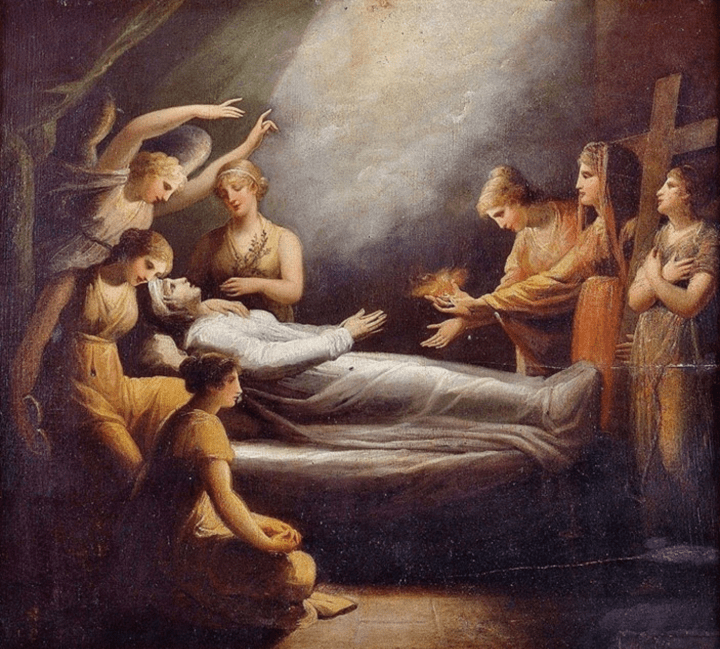
Maria Cosway, A Religious Allegory on the Death of a Young Woman, painted in Paris 1801–02, oil on panel, 46 × 51 cm
(Kansas City: The Nelson-Atkins Museum of Art, 2023.45)
◊ ◊ ◊ ◊ ◊
From the press release:
A major painting by an esteemed 18th-century female artist was gifted to The Nelson-Atkins Museum of Art. Realized in 1801–02, A Religious Allegory on the Death of a Young Woman is the last known work by celebrated painter Maria Cosway (1759–1838) and the second known work by the artist in a North American public collection. It is the gift of longtime museum supporters Virginia and James Moffett.
“This singularly important work is the last painting ever completed by Maria Cosway,” said Julián Zugazagoitia, Director & CEO of the Nelson-Atkins. “This, along with the Rachel Ruysch painting given by the Moffetts several years ago, has significantly enriched the diversity of our European collection, and we are most grateful to them. Thanks to their extraordinary generosity, we can provide visitors and scholars with a much deeper insight into the lives of two immensely significant women artists. Their inclusion in the collection enables us to explore their history more extensively and present a more comprehensive picture of European Art.”
The nocturnal scene portrays a young woman in white on her deathbed surrounded by three mourners and one angel at her head, who leans forward with her arms extended toward the light. Three additional figures appear at her feet representing Charity, Faith, and Hope. Influenced by neoclassicism, Cosway’s composition resonates with the works of her contemporaries Jacques-Louis David, John Flaxman, William Blake, and Antonio Canova.
“This final painting illustrates the summation of Cosway’s artistic journey, religious fervor, and the profound loss of her only child,” said Aimee Marcereau DeGalan, Louis L. and Adelaide C. Ward Senior Curator, European Arts.
“It is a major statement in Cosway’s career, embodying her intense Catholicism and personal grief,” added Stephen Lloyd, curator of the Derby Collection at Knowsley Hall, England, a specialist in Cosway’s work.
It is also the only known composition to have survived that Cosway realized in multiple media: painting, drawing, and etching.
Born in Italy in 1759, Maria Cosway exhibited artistic talents from an early age. Her multifaceted career included exhibiting at the Royal Academy in London and opening an art academy for women. This composition stands as her sole known painting executed in Paris.
This is the second major European gift to the Nelson-Atkins from the Moffett collection. Their painting Still Life of Exotic Flowers on a Marble Ledge by late 17th/early 18th-century Dutch artist Rachel Ruysch (1664–1750) hung in the museum’s European galleries, on loan, for 20 years. Virginia and her husband James Moffett came to the museum every Sunday afternoon during those two decades to visit the painting, and they were struck by the affection with which museum visitors admired the delicate work. They decided to make the loan a gift in 2017, and it became the first example by Ruysch to enter the collection. A mature work featuring many exotic flowers from India, Peru, South Africa, and North America, it remained in the artist’s immediate family for at least 10 years, leading scholars to speculate that the painting held special meaning for her.
The Cosway and Ruysch paintings greatly enrich the European collection and join significant works by fellow 18th-century women artists Elisabeth Louise-Vigée LeBrun, Maria Luigia Raggi, and Adélaïde Labille-Guiard. The Moffetts have been similarly generous with gifts to the museum’s American collection.
Lecture | Paris Spies-Gans on Imprints and Erasure

Image for the talk taken from Marie-Françoise Constance Mayer La Martinière (possibly with Pierre-Paul Prud’hon), Innocence Prefers Love to Wealth (L’Innocence préfère l’Amour à la Richesse), 1804, oil on canvas, 243 × 194 cm (St. Petersburg: Hermitage Museum).
◊ ◊ ◊ ◊ ◊
Next month at Harvard:
Paris Spies-Gans | Zerner Lecture — Imprints and Erasures: A New Story of Art
Harvard Art Museums, Cambridge, 23 April 2024, 6.00pm
In countless ways, women have been erased from the history of art. Their exhibited works have been reattributed to their male peers; their once-collected paintings have been left to deteriorate in museum storerooms; and many art historical accounts have questioned their very ability to create “great” art. We can even track the gradual removal of women’s names from the historical record in moments of deliberate, posthumous eradication. However, a growing mountain of evidence demands we recognize that women artists may have always existed—and were often quite prominent in their own places and times. In her lecture, Paris Spies-Gans will share this troubling history and present a series of recent discoveries to challenge the powerful, gendered assumptions that continue to inflect our views of the past. By recovering the traces of women artists—the imprints they left behind—we can update essential parts of art history’s most enduring narratives.
Paris A. Spies-Gans is a historian of art with a focus on women and the politics of artistic expression. She holds a PhD in History from Princeton University, an MA in Art History from the Courtauld Institute of Art, and an AB in History and Literature from Harvard University. Her research has been supported by fellowships from the Harvard Society of Fellows, the J. Paul Getty Trust, the Paul Mellon Centre for Studies in British Art, and the Yale Center for British Art, among other institutions. Her first book, A Revolution on Canvas: The Rise of Women Artists in Britain and France, 1760–1830, was published by Yale University Press in 2022. It has won several prizes in the fields of British art history and eighteenth-century studies, and was named one of the top art books of 2022 by The Art Newspaper and The Conversation. She is currently working on her second book, A New Story of Art (Doubleday/Penguin Random House).
Call for Papers | The Face in 18th- and 19th-C Public Sculpture
Excerpted from the Call for Papers at ArtHist.net, which includes the French:
The Intimate and the Public: The Face in 18th- and 19th-Century Public Sculpture in France and the German Sphere
L’intime face au public : le visage dans la sculpture publique des XVIIIe et XIXe siècles en France et dans la sphère germanique
Institut National d’histoire de l’Art, Paris, 25–26 November 2024
Proposal due by 15 May 2024
This study day devoted to sculpture will focus on one element in particular: the face. As an essential part of the sculpted figure, the face has the dual role of enabling identification and expression. This dual role became more apparent in the 18th and 19th centuries, with the rise of portraiture, as well as the interest in the inner self and more broadly, the intimate. The aim of this exhibition is to draw a parallel between two contradictory concepts: the intimate and the public. As sculpture is the art par excellence of the public space, the aim is to confront the face, which is intimate, with the imperatives of public sculpture. The subject is all the more relevant given that statues in public spaces were subject to constantly changing decorum throughout the 19th century. The portrait was and remains the preferred type of statuary, whether full-length or in bust form. As a means of honouring a person, a propaganda tool, and an official image, the sculptural face had many functions, which began to take shape in the 18th century and became clearer in the 19th, as sculpture shifted from a religious and royal function to a civic one. Oscillating between idealisation and resemblance, the figuration of the face in the sculptural medium is a questionable concept in the Franco-German 18th and 19th centuries. In addition to the similarities in their artistic and textual origins, these two geographical areas will enable us to examine the artistic circulations that took place, and above all to analyse how political developments, which affected both France and the Germanic sphere, led to a national affirmation that was embodied in public sculpture. The aim of this study day is to examine the representation of the face in Franco-German public sculpture in the 18th and 19th centuries, analysing its theories, practices, techniques, possible typologies and the way it is perceived by the viewer. . . .
The aim of this study day is to return to a motif that is already well known and studied, the face, but this time by analysing it as an element at the junction of two spheres—the intimate and the public—through a body of sculpture. In addition to the obvious lack of studies devoted to this art form, the choice of focusing on sculpture is justified above all by its coherence with the areas of research: sculpture is mainly used to represent figures, and therefore faces, and it is the art form par excellence used in the public space.
Written submission must address one of these 8 major themes:
• The role of the face in the sculpture of public spaces
• Theories and practices of facial representation
• The relationship between the intimate and the public
• Individualisation and typology of faces
• The relationship between the face of a sculpture and the urban space
• Technique and materiality of sculpture
• Destruction or alteration of the face of a contested statue
• The gaze of the sculpture and/or the viewer / the sculpted figures in relation to each other
This call is open to all researchers, whatever their discipline or status, and we particularly encourage young researchers. Proposals for papers in English or French (maximum 300 words, accompanied by a brief bio-bibliographical presentation) should be sent before 15 May 2024 to the following address: sculptureparis24@gmail.com. The selection committee will respond to proposals by 20 June 2024.
Organizers
• Justine Cardoletti, doctoral student in art history at the University of Paris 1 Panthéon-Sorbonne, justine.cardoletti@gmail.com
• Emilie Ginestet, doctoral student in art history at the University of Toulouse Jean Jaurès, emilie.ginestet8@gmail.com
• Sarah Touboul-Oppenheimer, doctoral student in art history at the University of Paris 1 Panthéon-Sorbonne, sarahtoub.st@gmail.com
Call for Papers | Human and Nature Interactions
From the Call for Papers:
Human and Nature Interactions in History: The Impact of Climate, Environment, and Natural Phenomena on Human Life
Istanbul University, Faculty of Letters, Kurul Odası, 28–29 May 2024 (with opportunities for virtual presentations)
Proposals due by 26 March 2024
Over the course of history, the fact that humans have been faced with the impact of the environment in which they live and that the relationship between humans and nature directly or indirectly has governed cultural, economic, and social structures and artistic currents has been a common problematic that concerns various disciplines. The fact that humans were subjected to compulsory guidance by nature, of which they were inclined to take control in the making of civilizations and cities, has been one of the main issues determining the historical and current agendas in varying degrees and forms.
This symposium will discuss the ways in which the natural environment shapes new habitations, the impact of the natural structure on the essential elements of the city such as architecture and settlement patterns, and how the diversity of fauna and flora affects social, cultural, emotional, and economic development or deprivation. In addition, it aims to examine the drawbacks such as water shortages, droughts, floods, fires, earthquakes, epidemics, storms, and forced migrations. In this context, it is expected to receive papers that can evaluate the manifold reflections of these phenomena that might positively or negatively affect, change, or give direction to the historical course.
Organized by the History Research Center, this free symposium aims to bring together experts from diverse fields, including environmental science, geography, historical geography, literature, economics, cultural heritage, history, and art history. If you would like to participate in the meeting with a paper, please send a short CV and an abstract of 200–300 words to tam@istanbul.edu.tr. The event will be held in a hybrid format, with both physical and online opportunities to present.
Conference | York and the Georgian City
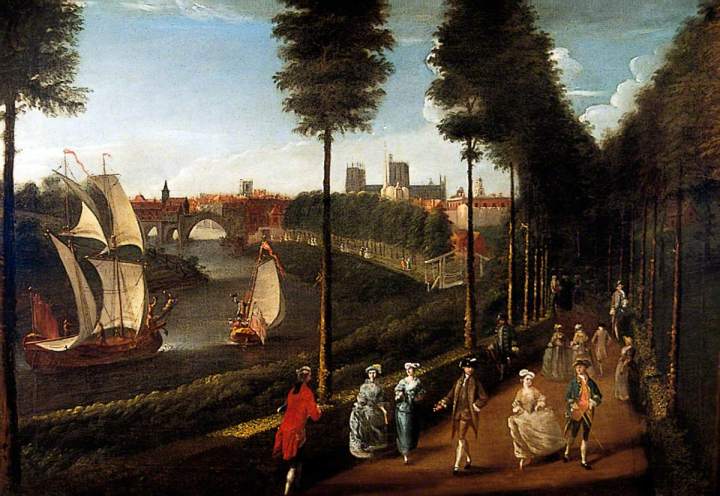
Nathan Drake, The New Terrace Walk, York, ca. 1756, oil on canvas, 76 × 107 cm
(York Art Gallery)
◊ ◊ ◊ ◊ ◊
From the York Georgian Society:
York and the Georgian City: Past, Present, and Future
King’s Manor, York, 18 May 2024
This conference aims to re-evaluate the notion of York as a Georgian city, one of the founding premises of the York Georgian Society in 1939. It will examine to what extent York can be described as a ‘Georgian’ city, and whether that label is relevant or meaningful in the present day. This is the first conference organised by the York Georgian Society in conjunction with the Centre for Eighteenth-Century Studies at the University of York. It will be held in the beautiful and historic King’s Manor just outside the city walls, historically the most important building in York after the Minster.
Keynote lectures will be given by Professor Rosemary Sweet of the University of Leicester and Madeleine Pelling, historian, writer, and broadcaster. Others speakers are from the Faculty of Arts and Humanities at the University of York: Professor Jon Mee, Dr Matt Jenkins, and PhD students Constance Halstead and Rachel Feldberg. The day ends with a round table to discuss issues raised on the day and a reception. Tickets cost £5 for students, £15 for members of the Society and University of York staff, and £25 for others. The price includes morning coffee, a light lunch, afternoon tea, and a reception.
p r o g r a m m e
10.15 Registration and coffee
10.50 Introduction — Charles Martindale (University of Bristol) and Jim Watt (University of York)
11.00 First Keynote
Chair: Charles Martindale
• Rosemary Sweet (University of Leicester) — When Did York Become Georgian?
12.00 First Panel: University of York Student Papers
Chair: Jon Mee
• Rachel Feldberg — Sense and Sociability: Jane Ewbank’s Critical Engagement with Georgian York
• Constance Halstead — Different Cities, Different Sensibilities: The Influence of Social Milieu on Anne Lister’s Discussion of Her Journal
12.50 Lunch
2.00 Second Keynote
Chair: Adam Bowett
• Madeleine Pelling (historian, writer, and broadcaster) — Writing on the Wall: Graffiti, Rebellion, and the Making of 18th-Century Britain
3.15 Second Panel
Chair: Jim Watt
• Matt Jenkins (University of York) — An Archetypal Georgian City?: Contradictions and Conformity in 18th-Century York
• Jon Mee (University of York) — Manchester College, York, 1803–40: An Outpost of Rational Dissent in an Anglican City
4.15 Tea
4.45 Roundtable
Chair: Charles Martindale
• Rosemary Sweet, Madeleine Pelling, Adam Bowett, and Peter Brown (formerly Director of Fairfax House)
5.30 Reception
New Book | Writing on the Wall
From Profile Books:
Madeleine Pelling, Writing on the Wall: Graffiti, Rebellion, and the Making of Eighteenth-Century Britain (Profile Books, 2024), 352 pages, ISBN: 978-1800811997, £25.
 What if walls could talk? For historian Madeleine Pelling, they can—if you know where to look. Hear the voices of the eighteenth century in this eye-opening new history of Britain’s most tumultuous period, told through its graffiti.
A brilliant new cultural history of the long eighteenth century, Writing on the Wall is told through the marks its citizens left behind, bringing into focus lost voices from the highest to the lowest in society. From the centre of London to the islands of the Caribbean, Pelling goes in search of graffiti, evidence of how ordinary people experienced the world-changing events that defined their lives—from political prisoners to sex workers, homesick sailors, Romantic poets, and the artisans of the industrial revolution. Here are lives, loves, triumphs, and failures, scratched into the walls of prisons and latrines, chalked up on doors, and etched into windows. The names of their creators may be lost to history, but together they tell the real story of Britain’s most rebellious and transformative century.
Madeleine Pelling is a cultural historian, author and broadcaster. She holds a PhD from the University of York and has held research fellowships at the universities of Yale, Edinburgh, and Manchester. She is co-host of History Hit’s After Dark: Myths, Misdeeds and the Paranormal, a podcast that shines a light on the shadier corners of the past and which brings a rigorous historical lens to folklore and true crime. She is also a regular contributor for television, most recently for Titanic in Colour (Channel 4, 2025), Mayhem! Secret Lives of the Georgian Kings (2025), Queens that Changed the World (Channel 4, 2023), and Who Do You Think You Are? Australia (Warner Bros, 2023). Her words appear in The Guardian, The Independent, BBC History Magazine, and History Today.










 Enfilade
leave a comment